Dubai Desert Conservation Reserve, United Arab Emirates
Al Maha, A Luxury Collection Desert Resort & Spa
A fenced private reserve of freestanding, sand-colored tented suites where the return of the Arabian oryx to the wild is the whole point of the stay, not a footnote to it.
- Rates from
- From $950 per night
- Nearest airport
- Dubai International Airport (DXB)
- Transfer
- About 45-60 minutes by road
- Best months
- November through March, when daytime desert temperatures are mild enough for game drives, camel treks and dining outdoors
There is a moment on the drive in, somewhere past the last roundabout on the Dubai-Al Ain Road, where the city simply stops. The malls, the construction cranes, the six-lane traffic, all of it falls away behind a perimeter fence, and what is left is 225 square kilometers of protected dune desert, quiet enough that the loudest sound most evenings is wind moving over sand. Al Maha sits inside that fence, and the fence itself is not incidental. It is the reason the resort exists in something close to its current form: a private, protected reserve built specifically to let a locally extinct animal, the Arabian oryx, walk back into the wild it had been hunted out of.
When Al Maha opened in 1999, it did so as one of the first true luxury desert lodges in the Gulf, a category that barely existed at the time. Dubai in 1999 was still years from the skyline it has now; the idea of building an ultra-luxury resort an hour from the city, with no beach, no golf course and no obvious tourist draw beyond the desert itself, was a genuine gamble. What made the gamble work was the decision, made at the same time as the resort’s construction, to fund the reintroduction of the Arabian oryx to the land around it. The resort and the conservation program were never separate initiatives bolted together for marketing purposes; they were built as the same project, and more than two decades later that is still the clearest way to understand what distinguishes Al Maha from virtually every other desert resort that has opened since.
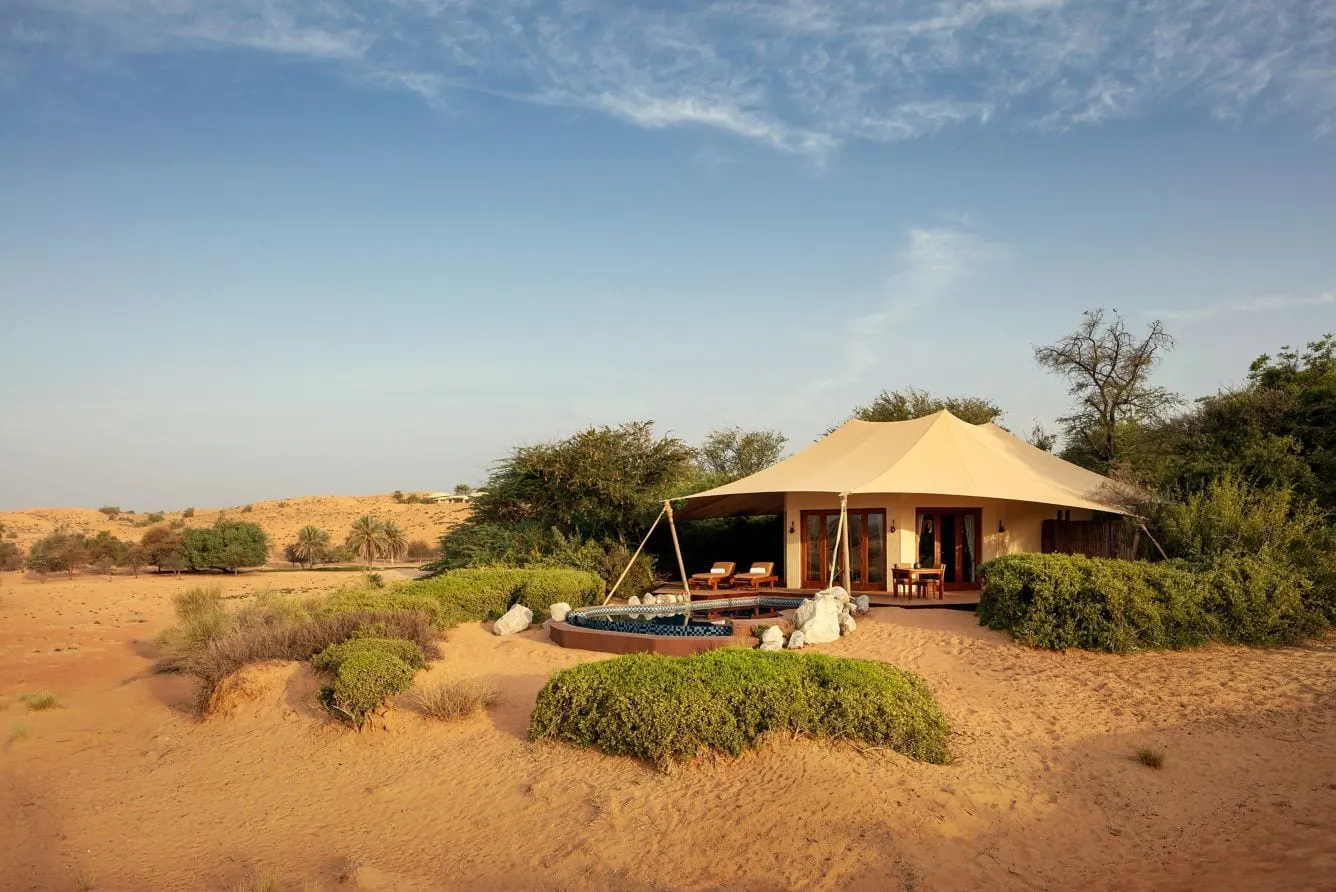
Forty-two freestanding suites, each shaped like a Bedouin tent and each with its own plunge pool, are spread across the reserve at a distance from one another that makes the property feel far larger than its guest count suggests. There is no central hotel block, no shared corridor, no view of a neighboring suite’s terrace. What there is, instead, is dune after dune of protected desert, a herd of oryx that now numbers in the hundreds, and a resort built to put a guest inside that landscape rather than merely looking out at it from behind glass.
Why It Stands Out
Al Maha’s clearest point of distinction is that its core luxury proposition and its conservation mission are the same thing. The Arabian oryx, after which the resort is named (al maha is Arabic for the species), had been hunted to the edge of extinction in the wild by the mid-20th century, and by the 1970s it survived only in captive herds. In 1997, Sheikh Mohammed bin Rashid Al Maktoum, then Crown Prince of Dubai, funded the reintroduction of the species to the desert around what would become Al Maha. Thirty-eight oryx from a private royal collection were released into the reserve in February 1999, the same year the resort opened, followed by 79 more animals from conservation herds in the United States that November. What began as a fenced private reserve tied to a single hotel helped establish the template for the much larger Dubai Desert Conservation Reserve that now surrounds it, one of the very few protected desert areas of its kind in the Gulf region.
The second distinguishing feature is scale, or rather the deliberate lack of it. Forty-two suites across a reserve of this size is an unusually low density, and it means Al Maha functions less like a conventional resort and more like a private conservation estate that happens to also be a hotel. Every suite has its own pool and its own uninterrupted view of open desert; there is no pool deck to share, no restaurant queue, no sense of other guests beyond the occasional distant vehicle on a wildlife drive. That combination, genuine working conservation land plus an unusually low guest-to-land ratio, is difficult to replicate, and it is the reason Al Maha is still frequently cited as the property that other desert resorts in the region are implicitly compared against, even ones built decades later with considerably larger budgets.
Architecture
Al Maha’s suites are built to evoke a Bedouin encampment, low-slung structures with sand-toned canopy roofs designed to echo traditional desert tents rather than to disappear entirely into the dunes. The forty-two suites are spread out and connected by raised timber walkways, spaced deliberately far apart so that no suite has a sightline to another, an arrangement that prioritizes privacy and unbroken desert views over the convenience of a compact footprint. The color palette outside, pale sand and warm neutral tones, is chosen to sit quietly against the surrounding dunes rather than announce itself against them.
The main lodge, which houses Al Diwaan restaurant, the lobby and reception, and the Hajar Terrace Bar, takes the same architectural cues at a larger scale, with high, tent-inspired rooflines and open sightlines out toward the reserve. In 2023 the resort completed a substantial refurbishment, undertaken with Emirates Airline’s own facilities design team (Al Maha is owned and operated by Emirates Hotels & Resorts and carries Marriott’s Luxury Collection brand, one of a small number of Luxury Collection properties not directly operated by Marriott itself). The stated intent behind that renovation was continuity rather than reinvention: guest feedback reportedly asked the team to change as little of the resort’s character as possible, and the refurbishment was carried out largely behind the scenes, modernizing systems and finishes while keeping the tented silhouette and general layout that has defined the property since 1999.
Interior Design
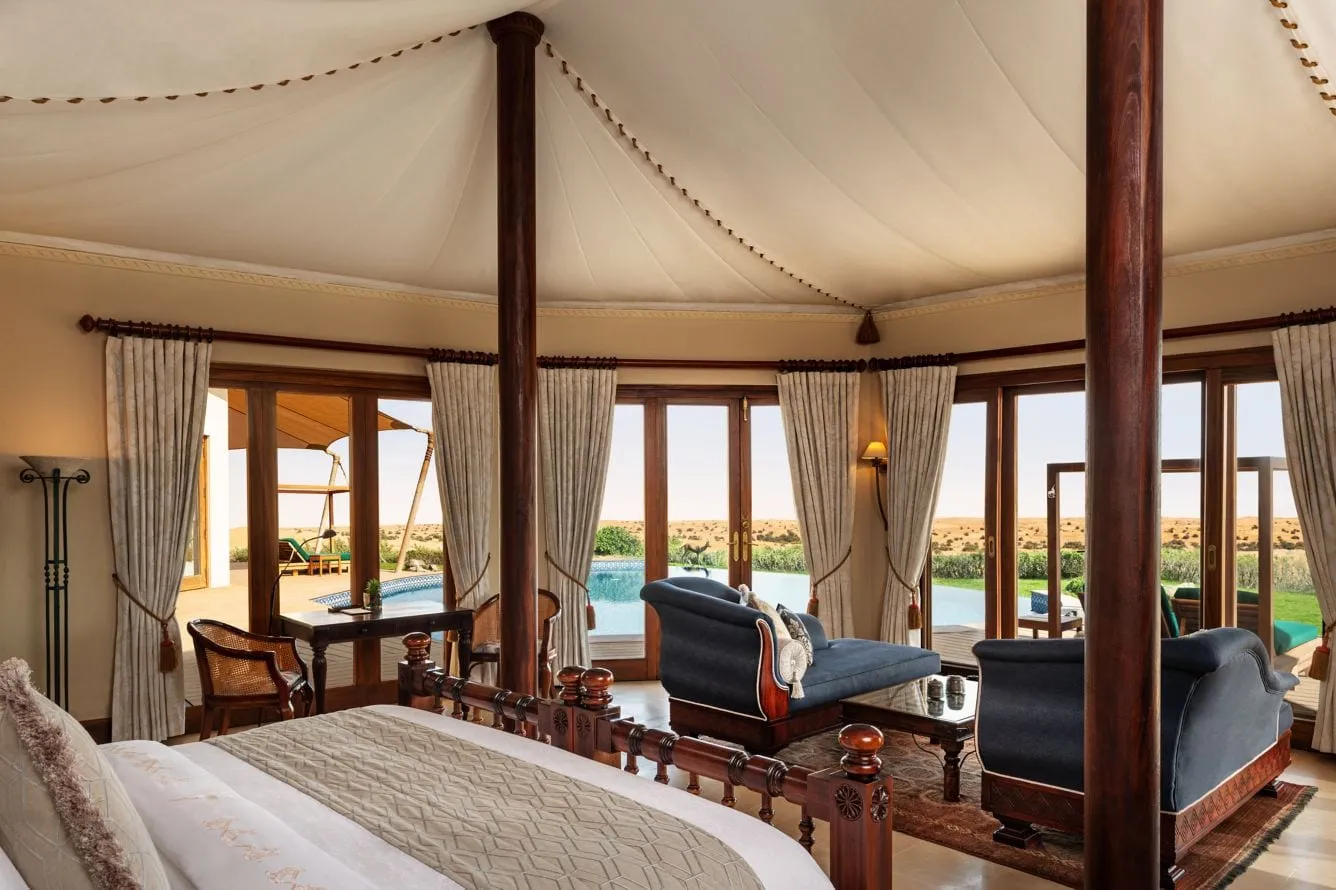
Inside, the suites depart from the pale canvas of the exteriors in favor of a darker, more richly furnished palette: dark wood furniture, antique-style pieces and handcrafted detailing, set against floor-to-ceiling glazing that keeps the desert visible from the bed. Every suite includes a spacious bathroom with a soaking tub and separate rain shower, a private seating area, and in-suite amenities that extend to a Nespresso machine and, in most categories, a telescope, a nod to the near-total absence of light pollution across the reserve after dark.
The larger categories scale up rather than change character. The Royal Suite adds a second bedroom and bathroom and a larger pool, aimed at two couples or a family traveling together within the resort’s guest policies, while the Presidential Suite, at roughly 530 square meters, extends to three bedrooms and a correspondingly larger private pool and deck. Across every category, the design brief stays consistent: warm, tactile, unmistakably Arabian in reference, but restrained enough that the desert outside the window remains the primary view rather than competition for it.
Atmosphere
The atmosphere at Al Maha is shaped almost entirely by scale and silence. With only 42 suites spread across a private, fenced section of the wider conservation reserve, guests can go long stretches without encountering anyone beyond their own butler-style suite host and the guides who run the resort’s activities. There is no beach club energy here, no pool bar scene; the loudest communal moment of most stays is likely to be dinner on Al Diwaan’s terrace or drinks at Hajar Terrace Bar as the light drops.
Evenings follow the desert’s own rhythm rather than a programmed schedule. Temperatures fall quickly after sunset, activities shift to falconry demonstrations at dawn and sunset wildlife drives, and the near-total absence of artificial light after dark turns stargazing into one of the resort’s more understated draws. The overall register is quiet, adult, and unhurried, closer in feel to a private safari camp than to a conventional five-star hotel, which is precisely the comparison the resort has cultivated since it opened.
Rooms and Suites
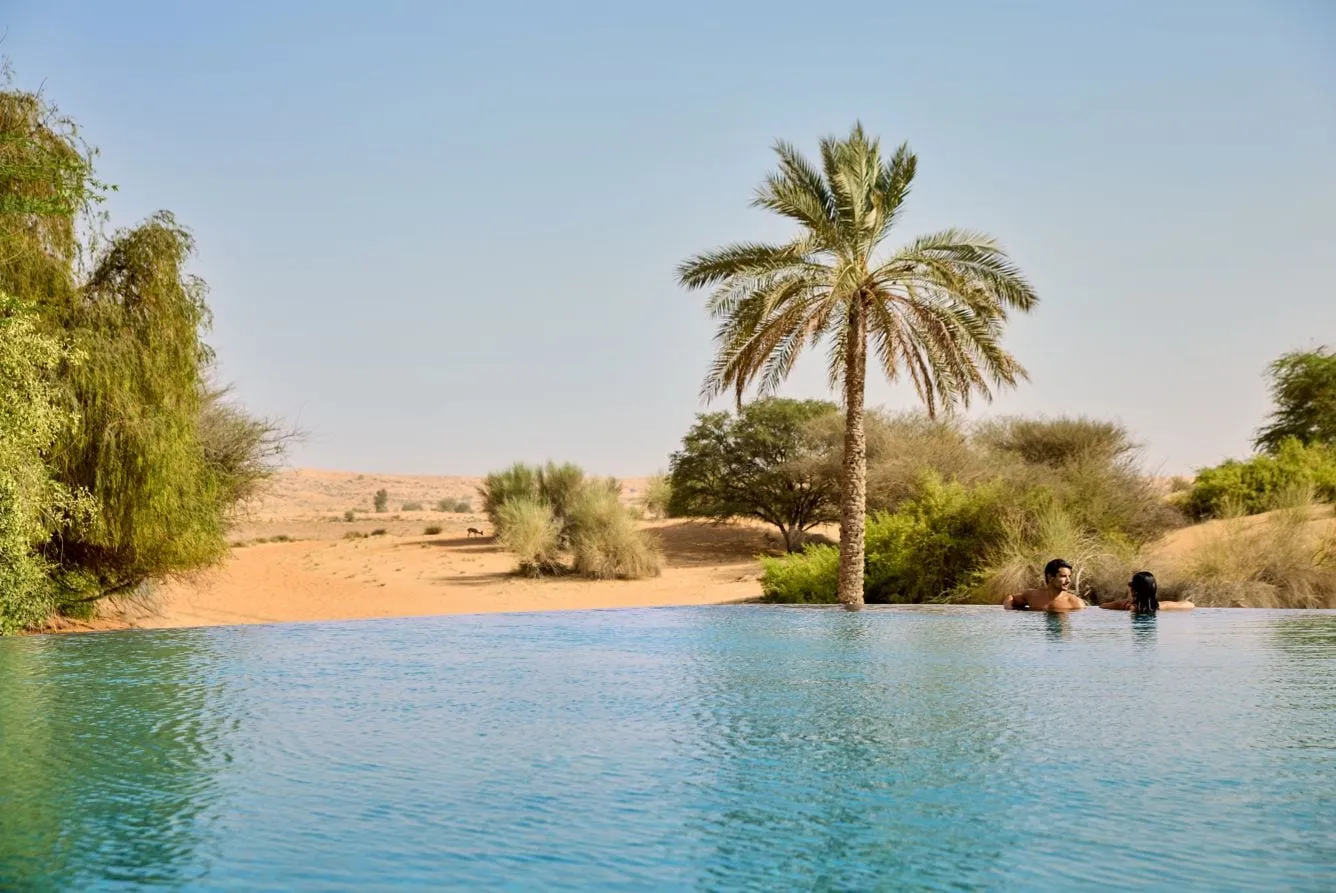
Al Maha has 42 freestanding suites across four categories, each with its own private, temperature-controlled pool set on a raised timber deck. The Bedouin Suite is the entry category, a junior suite of just over 800 square feet with a king bed or twin configuration, private pool, seating area and outdoor deck facing the dunes. The Emirates Suite sits above it, offering a larger footprint and pool while keeping the same essential one-bedroom layout.
The Royal Suite steps up to two bedrooms and two bathrooms with a larger pool, built for two couples or a family traveling together, and the Presidential Suite, at around 530 square meters, is the resort’s flagship, with three bedrooms, expansive bathrooms and the largest private pool and deck on the property. Every category, regardless of size, includes the same core amenities: a soaking tub, separate rain shower, in-suite espresso machine, private outdoor seating, and complete visual separation from every other suite on the property, achieved through spacing and the natural cover of the dune terrain rather than walls or landscaping.
Dining
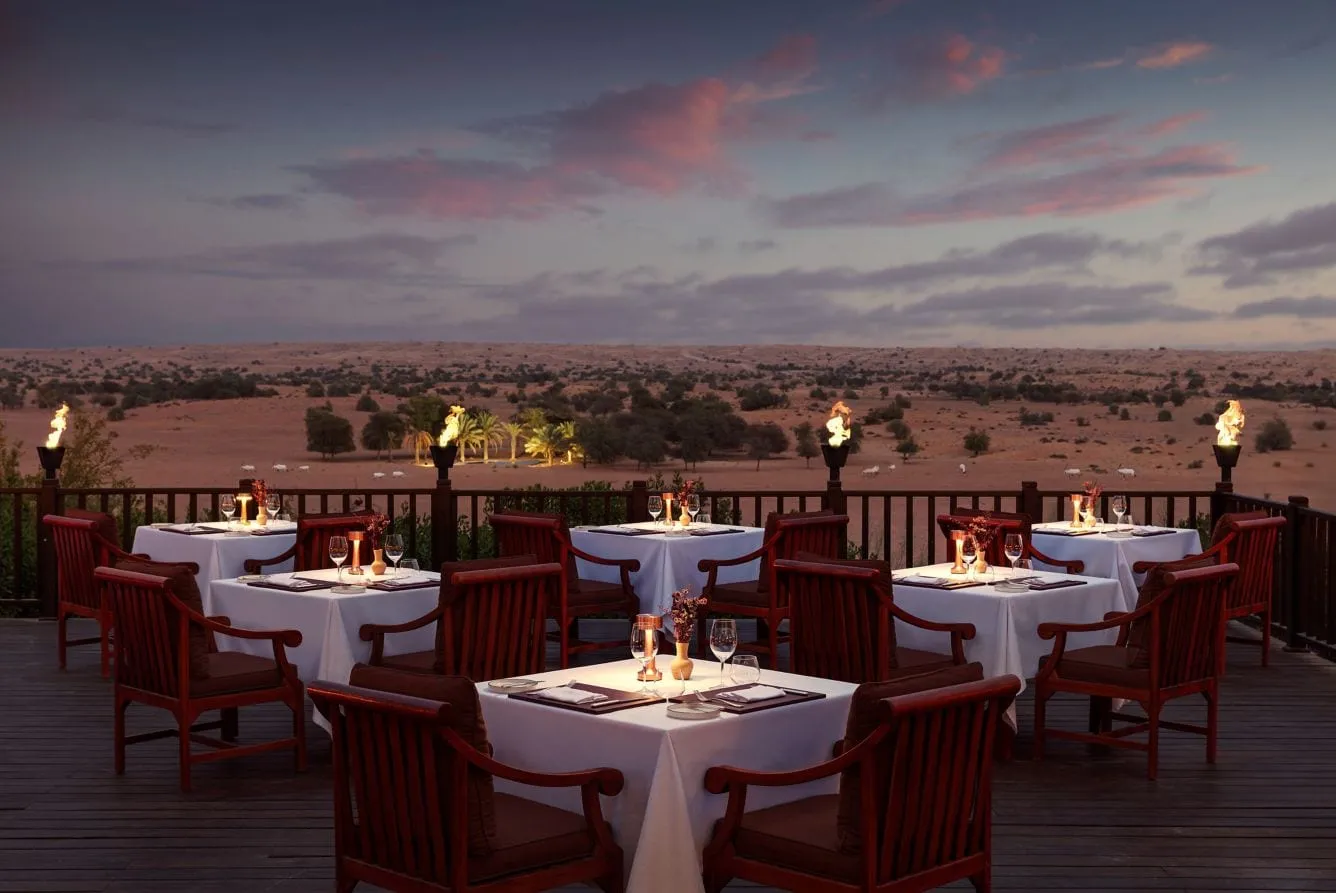
Al Diwaan is Al Maha’s principal restaurant, open from breakfast through dinner on a terrace that looks out over the reserve, with a menu built around organic ingredients that blends Emirati and international cooking. Guests are not restricted to the restaurant itself: dinner can be arranged on the open terrace, out in the dunes under a private setup, or in the privacy of a guest’s own suite, an option the resort promotes as one of its signature dining formats given how few properties in the region can offer a genuinely private outdoor dinner setting with no other structures in view.
Hajar Terrace Bar handles drinks and lighter bites, with views across the reserve toward the Hajar Mountains on the horizon, a rare geographic feature for a resort this close to Dubai. Between the two venues and the option of fully private in-suite or in-dune meals, Al Maha’s dining program is built less around variety of outlets, there are only two, and more around flexibility of setting, letting guests choose where in the reserve they want to eat rather than which restaurant to book.
Spa and Wellness
Timeless Spa occupies a secluded section of the property beneath mature palms, with treatment rooms surrounded by gardens and water features rather than clustered in a single wellness block. Facilities include single and double treatment rooms for couples, a rasoul chamber, a hydrotherapy bath, a sauna, steam room, indoor jacuzzi and an ice-cold plunge pool, alongside a gymnasium for guests who want a workout beyond the resort’s outdoor activities.
Treatments draw on a blend of Middle Eastern and Southeast Asian aromatherapy traditions, built around organic ingredients, and can be taken in the spa itself or arranged in-suite for guests who prefer not to leave their own deck. The resort’s main swimming pool, separate from the private suite pools, sits close to the spa and looks out over open desert, giving even non-spa guests a quiet, panoramic spot to spend an afternoon between activities.
Experiences
Activities at Al Maha are built around the reserve itself rather than imported entertainment, and up to two are included per person per day as part of the standard rate. The signature experience is the wildlife drive, typically run in the late afternoon, when open-sided 4x4 vehicles take guests out across the dunes to see the Arabian oryx, Arabian and sand gazelles, and smaller desert species such as Rueppell’s fox and the Arabian red fox, all animals that live wild within the fenced reserve rather than in enclosures built for viewing.
Falconry demonstrations, usually held around sunrise, walk guests through a tradition central to Emirati and wider Bedouin heritage, while archery sessions run through the mid-morning. Camel trekking departs in the late afternoon for a roughly 30-minute ride into the dunes, timed to reach a vantage point for sunset, often accompanied by refreshments served in the sand. Guided nature walks cover the reserve’s smaller-scale ecology, from tracks and burrows to native desert flora, and horse riding and open-desert dune drives are available as paid additions to the standard activity roster. Taken together, the program is less a checklist of resort amenities than a structured introduction to a working conservation landscape, which is the more accurate way to think about what a stay at Al Maha is actually selling.
Who It Is For
Al Maha suits couples, honeymooners and travelers with a genuine interest in conservation and desert wildlife more than it suits families with young children or larger groups seeking a conventional resort program. The low suite count, the absence of a central pool or lobby scene, and the pacing of the activity schedule, built around dawn and dusk rather than a full daytime roster, all point toward a slower, more intentional style of stay than the beach resorts that dominate the rest of Dubai’s luxury hotel market.
It is a strong fit for anyone stopping in Dubai who wants a genuinely different register from the city itself, a short transfer away rather than a multi-day expedition, and it appeals particularly to travelers who would otherwise consider a private safari camp in East or Southern Africa but want that experience compressed into a two or three night add-on to a Gulf itinerary. It is a weaker fit for travelers who want nightlife, a busy pool scene, or the option to walk to restaurants and shops outside the resort, none of which exist here by design.
Best Time to Visit
The most comfortable window to visit is roughly November through March, when daytime desert temperatures are mild enough to make midday activities, and simply sitting outside on a suite’s private deck, genuinely pleasant rather than punishing. This period also overlaps with Dubai’s broader high season, so rates and occupancy both rise accordingly, particularly around the December and January holiday weeks.
Summer months, roughly June through September, bring daytime temperatures that regularly exceed 40 degrees Celsius, which pushes most outdoor activity into the early morning or evening and limits how much time guests will realistically want to spend outside a suite’s pool or the resort’s shaded spaces during the day. Shoulder months, April, May and October, offer a reasonable compromise of lower rates and still-manageable heat for travelers willing to plan activities around the cooler parts of the day.
How to Get There
The nearest airport is Dubai International Airport (DXB), roughly 45 to 60 minutes’ drive from the resort depending on traffic and the exact route taken off the Dubai-Al Ain Road. There is no public transport option to Al Maha, and because the resort sits inside a fenced, protected reserve, only registered guest and staff vehicles are permitted past the entrance gate. Most guests arrange a private transfer directly through the resort or Marriott reservations, which is generally the simplest option given the drive includes a stretch through the reserve itself once past the main entrance.
Self-driving is possible via rental car, and the route from central Dubai is straightforward, largely highway driving followed by a shorter stretch on reserve access roads. Guests connecting through Dubai on Emirates flights, given the resort’s ownership link to the airline, sometimes build in a short Al Maha stopover as an alternative to a city hotel before continuing onward travel.
Nearby Experiences
Al Maha’s setting inside the Dubai Desert Conservation Reserve means most of what there is to see and do sits within the reserve itself rather than requiring a trip beyond it: the reserve holds the UAE’s largest free-roaming herd of Arabian oryx, along with Arabian and sand gazelles and a range of smaller desert wildlife, all visible on the resort’s own guided drives rather than at an external attraction. The Hajar Mountains are visible on the horizon from parts of the property, though visiting them directly falls outside a typical Al Maha stay.
For guests looking to combine the resort with wider Dubai sightseeing, the city’s skyline attractions, Burj Khalifa, the Dubai Mall, and the historic Al Fahidi district, are all within the same roughly hour-long drive back toward the coast, making Al Maha a workable two-or-three-night addition either at the start or end of a broader Dubai itinerary rather than a full replacement for a city stay.
Things to Know Before Booking
Rates at Al Maha are full-board, including breakfast, lunch and dinner, plus up to two complimentary activities per person per day; horse riding and open-desert dune drives are typically offered as paid extras. Rates vary substantially by season, with the cooler months from roughly November through February commanding a significant premium over the summer shoulder period.
Age policies for children have varied across booking channels and over time, and the resort is generally positioned toward couples and adult travelers rather than families with young children; anyone traveling with kids should confirm the current policy directly with the resort or Marriott reservations before booking. Because the property sits inside a protected conservation reserve accessed through a single gated entrance, arrival transfers should be arranged in advance rather than assumed, and self-driving guests should allow extra time to navigate reserve access roads that differ from a standard hotel approach.
Sustainability
Sustainability at Al Maha is inseparable from its founding mission rather than a program layered on afterward. The resort’s fenced private reserve, established alongside the hotel’s 1999 opening specifically to support the reintroduction of the Arabian oryx, became one of the templates for the much larger Dubai Desert Conservation Reserve that now surrounds it, a 225-square-kilometer protected area representing roughly 5 percent of Dubai’s total land area. The reserve today supports the UAE’s largest free-roaming herd of Arabian oryx along with Arabian and sand gazelles and smaller native species, all managed as a functioning conservation landscape rather than a curated wildlife display.
Operationally, the resort has implemented water recycling, biodiesel use and solar power generation as part of its environmental program, measures aimed at reducing the footprint of running a luxury property inside land that is, by definition, meant to be protected from exactly that kind of impact. The core sustainability case for Al Maha remains the oryx program itself: a species that was functionally extinct in the wild by the 1970s now roams in the hundreds across the reserve immediately surrounding the resort, a rare instance of a hotel’s conservation claim being demonstrably, visibly true rather than aspirational.
Practical Information
Al Maha, a Luxury Collection Desert Resort & Spa, is located within the Dubai Desert Conservation Reserve off the Dubai-Al Ain Road, roughly 45 to 60 minutes by road from central Dubai and Dubai International Airport (DXB). Check-in is at 3:00 PM and check-out at 12:00 PM. The resort has 42 suites across four categories, two dining venues (Al Diwaan restaurant and Hajar Terrace Bar), and Timeless Spa. Rates are full-board and include up to two activities per person per day; current pricing and availability are best confirmed directly through Marriott’s Luxury Collection booking channels given how significantly rates shift between peak winter and summer seasons.
Editorial Conclusion
More than twenty-five years after it opened, Al Maha still occupies an unusual position among Gulf luxury resorts: a property whose defining feature is not a view, a chef, or an architectural gesture, but a conservation outcome that can be verified by simply stepping outside a suite at dusk. The Arabian oryx that were reintroduced to this stretch of desert in 1999 now roam it in numbers that would have seemed implausible when the resort first opened, and the low-density, 42-suite layout that surrounds them has aged remarkably well against a Dubai skyline that has otherwise transformed almost beyond recognition since the resort’s founding. For travelers who want the Gulf region’s desert delivered as something closer to a working conservation estate than a themed resort backdrop, Al Maha remains the reference point that most competitors are still, implicitly, being measured against.
In pictures
On the map
Dubai Desert Conservation Reserve, United Arab Emirates
Questions
Frequently asked
How many suites does Al Maha have, and do they all have private pools?
Al Maha has 42 freestanding suites across four categories: Bedouin Suite, Emirates Suite, Royal Suite and Presidential Suite. Every suite, including the entry-level Bedouin Suite, comes with its own temperature-controlled plunge pool on a private deck, along with a separate seating area and dune or mountain views. The Royal and Presidential categories add extra bedrooms and larger pools for families or groups travelling together within the resort's age policies.
What is the connection between Al Maha and the Arabian oryx?
Al Maha takes its name from the Arabic word for the Arabian oryx. When the resort opened in 1999, Sheikh Mohammed bin Rashid Al Maktoum, then Crown Prince of Dubai, funded the reintroduction of the species to the surrounding desert after it had been hunted to near extinction in the wild by the mid-20th century. Thirty-eight oryx from a private royal collection were released in February 1999, followed by 79 more from conservation herds in the United States that November. The fenced reserve around the resort, now part of the wider Dubai Desert Conservation Reserve, holds the UAE's largest free-roaming herd of the species, along with Arabian and sand gazelles.
How far is Al Maha from Dubai and its airport, and how do guests get there?
Al Maha sits inside the Dubai Desert Conservation Reserve off the Dubai-Al Ain Road, roughly 45 to 60 minutes' drive from central Dubai and from Dubai International Airport (DXB), depending on traffic. There is no public transport to the property. Guests typically arrive by private transfer arranged through the resort, or by rental car; because the resort sits within a protected reserve, only registered guest vehicles are permitted past the entry gate.
Is Al Maha suitable for a family trip with children?
Al Maha is positioned primarily as an adults-focused retreat, and published age policies for children have varied over the years across booking channels, generally restricting younger children rather than excluding families outright. Given the private pools, open dune terrain and wildlife-focused activities, travelling families should confirm current age requirements directly with the resort or Marriott reservations before booking rather than relying on a single third-party listing.
What is included in the nightly rate at Al Maha?
Al Maha is sold on a full-board basis: breakfast, lunch and dinner are included, along with up to two complimentary activities per person per day, chosen from options such as guided wildlife drives, falconry, archery, guided nature walks and camel trekking. Horse riding and open-desert dune drives are typically offered as paid supplements. Rates rise substantially in the cooler, peak winter months between roughly November and February.
Same destination
More hotel guides in United Arab Emirates
Palm Jumeirah, United Arab Emirates
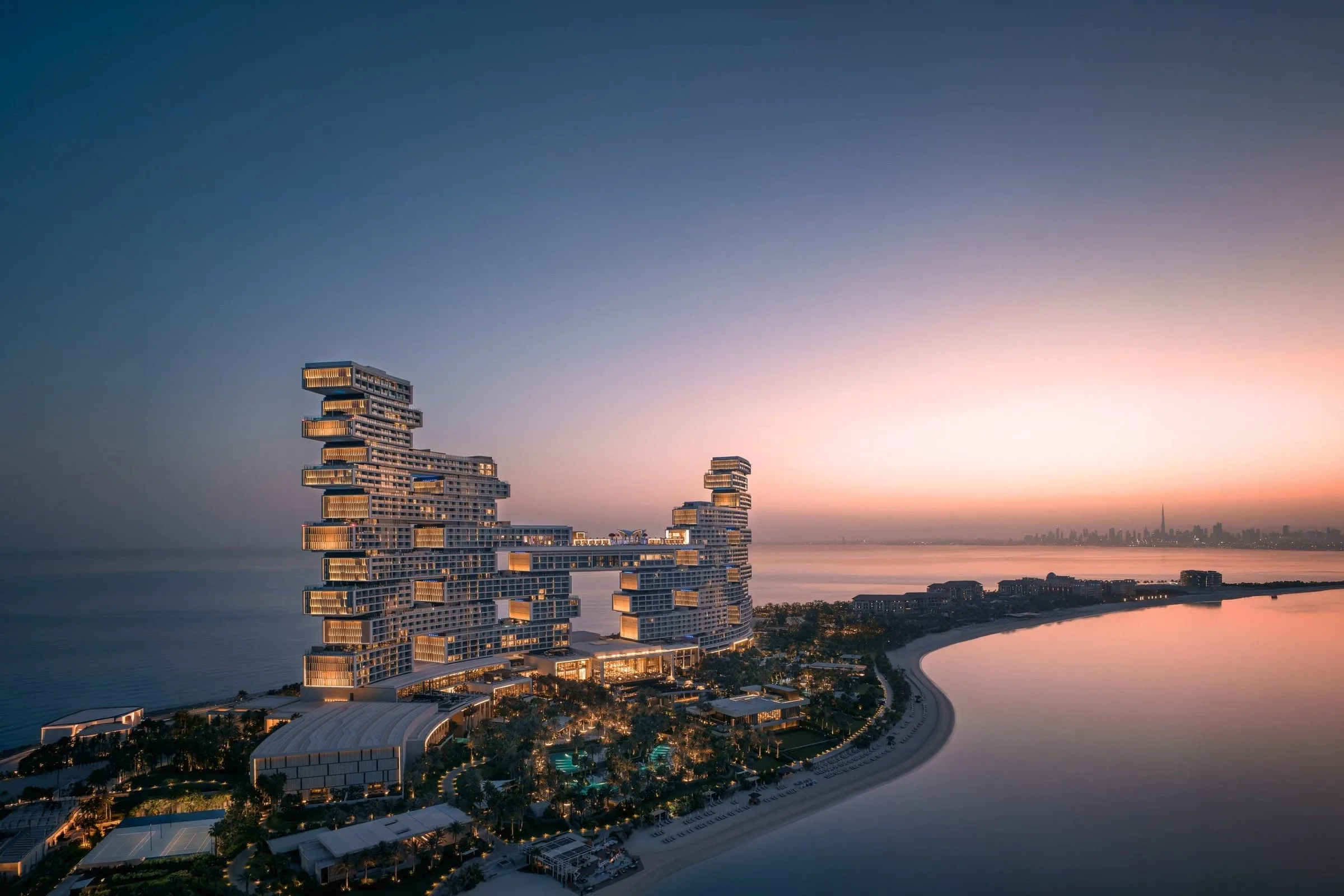
Atlantis The Royal
Six stacked towers, a 90-metre sky pool bridging them at height, and 795 rooms and suites arranged like a deliberately imperfect skyline on Palm Jumeirah.
From $650 per night
Jumeirah Bay Island, United Arab Emirates
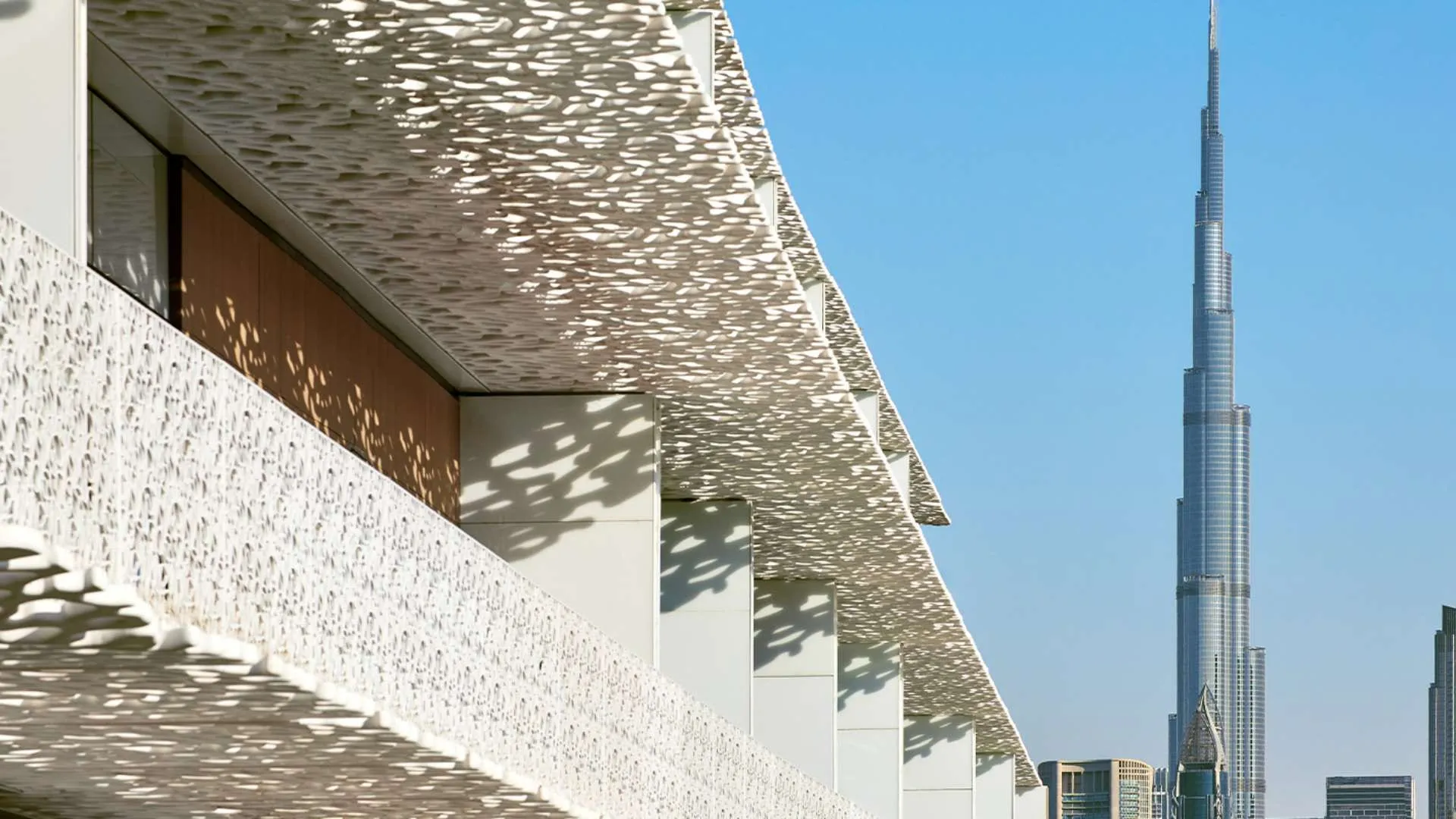
Bulgari Resort Dubai
An Italian jeweller's idea of the Arabian Gulf, built on a seahorse-shaped island with its own marina, a two-Michelin-starred dining room, and 101 rooms that all face water.
From $950 per night
Palm Jumeirah, United Arab Emirates
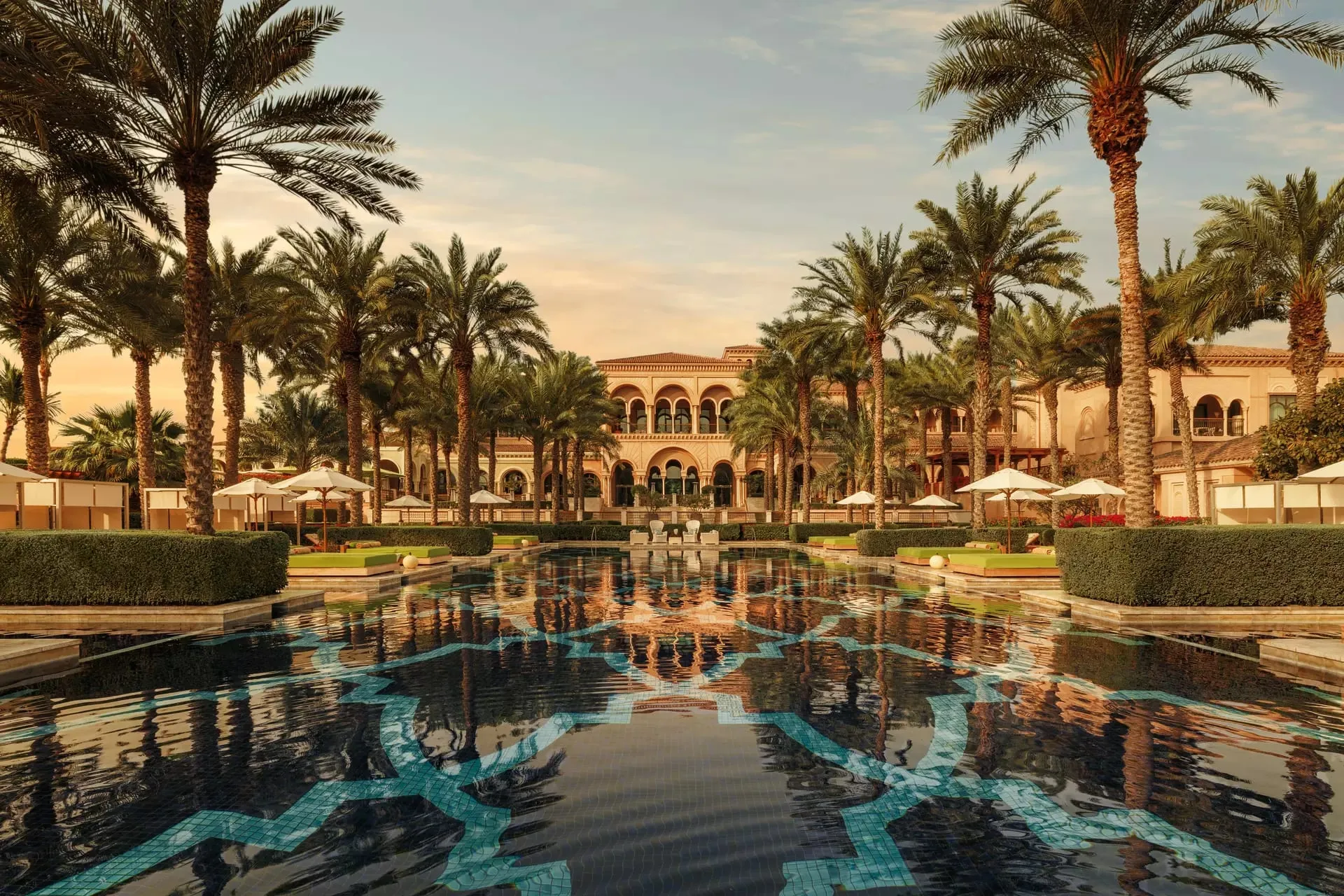
One&Only The Palm
A Moorish-Andalusian manor on the tip of Palm Jumeirah's West Crescent, built around a two-Michelin-star French dining room and four of Dubai's only private-pool beach villas.
From $650 per night