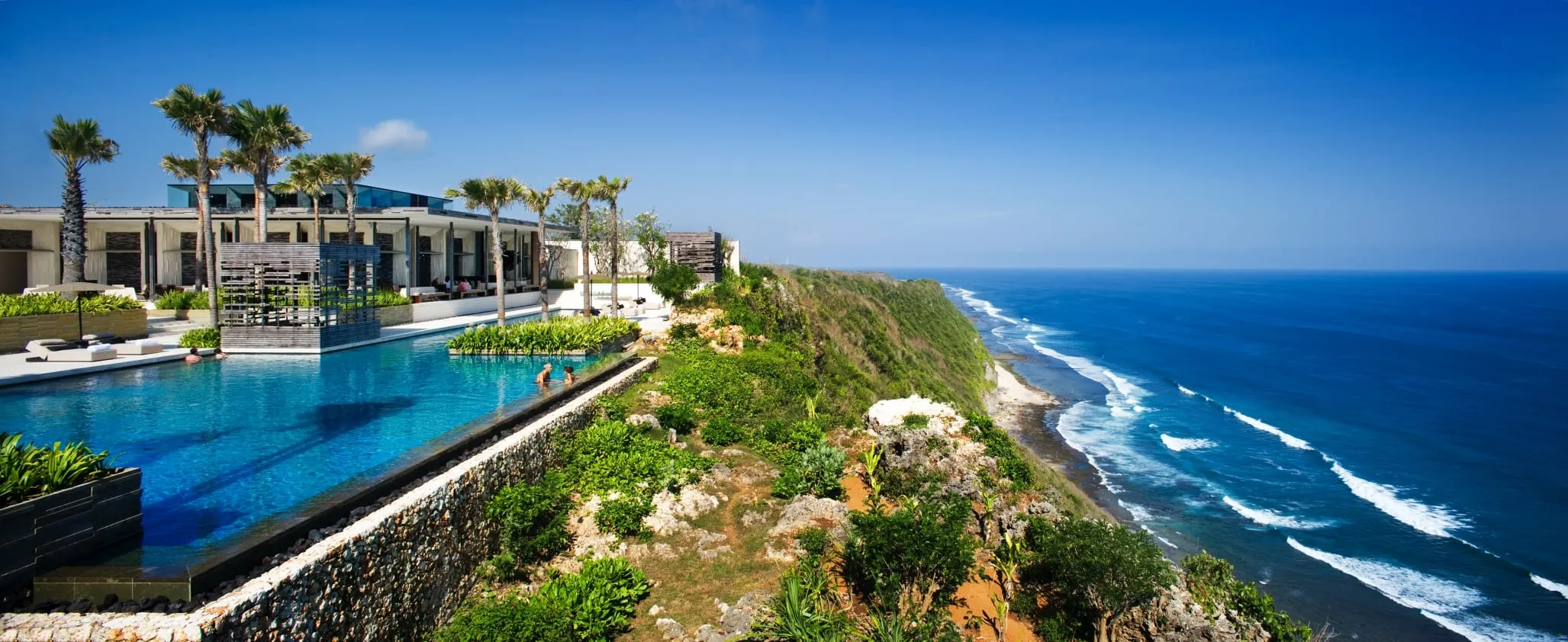
Uluwatu, Bukit Peninsula, Indonesia
Alila Villas Uluwatu
A Singapore architecture firm carved a geometric limestone resort into a Bukit Peninsula clifftop in 2009, planting grass roofs across it so the whole property reads as an extension of the savannah it replaced.
- Rates from
- From $800 per night
- Nearest airport
- Ngurah Rai International Airport (DPS), Denpasar
- Transfer
- About 30 to 45 minutes by car, depending on traffic on the Bukit Peninsula's main road
- Best months
- April to October, Bali's dry season, for the clearest skies and calmest conditions along the clifftop
There is a particular way the light moves across Alila Villas Uluwatu in the late afternoon, sliding along the flat limestone planes of the roofline until the whole resort seems to be made of the same pale stone as the cliff beneath it. That is not an accident of geography. It is the outcome of a design brief that asked a Singapore architecture firm to build a luxury resort on one of Bali’s most dramatic clifftops without making it look like it had been dropped there from somewhere else.
Alila Villas Uluwatu opened in June 2009 on the southern tip of the Bukit Peninsula, a limestone plateau quite different in character from the rice terraces and volcanic greenery most visitors associate with Bali. Where much of the island reads as lush and layered, the Bukit is dry, scrubby and dramatic, its coastline cut into sheer cliffs that drop straight into the Indian Ocean. WOHA, the architecture practice behind the resort, chose to work with that starker landscape rather than against it, producing a property built largely from stone quarried on site, roofed in places with living grass, and organised around courtyards, water gardens and long horizontal lines that echo the cliff edge itself.
The result has been widely published and repeatedly awarded in the sixteen years since it opened, cited as one of the clearer arguments that a large-scale luxury resort can also be a serious piece of architecture, and that sustainable design and five-star comfort are not necessarily in tension. It has also aged well as a hotel rather than only as a design object, which is the harder trick: the villas still function, the pools are still private, and the clifftop views have not been diminished by the crowding that has reshaped much of the Bukit Peninsula around it.
What follows is a guide to what the resort actually offers today: the architecture that made its name, the villas and dining rooms that make up a stay, and the practical detail a traveller needs before booking.
Why It Stands Out
Alila Villas Uluwatu’s core distinction is that it treats architecture as the primary luxury on offer, ahead of scale, brand recognition or amenity count. WOHA’s design, completed in 2004 and built out over the following five years, won the World Holiday Building of the Year award at the 2010 World Architecture Festival and a RIBA International Award in 2011, recognition that placed a Bali resort alongside civic and cultural buildings rather than only other hotels. Few luxury properties in Southeast Asia have been as consistently cited in architecture and design publications in the years since.
The second distinction is the site itself. Rather than a beachfront plot, the resort occupies an elevated limestone plateau on the Bukit Peninsula’s southern coast, a landscape of dry savannah and sheer cliff quite unlike the tropical greenery associated with the rest of Bali. WOHA leaned into that contrast instead of importing a more conventional lush-garden resort language, and the result is a property that looks, and feels, distinct from almost everything else on the island.
The third is an early and substantive commitment to sustainable building practice, at a scale and level of ambition unusual for a luxury resort of its era. Alila Villas Uluwatu became the first resort in Indonesia to achieve top-tier ecological design certification from EarthCheck, built largely from local and reclaimed materials, and engineered from the outset around rainwater harvesting and grey-water recycling rather than treating sustainability as a later add-on.
Architecture
WOHA, the Singapore-based practice founded by Wong Mun Summ and Richard Hassell, designed Alila Villas Uluwatu’s full masterplan, architecture, interiors and custom furniture on a roughly 14-hectare (35-acre) clifftop site. The firm has described the concept as drawn from “the pale limestone cliffs and the deep blue of the sea,” layered with references to Bali’s own architectural history, from Bronze Age animist structures through the Hindu Majapahit period to Dutch Art Deco and contemporary modernism, alongside external influences that include Carlo Scarpa’s stepped stonework and the courtyard houses of Mies van der Rohe.
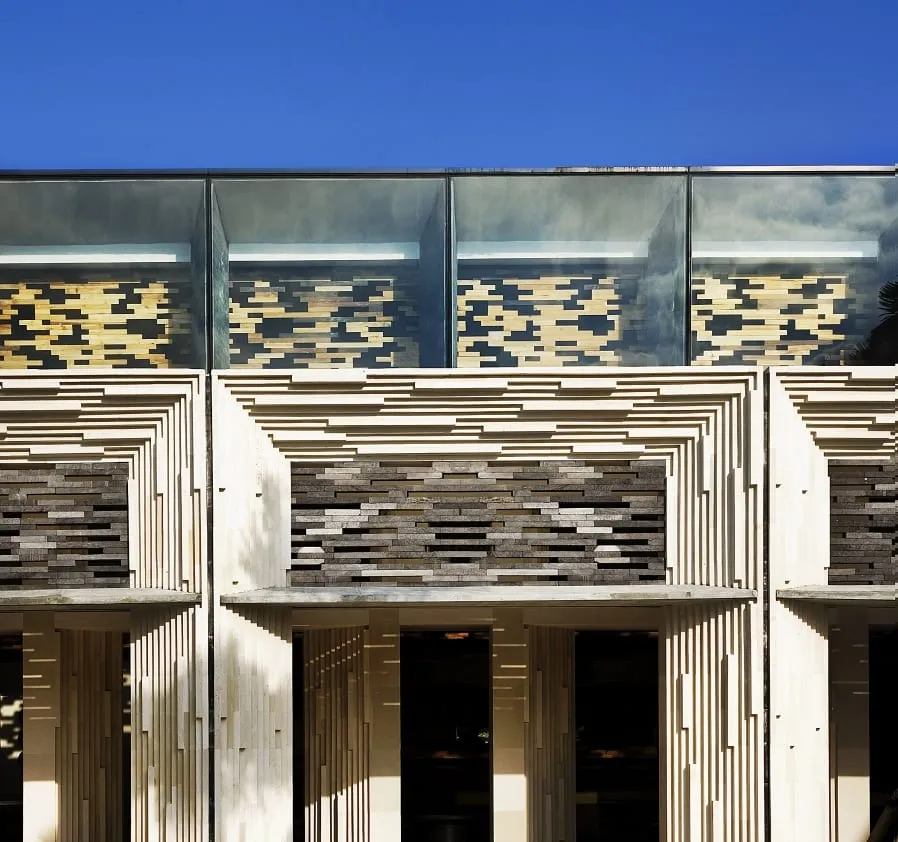
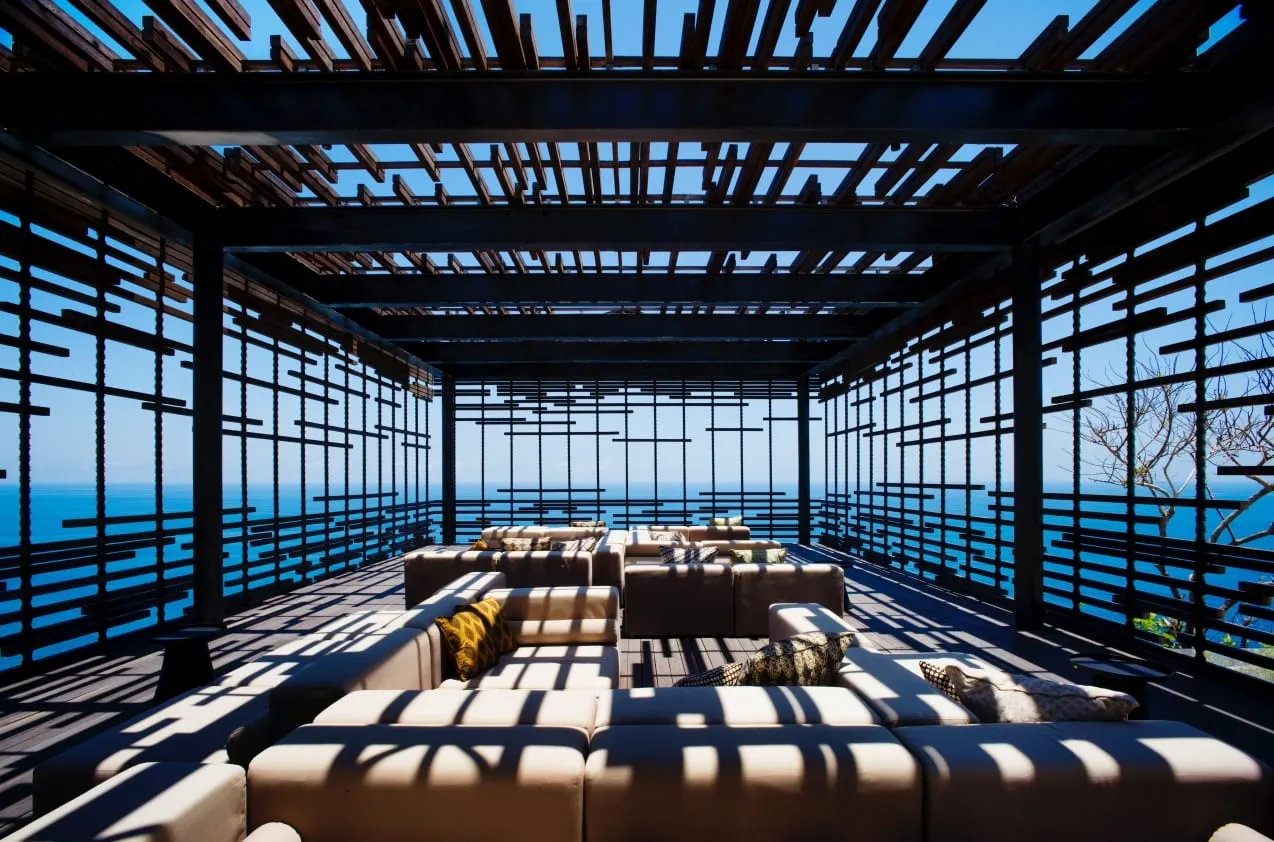
The built language is geometric and horizontal rather than curved or ornamental: long flat planes, deep overhangs, and a restrained material palette dominated by pale local limestone quarried directly from the site, board-formed concrete, and reclaimed ulin, a dense ironwood native to Kalimantan prized for its durability outdoors. Grass and lava-stone roofs, planted or laid flat across sections of the resort, help the buildings absorb heat and blend visually into the surrounding savannah landscape rather than reading as glass-and-steel intrusions on it. Villas and public buildings step down the site’s natural terracing in tiers, linked by bridges over water gardens and courtyards, an arrangement that gives most units an unobstructed line to the horizon without stacking accommodation into a conventional multi-storey block.
The design has been widely recognised since the resort opened in June 2009, including the World Holiday Building of the Year award at the 2010 World Architecture Festival, a RIBA International Award in 2011, and further citations from The Chicago Athenaeum, the European Centre for Architecture Art Design and Urban Studies, and the Asia Pacific Federation of Architects and Interior Designers. It remains one of the most consistently referenced hospitality projects in WOHA’s portfolio.
Interior Design
Interiors continue the architecture’s material logic rather than departing from it: pale stone floors, dark timber joinery, and a restrained, largely neutral palette that keeps the ocean and the cliff edge as the dominant visual note in every villa. Furniture, much of it custom-designed by WOHA as part of the original brief, favours clean geometric lines over carved Balinese ornament, a deliberate choice that positions the resort closer to contemporary tropical modernism than to the more decorative style associated with many of Bali’s older luxury properties.
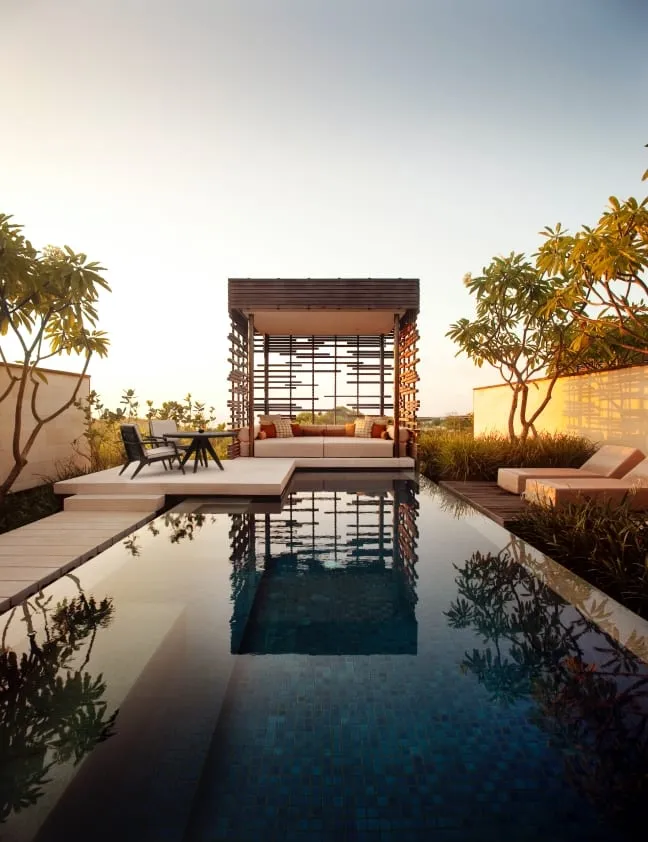
Villas are organised to dissolve the boundary between inside and outside: sliding walls, covered outdoor living pavilions, and pools positioned to be visible, and usable, from the main living space rather than tucked to one side. Bathrooms in most categories open partly to the sky or to a private garden court, a detail consistent with the resort’s broader emphasis on natural ventilation and light over fully enclosed, air-conditioned interiors. The effect across categories, from the smaller Pool Villas to the multi-bedroom Cliff Edge and Hillside villas, is a consistent sense of restraint: nothing in the room is designed to compete with the view outside it.
Atmosphere
The mood at Alila Villas Uluwatu is quieter and more architecturally minded than the Bukit Peninsula’s increasingly busy beach-club scene immediately around it. Because the resort sits atop the cliffs rather than at sea level, there is a natural remove from the surf culture and cliffside bar crowds that have grown up nearby over the past decade; guests looking for that energy can reach it by a short drive, while those who prefer to stay on property find a calmer, more contemplative pace built around the pool, the villa and the horizon.
Days tend to organise themselves around light: the flat, hard brightness of midday on the limestone plateau, and the long golden stretch toward sunset that the resort’s western-facing pool deck and restaurant terraces are explicitly oriented to catch. Evenings shift toward a more social register at the Sunset Cabana Bar and Batique Bar, without ever tipping into the louder beach-club atmosphere found elsewhere on the peninsula. Throughout, the architecture itself does much of the atmospheric work: deep shade, cross-ventilation and long uninterrupted sightlines keep the resort feeling open and unhurried even at full occupancy.
Rooms and Suites
Alila Villas Uluwatu operates 65 villas across one-, two- and three-bedroom categories, the great majority built around a private infinity-edge pool. Entry-level categories are the Pool Villa and Panoramic One Bedroom Pool Villa, both single-bedroom units with a private pool and outdoor living pavilion, the panoramic category adding a more open, unobstructed ocean view.
Two-bedroom categories, including the Two Bedroom Cliff Edge Villa, sit closer to the cliff line itself, typically with a larger private pool, an outdoor dining pavilion and configurations suited to couples travelling together or a small family. At the top of the range, Three Bedroom Hillside and Three Bedroom Cliff Edge villas add further living space and, in some categories, pools of 20 metres or more, positioning them for larger family groups or multi-couple trips who want a single self-contained villa rather than adjoining rooms.
Villa names and exact configurations are periodically revised by the hotel, so travellers with a specific category or view orientation in mind should confirm current inventory and floor plans directly with the resort or a specialist travel agent at the time of booking.
Dining
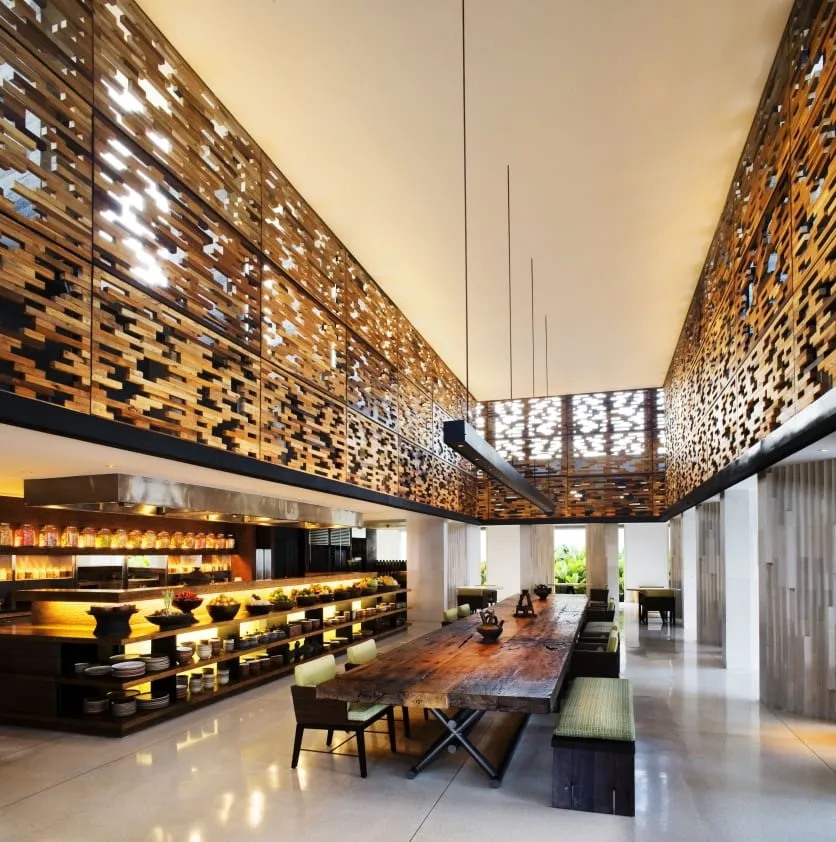
Dining at Alila Villas Uluwatu is built around two principal restaurants that sit at opposite ends of the same clifftop plateau. Cire occupies an open-sided terrace positioned for panoramic ocean views and sunset light, serving internationally inspired dishes built on fresh, seasonal and, where possible, locally sourced produce; it functions as the resort’s main all-day dining room. The Warung, styled after the traditional Indonesian food stall it takes its name from, concentrates on Indonesian and Balinese cooking, giving guests a more regionally specific counterpoint to Cire’s broader international menu.
Drinking is split between two venues: the Sunset Cabana Bar, positioned to catch the clifftop’s signature evening light with cocktails built for the hour, and Batique Bar, home to one of the more unusual whisky collections on the island and a quieter, more indoor counterpart to the Cabana’s open-air setting. In-villa dining is also available across categories, letting guests take breakfast, and in some cases full meals, without leaving their own pool terrace.
Spa and Wellness
Spa Alila operates eight treatment rooms, each opening onto its own private garden, offering a programme built on Balinese and broader Indonesian therapeutic traditions alongside more conventional massage and body treatments, with in-room amenities, playlists and minibars customised to each guest. The standout wellness setting on the property is the Cliff Edge Spa Cabana, reached along a planted path that runs along the clifftop before opening onto a private cabana suspended above the ocean; the cabana experience typically runs around two hours and combines a Balinese or therapeutic massage with a sound healing and eye ritual segment, set to the sound of the waves below.
Movement and yoga are centred on The Pavilion, a cantilevered deck that projects out over the cliff edge and hosts daily morning yoga sessions, along with occasional aerial yoga suspended above the same drop. A fitness centre and the resort’s 50-metre cliff-edge pool round out the wellness offering for guests who prefer to keep their routine less structured.
Experiences
Because the resort sits above rather than beside the water, much of its own on-site programming is built around the clifftop setting itself: sunrise and sunset yoga at The Pavilion, the Cliff Edge Spa Cabana ritual, and simply time spent at the 50-metre infinity pool, widely regarded as one of the most photographed hotel pools on the island. Cultural and culinary programming, including cooking classes centred on Balinese and Indonesian cuisine, is available through The Warung and can typically be arranged with advance notice.
Beyond the property line, the Bukit Peninsula offers some of Bali’s most consequential attractions for a resort of this kind. Uluwatu Temple (Pura Luhur Uluwatu), one of Bali’s most important sea temples, sits roughly 15 minutes away and stages a nightly kecak fire dance at sunset on its clifftop amphitheatre. The peninsula’s string of surf breaks, Uluwatu, Padang Padang, Bingin and Impossibles among them, draws surfers from around the world during the dry season, and several beaches reachable only by cliffside stairs, Padang Padang and Suluban in particular, offer a different, sea-level counterpoint to the resort’s own elevated setting.
Who It Is For
Alila Villas Uluwatu suits travellers for whom architecture and design are part of the appeal of a destination, not just its backdrop: couples on honeymoons or anniversary trips drawn to the privacy of a pool villa and the drama of the clifftop setting, and design-literate travellers who want to experience an award-winning building rather than simply read about it. The resort’s clifftop position, removed from the beach clubs and surf crowds at sea level, also suits guests prioritising quiet and a slower pace over immediate access to the water.
It is a less natural fit for travellers who want to walk directly from their room onto sand, since there is no beach at the resort itself and reaching one involves a drive down the peninsula. Families with very young children may also find the resort’s design-forward, adults-oriented atmosphere and the cliff-edge settings of several key spaces, from The Pavilion to the Spa Cabana, better suited to older children or a couples’ trip than to a young family’s needs, though the larger multi-bedroom villas can accommodate family groups comfortably for those who plan around it.
Best Time to Visit
Bali’s dry season, running roughly from April to October, brings the clearest skies, the calmest conditions and the most reliable weather for the resort’s outdoor spaces, from the cliff-edge pool to The Pavilion’s open-air yoga sessions, and coincides with the Bukit Peninsula’s best surf conditions at nearby breaks like Uluwatu and Padang Padang. It is also the island’s busiest and most heavily booked period, particularly around July, August and the year-end holidays, so travellers prioritising availability and rate should plan and book well ahead.
The wetter months from November to March bring a higher chance of afternoon showers and more humid conditions, along with quieter grounds and generally lower rates; short, intense tropical downpours are typical rather than prolonged wet-weather stretches, and many travellers find the shoulder months either side of the wet season, April and October in particular, offer a reasonable balance of good weather and lighter crowds.
How to Get There
All guests arrive first at Ngurah Rai International Airport (DPS) in Denpasar, Bali’s main international gateway, which sits on the isthmus connecting the Bukit Peninsula to the rest of the island. From there, Alila Villas Uluwatu is reached by a road transfer that typically takes 30 to 45 minutes, depending on traffic conditions on the peninsula’s single main access road, which can be significantly busier during peak season or around popular sunset hours as beach-bound traffic converges on the same stretch of road.
The resort can arrange a private car transfer directly from the airport, which is the most straightforward option for most guests, particularly those arriving with luggage for a multi-night stay. Ride-hailing and metered taxis are also available at the airport, though guests should confirm current pickup arrangements given periodic restrictions on ride-hailing services in parts of Bali’s more tourist-dense zones.
Nearby Experiences
The Bukit Peninsula’s defining attraction is Uluwatu Temple (Pura Luhur Uluwatu), a clifftop sea temple roughly 15 minutes from the resort by car, which stages a nightly kecak fire dance at sunset in an open-air amphitheatre overlooking the ocean, drawing a steady flow of visitors most evenings of the year. The temple complex is also home to a resident population of macaques, and visitors are typically advised to secure loose belongings, including sunglasses and jewellery, before walking the grounds.
The peninsula’s beaches and surf breaks form the other major draw within easy reach of the resort. Padang Padang, Bingin, Balangan and Dreamland each offer a different character, from Padang Padang’s dramatic cliffside entrance and famous left-hand break to Dreamland’s wider, more open sand, and most are reachable within 15 to 25 minutes by car. Uluwatu’s own surf break, one of the most storied in the world for experienced surfers, sits close to the temple and can be watched from clifftop warungs even by guests who do not intend to paddle out themselves.
Things to Know Before Booking
Alila Villas Uluwatu sits atop the Bukit Peninsula’s cliffs rather than at sea level, so travellers expecting direct beach access should plan for a short drive to reach the nearest sand; the resort’s own 50-metre infinity pool is the primary swimming feature on site. Villa categories vary meaningfully in size, privacy and pool dimensions, from compact one-bedroom Pool Villas to multi-bedroom Cliff Edge villas, so prospective guests should confirm the exact category, view orientation and pool size before booking rather than assuming all “pool villa” listings are equivalent.
The Bukit Peninsula’s single main access road can become congested at peak times, particularly around sunset when traffic converges on the area’s beach clubs and viewpoints, which is worth building into any plans for dinner reservations or transfers timed around the evening. Standard check-in is 2:00pm and check-out 12:00pm, with early check-in or late check-out available on request, subject to availability and, in some cases, an additional charge.
Sustainability
Alila Villas Uluwatu was built with sustainability as a structural design principle rather than a later addition, using materials sourced largely on site or regionally, including limestone quarried directly from the property and reclaimed ulin, a durable ironwood native to Kalimantan salvaged from older structures. The resort was engineered from the outset around rainwater harvesting and a grey-water recycling system that channels used water through reverse osmosis treatment for reuse elsewhere on the property, and flat lava-stone and planted roofs help reduce solar heat gain and, by extension, air-conditioning demand.
The property became the first resort in Indonesia to achieve the highest tier of ecological design certification from EarthCheck, the sustainability benchmarking programme that absorbed the earlier Green Globe 21 rating the resort held at its 2009 opening. On an ongoing basis, the resort runs an upcycling programme that repurposes waste glass and ceramics into tableware and tiles and buggy tyres into planters, among other initiatives. As with any resort-reported sustainability programme, these details reflect the property’s own disclosures and industry coverage rather than independent third-party audit, and guests with a specific interest in the detail are best served asking directly on property.
Practical Information
Alila Villas Uluwatu sits on the Bukit Peninsula in southern Bali, roughly 30 to 45 minutes by car from Ngurah Rai International Airport in Denpasar. The resort’s 65 villas span one-, two- and three-bedroom categories, the majority with a private infinity-edge pool, alongside two restaurants (Cire and The Warung), two bars, an eight-room spa with a signature cliff-edge cabana, and a 50-metre cliff-edge pool.
Rates start from an indicative $800 per night based on published cash rates for entry-level villa categories, though the exact figure depends heavily on villa category, season and any promotional offers, and prospective guests should confirm current pricing directly with the resort or a specialist Bali travel agent. Standard check-in is 2:00pm and check-out 12:00pm. Bali’s dry season, from April to October, offers the most reliable weather for the resort’s outdoor spaces, while a stay of three to four nights gives most guests enough time to settle into a villa, take in the spa’s Cliff Edge Cabana experience, and make at least one excursion to Uluwatu Temple or the peninsula’s beaches.
Editorial Conclusion
Alila Villas Uluwatu’s case rests on something more specific than luxury amenity: it is one of the clearer examples of a large-scale resort built as a serious piece of architecture first, and a five-star hotel second, without the two ever working against each other. WOHA’s geometric limestone masterplan, honoured by architecture juries as readily as by hospitality critics, has held up across sixteen years of Bali’s rapid tourism growth in a way that many more decorative, less structurally considered resorts of the same era have not.
For travellers weighing it against the Bukit Peninsula’s newer, more heavily marketed clifftop properties, the calculation is fairly direct: Alila Villas Uluwatu asks for a short drive down to the beach in exchange for a genuinely distinctive setting, an early and substantive sustainability programme, and a design language that has not dated the way more ornamental Balinese luxury has. For couples and design-minded travellers prepared to make that trade, it remains one of the more considered arguments on the island for what a clifftop resort can be.
In pictures
On the map
Uluwatu, Bukit Peninsula, Indonesia
Questions
Frequently asked
Who designed Alila Villas Uluwatu and when did it open?
The resort was designed by WOHA, the Singapore-based architecture practice founded by Wong Mun Summ and Richard Hassell, and opened in June 2009. It won the World Holiday Building of the Year award at the World Architecture Festival in 2010 and a RIBA International Award in 2011, among other recognitions, and remains one of WOHA's most widely published projects.
How many villas does Alila Villas Uluwatu have, and do they all have private pools?
The resort operates 65 villas across one-, two- and three-bedroom categories, from Pool Villas and Panoramic Pool Villas up to multi-bedroom Cliff Edge and Hillside villas. The great majority of categories include a private infinity-edge pool; travellers with a specific configuration in mind should confirm current villa categories directly with the hotel, since naming and inventory are periodically revised.
How far is Alila Villas Uluwatu from the airport, and what is nearby?
The resort sits roughly 30 to 45 minutes by car from Ngurah Rai International Airport in Denpasar, depending on traffic on the Bukit Peninsula's single main access road. Uluwatu Temple, with its clifftop kecak fire dance at sunset, is about 15 minutes away, and the peninsula's well-known surf breaks, including Padang Padang, Bingin and Uluwatu itself, are all within a short drive.
What sustainability measures has Alila Villas Uluwatu taken?
The resort was built largely from local materials, including limestone quarried on site and reclaimed ulin timber, and was designed around rainwater harvesting and a grey-water recycling system. It became the first resort in Indonesia to receive top-tier ecological design certification from EarthCheck (the programme that absorbed the earlier Green Globe 21 rating the property held at opening), and it runs an ongoing upcycling programme that turns waste glass and ceramics into tableware and tiles.
Is Alila Villas Uluwatu within walking distance of a beach?
No. The resort sits on top of the Bukit Peninsula's limestone cliffs rather than at sea level, so there is no direct beach access from the property itself. Guests reach nearby beaches such as Padang Padang, Bingin or Suluban by a short drive down the cliff, and the resort's own 50-metre infinity pool and ocean-facing decks are the primary water feature on site.
Same destination
More hotel guides in Indonesia
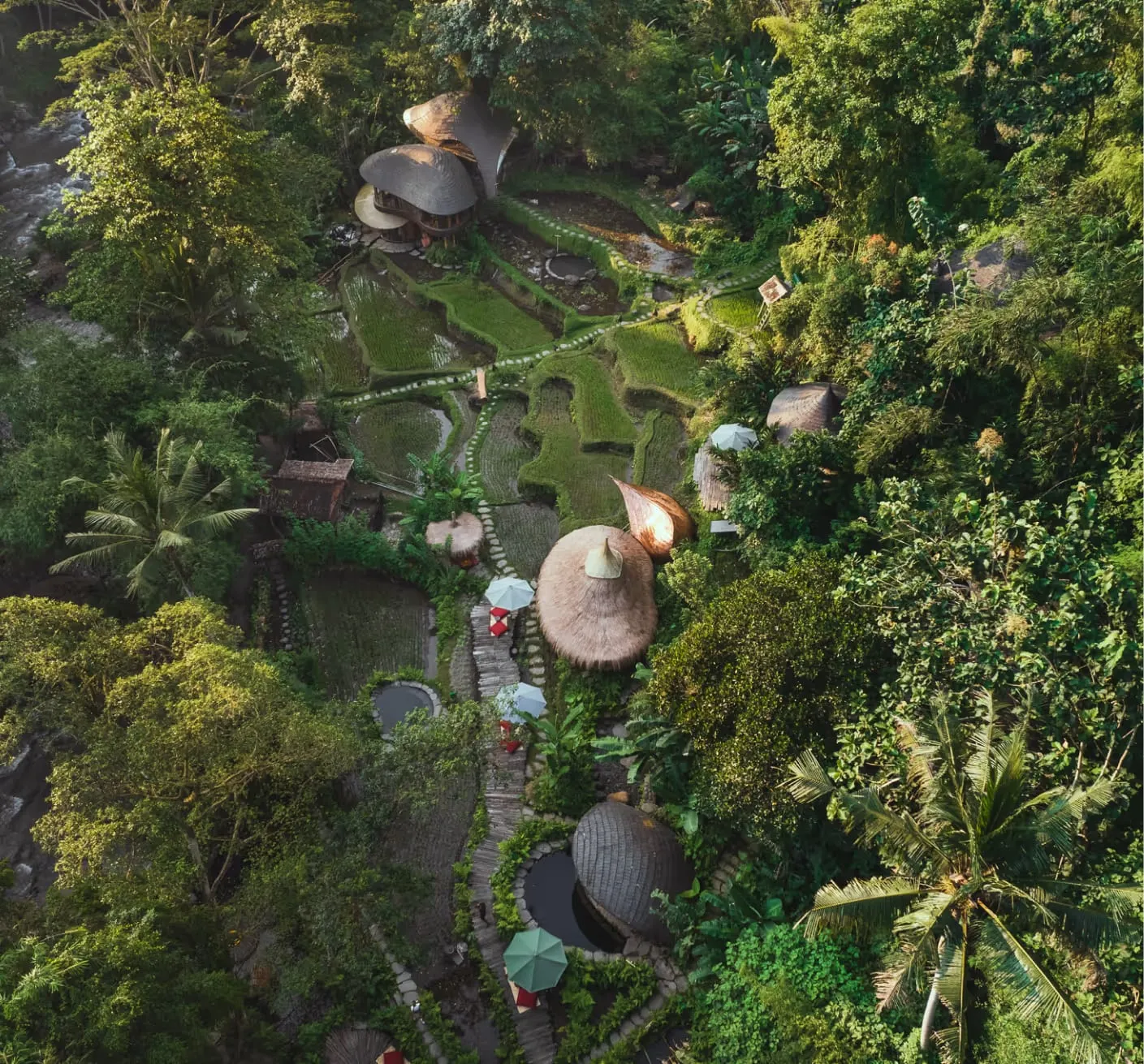
Sayan, Ubud, Indonesia
Bambu Indah
Antique Javanese bridal houses and hand-built bamboo pavilions, dismantled, relocated and rebuilt above the Ayung River gorge by the founders of Green School Bali.
From $250 per night
Uluwatu, Bukit Peninsula, Indonesia
Bulgari Resort Bali
A Milanese architecture firm cut 59 villas and five mansions into a limestone clifftop above the Indian Ocean, then built one of the longest hotel funiculars in the world to reach the private beach below.
From $1,500 per night
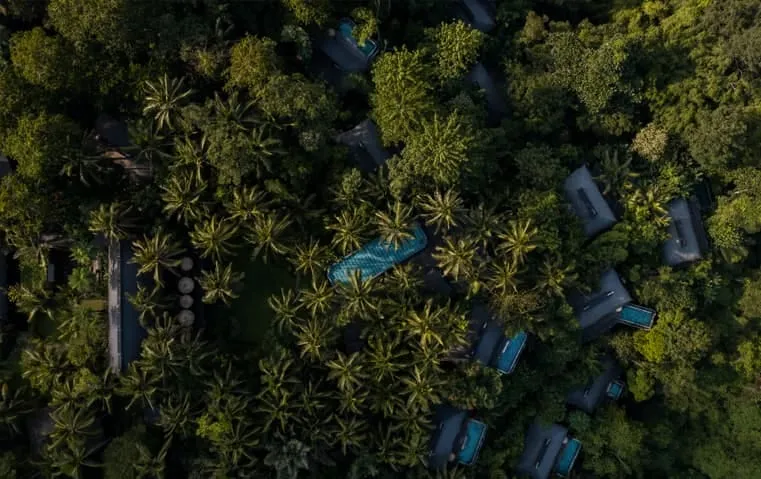
Keliki, Ubud, Indonesia
Capella Ubud
A colonial-era explorer's camp reimagined by Bill Bensley, its 23 tents strung along a jungle ridge above Ubud's Wos River valley.
From $660 per night