Keliki, Ubud, Indonesia
Capella Ubud
A colonial-era explorer's camp reimagined by Bill Bensley, its 23 tents strung along a jungle ridge above Ubud's Wos River valley.
- Rates from
- From $660 per night
- Nearest airport
- Ngurah Rai International Airport (DPS), Denpasar
- Transfer
- Roughly 1hr 45min to 2hr by road, around 40km
- Best months
- April to October, the drier season for jungle walks and clearer valley views
There is a particular theatricality to arriving at Capella Ubud that most Bali resorts do not attempt. Guests are met not at a marble porte-cochère but at a modest reception building on a village road in Keliki, north of Ubud, before being walked or buggied down into a forested ravine where a scatter of canvas tents appears, one by one, strung along a ridge above the Wos River. It reads less like checking into a hotel than like stumbling on an expedition camp that has been there for decades, its owners simply away for the afternoon.
That is precisely the illusion architect and designer Bill Bensley set out to build. Since opening in July 2018, Capella Ubud has staged itself as a 19th-century explorer’s outpost: a colonial-era fantasy of shipwrecked Dutch settlers and itinerant traders pitching camp in the Balinese jungle, translated into 23 individually designed tented pavilions, each with its own pool, cut into nine acres of rainforest without felling a single existing tree. It is one of the more fully realised pieces of narrative design in Southeast Asian hospitality, and one of the reasons the camp now holds a Michelin Key, a Travel + Leisure World’s Best ranking among the world’s top hotels, and a loyal following among design-minded travellers who might otherwise overlook Ubud’s more conventional villa resorts.
Eight years on from opening, the property has also built a genuine sustainability story around its setting, from an EarthCheck Gold certification to a partnership supporting firefly conservation in the nearby village of Taro. It is, in other words, a resort that asks to be read as much as stayed in, and this guide sets out what that story actually involves: the design, the rooms, the food, and the practical realities of a camp built quite deliberately on a steep jungle slope.
Why It Stands Out
Capella Ubud’s central claim to distinction is narrative discipline. Rather than assembling the usual vocabulary of Balinese luxury, thatched roofs, lily ponds, teak pavilions, Bensley built an entire fictional backstory, cast individual tents as characters within it (an Explorer’s tent, a Puppet Master’s, a Cartographer’s, among others), and then followed that story through to genuinely unusual details: hand-carved Balinese doors commissioned specifically for the project and reported to have taken a year to complete, teak flooring sourced from Central Java, and a “Culturalist” assigned to every tent who carries a walking staff to help guests manage the site’s steep terrain. Few resorts anywhere commit this hard to a single design conceit, and fewer still manage to make it feel considered rather than themed.
The second distinguishing element is the setting itself. Unlike Ubud’s more common rice-terrace or riverside villa format, Capella Ubud is built into genuine, densely forested jungle sloping down toward the sacred Wos River, with several tents perched high on the ridge and only reachable via a network of raised walkways and buggy paths. That topography, combined with a stated commitment not to remove a single tree during construction, gives the camp a level of immersion in actual rainforest that is unusual even by Ubud’s already jungle-heavy standards.
Architecture
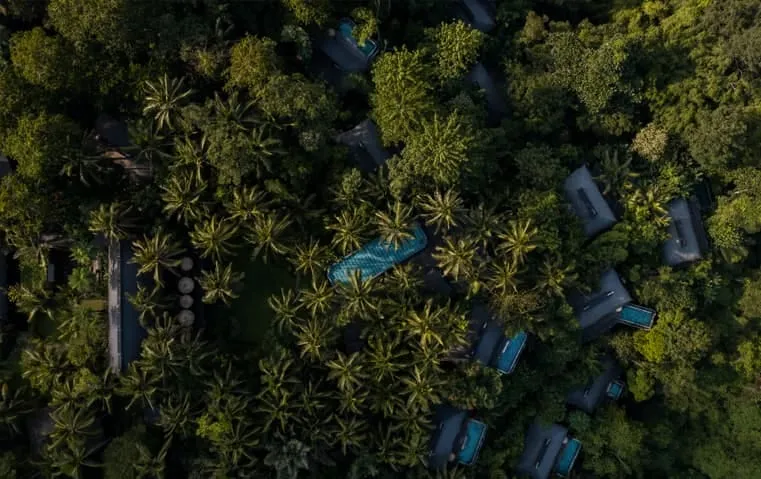
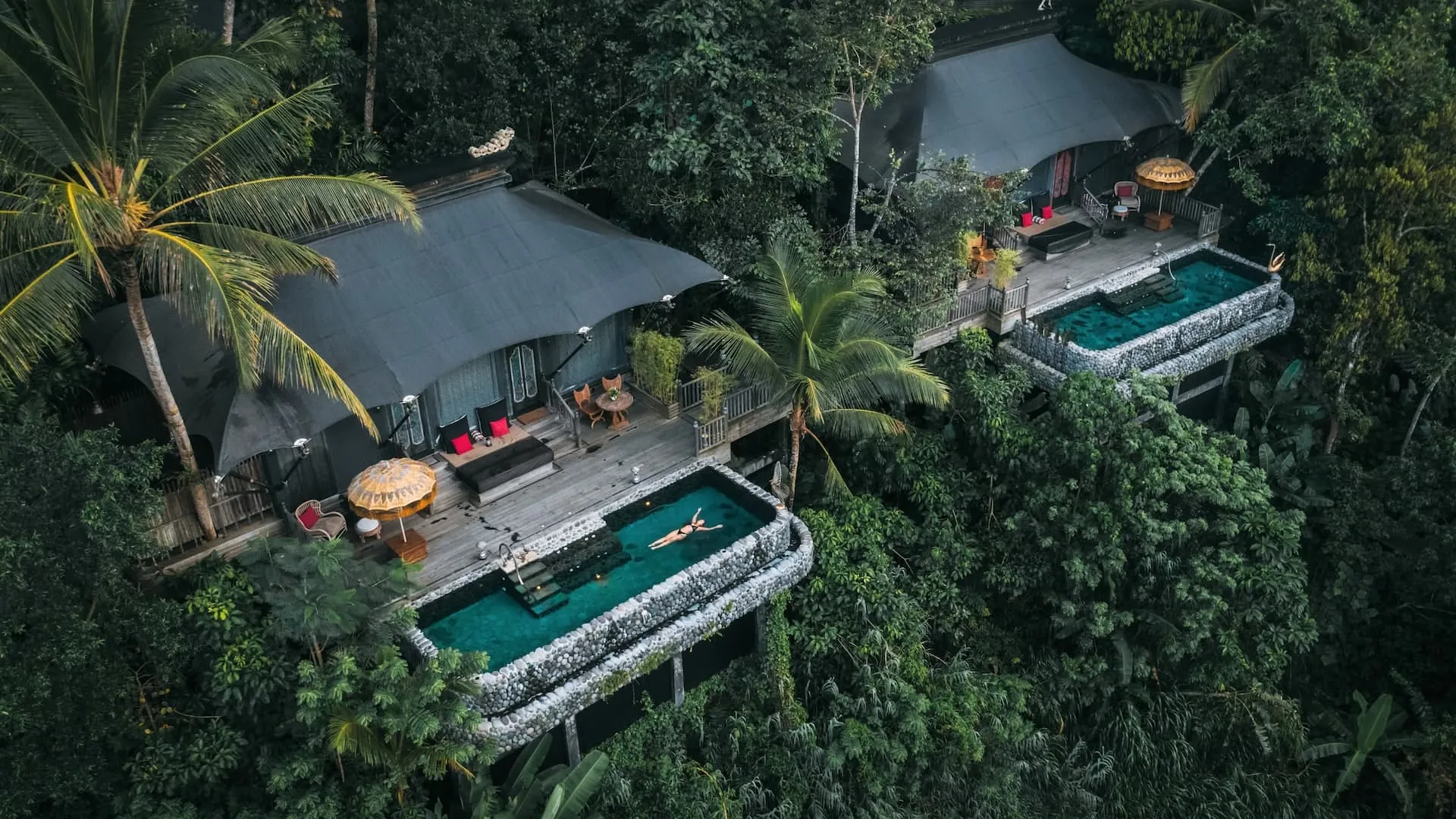
Capella Ubud occupies roughly nine acres of steep, forested land in Keliki village, in the Tegallalang district north of central Ubud. Bill Bensley is reported to have persuaded the property’s owners to abandon an original brief for a conventional hotel of around 100 rooms in favour of a much smaller, lower-impact tented format, a decision that shaped everything about how the site was subsequently built. Rather than clearing the slope for a standard footprint, Bensley’s team used bamboo mock-ups on site to test sightlines and tent placement tree by tree, positioning each of the camp’s pavilions to preserve existing canopy rather than around it; the resort’s own account of the build states that not a single mature tree was removed during construction, and it is not unusual, on property, to find a palm growing directly up through a tent’s terrace decking.
The result is a camp that reads less as a single building and more as a scattered settlement, its tents linked by raised timber walkways, stairs and buggy paths that follow the contours of the ravine down toward the Wos River rather than imposing a flat, graded site plan. Some tents sit on relatively level ground; others are perched high on genuinely steep terrain, a topography the property itself flags as unsuitable for guests with mobility limitations or very young children. That vertical, ridge-following layout, unusual for a resort of this scale, is core to the architecture’s effect: nothing about the site plan behaves like a conventional hotel campus.
Interior Design
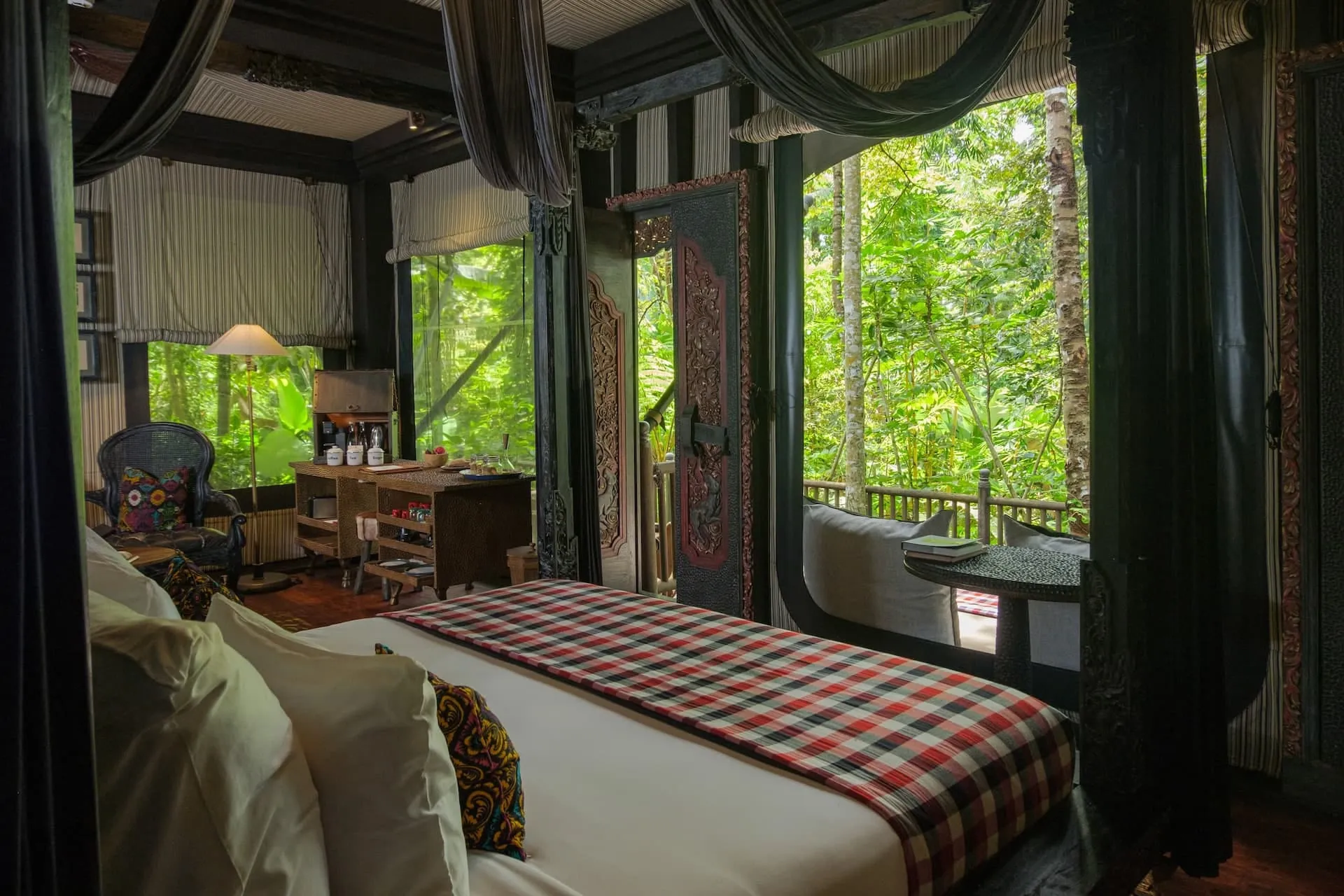
Inside, Bensley pushed the colonial explorer-camp concept into individual character studies rather than a single repeated room template. Each tent is designed as though inhabited by a specific fictional 19th-century adventurer, among them an Explorer, a Puppet Master and a Cartographer, with furnishings, artwork and objets curated to suggest a particular occupant and profession rather than a generic luxury tent. Campaign-style furniture, dark rattan, brass fittings, vintage travel trunks and framed botanical or cartographic prints recur throughout, alongside copper soaking tubs positioned as a signature fixture in every category.
Craft and commission work runs deep rather than decorative: hand-carved Balinese doors were commissioned specifically for the project and are reported to have taken roughly a year to produce, while flooring uses handmade teak sourced from Central Java, chosen for durability across the tents’ canvas-and-timber construction. Bensley has described the overall approach as closer to “movie-making,” building a narrative that surprises guests room to room, than to conventional interior schemes, and the tent-by-tent variation, no two are decorated identically, is a deliberate extension of that idea rather than a cost-driven shortcut.
Atmosphere
For a resort built around a fictional 1800s expedition, Capella Ubud manages to feel unusually lived-in rather than costumed. Days settle into the rhythm of a working camp: mist rising off the valley in the early morning, the sound of the Wos River below, birdsong and, at dusk from the surrounding forest, the occasional pulse of fireflies the property’s conservation partners have worked to bring back to the area. Service leans on the camp’s “Culturalist” model, personal hosts rather than conventional butlers, who accompany guests around the steep site and lean into the storytelling conceit rather than breaking it.
The absence of a large central pool or a busy lobby scene keeps the atmosphere deliberately quiet; most guests circulate between their own tent, the spa tents and the two restaurants rather than a single social hub, and evenings often centre on the Campfire experience, black-and-white films and hot chocolate under the stars, rather than a conventional bar scene. It is a resort built for immersion in its own fiction and its own forest rather than for high-energy sociability, and it rewards guests willing to buy into both.
Rooms and Suites
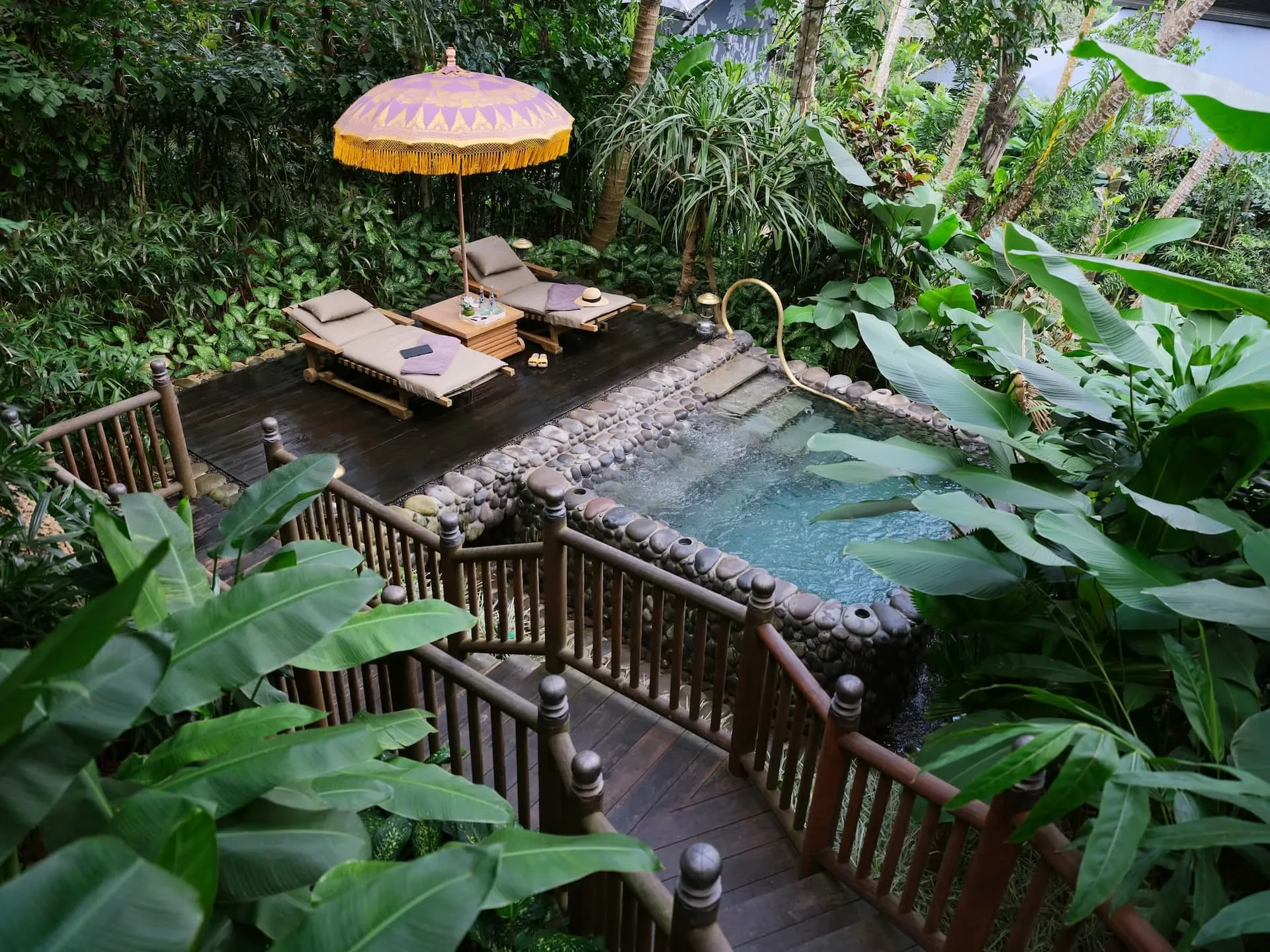
Accommodation is organised into four one-bedroom tent categories, Keliki, Valley, Forest and Terrace, plus a single Two Bedroom Lodge, for 23 total keys across the property. Keliki Tents come with heated private pools and jungle views; Valley Tents offer plunge pools with jungle outlooks across terraced, stepped terrain (the property notes this category as unsuitable for guests with mobility limitations); Forest Tents, reachable by buggy, look onto denser rainforest panoramas from their own plunge pools; and Terrace Tents offer plunge pools with forest views from a more accessible position on the site. Every one-bedroom category includes an outdoor deck with daybeds, a copper soaking tub, and both indoor and outdoor showers.
At the top of the range, the Two Bedroom Lodge is built around an oriental-themed interior overlooking the Keliki valley, with a 19-square-metre heated pool connected to an open-plan living room and two ensuite bedrooms, positioned by the resort as its option for families or small groups travelling together. Across all categories, the tented format means genuine canvas walls rather than solid construction, an experience the property markets explicitly as sleeping “under canvas” with the sounds of the forest audible from dusk until dawn, a detail worth knowing for guests expecting the acoustic isolation of a conventional hotel room.
Dining
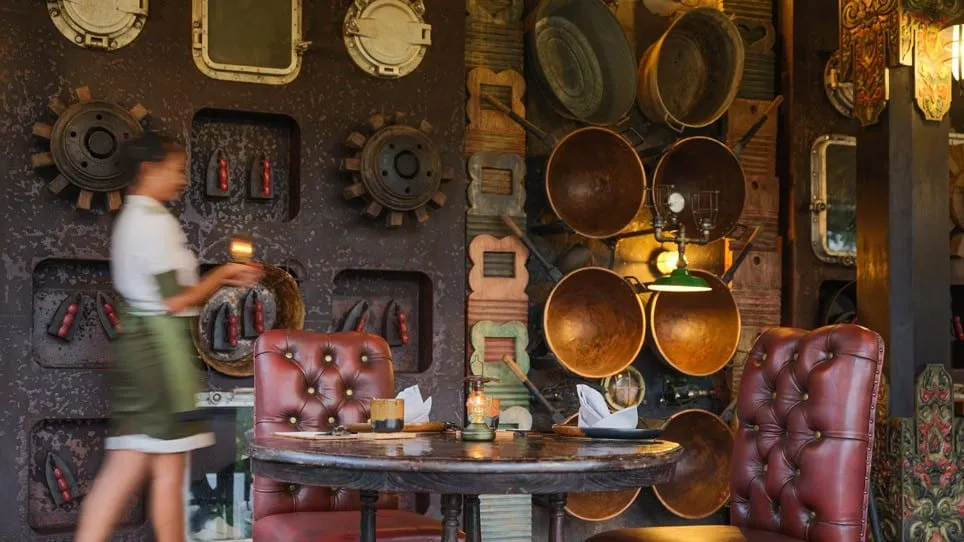
Mads Lange functions as the camp’s principal restaurant, a tented dining room named for the 19th-century Danish trader and diplomat nicknamed “the White King of Bali,” serving Indonesian and international dishes built on hand-harvested vegetables, herbs and poultry from neighbouring farms alongside seafood from regional waters, across breakfast, lunch and dinner service.
Api Jiwa, meaning “fire to the soul,” is the camp’s more theatrical set-piece: an intimate, roughly 16-seat, multi-course dinner built around Wara, an open-fire cooking technique that burns surplus rice straw from nearby paddy fields to infuse dishes with smoke and aroma, developed under the direction of Michelin-recognised executive chef Nicola Russo and served as a single nightly seating. The poolside Mortar and Pestle Bar handles lighter food and a cocktail programme built around traditional, hand-worked preparation methods, while Campfire turns evenings into a communal ritual of camp snacks, hot chocolate and toasted marshmallows around a fire pit, accompanied by silent black-and-white films evoking 1800s Bali. Private dining, from candlelit dinners to picnics at scenic points on the estate, can be arranged on request, and the on-site Keliki Garden, an organic vegetable and herb plot, supplies both the kitchens and, according to the resort, some of Auriga Wellness’s treatment ingredients.
Spa and Wellness
Auriga Wellness is spread across three dedicated spa tents cocooned within the rainforest, open daily from 9:00am to 9:00pm, with in-tent treatments also available for guests who prefer not to leave their own accommodation. The spa’s defining conceit ties its treatment menu to lunar phases, an approach the resort frames as aligning guests with natural rhythms rather than a fixed, generic spa card, alongside Melukat, a traditional Balinese spiritual cleansing ritual aimed at purifying body and soul.
Beyond treatments, wellness facilities include The Armory, a fully equipped, 24-hour tented gymnasium built around an “Adventure Wellness” programme of boot camps, aerial yoga, mountain bike trails and jungle hikes that leans directly into the camp’s forest setting, and The Cistern, a 20-metre heated outdoor pool with pool service from 7:00am to 8:00pm, functioning as the closest thing the property has to a conventional resort pool.
Experiences
Given its position inside genuine rainforest above the Wos River, Capella Ubud builds much of its activity programme around the site itself rather than importing offsite excursions as the headline draw. Guided treks with an on-site Camp Ranger explore virgin rainforest, rice-field paths and river crossings, some routes beginning near Koko Bambu and descending toward an ancient temple, typically finishing with a picnic-style lunch at a scenic point on the estate. Jungle boot camps, mountain bike rides along ridge trails, and low- and high-impact workouts staged directly in the surrounding rice paddies extend the camp’s Adventure Wellness programming beyond the gym tent itself.
The resort’s most distinctive recent addition is a firefly conservation experience, developed in partnership with forest guardian Wayan Wardika in the nearby village of Taro, where regenerative farming practices and reduced chemical use and light pollution have helped fireflies return to a landscape where they had largely disappeared; guests are guided into the firefly forest at dusk to watch the display firsthand. Cooking classes built around the camp’s own Keliki Garden, visits to the Tegalalang rice terraces and Kanto Lampo waterfall, and the evening Campfire storytelling ritual round out a programme built more around slow immersion than a long menu of packaged tours.
Who It Is For
Capella Ubud suits design and architecture-minded travellers specifically drawn to Bensley’s work and to a resort that commits fully to a single narrative idea rather than a more generic luxury-jungle formula. Couples, honeymooners and anyone planning a wellness-forward stay will find a genuinely private, tent-and-pool format well suited to a slower, more secluded few days, and the lunar-phase spa programme and Cistern pool give the stay a real wellness spine beyond the design story.
It is a less natural fit for families travelling with children under six or guests with mobility challenges, given the site’s steep, forested terrain and the property’s own stated guidance on the point; the Two Bedroom Lodge is the more realistic option for families with older children. Travellers who want a large, highly social pool scene, a beach-adjacent base, or a resort with flat, easily walkable grounds are likely better served elsewhere in Ubud, since Capella Ubud’s defining character, canvas walls, steep paths, a scattered rather than centralised layout, is also what limits its practicality for some travellers.
Best Time to Visit
Bali’s dry season, roughly April through October, generally offers the clearest conditions for the camp’s jungle treks, rice-terrace walks and open-air dining, with lower humidity and reduced rainfall making the steep site’s paths easier to navigate. The wet season, November through March, brings heavier and more frequent rain to the Ubud highlands, which can affect outdoor experiences and views across the forested ravine, though the property remains open and operational year-round, and the surrounding rainforest is, unsurprisingly, at its greenest during these months.
How to Get There
The nearest international gateway is Ngurah Rai International Airport (DPS) near Denpasar, roughly 40km from the camp and a drive of about 1hr 45min to 2hr depending on traffic and time of day, since the route climbs from the coast into Bali’s central highlands through Ubud town. Private transfers can be arranged directly through the resort, and are the most straightforward option given the camp’s rural, village-adjacent location in Keliki; ride-hailing services are also usable for the airport leg for guests arranging their own transport.
Nearby Experiences
Ubud’s town centre, with its palace, art museums and markets, sits a short drive south of the camp and is the natural base for guests wanting temples, galleries or the Ubud Monkey Forest beyond the resort’s own grounds. The terraced rice fields at Tegalalang, one of Bali’s most photographed agricultural landscapes, and the Kanto Lampo waterfall are both within reach for a half-day excursion, and the Gunung Kawi temple complex, an 11th-century rock-cut shrine, lies within a similar radius. The village of Taro, roughly a short drive from the camp and the site of the resort’s firefly conservation partnership, offers a specific, low-key cultural and ecological detour distinct from Ubud’s busier attractions.
Things to Know Before Booking
The site’s terrain is genuinely steep in places, and the resort itself advises that the camp is not best suited to families with children under six or to guests with mobility challenges; travellers with those concerns should discuss room placement and accessibility directly with the resort before booking. Rooms are canvas tents rather than solid-walled structures, which suits guests seeking genuine immersion in the forest but is worth knowing for anyone expecting the soundproofing of a conventional hotel room. Drones are not permitted on site, a policy the resort maintains for guest privacy and security, and Api Jiwa, the camp’s set-menu tasting restaurant, seats a small number of guests nightly and is worth reserving early.
Sustainability
Capella Ubud holds EarthCheck Gold certification and has been recognised by The Leading Hotels of the World as a Sustainability Leader, credentials the resort ties most directly to its founding decision not to remove a single mature tree during construction, preserving the existing rainforest canopy across the site rather than clearing and replanting. An on-site water bottling plant is used to reduce single-use plastic across the resort’s operations, and the Keliki Garden supplies organic vegetables and herbs directly to the kitchens and, per the property, to some of Auriga Wellness’s treatments.
The resort’s most publicised conservation initiative is its partnership with forest guardian Wayan Wardika in the nearby village of Taro, supporting regenerative farming and reduced light pollution and chemical use that have helped fireflies return to areas of forest where they had largely disappeared, an effort the camp marked with a dedicated eight-year anniversary programme built around forest, community and firefly conservation in 2026. As with any resort-authored sustainability programme, these figures and claims are best understood as the property’s own account of its work rather than independently audited data, and guests with a particular interest in the detail should ask directly on property.
Practical Information
Capella Ubud is operated by Capella Hotels & Resorts and opened in July 2018 as the brand’s Bali property, designed throughout by Bill Bensley. Indicative rates begin from around USD 660 per night for entry-level tent categories, rising through the Valley, Forest and Terrace categories to the Two Bedroom Lodge; travellers should confirm current pricing directly with the resort or its official booking channels, since rates vary significantly by season and category. Check-in is from 3:00pm and check-out by noon.
The camp sits in Keliki village, Kecamatan Tegallalang, Ubud, Gianyar Regency, Bali, roughly 40km and 1hr 45min to 2hr by road from Ngurah Rai International Airport (DPS) near Denpasar. Most stays run three to four nights, enough time to work through the spa’s lunar-phase treatments, both signature restaurants, and at least one guided forest trek, with the April to October dry season generally offering the most reliable conditions for the camp’s outdoor programming.
Editorial Conclusion
Capella Ubud’s achievement is holding a single, fully committed design idea, a 19th-century explorer’s camp pitched in the Balinese jungle, together across architecture, interiors, dining and even its conservation programme, without the concept curdling into pastiche. Eight years after Bill Bensley’s tents first went up on this stretch of forest above the Wos River, the camp has aged into one of the more distinctive arguments in Ubud’s crowded luxury market for what a resort can be when it commits to a story rather than a checklist of amenities: not the biggest pool, not the most rooms, but a scattered, tree-preserving settlement that asks guests to slow down, climb a few stairs, and sleep, quite literally, under canvas in the rainforest.
In pictures
On the map
Keliki, Ubud, Indonesia
Questions
Frequently asked
Where exactly is Capella Ubud located?
The camp sits in Keliki village, within the Tegallalang district north of Ubud in Bali's Gianyar regency, on sloping rainforest terrain that leads down to the Wos River. It is roughly 40km, or about 1hr 45min to 2hr by road depending on traffic, from Ngurah Rai International Airport near Denpasar, and a short drive from Ubud's town centre.
How many tents does Capella Ubud have?
The camp comprises 22 one-bedroom tents, split across the Keliki, Valley, Forest and Terrace categories, plus a single Two Bedroom Lodge with its own 19-square-metre heated pool, for 23 accommodations in total. Every tent has its own private pool, either heated or a plunge pool depending on category.
Who designed Capella Ubud, and what is the concept?
Bill Bensley designed the camp, drawing on the story of Dutch settlers arriving in Bali in the 1800s and pitching camp in the forest. He is reported to have persuaded the owners to scale back an original plan for a roughly 100-room conventional hotel in favour of the smaller tented format, and construction is said not to have removed a single existing tree from the site.
Is Capella Ubud suitable for families with young children?
The property itself advises that, because of the site's steep, forested terrain and the tents' elevated positions above the valley, it is not best suited to families travelling with children under six or to guests with mobility challenges. Families with older children, particularly those drawn to the Two Bedroom Lodge, are better catered for.
What dining and spa facilities does the camp have?
Dining runs across Mads Lange, the main Indonesian and international restaurant named for a 19th-century Danish trader in Bali; Api Jiwa, a multi-course open-fire tasting menu; the poolside Mortar and Pestle Bar; and Campfire, an evening storytelling and s'mores ritual. Auriga Wellness offers treatments across three spa tents keyed to lunar phases, alongside The Armory gym tent and The Cistern, a 20-metre heated pool.
Same destination
More hotel guides in Indonesia
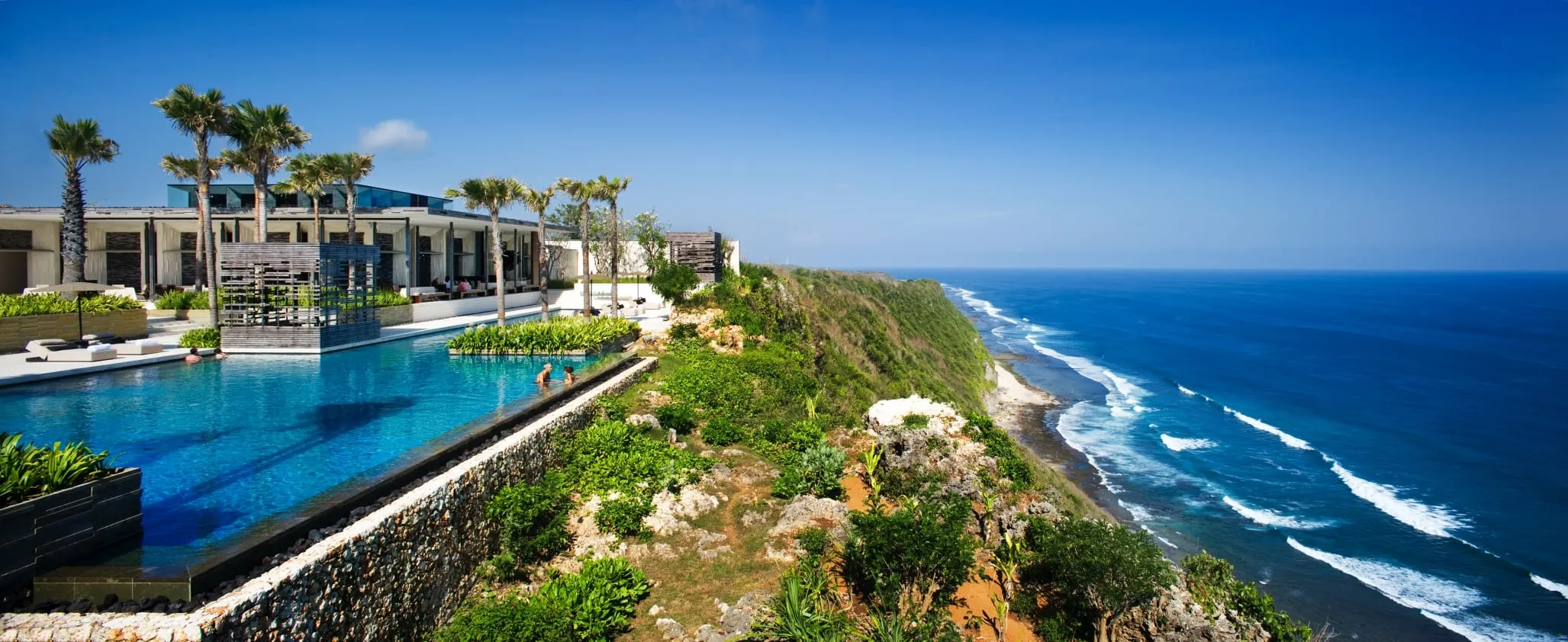
Uluwatu, Bukit Peninsula, Indonesia
Alila Villas Uluwatu
A Singapore architecture firm carved a geometric limestone resort into a Bukit Peninsula clifftop in 2009, planting grass roofs across it so the whole property reads as an extension of the savannah it replaced.
From $800 per night
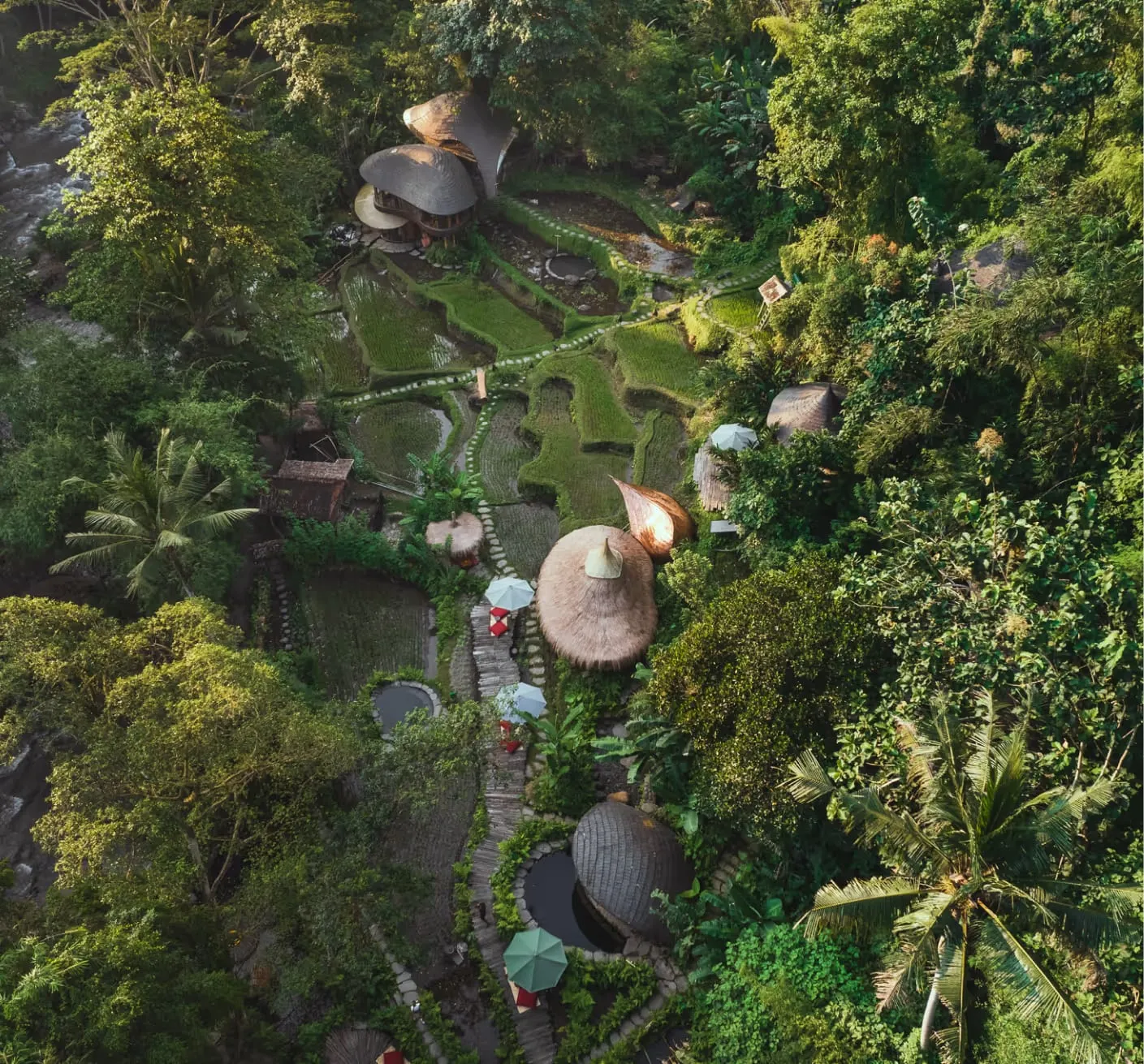
Sayan, Ubud, Indonesia
Bambu Indah
Antique Javanese bridal houses and hand-built bamboo pavilions, dismantled, relocated and rebuilt above the Ayung River gorge by the founders of Green School Bali.
From $250 per night
Uluwatu, Bukit Peninsula, Indonesia
Bulgari Resort Bali
A Milanese architecture firm cut 59 villas and five mansions into a limestone clifftop above the Indian Ocean, then built one of the longest hotel funiculars in the world to reach the private beach below.
From $1,500 per night