Sayan, Ubud, Indonesia
Bambu Indah
Antique Javanese bridal houses and hand-built bamboo pavilions, dismantled, relocated and rebuilt above the Ayung River gorge by the founders of Green School Bali.
- Rates from
- From $250 per night
- Nearest airport
- Ngurah Rai International Airport, Denpasar (DPS)
- Transfer
- About 1 to 1.5 hours by car, roughly 35 km, depending on traffic
- Best months
- April to October, during Bali's drier season
There is a particular kind of hotel origin story that hospitality brands like to invent after the fact, a founder’s myth retrofitted to justify a business plan. Bambu Indah’s version has the rare advantage of being true, and slightly accidental. John Hardy, a Canadian jewelry designer who settled in Bali in 1975, and his wife Cynthia, who joined him there in 1982 and ran a crafts export business, began in 2005 to bring antique Javanese houses onto their private property above the Ayung River, mainly to have somewhere to put visiting friends and family. By 2008 there were nine of them, plus a bamboo barn, and what had been a personal collection of rescued architecture had quietly become a hotel.
That origin still shapes everything about the place. Bambu Indah is not a resort built to a brief; it is a working piece of the Hardy family’s decades-long project in Bali, one that also produced Green School, the bamboo-campus international school the couple founded in 2008, and, through their daughter Elora Hardy’s design studio Ibuku, the bamboo villa community Green Village a short distance away along the same river. Guests at Bambu Indah are, in effect, staying inside the family’s design archive: a scattering of century-old Javanese teak houses that would otherwise have been lost, set among newer bamboo structures built by the same craftspeople responsible for some of the most photographed sustainable architecture in Southeast Asia.
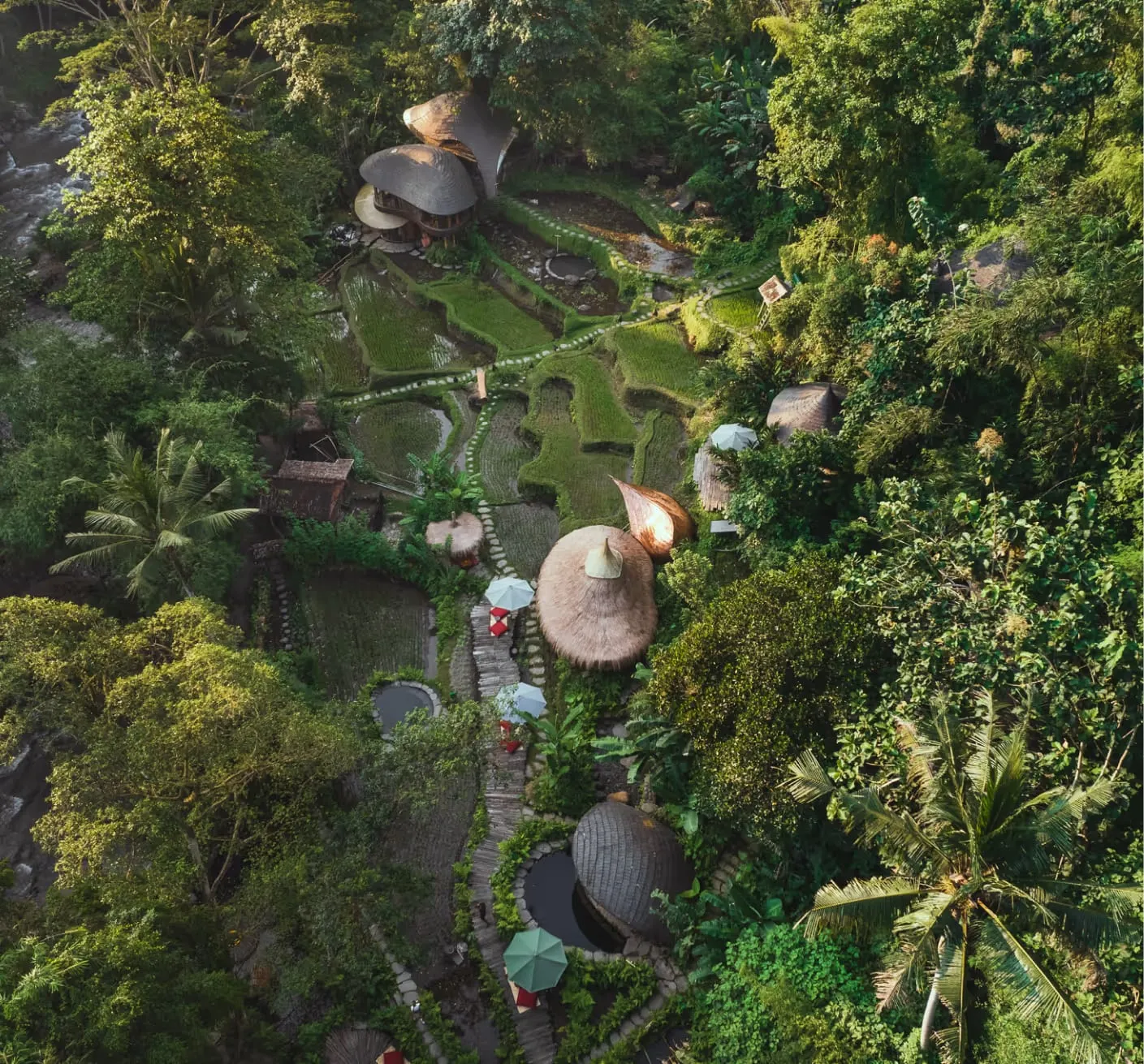
The setting does real work here too. The property sits on a jungle ridge above the Ayung River gorge in Sayan, on Ubud’s western edge, close enough to town for a short drive but genuinely separated from it by terrain: steep, forested, cut through by the river’s own gorge, with rice paddies terracing the opposite slope. After an extensive renovation, Bambu Indah reopened in June 2024 with a new longevity-focused restaurant, a rebuilt bar with what the property claims is the only bamboo-shafted elevator of its kind in the world, and the same core proposition it has held for two decades: architecture as conservation, luxury as a byproduct of care rather than excess.
Why It Stands Out
Most hotels that describe themselves as “unlike anywhere else” are exaggerating. Bambu Indah’s claim holds up mainly because its rooms are not, technically speaking, hotel rooms at all. A meaningful share of them are genuine antique Javanese gladak houses, teak structures built more than a century ago as bridal homes for noble Javanese families, which John Hardy sourced, had carefully dismantled joint by joint, and had rebuilt on this Bali ridge rather than left to decay or be broken up for parts. That practice of architectural rescue, rather than replica-building, is unusual among luxury properties anywhere, let alone in Bali, where “traditional” construction more often means a new building designed to look old.
The second distinguishing element is the property’s bamboo architecture, which places Bambu Indah at the origin point of a design lineage that has since become genuinely influential. Elora Hardy, John and Cynthia’s daughter, founded the design studio Ibuku in 2010 after helping shape bamboo structures on this property, and Ibuku’s later, larger projects, the Green School campus and the Green Village villa community nearby, both trace their design language back to experiments made first at Bambu Indah. River Warung, the resort’s original riverside restaurant, with its arched bamboo roof shingled in hand-folded copper, remains one of the clearest small-scale demonstrations of what that studio’s engineering can do.
Add to that a genuinely dramatic site, a jungle ridge falling away into the Ayung River gorge, spring-fed pools filtered through volcanic rock rather than heavy chemical treatment, and a sustainability programme built into the property’s operations rather than bolted onto its marketing, and the result is a hotel whose distinctiveness is closer to structural fact than editorial spin.
Architecture
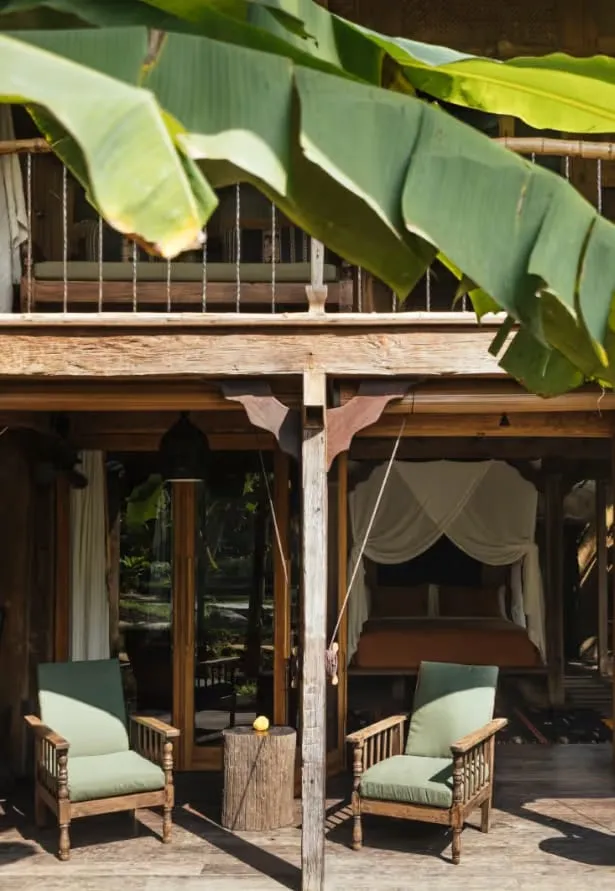
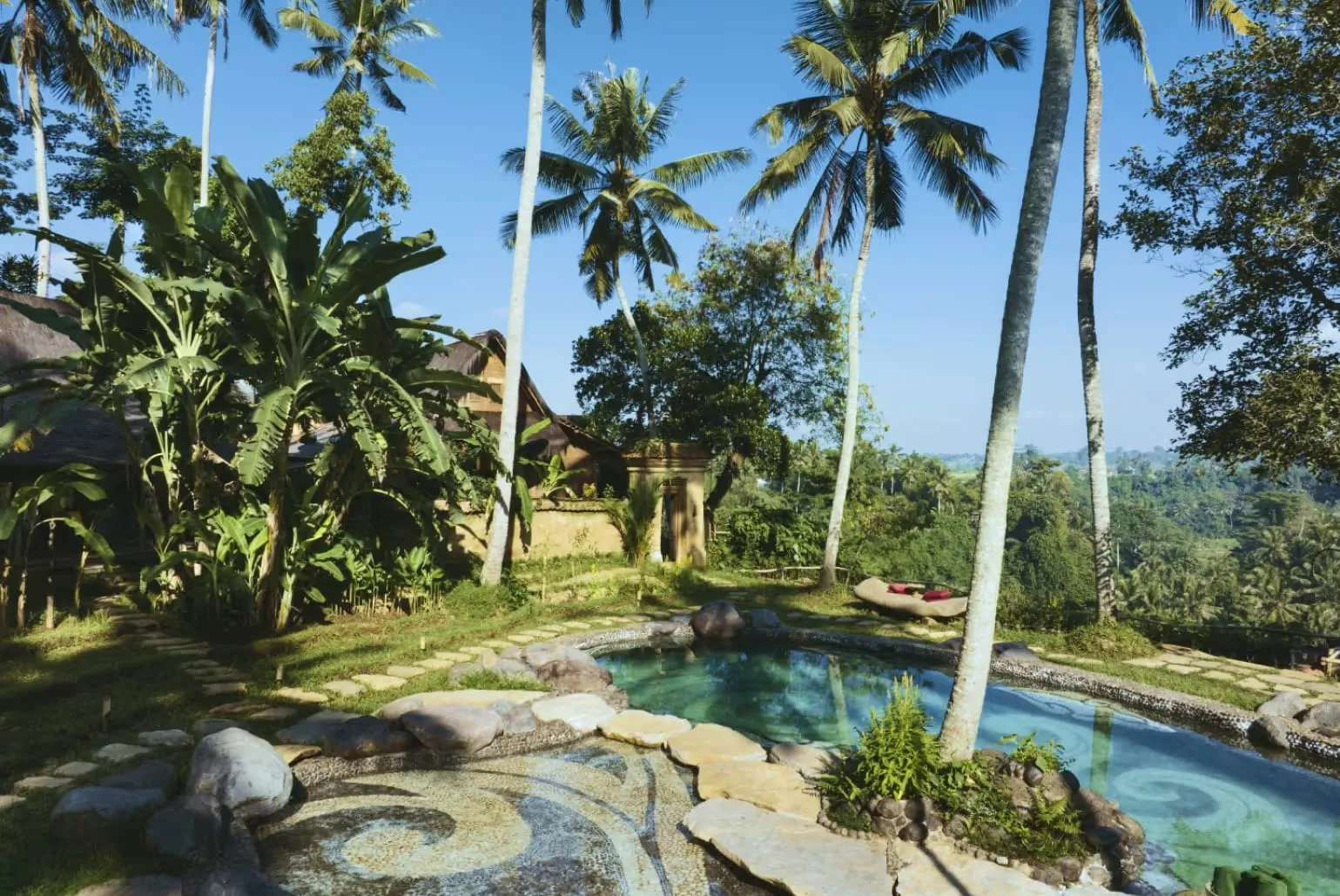
Bambu Indah’s built environment runs on two parallel tracks that rarely appear together elsewhere. The first is reclamation: the antique Javanese houses, known as gladak, that anchor much of the property were sourced from villages across Java, carefully taken apart, transported to Bali, and reassembled by craftspeople skilled in the joinery techniques the original builders used, work that predates modern fasteners and relies instead on interlocking teak joints. Seven of these teak bridal homes now stand arranged in a crescent around one of the property’s saltwater pools, their carved columns, high-pitched roofs and open verandas essentially unaltered from their original form, aside from the plumbing and wiring needed to function as hotel rooms.
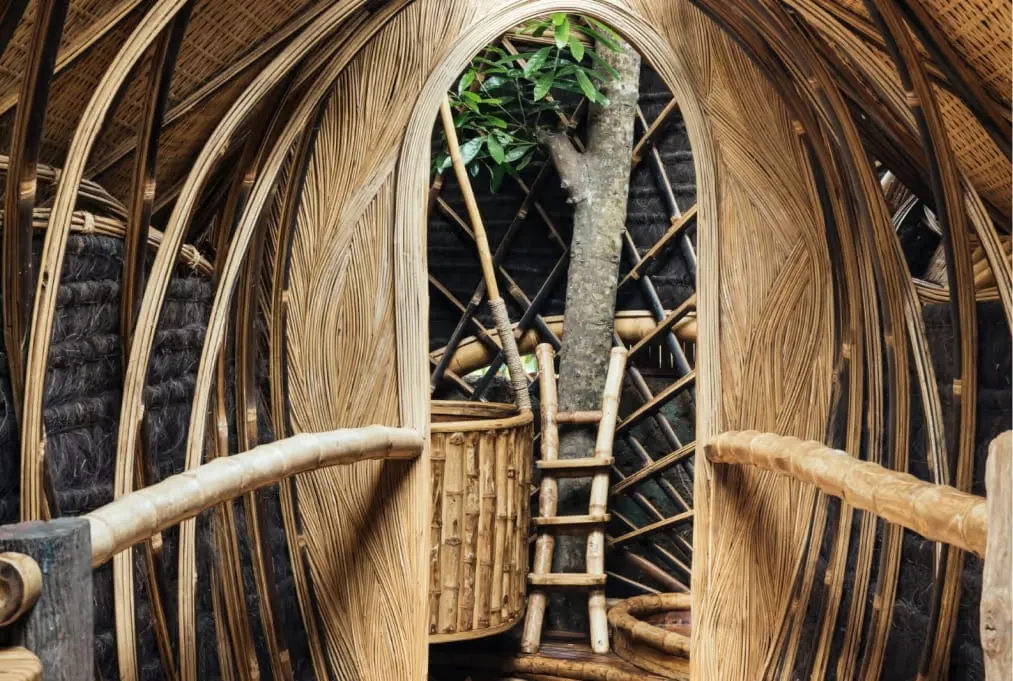
The second track is new construction in bamboo, developed on this property well before it became closely associated with Bali luxury architecture. Guest “Nests,” suspended and elevated bamboo structures, sit alongside the teak houses, while the resort’s dining and bar pavilions push the material further: River Warung’s roof bends treated bamboo into overlapping arches, shingled by hand in hammered copper, and the newer Sunset Bar, rebuilt during the 2024 renovation from bamboo, stone and ironwood, contains what the property describes as the only bamboo-shafted elevator of its kind anywhere, descending roughly 20 metres through a hand-carved mud shaft to a spring-fed pool below. Both building traditions share a guiding logic: that construction on this ridge should work with a very steep, forested site rather than flatten it, and that materials, whether century-old teak or freshly harvested bamboo, should be visibly what they are rather than disguised.
Interior Design
Because so much of the accommodation is built from salvaged structures rather than a single architect’s plan, Bambu Indah’s interiors read less as a coordinated scheme and more as a considered collection, room by room. Inside the antique teak houses, high timber ceilings and carved structural columns are left exposed, furnished with art and artifacts John and Cynthia Hardy have gathered over five decades in Indonesia and further afield: textiles, sculpture, and objects chosen for provenance rather than matching a set palette. Bathrooms and modern comforts, air conditioning, minifridges, proper plumbing, have been worked into these historic shells without disguising their age.
The newer bamboo Nests and riverside houses take a different, more sculptural approach, following the same material logic Ibuku later scaled up at Green Village: structural bamboo left exposed as both frame and finish, sometimes with individual shoots visibly growing up through a floor or terrace, paired with brass and copper detailing, stone and reclaimed timber. Across both traditions, the common thread is fine, unfussy bedding, waffle cotton robes and natural bath products rather than branded amenity kits, and a general resistance to anything that would read as generic five-star polish; the interiors are meant to feel gathered and lived-in rather than styled.
Atmosphere
Bambu Indah is loud with nature and unusually quiet otherwise. The Ayung River runs audibly through the gorge below much of the property, cicadas and birdsong fill the evenings, and the steep, forested terrain means guest houses are genuinely dispersed rather than clustered around a central pool deck; getting between some rooms and the reception area can involve several hundred steps along paths cut into the ridge, a detail the property is upfront about rather than something guests discover on arrival. That physical separation is deliberate: it produces a level of privacy between houses that flatter, purpose-built resorts of similar size rarely match.
The overall mood leans rustic-luxe rather than polished: oil-lit gathering spaces at River Warung after dark, the low hum of the elevator descending through its mud shaft to the Sunset Bar, staff moving between houses on foot rather than by golf cart. It is a property that asks guests to slow their pace to match the terrain, and it rewards travellers who come without a tight itinerary more than those looking for brisk, five-star efficiency.
Rooms and Suites
Following an extensive renovation completed with its June 2024 reopening, Bambu Indah operates roughly 23 individual accommodations, no two configured quite alike. Seven antique Javanese teak bridal houses are arranged in a crescent around a saltwater pool, offering the property’s most historically significant category. Four bamboo Nests, suited to solo travellers and couples, sit elsewhere on the ridge, while six further Riverside houses, including the family-friendly Riverbend House and the copper-and-brass-accented New Moon House, sit closer to the gorge, several with private plunge pools. At the more accessible end of the range, three canvas Mahogany Tents offer glamping-style stays of around 28 square metres, each with an air-conditioned queen bed under mosquito netting and a private open-air bathroom in a separate pod, roughly a ten-minute walk from reception. A single treehouse, built within the branches of a ficus tree, rounds out the most distinctive categories.
All rooms include air conditioning, fine linens, waffle cotton robes, natural bath amenities, complimentary coffee and tea, and a stocked minifridge, though guests should expect the walk between some houses and central facilities to be part of the experience rather than an inconvenience to be engineered away; this is a property built into a slope, not flattened for convenience.
Dining
Bambu Indah runs three distinct venues, each with its own architecture and culinary focus. Tembaga, meaning “copper” in Indonesian, opened in July 2024 inside a large open-air former barn built of bamboo, copper and stone, and is positioned as a longevity-focused restaurant built around adaptogenic ingredients, fermentation and plant-forward cooking, organised loosely around the ideas of growing, transforming and sharing food. Its centrepiece is a long communal table made from roughly 70,000 upcycled chopsticks, and the kitchen leans on live-fire cooking, mushrooms, and rice and vegetables grown in the estate’s own paddies and permaculture gardens, alongside an adaptogenic cocktail bar using ingredients such as lion’s mane mushroom and fermented fruit vinegars.
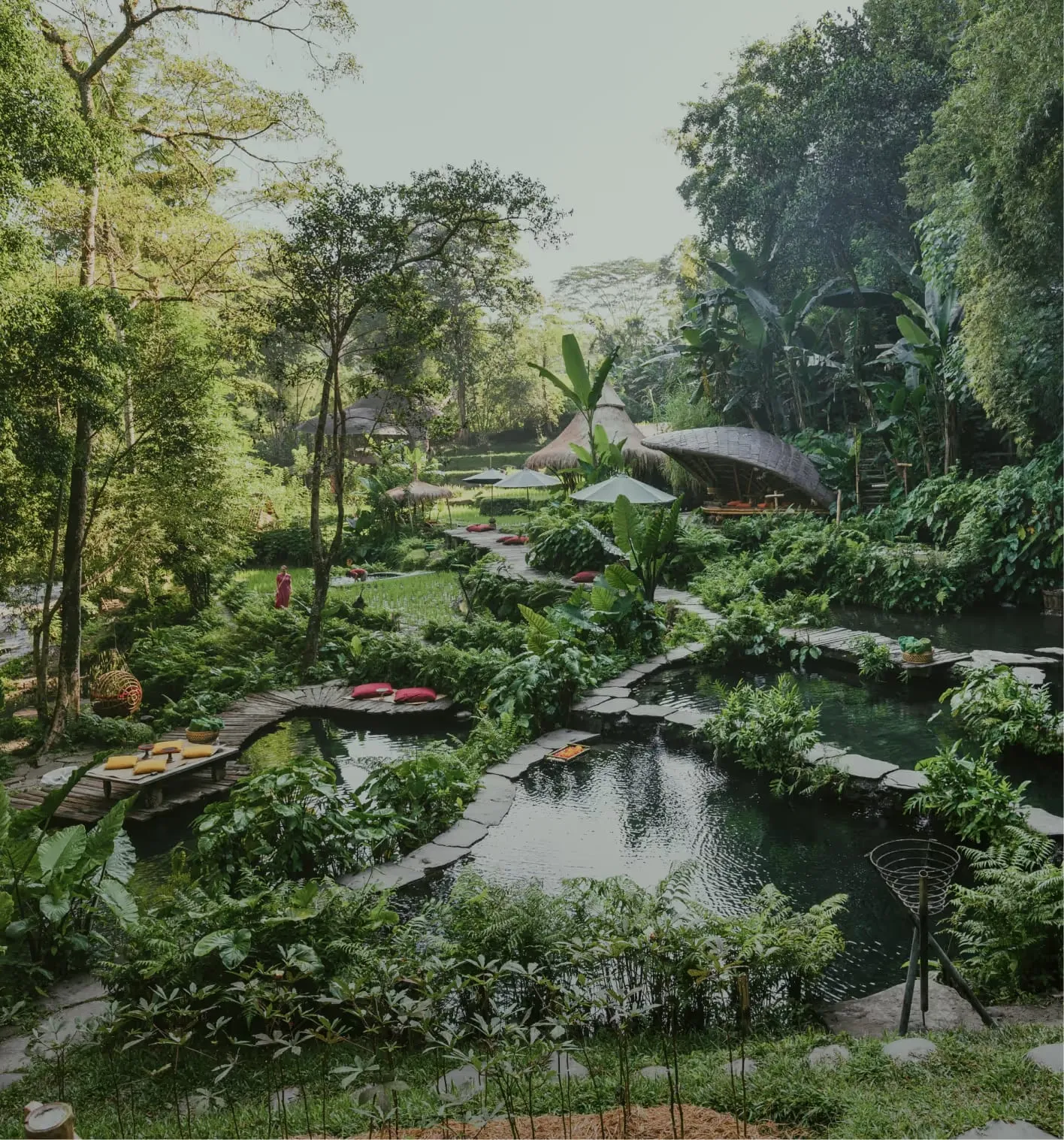
River Warung, the property’s original restaurant, occupies a riverside pavilion beneath an arched bamboo roof shingled in hand-hammered copper, seating guests at communal riverside tables, in oil-lit gathering areas, suspended bamboo pods, or poolside pavilions. Its menu draws on Indonesian tradition, from babi guling (Balinese roast suckling pig) to jackfruit rendang, grilled fish and plant-based options, alongside all-day breakfast. The Sunset Bar, rebuilt in bamboo, stone and ironwood during the 2024 renovation, serves handcrafted cocktails using home-infused spirits from a ridge-top perch with views toward rice terraces and, on clear days, distant volcanic peaks, reached by the property’s much-discussed bamboo elevator. Private dining can also be arranged at various points around the estate, from poolside pavilions to a table beneath a banyan tree.
Spa and Wellness
Wellness at Bambu Indah is built around the estate’s own water and landscape rather than a conventional treatment menu. More than twenty spring-fed pools draw from underground aquifers and are filtered naturally through volcanic rock and sand before reaching the surface, an approach the property uses in place of heavy chlorination across most of its swimming areas; a separate saltwater pool serves the crescent of teak houses. A dedicated wellness circuit includes a mud bath, sauna, cold plunge and ice bath, available to overnight guests and, on a day-pass basis, to outside visitors.
Massage and bodywork treatments are offered from dedicated treatment rooms, and a riverside yoga shala hosts sessions overlooking the gorge, with some multi-night packages built around daily yoga as a standard inclusion. The programme here is deliberately understated by the standards of larger resort spas: there is no sprawling treatment menu or hammam-style complex, and the emphasis sits closer to restorative time outdoors, in and around natural water, than to a curated spa itinerary.
Experiences
Guests can join guided walks through the estate’s working rice paddies and permaculture gardens, which supply produce directly to Tembaga and River Warung, and the property’s own grounds, cut through by trails along the ridge and down toward the river, offer enough terrain for an unhurried few hours without leaving the property. Balinese blessing ceremonies and other spiritual or cultural sessions are arranged periodically for guests interested in a more grounded introduction to local practice, and the estate’s Watsu-adjacent, water-centred wellness offerings tie directly into its spring-fed pools.
Beyond the property line, Bambu Indah’s Sayan ridge location puts it within easy striking distance of central Ubud, roughly 15 minutes by car, for its art markets, the Sacred Monkey Forest Sanctuary and its dense concentration of galleries and yoga studios. The wider Ayung River is one of Bali’s principal white-water rafting stretches, and operators run half-day trips through the gorge close to the resort itself, while Tegalalang’s terraced rice fields, a short drive north of Ubud, remain one of the region’s most recognisable landscapes for those who want to see, on a larger scale, the paddies that supply the hotel’s own kitchens.
Who It Is For
Bambu Indah suits travellers who find genuine appeal in the story behind their room, not just its finish: guests staying in a rescued Javanese bridal house, or in a bamboo Nest built by the studio behind Green Village, are meant to feel that provenance as part of the stay. It works well for couples and honeymooners drawn to a romantic, jungle-bound setting with real privacy between houses, and for architecture and design-minded travellers who want to see, in built form, the lineage that runs from this property through to Green School and Green Village. Sustainability-minded guests will find a property whose environmental practices, from pool filtration to composting to on-site food growing, are structural rather than promotional.
It is a considerably harder fit for travellers who want flat, easy circulation between rooms and amenities, since the ridge terrain means real walking, sometimes several hundred steps, between houses and central facilities. Guests expecting a conventional resort pool scene, extensive spa menu, or brisk five-star service pacing should look elsewhere; Bambu Indah’s whole appeal depends on a slower, more textured relationship with its own landscape.
Best Time to Visit
Bali’s dry season, roughly April through October, offers the most reliable conditions for a property built so thoroughly around outdoor space: pools, riverside dining, garden walks and open-air pavilions all benefit from lower rainfall and generally clearer skies. The wetter months from November through March bring heavier, more frequent rain and higher humidity, which can affect river activities and outdoor circulation on a property spread across a steep, forested ridge, though the architecture, with its deep eaves and open-sided pavilions, is built to accommodate tropical downpours rather than be undone by them. Ubud’s elevation keeps temperatures milder than Bali’s coastal resorts year-round, a modest but real advantage for guests sensitive to heat.
How to Get There
The nearest airport is Ngurah Rai International Airport (DPS) in Denpasar, Bali’s main international gateway. The drive to Bambu Indah’s Sayan ridge location covers roughly 35 kilometres and typically takes between one and one and a half hours by car, depending on traffic through Denpasar and Ubud’s town centre before the final climb up to the property. Private car transfers can be arranged through the hotel, and taxis and pre-booked drivers are widely available for guests organising their own transport from the airport or from elsewhere on the island.
Within Bali, the route from the airport runs north through Denpasar and Sukawati toward Ubud before turning onto the smaller roads that lead into Sayan; traffic through central Ubud, particularly in peak afternoon hours, is the main variable affecting transfer time.
Nearby Experiences
Central Ubud, roughly 15 minutes away by car, offers the wider region’s densest concentration of galleries, craft markets, yoga studios and restaurants, along with sites such as the Sacred Monkey Forest Sanctuary and the Ubud Palace. The Ayung River, which runs directly below Bambu Indah’s ridge, is one of Bali’s principal white-water rafting rivers, with operators running trips through the gorge in reasonable proximity to the property.
Green Village and the Green School campus, both designed by Ibuku and directly connected to the Hardy family’s broader body of work in Bali, sit a short drive from the resort along the same river valley, offering a natural extension for guests interested in the design lineage that began at Bambu Indah. Tegalalang’s terraced rice fields, among the most photographed agricultural landscapes on the island, lie a short drive north of Ubud, and the temples and craft villages scattered through the surrounding Gianyar regency reward a full day’s exploration for guests willing to leave the ridge.
Things to Know Before Booking
Bambu Indah’s terrain is genuinely steep, and getting between some houses and the reception, restaurants or pools can involve a meaningful walk, in some cases several hundred steps along paths cut into the ridge; travellers with mobility concerns should discuss room location with the property before booking. The property underwent an extensive renovation completed with its June 2024 reopening, which added the Tembaga restaurant and rebuilt the Sunset Bar and its bamboo-shafted elevator, so some published reviews and photographs predate the current version of the resort.
Room categories vary substantially in privacy and character, from antique teak bridal houses to canvas glamping tents, so it is worth confirming exactly which category is being booked rather than assuming uniform standards across the property. As with much of rural Bali, insects are part of the outdoor, open-sided design language here; mosquito netting and screened bathrooms are standard, but guests who need fully sealed, air-conditioned environments throughout their stay should set expectations accordingly.
Sustainability
Sustainability runs through Bambu Indah’s operations as infrastructure rather than as a marketing layer. The estate’s spring-fed pools, more than twenty of them, are filtered naturally through volcanic rock and sand before reaching guests, reducing reliance on chemical treatment, and drinking and kitchen water is triple-filtered on site specifically to eliminate the need for single-use plastic bottles. Organic waste from the restaurants is composted and returned to the property’s own working rice paddies and permaculture gardens, which in turn supply a meaningful share of the produce used at Tembaga and River Warung, shortening supply chains in a way few resorts at this scale attempt.
The Hardy family’s wider environmental record in Bali reinforces the property’s own practices: John and Cynthia Hardy founded Green School in 2008, an international campus built substantially from bamboo and organised around environmental education, and their daughter Elora Hardy’s design studio, Ibuku, has extended the same bamboo construction techniques developed in part at Bambu Indah into Green Village and dozens of other projects across the region. Rebuilding rather than replacing the antique Javanese houses at the core of the property is itself a form of conservation, preserving joinery and craftsmanship that would otherwise have been lost to decay or demolition.
Practical Information
Bambu Indah is independently owned and operated by John and Cynthia Hardy and has run as a hotel since roughly 2008, following its origins as a private collection of relocated antique houses from 2005. Indicative rates start from around USD 250 per night for entry-level Mahogany Tent accommodation, based on published rate data, rising through the bamboo Nests and riverside houses to the antique teak bridal houses at the top of the range; rates vary by season and category. Check-in is from 2:00pm and check-out by noon.
The property sits at Banjar Baung, Desa Sayan, on the western edge of Ubud in Bali’s Gianyar regency. The nearest airport is Ngurah Rai International Airport (DPS) in Denpasar, roughly 35 kilometres and 1 to 1.5 hours away by road. Most stays run three to four nights, enough time to make use of the property’s pools, dining venues and surrounding rice-paddy trails without rushing the walk between houses that the ridge setting requires. April through October, Bali’s drier season, offers the most reliable weather for a property built so extensively around open-air pavilions and outdoor pools.
Editorial Conclusion
Bambu Indah’s real achievement is refusing to treat its own origin story as decoration. The antique Javanese houses at its centre are not reproductions built to suggest age; they are actual century-old structures, rescued rather than replicated, standing alongside bamboo architecture that would go on to define a regional design movement through Green Village and Green School. That combination, historical conservation and material innovation, developed on the same jungle ridge by the same family over two decades, is not something a competitor can simply commission into being.
What results is a hotel that asks more of its guests than most properties at this price point: more walking, more tolerance for insects and open-sided rooms, more patience with a terrain that was never flattened for convenience. In exchange, it offers something increasingly rare in Bali’s crowded luxury market, a property whose character was not designed by a hospitality group but accumulated, house by house, over twenty years of one family’s actual life on the land. For travellers willing to meet it on those terms, Bambu Indah remains one of the more genuinely original hotels on the island.
In pictures
On the map
Sayan, Ubud, Indonesia
Questions
Frequently asked
What is Bambu Indah, and who owns it?
Bambu Indah is a boutique hotel on a jungle ridge above the Ayung River near Sayan, on the edge of Ubud, Bali. It was founded by John and Cynthia Hardy, the jewelry designers who also founded Green School Bali in 2008. What began in 2005 as antique Javanese houses installed on their private property to host visiting family and friends grew into a working hotel, and it remains independently owned and operated by the Hardy family.
What makes the architecture at Bambu Indah unusual?
The property combines two distinct building traditions. A cluster of the rooms are genuine antique Javanese gladak houses, teak structures more than a century old, originally built as bridal homes for Javanese noble families, which John Hardy sourced, had dismantled piece by piece, and rebuilt on the Bali ridge. Alongside them stand newer bamboo structures, including guest 'Nests' and the arched, copper-shingled River Warung dining pavilion, designed by Ibuku, the bamboo architecture studio founded by the Hardys' daughter, Elora Hardy, who also designed the nearby Green Village and Green School campus.
How many rooms does Bambu Indah have?
The property operates in the low twenties, roughly 23 individual accommodations, following a renovation and 2024 reopening. The mix spans antique teak bridal houses arranged around a saltwater pool, bamboo Nests, riverside houses with private plunge pools, canvas Mahogany Tents at entry-level rates, and a treehouse built within a ficus tree, no two of them alike.
Does Bambu Indah have a spa or wellness facilities?
Yes. The estate's spring-fed pools are filtered naturally through volcanic rock and sand rather than heavy chlorination, and guests have access to a mud bath, sauna, cold plunge and ice bath as well as massage treatments and a riverside yoga shala. Programming leans toward restorative, nature-based wellness rather than a conventional spa menu, in keeping with the property's broader sustainability ethos.
How do guests get to Bambu Indah from the airport?
The nearest airport is Ngurah Rai International Airport (DPS) in Denpasar, roughly 35 kilometres and 1 to 1.5 hours away by road depending on traffic, since the route runs through Ubud's town centre before climbing to the Sayan ridge. The hotel can arrange a private car transfer, and taxis and pre-booked drivers are readily available from the airport for guests arranging their own transport.
What is Tembaga, and is it the same as River Warung?
They are separate venues. Tembaga (Indonesian for 'copper') is the resort's newer, longevity-focused restaurant, opened in July 2024 inside a large open-air former barn built of bamboo, copper and stone, with a communal table made from roughly 70,000 upcycled chopsticks. River Warung is the original riverside restaurant, set beneath an arched bamboo roof of hand-hammered copper shingles, serving Indonesian dishes such as babi guling and jackfruit rendang alongside breakfast and all-day plates.
Same destination
More hotel guides in Indonesia
Uluwatu, Bukit Peninsula, Indonesia
Alila Villas Uluwatu
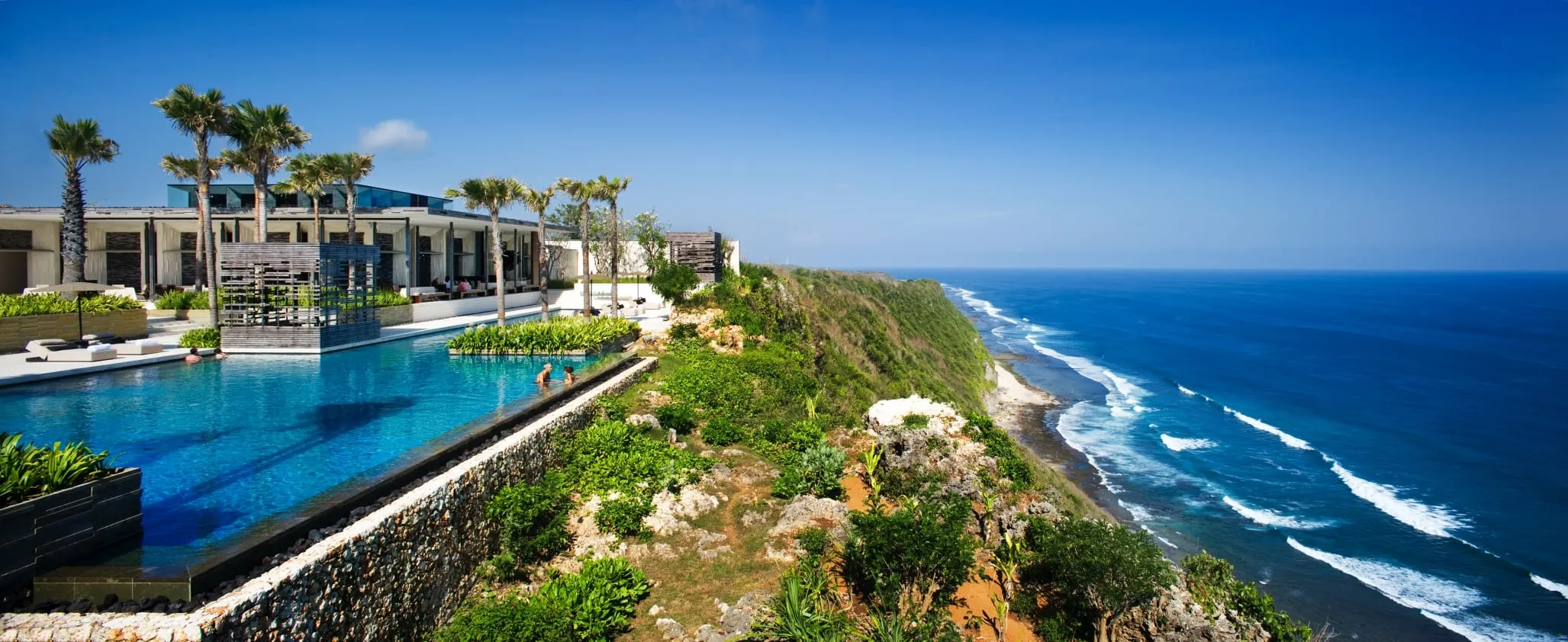
A Singapore architecture firm carved a geometric limestone resort into a Bukit Peninsula clifftop in 2009, planting grass roofs across it so the whole property reads as an extension of the savannah it replaced.
From $800 per night
Uluwatu, Bukit Peninsula, Indonesia
Bulgari Resort Bali
A Milanese architecture firm cut 59 villas and five mansions into a limestone clifftop above the Indian Ocean, then built one of the longest hotel funiculars in the world to reach the private beach below.
From $1,500 per night
Keliki, Ubud, Indonesia
Capella Ubud
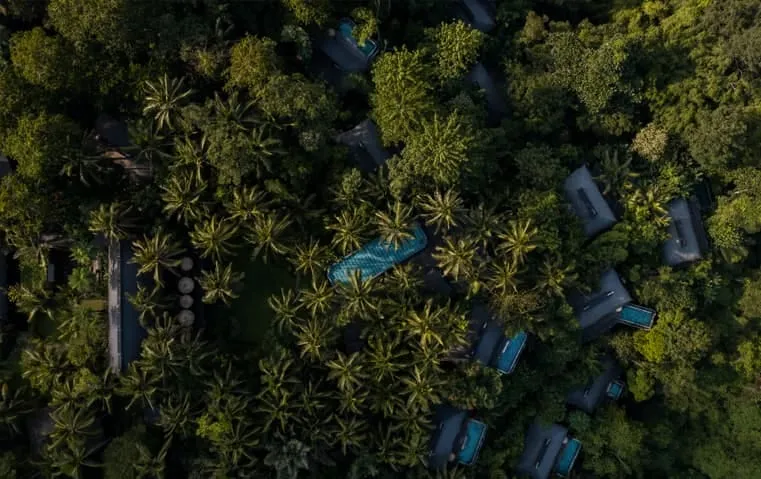
A colonial-era explorer's camp reimagined by Bill Bensley, its 23 tents strung along a jungle ridge above Ubud's Wos River valley.
From $660 per night