Begawan, Ubud, Indonesia
COMO Shambhala Estate
A jungle sanctuary above the Ayung River where a British jeweller's decade-long folly became the flagship of one of Asia's original destination wellness retreats.
- Rates from
- From $650 per night
- Nearest airport
- Ngurah Rai International Airport (DPS), Denpasar
- Transfer
- About 90 minutes by car from Denpasar, roughly 20 minutes beyond central Ubud
- Best months
- May to September, Bali's drier, lower-humidity months
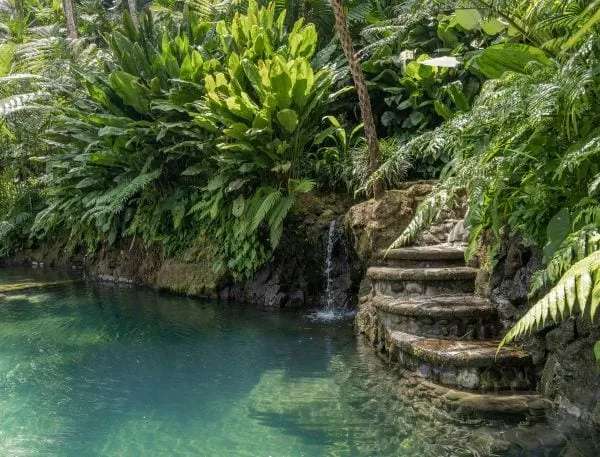
There is no beach at COMO Shambhala Estate, no infinity pool angled at a sunset, no lobby built to be photographed on arrival. What there is instead, on a forested promontory cut between two branches of the Ayung River north of Ubud, is quiet: birdsong, running water, and a scattering of stone-and-thatch pavilions that a British jeweller spent the better part of a decade building before anyone had decided what kind of hotel they might become. That accident of history, a private folly that turned into one of Southeast Asia’s first dedicated destination wellness retreats, still shapes almost everything about how the place operates today.
The estate’s premise has not changed much since Christina Ong, the Singapore hotelier behind COMO Hotels and Resorts, bought the property in 2004 and rebranded it as the flagship of her wellness label, COMO Shambhala. It is not a resort with a spa attached; it is a wellness programme with rooms attached, structured around multi-day paths, Ayurvedic consultation and a kitchen built to support both, rather than around a pool bar or an evening entertainment schedule. Guests who arrive expecting a conventional Bali luxury stay, cocktails at sunset, a beach club playlist, tend to recalibrate within a day or two; guests who arrive already looking for exactly this tend to stay considerably longer than they planned.
Two decades on, the estate has become something of a reference point for how a wellness hotel is supposed to work: judged not by its poolside styling but by whether guests leave measurably different from how they arrived. COMO has kept adding to that case since, most recently with hyperbaric oxygen and contrast therapy folded into its most intensive programme, without ever letting the additions compete with the original argument, that a serious health reset benefits from real forest, real river, and real distance from anywhere else.
Why It Stands Out
COMO Shambhala Estate’s clearest point of difference is that it was never converted into a wellness retreat, it was built as one, twice over. The estate began life in the late 1990s as Begawan Giri, a private eight-hectare compound developed over roughly a decade by British jeweller Bradley Gardner and his wife Debbie, who assembled the land parcel by parcel on a promontory bordered by two arms of the Ayung River and laid out five residences, each named for and architecturally themed around one of the five elements recognised in Balinese Hinduism: earth, fire, water, wind and forest. When Christina Ong bought the property in 2004, she kept that architectural DNA intact and layered a genuine wellness infrastructure on top of it, treatment pavilions, an Ayurvedic programme, a dedicated healthy-eating kitchen, rather than tearing it down to build a more conventional resort.
The result is a property whose wellness credentials are not a marketing overlay on generic luxury accommodation, but the organising idea behind the whole estate. Every one of the roughly nine hectares of grounds, every suite and residence, and the daily rhythm of sunrise yoga, treatment bookings and healthy-eating menus, is built around the same proposition: that recovery and renewal are better served by a structured, multi-day programme in genuine forest than by a spa menu bolted onto a beach holiday. Where Bali’s coastal luxury hotels compete on view and pool design, COMO Shambhala Estate competes on programme depth, treatment-room count, and the credentials of its Ayurvedic and wellness staff, a different contest entirely, and one it has spent over twenty years refining.
Architecture
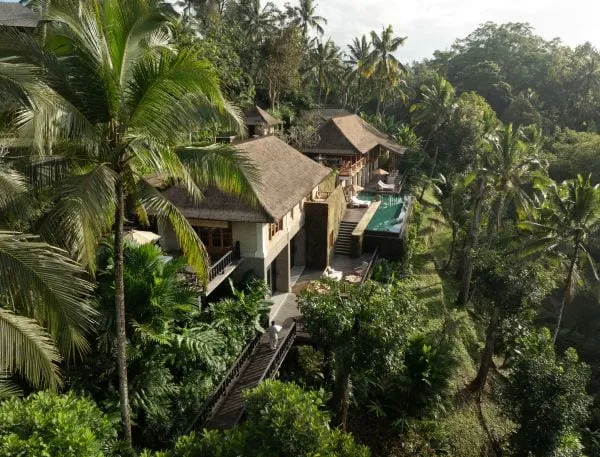
The architecture at COMO Shambhala Estate was largely set before COMO ever owned it. Bradley and Debbie Gardner worked with a small team over roughly ten years to build Begawan Giri’s five residences, drawing on traditional Balinese materials, volcanic stone, timber, and alang-alang thatched roofing, worked at a scale and with a level of craft closer to a private estate than a commercial hotel. Each residence took its architectural cues from one of the five Balinese Hindu elements, giving the property a genuine variety of built form rather than a single repeated villa design stamped across the grounds.
When COMO acquired the estate in 2004, architect Cheong Yew Kuan and interior designer Koichiro Ikebuchi were brought in to extend that language rather than replace it, adding the wellness centre, additional villas and the infrastructure a serious health retreat requires, while keeping the same material vocabulary of stone, wood and thatch that the Gardners had established. The Wanakasa residence carries one of the estate’s most distinctive built features, a centuries-old banyan tree growing through the property, ringed by a semi-circular infinity pool built around its root system rather than displacing it. Across the grounds, buildings are set low, deliberately overshadowed by canopy and river sound rather than announcing themselves, an architectural restraint that reads as intentional given how easily an estate this large could have leaned toward grandeur instead.
Interior Design
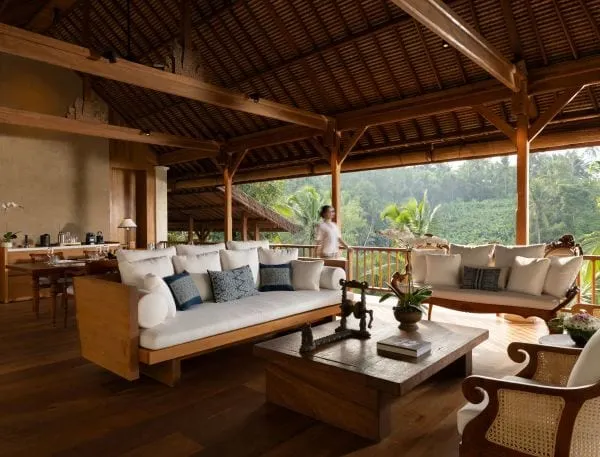
Interiors carry through the estate’s founding character as a private residence rather than a hotel built from a single design brief. Many of the suites and residences are furnished with Indonesian antiques, collected over years rather than sourced for a single fit-out, giving rooms a lived-in, curated feel closer to a well-travelled private house than a resort’s standard-issue furniture package. COMO Shambhala Suites, the estate’s top individual-suite category, run between roughly 70 and 96 square metres, each finished with antique pieces, a private jacuzzi and access to their residence’s shared pool, lounge and dining areas.
The five residences (Wanakasa, Tirta Ening, Tejasuara, Bayugita and Umabona) each hold their own distinct character within that shared material language, a function of the site-specific way the original Begawan Giri was designed and built. Pool Villas, ranging from one-bedroom to three-bedroom configurations, lean more contemporary in finish while retaining the same natural materials, stone floors, timber joinery, and jungle-facing layouts oriented toward privacy over spectacle. Modern amenities, air conditioning, Wi-Fi, smart televisions, are present throughout but kept unobtrusive, in keeping with a property that would rather a guest notice the river than the room’s technology.
Atmosphere
The register here is deliberately unhurried and inward-facing. There is no beach club energy, no evening DJ set, no central bar built for socialising; the estate’s rhythm instead runs on treatment bookings, yoga sessions timed to sunrise and full moon, and meals built around a wellness programme rather than a dinner reservation. Guests describe the atmosphere as closer to a private retreat than a hotel stay, helped by the fact that accommodation is spread thinly across nine hectares of jungle, keeping neighbouring guests largely out of sight and earshot.
That quiet is reinforced by genuine isolation: the estate sits roughly 20 minutes beyond central Ubud, far enough that there is little temptation to duck out for an evening in town, and the sound of the Ayung River below the promontory functions as a kind of ambient soundtrack across the grounds. It suits couples and solo travellers considerably better than groups looking for a livelier social scene, and children under 16 are restricted to Pool Villas and full-Residence bookings rather than the individual suites, a policy that keeps the estate’s general tenor calm and adults-leaning even when families are in-house.
Rooms and Suites
Accommodation at COMO Shambhala Estate runs across three broad categories: individual suites within shared residences, private Pool Villas, and full multi-suite Residences bookable as a single unit. The suite tier includes Terrace Suites (42 to 80 square metres), Estate Suites (62 to 88 square metres) and COMO Shambhala Suites (70 to 96 square metres), each with a king bed, space for up to three guests, and, in the case of the COMO Shambhala Suite, a private jacuzzi and interiors furnished with Indonesian antiques.
Pool Villas range from a One-Bedroom Pool Villa (235 square metres) through Two-Bedroom Garden and standard Two-Bedroom Pool Villas (591 and 300 square metres respectively) to a Three-Bedroom Pool Villa (620 square metres) sleeping up to eight, each with its own private pool and outdoor space. The five multi-suite Residences, Wanakasa, Tirta Ening, Tejasuara, Bayugita and Umabona, hold between four and five suites apiece and can be booked in full by a single group or family, each with its own shared pool, lounge and dining area; Umabona’s largest configuration, a two-bedroom COMO Suite, runs to roughly 308 square metres. Every category faces jungle or river views rather than a shared resort pool deck, in keeping with the estate’s low-density layout.
Dining
Two restaurants anchor the estate’s food programme, each built around a different register of the same underlying philosophy. Glow serves the COMO Shambhala Kitchen menu, an all-day programme of nutritionally balanced dishes designed to support whichever wellness path a guest is following, without tipping into the kind of restrictive “spa food” that reads as a compromise. Kudus House takes the opposite tack on setting while keeping the same nutritional discipline: it occupies a relocated 19th-century Javanese joglo house, one of the estate’s more striking structures, and serves Indonesian dishes reworked for a lighter, more nutritious profile than their traditional versions.
In-room and private dining are available across the property, and meals are frequently built directly into a guest’s wellness programme rather than offered as a separate service, with menus adjusted for dietary requirements flagged during a nutritionist or Ayurvedic consultation. The overall approach favours flavour and cultural specificity over generic health-food styling, a balance the kitchen has clearly worked at rather than defaulted into.
Spa and Wellness
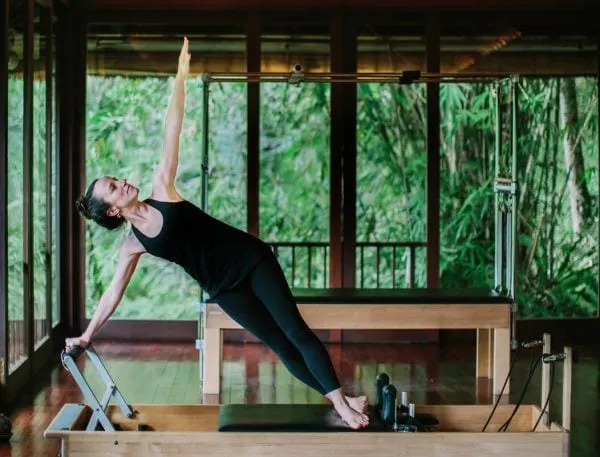
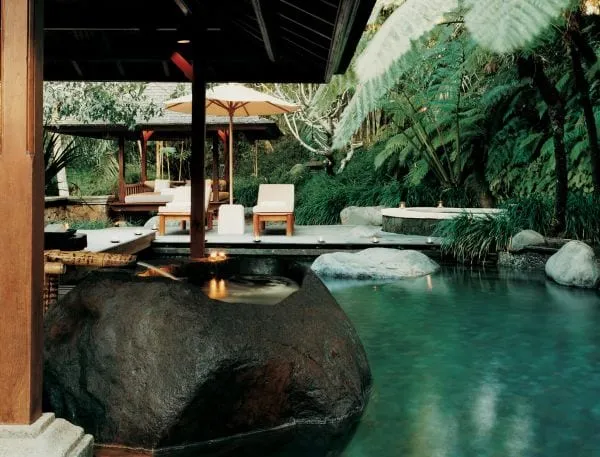
Wellness is the organising structure of a stay here rather than an amenity within one. The estate’s treatment facilities run to nine indoor treatment rooms and four outdoor pavilions with baths, alongside a dedicated outdoor vitality pool used for hydrotherapy, a 25-metre lap pool, steam rooms and saunas, a Pilates studio and a yoga pavilion, plus a gym and, unusually for a wellness property, a rock-climbing wall.
Guests choose between two structures: multi-night Wellness Paths, generally requiring a minimum of three to six nights, built around specific goals (Integrated Wellness, Ayurveda, Fit to Perform, Nourish to Glow, and Connect to Rebalance among the named tracks), and standalone a la carte treatments for guests who prefer to assemble their own schedule without committing to a full programme. The most intensive Integrated Wellness path incorporates contrast therapy, hyperbaric oxygen sessions and personal training, with optional add-ons such as colonic therapy and microbiome-focused facials, reflecting how far the property has extended beyond a conventional spa menu. Ayurvedic care is led by a consultant with more than 25 years of experience, working alongside nutritionists, physiotherapists, massage therapists, chakra-healing practitioners, a traditional Chinese medicine specialist and yoga instructors. Daily complimentary activities, sunrise and full-moon yoga, afternoon meditation and stretch clinics, run regardless of whether a guest is on a formal programme, giving even a short, unstructured stay a built-in wellness rhythm.
Experiences
The estate’s excursion list runs considerably deeper than a typical hotel activities desk, reflecting both Ubud’s cultural density and the surrounding landscape’s range. Spiritually oriented options include a water blessing at the estate’s own sacred spring, a water purification ceremony at the 10th-century Tirta Empul temple, a Balinese blessing ceremony at the estate’s Padmasana temple, and a considerably more demanding nine-hour trek to Lempuyang, one of Bali’s six holiest sites, known outside Bali mainly for the so-called Gates of Heaven photo spot at its entrance.
Nature and adventure options range from an easy rice-field walk through the estate’s own environs to a dawn ascent of Mount Batur for sunrise crater views, a hike up Mount Abang (Bali’s third-highest peak), and white-water rafting on the Ayung River directly below the property. Culinary and craft activities include a cooking class built around a three-course meal, a herb walk and jamu class exploring Balinese herbal medicine traditions, a pottery masterclass at Tana Ampo Pottery Studio, and silversmithing and wood-carving lessons. Sightseeing options extend to the Jatiluwih rice terraces (a UNESCO World Heritage site), a broader Ubud cultural tour taking in galleries and temples, and a Black Lava jeep tour of Mount Batur’s volcanic terrain, giving guests who want to leave the estate for a day a genuinely wide range of options rather than a short standard list.
Who It Is For
COMO Shambhala Estate suits travellers arriving with an actual health or wellness objective, whether that is a structured detox, an Ayurvedic reset, a fitness-focused reset, or simply an extended stretch of quiet built around yoga, treatments and forest air rather than sightseeing. It works especially well for solo travellers and couples, given how individually the treatment and consultation schedule is built, and for honeymooners who want a jungle-and-river alternative to Bali’s more conventional beach-resort circuit.
It is a considerably weaker fit for families with young children, given the restriction on children under 16 in individual suites, for travellers who want an active nightlife or social scene, and for anyone hoping for direct beach access, since the estate is inland and built around river and forest rather than coastline. Guests who want Bali’s cultural sights close at hand but are not interested in a wellness programme are usually better served by a stay in central Ubud itself, with a day visit to the estate’s spa instead.
Best Time to Visit
Bali’s equatorial climate keeps COMO Shambhala Estate operating year-round without a true off-season, since the property’s core appeal, its treatments, its programme structure, its jungle setting, does not depend heavily on clear skies the way a beach holiday would. That said, the drier months from roughly May to September bring lower humidity and more consistently clear conditions for outdoor activities like yoga sessions, jungle walks and the estate’s various trekking excursions, making this the most reliable window for guests who want to spend meaningful time outdoors between treatments. The wetter months from October to April bring more frequent afternoon showers and higher humidity, which rarely disrupts the wellness programme itself but can affect visibility on excursions like the Mount Batur sunrise trek.
How to Get There
The nearest airport is Ngurah Rai International Airport (DPS) in Denpasar, roughly a 90-minute drive from the estate, which sits about 20 minutes beyond central Ubud on a forested promontory north of the town. The resort can arrange a private car transfer on request, and pre-booked drivers or taxis are readily available at the airport for guests who prefer to organise their own transport.
Given Bali’s traffic patterns, particularly around Denpasar, Kuta and the roads leading north through Gianyar toward Ubud, transfer times can extend meaningfully during peak periods, and guests arriving on evening flights should build in extra time. There is no realistic public transport route directly to the estate, so a car transfer, arranged either through the hotel or independently, is effectively required.
Nearby Experiences
Central Ubud, with its palace, art museums, the Ubud Monkey Forest and its well-known market and gallery district, sits roughly 20 minutes from the estate and makes an easy half-day or full-day addition to a stay for guests who want a break from the resort’s own programme. The 10th-century Tirta Empul water temple, one of Bali’s most significant purification sites, and the Tegalalang and Jatiluwih rice terraces (the latter a UNESCO World Heritage site) are within a manageable drive and frequently paired together on a single excursion.
Further afield, Mount Batur offers both a dawn crater-view trek and, for less strenuous days, a jeep tour of its black lava fields, while the Ayung River, which borders the estate’s own grounds, is a popular white-water rafting run for guests looking for a more active day out. Lempuyang temple, considerably further east, requires a full-day commitment given its nine-hour round trip, but ranks among Bali’s most significant pilgrimage sites for guests willing to make the journey.
Things to Know Before Booking
The estate’s wellness paths generally require a minimum stay of three to six nights depending on the programme, so travellers wanting a specific structured path (Integrated Wellness, Ayurveda, Fit to Perform, Nourish to Glow or Connect to Rebalance) should plan their trip length around that requirement rather than assuming a shorter visit can accommodate it; a la carte treatments remain available without a minimum-stay commitment for guests who prefer more flexibility. Children under 16 cannot be booked into individual suites and are only permitted in Pool Villas or full-Residence bookings, a detail worth confirming early for anyone travelling with a family.
Because the estate sits inland with no direct beach access, travellers who want both a wellness stay and beach time typically pair a few nights here with a coastal property elsewhere in Bali rather than expecting one trip to cover both. The property’s remoteness, roughly 20 minutes beyond central Ubud with limited casual access to town, is very much by design rather than an inconvenience, and guests who want easy evening access to Ubud’s restaurants and nightlife may find a town-centre hotel a better fit for at least part of their trip.
Sustainability
COMO Shambhala Estate holds Silver certification from EarthCheck, an internationally recognised sustainable tourism benchmarking programme, and the property has published specific figures behind that certification for its 2024 operating year. Roughly 94 percent of daily supplies are sourced from local Balinese suppliers, and all fresh fruit and vegetables come from Santika Farm in Bedugul; 97 percent of guests opted to reuse towels and linens during their stay that year. The estate also replaced single-use plastic garbage and laundry bags with reusable leather and durable fabric alternatives, eliminating an estimated 2,850 plastic bags annually.
On waste, the estate produced roughly 9 tonnes of landscape compost and diverted more than 14 tonnes of food waste from landfill in partnership with Magi Farm in 2024, converting some of that waste into animal feed for local farmers. Used cooking oil (324 litres) and used Ayurvedic massage oils (129 litres) were recycled into biodiesel, the latter supplying a biodiesel bus operated by Green School Bali. Community programmes in the same year included a US$3,708 donation to Yayasan Bali Baby Home, monthly village clean-ups involving representatives from 147 local businesses, and support for 119 students through a partnership called Bali Bangga Bersama, which provided composting units and free waste collection to nearby schools.
Practical Information
COMO Shambhala Estate is located in Banjar Begawan, Desa Melinggih Kelod, Payangan, Gianyar 80571, Bali, Indonesia, on a forested promontory above the Ayung River roughly 20 minutes north of central Ubud. Check-in begins at 2:00pm and check-out is at noon. The nearest airport is Ngurah Rai International Airport (DPS) in Denpasar, around 90 minutes away by car.
Rates start from roughly USD 650 per night for an entry-level suite, rising considerably for Pool Villas, full Residence bookings, and multi-night Wellness Paths, which bundle treatments and consultations into the nightly rate; travellers should confirm current pricing directly with the property or a travel advisor given how much rates vary by season, room category and programme selected. There is no fixed minimum stay to book the estate itself, though the property recommends at least three nights, and most guests booking a structured wellness programme stay between three and six nights. The estate is owned by Christina Ong through COMO Hotels and Resorts, and operates as the flagship property of the COMO Shambhala wellness brand.
Editorial Conclusion
COMO Shambhala Estate’s case rests on a genuinely unusual origin story and two decades of disciplined follow-through. A British jeweller’s decade-long private folly, five residences built around the elements of Balinese Hinduism on a river-bound promontory, became, almost by accident of ownership, the flagship of one of Asia’s first serious destination wellness brands, and the property has spent the years since building out the clinical and programmatic depth (Ayurvedic consultation, hyperbaric oxygen, structured multi-night paths) to match the setting it inherited rather than simply trading on jungle views. It asks more of a guest than a beach resort does: a real commitment of days, a willingness to let a programme rather than a poolside chaise structure the stay. For travellers prepared to make that trade, few properties in Bali, or arguably in Asia, offer a more coherent version of it.
In pictures
On the map
Begawan, Ubud, Indonesia
Questions
Frequently asked
Is COMO Shambhala Estate a beach resort?
No. It sits inland, north of Ubud, on a forested promontory above the Ayung River, with no direct beach access. It was built specifically as a wellness retreat rather than a conventional resort, and guests wanting sea and sand typically pair a stay here with one of COMO's or another operator's coastal properties elsewhere in Bali.
Who owns COMO Shambhala Estate?
It is owned by Christina Ong, the Singapore-based hotelier and businesswoman who founded COMO Hotels and Resorts in 1991. Ong's company acquired the property, then known as Begawan Giri Estate, from its original owners in 2004 and rebranded it as the flagship of the COMO Shambhala wellness concept.
Do guests need to book a multi-day wellness programme, or can they book individual treatments?
Both are available. The estate offers structured multi-night Wellness Paths (Integrated Wellness, Ayurveda, Fit to Perform, Nourish to Glow and Connect to Rebalance among them, generally requiring a minimum of three to six nights) alongside standalone, a la carte spa treatments and consultations for guests who prefer to build their own schedule. There is no minimum-stay requirement to book the property itself, though the resort recommends at least three nights.
How do guests get from the airport to COMO Shambhala Estate?
The nearest airport is Ngurah Rai International Airport (DPS) in Denpasar, roughly a 90-minute drive to the estate, which sits about 20 minutes beyond central Ubud. The resort can arrange private car transfers on request; taxis and pre-booked drivers are also readily available at the airport.
Are children allowed at COMO Shambhala Estate?
Children under 16 are welcome in a Pool Villa or when a family occupies an entire Residence, but they are not permitted to share or occupy the individual Terrace, Estate or COMO Shambhala Suites. The property's programming, treatment-led, quiet, largely adults-oriented, is generally better suited to couples and solo travellers than to young families.
Same destination
More hotel guides in Indonesia
Uluwatu, Bukit Peninsula, Indonesia
Alila Villas Uluwatu
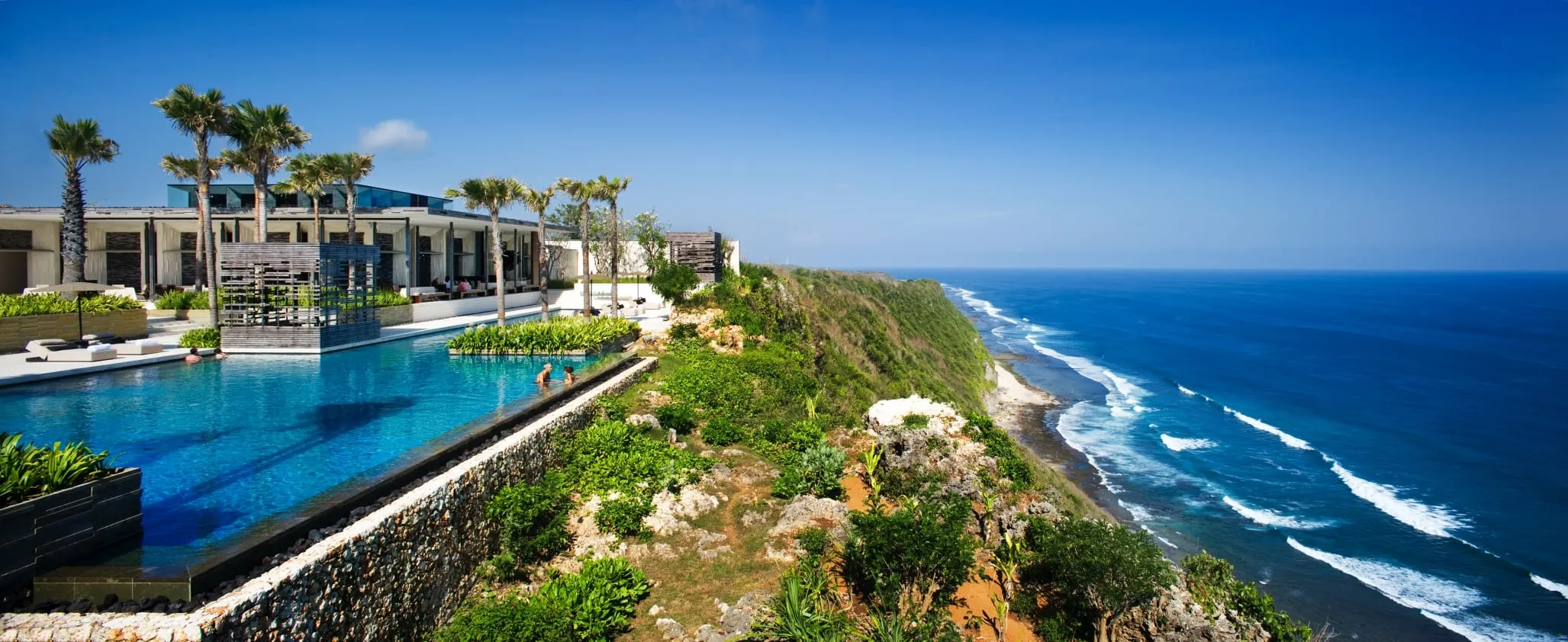
A Singapore architecture firm carved a geometric limestone resort into a Bukit Peninsula clifftop in 2009, planting grass roofs across it so the whole property reads as an extension of the savannah it replaced.
From $800 per night
Sayan, Ubud, Indonesia
Bambu Indah
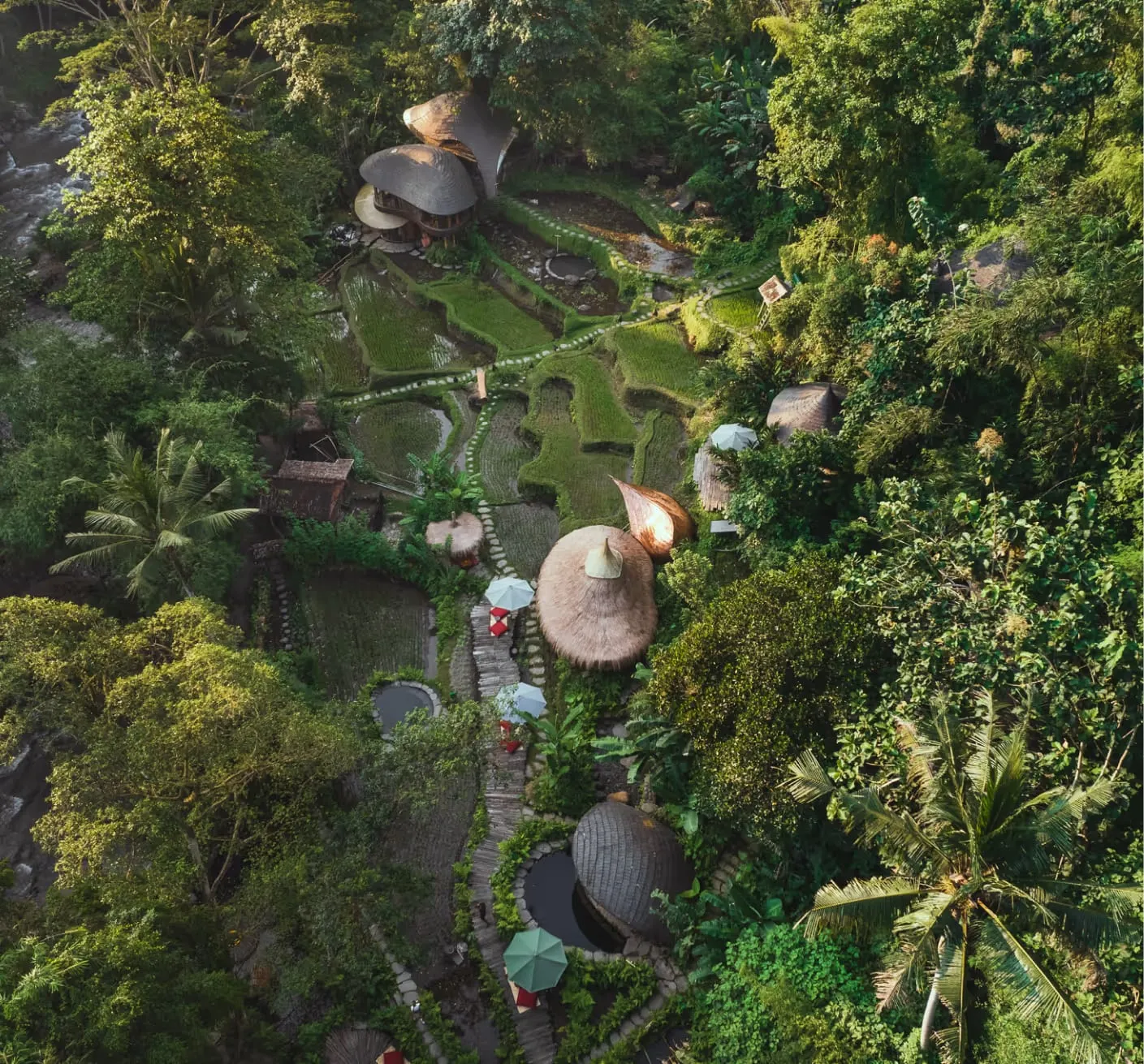
Antique Javanese bridal houses and hand-built bamboo pavilions, dismantled, relocated and rebuilt above the Ayung River gorge by the founders of Green School Bali.
From $250 per night
Uluwatu, Bukit Peninsula, Indonesia
Bulgari Resort Bali
A Milanese architecture firm cut 59 villas and five mansions into a limestone clifftop above the Indian Ocean, then built one of the longest hotel funiculars in the world to reach the private beach below.
From $1,500 per night