near Witney, United Kingdom
Estelle Manor
A Jacobethan manor turned country club, where a Roman-style bathhouse now sits where a police training centre once stood.
- Rates from
- From £450 per night
- Nearest airport
- Oxford Airport (15 minutes); London Heathrow (LHR), about 1hr 15min by road
- Transfer
- 1hr 15min by road from Heathrow
- Best months
- Year-round
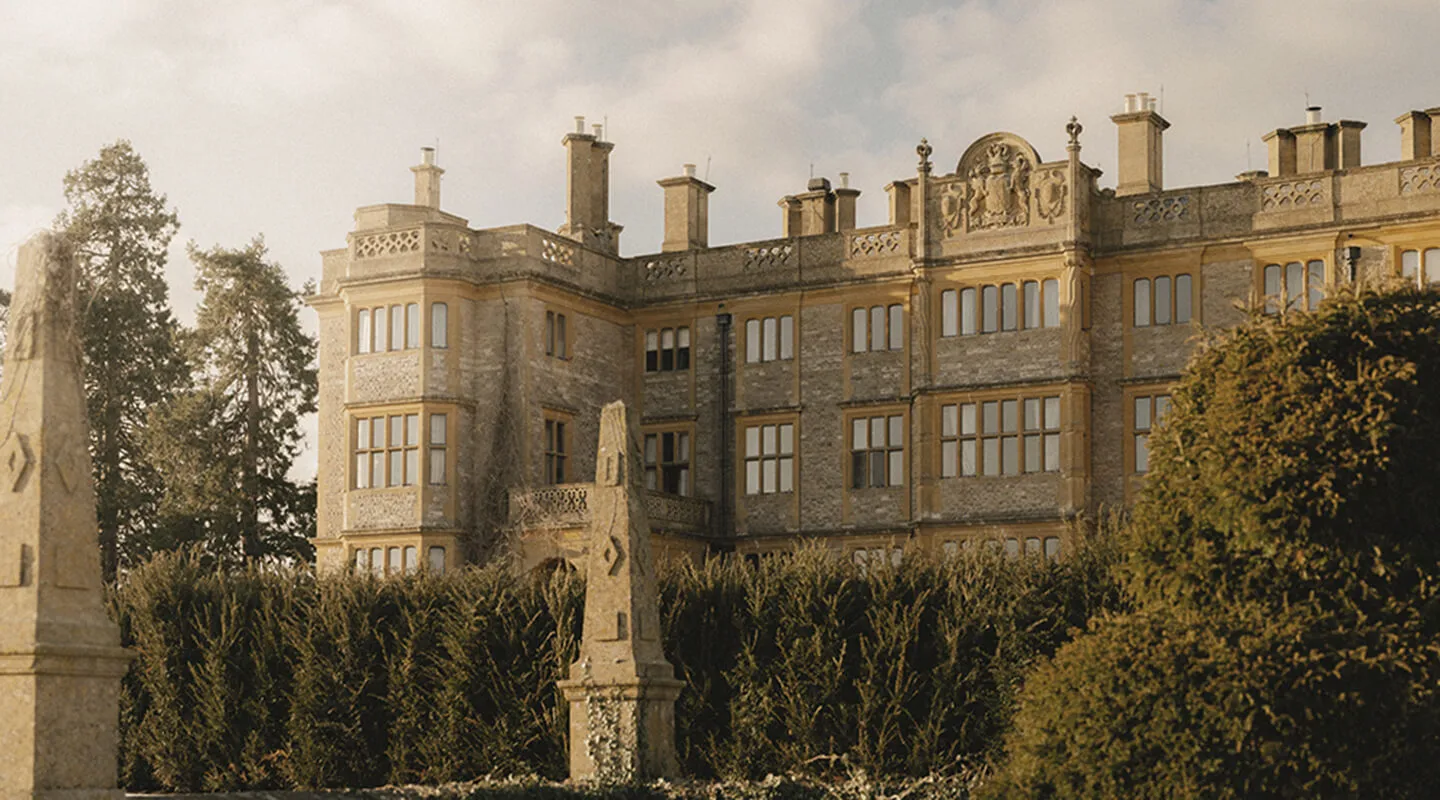
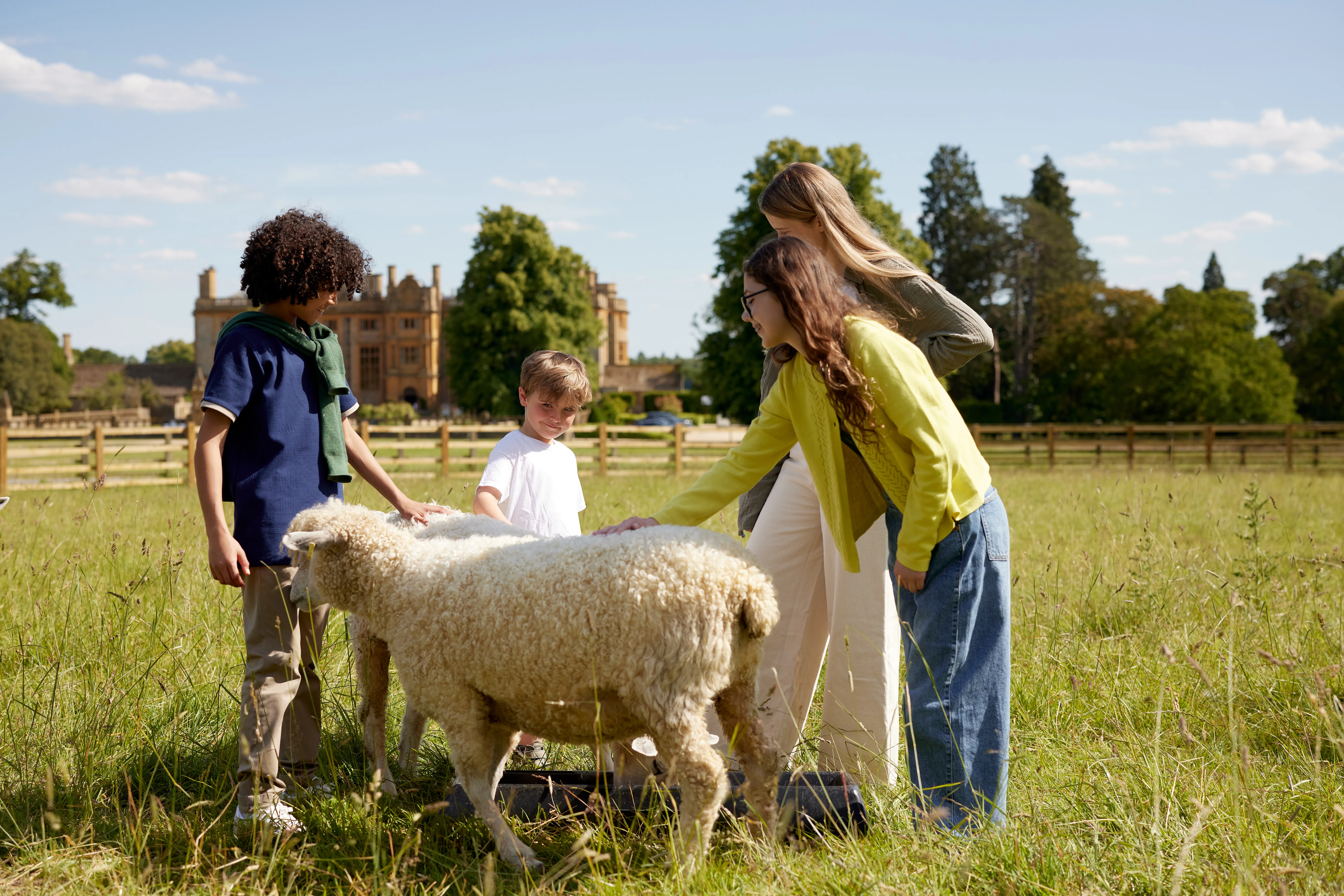
There is a particular kind of English house that has been so many things over its lifetime, a family seat, a hospital ward, a training college, that by the time it becomes a hotel the building has stopped being surprised by anything. Estelle Manor is that kind of house. The stone facade, all steep gables and mullioned windows in the Jacobethan style fashionable at the turn of the twentieth century, has sheltered evacuated mothers from the London Blitz, rested American airmen between missions, and drilled generations of Home Office police cadets. None of that history is hidden or varnished over. It is simply the ground the hotel stands on, and Estelle Manor, which opened in the Oxfordshire countryside in the spring of 2023, has built its entire identity around treating that inheritance as raw material rather than a museum piece.
The house itself is Eynsham Hall, and it sits on an estate of some 85 acres near Witney, ringed by thousands more acres of parkland and working farmland, close enough to Oxford to make a half-day trip of it and close enough to the Cotswolds to be discussed in the same breath. What distinguishes Estelle Manor from the wave of British country house hotels that preceded it is less the building than the concept layered onto it: a hybrid of hotel and private members’ club, four distinct restaurants under one roof, and, as its most talked-about addition, a 3,000 square metre bathhouse built on the scale and logic of a Roman spa rather than a hotel treatment suite.
Arriving up the drive, past cattle grids and the estate’s old stone lodges, the scale of the place announces itself before the front door does. This is not a boutique conversion of a modest manor house; it is a full Edwardian estate, complete with its own stable block, walled garden, cottages, and outbuildings, all pulled into the same operation. A guest who checks in for a single night will see only a fraction of it, which is precisely why the hotel encourages longer stays and treats the estate itself, not just the bedroom, as the product being sold.
Why It Stands Out
Britain has no shortage of restored country houses turned hotels, but few have been reimagined with this much scale or this particular sensibility. Estelle Manor was bought in 2018 by Sharan Pasricha, the hospitality entrepreneur who founded Ennismore, the group behind The Hoxton hotels and a stake in Gleneagles, and who separately runs the Estelle Community of private members’ clubs, including Maison Estelle in Mayfair and Celeste in Notting Hill. Estelle Manor extends that same club model into the countryside: 108 bedrooms and suites across the main house, a converted stable block, cottages and private houses, four restaurants spanning European, Chinese, Japanese and South American registers, and Eynsham Baths, a bathhouse conceived on a scale that few hotel spas in the country can match. The result reads less like a themed weekend retreat and more like a small, self-contained village organised around history, food, and water.
Few properties in the English countryside attempt this many registers at once without the whole thing collapsing into pastiche. A restored Edwardian mansion, a working members’ club, a multi-cuisine dining programme, and a bathhouse modelled on a Roman villa are each, on their own, a reasonable basis for a hotel. Estelle Manor runs all four simultaneously, and the fact that it holds together is arguably the more interesting story than any single element within it. It also, notably, does not lean on a marquee chef name or a headline award to make its case; the pitch is the estate itself, and the range of things there are to do on it.
Architecture
Eynsham Hall’s story begins well before the current building. A Georgian house occupied the site from the 1770s, altered over the following century first by Charles Barry and later by Owen Jones, before being demolished entirely in 1904. What replaced it, completed in 1906-08 for the Mason family, is the Jacobethan mansion that survives today: an Edwardian architect’s confident, slightly theatrical revival of Elizabethan and Jacobean forms, designed by Ernest George, whose practice trained a generation of notable British architects. The house was built with its own electric plant, waterworks and private telephone network, the amenities of a very grand private residence rather than a modest one.
Its subsequent uses were less glamorous but no less formative. During the Second World War, part of the hall operated as a maternity ward for expectant mothers evacuated from London, while another wing served as a rest centre, nicknamed the “flak shack”, for US Army Air Corps officers stood down between operations. From 1946 the Home Office ran it as a police training centre, a use that persisted for decades and left the estate physically intact but architecturally frozen, more institutional than domestic by the time Pasricha acquired it in 2018. The conversion to Estelle Manor preserved the Grade II listed structure and its principal rooms rather than reworking the footprint, with new building limited largely to the spa and the estate’s outbuildings.
That long institutional interlude is, in an odd way, the reason the house survives as well as it does. Decades as a training college meant the building was maintained, heated and structurally kept up rather than left to decline as so many English country houses were across the twentieth century, even as its interiors were stripped of the domestic detail a private residence would have retained. The restoration that produced Estelle Manor therefore had a sound, weatherproof shell to work with, but relatively little original furniture or decoration to preserve, which explains why so much of what fills the house today, the period pieces, the art, the layered fabrics, was sourced and assembled rather than simply uncovered.
Interior Design
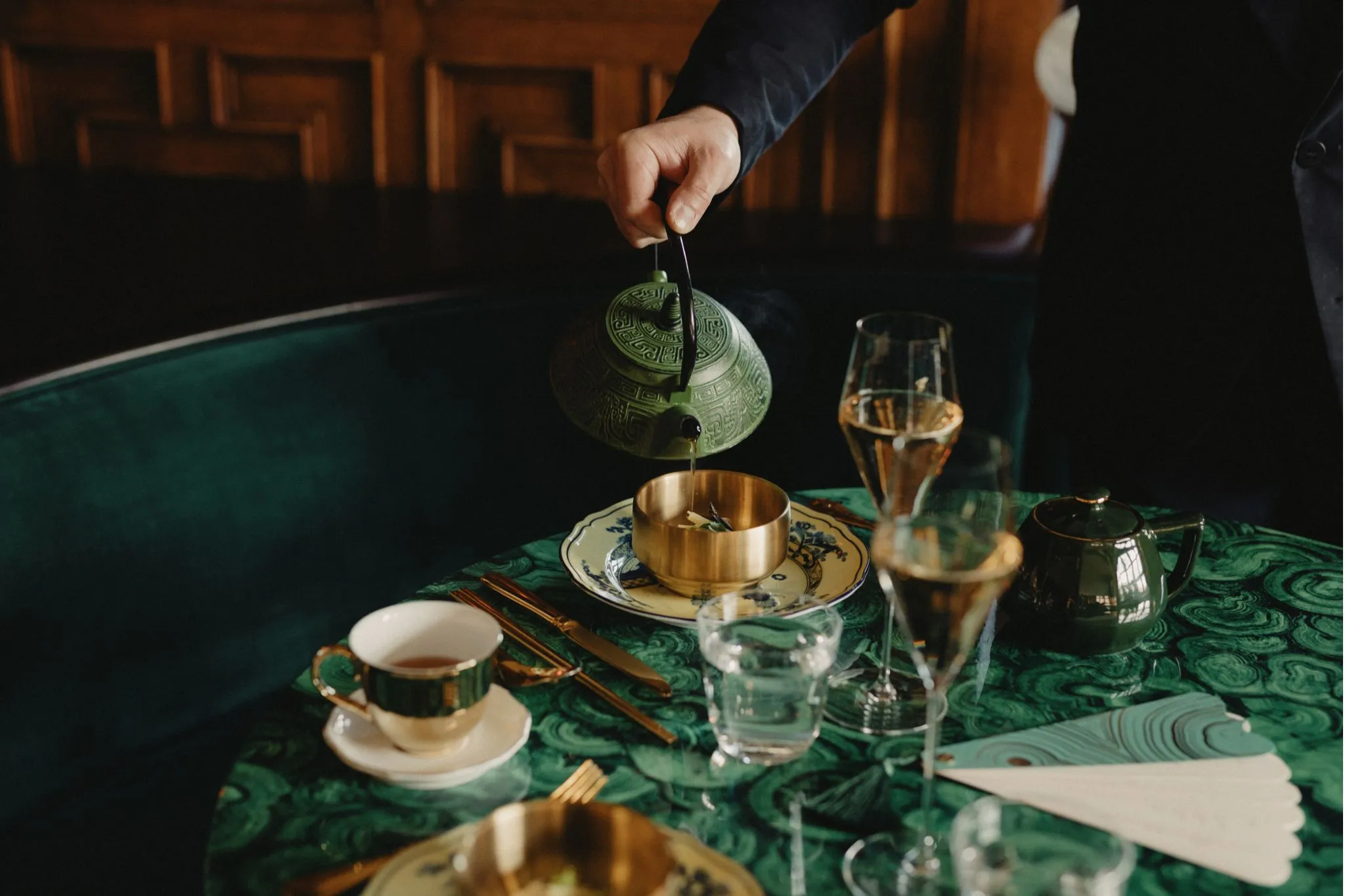
Inside, the design approach favours accumulation over minimalism: original architectural detail, period furniture, and contemporary art layered together rather than one style clearing out the last. The house’s original library survives largely as found, its shelves and objects intact, and several reception rooms keep their original fireplaces and cornicing. Elsewhere, rooms have been given a more pointed reinvention, most visibly the former Billiards Room, now a Chinese restaurant dressed in malachite green around its original fireplace, a deliberate collision of an Edwardian gentleman’s room and contemporary Chinese dining.
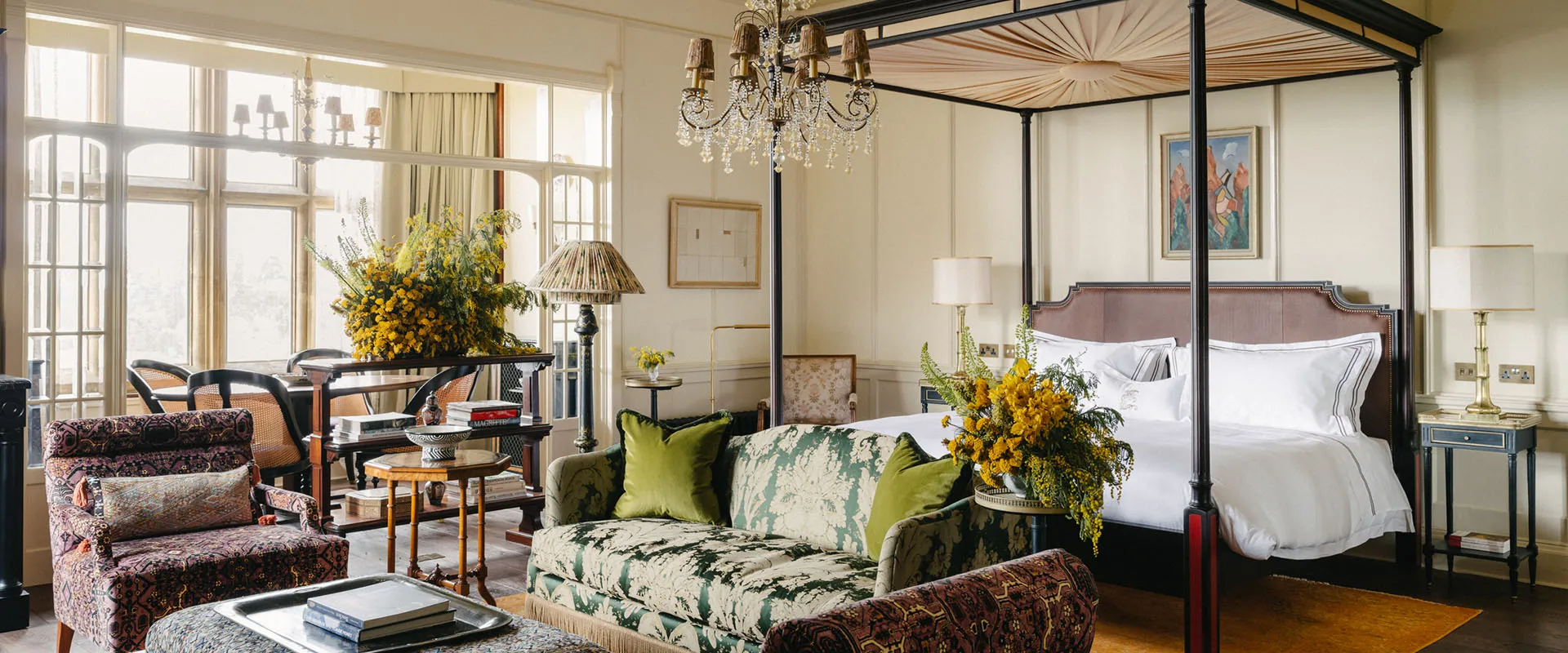
Bedrooms follow the same logic but calibrated to their setting: rooms in the Manor House itself lean traditional, with canopied beds and richly patterned fabrics that read as an extension of the historic rooms below them, while bedrooms in the Stables, the Walled Garden and the freestanding Woodland Cabins are noticeably more contemporary, pared back toward natural materials and a quieter palette. The effect across the estate is of one house with several distinct moods rather than a single decorative scheme applied uniformly, so that moving between the Manor House and the garden buildings feels like moving between different decades of the same family’s taste.
The public rooms carry the same instinct further. Corridors and stairwells are hung with contemporary art rather than left as plain passageways, and communal spaces, the lounges, the co-working areas, the bar, are furnished more like the reception rooms of a large private house than the standardised public spaces of a chain hotel: mismatched seating, low lighting, objects that look collected rather than specified from a single supplier catalogue. Nothing in the public areas signals a strict decorative brief; the consistency comes instead from a shared confidence about how much pattern, colour and texture one room can hold before it becomes noise, and the design team has judged that line carefully throughout.
Atmosphere
Estelle Manor was built to function as a country club as much as a hotel, and that distinction shapes almost everything about how it feels to move through the estate. Annual members pay for access to the property year-round, with dedicated lounges, workspaces, a kids’ club and priority booking on restaurants and the spa, while hotel guests are folded into the same spaces and the same programming for the length of their stay. The tone this produces sits somewhere between a country house party and a private club: staff know regulars by name, the public rooms are furnished for lingering rather than passing through, and the pace of the day is set by the estate’s own rhythms, breakfast in the Brasserie, a walk through the walled garden, an afternoon at the baths, rather than by a concierge desk pushing an itinerary. It is deliberately unstuffy for a house of this scale and history, closer in spirit to a well-run private party than to a formal English country house hotel of the old school.
Rooms and Suites
The 108 rooms and suites are distributed across five distinct settings, each with its own character. Manor House bedrooms and suites occupy the original building and lean into its traditional detail, with canopied beds and period-inspired furnishings; these rooms are reserved for guests aged 13 and over. The Stables and the Walled Garden each hold their own bedrooms and suites in a more contemporary register, better suited to families since they carry no minimum-age restriction. Beyond the main buildings sit ten two-bedroom Woodland Cabins scattered through the grounds, and at the top of the range, a small number of private houses with between three and six bedrooms, suited to larger family groups or gatherings who want a self-contained base within the estate. Across every category, rooms are furnished individually rather than to a repeated template, which is consistent with the house’s overall preference for accumulated character over uniformity.
Dining
Four restaurants operate across the estate, each with a distinct identity rather than functioning as variations on a single kitchen. The Brasserie is the all-day anchor, serving a broadly European menu that runs from an Oxford cheddar souffle to beef Wellington. The Billiards Room, set in the manor’s original games room beneath its restored fireplace, serves traditional Chinese feasting-style dishes. The Armoury is the estate’s Japanese restaurant, and The Glasshouse, positioned to overlook the walled kitchen garden, serves seasonal dishes drawn partly from produce grown metres away, alongside wood-fired pizzas and Indian-inflected dishes. Additional, more casual outlets, including an Airstream trailer serving seafood rolls and poke bowls and a South American-leaning spot at Redwood Lodge, round out the estate’s food and drink offering alongside a Cocktail Hour terrace for pre-dinner drinks. The spread is unusually wide for a single property, reflecting the club’s ambition to give members and guests somewhere different to eat most nights of a stay rather than a single dining room repeated throughout.
That breadth also changes how a stay tends to unfold in practice. Rather than defaulting to the hotel’s one main restaurant every evening, as is typical at most country house properties, guests at Estelle Manor can move through an entirely different cuisine and room each night of a multi-day stay without leaving the grounds, which is closer to the dining variety of a small resort than a single-restaurant manor hotel. It also means the estate absorbs a wide range of moods within one visit: a formal dinner in the Billiards Room one evening, a casual poke bowl from the Airstream by the pool the next afternoon.
Spa and Wellness
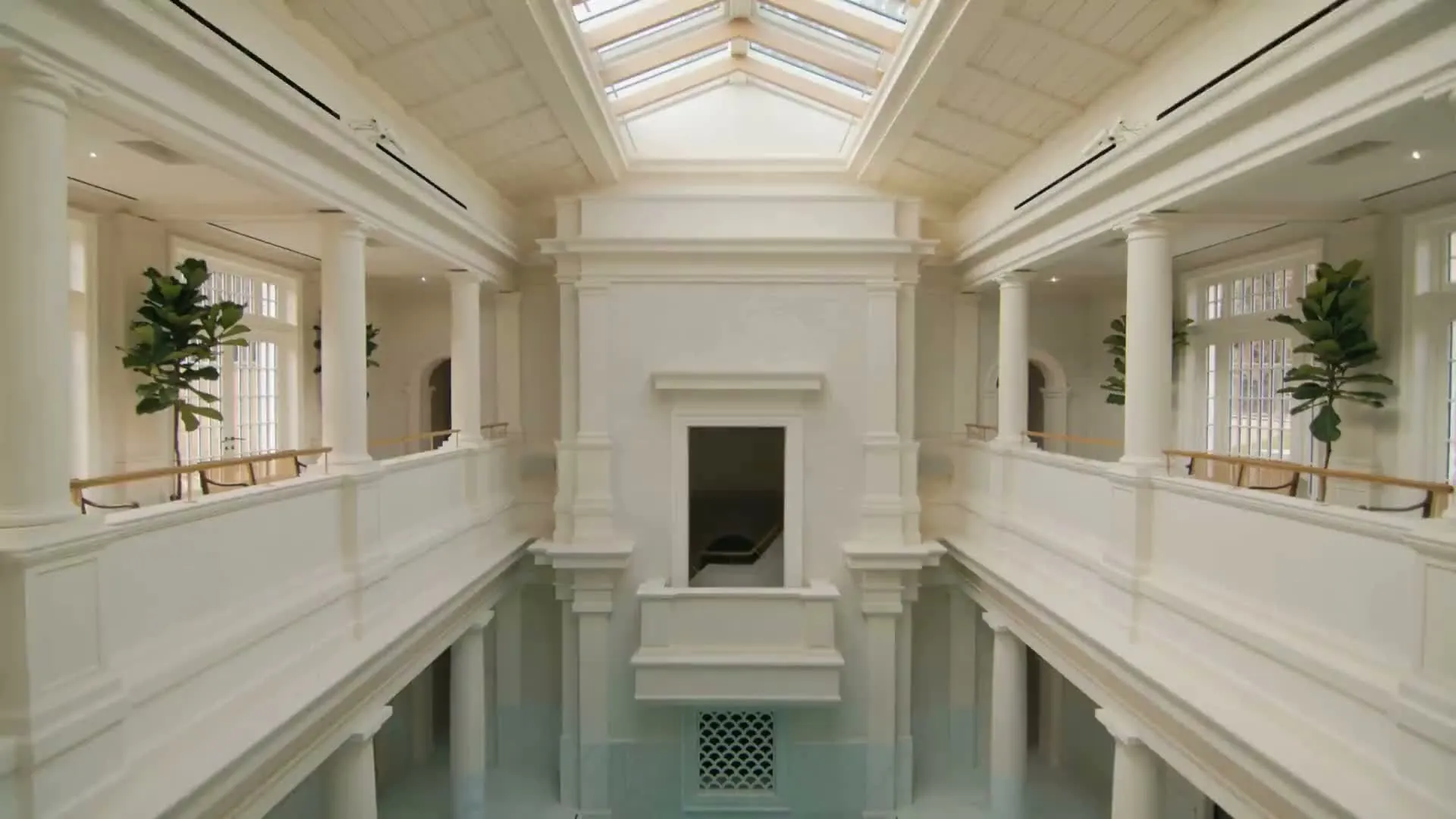
Eynsham Baths is Estelle Manor’s defining feature and the product of a five-year building project, a 3,000 square metre Roman-inspired bathhouse constructed within the estate’s grounds and directly informed by the ruins of a Roman villa discovered nearby. The design commits fully to the reference: sculpted stone columns, pilasters, hand-shaped bricks and carved marble details surround a central mezzanine bathing hall lit from above, with a circular first-floor balcony looking down over the water below.
The bathing circuit runs through a sequence of pools at different temperatures in the classical Roman manner: a tepidarium warmed to around 36 degrees Celsius, a caldarium heated to roughly 40 degrees, and two cold-plunge pools within the frigidarium, chilled to around 6 degrees, connected by walkthrough showers and plunge buckets designed to move the body between temperature extremes. Beyond the main hall, the facility holds a hammam, a hay sauna, a steam room, a tea lounge, couples’ treatment suites, an outdoor breathwork pool, and ten treatment rooms in total, where the therapy menu draws on Indian, Tibetan and Chinese healing traditions rather than a conventional Western spa list. Access to the baths and the full Thermal Journey, a structured 180-minute circuit through the different rooms and pools, is complimentary for Estelle members; hotel guests and members’ guests should confirm current access terms and pricing when booking, since these arrangements are periodically revised.
What sets Eynsham Baths apart from the wellness suites bolted onto most British country house hotels is its refusal to treat the spa as a secondary amenity. A conventional hotel spa is sized to a fraction of the guest count and tucked below stairs or into a converted outbuilding; Eynsham Baths was built as a standalone architectural statement in its own right, on a footprint large enough to anchor an entire day rather than fill an hour before dinner. The five-year build reflects that ambition: this is closer in scale and intent to a public Roman bath complex reimagined for a private clientele than to a spa menu appended to a hotel brochure, and it is the single feature most responsible for Estelle Manor’s reputation beyond the country house hotel category it technically belongs to.
Experiences
Beyond the bathhouse, the estate is built for a full day’s occupation rather than a single signature activity. A gym with a dedicated studio and padel tennis courts sit alongside more sedate pursuits: guided tours of the walled kitchen garden, workspace and co-working areas for members combining a stay with remote work, and grounds substantial enough, at 85 acres within a much larger parkland setting, for extended walks without leaving the property. A kids’ club gives the estate a family dimension that many English country house hotels deliberately avoid, positioning Estelle Manor as workable for a multi-generational weekend rather than strictly a couples’ retreat.
Who It Is For
Estelle Manor suits travellers drawn to design-forward British country houses who also want a genuine wellness centrepiece rather than a token spa menu, and it works particularly well for a long weekend out of London that does not require sacrificing good restaurants or an active daily structure. Its members’-club framework and range of room categories, from traditional Manor House suites to family-friendly cabins and full private houses, make it flexible for couples, small groups and multi-generational families alike, though the age restriction on Manor House bedrooms is worth noting for anyone travelling with younger children who wants that specific setting.
Best Time to Visit
Estelle Manor operates year-round, and the presence of an indoor bathhouse means the property does not depend on good weather to justify a stay. Spring and summer bring the walled garden and wider grounds into full use, better suited to walking, padel and time outdoors between spa sessions, while autumn and winter shift the emphasis toward the house’s interior rooms, log fires and the baths themselves, which are arguably at their best when the weather outside is at its worst.
How to Get There
The closest airport is Oxford Airport, about 15 minutes from the estate, with helicopter arrivals also possible by prior arrangement for guests who want to skip the road entirely. From London Heathrow, the drive takes roughly 1 hour 15 minutes. By train, Hanborough station or Oxford Parkway are the two closest stations, both a little over an hour from central London, with a short onward taxi transfer to the estate. The hotel can arrange chauffeured transfers on request.
Nearby Experiences
Oxford sits close enough for a half-day trip, its colleges, museums and river punting all reachable within roughly 20 to 30 minutes by road from the estate, making it easy to combine a stay at Estelle Manor with a day of city sightseeing without changing base. The wider Cotswolds, with their honey-stone villages, market towns and countryside walking routes, lie just beyond Oxfordshire’s western edge, close enough that guests frequently treat Estelle Manor as a base for exploring the region rather than a single-purpose destination in itself.
Things to Know Before Booking
The property operates on a members’-and-guests model, so certain spaces and access arrangements, particularly around Eynsham Baths, are calibrated differently for members than for hotel guests; it is worth confirming current terms directly with the hotel at the time of booking. Manor House bedrooms are restricted to guests aged 13 and over, with younger children accommodated instead in the Stables, Walled Garden, Woodland Cabins or private houses. Dogs are welcome across most of the estate, with exceptions including the Manor House bedrooms, the Billiards Room and Eynsham Baths, and advance notice along with vaccination documentation is required. The property operates on a cashless basis, accepting card payments only, and free parking is available on site.
Sustainability
Estelle Manor holds Green Key certification, the international standard for environmental performance in hospitality, maintained through independent audits of the estate’s operations. The walled kitchen garden is farmed using no-dig, organic methods, with produce travelling a short distance from soil to kitchen for use largely at The Glasshouse, and waste from the property, including coffee grounds and ash, is composted back into the garden. The estate has also moved toward reusable, recyclable and compostable materials across its operations and uses electric buggies to move guests around the grounds as part of a broader push toward renewable-powered operation.
Practical Information
Standard check-in is from 3pm, with 4pm for private houses; check-out is by noon, or 11am for houses. Early check-in and late check-out can both be requested, subject to availability. The estate is a cashless property, accepting card payments only, with complimentary Wi-Fi and free on-site parking throughout.
Editorial Conclusion
What makes Estelle Manor worth the detour from Oxford or the drive out from London is not that it restored a historic house well, several British hotels manage that, but that it refused to let the history dictate a single, reverent tone. A building that has been a family seat, a maternity ward, an officers’ rest centre and a police college now houses a Chinese restaurant in its old billiards room and a Roman bathhouse modelled on ruins found nearby, and somehow the combination reads as considered rather than chaotic. For a certain kind of traveller, one who wants design, scale and a genuine spa centrepiece without a formal country house atmosphere, that willingness to layer rather than restrict is exactly the point.
In pictures
On the map
near Witney, United Kingdom
Questions
Frequently asked
What was Estelle Manor before it became a hotel?
The building is Eynsham Hall, a Grade II listed Jacobethan mansion designed by architect Ernest George and completed in 1906-08 on the site of an earlier Georgian house. Over the twentieth century it served as a maternity ward for mothers evacuated from London and a rest centre for US Army Air Corps officers during the Second World War, then as a Home Office police training centre from 1946. Ennismore founder Sharan Pasricha bought the estate in 2018 and reopened it as Estelle Manor in spring 2023.
Is Estelle Manor a members' club or a hotel?
Both. Estelle Manor operates as a country club with a paying membership as well as a hotel open to non-member guests, part of the same Estelle Community that runs Maison Estelle in Mayfair and Celeste in Notting Hill. Members and hotel guests share most of the estate, including the restaurants and grounds, though a few spaces, such as certain lounges and the kids' club, are calibrated toward one group or the other.
What is Eynsham Baths and does every guest get access?
Eynsham Baths is the hotel's 3,000 square metre Roman-inspired bathhouse and spa, built around a central tepidarium hall with a tepidarium, caldarium and cold-plunge frigidarium pools, plus a hammam, hay sauna, steam room and ten treatment rooms. Access to the baths and the 180-minute Thermal Journey is complimentary for members, and available to hotel guests and members' guests for a separate fee, which is worth confirming at the time of booking since access terms can change.
How do guests get to Estelle Manor from London or from the airport?
The nearest airport is Oxford Airport, about 15 minutes away, with helicopter arrivals also possible by prior arrangement. From Heathrow it is roughly 1 hour 15 minutes by road. By train, Hanborough station or Oxford Parkway are both about an hour from London, with a short taxi transfer on to the estate; the hotel can also arrange chauffeured transfers.
Can children stay at Estelle Manor?
Yes, though with some room restrictions. Children aged 13 and over may stay in Manor House bedrooms, while younger children are accommodated in the Walled Garden, Stables, Woodland Cabins or private houses. The estate runs a kids' club, and children under 18 require adult supervision throughout the property outside of that dedicated space.
Same destination
More hotel guides in United Kingdom
near Leatherhead, United Kingdom
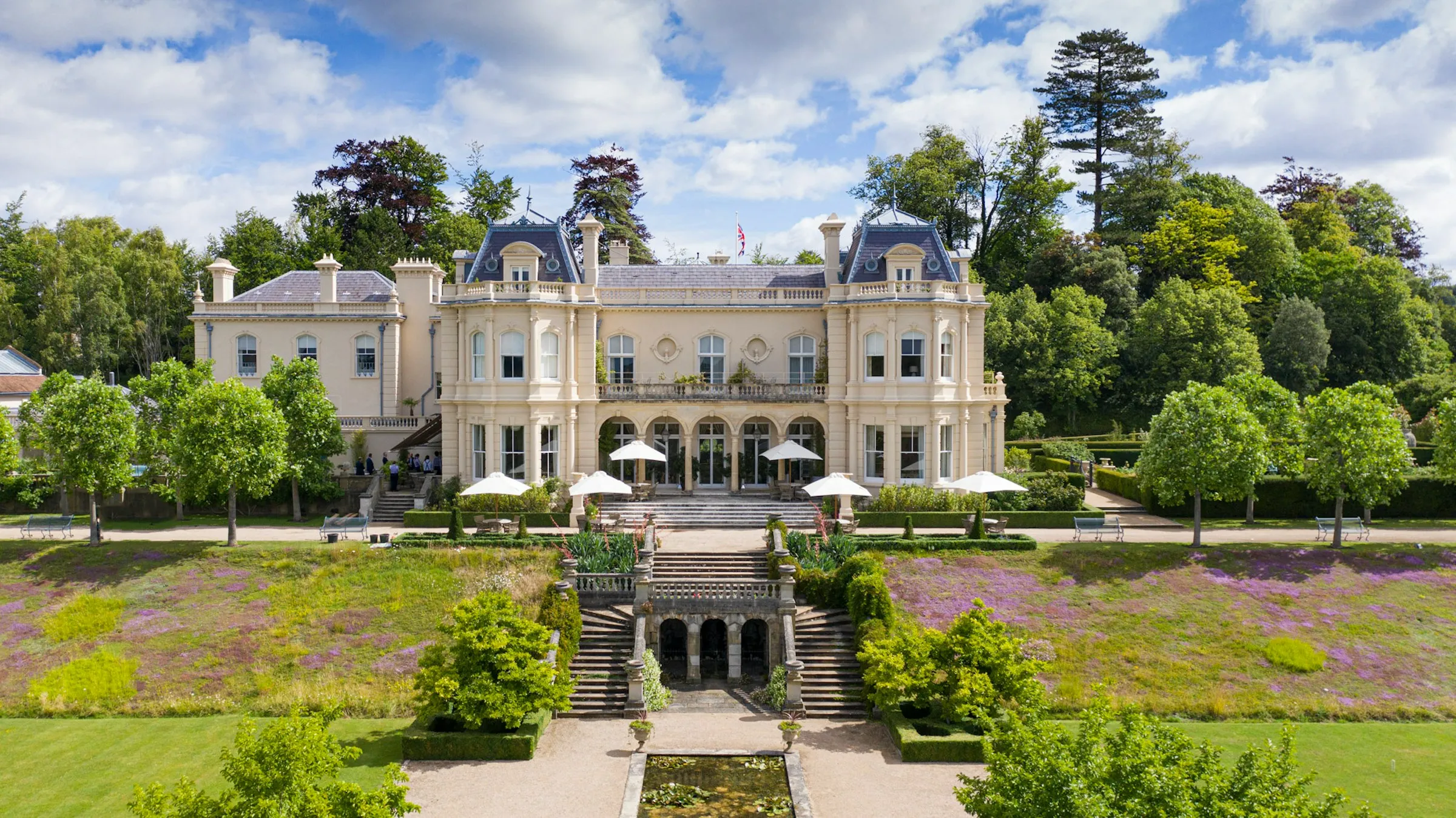
Beaverbrook
A press baron's Surrey estate, once Churchill's wartime refuge, run today as one of England's most quietly assured country house hotels.
From £475 per night
Mayfair, United Kingdom
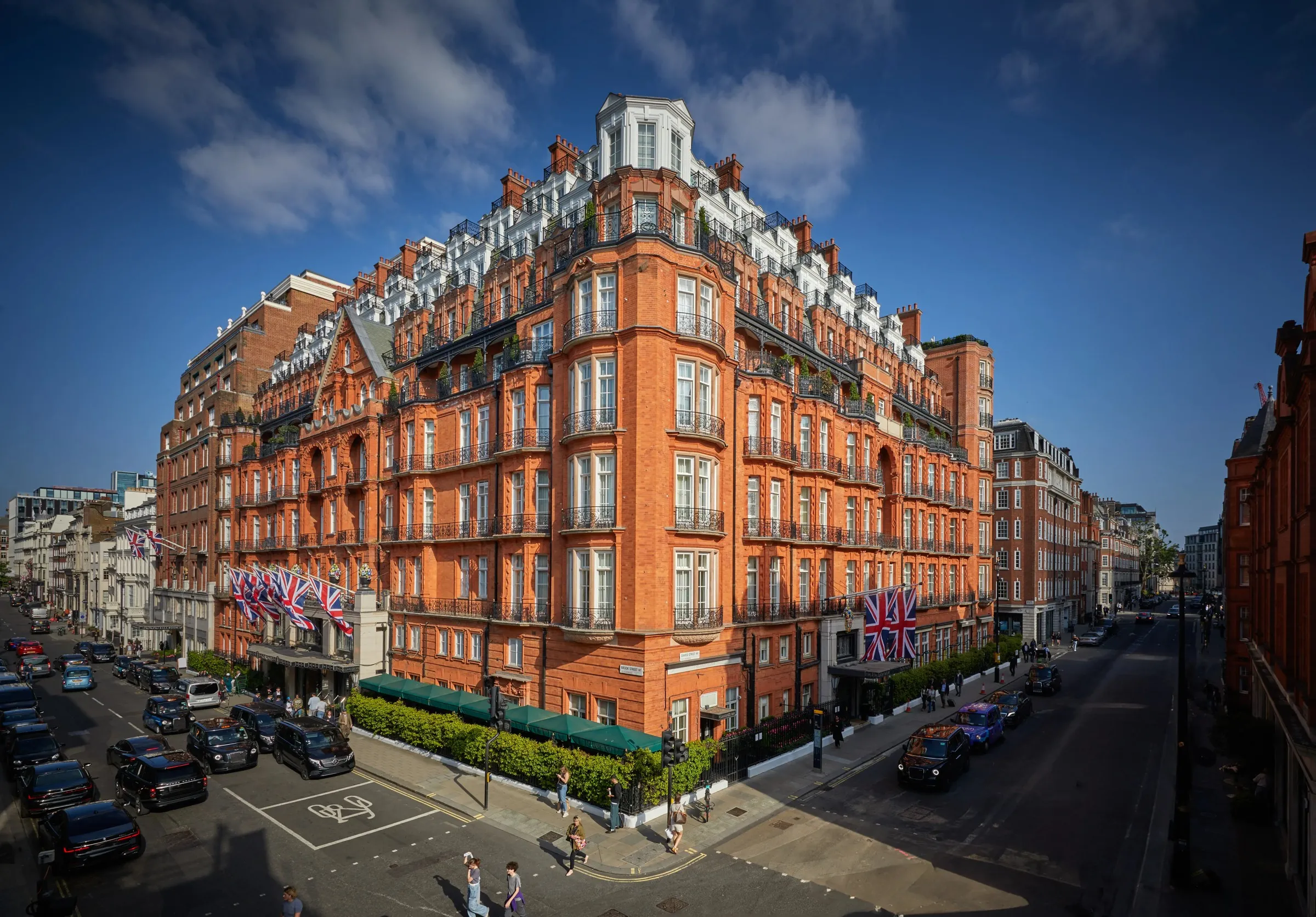
Claridge's
A 1930s Art Deco time capsule on a Mayfair corner, still the most self-assured address in London.
From £950 per night
Auchterarder, United Kingdom
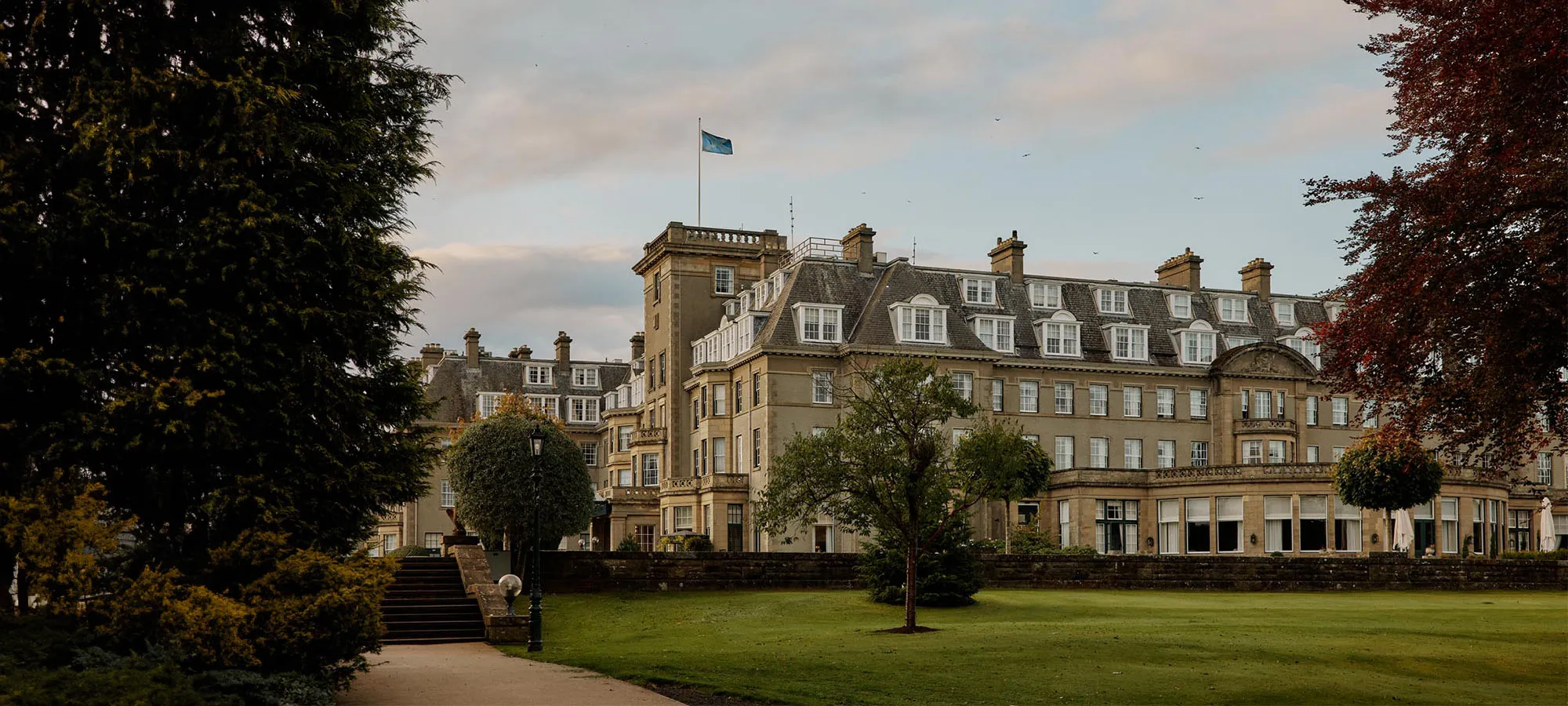
Gleneagles
A 1924 railway hotel turned golf pilgrimage site, still run on the scale that once hosted a G8 summit and a Ryder Cup.
From £650 per night