Auchterarder, United Kingdom
Gleneagles
A 1924 railway hotel turned golf pilgrimage site, still run on the scale that once hosted a G8 summit and a Ryder Cup.
- Rates from
- From £650 per night
- Nearest airport
- Edinburgh Airport (EDI)
- Transfer
- About 45min to 1hr by road; Gleneagles railway station sits under 2 minutes from the hotel with complimentary transfers
- Best months
- May to September for golf; December for Christmas house parties
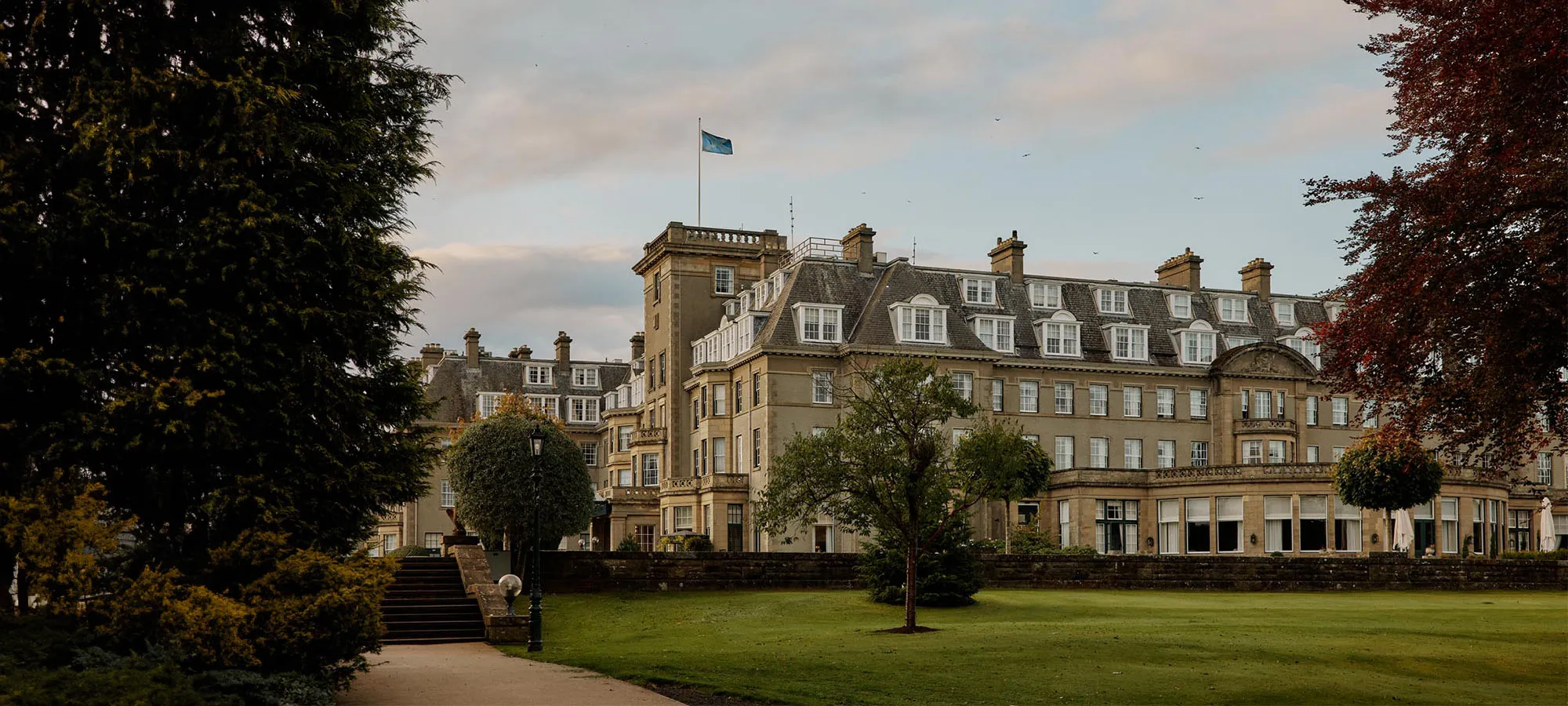
The approach to Gleneagles gives away its ambitions before the front door does. The drive runs long and straight through parkland, past cropped fairways visible on either side, before the hotel itself appears: a pale sandstone block with a domed tower and a facade wide enough to suggest a railway terminus rather than a country house, because in a sense that is exactly what it was built as. Gleneagles was conceived not by a family with land to spare but by a railway company with a route to sell, and more than a century later the hotel still carries that founding logic. It was built to be a destination, not a discovery, and everything about the scale of the place, the three golf courses, the sprawling grounds, the roster of country pursuits, still reads as a deliberate answer to the question of what would make people travel a long way on purpose.
That purpose has held since 7 June 1924, when the hotel opened to newspaper coverage that called it “the eighth wonder of the world,” and it has been renewed rather than diluted by everything that has happened since: a Commonwealth agreement signed in its rooms in 1977, a G8 summit hosted on its grounds in 2005, a Ryder Cup played on its newest course in 2014. Few hotels anywhere carry that density of institutional history while still functioning, day to day, as a working golf resort where a family can book a week and a couple can book a weekend. Gleneagles has never fully settled into being one thing, a hotel, a golf course, a sporting estate, a piece of Scottish civic history, and that refusal to specialise is very much the point.
Why It Stands Out
Most hotels built around golf are golf-first and hotel-second, or the reverse; Gleneagles is unusual for having been engineered, from its very conception, to be both at once and at a genuinely large scale. The Caledonian Railway Company that built it understood in 1910 that a golf course alone would not justify the investment, and neither would a hotel without one, so it commissioned James Braid, already a five-time Open champion, to lay out two courses before a single stone of the hotel itself was set. That founding decision, golf as infrastructure rather than amenity, is still legible in how the estate is organised: three championship courses covering different eras and design philosophies, a hotel built to a scale that can absorb tournament crowds, and a level of institutional memory, of hosting statesmen, of hosting the Ryder Cup, that a newer resort simply cannot manufacture.
The other distinguishing fact is durability under new ownership. Since Ennismore acquired the estate from Diageo in 2015, the group has run a lengthy renovation programme, new bars, new restaurants, redesigned bedrooms and suites, a rebuilt spa, without disturbing the pieces of the identity that make Gleneagles what it is: Restaurant Andrew Fairlie has stayed open and stayed exceptional after its founder’s death, the golf courses have stayed the estate’s organising principle, and the country pursuits programme, falconry, shooting, fishing, has expanded rather than been quietly dropped in favour of something more contemporary. It is a rare case of a century-old institution being modernised without being flattened.
Architecture
The building that stands today was not the building first drawn. Donald Matheson, general manager of the Caledonian Railway Company, conceived the project after a holiday in Strathearn convinced him the landscape could support a grand resort hotel, and the commission initially went to James Miller, the Perthshire-born architect responsible for Turnberry and Peebles Hydro, both other railway-backed golf hotels of the same era. The outbreak of the First World War halted construction before it properly began, and when work resumed in 1922 the project passed to Matthew Adam, the Caledonian Railway’s chief architectural draughtsman and later divisional engineer of the London, Midland and Scottish Railway, which had absorbed the Caledonian by the time the hotel finally opened.
The result is a long, pale sandstone building organised around a central tower and a symmetrical run of wings, built at a scale closer to a grand European spa hotel or a transatlantic ocean liner than a Scottish country house, which was very much the intended comparison at the time. Its interiors were originally the work of Charles W. Swanson, and the building’s footprint has grown in phases since, most notably with the Braid House wing, added to expand the room count while keeping the Main House’s older, more ceremonial spaces intact. The opening night itself, a gala led by the bandleader Henry Hall, was broadcast live on BBC Radio, an early and telling signal that Gleneagles was designed from the outset to be a national event as much as a hotel.
Interior Design
Ennismore’s renovation, carried out over roughly six years following the 2015 acquisition, has been the most significant refresh of the interiors since the hotel opened, touching every bedroom and suite, adding three new bars, three new restaurants, an afternoon tea lounge and dedicated children’s spaces, while working around the Main House’s original architectural bones rather than against them. The public rooms retain the scale and formality that the 1924 building was designed around, high ceilings, deep cornicing, a grand central staircase, but the material palette has been lightened and updated: tartan and tweed appear as considered accents rather than wall-to-wall theming, and the furniture mixes traditional Scottish materials, wood panelling, leather, wool, with a calmer, more contemporary hand than the heavier country-house style the hotel carried in previous decades.
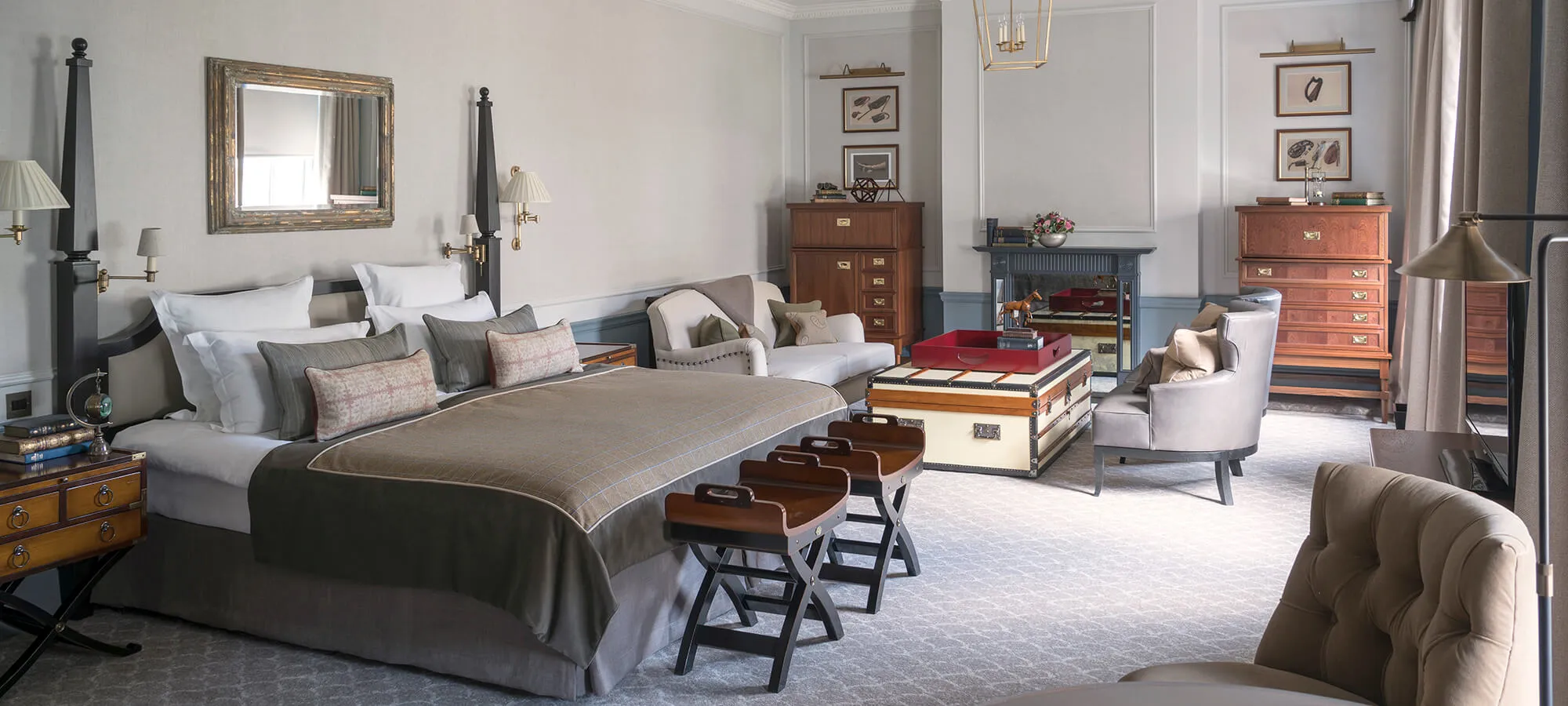
Bedrooms and suites follow a similar logic, with eight categories spread across the Main House and Braid House, ranging from classic and family rooms that overlook the hotel itself to estate rooms, sovereign rooms and the top-tier suites, among them the Royal Lochnagar Suite, the Tower Suite and the one and two-bedroom Whisky Suites, that look out over the grounds and golf courses beyond. The design brief across the upper categories favours generous, understated rooms over overt display: good linens, deep baths, tartan used as punctuation rather than wallpaper, and views treated as the real luxury rather than anything applied to the walls.
Atmosphere
Gleneagles carries itself with the particular confidence of an institution that has hosted heads of state and does not need to perform grandeur for anyone else’s benefit. The public spaces are busy without being loud: golfers coming off the course in the late afternoon, families moving between the pool and the adventure spaces, a steady traffic of guests heading to afternoon tea or to one of the bars, all absorbed easily into a building with enough scale to hold several different kinds of holiday happening simultaneously without any of them crowding the others. It reads less like a single-register luxury hotel and more like a self-contained resort town, one with its own shops, its own train station, its own falconry mews, organised around a shared reverence for the grounds.
That said, the formality never entirely disappears. Jacket-preferred dress codes persist in some of the dining rooms in the evening, staff are trained to a traditional standard of table and door service, and there remains a slightly old-world seriousness to how the hotel treats golf, tee times, handicaps, course etiquette, that marks Gleneagles out from the more relaxed, spa-led country house hotels that have opened across Britain in the past decade. It is grand rather than cosy, and guests who want intimacy tend to find it in a private bungalow experience, on a quiet fairway at dawn, or at a corner table in Restaurant Andrew Fairlie, rather than in the scale of the hotel itself.
Rooms and Suites
Gleneagles holds 205 individually designed rooms and 28 suites across the Main House and the Braid House wing, along with dedicated family rooms built for multi-generational stays. The room hierarchy runs from classic and family categories, generally overlooking the hotel and its immediate grounds, through sovereign and estate rooms, which trade a little proximity for wider views over the parkland and courses, up to the named suites: the Royal Lochnagar Suite, the Tower Suite, the Estate Suite, and the one and two-bedroom Whisky Suites, each with its own layout and outlook rather than a repeated template scaled up.
The overall design language across categories favours restraint over ornamentation, tartan and tweed used as accents against a calmer neutral palette, generous proportions, and deep baths in the upper categories, with the Braid House rooms generally offering a more contemporary finish than the older, more traditionally dressed Main House rooms. Family rooms are built with connecting configurations and enough floor space to accommodate the hotel’s wider country-house programme, given how much of a Gleneagles stay for families happens outdoors rather than in the room itself.
Dining
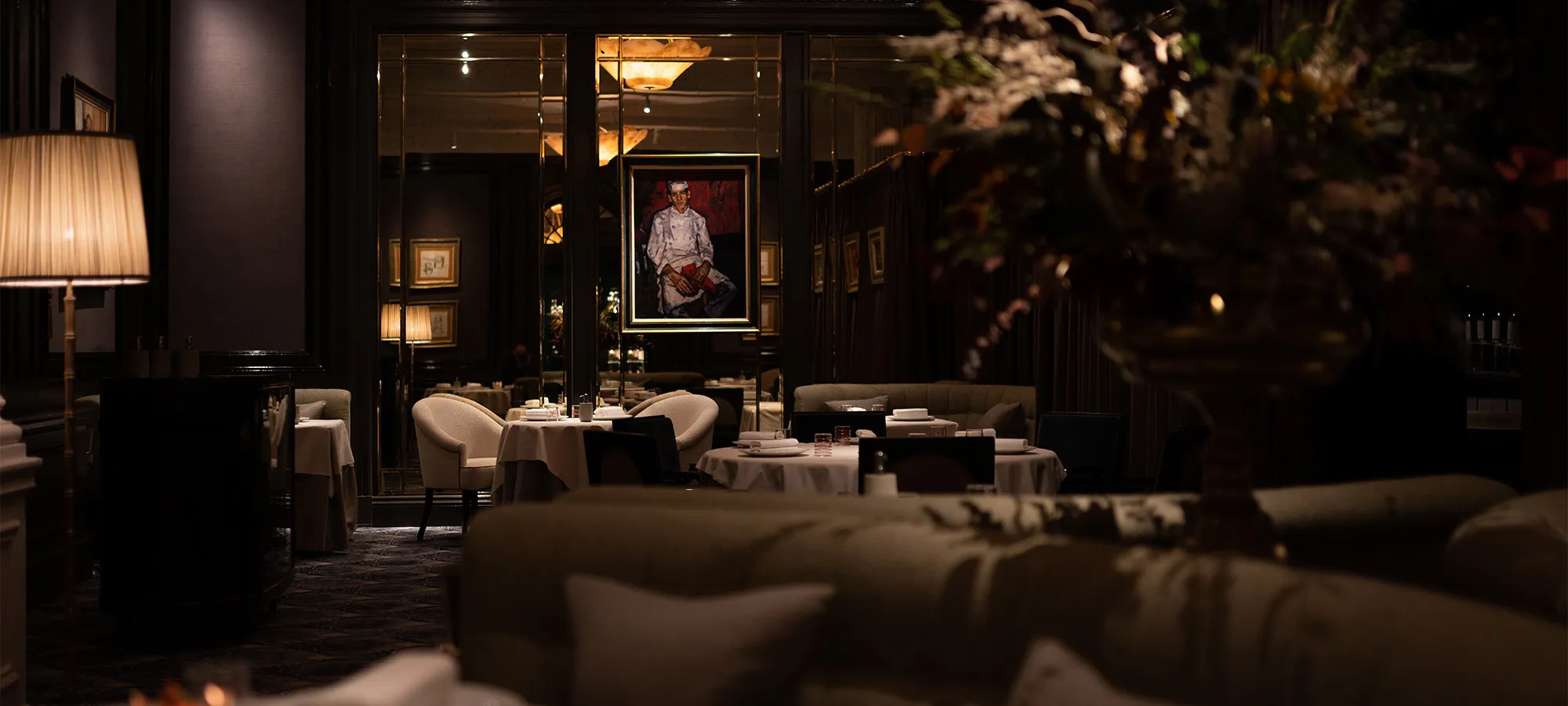
The dining question at Gleneagles inevitably starts with Restaurant Andrew Fairlie, and it is worth being precise about its status: the restaurant remains open, still carries two Michelin stars, and is still named for the chef who opened it in 2001 and who died of a brain tumour in 2019. Rather than closing or rebranding after his death, the kitchen has continued under Stephen McLaughlin, who has cooked there since the restaurant’s opening and took over as head chef, working alongside a front-of-house team that, for over two decades, was led by general manager Dale Dewsbury until his retirement in 2025. It is now recognised as Scotland’s longest-standing two-Michelin-starred restaurant, a rare case of a chef’s-name restaurant outliving its founder without losing the reason people booked it in the first place.
Beyond Restaurant Andrew Fairlie, the estate runs a genuinely broad food and drink programme built up substantially during Ennismore’s renovation: The Strathearn, the hotel’s grander all-day dining room, sits alongside The Birnam and The Dormy, the latter geared toward golfers coming straight off the course, while the American Bar, the Century Bar, The Cellar and Auchterarder 70 cover cocktails, whisky and more informal drinking and eating across the day and evening. The range is deliberate: a resort holding guests for three or four nights at a time needs more registers than a single fine-dining room can offer, and Gleneagles has built out enough of them that a stay rarely repeats the same room twice.
Spa and Wellness
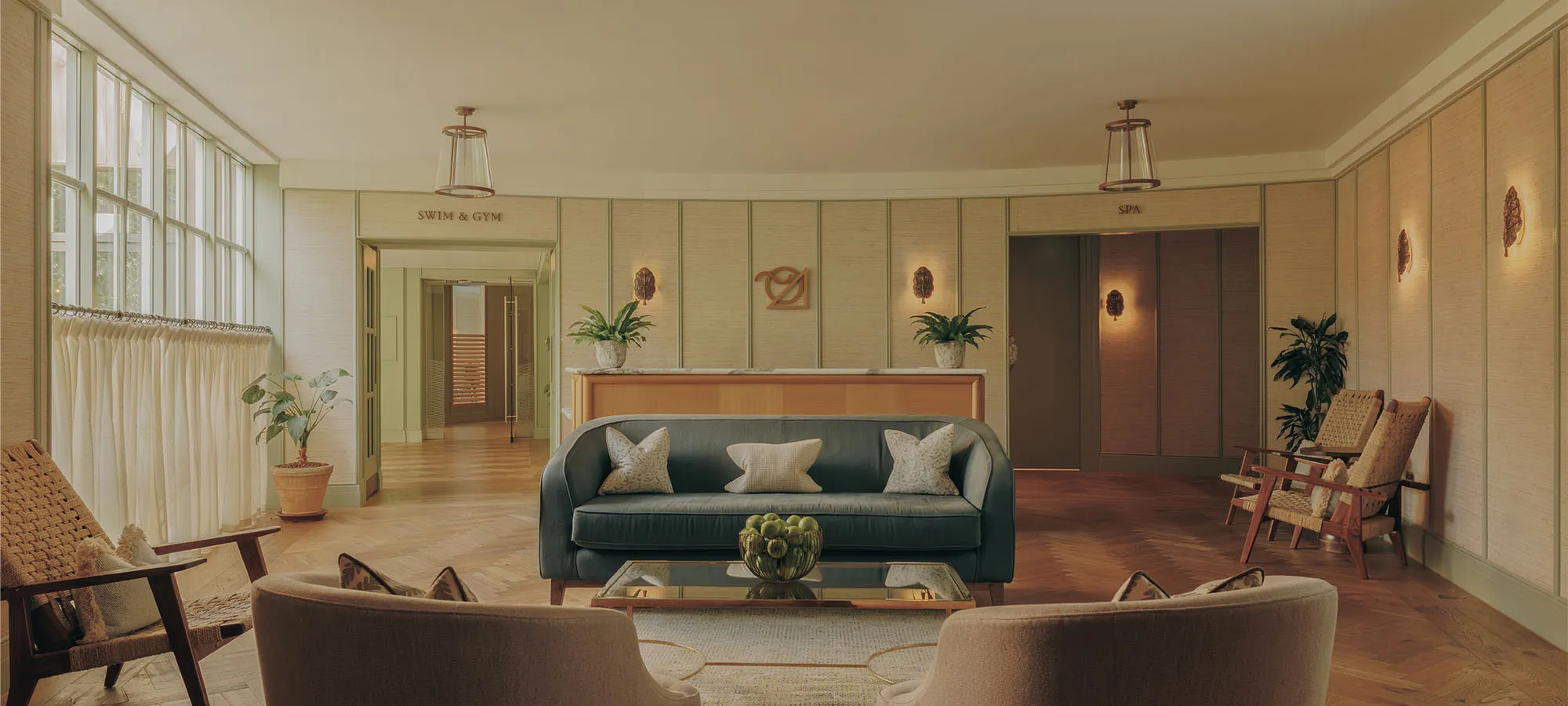
The spa at Gleneagles operates at a scale that matches the rest of the estate: 20 treatment rooms using ESPA, Grown Alchemist, Tata Harper and Dr Barbara Sturm products, alongside two indoor pools, an outdoor thermal pool, a hydrotherapy pool, indoor and outdoor hot tubs, a sauna, steam room and an arctic mist shower, gathered around an adults-only thermal suite. It is open daily and, notably, does not require an overnight stay to access, with day-spa packages sold separately that include the pools and gym alongside a treatment.
The wellness offer sits deliberately apart from the golf and country pursuits programming rather than folding into it, giving guests a genuine choice of pace across a multi-day stay: a morning on the King’s Course followed by an afternoon in the thermal suite is a common enough rhythm that the hotel’s own scheduling seems built to accommodate it. The gym and fitness facilities round out a wellness offer sized for a resort that expects to hold families and groups for several days at a time, rather than a boutique spa built for a single treatment.
Experiences
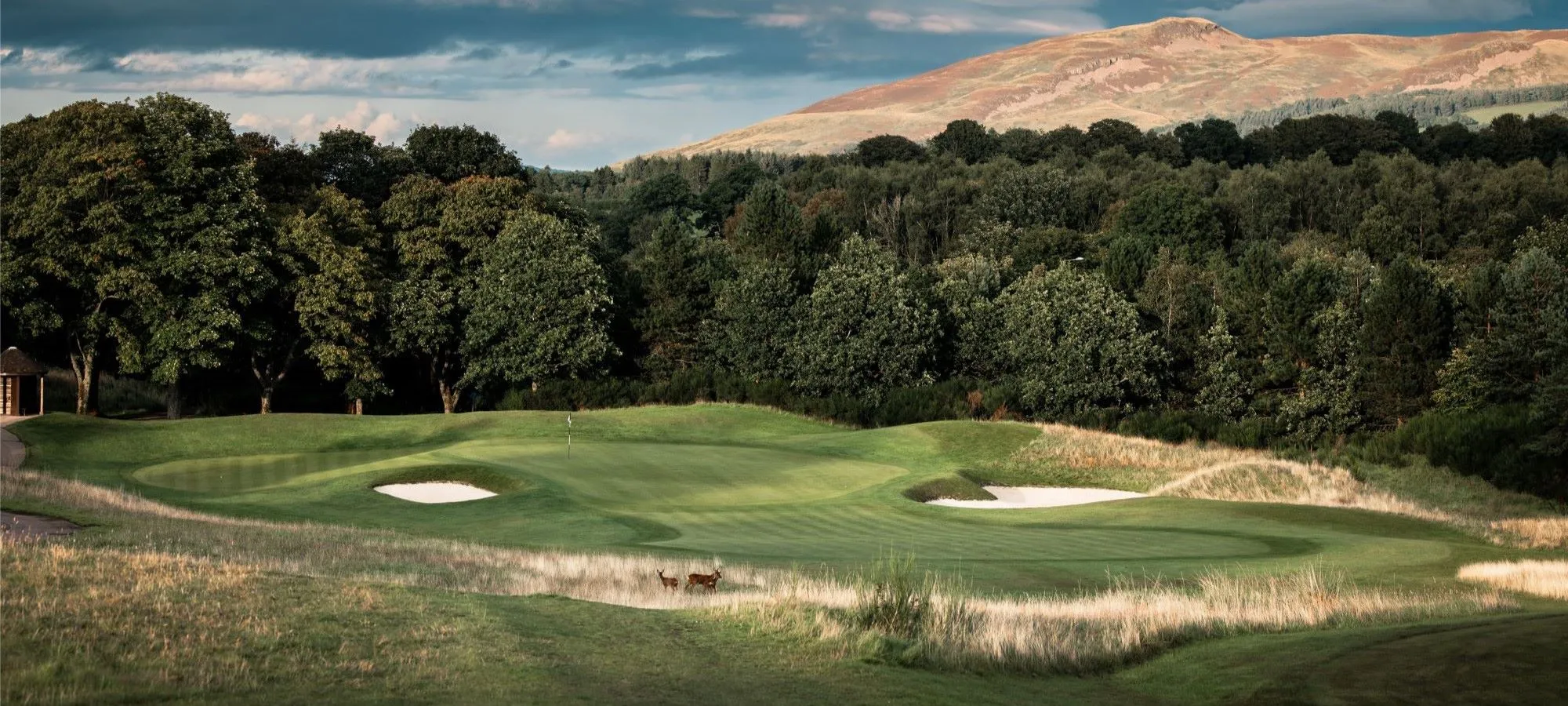
Golf is, and has always been, the organising fact of Gleneagles, and the estate now holds three championship courses that between them tell the story of how golf architecture in Scotland changed across the twentieth century. The King’s Course, laid out by James Braid in 1919 and widely regarded as his finest heathland design, remains the estate’s most decorated course, its firm, undulating fairways and views across Strathearn to the Ochil Hills largely unchanged in character since it opened five years before the hotel itself. The Queen’s Course, also by Braid, with C.K. Hutchison, is shorter and gentler but shares the same heathland character and is often recommended as a companion round rather than a lesser alternative.
The PGA Centenary Course is the estate’s modern counterpoint: designed by Jack Nicklaus and opened in 1993, it is a longer, more American-parkland style layout, and it is the course that hosted the 2014 Ryder Cup, in which Europe beat the United States 16½ to 11½ in front of record crowds. That match cemented Gleneagles’ place in golf history in a way the older courses, for all their pedigree, had not previously achieved on quite the same global stage, and the estate leans into that legacy deliberately: the course is presented and maintained with its tournament history front and centre, and it hosted the Solheim Cup again in 2019, drawing over 90,000 spectators. A shorter course, the Wee Course, rounds out the golf offer for beginners, families and anyone wanting a quicker round.
Beyond golf, Gleneagles runs one of Britain’s most extensive country pursuits programmes: falconry with resident birds of prey, clay and game shooting, fly fishing, horse riding, off-road driving, climbing, tennis, padel and water sports are all available across the estate’s roughly 850 acres, largely under the umbrella of what the hotel still markets as the British School of Falconry and its wider country pursuits operation. It is this breadth, not just the golf, that gives Gleneagles its particular identity among British resort hotels: a guest with no interest in a golf club can still fill several days entirely on the estate.
Who It Is For
Gleneagles is built for golfers first, and it delivers on that promise as thoroughly as almost anywhere in Britain: three genuinely different championship courses, Ryder Cup pedigree, and a level of golf infrastructure, caddies, practice facilities, a dedicated golfers’ dining room in The Dormy, that a serious player will notice and appreciate immediately. But the estate’s scale means it works just as well for multi-generational family groups who want a country pursuits itinerary that can occupy children, grandparents and everyone in between across several days, and for couples or small groups drawn primarily by Restaurant Andrew Fairlie and the spa rather than by golf at all.
It is less suited to travellers wanting an intimate, low-key country house stay; Gleneagles is grand and busy by design, closer to a self-contained resort than a boutique retreat, and its formality, in dress codes, in service style, in the sheer scale of the public rooms, will read as old-fashioned to guests who prefer a more relaxed register. Anyone hoping for a quiet weekend without other guests visibly around, or without golf and events happening somewhere on the grounds, should look toward one of the smaller Scottish country house hotels instead.
Best Time to Visit
May to September is the core season, when the courses are at their driest and firmest and the estate’s long Scottish evenings make the most of the grounds; this is also, unsurprisingly, the busiest and most expensive period, with the Ryder Cup-anniversary weeks in September carrying particular demand. Spring brings good golfing conditions with fewer crowds and often better rates, while autumn offers similar advantages along with the colour change across the estate’s parkland. Winter, particularly December, is its own distinct season at Gleneagles, built around Christmas and New Year house-party programming, log fires and the hotel’s grander public rooms, rather than golf, which is playable but far less central to a winter stay.
How to Get There
The nearest airport is Edinburgh (EDI), roughly 45 minutes to an hour’s drive away, with Glasgow Airport a broadly similar distance in the other direction; both keep Gleneagles within easy reach of two major international gateways rather than requiring a long onward transfer. The more distinctive option is rail: Gleneagles has its own railway station, on the main line linking London, Edinburgh, Glasgow, Perth and Inverness, situated less than two minutes from the hotel, and the hotel offers complimentary transfers for guests arriving by train. For guests driving from Edinburgh or Glasgow, the journey runs largely on motorway before a final stretch through Perthshire countryside into Auchterarder.
Nearby Experiences
Auchterarder itself, the small Perthshire town at the foot of the estate, is known locally as the “Lang Toun” for its long high street, and offers a low-key counterpoint to the hotel’s scale with independent shops, cafes and galleries worth an hour’s wander. Perth, Scotland’s newest city and a former royal capital, sits within a short drive and offers a fuller day out, with Scone Palace, the historic crowning place of Scottish kings, among its most notable sights. Stirling, with its castle and its Wallace Monument, and the wider Trossachs and Loch Lomond countryside, are both reachable as a longer day trip for guests wanting to extend beyond the estate.
For golf specifically, Perthshire and the surrounding regions hold several other notable courses that guests sometimes pair with a Gleneagles stay, while golf pilgrims making a longer Scottish trip often use Gleneagles as one stop on a wider itinerary that includes St Andrews, roughly an hour and a half away by road. Ennismore’s second Scottish property, Gleneagles Townhouse in Edinburgh, opened in 2022 inside a former Bank of Scotland building on St Andrew Square, offers a natural city-based bookend to a Gleneagles stay for guests splitting their trip between the estate and Edinburgh.
Things to Know Before Booking
Golf at Gleneagles is priced and booked separately from the room rate, and tee times on the more in-demand courses, particularly the PGA Centenary and King’s courses, are worth securing well ahead of arrival, especially across the peak May to September season. Restaurant Andrew Fairlie operates independently of the hotel’s other dining rooms with its own booking system, and given its two-star status and relatively small dining room, reservations should be made as early as possible, ideally at the time of booking the stay itself. Some of the hotel’s restaurants and public areas maintain a smart dress code in the evening, jackets in particular, which is worth checking before packing. Given the estate’s size, first-time guests are generally advised to allow a little extra time to navigate between the Main House, Braid House and the various golf, spa and activity facilities, particularly on arrival.
Sustainability
Gleneagles has pursued sustainability accreditation for longer than most comparable resorts, having become the first hotel in the UK to achieve Gold status under the Green Tourism Business Scheme in 2010, and in 2024 both Gleneagles and Gleneagles Townhouse achieved Green Key certification, one of the hospitality industry’s leading global standards for environmental management. The hotel has also committed to reaching net-zero emissions by 2040, with interim targets to cut absolute Scope 1 and 2 emissions by 42 percent and Scope 3 emissions by 25 percent by 2030, working with the Carbon Trust to establish its emissions baseline and increase its reliance on renewable energy.
The estate’s three golf courses have held GEO Certified status, the Golf Environment Organization’s environmental standard for golf facilities, since 2014, reflecting practices around water use, habitat management and course maintenance across the 850-acre estate. Investment in food waste management technology and continued work on the estate’s renewable energy reliance are ongoing parts of the sustainability programme rather than a one-off certification exercise.
Practical Information
Gleneagles holds 205 rooms and 28 suites across the Main House and Braid House wing. Check-in is from 3:00 PM and check-out by 11:00 AM. Rates begin from around £650 per night and vary considerably by room category, season and demand, particularly around peak golf weeks and the Christmas and New Year period. The nearest airport is Edinburgh (EDI), about 45 minutes to an hour away by road, with Gleneagles’ own railway station immediately adjacent to the hotel and served by direct trains from Edinburgh, Glasgow and further afield. The hotel is a member of The Leading Hotels of the World. Golf, spa treatments and some country pursuits are booked and charged separately from the room rate, and are worth arranging in advance of arrival, particularly across the May to September season.
Editorial Conclusion
Few hotels anywhere can claim to have been built for one purpose and then to have grown, without losing the thread of it, into a national institution: a G8 summit, a Ryder Cup, a Solheim Cup, a two-Michelin-starred restaurant that outlived the death of the chef whose name it carries. Gleneagles has managed all of that while still functioning as a working resort hotel that a family can book for a long weekend, and the fact that Ennismore’s ownership has expanded and modernised the property since 2015 without disturbing what makes it distinctive, the golf, the country pursuits, Restaurant Andrew Fairlie, says a good deal about how carefully that renovation was handled. It remains, above all, a golf resort of genuine historical weight rather than a country house hotel that happens to have a course attached, and it rewards guests who come prepared to spend several unhurried days finding out just how much the estate actually offers beyond the fairways.
In pictures
On the map
Auchterarder, United Kingdom
Questions
Frequently asked
Is Restaurant Andrew Fairlie still open, given that Andrew Fairlie died in 2019?
Yes. Restaurant Andrew Fairlie continues to operate inside the hotel under the name of its founder, run today by chef Stephen McLaughlin, who has worked in the kitchen since it opened in 2001. It holds two Michelin stars and is recognised as Scotland's longest-standing two-star restaurant.
Who owns Gleneagles now?
Gleneagles is owned and operated by Ennismore, the London-based hospitality group led by Sharan Pasricha, which bought the estate from drinks conglomerate Diageo in 2015 and has since carried out a multi-year renovation of the bedrooms, restaurants and bars.
Can non-guests play the golf courses or use the spa?
Tee times on the King's, Queen's and PGA Centenary courses are open to non-resident visitors subject to availability and are generally easier to secure with advance booking. The spa also sells day access that includes the pools, thermal suite and gym, separate from an overnight stay.
How far is Gleneagles from Edinburgh and Glasgow?
Both Edinburgh and Glasgow airports are under an hour's drive away. Gleneagles also has its own railway station, immediately adjacent to the hotel, with direct services from Edinburgh, Glasgow and further afield on the main London to Inverness line.
What is the PGA Centenary Course and why is it significant?
It is one of Gleneagles' three championship courses, designed by Jack Nicklaus and opened in 1993. It hosted the 2014 Ryder Cup, in which Europe defeated the United States 16½ to 11½, and remains the estate's dedicated tournament course, distinct from the older heathland King's and Queen's courses.
Same destination
More hotel guides in United Kingdom
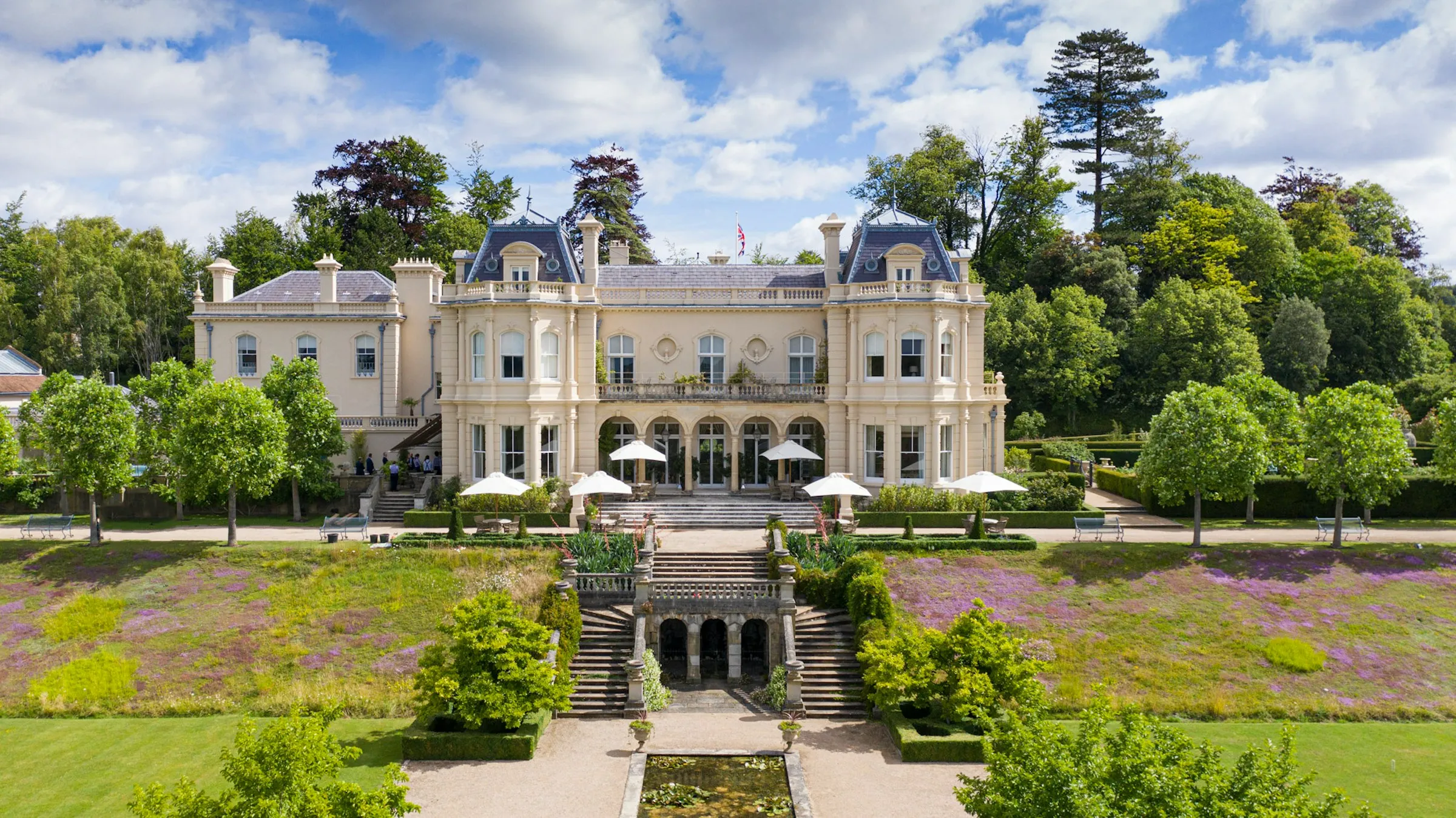
near Leatherhead, United Kingdom
Beaverbrook
A press baron's Surrey estate, once Churchill's wartime refuge, run today as one of England's most quietly assured country house hotels.
From £475 per night
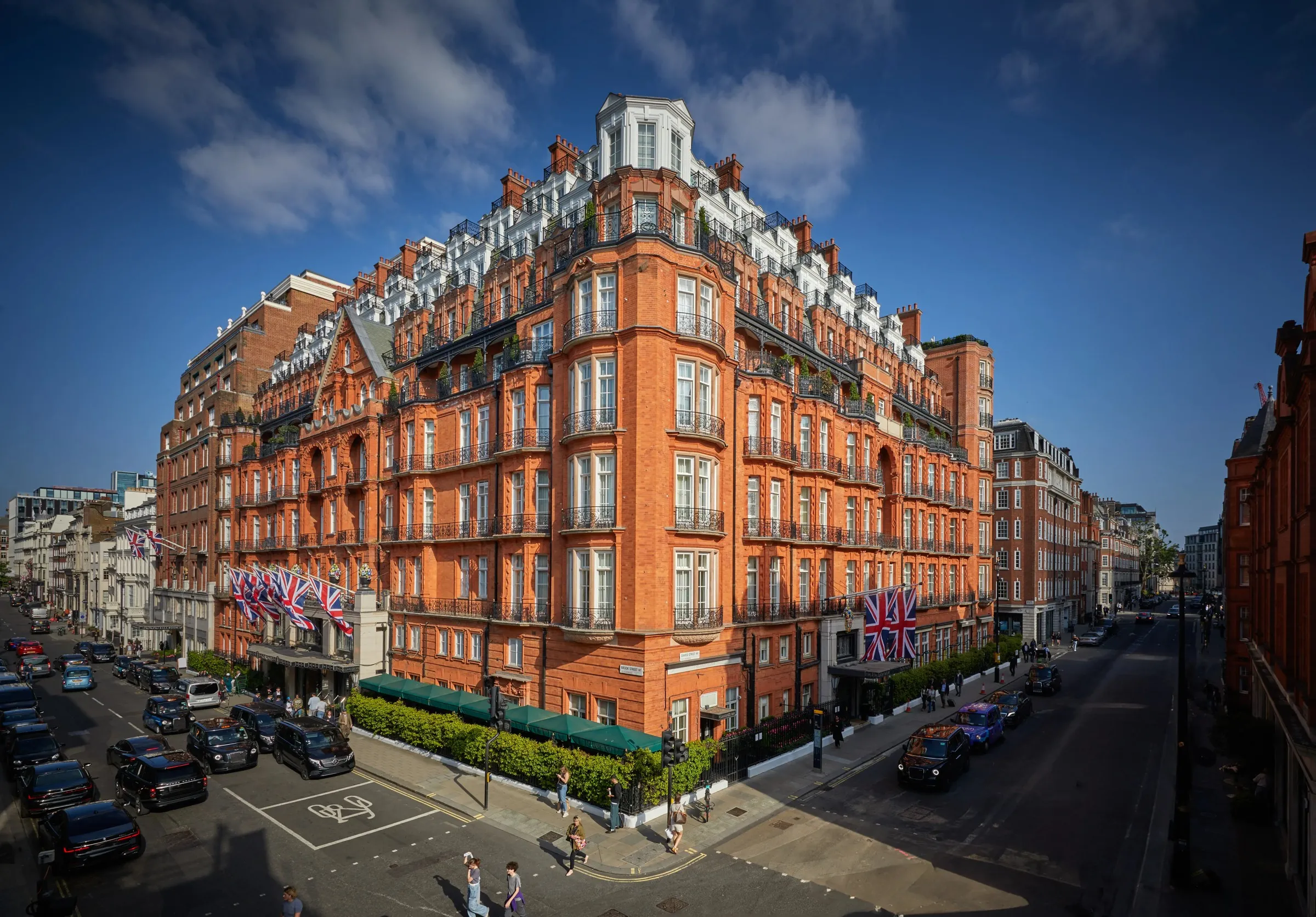
Mayfair, United Kingdom
Claridge's
A 1930s Art Deco time capsule on a Mayfair corner, still the most self-assured address in London.
From £950 per night
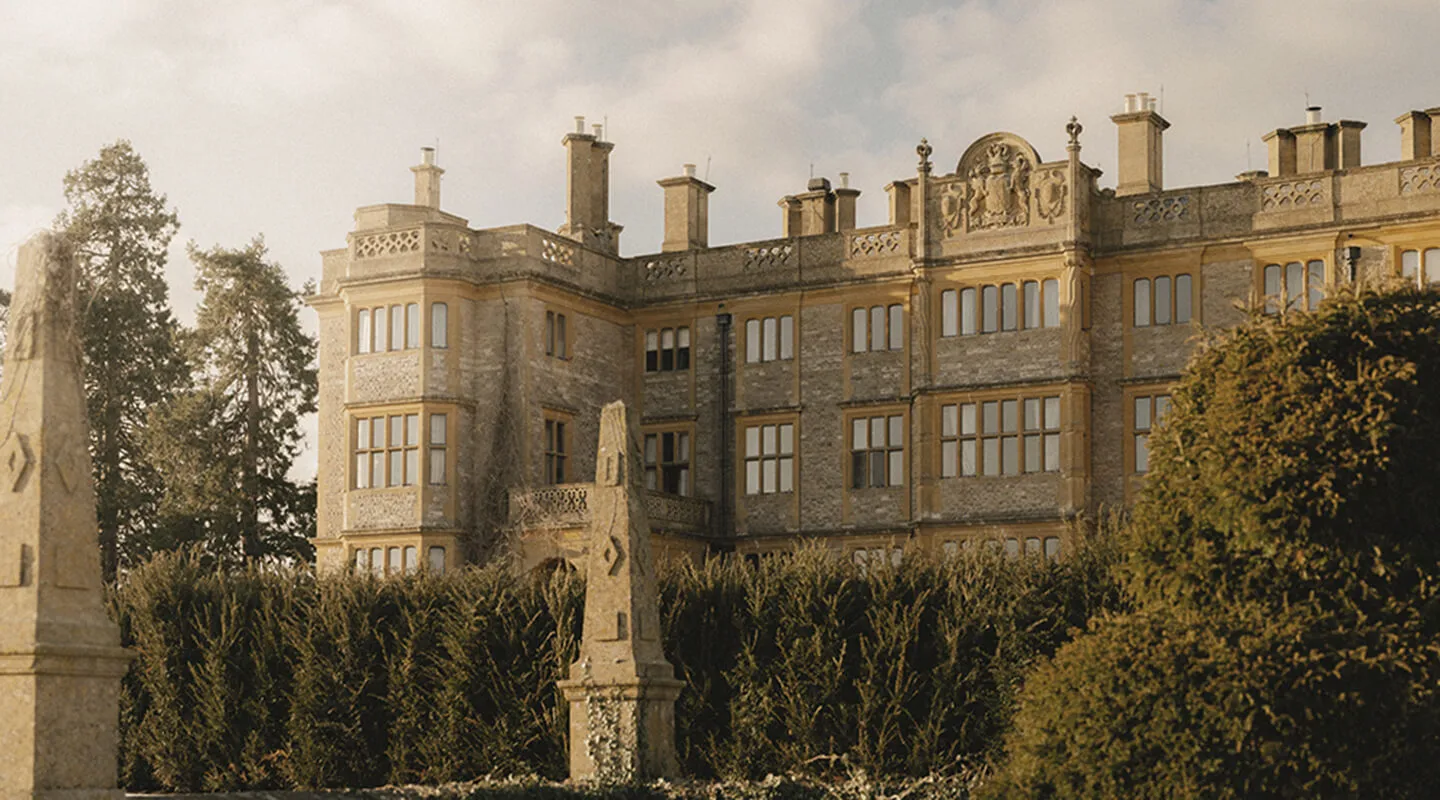
near Witney, United Kingdom
Estelle Manor
A Jacobethan manor turned country club, where a Roman-style bathhouse now sits where a police training centre once stood.
From £450 per night