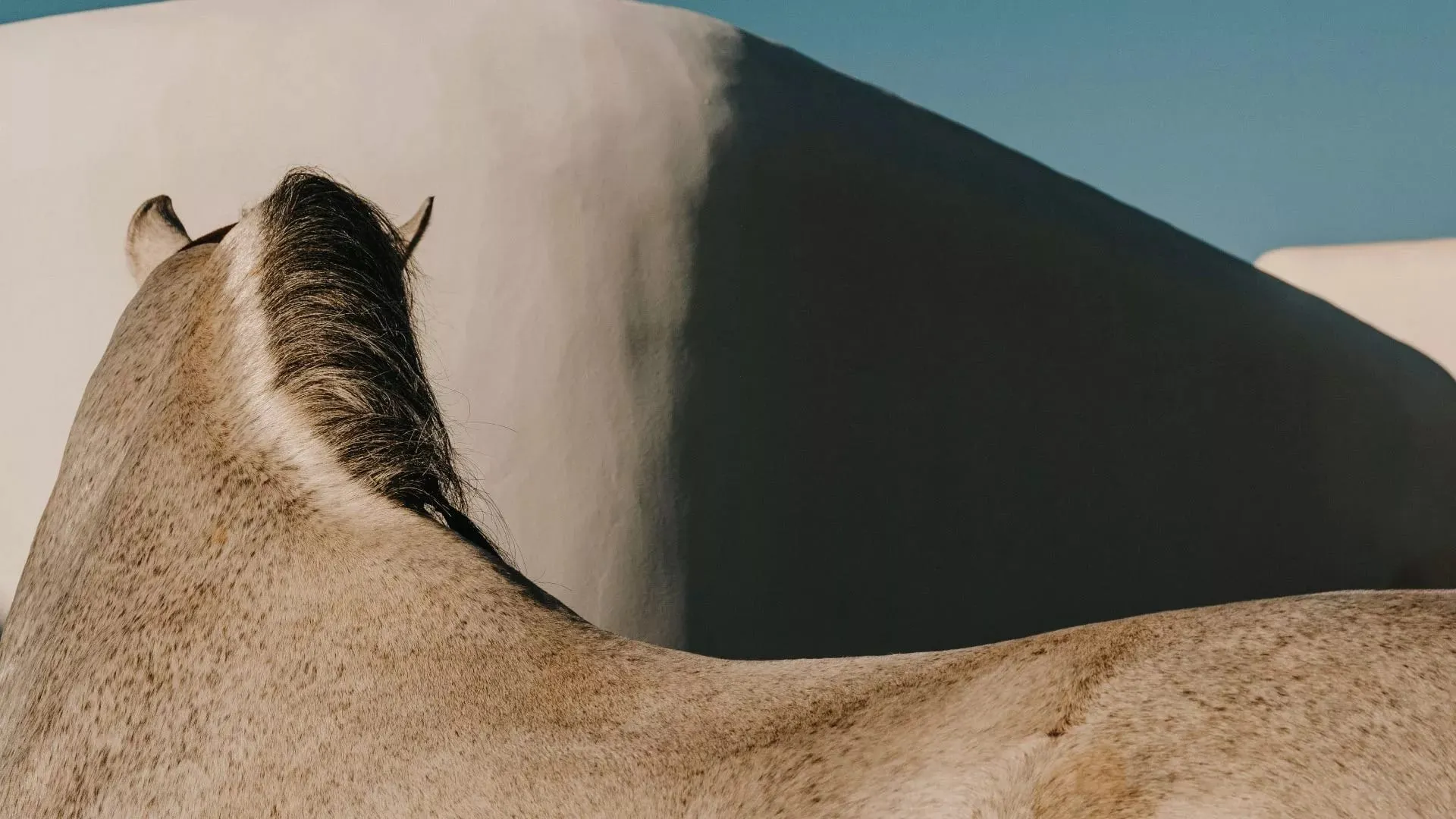
Ornos, Mykonos, Greece
Kalesma Mykonos
A whitewashed hillside village above Ornos Bay where every suite has its own heated pool and K-Studio's architecture reads less like a hotel than an extended Cycladic family home.
- Rates from
- From €960 per night
- Nearest airport
- Mykonos Island National Airport (JMK)
- Transfer
- About 15 minutes by road
- Best months
- Late May to June, and September to early October
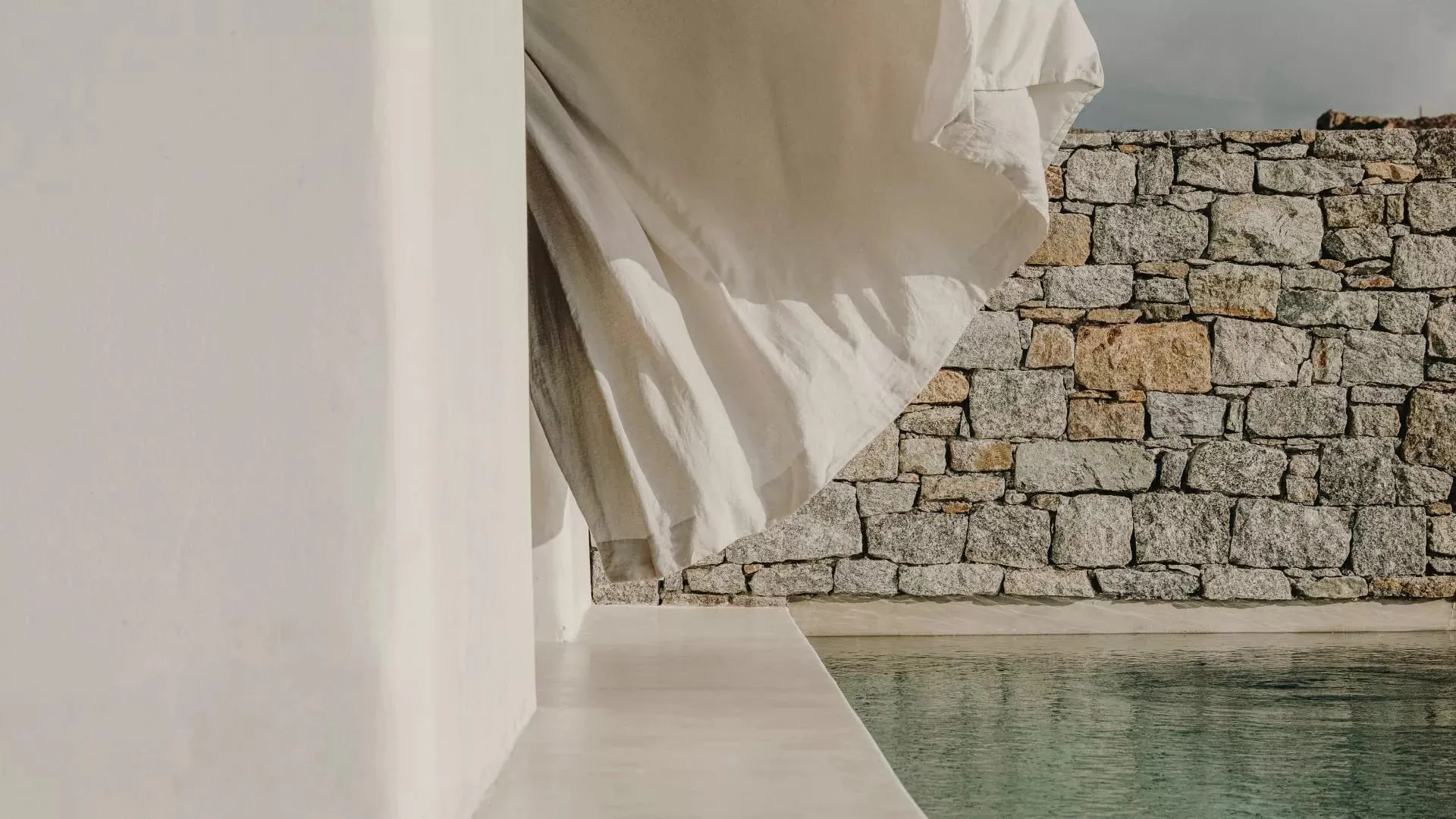
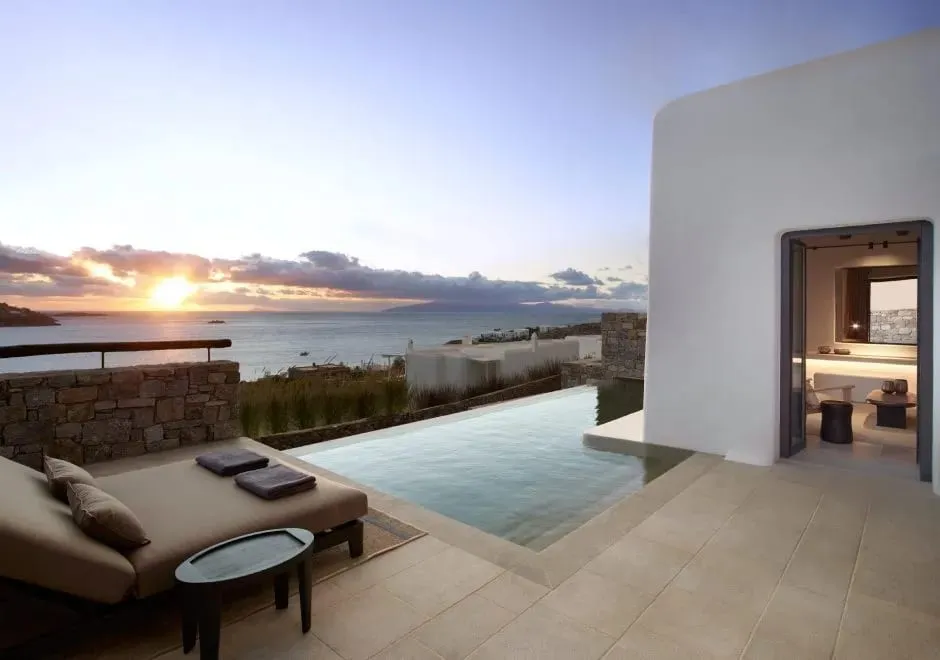
There is a specific kind of Mykonos hotel photograph that has become almost a cliché by now: a whitewashed cube, a blue-edged pool, the Aegean dropping away behind it. Kalesma Mykonos produces that photograph too, but it arrives at it from an unusual angle. Rather than a single hero infinity pool shared by the whole property, nearly every one of its suites and villas has its own, stepped down a five-acre hillside above Ornos Bay in a cluster the architects have described, only half rhetorically, as a village.
That word matters more than it might in most hotel marketing copy. Kalesma opened in April 2021, the work of Athens-based architecture practice K-Studio and interior studio Bonarchi, and its central design premise was to reject the long horizontal hotel block that dominates so much of Mykonos’s newer building stock in favour of a scatter of small, individually roofed volumes linked by stone paths, courtyards and terraces, in the manner of an old Cycladic settlement rather than a resort. The site’s own history gave the idea a literal anchor: an existing aloni, a circular stone threshing floor once used to process wheat, sat on the property before construction began, and it became both a physical feature retained in the finished design and the conceptual seed for everything built around it.
The result, four building seasons and one significant 2025 expansion later, is a property that has moved fairly quickly from promising newcomer to genuinely decorated address: Best Resort in Greece at the Travel + Leisure World’s Best Awards 2024, a place on Condé Nast Traveler’s 2025 Gold List, and a Michelin Key in the guide’s first-ever Keys selection for Greek hotels. None of those honours were guaranteed when Kalesma opened quietly, three developers with an Athens restaurant background rather than an established hospitality group behind it, into a Mykonos hotel market that already had no shortage of confident new entrants.
What follows is an attempt to separate what actually distinguishes Kalesma, architecture, private pools as standard, a genuinely considered spa and restaurant programme, from the more generic ultra-luxury-on-Mykonos claims that could describe half a dozen of its hillside neighbours.
Why It Stands Out
The clearest, least arguable distinction is structural: at Kalesma, a private heated pool is the rule rather than the upsell. The property’s original 27 accommodations, 25 one-bedroom suites and two multi-bedroom villas, were all built with their own pool and terrace from the outset, a decision that shaped the whole hillside layout since every unit needed direct outdoor access and enough separation from its neighbours to feel private. Most Mykonos hotels reserve that feature for a handful of top-tier suites; Kalesma made it the baseline.
The second distinction is architectural coherence. K-Studio, the practice behind the design, is also responsible for Mykonos’s newer airport terminal, and its founders have spoken about Kalesma specifically as an attempt to reinterpret the extended Cycladic family compound rather than build a conventional hotel. The whitewashed, rounded, small-scale volumes, deliberately broken apart rather than consolidated into one large structure, are a legible expression of that idea rather than a marketing gloss over a standard floor plan.
The third is the speed and specificity of the property’s critical recognition. A Michelin Key in the guide’s debut Greek selection and a Travel + Leisure World’s Best Award for Best Resort in Greece, arriving within its first three or four seasons of operation, put Kalesma in a different conversation than a merely well-photographed newcomer. That recognition, alongside a considered restaurant and spa programme rather than a single flagship pool, is what separates it from Mykonos properties trading primarily on scale or on a famous beach club.
Architecture
Kalesma sits on a five-acre hillside in Aleomandra, on the quieter southwestern flank of the island above Ornos Bay, roughly two miles from Mykonos Town. K-Studio’s design, led by brothers Dimitris and Konstantinos Karampatakis, arranges the property’s suites and villas as a cluster of small, individually articulated whitewashed volumes rather than a single connected wing, a choice the architects have framed explicitly around the idea of a Mykonian village rather than a hotel in the conventional sense.
The site’s original aloni, a stone threshing floor used historically to process grain, was preserved and became a literal and conceptual centrepiece: its circular geometry and rough stone surface recur, in reinterpreted form, across communal areas of the property. Around it, the whitewashed cubist blocks that hold the guest accommodation step down the slope in a loosely organic pattern, following the hill’s natural contours rather than a rigid grid, with stone paths, low walls and small courtyards breaking up sightlines between units so that neighbouring pools and terraces stay visually separate from one another despite the density of the layout. Roughly 20,000 plants were introduced across the grounds as part of the build, softening what could otherwise read as a fairly compact, high-density hillside development.
Pere Ubu, the estate’s principal restaurant, occupies the property’s highest point, a positioning that gives it the most complete 360-degree sea views on site and effectively treats the summit of the hill as a communal room rather than reserving it for a single top suite.
Interior Design
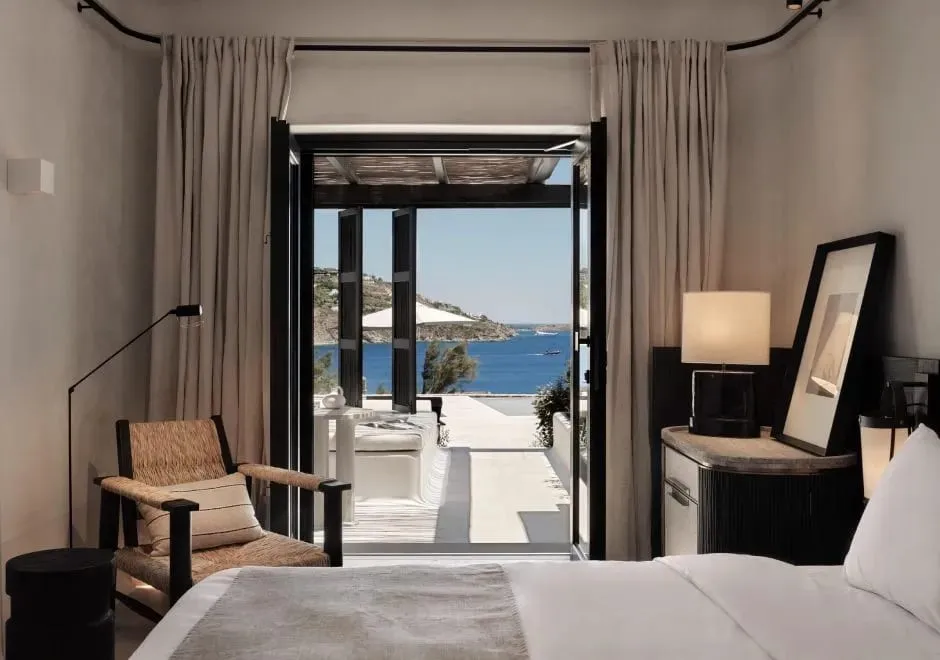
Interiors are the work of Studio Bonarchi under creative director Vangelis Bonios, and they lean into a materials-first version of Cycladic style rather than a purely white, minimalist reading of the aesthetic. Brushed oak, bush-hammered stone and patinated brass recur throughout the suites and public spaces, paired with earth-toned textiles and traditional whitewashed plaster finishes, a combination the design team has described as pursuing “noble, authentic simplicity” over decorative flourish.
Original artwork by the Serbian ceramic artist Aleksandar Vac punctuates communal areas with rougher, more sculptural Cycladic-adjacent forms, and furniture throughout draws on a mix of custom Bonarchi pieces and select design-world names, including, in the lobby, pieces by the fashion designer Rick Owens, an unusual choice for a Greek island hotel that has been noted by several design publications covering the property.
Suites are organised as open, low-clutter one-bedroom layouts that treat the private terrace and pool as a continuation of the living space rather than a separate outdoor amenity, with outdoor showers and poolside sun loungers built into the same footprint. The two original grand villas, Apollon and Artemis, extend the same material language across larger, multi-bedroom footprints designed for groups rather than couples, while the Deluxe Rooms and Junior Suites added in the 2025 expansion apply a related but slightly more compact version of the same palette.
Atmosphere
Kalesma’s mood is deliberately closer to a private hillside compound than a conventional resort, a distinction the ownership group, three partners with an Athens restaurant background rather than a hotel-chain pedigree, appears to have pursued on purpose. Public spaces are limited and considered rather than sprawling: a lobby, the restaurant and lounge areas at the property’s summit, the spa, and the paths connecting them, with no large central pool deck acting as the social hub the way it would at a bigger resort.
That structure pushes much of the day toward the individual suite terrace and pool rather than a shared amenity, giving Kalesma a quieter, more insular character than Mykonos hotels built around one dominant pool scene. Evenings shift the energy toward Pere Ubu and the Aloni Sunset Lounge, both positioned to catch the view toward Delos as the light changes, with the restaurant’s DJ-accompanied dinner service giving the property a more sociable, later-night register without spilling into the club-scale party atmosphere associated with some of Mykonos’s beachfront hotels. Staff ratios and the compact scale of the estate, even after the 2025 expansion, keep the tone personal rather than processed.
Rooms and Suites
Kalesma’s original accommodation, the core of the property since its 2021 opening, comprises 25 one-bedroom suites and two grand villas, Apollon and Artemis, all with private heated pools and sea-facing terraces as standard. The suites are arranged in a few tiers, from the entry Kalesma Suite through sea-view and larger one-bedroom villa categories, with the named Leto Villa adding its own private infinity pool at the top of that range. Apollon, a three-bedroom villa, and Artemis, a four-bedroom villa, sit at the summit of the accommodation offer, built for larger family or friend groups who want a fully private, self-contained base with round-the-clock butler service rather than shared hotel facilities.
In 2025 the property added 19 further rooms and suites: Deluxe Rooms with Sea View and Junior Suites with Sea View and Jetted Tub, both more compact categories that do not include a private pool but gain access to a newly built shared pool introduced as part of the same expansion, alongside a new all-day Greek tavern. This addition broadened Kalesma’s price ladder meaningfully, giving the property an entry point below its original pool-suite baseline for the first time, though guests specifically booking Kalesma for a private pool should confirm they are booking from the Kalesma Suite category upward rather than one of the newer Deluxe or Junior categories.
All pool-equipped categories include heated water, typically kept around 23°C, private terraces with sun loungers, and outdoor showers, features that were part of the original design brief rather than later additions.
Dining
Kalesma’s food and beverage programme is anchored by Pere Ubu, the all-day restaurant occupying the property’s highest point, run under executive chef Costas Tsingas and developed by the same Athens-based trio behind the hotel itself, who also built the Athens restaurants Sea Spice, Pere and Ubu. The kitchen works a modern Greek and broader Mediterranean menu built around Cycladic produce, island cheeses and fish sourced from neighbouring islands, moving from a mezze-driven lunch service into a more theatrical dinner with occasional DJ sets, and it has been the venue most consistently singled out in the hotel’s press coverage and awards recognition.
Kuveda, introduced as part of the 2025 expansion, takes a more casual, tavern-style approach, framed by the hotel as a revival of the village kafenion, all-day and built around traditional Greek recipes rather than the more composed cooking at Pere Ubu. The Aloni Sunset Lounge, positioned to look directly toward Delos, functions as the property’s golden-hour ritual, serving drinks and light bites as the light changes over the sacred island, while a Pool Bar covers the more casual daytime rhythm of swimming and lounging between the two.
Sustainability runs through the kitchen’s sourcing as much as through the hotel’s operations more broadly: Kalesma has publicised a farm-to-table approach that draws on nearby producers and aims to use produce fully rather than waste offcuts, a stance the hotel frames as core to its identity rather than a side initiative.
Spa and Wellness
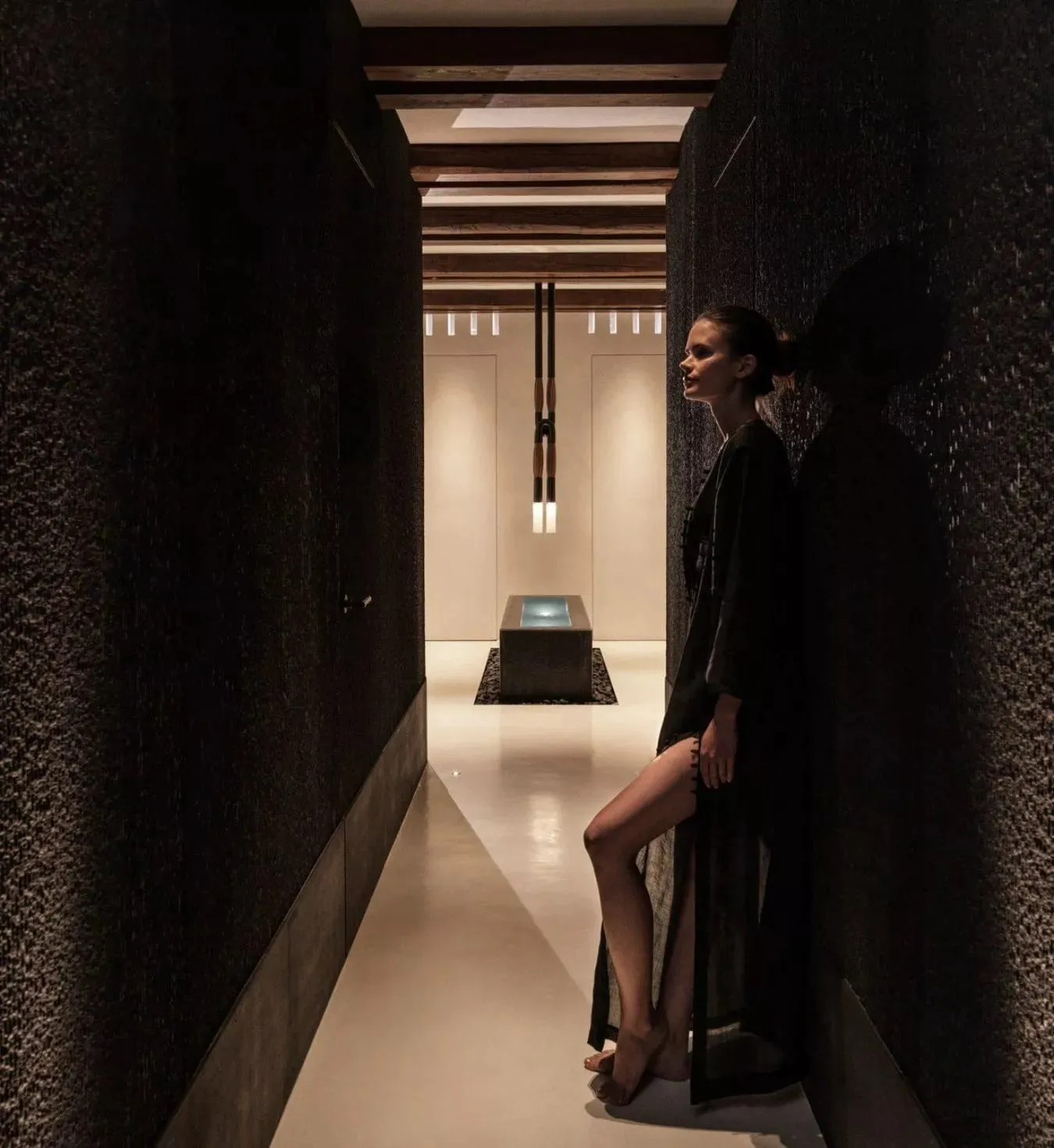
Wellness at Kalesma is organised around The Spa at Kalesma, a compact but carefully curated facility built into the hillside layout rather than a large standalone building. Facial treatments run on Dr. Barbara Sturm’s science-led skincare line, and the spa also carries Beau Domaine, the skincare brand co-founded by Brad Pitt, alongside body treatment programmes drawing on both traditional and more contemporary techniques.
Facilities include two indoor treatment rooms with private showers, a traditional hammam, a KLAFS sauna, and a Brass Monkey cold plunge, supported by Gharieni treatment beds and a Technogym-equipped fitness area. An Open-Air Wellness Sanctuary extends treatments outdoors, and the spa’s programming leans into the property’s proximity to Delos, offering sound and energy rituals, including Tibetan bowl sessions and open-water Sacred Sound Journeys, alongside indoor and outdoor yoga. A retail counter, the Glow Bar, rounds out the offer for guests wanting to take products home. The spa is compact by the standards of a large resort, which suits a property built primarily around private-pool suites where a significant share of wellness time happens on guests’ own terraces rather than in a communal spa building.
Experiences
Much of what Kalesma offers beyond the suite terrace draws directly on its hillside setting and its sightline to Delos, the uninhabited island considered sacred in Greek mythology as the birthplace of Apollo and Artemis, whose stables were, according to local legend, once sheltered in the Aleomandra region where the hotel now stands. That mythological framing runs through the property’s wellness programming and its two grand villa names, and the hotel arranges cultural excursions to Delos itself, a UNESCO World Heritage Site and one of the most significant archaeological sites in Greece, reachable by boat from Mykonos.
Closer to the property, Kalesma offers yacht charter arrangements and a beach concierge service connecting guests to Mykonos’s beach club circuit, useful given the hotel’s own hillside position sits a short drive rather than a direct walk from the sand. A private chapel on the estate is available for weddings and small ceremonies, reflecting a broader trend among Mykonos’s higher-end hotels toward hosting destination weddings and events. Guests focused purely on staying put can also lean on the spa’s Sacred Sound Journeys and yoga sessions, or simply make use of the suite’s own pool and terrace, which for many guests functions as the primary activity of the stay.
Who It Is For
Kalesma is built, in both its architecture and its accommodation mix, primarily around couples: the original 25 suites are one-bedroom layouts, the design language leans toward quiet, adult-oriented restraint, and the hotel does not run a structured children’s programme. Honeymooners and couples celebrating a milestone are the clearest fit, particularly those who want the specific combination of a private pool, considered architecture and strong restaurant programme rather than a beach club scene as the centre of the stay.
The two grand villas, Apollon and Artemis, extend that fit to larger groups, families travelling multi-generationally or friends sharing a villa, who want a fully private, self-contained base with butler service rather than shared resort facilities; this is a more natural use of the villas than a young family seeking supervised kids’ activities, which the property is not set up to provide. Design-focused travellers with a specific interest in K-Studio’s or Studio Bonarchi’s work, and guests who value Mykonos’s restaurant and nightlife culture but prefer to retreat to a quieter hillside base rather than stay directly on a party beach, are also well matched to what Kalesma offers.
Best Time to Visit
Mykonos operates on a firmly seasonal hotel calendar, and Kalesma follows that pattern, generally opening in late April and closing in mid-October. Within that window, July and August bring the island’s peak heat, the strongest Meltemi winds, the fullest beach clubs and nightlife, and the highest hotel rates, a combination that suits travellers specifically chasing Mykonos’s party-season reputation but that also means the busiest crowds and the steepest prices at Kalesma itself.
The shoulder months, late May into June, and September into early October, offer a more balanced trade: sea temperatures remain comfortable for swimming, the Meltemi is generally less intense, restaurant and beach club bookings are easier to secure, and hotel rates sit meaningfully below the July and August peak. For travellers prioritising the private-pool suites and the quieter, architecture-led character of the property over the island’s high-summer social scene, these shoulder windows tend to be the more rewarding time to book.
How to Get There
All guests arrive via Mykonos Island National Airport (IATA code JMK), which sits close to Mykonos Town and receives both international charter and scheduled flights, as well as frequent domestic connections from Athens, particularly in the high season. From the airport, Kalesma is roughly 15 minutes away by road, and the hotel arranges private transfers for guests who confirm flight details in advance; a fleet of electric vehicles is used for at least part of this service as part of the property’s broader sustainability commitments.
An alternative arrival route runs via the Athens-Piraeus ferry network, with high-speed catamaran services connecting Piraeus port to Mykonos’s New Port in around two and a half to five hours depending on the vessel and route; this option suits travellers combining Mykonos with an Athens stay or an island-hopping itinerary through the Cyclades rather than those prioritising the shortest possible transfer time.
Nearby Experiences
Ornos Bay itself, from which Kalesma takes much of its outlook, sits at the base of the hill the hotel occupies, with Ornos Beach a short drive away offering a calmer, more family-oriented stretch of sand than Mykonos’s more exposed beach-club coastline. Mykonos Town, roughly two miles or a short drive from the property, gives guests access to the island’s well-known whitewashed old town, its windmills, and its concentrated cluster of boutiques, galleries and restaurants along Matoyianni Street.
Delos, visible from Kalesma’s own hillside and from the Aloni Sunset Lounge in particular, is reachable by a short boat excursion and ranks among the most significant archaeological sites in Greece, a UNESCO World Heritage Site that was, according to myth, the birthplace of Apollo and Artemis, the deities for whom the hotel’s two grand villas are named. Further along the coast, Mykonos’s well-known beach club circuit, including Psarou and Paraga, gives guests seeking a livelier beach-day scene an easy day-trip alternative to the hotel’s own quieter pool terraces.
Things to Know Before Booking
Not every accommodation category at Kalesma includes a private pool: the original 27 suites and villas do, but the Deluxe Rooms and Junior Suites added in 2025 rely instead on a newly built shared pool, so travellers specifically booking for a private pool should confirm the exact category before reserving. The hotel operates seasonally, generally from late April to mid-October, and closes entirely outside that window, a standard pattern for Mykonos hotels but one worth checking against specific travel dates.
Kalesma sits on a hillside above Ornos Bay rather than directly on a beach, so guests wanting immediate beach access without a short drive should factor that into expectations, even though the hotel’s own private pools reduce how much that distinction matters for many stays. The spa is compact relative to the scale of some competing resorts, better suited to individual treatments and shorter wellness rituals than an extensive daily programme. Standard check-in is 3:00pm and check-out 11:00am, with early or late arrangements available on request, subject to availability.
Sustainability
Kalesma has published a fairly detailed set of operational sustainability commitments alongside its design and dining story. The hotel uses freon-free, energy-saving cooling technology across guest rooms and public areas, runs equipment and appliances in energy-saving modes, and has pursued a solar panel programme aimed at reaching a substantially renewable energy supply, targeted around October 2024. Guest transportation includes a fleet of electric vehicles, and housekeeping practices include eco-friendly cleaning products, recycled toilet paper, and a linen-and-towel-change-on-request policy intended to reduce water use and unnecessary laundering.
On the sourcing side, the hotel has emphasised working with local and regional suppliers across construction, furnishing and food and beverage operations, and its restaurants publicise a farm-to-table approach built around nearby producers and full use of ingredients rather than high-wastage kitchen practices. As with most hotel-reported sustainability programmes, these figures and commitments reflect the property’s own disclosures rather than independent third-party audit, and guests with a specific interest in the detail are best served asking directly on property or via the hotel’s own sustainability page.
Practical Information
Kalesma Mykonos sits on a five-acre hillside above Ornos Bay in Aleomandra, on Mykonos’s southwestern side, roughly two miles from Mykonos Town and about 15 minutes by road from Mykonos Island National Airport. The property opened in April 2021 with 25 one-bedroom suites and two grand villas, Apollon and Artemis, all with private heated pools, and expanded in 2025 with 19 further rooms and suites, Deluxe Rooms with Sea View and Junior Suites with a jetted tub, plus a new shared pool and an all-day Greek tavern.
Dining runs across Pere Ubu, the signature restaurant at the property’s summit, Kuveda, a more casual tavern-style venue added in 2025, the Aloni Sunset Lounge facing Delos, and a Pool Bar. Wellness is handled through The Spa at Kalesma, working with Dr. Barbara Sturm and Beau Domaine skincare alongside a hammam, sauna, cold plunge and gym. The hotel operates seasonally, generally late April to mid-October, with standard check-in at 3:00pm and check-out at 11:00am. Indicative rates start from around €960 per night in low season for entry categories, rising to roughly €1,700 per night and beyond for pool suites in high season, though guests should confirm current rates directly with the hotel given how significantly Mykonos pricing moves between shoulder and peak season. A stay of three to four nights gives most guests time to settle into a suite routine, take in Pere Ubu and Kuveda, a spa treatment or two, and at least one evening at the Aloni Sunset Lounge watching the light change over Delos.
Editorial Conclusion
Kalesma’s case rests less on any single showstopping feature than on the discipline of a fairly simple idea, that a private pool should be the default rather than the reward, carried consistently through the architecture, the room mix and even the way the hillside itself was built. K-Studio’s decision to break the hotel into a scatter of small whitewashed volumes rather than one long block, anchored around a preserved threshing floor, gives the property a genuine sense of place that a more generic Cycladic-luxury build would lack, and the Michelin Key and Travel + Leisure recognition that followed within a few seasons suggest that discipline has been noticed well beyond the usual hotel-press circuit.
Where the calculation gets more specific is in the 2025 expansion: the new Deluxe Rooms and Junior Suites broaden Kalesma’s price ladder and make the address reachable to more travellers, but they also mean the property’s founding promise, a pool with every stay, no longer applies to every category on the booking page. For couples specifically seeking that original idea, a hillside suite with its own heated pool, considered architecture, and a restaurant programme built by people who know Athens dining as well as Mykonos hospitality, Kalesma remains one of the more coherent arguments on the island for what a small, design-led hotel can be.
In pictures
On the map
Ornos, Mykonos, Greece
Questions
Frequently asked
Do all rooms at Kalesma Mykonos have private pools?
The property's original 27 accommodations, 25 one-bedroom suites and two grand villas, all come with a private heated pool. In 2025 Kalesma added 19 further rooms and suites, Deluxe Rooms with Sea View and Junior Suites with a jetted tub, which do not have private pools but do have access to a new shared pool added as part of the same expansion. Guests who want a private pool as standard should book from the Kalesma Suite category upward.
How far is Kalesma Mykonos from the airport and from Mykonos Town?
Mykonos Island National Airport is about 15 minutes away by car, and the hotel arranges private transfers for guests. Mykonos Town is roughly 3 to 4 kilometres from the property, a short drive along the coast, while Ornos Beach itself is only a few minutes away at the base of the hill the hotel sits on.
What awards has Kalesma Mykonos won?
Kalesma was named Best Resort in Greece at the Travel + Leisure World's Best Awards 2024, placing fourth in Europe and 45th globally in that survey. It also appeared on Condé Nast Traveler's Gold List in 2025 and received a Michelin Key in the inaugural 2025 Michelin Keys selection for Greek hotels, one of the first Mykonos properties to be recognised.
Who designed Kalesma Mykonos?
The architecture is by K-Studio, the Athens-based practice founded by brothers Dimitris and Konstantinos Karampatakis, who have also designed Mykonos's new airport terminal. Interiors are by Studio Bonarchi, led by Vangelis Bonios, working with an existing threshing floor, or aloni, on the site as a conceptual starting point for the whole estate.
Is Kalesma Mykonos suitable for families?
Kalesma is built primarily around one-bedroom suites and couple-oriented design, so it suits honeymooners and couples more naturally than young families. That said, the two multi-bedroom villas, Apollon and Artemis, sleep larger groups and would suit families or friends travelling together who want a private, self-contained base with its own pool rather than a resort with structured kids' programming, which Kalesma does not operate.
Same destination
More hotel guides in Greece
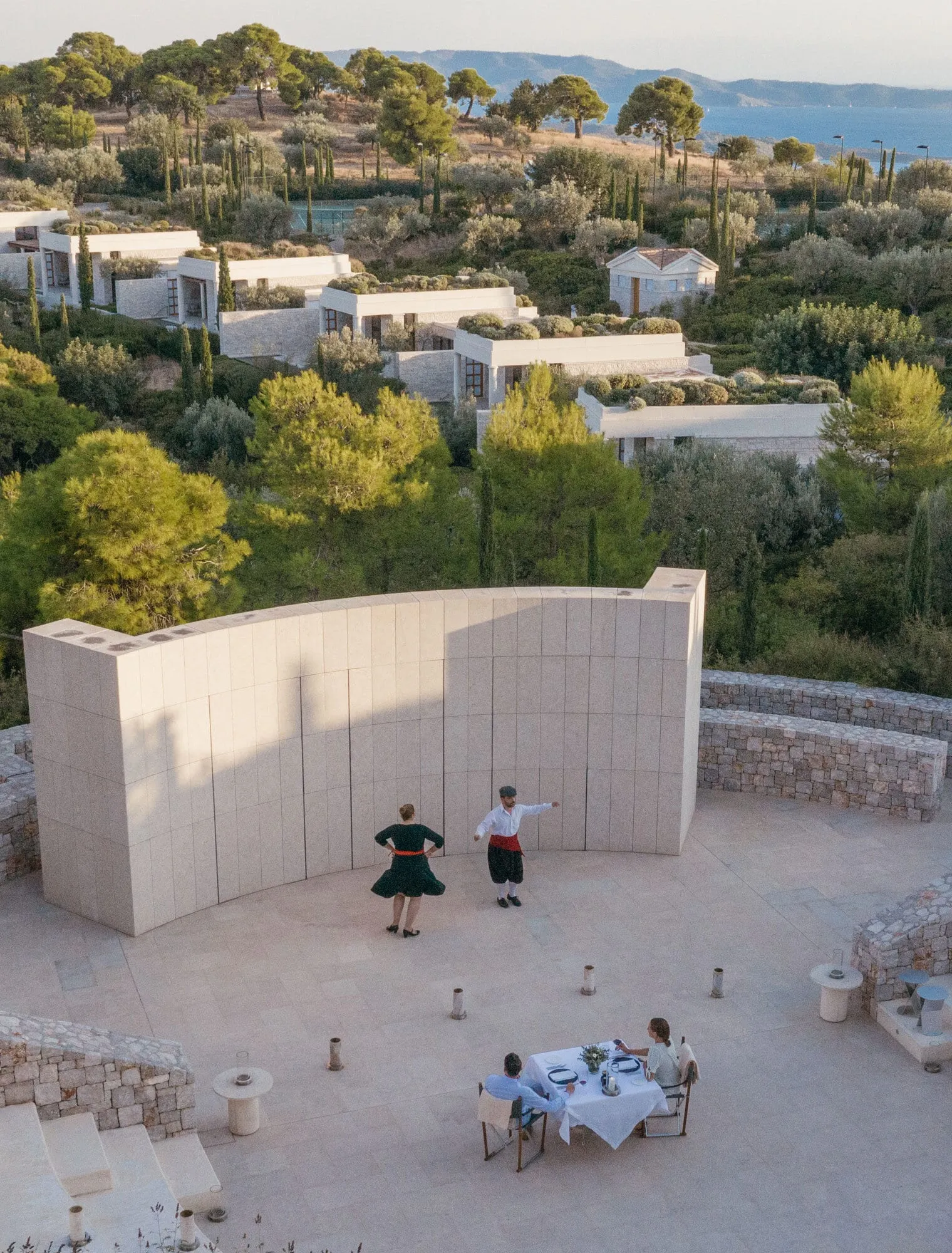
Porto Heli, Greece
Amanzoe
A hilltop citadel of Doric columns and marble courtyards above Porto Heli, built as a modern-day temple to the Peloponnese coastline it overlooks.
From €1,900 per night
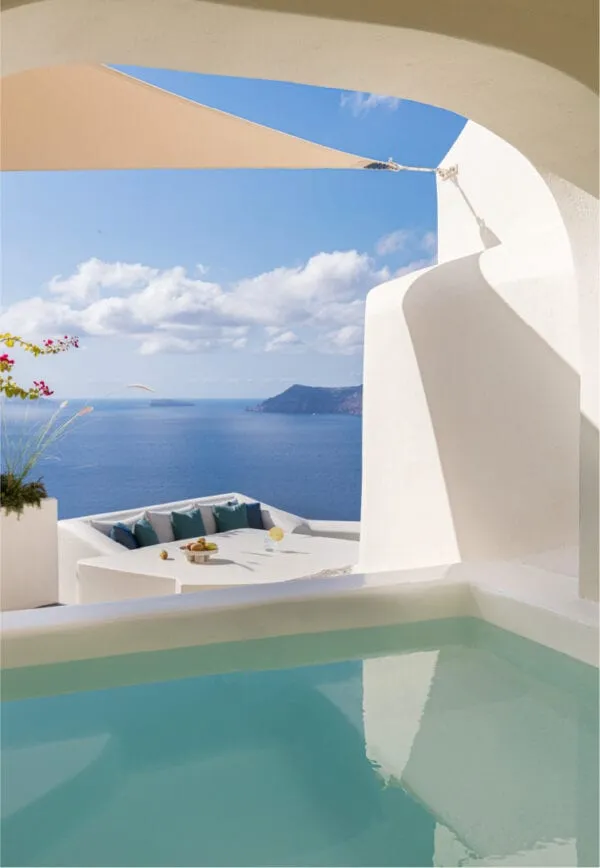
Oia, Santorini, Greece
Canaves Oia Suites
Cave suites cut into Oia's caldera cliff by the family that opened the village's first hotel, rebuilt cube by cube for a new generation of guests.
From €900 per night
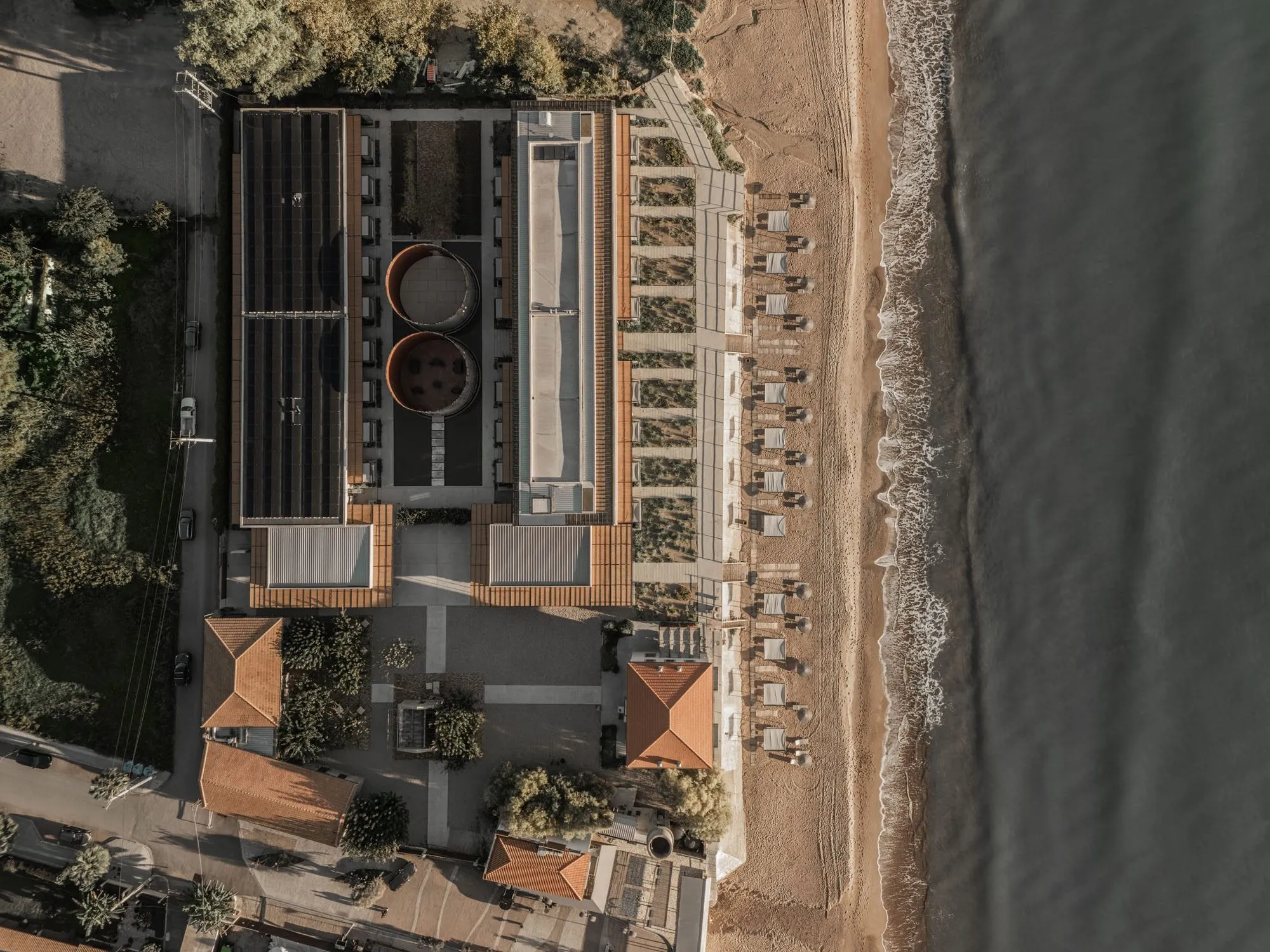
Kourouta, Ilia, Greece
Dexamenes Seaside Hotel
A 1920s currant-wine factory on a Peloponnese beach, its concrete fermentation tanks cut open one by one and turned into 44 suites facing the Ionian Sea.
From €260 per night