Asni Valley, Atlas Mountains, Morocco
Kasbah Tamadot
Richard Branson's former antiques-dealer's kasbah, rebuilt above the Asni Valley with Berber tents, three-bedroom riads and Mount Toubkal on the horizon.
- Rates from
- From $700 per night
- Nearest airport
- Marrakesh Menara Airport (RAK)
- Transfer
- 45 minutes to 1 hour by road
- Best months
- March to May and September to November
An hour outside Marrakech, the road climbs out of the plain and into the foothills of the High Atlas, past roadside almond groves and mule carts, until it reaches Asni, a market town where the tarmac gives way to the valley proper. From there a private drive winds up toward a cluster of pink-walled towers and tiled courtyards perched above the Asni Valley, with the snow-capped bulk of Mount Toubkal, North Africa’s highest peak, filling the view beyond. This is Kasbah Tamadot, the mountain retreat Sir Richard Branson has owned since 1998 and the only Virgin Limited Edition property on the African continent.
The kasbah did not start life as a hotel. It was built as the private home of Luciano Tempo, an Italian antiques dealer who filled it with furniture, sculpture and ornaments gathered from India, Indonesia and North Africa over decades of collecting. Branson’s parents, Ted and Eve Branson, came across the property while their son was preparing for a hot-air balloon crossing of Morocco, and the family bought it soon after. It took years of building and expansion before Kasbah Tamadot opened to guests in 2005, by which point the original house had grown into a much larger complex of rooms, tented suites and riads, all still furnished in part from Tempo’s own warehouse of antiques.
What distinguishes Kasbah Tamadot from Morocco’s other mountain and desert retreats is less its guest list, Branson has hosted everyone from Nelson Mandela to members of his own extended family here, than its relationship with the valley around it. The hotel’s staff are drawn almost entirely from the surrounding Berber villages, and the Eve Branson Foundation, set up in 2006 and named for Richard’s mother, runs craft centres nearby that train young people in weaving, embroidery and woodworking, some of it destined for the hotel’s own rooms. It is a five-star property built into a working rural economy rather than dropped onto an empty hillside.
This guide covers the architecture and interior design that make Kasbah Tamadot recognisable within the Virgin Limited Edition portfolio, its four accommodation categories from kasbah rooms to Berber tents and three-bedroom riads, its restaurants and spa, and the practical detail (routes in, seasons, nearby excursions) that a prospective guest needs before booking a stay in the Asni Valley.
Why It Stands Out
Kasbah Tamadot occupies a genuinely unusual position among Morocco’s luxury mountain hotels: it is neither a purpose-built resort dressed in local motifs nor a restored historic kasbah preserved as a museum piece, but a private house that grew, organically and over two decades, into a small hotel without losing the feel of somewhere lived in. The antiques that fill its courtyards and sitting rooms are not props sourced for the opening; they came with the building, inherited along with Luciano Tempo’s 1,000 square metre warehouse of collected pieces when Branson bought the property in 1998.
The setting does the rest of the work. Perched above the Asni Valley with an unobstructed view toward Mount Toubkal, the hotel sits at the point where Marrakech’s plain gives way properly to the mountains, close enough to the city for an easy transfer, remote enough that the valley below still runs on its own rhythms of market days, mule trains and terraced orchards. Few luxury hotels in Morocco combine that scenic drama with the depth of community investment Kasbah Tamadot has built through the Eve Branson Foundation, which makes a stay here feel connected to the region rather than simply overlooking it.
Architecture
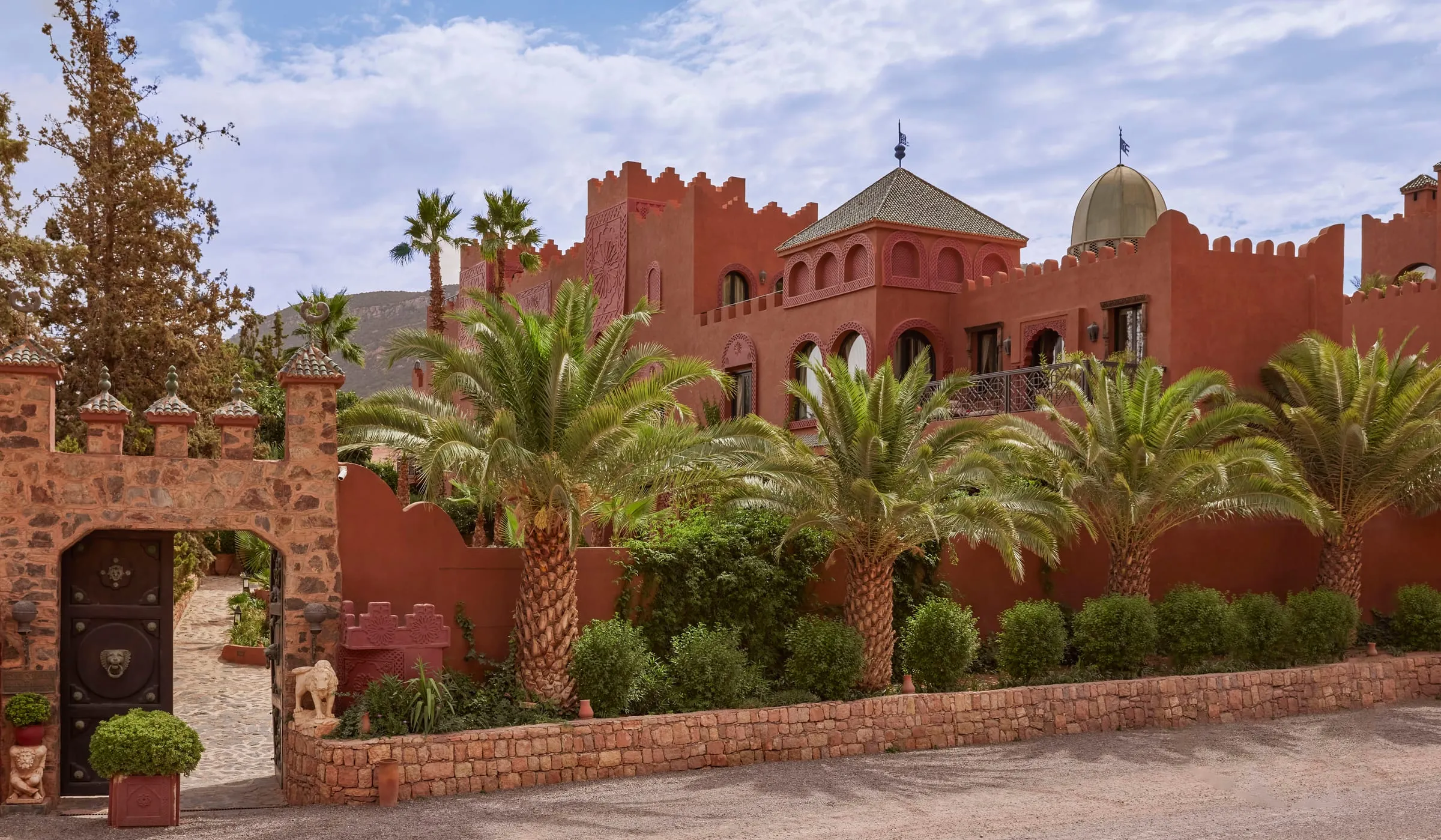
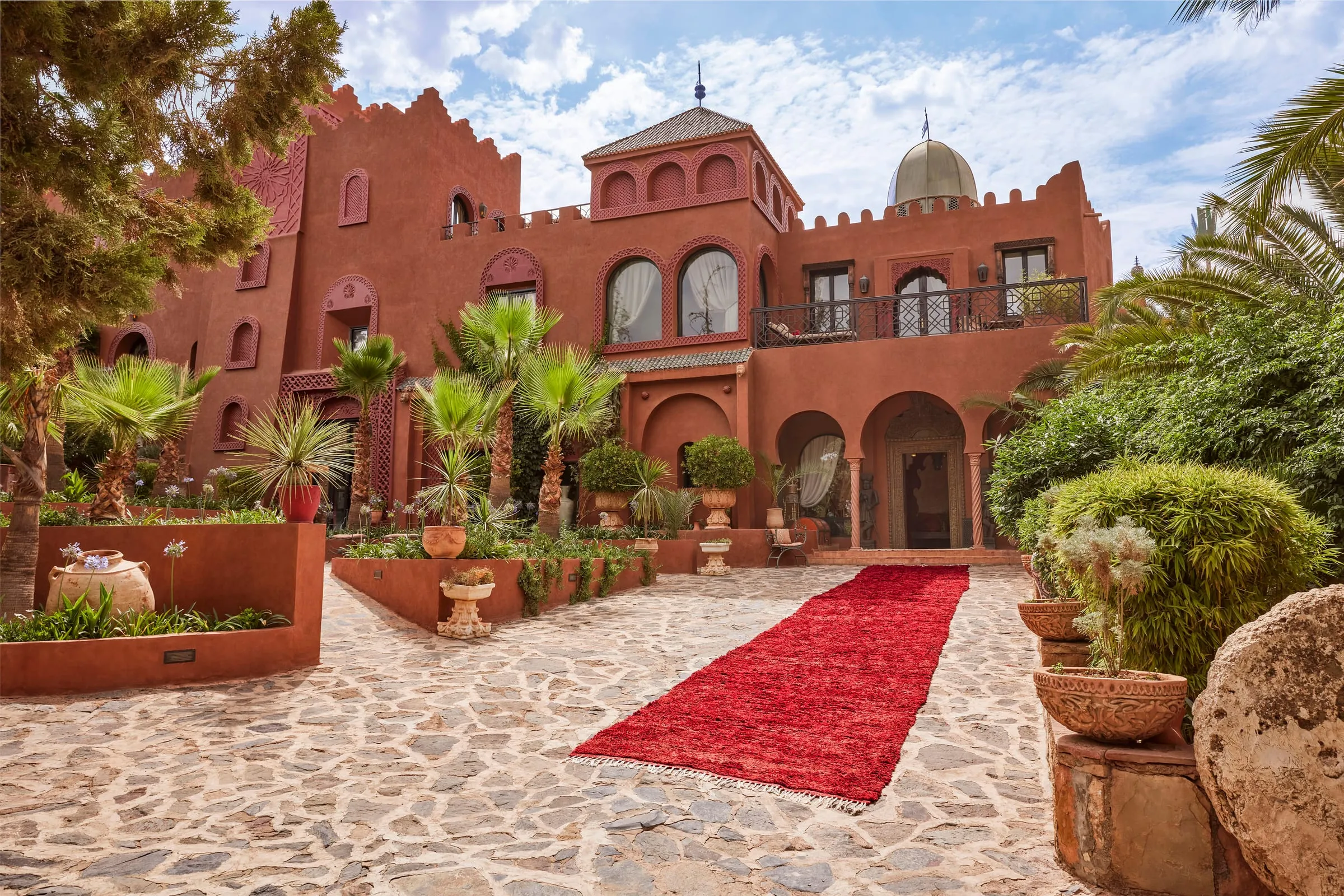
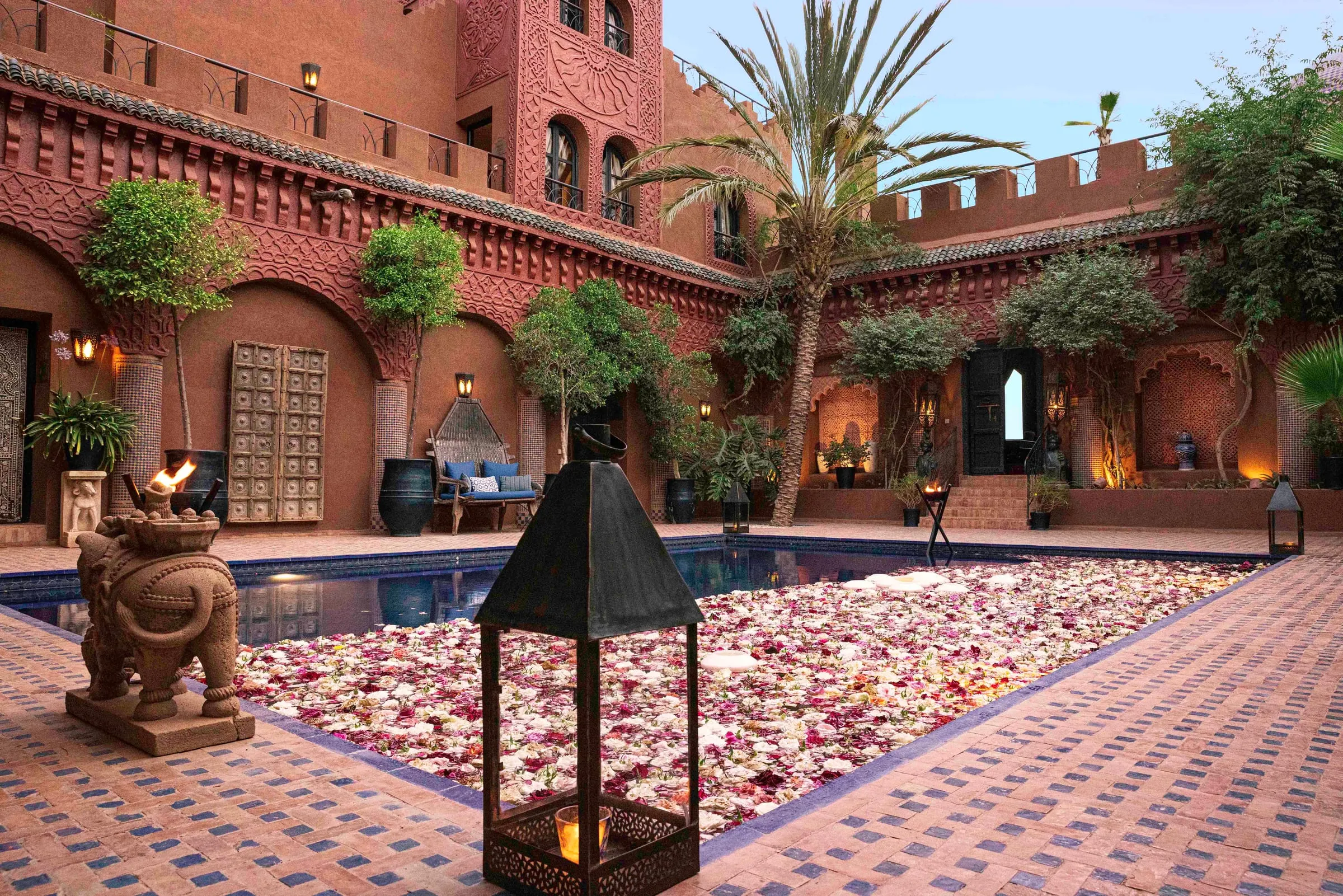
The building’s core is the original kasbah structure, a fortified Berber-style house built with the thick pink-toned walls, crenellated parapets and corner towers typical of the region’s traditional architecture, using rammed earth and stone construction methods adapted for a much higher standard of comfort than a working kasbah would ever have needed. Around that core, Branson’s team built outward and upward over the years following the 1998 purchase, adding wings of rooms, a scattering of Berber-style tents across the hillside gardens, and a cluster of three-bedroom riads, all while keeping the silhouette consistent with the original tower and battlements.
The result reads less as a single building than as a small hillside village: tiled courtyards connect one wing to the next, archways frame views down into the valley, and the tented accommodation is arranged apart from the main house so that even the busiest weeks at the hotel do not feel crowded. Local materials, tadelakt plasterwork, carved cedar, hand-cut zellige tile, run through the newer construction as much as the original building, a deliberate choice to keep the additions from reading as later, lesser copies of the historic core.
Interior Design
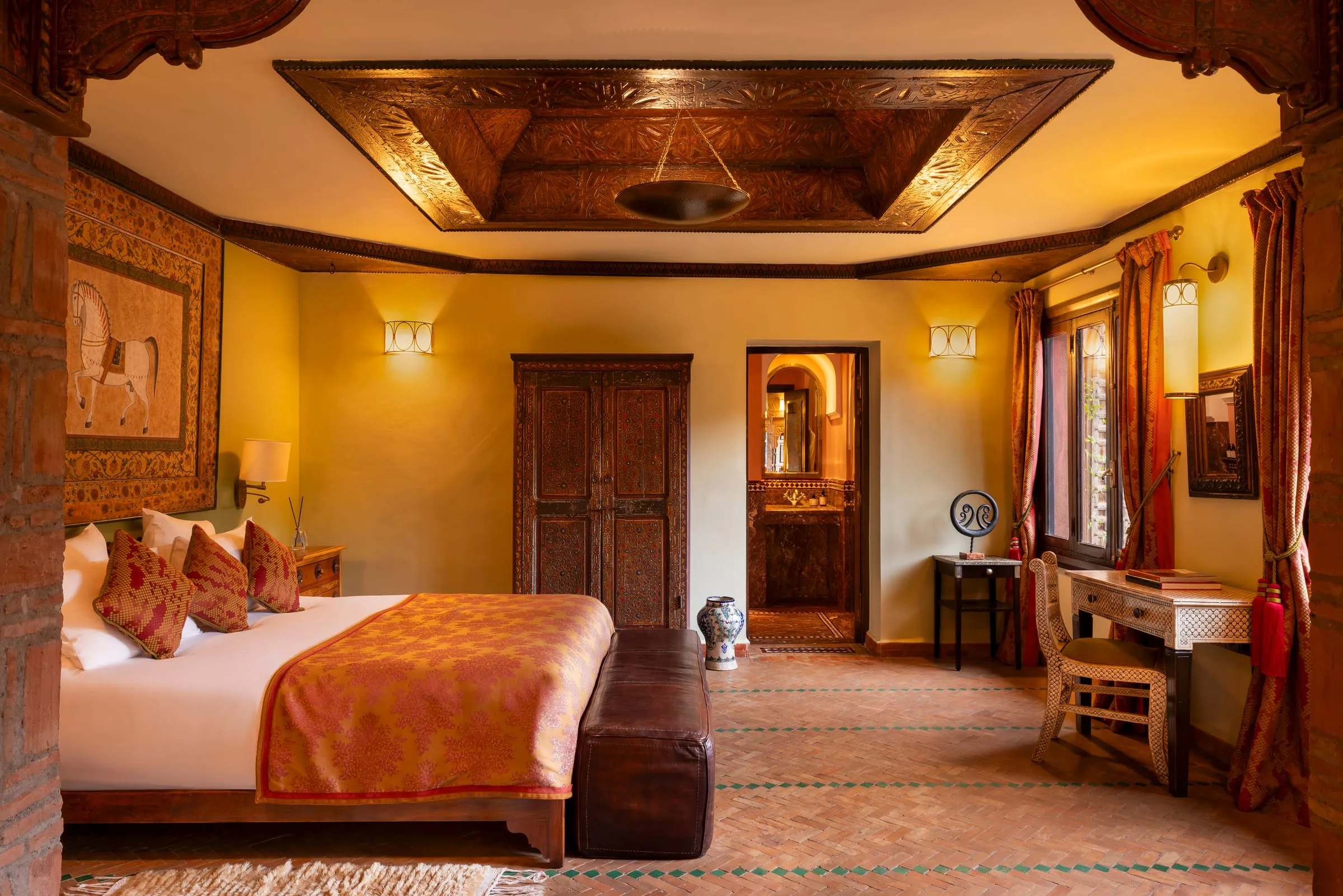
Interiors throughout Kasbah Tamadot draw heavily on Luciano Tempo’s original collection: carved wooden doors, brass lanterns, Indian and Indonesian furniture pieces and North African textiles are worked into rooms alongside newer, locally made additions. Every room is individually decorated rather than fitted to a repeated template, which gives the property a collected, almost domestic character closer to a large family house than a hotel chain’s standardised suite.
More recent furnishing has leaned into the surrounding Berber craft economy specifically, with textiles, rugs and soft furnishings in the riads made by artisans connected to the Eve Branson Foundation’s training centres in nearby villages. Fireplaces, rolltop bathtubs and richly patterned rugs recur across the tented suites, while the rooms inside the main kasbah lean on carved plaster, dark wood and antique lighting for a more traditionally Moroccan register. The overall effect is warm and layered rather than minimalist, a deliberate counterpoint to the starker, more architecturally severe hotels that dominate much of Morocco’s current design conversation.
Atmosphere
Kasbah Tamadot trades on quiet more than spectacle, at least outside of peak family weeks. Days move at the pace set by the mountains: breakfast on a terrace with Toubkal in view, a slow walk or a driven excursion into the valley, an afternoon by the pool or in the hammam, dinner under lanterns in the garden. The property can host large groups, and does, particularly around holidays and when riads are booked out by extended families, but the layout, with tents and riads dispersed across the hillside rather than stacked into a single block, keeps even a full house from feeling crowded.
The staff, almost entirely Moroccan and largely drawn from villages within a short drive of the hotel, give the place a texture that is difficult to manufacture: genuine familiarity with the valley, its markets, its walking routes and its festivals, rather than a script learned for guests passing through. That local grounding, more than any single design flourish, is what gives Kasbah Tamadot its particular atmosphere among Morocco’s mountain retreats.
Rooms and Suites
Kasbah Tamadot has 43 rooms, suites and tents across four accommodation categories. Rooms and suites within the main kasbah building range from Deluxe and Superior Rooms to Terrace Rooms with private outdoor space, each individually decorated with antiques and finished in courtyard, garden or pool-facing outlooks; suites add larger sitting areas and, in some cases, private balconies suited to families.
The ten Berber tents are the property’s signature category: large canvas structures set apart on the hillside with private terraces built for outdoor dining, king-size beds and oversized rolltop bathtubs. Five are Standard Berber Tents at around 55 square metres, five are Berber Tents with a private outdoor hot tub at roughly 65 square metres, and a further Asmoun Tent adds its own lounge area within the same footprint. All are positioned for Atlas Mountain and valley views rather than proximity to the main house, so a stay in one of the tents comes with more separation, and more quiet, than a room inside the kasbah.
The six three-bedroom riads sit at the top of the property’s accommodation range, each combining a two-bedroom pool suite with a rooftop tented suite to sleep up to seven guests, and each individually decorated with handcrafted textiles from the local Berber community. They are built for extended families or groups travelling together who want a private house within the wider hotel, complete with their own pool and outdoor space, rather than adjoining hotel rooms.
Dining
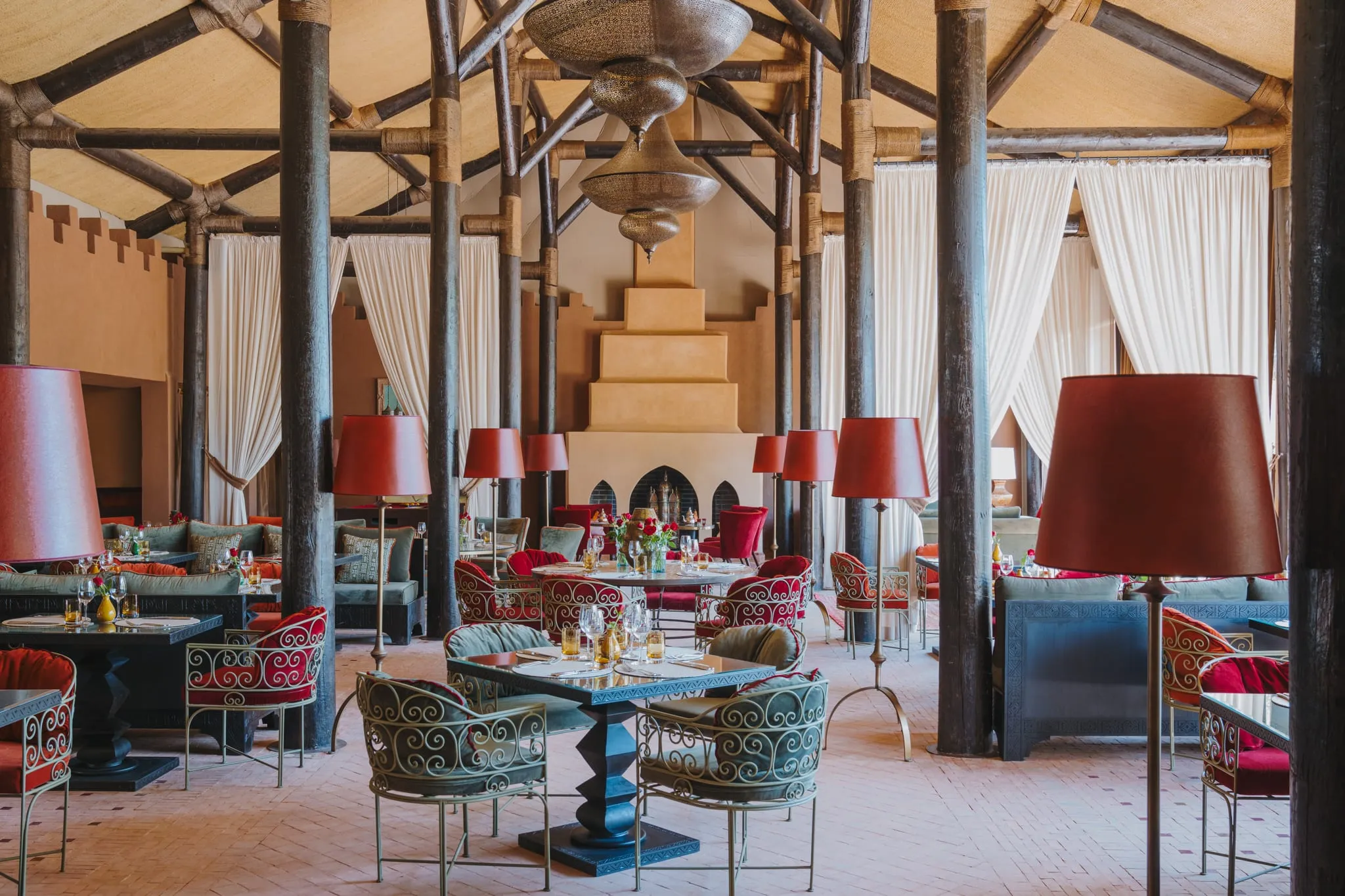
Kasbah Tamadot runs two restaurants. Asayss, set behind the property’s Berber tents and adjacent to the garden, is the more relaxed of the two, with cosy sofas, communal tables, private terraces, fireplaces and a bar built around Moroccan and international dishes served in a casual register. Kanoun, at the heart of the kasbah itself, offers a more refined setting with mountain views, suited to a quieter or more romantic dinner, and draws on the same Moroccan and international repertoire in a more formal presentation.
Beyond the two restaurants, the hotel builds a fair amount of its dining around setting rather than menu: poolside lunches often take the form of family-style Berber feasts, rooftop dinners are served under the stars, and private dinners can be arranged inside one of the Berber tents with a dedicated chef. Cooking lessons run for around three hours and take guests through preparing a tagine and a full Moroccan meal from scratch, and traditional mint tea, poured with the characteristic height and ceremony of Moroccan hospitality, is offered throughout the day.
Spa and Wellness
The hotel’s spa, Asounfou, takes its name from the Berber word for relaxation and is built around a traditional hammam alongside a menu of face and body treatments using natural, locally inspired ingredients. The hammam ritual follows the classic Moroccan sequence, black soap, an exfoliating scrub, a neroli mask and an argan wrap, typically finishing with a hair cleanse, and can be booked as a standalone treatment or paired with a massage.
Outside the treatment rooms, Kasbah Tamadot has an outdoor infinity pool looking toward Mount Toubkal, a heated indoor pool for cooler months, and an open-air hot tub. Two floodlit tennis courts with private coaching, a small fitness centre with cardio and weights equipment, and access to several championship golf courses closer to Marrakech round out the more active end of the wellness offering, alongside evening cinema screenings under the stars for guests who prefer to wind the day down slowly rather than with a workout.
Experiences
The hotel’s location makes the Atlas Mountains themselves the main draw. Hiking routes run from gentle valley walks to more demanding treks with panoramic views, mountain biking is offered as half-day and full-day guided rides (including e-bikes) through the nearby Ouirgane Valley, and traditional mule treks through Berber villages give a slower, more historically grounded way to see the same terrain.
Cultural experiences are woven closely into the Eve Branson Foundation’s work: guided visits to craft houses in the villages of Tansghart and Tamgounssi let guests watch weaving, embroidery and woodworking training in progress, and meet some of the young artisans the foundation supports. Day excursions further afield take in the twelfth-century Tin Mal Mosque, the village of Ouirgane, the Ourika Valley and the pilgrimage site of Moulay Brahim, while families with children can make use of the Kasbah Kids programme, which runs crafts, nature walks and cultural activities tailored to younger guests.
Who It Is For
Kasbah Tamadot suits couples looking for a romantic mountain counterpoint to a Marrakech stay, particularly in one of the Berber tents with a private hot tub, and it suits multi-generational families equally well through its three-bedroom riads, which give a group its own pool, kitchen-adjacent living space and rooftop suite without sacrificing access to the wider hotel’s restaurants and spa. Guests drawn to Berber culture, craft and the Eve Branson Foundation’s community work will find more depth here than at most hotels trading on similar imagery, since the connection to the surrounding villages runs through staffing, sourcing and guest programming rather than decor alone.
It is a less natural fit for travellers who want beach weather, a purely urban Marrakech stay, or a hotel with the glass-and-minimalist design language now common across parts of the city; Kasbah Tamadot’s appeal rests on its mountain setting, its collected, antique-filled interiors and its slower pace, which reward a stay of at least two or three nights rather than a rushed overnight en route elsewhere.
Best Time to Visit
Spring, from March to May, and autumn, from September to November, offer the mildest daytime temperatures and the clearest air for views of Mount Toubkal and the surrounding peaks, making them the strongest windows for hiking, biking and time spent outdoors. Summer brings hot days to the valley floor, though the altitude and thick kasbah walls keep interiors comfortable and evenings cool quickly once the sun drops. Winter is markedly colder, with snow visible on the higher peaks and some cold nights, which suits guests happy to trade pool time for fireside evenings and quieter trails.
How to Get There
The nearest airport is Marrakesh Menara Airport (RAK), served by direct flights from major European hubs and a growing number of long-haul connections. From the airport, Kasbah Tamadot is roughly 45 minutes to an hour by road, depending on traffic through Marrakech’s outskirts before the route climbs toward Asni. The hotel arranges private road transfers on request and offers a VIP airport service to help guests bypass queues on both arrival and departure; self-drive rental is also an option for guests who prefer to make the drive independently.
Nearby Experiences
Asni itself, the market town just below the hotel, holds a Saturday souk that draws traders from villages across the valley and gives a far more working, unvarnished view of rural Atlas life than anything staged for tourists. Imlil, the trailhead village for Mount Toubkal ascents, sits within reach for guests wanting to combine a stay at Kasbah Tamadot with a serious trekking day or a multi-day summit attempt. The Ourika Valley, with its waterfalls and terraced villages, and the twelfth-century Tin Mal Mosque, one of the few in Morocco open to non-Muslim visitors, both make for straightforward half-day or full-day excursions from the hotel.
Marrakech itself, with the souks of the medina, the Jardin Majorelle and the wider Ville Nouvelle, remains close enough for a day trip given the roughly hour-long transfer, and many guests choose to pair a city-based stay with a shorter mountain stay at Kasbah Tamadot rather than treating the two as separate trips.
Things to Know Before Booking
Kasbah Tamadot sits at altitude in the Atlas foothills, so nights are cooler than Marrakech even in summer, and guests should pack layers regardless of season. The property’s four accommodation categories vary considerably in privacy and setting, rooms inside the main kasbah put guests closest to the restaurants and spa, while the Berber tents and riads trade some of that proximity for more space and seclusion, so it is worth matching the category to whether the priority is convenience or privacy. Given the hotel’s popularity with extended families during school holidays, travellers seeking a quieter, adults-oriented stay may prefer to book outside peak holiday weeks. Roads into the valley involve winding mountain driving, which is worth noting for guests prone to motion sickness.
Sustainability
Kasbah Tamadot’s approach to sustainability is built primarily around its relationship with the local Berber community rather than headline environmental certifications. The hotel’s workforce is drawn almost entirely from villages in the surrounding valley, and the property has long framed local employment, at a wage that in many cases supports an extended family network, as central to its operating model. The Eve Branson Foundation, established in 2006 with support from Virgin Unite and the hotel, works with more than 75 young people across craft centres in nearby villages, training them in weaving, carpet-making, embroidery, tailoring and woodworking, and free English classes are offered to members of the local community regardless of whether they work at the hotel. Guests can support specific local projects directly through the hotel’s Pack for a Purpose partnership, and the hotel has ongoing, if less publicly detailed, initiatives around recycling and energy efficiency on-site.
Practical Information
Check-in at Kasbah Tamadot is from 2:00 PM and check-out by 12:00 PM, with early check-in or late check-out available on request, subject to availability and sometimes an additional cost. Rates begin at roughly $700 per night for an entry-level double room, based on published rate data, and rise considerably for tented suites with private hot tubs and for the three-bedroom riads, which are typically booked by the house rather than the room. The nearest airport is Marrakesh Menara Airport (RAK), with a private transfer of 45 minutes to an hour. The hotel operates two restaurants, Asayss and Kanoun, an Asounfou spa with hammam, indoor and outdoor pools, and two tennis courts. Most guests find two to three nights sufficient to settle into the property, take in the spa and pool, and fit in at least one excursion into the surrounding valley or villages, though longer stays suit families making use of the riads.
Editorial Conclusion
Kasbah Tamadot works because it resists the two easiest paths available to a hotel with its backstory and setting: it is neither a celebrity vanity project coasting on its owner’s name, nor a themed resort borrowing Berber motifs for atmosphere. What Richard Branson’s family bought in 1998 was an antiques dealer’s private house on a genuinely spectacular piece of ground above the Asni Valley, and what they built around it over the following years has stayed unusually close to that inheritance, in the furniture that fills its courtyards, the staff who run it, and the foundation that channels part of its presence back into the villages below. For travellers who want the Atlas Mountains at full scale, Toubkal on the horizon, Berber culture close at hand, and a level of comfort and privacy that a working kasbah never offered its original occupants, it remains one of Morocco’s most distinctive addresses outside Marrakech itself.
In pictures
On the map
Asni Valley, Atlas Mountains, Morocco
Questions
Frequently asked
How far is Kasbah Tamadot from Marrakech?
The hotel sits in the Asni Valley in the foothills of the High Atlas Mountains, roughly 45 minutes to an hour by road from Marrakesh Menara Airport, depending on traffic through the city's outskirts. The hotel arranges private road transfers, and a VIP airport meet-and-greet service can be booked to bypass queues on arrival and departure.
What kind of rooms does Kasbah Tamadot have?
The property has 43 rooms, suites and tents in total, spread across four categories: rooms and suites inside the original kasbah building, ten Berber-style tents on the hillside (some with private hot tubs or plunge pools), and six three-bedroom riads, each combining a two-bedroom pool suite with a rooftop tented suite for larger groups or families.
Who owns Kasbah Tamadot?
It is owned by Sir Richard Branson and operated as part of Virgin Limited Edition, the small collection of hotels built around Virgin's founder. Branson bought the property, then the private home of Italian antiques dealer Luciano Tempo, in 1998, after his parents Ted and Eve Branson first spotted it while he was preparing for a hot-air balloon expedition through Morocco. It opened as a hotel in 2005.
Does Kasbah Tamadot support the local Berber community?
Yes. The hotel's workforce is drawn almost entirely from the surrounding Berber villages, and it is closely tied to the Eve Branson Foundation, established in 2006 and named for Richard Branson's mother. The foundation runs craft centres in nearby villages teaching weaving, embroidery, carpet-making and woodworking, and guests can visit the workshops as part of a stay.
What is the best time of year to visit?
Spring (March to May) and autumn (September to November) bring the mildest daytime temperatures and the clearest mountain air for hiking and views of Mount Toubkal. Summer can be hot in the valley, though evenings cool quickly at altitude, and winter brings crisp, sometimes cold nights with snow visible on the higher peaks, which suits guests who want fireside evenings over pool days.
Same destination
More hotel guides in Morocco
Marrakech medina, Morocco
El Fenn
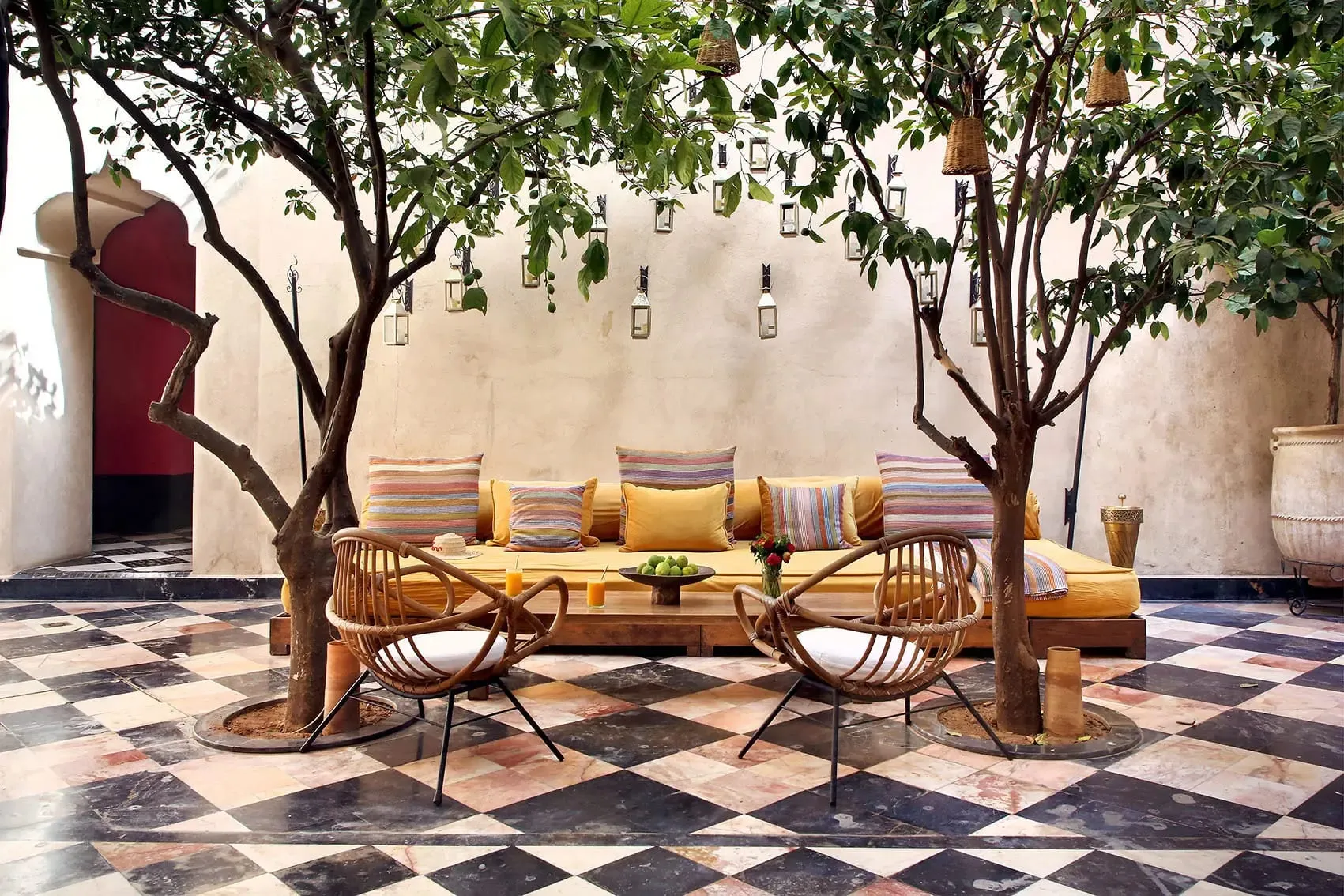
A private art collector's riad turned hotel, stitched together from more than a dozen houses behind the walls of the Marrakech medina.
From $480 per night
Marrakech medina, Hivernage, Morocco
La Mamounia
The 1923 Marrakech palace built around an 18th-century royal garden, where Winston Churchill painted from the balconies and Jacques Garcia's 2009 restoration still sets the city's benchmark for Moorish-Art-Deco grandeur.
From $650 per night
Marrakech medina, Morocco
Royal Mansour Marrakech
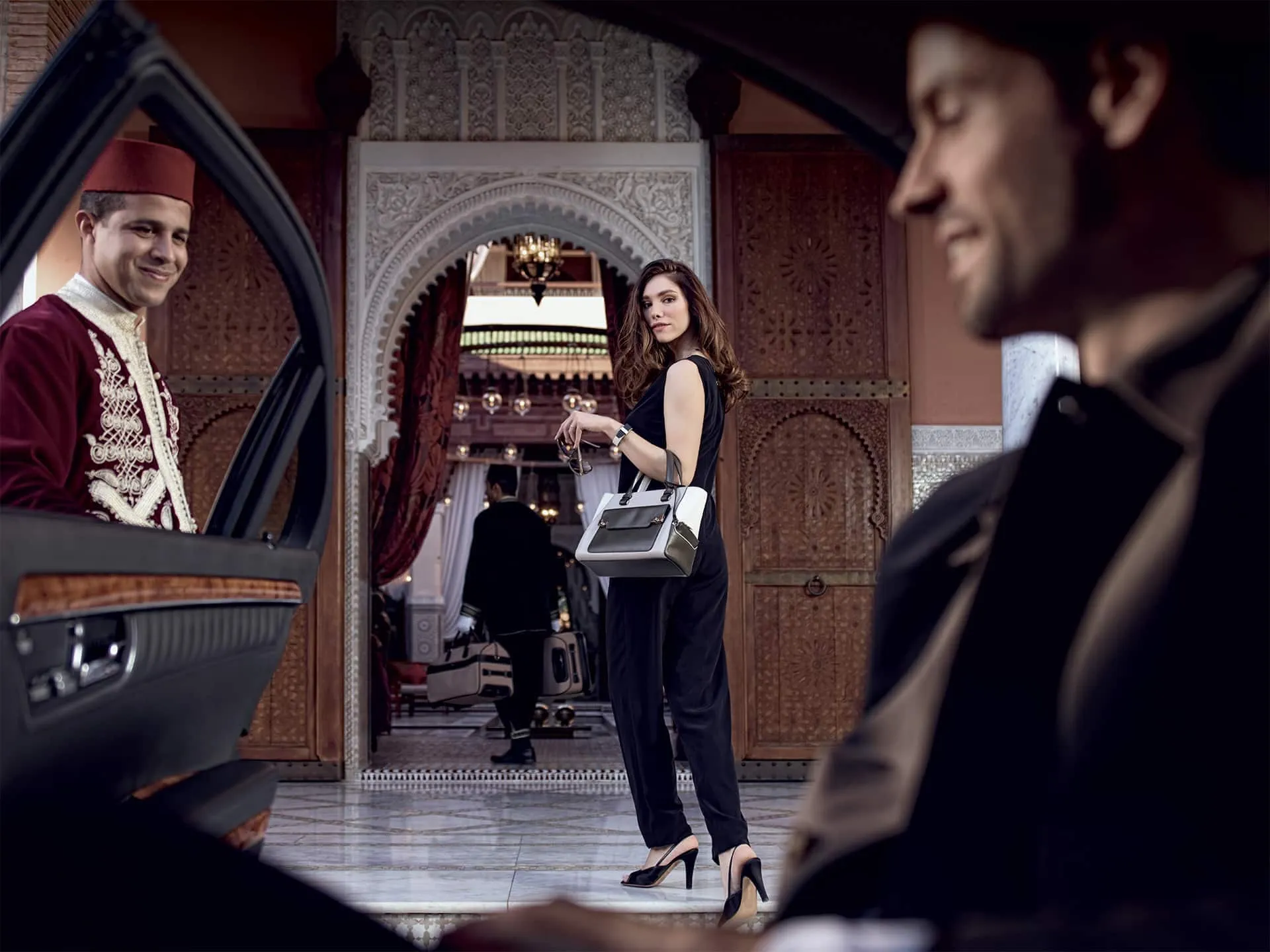
A king's private commission built by 1,200 Moroccan artisans, where every guest gets a multi-storey riad and its own rooftop rather than a room.
From $1,500 per night