Marrakech medina, Hivernage, Morocco
La Mamounia
The 1923 Marrakech palace built around an 18th-century royal garden, where Winston Churchill painted from the balconies and Jacques Garcia's 2009 restoration still sets the city's benchmark for Moorish-Art-Deco grandeur.
- Rates from
- From $650 per night
- Nearest airport
- Marrakech Menara Airport (RAK)
- Transfer
- 10 to 20 minutes by road, around 6 kilometres from the hotel
- Best months
- March to May and October to November, when daytime temperatures are mild enough for the gardens and terraces to be used fully
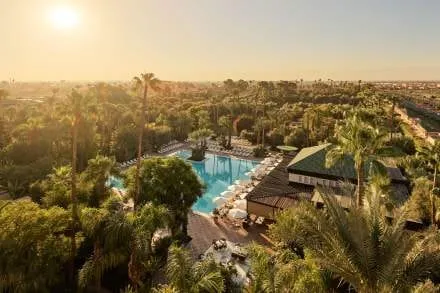
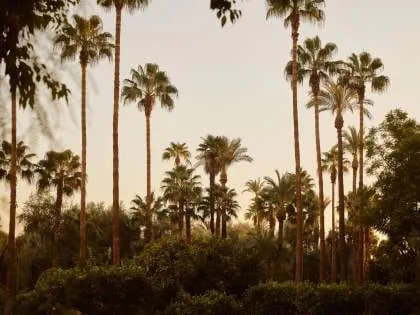
There is a particular way the light falls through La Mamounia’s gardens in the late afternoon, filtered through the canopies of olive and palm trees that were already old when the hotel’s first guests arrived in 1923, and it is this light, more than any single room or restaurant, that has kept painters, writers and heads of state returning to this address on the edge of the Marrakech medina for a century. The gardens came first, laid out in the 18th century as a wedding gift from a sultan to his son, and the hotel was, in effect, built into them rather than the other way around.
That sequencing still shapes how La Mamounia reads today. It is a Moorish and Art Deco building from the 1920s set inside a much older landscape, restored at enormous expense in 2009 by French designer Jacques Garcia, and updated again through 2020 and its 2023 centenary with new restaurants and public spaces. Few hotels anywhere can claim a documented history that runs through Winston Churchill’s wartime watercolours, a state visit by Franklin Roosevelt, and a continuous, if interrupted, run of use by the world’s political and cultural elite since the interwar years.
What follows is a researched account of what La Mamounia actually is today: its architecture and the renovations that have reshaped it, its restaurants and spa, its gardens, and the practical detail a traveller needs to plan a stay, rather than the shorthand version of “Churchill’s hotel” that tends to summarise it in a single line.
Why It Stands Out
La Mamounia’s clearest distinction is the age and integrity of its grounds. The roughly 13-hectare garden was established in the 18th century when Sultan Sidi Mohammed Ben Abdallah gave the land to his son, Prince Moulay Mamoun, as a wedding gift, and the prince used it to host garden parties, or nzahas, among orchards of olive, orange and other fruit trees. The hotel that eventually took the garden’s name did not open until 1923, which makes La Mamounia unusual even within Marrakech: a five-star hotel built around a landscape roughly two centuries older than the building itself, with plantings that in places predate the hotel by generations.
The second distinction is a documented, rather than merely rumoured, history with Winston Churchill. Churchill was a regular winter visitor to Marrakech from the 1930s and stayed at La Mamounia repeatedly, painting watercolours from its balconies and gardens as he chased the changing light across the day. In January 1943, following the Casablanca Conference, he brought Franklin D. Roosevelt to the hotel for several days, and later gave Roosevelt a painting he completed on that trip, Tower of the Katoubia Mosque, one of only a handful of works Churchill produced during the entire Second World War. The hotel still keeps a suite and a bar named after him.
The third is the scale and recency of its restoration. Jacques Garcia’s 2006-to-2009 renovation, reported at around 120 million euros, rebuilt the interiors from the ground up around an Arabo-Andalusian design language, and a second phase of work led by the Paris firm Jouin Manku, introducing restaurants from chefs Jean-Georges Vongerichten, Pierre Herme and Simone Zanoni, carried through 2020 and into the hotel’s 2023 centenary. Few palace hotels of this age have been this thoroughly and this recently reworked while keeping their original footprint and garden layout intact.
Architecture
La Mamounia was designed by French architects Henri Prost and Antoine Marchisio and opened in 1923, built directly into the existing 18th-century garden rather than displacing it. The original design paired Moroccan craft traditions, carved cedar, zellige tilework, horseshoe arches, with the geometric restraint of Art Deco, a combination fashionable in French Morocco’s Protectorate-era architecture of the 1920s. A significant expansion in 1946 enlarged the hotel to roughly 100 rooms and involved painter Jacques Majorelle, whose own Marrakech garden remains one of the city’s other major horticultural landmarks.
The building’s footprint has grown in stages since, most substantially during the Jacques Garcia renovation of the 2000s, which added guest room and suite capacity, including three standalone riads set within the grounds, each with its own pool, terrace and salon. The core structure, however, still reads as a low-rise palace pressed into its garden rather than rising above it, with the historic building’s silhouette against the Atlas Mountains largely unchanged since the interwar period.
That relationship between structure and garden is the point architecturally. Much of the hotel’s principal frontage and its main terraces face into the grounds rather than out toward the surrounding streets, so that the building tends to read as a frame for the plantings rather than a freestanding object beside them, a logic closer to the inward-facing courtyard tradition of a riad than to a conventional street-fronted hotel, scaled up to a much larger footprint. It is a large part of why the property still reads as rooted in its site even after a century of expansion and renovation.
Interior Design
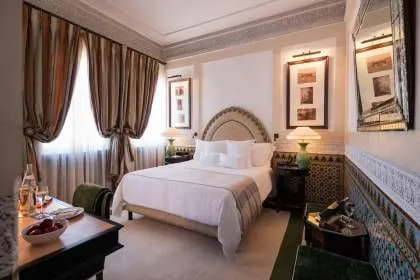
The interiors in use today are largely the result of Jacques Garcia’s 2006-to-2009 restoration, undertaken after the hotel closed for three years and, by most published accounts, sold off its existing furniture, artwork and fittings before starting from scratch. Garcia, known for a maximalist, richly coloured decorative style, reworked the hotel around what he and the hotel describe as an Arabo-Andalusian identity: deep jewel-toned fabrics, hand-carved cedar screens, intricate zellige tilework, wrought ironwork and tadelakt plaster finishes, staged through dramatic use of light and layered perspective across the public rooms.
A second renovation phase, overseen by architecture and design practice Jouin Manku, reworked the hotel’s restaurants, bars and pavilions between 2020 and the property’s 2023 centenary, introducing new dining rooms built around chefs Jean-Georges Vongerichten, Pierre Herme and Simone Zanoni without disturbing Garcia’s underlying decorative language in the main mansion and guest floors. A commissioned Centenary Chandelier, referencing traditional Berber jewellery forms, was added during the 2023 celebrations as a visible marker of the hotel’s hundred-year run.
Atmosphere
La Mamounia carries itself with the formality expected of a hotel that has hosted heads of state for a century, but that formality sits inside a setting built for slowness: shaded garden paths, tiled courtyards, and a pool pavilion designed for long afternoons rather than quick laps. The mood shifts through the day, brisk and structured around breakfast and check-in, then loosening into the unhurried rhythm of the gardens by mid-afternoon, before the hotel’s restaurants and bars take over in the evening with live Andalusian music at Le Marocain and a more cosmopolitan bar scene elsewhere on the property.
Its location, just outside the walls of the Marrakech medina in the Hivernage district, means the hotel functions as a genuine retreat from the souks and squares rather than a base directly inside them, a contrast many guests treat as part of the appeal: intense, sensory Marrakech a short walk or drive away, and a controlled, garden-bound calm on the property itself.
Rooms and Suites
The hotel comprises 135 rooms and 71 suites, plus 3 private riads, for a total of around 209 keys. Rooms range roughly from 30 to 45 square metres, finished with the carved wood ceilings, mashrabiya-inspired screening and mixed traditional-contemporary furnishings characteristic of the Garcia restoration. Suites scale from around 55 up to 212 square metres, running from one to three bedrooms, with a small tier of Exceptional Suites, including the Churchill Suite, a roughly 107-square-metre, two-bedroom suite overlooking the gardens Churchill painted from during his stays.
The three riads sit apart from the main hotel building, each around 700 square metres with three bedrooms, private terraces, a Moroccan salon and its own swimming pool, offering a more self-contained, villa-like version of the property for guests wanting privacy from the main hotel’s public spaces.
Dining
La Mamounia’s current restaurant lineup reflects the 2020-and-after renovation phase as much as its own longer culinary history. Le Marocain, set within a riad-style pavilion among the garden’s palm and olive trees, serves modern Moroccan cuisine in a series of intimate alcoves, with live Andalusian music played by a trio in the evenings. L’Italien, redesigned under chef Simone Zanoni in the register of a luxury trattoria, integrates open preparation areas into the dining room itself. L’Asiatique, developed with chef Jean-Georges Vongerichten, draws on Chinese, Japanese and Thai influences. Le Pavillon de la Piscine handles all-day dining by the pool, including a buffet lunch through the week and a Sunday brunch.
Beyond the main restaurants, the hotel runs a Salon de The developed with pastry chef Pierre Herme, an Oenotheque wine cellar, and four bars, including the Churchill Bar named for the hotel’s best-known regular guest. The overall dining programme, four restaurants, two tea rooms and four bars, positions La Mamounia among the more extensively resourced hotel dining operations in Marrakech.
What distinguishes the current lineup from a fairly common playbook of importing marquee chef names is that the collaborations were built into the 2020 renovation from the outset rather than layered onto an existing kitchen, giving Jouin Manku’s redesigned dining rooms and each chef’s format a closer fit than is typical when a hotel adds a headline restaurant after the fact. Reservations for Le Marocain and the smaller specialty rooms are generally advisable well ahead of a stay, particularly during the high season shoulder months.
Spa and Wellness
The Mamounia Spa occupies around 2,500 square metres within the property, one of the larger hotel spas in the city. Facilities include two traditional hammams and one private hammam, ten treatment and massage rooms, three of them configured for couples, a heated indoor pool, a jacuzzi and a private spa suite. The treatment menu runs to around 80 offerings, built around traditional Moroccan rituals, including a black soap and kessa-glove hammam scrub, alongside international spa brands.
Outdoors, the hotel’s main swimming pool measures 25 by 26 metres, entirely clad in Murano glass and heated to around 28 degrees Celsius year-round, open from 9am with last entry at 8pm; pool access is restricted to guests aged 18 and over, or 16 with adult supervision. A fitness centre and additional sports facilities round out the wellness offering.
Experiences
The gardens themselves are the hotel’s central experience: some 13 hectares of olive, orange and palm trees, roses, cacti and a roughly 1,500-square-metre vegetable garden that supplies some of the hotel’s kitchens, laid out originally for royal garden parties in the 18th century and still walkable in full by guests. The hotel occasionally opens elements of this history to guests through curated tours or exhibitions, including a 2014 exhibition pairing Churchill’s own paintings with work by Moroccan artist Hassan El Glaoui, whose father had a documented friendship with Churchill.
Beyond the grounds, the hotel’s location just outside the medina walls makes it a workable base for exploring the Koutoubia Mosque, the souks, and the Majorelle Garden, all within a short taxi ride, while the concierge can arrange desert excursions into the Atlas Mountains and Agafay desert for guests wanting to extend beyond the city itself.
Who It Is For
La Mamounia suits travellers who want a first Marrakech stay built around a historic, garden-set property with a serious dining and spa programme attached, rather than a compact riad experience inside the medina itself. Honeymooners and couples marking an anniversary will find the riads and Exceptional Suites, along with the garden setting, well suited to a high-ceremony stay, and history-minded travellers with an interest in the hotel’s Churchill-era past have a genuinely documented story to explore rather than repackaged marketing.
It is a less natural fit for travellers who specifically want to be inside the medina’s souks and squares on foot from their front door, since the hotel sits just outside the walls in the quieter Hivernage district, or for budget-conscious travellers, given rates that sit at the top of Marrakech’s hotel market.
Best Time to Visit
Marrakech’s most comfortable travel months run from March to May and again from October to November, when daytime temperatures are warm without reaching the extremes of the summer months and the hotel’s gardens and outdoor restaurants are at their most usable. Summer, particularly July and August, brings consistently high heat that pushes most outdoor activity to early morning or evening, while winter days are mild but evenings can turn cool, a season historically associated with the hotel given Churchill’s own habit of wintering there.
How to Get There
Marrakech Menara Airport (RAK) is the nearest international gateway, roughly 6 kilometres from the hotel, with a road transfer of about 10 to 20 minutes depending on traffic; the hotel can arrange a private transfer directly from the airport. Marrakech’s airport handles a wide range of direct European routes as well as connections from further afield, making it a relatively straightforward final leg for most international visitors compared with hotels requiring a further domestic connection.
Nearby Experiences
The Koutoubia Mosque, Marrakech’s largest and most recognisable landmark, sits within easy reach of the hotel, as does the medina’s network of souks and the Jemaa el-Fnaa square, all workable by a short taxi ride or, for confident walkers, on foot. The Majorelle Garden, the cobalt-blue garden created by painter Jacques Majorelle and later restored by Yves Saint Laurent and Pierre Berge, makes a natural pairing with La Mamounia’s own historic gardens for visitors interested in the city’s garden culture specifically. Further afield, the Atlas Mountains and the Agafay desert are within range for a day trip, typically arranged through the hotel’s concierge.
Things to Know Before Booking
Rates at La Mamounia sit at the top of the Marrakech hotel market and vary considerably by season, room category and demand, so travellers should confirm current pricing directly with the hotel or a specialist agent rather than relying on any single published figure. The pool has a minimum age policy (18, or 16 with adult supervision) worth knowing for families travelling with teenagers, and the hotel enforces an elegant dress code in its public spaces, including a restriction on shorts and flip-flops after 6pm. Small dogs under 8 kilograms are permitted in rooms under specific conditions, but access to restaurants and the pool is limited to select areas.
Sustainability
La Mamounia holds Green Key certification, the international standard for environmental responsibility in tourism, and the hotel has publicised the use of solar power and produce grown in its own roughly 1,500-square-metre vegetable garden within the grounds. As with many historic properties, the constraints of operating a nearly century-old building set within a protected, centuries-old garden shape what further retrofitting is practical; travellers wanting more detail on current initiatives are best served asking the hotel directly.
Practical Information
This guide prices La Mamounia from an indicative USD 650 per night for entry-level rooms, as a general orientation only; published third-party rates vary widely by season and availability, and travellers should confirm current pricing directly with the hotel or a specialist agent. Check-in is from 3:00pm and check-out by 12:00pm. The nearest airport is Marrakech Menara (RAK), around 6 kilometres and a 10-to-20-minute drive from the hotel. Most guests plan three to four nights, enough time to move through the hotel’s restaurants and spa alongside a day or two exploring the medina and greater Marrakech. Best months to visit are March to May and October to November, when the city’s climate is most comfortable for using the gardens and outdoor spaces fully.
Editorial Conclusion
La Mamounia’s case rests on a rare pairing: a garden landscape that predates the hotel by nearly two centuries, and a hundred-year-old building that has been restored recently and thoroughly enough, first by Jacques Garcia in 2009, then by Jouin Manku through 2020 and the 2023 centenary, to feel current rather than preserved under glass. Its Churchill history is documented rather than merely repeated, and its dining and spa programmes are resourced at a scale that matches the address’s reputation. For travellers who want their first Marrakech stay to carry real institutional weight, and who are comfortable with a location just outside the medina walls rather than inside its densest quarters, La Mamounia remains one of the clearest cases in the city for why that reputation holds.
In pictures


On the map
Marrakech medina, Hivernage, Morocco
Questions
Frequently asked
How old are La Mamounia's gardens, and are they older than the hotel itself?
Yes, considerably. The land was given by Sultan Sidi Mohammed Ben Abdallah to his son, Prince Moulay Mamoun, as a wedding gift in the 18th century, and the prince laid out the original gardens and orchards on the site. The hotel itself did not open until 1923, meaning the gardens, planted with olive, orange and palm trees, some of them centuries old, predate the building by more than 150 years and gave the property its name.
Is it true that Winston Churchill painted at La Mamounia?
Yes, this is well documented. Churchill was a regular winter guest from the 1930s onward and painted watercolours from the hotel's balconies and gardens, reportedly moving between vantage points to follow the light. He brought Franklin D. Roosevelt to stay at the hotel in January 1943 after the Casablanca Conference, and later gave Roosevelt a painting he made on that trip, Tower of the Katoubia Mosque, one of the few pictures Churchill completed during the Second World War. A suite and a bar at the hotel are named after him.
What changed in the 2009 Jacques Garcia renovation?
French designer Jacques Garcia led a three-year renovation, closing the hotel between 2006 and 2009 at a reported cost of around 120 million euros. The project rebuilt the interiors around an Arabo-Andalusian design language, deep colour, zellige tilework, carved cedar and tadelakt plaster, while adding new guest room and suite capacity, including three private riads with their own pools. A second renovation phase, led by architecture and design firm Jouin Manku with restaurants introduced by chefs Jean-Georges Vongerichten, Pierre Herme and Simone Zanoni, ran through 2020 and again ahead of the hotel's 2023 centenary.
How many rooms and suites does La Mamounia have?
The hotel counts 135 rooms, 71 suites and 3 private riads, around 209 keys in total. Suites range from one to three bedrooms, with a small group of Exceptional Suites, including the Churchill Suite, at the top of the range, while each riad has its own private pool, terrace and salon.
How far is La Mamounia from Marrakech Menara Airport?
The hotel sits roughly 6 kilometres from Marrakech Menara Airport (RAK), a transfer of about 10 to 20 minutes by road depending on traffic, making it one of the more conveniently placed luxury hotels in the city relative to its international gateway.
Same destination
More hotel guides in Morocco
Marrakech medina, Morocco
El Fenn
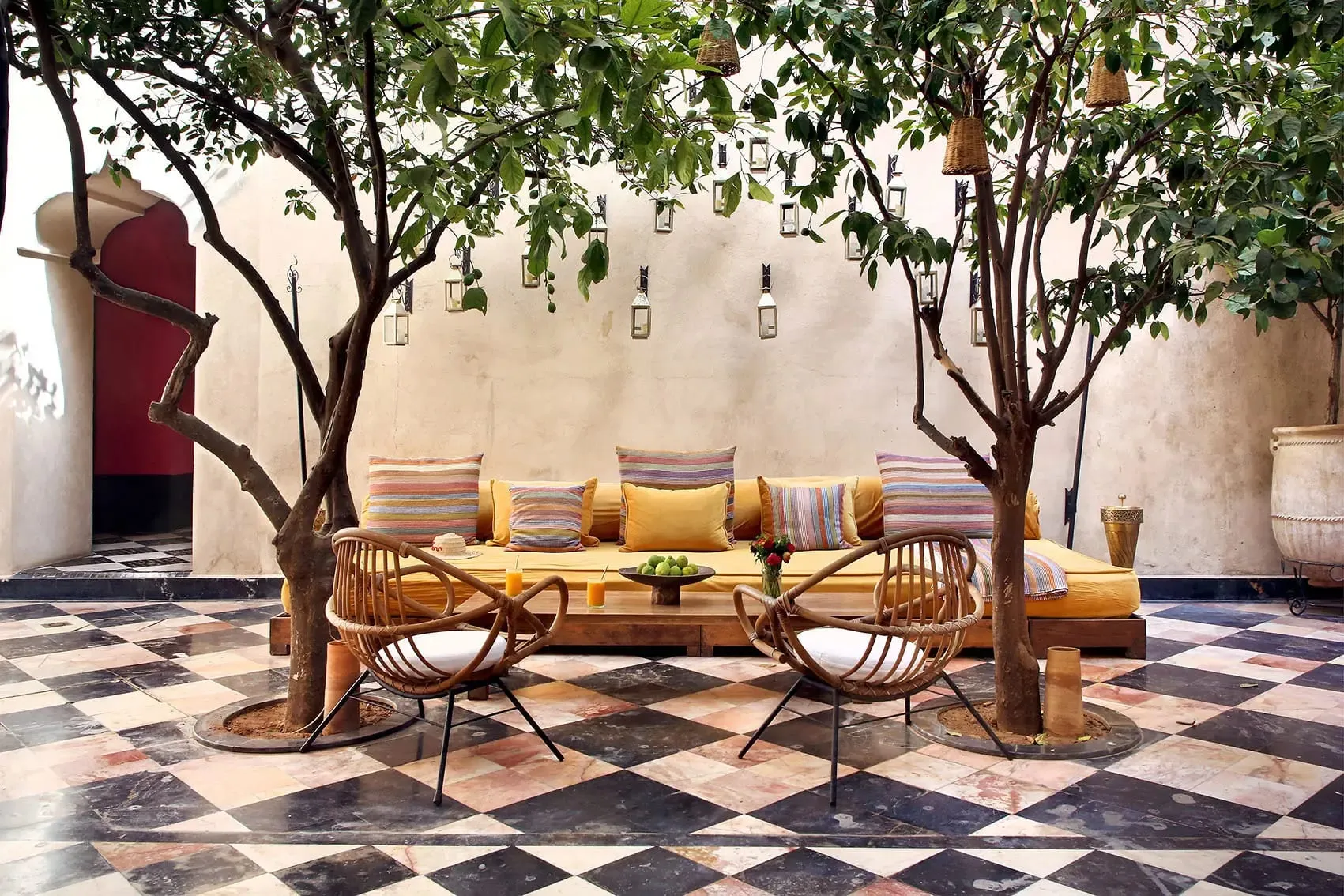
A private art collector's riad turned hotel, stitched together from more than a dozen houses behind the walls of the Marrakech medina.
From $480 per night
Asni Valley, Atlas Mountains, Morocco
Kasbah Tamadot
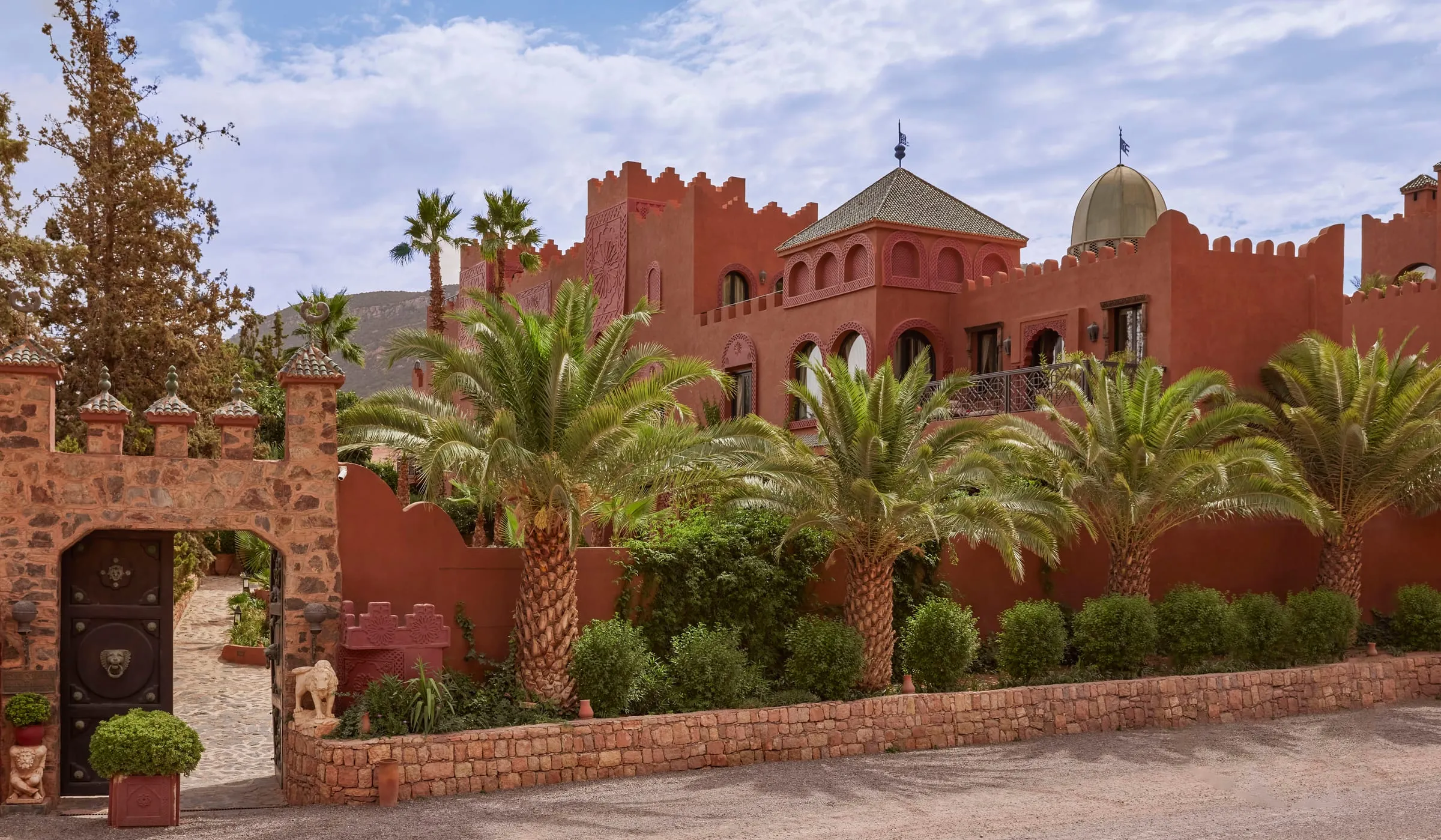
Richard Branson's former antiques-dealer's kasbah, rebuilt above the Asni Valley with Berber tents, three-bedroom riads and Mount Toubkal on the horizon.
From $700 per night
Marrakech medina, Morocco
Royal Mansour Marrakech
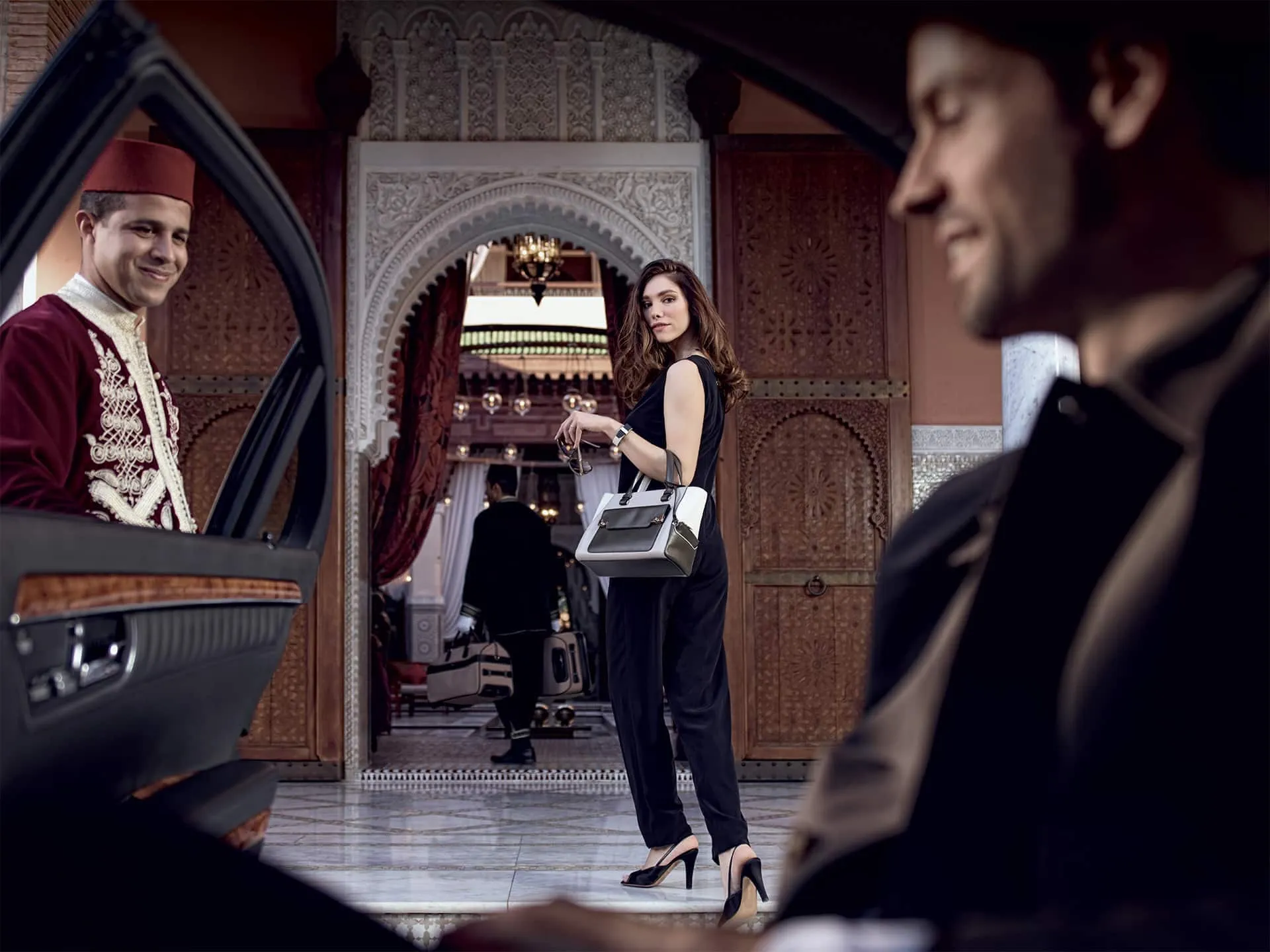
A king's private commission built by 1,200 Moroccan artisans, where every guest gets a multi-storey riad and its own rooftop rather than a room.
From $1,500 per night