Ayung River Valley, Ubud, Indonesia
Mandapa, A Ritz-Carlton Reserve
A bamboo-and-stone sanctuary cut into the Ayung River gorge, where Bali's most exclusive address still moves at the pace of the rice terraces around it.
- Rates from
- From $950 per night
- Nearest airport
- Ngurah Rai International Airport, Denpasar (DPS)
- Transfer
- About 1 to 1.5 hours by car, roughly 35km, with timing dependent on Bali's traffic
- Best months
- April to October, Bali's drier season, though the Ayung Valley stays lush and green year-round
Ubud has no shortage of hotels claiming a river view and a rice-paddy backdrop, but Mandapa occupies a specific and narrower category: it is one of fewer than ten hotels in the world carrying the Ritz-Carlton Reserve name, the brand’s most exclusive and least replicated tier, built one property at a time rather than rolled out to a formula. It opened in September 2015 as only the third Reserve property globally, cut into a bend of the Ayung River where the water drops through a narrow gorge below terraced rice fields, and almost eleven years later it remains one of the more understated arguments for what “ultra-luxury” can mean when a hotel group deliberately builds small.
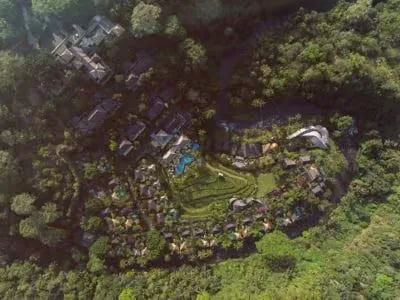
The setting does a great deal of the work. Kedewatan, the village just north-west of central Ubud where Mandapa sits, has long been a magnet for architecturally ambitious hotels precisely because the Ayung Valley offers what flatter parts of Bali cannot: real topographic drama, a fast-moving river, dense jungle canopy and rice terraces that step down toward the water in the kind of view that photographs itself. Mandapa’s 60 suites and villas are threaded along that slope rather than stacked into a conventional hotel block, which keeps the resort feeling closer to a scattered village than a single building, and gives almost every room a version of the valley view that first drew hoteliers to this stretch of river decades ago.
What separates Mandapa from its Ubud peers, several of which sit within a few kilometres along the same river, is the specificity of its brand positioning and the discipline that comes with it. A Ritz-Carlton Reserve property does not borrow a template from the mainline Ritz-Carlton portfolio; each one is designed from scratch for its site, with its own name, its own architectural language and, in Mandapa’s case, its own dedicated butler role, known here as a Patih, drawn from Balinese court tradition. The result reads less like a branded hotel and more like a private estate that happens to be bookable, an impression the resort works hard to sustain from arrival to departure.
This guide covers what actually distinguishes Mandapa within Ubud’s crowded luxury market: its architecture and site planning along the Ayung gorge, its 60 suites and pool villas, its four restaurants and bars, its six-pillar spa programme, and the practical detail, from transfer times to seasonal rates, that a prospective guest needs before booking one of the more expensive stays in Bali.
Why It Stands Out
Mandapa’s clearest differentiator is structural rather than cosmetic: it belongs to the Ritz-Carlton Reserve collection, a tier the group has kept deliberately small since launching it with Dorado Beach in Puerto Rico in 2012. Mandapa was the third property to join, ahead of later additions in Thailand, Saudi Arabia and Mexico, and the collection has stayed under ten hotels worldwide even as Marriott’s broader Ritz-Carlton brand has expanded into dozens of cities. That scarcity is not just a marketing line; it shapes the guest experience directly, since each Reserve property is designed independently for its site rather than adapted from a corporate prototype, and staffing ratios and service style are built around a much smaller number of keys than a typical five-star resort.
The second distinguishing factor is the site itself. Many Ubud hotels advertise a river or jungle outlook, but relatively few sit directly in the Ayung gorge the way Mandapa does, with the water audible from much of the property and the resort’s signature restaurant literally suspended over it. Combined with the surrounding rice terraces, still farmed by local subak cooperatives rather than maintained purely for hotel views, the setting gives Mandapa a working landscape rather than a manicured one, which is a meaningful distinction in a destination where “jungle resort” sometimes means a garden with tall trees rather than an actual river valley.
Finally, there is the matter of restraint. At 60 keys spread across a genuinely large plot of land, Mandapa never feels crowded even at full occupancy, and the resort has resisted the temptation to add the kind of large-scale event space, sprawling pool decks or retail arcades that larger luxury resorts use to diversify revenue. The result is a property that stays legible as a retreat rather than a resort complex, which is precisely the proposition the Ritz-Carlton Reserve brand is built to deliver.
Architecture
Mandapa was designed by architect Miles Humphreys, whose brief was to work with the gorge rather than against it: rather than levelling the site for a conventional horizontal resort layout, the buildings are staggered down the slope toward the river, connected by paths, stairs and covered walkways that follow the valley’s natural contours. The name itself is drawn from Sanskrit, referring to the open-sided pavilion that marks the entrance to a Hindu temple, a threshold space intended to mark the transition from the everyday into something more contemplative, and the architecture leans into that idea through a sequence of arrival: guests move from a formal entrance pavilion down through gardens and rice-paddy views before the river itself comes into view.
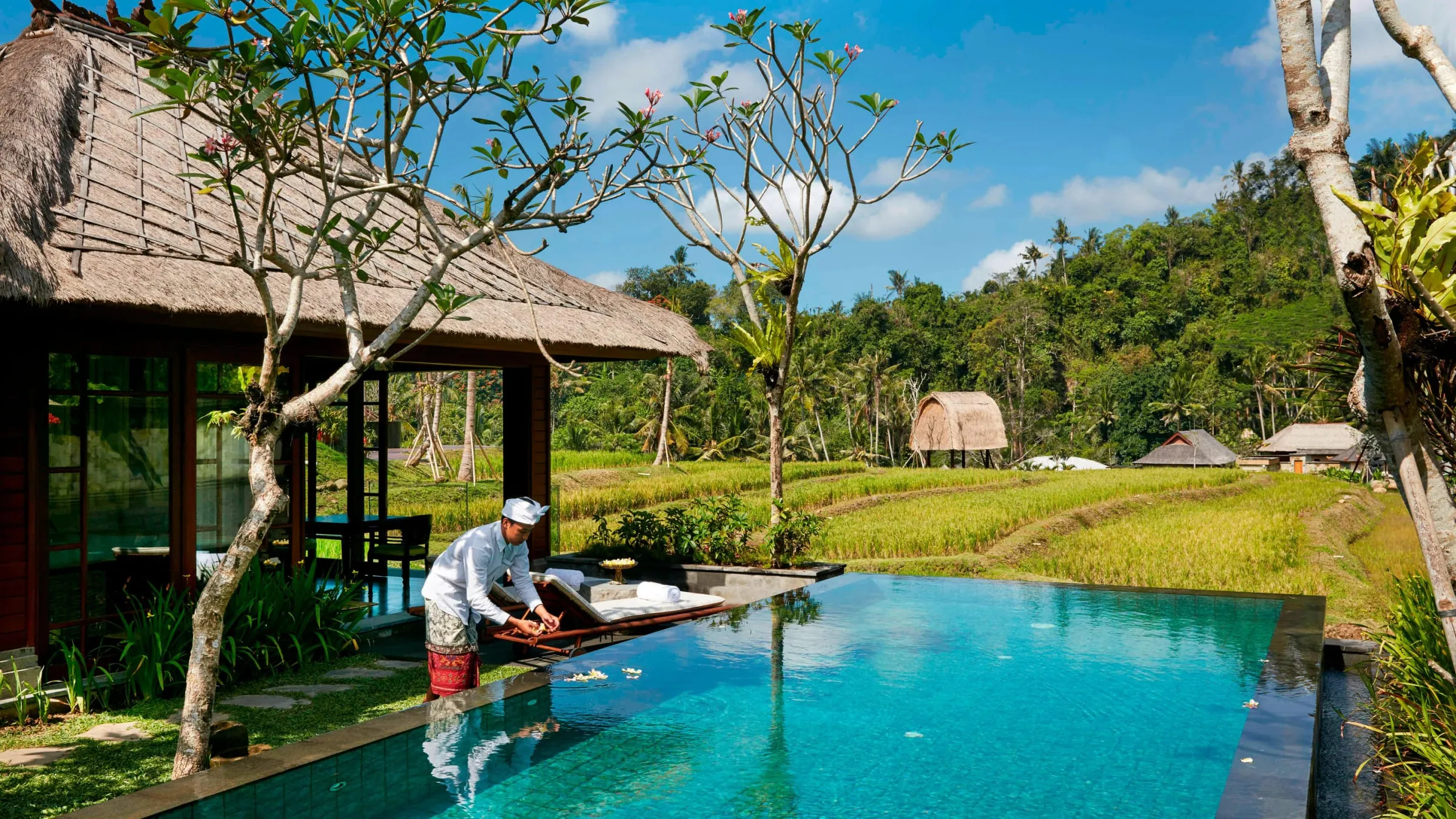
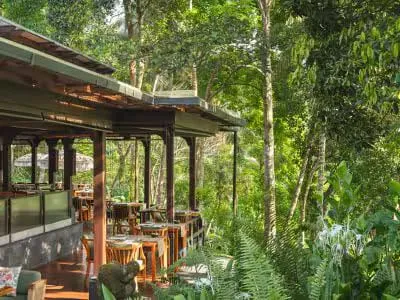
Materials favour bamboo, thatch, local stone and timber over the glass-and-concrete vocabulary that defines much of Bali’s newer luxury development, an approach that keeps the built environment visually subordinate to the landscape it sits within. Kubu, the resort’s signature restaurant, is the clearest expression of this: a bamboo structure built out over the river itself, its nine private dining cocoons cantilevered above the water so that the sound and movement of the Ayung become part of the dining room rather than a view beyond it. Villas and suites are similarly low-slung, with deep roof overhangs, open-sided living pavilions and extensive use of operable glass walls that let interiors dissolve into their terraces and gardens during the day.
The site’s considerable elevation change, the resort drops roughly 40 metres from its entrance to the riverbank in places, was treated as a design opportunity rather than an obstacle, giving different accommodation categories genuinely distinct outlooks: some villas sit high above the gorge with sweeping valley views, while others are tucked closer to the water with a more enclosed, jungle-canopy feel. That variation is unusual for a resort of this size, where a single repeated villa typology is the norm, and it means the physical experience of a stay can differ meaningfully depending on which part of the property a guest is assigned.
Interior Design
Interiors throughout Mandapa were designed by Jeffrey A. Wilkes of DESIGNWILKES, an Asia-based practice known for what the resort itself describes as a “traditional-meets-contemporary Balinese” approach: carved timber screens, woven textiles, stone flooring and locally made furniture set against a restrained, neutral palette rather than the more maximalist, richly patterned interiors sometimes associated with Balinese luxury hospitality. The intent is a sense of authenticity without pastiche, with craft techniques and materials sourced locally wherever possible and blended into a scheme that reads as contemporary rather than themed.
Suites and villas carry that language through into private spaces, with separate living pavilions distinct from the sleeping quarters, high thatched or timber ceilings, and bathrooms that generally open toward the garden or pool rather than being enclosed as an afterthought. The three-bedroom Mandapa River Estate, added to the property some years after opening and positioned as its most substantial single accommodation, extends the same material vocabulary across a considerably larger footprint, with multiple living and dining spaces built for a family or group rather than a couple.
Public interiors, particularly Kubu and the spa, use the same restrained material logic at a larger scale: bamboo structural elements left exposed rather than clad over, stone detailing that echoes the river below, and lighting designed to work with candlelight and dusk rather than against it. The consistency between private and public spaces gives the resort a coherent design identity that holds up across its various buildings, despite the site’s considerable spread and elevation change.
Atmosphere
The prevailing mood at Mandapa is quiet rather than lively, closer to a private wellness retreat than a social resort, and the layout reinforces that: because accommodations are staggered down the valley rather than clustered around a central pool deck, guests are rarely in close proximity to one another outside of the restaurants, and the sound of the Ayung River provides a constant, low ambient backdrop that does much of the work other resorts leave to music or activity programming. Days tend to move slowly, between a villa’s private pool, the spa, a walk through the surrounding rice paddies and one of the restaurants, with relatively little pressure to fill a schedule.
Evenings shift the tone slightly without losing the underlying calm. Kubu’s river-side cocoons and Ambar’s clifftop bar, with occasional live jazz, give the resort a more atmospheric, candlelit register after dark, while Sawah Terrace’s Balinese dance performances offer one of the more direct connections to local culture available on-site rather than requiring an excursion into town. Even so, Mandapa’s version of nightlife stays deliberately low-key by design; travellers looking for the livelier bar and restaurant scene that central Ubud or South Bali can offer will need to leave the property for it, since the resort itself is built around restoration rather than entertainment.
Rooms and Suites
Mandapa’s 60 accommodations split into 35 suites and 25 private pool villas, with the villas forming the resort’s headline category. Every villa has its own private pool, roughly 30 square metres, set within a walled garden or terrace, a separate open-air living pavilion distinct from the bedroom, and operable glass walls that allow the interior to open fully onto the outdoor space. Villa categories differ mainly by position and size: some sit closer to the river with denser jungle canopy overhead, others sit higher on the slope with wider views across the rice terraces and gorge, and the largest is the three-bedroom Mandapa River Estate, a roughly 21,000-square-foot residence that can accommodate up to nine guests across multiple bedrooms, living and dining spaces, positioned as a self-contained property for families or groups travelling together.
The 35 suites, while lacking private pools, retain the same design language and generous proportions as the villas, with separate living areas and either rainforest or rice-paddy outlooks depending on category, and they represent the resort’s relative entry point, still positioned well above typical five-star Ubud rates given the Reserve brand’s overall pricing. Across every category, guests are assigned a dedicated Patih, the resort’s term for a personal butler drawn from Balinese court tradition, responsible for arranging everything from dining reservations to laundry and excursion bookings throughout the stay, a service layer that is standard at Reserve properties rather than an optional upgrade.
Dining
Mandapa runs four restaurants and bars, a comparatively compact lineup for a resort at this price point, but one built around distinct identities rather than redundant variations on the same format. Kubu, the signature venue, is the bamboo structure suspended over the Ayung River with nine private dining cocoons, serving an international, Mediterranean-leaning tasting menu under executive chef Eka, built around ingredients the resort states are sourced within roughly 100km, and operating under a stated zero-waste kitchen philosophy that extends the resort’s sustainability positioning directly into its most formal dining room.
Sawah Terrace sits at the edge of the valley and serves Indonesian and Balinese heritage dishes, including grilled tiger prawns and spiced suckling pig among its specialities, with traditional Balinese dance performances offered periodically to accompany dinner service, making it the most culturally rooted of the resort’s venues. Ambar Ubud Bar occupies a clifftop position and pairs Japanese-fusion small plates with a cocktail programme and live jazz, functioning as the resort’s principal evening bar. Dining Beyond, rather than a fixed restaurant, is Mandapa’s private dining arm, arranging bespoke meals at settings around the property and beyond it, including a table known as The Cliff at Sawah, drawing on the same kitchens but built for guests wanting a more customised or secluded setting. The Pool Bar and The Library round out the daytime offering with light bites, juices and a quiet reading space respectively, and in-villa dining runs around the clock across Balinese, Asian and international menus.
Spa and Wellness
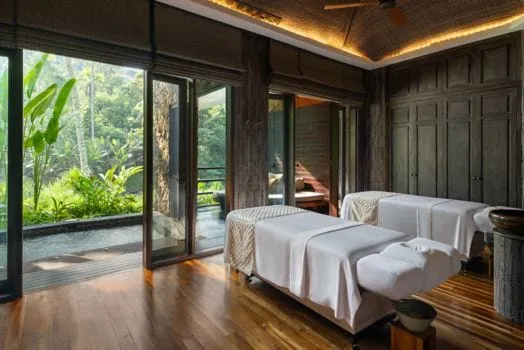
Mandapa Spa and Wellness Center is organised around six treatment pillars: Balinese spa traditions, detox, nutrition, alternative therapy, body therapy and healing, a structure intended to position the spa as a programme rather than a menu of standalone treatments. Eight treatment rooms, three of them configured for couples, use a combination of ESPA products and Balinese-sourced ingredients, and the facility includes a riverfront yoga studio, a vitality pool, saunas and a fitness centre, giving the wellness offering a genuine physical footprint on the property rather than a handful of rooms tucked beside the gym.
The riverfront positioning of the yoga studio in particular ties the wellness programming back to the resort’s defining natural feature, with sunrise sessions timed to the sound and light of the Ayung Valley below. Beyond the formal spa, Mandapa treats wellness as something that runs through the wider stay, from rice-paddy walks and cycling routes through the surrounding countryside to the simple fact that the resort’s layout, staggered down a quiet valley away from any main road, does much of the work of slowing guests down before a single treatment has been booked.
Experiences
The Ayung River itself is the resort’s most distinctive activity platform, and Mandapa arranges private white-water rafting trips on it, giving guests direct access to a stretch of river considered one of Bali’s best for the sport without needing to book through an outside operator. Cycling and hiking routes run through the surrounding rice paddies and villages, typically guided, and offer a closer look at the working agricultural landscape that surrounds the resort, including the subak irrigation cooperatives that still manage water flow to the terraces visible from many of the villas. Cooking classes and market visits connect guests with Balinese cuisine beyond the resort’s own restaurants, and Ubud’s temples, art markets and the nearby Monkey Forest are all reachable by a short car journey for guests wanting a cultural excursion into town.
Families are catered for through Mandapa Camp, a children’s programme built around an organic garden and small educational farm on the property, with full and half-day activities that include hands-on exposure to farm animals, nature walks and, for younger guests, making canang, the small daily offerings placed throughout Bali as part of everyday Hindu practice, giving children a genuine, if simplified, introduction to local custom rather than a generic kids’ club format. Beyond the structured programme, the scale of the grounds themselves, gardens, rice terraces, riverbank paths, gives families room to explore independently in a way that a more tightly packed resort could not accommodate.
Who It Is For
Mandapa suits travellers who want Ubud’s cultural and natural setting delivered with a very high level of privacy and service, rather than those looking for a livelier social scene or direct beach access, since the resort sits well inland along a river gorge rather than on Bali’s coast. Honeymooners and couples are particularly well served by the villa category’s private pools and the resort’s generally quiet, unhurried pace, while wellness-minded travellers will find the spa’s structured six-pillar programme and riverfront yoga more substantial than a typical resort spa’s a la carte treatment list.
Families with the budget for it are also well accommodated, particularly through the three-bedroom River Estate and the Mandapa Camp children’s programme, though the resort’s overall tone, quiet, adult-leaning and design-forward, may suit families with slightly older or more independent children better than those travelling with very young ones who need constant activity. Guests specifically seeking beach time, nightlife or a more urban base for exploring South Bali should look elsewhere; Mandapa’s proposition is the river valley itself, and that comes with a genuine, if scenic, remove from the coast.
Best Time to Visit
Bali runs on a broadly two-season calendar, with a drier period from roughly April through October and a wetter season from November through March, and the drier months generally bring more reliable conditions for the resort’s outdoor programming, including rafting, cycling and rice-paddy walks. That said, Ubud’s inland, higher-elevation setting keeps the Ayung Valley green and the river running year-round regardless of season, and rain in the wetter months tends to arrive in shorter, heavier bursts rather than settling in for full days, so a visit outside the peak dry season is far from a compromise for guests mainly focused on the spa, dining and villa experience rather than river sports.
Peak demand, and peak rates, generally align with the Northern Hemisphere’s summer holidays and the December to January period, so travellers with flexible dates can often find calmer conditions and somewhat better rates in the shoulder months of April, May, September and October, which also tend to offer a good balance of drier weather and lower crowds across Ubud more broadly.
How to Get There
Almost all international visitors arrive via Ngurah Rai International Airport (DPS), located near Denpasar on Bali’s southern coast. Mandapa sits roughly 35km inland and north of the airport, in the village of Kedewatan just outside central Ubud, and the standard route is a private car transfer arranged directly through the resort. Because Ubud has no airport of its own and much of the route runs through populated areas rather than open highway, the drive typically takes between one and one and a half hours, with actual timing highly dependent on Bali’s often heavy road traffic, particularly around Denpasar and the approach into Ubud itself. Guests with flexibility in their arrival time may find it worth avoiding late-afternoon arrivals, when traffic on the main routes north from the airport tends to be at its heaviest.
Nearby Experiences
Central Ubud, roughly a fifteen-to-twenty-minute drive from the resort depending on traffic, offers the town’s well-known art markets, the Sacred Monkey Forest Sanctuary, and a concentration of galleries and craft workshops tied to Ubud’s long-standing role as Bali’s cultural and artistic centre. The Tegallalang rice terraces, one of the island’s most photographed agricultural landscapes, sit a short drive further north and offer a larger-scale version of the terraced views visible from parts of Mandapa’s own grounds.
Closer to the resort, the Ayung River corridor itself hosts several of Ubud’s better-known rafting operators, and the broader Kedewatan and Payangan area includes a number of temples and smaller villages worth a stop for guests wanting to see rural Balinese life beyond the resort’s boundary. Sacred sites further afield, including Tirta Empul’s holy spring temple and the Goa Gajah “Elephant Cave,” are reachable as half-day excursions and are commonly arranged through the resort’s concierge for guests wanting a deeper look at Balinese Hindu practice during their stay.
Things to Know Before Booking
Rates at Mandapa sit firmly in Bali’s ultra-luxury bracket, with published rates for entry-level suites starting from roughly USD 900 to 1,000 per night in shoulder-season conditions and rising well beyond that for pool villas and the three-bedroom River Estate, particularly in peak season. As with most Bali hotels, government tax and service charges are typically applied on top of quoted rates, so it is worth confirming whether a specific rate is quoted net or inclusive when booking. A minimum check-in age of 21 applies, and the resort does not accept pets.
Given the resort’s inland, river-valley setting, guests expecting the beach access common to many Bali luxury resorts should adjust expectations accordingly; there is no direct sea access here, and a stay is generally best combined with time at a coastal property elsewhere on the island if beach time is a priority for the wider trip. Because accommodations are spread across a sloped site with real elevation change, guests with mobility concerns should raise this with the resort in advance, since some pathways between villas, the spa and the restaurants involve stairs and gradients that a flatter resort layout would not present.
Sustainability
Mandapa holds Green Globe certification, the sustainability accreditation used widely across the hospitality industry, and its most visible sustainability commitment sits in its kitchens: Kubu operates under a stated zero-waste philosophy, with ingredients sourced within roughly 100km of the property wherever possible, reducing both food miles and reliance on imported produce in a destination where much of high-end dining still depends heavily on it. The resort has also described community-facing initiatives including river cleanup efforts along the Ayung, English-language classes for local schoolchildren, and a soap recycling programme that repurposes used guest amenities rather than discarding them.
The property’s architecture supports these operational commitments to some degree as well, since its use of local, lower-impact materials such as bamboo and thatch, alongside a design that works with the site’s natural slope rather than requiring extensive levelling, reduced the scale of construction disruption relative to a more conventional flattened resort layout. As with most hotel sustainability programmes, guests should treat published figures and certifications as a starting point for questions rather than a complete picture, and the concierge team can typically speak in more detail about current initiatives during a stay.
Practical Information
Check-in is from 3:00pm and check-out by 12:00pm, with a minimum check-in age of 21 and no pets accepted. Rates start from around USD 950 per night for entry-level suite categories, rising substantially for pool villas and the three-bedroom Mandapa River Estate, particularly during peak season; taxes and service charges are generally applied on top of quoted rates. The nearest airport is Ngurah Rai International Airport (DPS) near Denpasar, roughly 35km away, reached by private car transfer in about one to one and a half hours depending on traffic. Most stays run three to four nights, enough time to move between a villa’s private pool, the spa’s six-pillar programme, at least two of the resort’s restaurants and one excursion, whether that is river rafting, a rice-paddy walk or a half-day trip into central Ubud or further afield to one of the island’s temple sites.
Editorial Conclusion
Mandapa’s case for itself rests less on any single spectacular feature than on the discipline of the whole: a Ritz-Carlton Reserve property, one of a genuinely small global handful, built specifically for a working river gorge rather than adapted to it, with just 60 keys spread across a site that gives most of them real privacy and a real view. The bamboo cocoons over the Ayung at Kubu, the six-pillar spa programme, the staggered architecture that follows the valley’s own contours rather than flattening it, all point toward the same underlying idea, that the setting itself, rice terraces, river, jungle canopy, is the actual luxury on offer here, and the hotel’s job is simply to get out of its way as elegantly as possible. For travellers who want Ubud’s cultural and natural depth delivered with a genuinely high level of privacy and service, and who are comfortable trading beach access for a river valley, Mandapa remains one of the clearer arguments in Bali for what the top of the market can look like when a hotel group builds only a handful of these properties rather than dozens.
In pictures
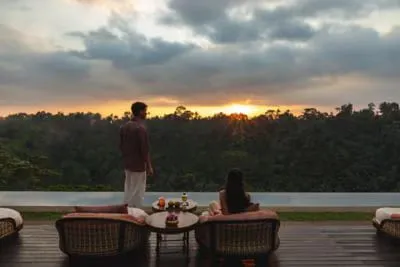
On the map
Ayung River Valley, Ubud, Indonesia
Questions
Frequently asked
What does 'Ritz-Carlton Reserve' mean, and how is Mandapa different from a regular Ritz-Carlton?
Ritz-Carlton Reserve is the brand's most exclusive tier, a small global collection of individually designed, deliberately intimate resorts that sit apart from the mainline Ritz-Carlton portfolio in both scale and positioning. Mandapa opened in September 2015 as the third property in the Reserve collection, following Dorado Beach in Puerto Rico and Zadun in Mexico, and it remains one of fewer than ten Reserve properties operating worldwide. Unlike a typical big-city Ritz-Carlton, Mandapa has just 60 keys, its own architectural identity built specifically for the Ayung River site, and a level of personalised service, including a dedicated butler known locally as a Patih, that the mainline brand does not offer as standard.
How many rooms and villas does Mandapa have, and do they all have private pools?
Mandapa has 60 accommodations in total: 35 suites and 25 private pool villas. Every villa category has its own private pool, roughly 30 square metres, along with a separate living pavilion and operable glass walls that open the interior onto the surrounding jungle or rice-paddy view. The resort's largest configuration is the three-bedroom Mandapa River Estate, a later addition of roughly 21,000 square feet that can sleep up to nine guests, positioned as a standalone residence for families or groups travelling together.
How far is Mandapa from the airport, and how do guests get there?
The resort sits inland from the coast in Kedewatan, a village just outside central Ubud, roughly 35km from Ngurah Rai International Airport (DPS) near Denpasar. There is no direct highway for most of the route, so the drive typically takes between one and one and a half hours depending on traffic, which can be significant on Bali's roads at peak times. The resort arranges private car transfers for guests, and this is the standard way to arrive, since Ubud has no airport of its own and the inland, river-valley setting is not reachable by boat.
What is the food like at Mandapa, and how many restaurants does it have?
Mandapa runs four restaurants and bars plus a private dining programme. Kubu, the signature venue, is built from bamboo with nine dining cocoons suspended over the Ayung River and serves an international, Mediterranean-leaning tasting menu built around ingredients sourced within roughly 100km, under a stated zero-waste kitchen philosophy. Sawah Terrace serves Indonesian and Balinese heritage dishes beside the river with occasional traditional dance performances, Ambar Ubud Bar is a clifftop Japanese-fusion and cocktail venue with live jazz, and Dining Beyond arranges private meals at settings around and beyond the property, including a table known as The Cliff at Sawah.
What is the spa like, and is Mandapa a wellness-focused hotel?
Mandapa Spa and Wellness Center is built around six treatment pillars: Balinese spa traditions, detox, nutrition, alternative therapy, body therapy and healing, delivered across eight treatment rooms, three of them for couples, using a mix of ESPA and Balinese-sourced products. The resort also has a riverfront yoga studio, a vitality pool, saunas and a fitness centre, and the wider property leans into wellness through rice-paddy walks, cycling and river-based activity rather than confining it to the spa alone, which fits its billing as a resort built for slower, more restorative stays rather than sightseeing-heavy itineraries.
Same destination
More hotel guides in Indonesia
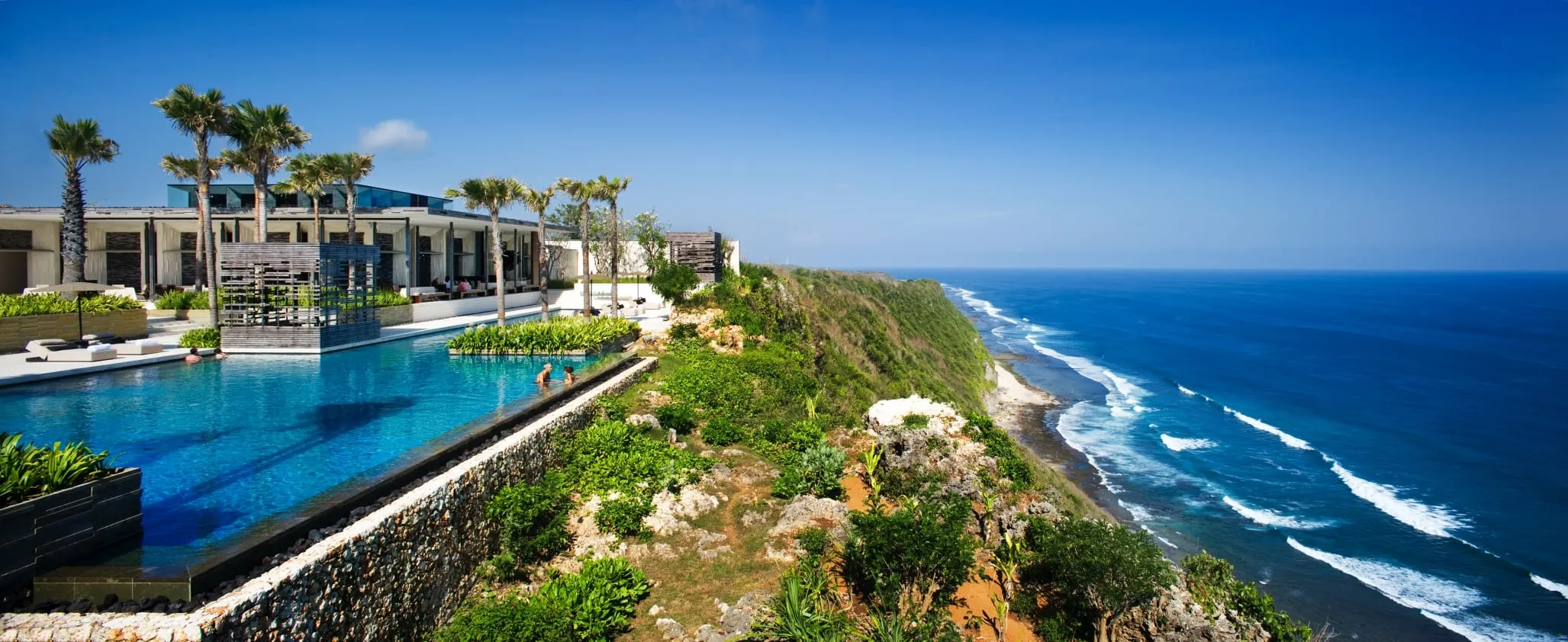
Uluwatu, Bukit Peninsula, Indonesia
Alila Villas Uluwatu
A Singapore architecture firm carved a geometric limestone resort into a Bukit Peninsula clifftop in 2009, planting grass roofs across it so the whole property reads as an extension of the savannah it replaced.
From $800 per night
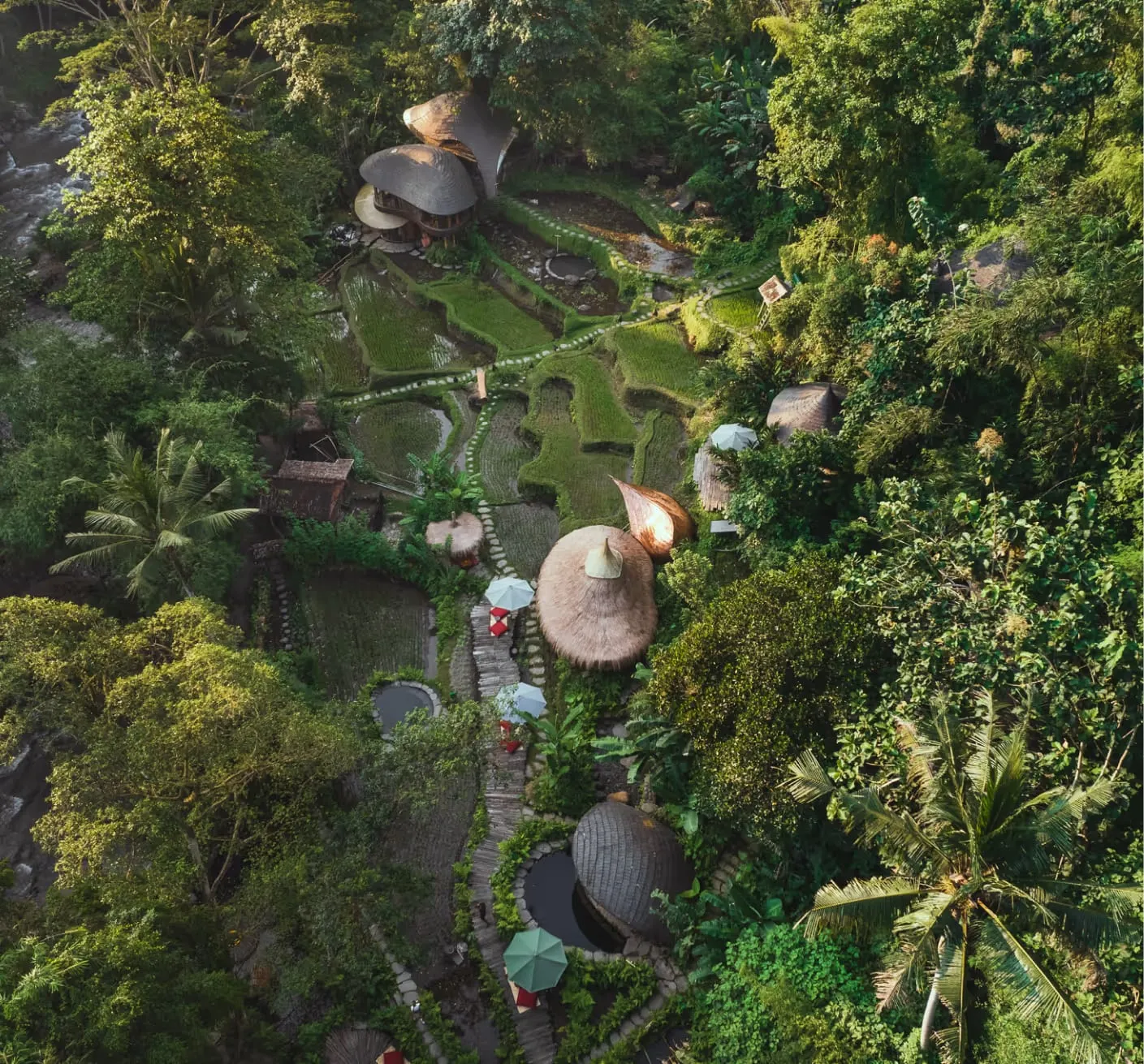
Sayan, Ubud, Indonesia
Bambu Indah
Antique Javanese bridal houses and hand-built bamboo pavilions, dismantled, relocated and rebuilt above the Ayung River gorge by the founders of Green School Bali.
From $250 per night
Uluwatu, Bukit Peninsula, Indonesia
Bulgari Resort Bali
A Milanese architecture firm cut 59 villas and five mansions into a limestone clifftop above the Indian Ocean, then built one of the longest hotel funiculars in the world to reach the private beach below.
From $1,500 per night