West Sumba, Indonesia
NIHI Sumba
A former surf camp on Indonesia's wildest island, rebuilt into one of the world's most private ultra-luxury resorts, still built around a wave almost nobody gets to surf.
- Rates from
- From $1,650 per night
- Nearest airport
- Tambolaka Airport (TMC), Sumba
- Transfer
- About 90 minutes by resort vehicle from Tambolaka Airport
- Best months
- May to October
There is a version of luxury travel built entirely around access: not to thread counts or butler service, but to a specific, finite, physical thing that cannot be manufactured or expanded. At NIHI Sumba, that thing is a wave. Occy’s Left peels down a reef a short walk from the villas, a left-hander good enough that the Australian surfer Mark Occhilupo, after whom it is named, once called it among the best he had ridden anywhere. The resort caps the number of surfers in the water at any one time, which means a guest paying for one of the world’s most expensive hotel rooms can still, on a crowded day, be told to wait their turn.
That tension, between total comfort and deliberate scarcity, runs through the entire property. NIHI Sumba sits on the west coast of Sumba, an island in eastern Indonesia that tourism largely bypassed for decades in favour of Bali, Lombok and the more accessible parts of the archipelago. It began in 1988 as a bamboo hut built by an American surfer and his wife who had come looking for a wave and stayed to build a life around it, and it has since passed through two very different eras: a rustic, off-grid surf camp that opened formally as Nihiwatu in 2001, and a rebuilt, internationally garlanded resort that reopened as NIHI Sumba in 2015 under new ownership and a reported thirty-million-dollar renovation.
What has not changed across either era is the resort’s relationship to the island around it. Sumba remains one of the least developed of Indonesia’s larger islands, its interior given over to grassland, thatched clan villages and megalithic tombs rather than resort infrastructure, and NIHI Sumba has built its identity, and much of its philanthropic effort through the independent Sumba Foundation, around treating that isolation as the point rather than the obstacle. The result is a property that reads, from a distance, as a conventional catalogue of ultra-luxury signifiers: private-pool villas, a spa reached on horseback or by jeep through rice paddies, a stable of horses that gallop guests along an empty beach at sunset. Look closer and the story is stranger and more specific than that, rooted in one wave, one beach and nearly forty years of one family’s, and then one company’s, insistence on staying there.
Why It Stands Out
NIHI Sumba’s most distinctive asset is the one it cannot advertise too loudly: Occy’s Left, a fast, barrelling reef break directly in front of the property, access to which is capped at roughly ten surfers at a time and prioritised for resort guests. Few luxury resorts anywhere control a wave of this quality this closely, and the scarcity is not marketing artifice but a genuine, decades-old arrangement that predates the current ownership.
The second distinction is scale of remoteness matched to scale of investment. Sumba remains a genuinely undeveloped island by regional standards, reachable only via a connecting flight through Bali and a long overland transfer, yet the resort has built an equine wellness programme with its own stables, a spa safari through rice paddies, and multiple dining venues to a standard usually associated with far more accessible destinations. That combination, serious infrastructure in a genuinely hard-to-reach place, is unusual even within the ultra-luxury tier.
The third is the resort’s philanthropic architecture. The Sumba Foundation, founded in 2001 by the original owners alongside an early guest turned benefactor, operates as an independent charity funding malaria control, clean water and education projects across the island, reaching tens of thousands of Sumbanese people in well over a hundred villages. It predates the resort’s current ownership and has outlasted one change of hands already, giving NIHI Sumba’s community engagement a depth that goes beyond the standard resort foundation.
Architecture
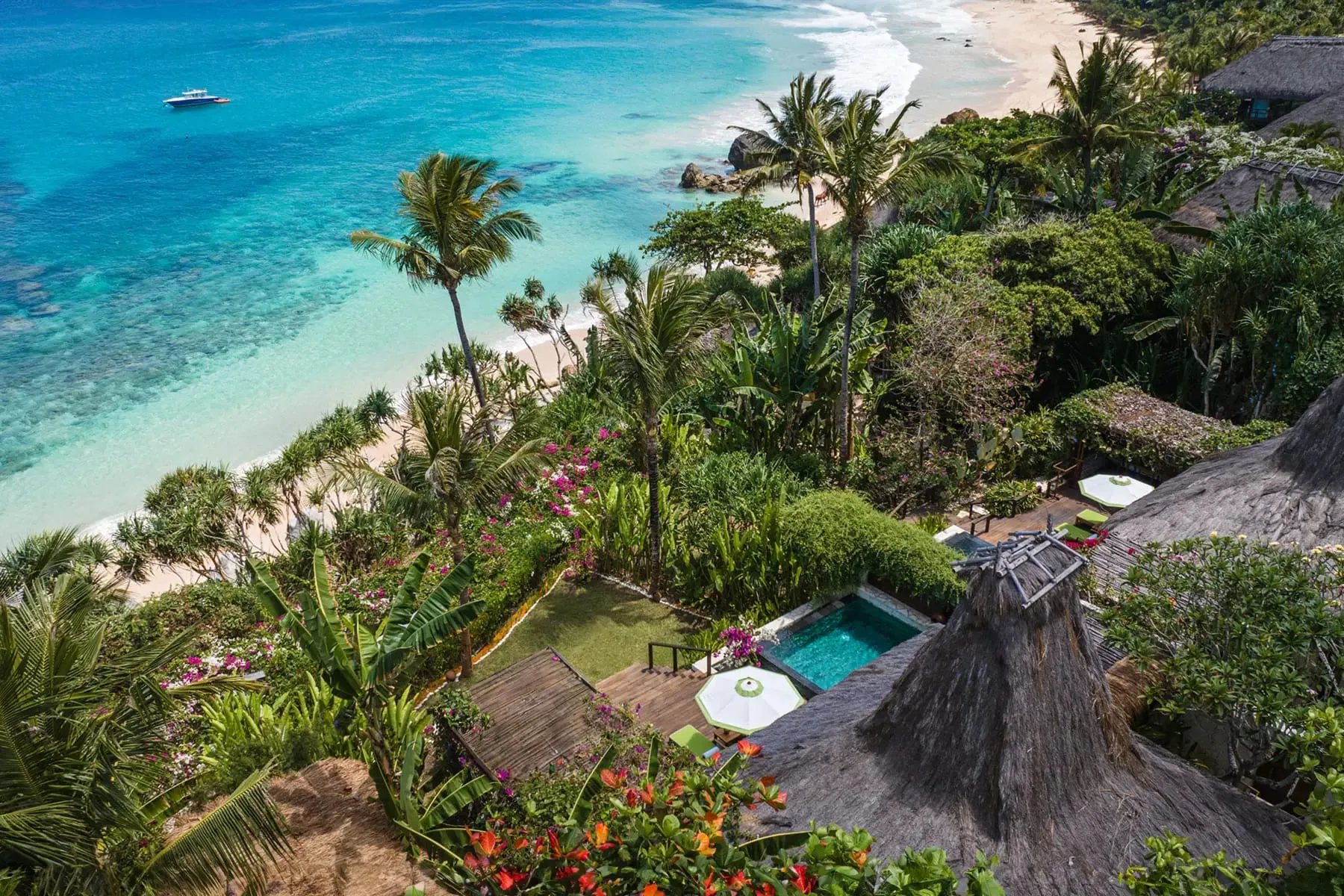
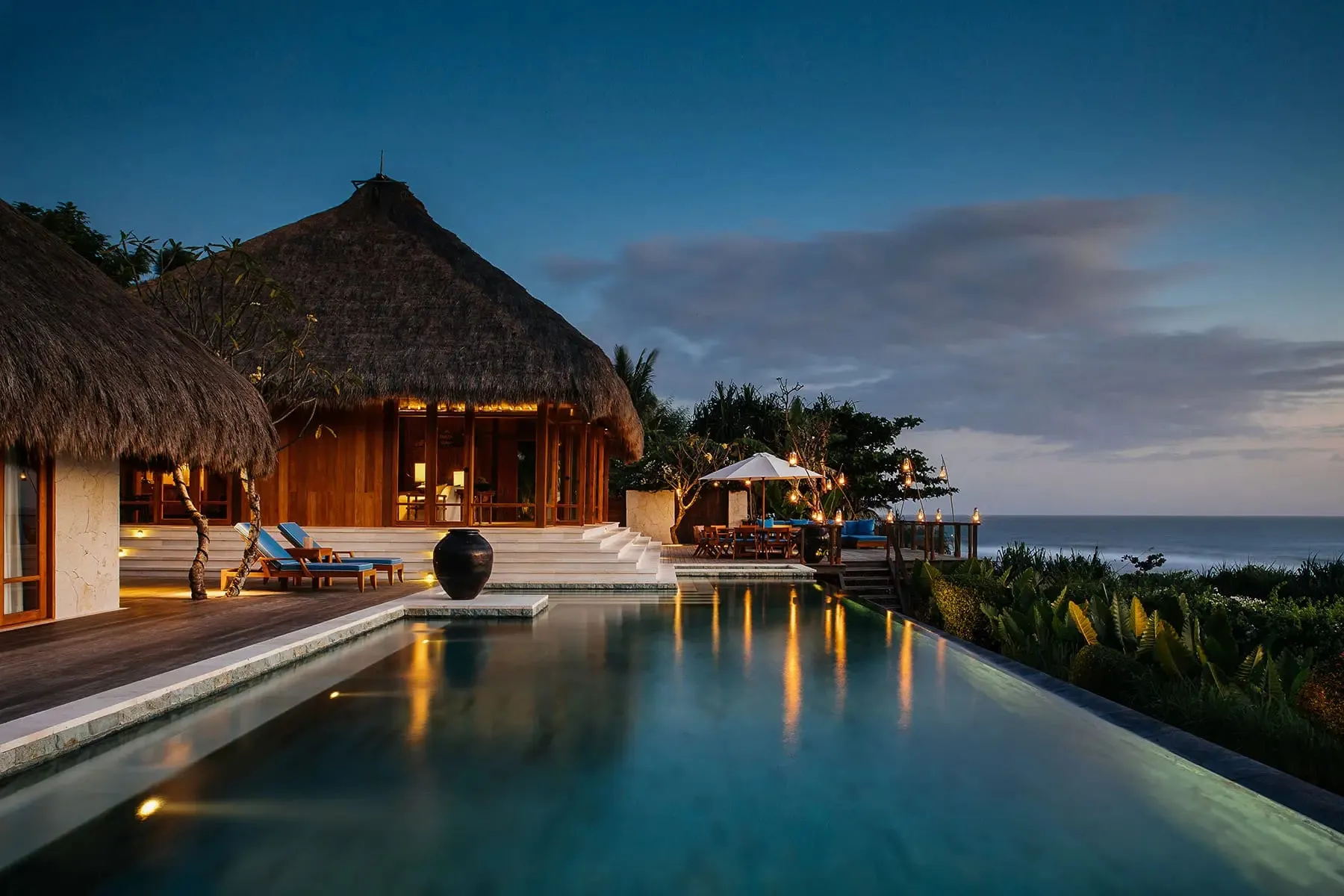
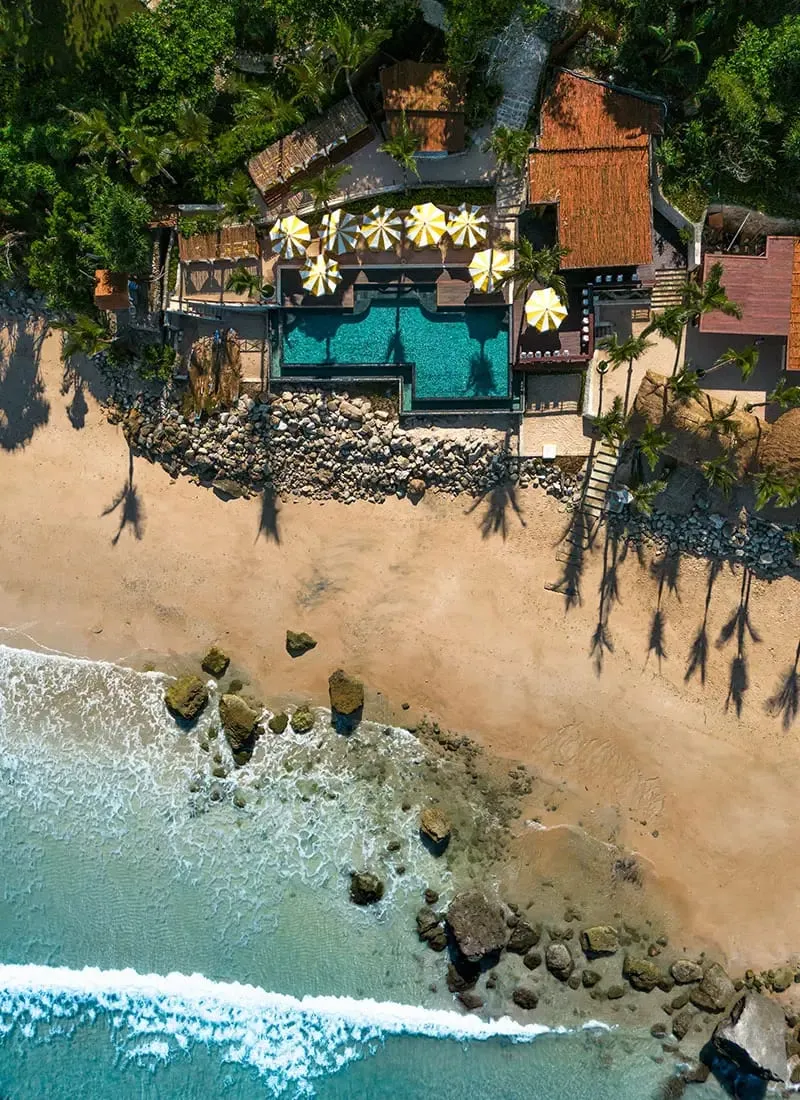
The resort’s built form is shaped as much by Sumba’s climate and materials as by any single architectural signature. Villas are constructed largely from local materials, bamboo prominent among them, with steep thatched roofs derived from traditional Sumbanese building forms, raised on rocky bluffs or set back into the tree line above Nihiwatu Beach. Nothing on the property rises above a low, villa-scale profile; there is no central hotel tower, and the closest thing to a hub is Ombak, the open-air restaurant and lounge cantilevered on wooden decking over the sand.
The 567-acre property, around 230 hectares of largely untouched jungle, gives the architecture room to spread rather than stack, with individual villas set apart from one another by dense vegetation rather than shared walls or corridors. This spacing is a deliberate structural choice as much as an aesthetic one: privacy at NIHI Sumba is engineered through distance and landscaping, not just design, and a guest can walk from one villa to another without another building coming into view.
The Nihioka Spa Safari extends the same logic further from the main resort footprint, sited on a bluff reached by a hike through rice paddies and village land or by open-air safari jeep, its treatment spaces built as simple open-air bales rather than an enclosed spa building. The Sandalwood Stables, similarly, sit apart from the guest villas entirely, and the resort has confirmed plans to add further villas near the stables and a treetop yoga pavilion between 2025 and 2027, extending the same spread-out, low-density approach as the property grows.
Interior Design
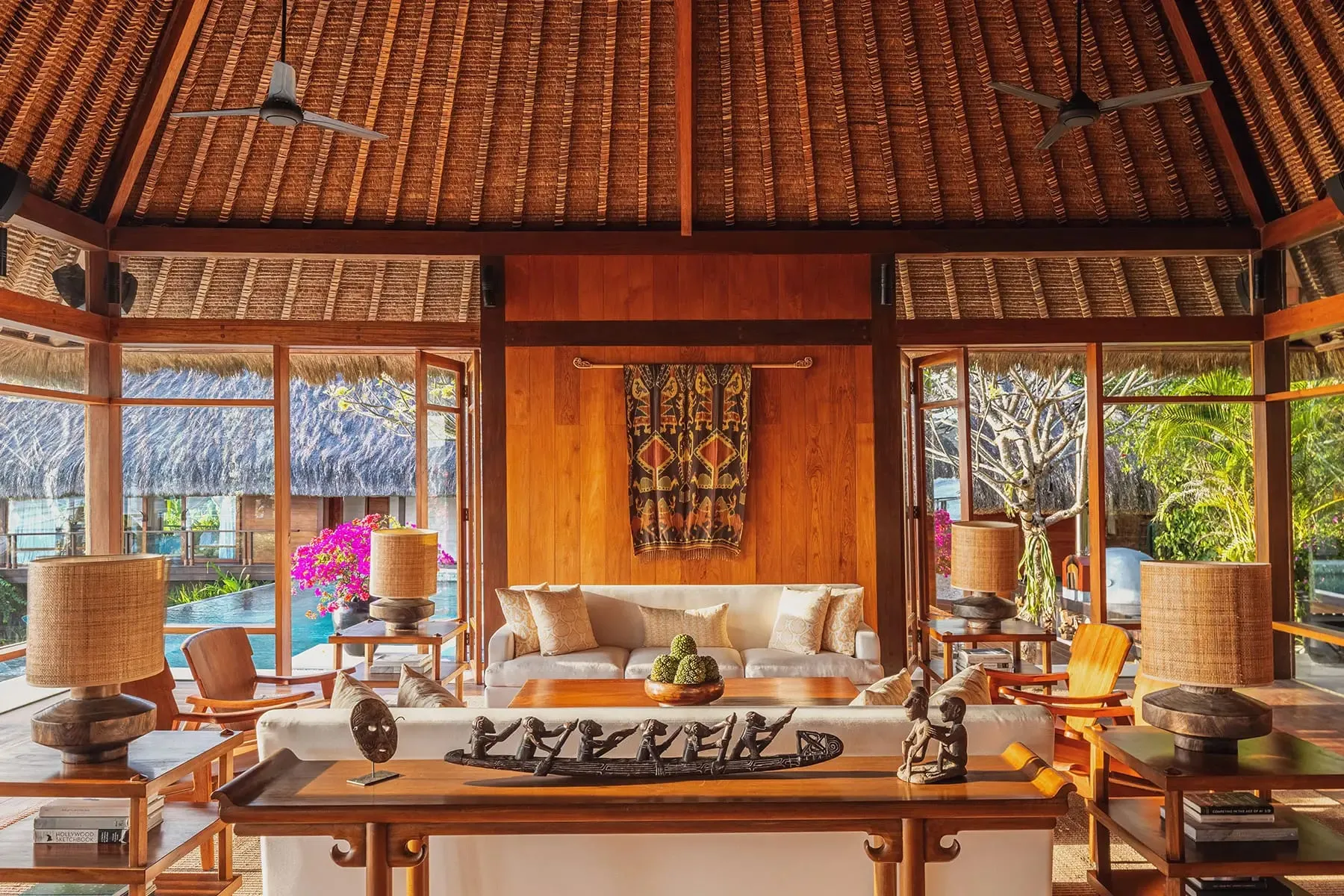
Interiors across NIHI Sumba’s 27 villas favour natural, tactile materials over polish: teak and reclaimed timber furniture, woven textiles, stone bathrooms and thatch ceilings, with decor drawing on Sumbanese craft traditions, ikat weaving among them, rather than a generic tropical-luxury template. Every villa is built around a private infinity pool, most facing the ocean or the surrounding jungle, and outdoor living space, decks, open-air bathing areas, alfresco dining pavilions, is treated as integral to the villa rather than an add-on.
The larger estate-scale properties push this further. Raja Mandaka, the resort’s principal residence with beachfront access to Nihiwatu Beach, and multi-bedroom configurations such as the Treehouse, sleeping up to six across three bedrooms, extend the same material language across dedicated living pavilions, private gardens and, in some categories, private staff. The Marangga villas, four of roughly 190 square metres each, pair a four-poster king bedroom with private gardens running to the sea, an outdoor bath and shower, and an alfresco dining and lounge area, giving a sense of the mid-tier villa experience at the property.
Across every category, air conditioning is generally limited to bedrooms, with living and outdoor spaces designed to work with natural ventilation, in keeping with the resort’s broader sustainability commitments and its preference for interiors that feel grown out of Sumba rather than imported into it.
Atmosphere
NIHI Sumba trades in a specific mood: barefoot but not casual, remote but not austere. Days move around the tide and the swell as much as the clock, with the resort’s surf report shaping plans for many guests as directly as any spa booking, and the open, sand-floored dining rooms at Ombak keep the ocean audible from most meals. Staff, drawn substantially from surrounding villages, bring a warmth that guests and press coverage repeatedly single out, distinct from the more formal service style of comparable ultra-luxury properties elsewhere in Asia.
Evenings shift toward a quieter register than the daytime’s surf-and-horseback energy, with the property’s remoteness meaning genuinely dark skies and little of the piped ambient soundtrack common to larger resorts; the loudest sound most nights is the reef. The equine programme adds its own texture to the property’s rhythm, with the sound and movement of horses being led to and from the stables and the beach a near-constant, deliberately unhidden presence rather than a scheduled activity tucked away from view. Couples and solo travellers describe an unhurried, almost monastic calm outside of surf sessions; families report a livelier, more physically active atmosphere centred on the beach, the pony club and the resort’s wider activity programme.
Rooms and Suites
NIHI Sumba comprises 27 private villas totalling 38 rooms, spread across one- to five-bedroom configurations, every one built with its own private pool. The resort groups its villas informally by guest type rather than a strict tiered category system: options aimed at couples and solo travellers include Mandaka Surf and Lulu Amahu among roughly a dozen smaller villas, while family- and group-oriented properties include Kasambi, Wamoro, Lantoro, Kanatar, Lamba, Puncak and Haweri, alongside the larger estate-scale villas.
At the top of the range, Raja Mandaka is the resort’s principal residence, a two-bedroom estate with direct, private access to Nihiwatu Beach, generally positioned as the flagship villa for guests wanting the most immersive beachfront setting. The Treehouse, a three-bedroom property sleeping up to six, and the four-villa Marangga cluster, including a dedicated Marangga Occy’s Villa positioned closest to the surf break, round out the honeymoon- and celebration-oriented categories, alongside Villa Rahasia and Hillrise. Villa Rahasia’s name, meaning roughly “secret” or “hidden” in Indonesian, reflects its more secluded positioning within the property.
Every villa includes a private pool as standard, and most guests are assigned a personal villa host during their stay, a service model the resort positions as central to its personalised, largely unscripted approach rather than a fixed daily itinerary.
Dining
Dining at NIHI Sumba runs across four principal venues rather than a single flagship restaurant. Ombak, whose name translates roughly as “wave,” is the resort’s main dining room, an open-air restaurant and lounge bar built on wooden decking cantilevered toward the ocean, serving à la carte breakfast and dinner daily with a menu built around produce from the resort’s own organic garden and fresh local seafood.
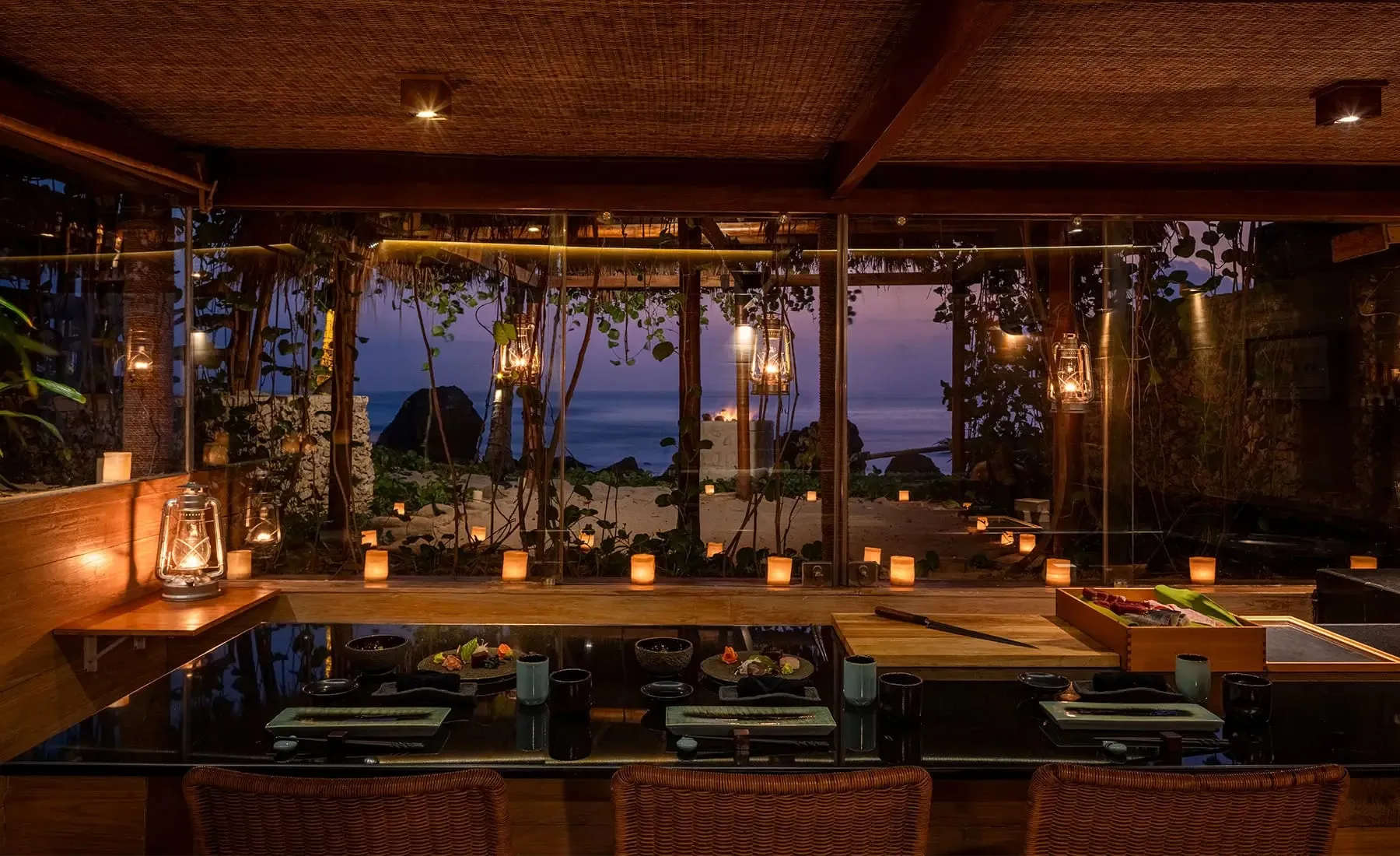
Nio Beach Club sits beachfront beside the main pool, an open-air pavilion set up for long, unhurried lunches by the sea, while Kaboku, also on the beachfront, is dedicated to sushi and Japanese-inflected dishes, a deliberate counterpoint to the otherwise strongly Sumbanese and Indonesian character of the resort’s food. The Boathouse Bar rounds out the offer as a more informal spot for drinks. In-villa dining is also widely used given the spread-out layout of the property, and the emphasis throughout leans toward relaxed, unstructured meals rather than a tasting-menu formality more common at comparably priced resorts elsewhere in Asia.
Spa and Wellness
The centrepiece of NIHI Sumba’s wellness offer is the Nihioka Spa Safari, a spa experience built around the journey to reach it as much as the treatments themselves. Guests can trek at sunrise through rice paddies and past working villages, or ride out in an open-air safari jeep, to reach a secluded site on a bluff overlooking the ocean, framed by rice fields and jungle. Treatments take place in open-air bales rather than a conventional enclosed spa, are largely intuitive and personalised rather than drawn from a fixed menu, and use natural, house-made oils and lotions rather than a standard international product line.
Running alongside the spa is the resort’s Wild Wellness programme, which folds the Sandalwood Stables’ horses into structured therapeutic and mindfulness work, organised loosely around themes the resort calls Equine-Essence, Equine-Seen, Equine-Tuned and Equine-Feel. Retreats built around this framework, including a Kuda Guru Retreat and an Equine Intuitive Awareness Retreat, combine meditation, breathwork and reiki-style sessions with guided time around and on the resort’s horses, positioning the programme as a genuine alternative to conventional spa treatments rather than an add-on activity for riders.
Experiences
Surfing anchors much of the resort’s activity programme, with Occy’s Left as the headline draw and the resort’s own surf guides managing access and coaching for guests at every level, though the wave’s power and the reef beneath it mean it suits confident, experienced surfers more than beginners. Beyond the break directly in front of the property, guided boat trips reach other nearby Sumbanese surf spots for guests wanting variety.
Horseback riding is close to equally central, run through the Sandalwood Stables, home to several dozen Sumbanese Sandalwood horses, a hardy local breed descended from Mongolian and Arab bloodlines brought to the island through the historic sandalwood and spice trade. Guided rides range from sunset gallops along a roughly 2.5-kilometre stretch of Nihiwatu Beach to swimming with horses in the shallows, jungle and grassland trail rides, and lessons for children through a dedicated pony club.
Beyond the water and the stables, the resort runs jeep excursions into Sumba’s interior to visit traditional clan villages and their distinctive peaked-roof houses and megalithic tombs, snorkelling trips on the property’s private reef, and a turtle hatchling release programme tied to its conservation work. Guests can also arrange visits to Sumba Foundation project villages, seeing the wells, water stations and clinics the charity has built firsthand, a rarer and more direct form of community engagement than the typical resort-branded village tour.
Who It Is For
NIHI Sumba suits experienced surfers who want serious, uncrowded waves without the scrum of Bali’s better-known breaks, and travellers drawn to genuine physical remoteness over the convenience of a shorter transfer. Honeymooners and couples looking for a resort built around a strong, singular identity, rather than a broad menu of interchangeable luxury amenities, will find the combination of the wave, the horses and the spa safari distinctive even against other top-tier Indonesian and wider Asian properties.
It is also a strong match for families able to make use of its multi-bedroom estate villas and pony club, and for travellers with a specific interest in the resort’s community development work through the Sumba Foundation. It is a less natural fit for guests wanting a short, easy transfer or a conventional resort strip of shops and multiple pools, and beginner surfers or non-surfing guests should confirm which beach areas and activities suit them, since the resort’s signature wave and much of its beachfront energy are built around a serious swell rather than calm, swimmable shallows.
Best Time to Visit
Sumba’s dry season, running roughly from May to October, brings the clearest skies, the most reliable road conditions for inland excursions and generally the best and most consistent surf, making it the resort’s peak period. August tends to be the driest month on the island. The wetter months, broadly November through April, bring shorter but more intense afternoon downpours rather than sustained grey weather, along with a visibly greener landscape and fuller waterfalls inland, an appeal of its own for travellers less focused on guaranteed clear surf conditions.
Given the resort’s identity is built substantially around Occy’s Left, surf-focused travellers should lean toward the dry season, particularly its earlier and later months, for the most consistent swell, while guests prioritising the spa, horseback riding and cultural excursions have more flexibility across the calendar.
How to Get There
All guests reach NIHI Sumba via Bali. International flights land at Ngurah Rai International Airport (DPS) in Denpasar, from where a domestic connection of roughly 60 to 75 minutes reaches Tambolaka Airport (TMC) on Sumba, served by several flights daily from regional Indonesian carriers. Given the relatively limited schedule of onward flights, most guests plan for at least one buffer day around this connection, particularly on arrival from long-haul international routes.
From Tambolaka, the resort collects guests directly for an overland transfer of around 90 minutes by open-air safari vehicle, a scenic drive through Sumbanese grassland, villages and rice terrain that the resort treats as the first experience of the island rather than simply a logistical necessity. Round-trip transfers are typically included in the nightly rate; guests should confirm current arrangements and any VIP airport-lounge or fast-track options directly with the resort when booking.
Nearby Experiences
Sumba’s interior remains sparsely developed, and much of what lies beyond the resort’s own grounds is reached through NIHI Sumba’s own excursion programme rather than independent travel. Traditional clan villages within driving distance preserve distinctive high-peaked thatched roofs and megalithic stone tombs, offering a direct look at Sumbanese customary life, or adat, that has changed relatively little despite the island’s growing profile among travellers.
Weavers producing Sumba’s well-known hand-dyed ikat textiles work in villages accessible on guided day trips, and Sumba’s wider south and west coasts hold numerous other surf breaks reachable by boat for guests wanting variety beyond Occy’s Left. For travellers with a specific interest in the Sumba Foundation’s work, visits to project villages with functioning wells, water stations or health clinics offer a rare, direct view of the resort’s community development legacy beyond its own boundary.
Things to Know Before Booking
NIHI Sumba enforces a minimum stay of three nights, and given the length and cost of the journey to reach it, most guests and travel advisors recommend planning for at least four to five nights to make the transfer worthwhile. Rates are generally quoted exclusive of Indonesia’s government tax and service charge, commonly around 21 percent combined, and most guests book on a full-board basis that includes breakfast, lunch, dinner and soft drinks, so prospective guests should confirm exactly what a quoted rate covers before booking.
Occy’s Left is a serious, reef-breaking wave suited to experienced surfers, and access is managed by the resort rather than freely available, so surf-focused travellers should discuss conditions, tides and access ahead of arrival. The resort’s remoteness also means limited connectivity in places and a genuinely rural surrounding environment; guests should pack accordingly and set expectations for a slower pace of local infrastructure than in Bali. Standard check-in is 2:00pm and check-out 11:00am, with early or late arrangements available on request, subject to availability.
Sustainability
NIHI Sumba’s environmental programme centres on a largely self-sufficient operational model: an organic garden supplies much of the resort’s kitchens, fed by a composting and water-recycling system, and the property draws power in part from an on-site solar installation, reported at around 288 panels, while an estimated 80 percent of wastewater is treated and reused for irrigation. Villas built substantially from bamboo and other local materials reduce the resort’s reliance on imported construction inputs relative to more conventional resort building methods.
Marine conservation work includes a turtle hatchling release programme and stewardship of the resort’s private reef, alongside a broader emphasis on employing staff from surrounding villages. The resort’s most significant sustainability legacy, however, runs through the independent Sumba Foundation, which it supports: since 2001 the Foundation has drilled or dug more than 80 wells and built over 300 water stations delivering clean water to more than 30,000 people across roughly 200 villages, established four health clinics that have contributed to a malaria case reduction of over 90 percent in their catchment areas, and opened a Learning Development Center in Hobawawi in 2019 teaching English and computer skills to several hundred students while providing school lunches to thousands of children weekly. As with any resort-linked philanthropic programme, these figures come from the Foundation’s own reporting rather than independent audit, and guests with a deeper interest are best served asking to visit project villages directly during their stay.
Practical Information
NIHI Sumba sits on the west coast of Sumba island, in Indonesia’s East Nusa Tenggara province, roughly 90 minutes overland from Tambolaka Airport (TMC), itself a domestic connection of 60 to 75 minutes from Bali’s Ngurah Rai International Airport. The resort comprises 27 private villas across 38 rooms and one- to five-bedroom configurations, spread over 567 acres of largely undeveloped jungle, with every villa built around a private pool.
Rates start from an indicative $1,650 per night, though the published figure varies significantly by villa category, season and meal inclusions, and prospective guests should confirm current pricing directly with the resort or a specialist travel advisor. A minimum stay of three nights applies, with four to five nights generally recommended given the length of the journey. Standard check-in is 2:00pm and check-out 11:00am. The dry season, from May to October, offers the most reliable surf and the clearest conditions for the resort’s beach and inland excursions.
Editorial Conclusion
NIHI Sumba’s case rests on a premise that is unusual for a resort at this price point: that the single most valuable thing it offers cannot be built, only protected. Occy’s Left existed as a wave long before anyone built a villa near it, and the resort’s entire identity, from the capped surfer count to the horses that share the same stretch of beach, has been organised around treating that wave, and the island it breaks on, as something to be stewarded rather than simply monetised.
That approach extends past the shoreline. Nearly four decades after Claude and Petra Graves first built a bamboo hut on this coast, and more than a decade after new ownership rebuilt the property into its current form, NIHI Sumba still measures itself as much by the Sumba Foundation’s wells and malaria clinics as by its award shelf. For travellers weighing it against other top-tier Indonesian and Asian resorts, the calculation is straightforward: a longer, costlier journey than Bali or Lombok, in exchange for a genuinely singular wave, a serious equine and wellness programme, and a resort whose relationship to the community around it is unusually substantive for the category.
In pictures
On the map
West Sumba, Indonesia
Questions
Frequently asked
What is Occy's Left and can every guest surf it?
Occy's Left is the left-hand reef break directly in front of the resort, named after Australian surfer Mark Occhilupo, who rode it on an early visit and called it one of the best waves he had surfed. Access is deliberately limited to around ten surfers in the water at any one time, prioritised for resort guests and arranged through the resort's own surf programme, which keeps the wave far less crowded than comparable breaks elsewhere in Indonesia.
How do guests get from Bali to NIHI Sumba?
Guests fly first to Bali's Ngurah Rai International Airport (DPS), then take a domestic flight of roughly 60 to 75 minutes to Tambolaka Airport (TMC) on Sumba, served by several daily flights from regional Indonesian carriers. From Tambolaka, the resort's own open-air vehicle collects guests for a scenic overland transfer of about 90 minutes through Sumbanese villages and grasslands.
What is the Sumba Foundation and how is it connected to the resort?
The Sumba Foundation is an independent charity founded in 2001 by the resort's original owners, Claude and Petra Graves, together with American businessman Sean Downs, to fund clean water, malaria control, healthcare and education projects across the island. It has since drilled or dug more than 80 wells and built over 300 water stations reaching more than 30,000 people, and its malaria programme is credited with a reduction of over 90 percent in cases since its clinics opened. The resort supports the Foundation and guests can visit some of its project villages.
What horse-related activities does NIHI Sumba offer?
The resort's Sandalwood Stables houses several dozen Sumbanese Sandalwood horses, a hardy local breed with Mongolian and Arab bloodlines brought to the island through the historic sandalwood and spice trade. Activities range from sunset rides along a roughly 2.5-kilometre stretch of Nihiwatu Beach and lessons for children through the resort's pony club, to structured equine wellness sessions offered under its Wild Wellness programme, pairing time with the horses with meditation, breathwork and other therapeutic practices.
Is NIHI Sumba suitable for families with children?
Yes. Many of the resort's villa categories, including multi-bedroom estates such as Raja Mandaka and The Treehouse, are built for families or multi-generational groups, and children can join horseback lessons through the pony club, learn to surf on gentler nearby breaks, and take part in cultural and nature excursions with resort guides. Given the resort's remoteness and the strength of the surf directly in front of the property, families should discuss which beach areas and activities suit younger children with the resort in advance.
Same destination
More hotel guides in Indonesia
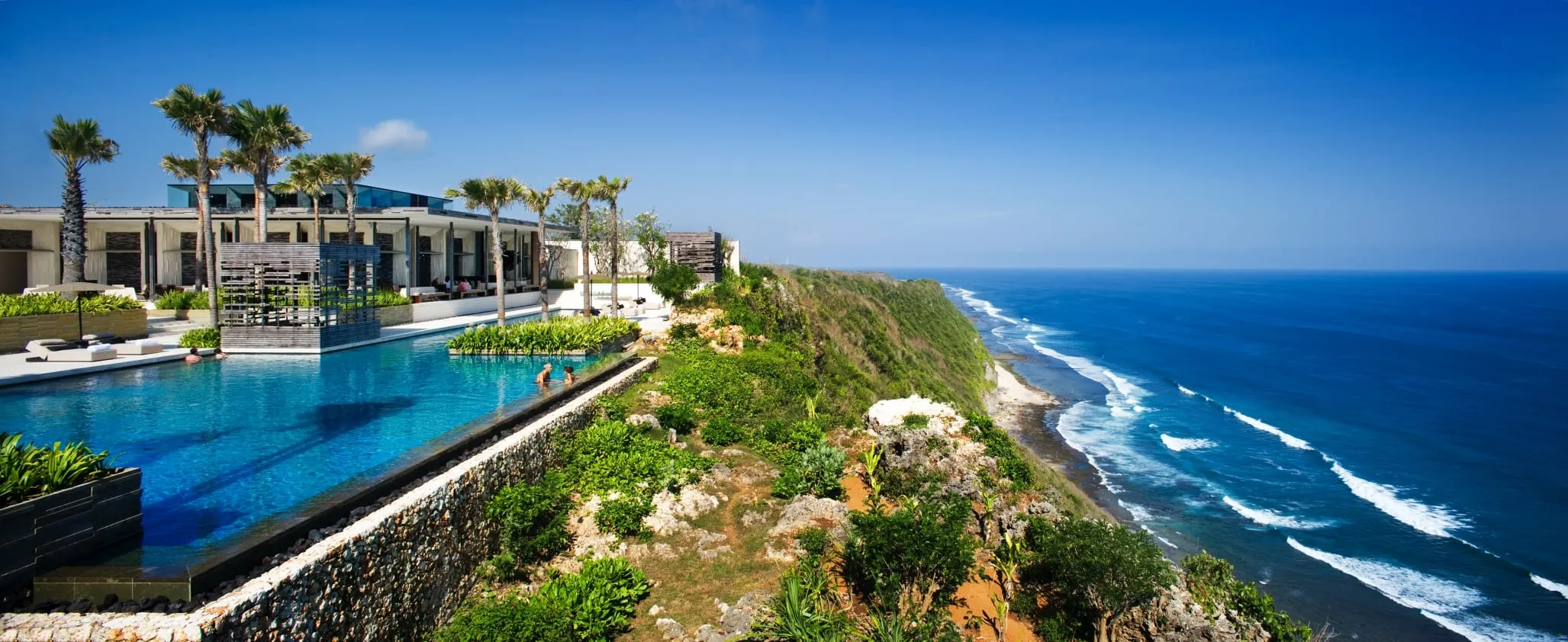
Uluwatu, Bukit Peninsula, Indonesia
Alila Villas Uluwatu
A Singapore architecture firm carved a geometric limestone resort into a Bukit Peninsula clifftop in 2009, planting grass roofs across it so the whole property reads as an extension of the savannah it replaced.
From $800 per night
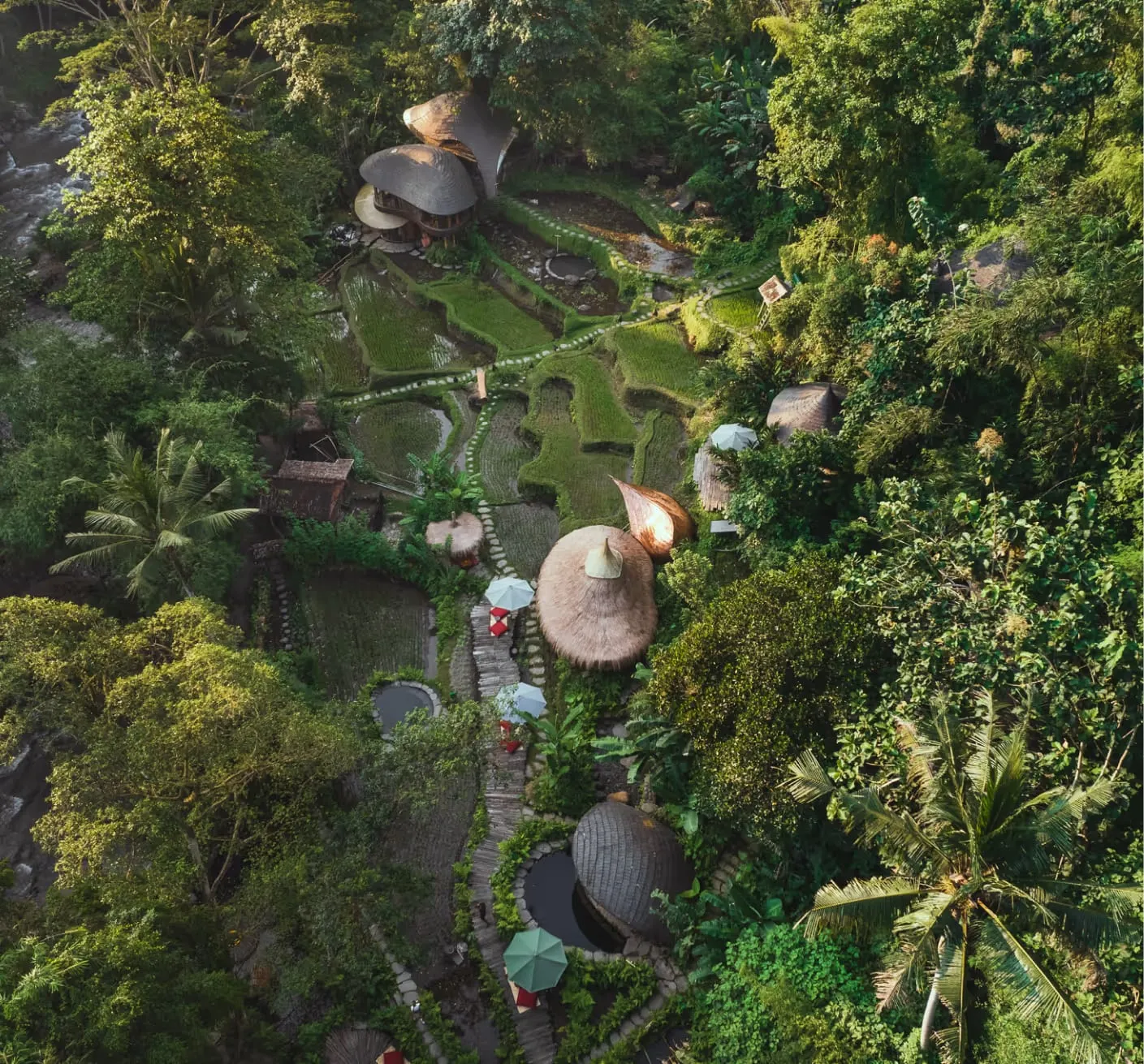
Sayan, Ubud, Indonesia
Bambu Indah
Antique Javanese bridal houses and hand-built bamboo pavilions, dismantled, relocated and rebuilt above the Ayung River gorge by the founders of Green School Bali.
From $250 per night
Uluwatu, Bukit Peninsula, Indonesia
Bulgari Resort Bali
A Milanese architecture firm cut 59 villas and five mansions into a limestone clifftop above the Indian Ocean, then built one of the longest hotel funiculars in the world to reach the private beach below.
From $1,500 per night