Liwa Desert, Empty Quarter, United Arab Emirates
Qasr Al Sarab Desert Resort by Anantara
A fortress that appears to rise out of the dunes of the Empty Quarter, built so that the world's largest sand desert, not the hotel, remains the point of the stay.
- Rates from
- From $368 per night
- Nearest airport
- Abu Dhabi International Airport (AUH)
- Transfer
- About 2 to 2.5 hours by road
- Best months
- November through March, when cooler desert temperatures make daytime dune activities and outdoor dining genuinely comfortable
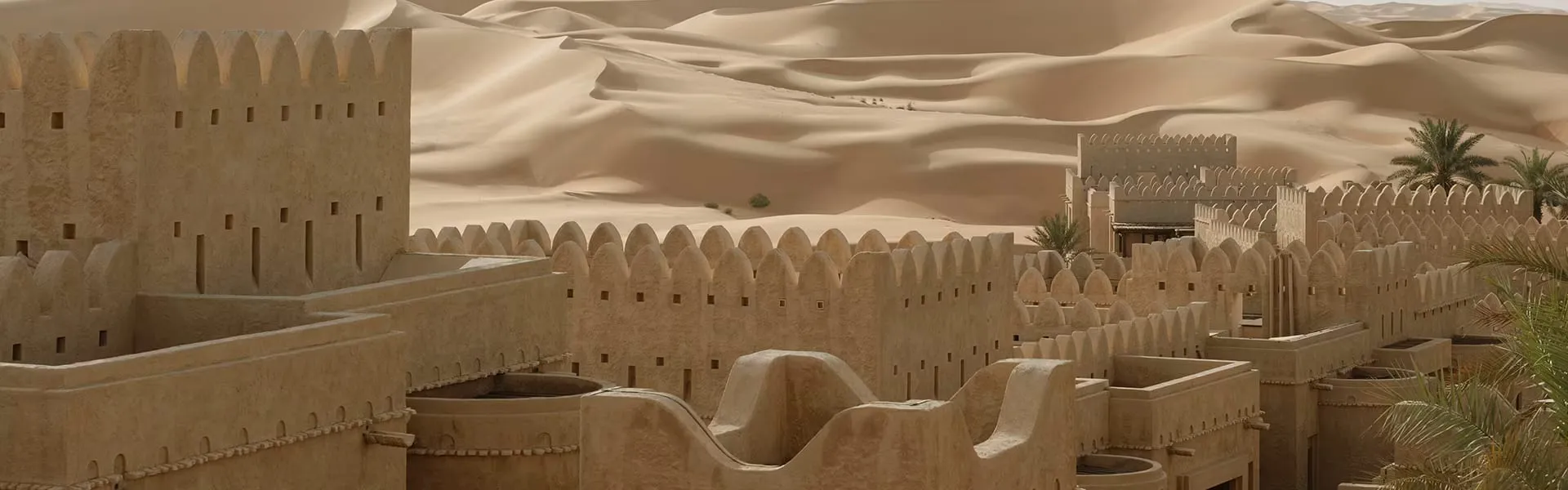
There is a point on the drive southwest from Abu Dhabi, somewhere past the last petrol station and the last cluster of date-palm farms, where the road narrows, the traffic thins to almost nothing, and the land on either side turns to open sand. It keeps going like that for well over an hour: no billboards, no service roads, just the rolling, flame-colored dunes of the Rub’ al Khali, the Empty Quarter, the largest contiguous sand desert on Earth. Then, cresting a rise in the dunes, a fortress appears. Turrets, crenellated walls, arched gateways, all rendered in the same ochre tone as the sand around it, as if it had been standing there for centuries rather than since 2009.
That fortress is Qasr Al Sarab Desert Resort by Anantara, and the illusion of age is entirely deliberate. Built on a crescent-shaped dune roughly 205 kilometres from Abu Dhabi, deep inside the Liwa region that forms the UAE’s southern edge against Saudi Arabia, the resort was designed to look like it had grown out of the desert’s own architectural history rather than been imported into it. There is no beach here, no marina, no obvious tourist landmark within reach. The entire premise of the property is the desert itself, and the resort’s job is to put a guest inside that landscape as convincingly as possible.
Qasr Al Sarab translates loosely as “palace of the mirage,” a name that captures both the visual trick of the building appearing out of the heat-shimmer of the dunes and the more literal fact that, for most of its history, almost nothing has stood on this stretch of the Empty Quarter besides sand. What the resort has built around that emptiness, over roughly a decade and a half of operation, is a case study in how a single hotel can function as a genuine gateway to one of the world’s more extreme and least visited landscapes, without pretending the desert is anything gentler than it is.
Why It Stands Out
Most desert resorts in the Gulf sit within an hour or so of a major city, close enough to be a half-day excursion rather than a destination in its own right. Qasr Al Sarab is not that kind of property. Its location, roughly two to two and a half hours from Abu Dhabi by road, places it genuinely inside the Rub’ al Khali rather than on its outskirts, among dunes that reach some of the tallest heights recorded anywhere in the world’s sand deserts. That distance is the resort’s clearest point of differentiation: guests are not visiting a themed desert experience bolted onto a city hotel, they are staying inside the actual Empty Quarter, with the nearest settlement of any size a genuine drive away in every direction.
The second distinguishing feature is the architecture itself. Rather than building a conventional low-rise resort and dressing it in desert motifs, the design team constructed something that reads, from a distance, as a historic Arabian fort, complete with wind towers, round turrets and thick, self-shading walls. It is a rare example of a modern luxury resort where the exterior architecture is not simply attractive but functionally accurate to its climate: the crenellated parapets and dense wall construction do real thermal work, shading the upper stories and providing mass that moderates the extreme swings between desert day and night temperatures.
The third is the resort’s direct relationship with the Qasr Al Sarab Protected Area, a 308-square-kilometre reserve of dunes and salt flats adjoining the property, managed with Abu Dhabi’s Environment Agency and home to a reintroduced population of Arabian oryx. Guests do not need to book a formal safari to see the payoff of that conservation work; oryx are frequently visible near the resort itself, particularly at dusk, a level of casual wildlife access that few other hotels anywhere can offer without staged encounters.
Architecture
Qasr Al Sarab’s design was led by Northpoint, a South African architecture firm, with interiors by Hirsch Bedner Associates (HBA) and input from the Abu Dhabi Authority for Culture and Heritage to ensure the building drew on authentic regional forms rather than a generic idea of “Arabian” style. Construction began in 2007 and the resort opened in October 2009, after roughly two years of building on a site chosen specifically for its crescent-shaped dune, which the fortress appears to rise directly out of.
The architectural language is explicitly that of a historic desert fort: round turrets, crenellated parapets, arched walkways and courtyards organized around fountains and shaded walking routes. The ochre tone of the exterior walls was matched precisely to the color of the surrounding dunes, so the building reads as an extension of the landscape rather than an object placed on top of it. Beyond the aesthetic reference, the fortress form does functional work. The thick walls provide thermal mass that slows heat transfer through the day, the crenellated upper sections self-shade the building through most of daylight hours, and the compact, walled layout was designed specifically to minimize the impact of the strong winds that can whip up sudden sandstorms across open dune terrain. The result is a building that looks like a period reconstruction but was engineered from the ground up for a punishing desert climate.
Interior Design
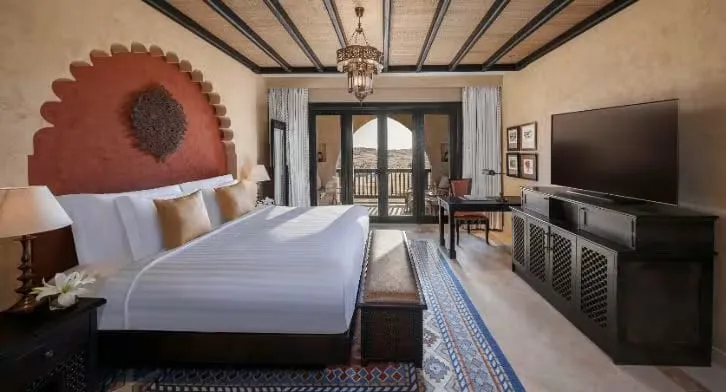
Inside, HBA’s interiors continue the fortress reference without tipping into pastiche: dark wood furniture, wrought ironwork, richly patterned textiles and Arabian-influenced detailing sit against the same warm, sand-toned palette used on the exterior. Guest rooms and suites are arranged around courtyards and corridors that echo the layout of a historic caravanserai, with archways and covered walkways connecting the various wings of the resort rather than a single, undifferentiated hotel corridor.
Room categories scale from the 45-square-metre Deluxe Garden Room through the 48-square-metre Deluxe Balcony Room to the 50-square-metre Deluxe Terrace Room, an upper-floor corner category with a wraparound outdoor terrace built for dining and lounging above the desert. All three include a sunken tub and a Nespresso machine as standard. The Anantara Suite, at 106 square metres, adds a separate indoor lounge and outdoor dining terrace, while the Two Bedroom Family Suite, at 178 square metres, is built around a fully separate living room for families or groups sharing a stay. Every category is designed with the same underlying logic as the exterior: dark, tactile interiors that make the desert visible through the window feel like the main event, not a backdrop competing with the room itself.
Atmosphere
Qasr Al Sarab’s atmosphere is defined almost entirely by isolation and scale. With 207 keys spread across a resort built around courtyards, wings and a separate villa enclave, the property rarely feels crowded even at fuller occupancy, and the genuine physical distance from any other settlement means there is no ambient noise, light or traffic from outside the resort’s own walls after dark. Evenings settle into a rhythm shaped by the desert rather than a hotel program: temperatures drop quickly after sunset, dinner shifts outdoors or onto Suhail’s rooftop terrace, and the near-total absence of light pollution turns the night sky into one of the resort’s more understated draws.
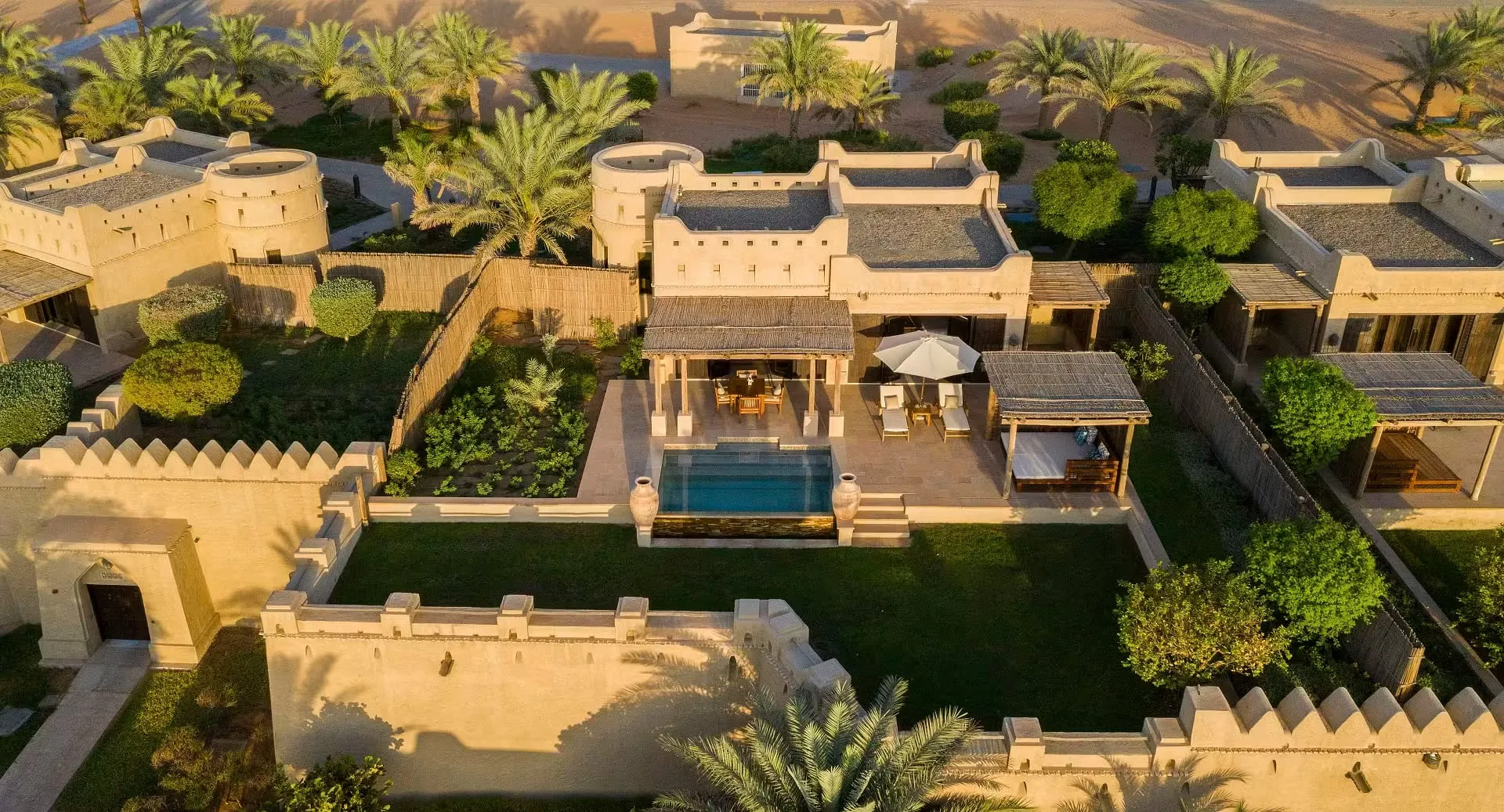
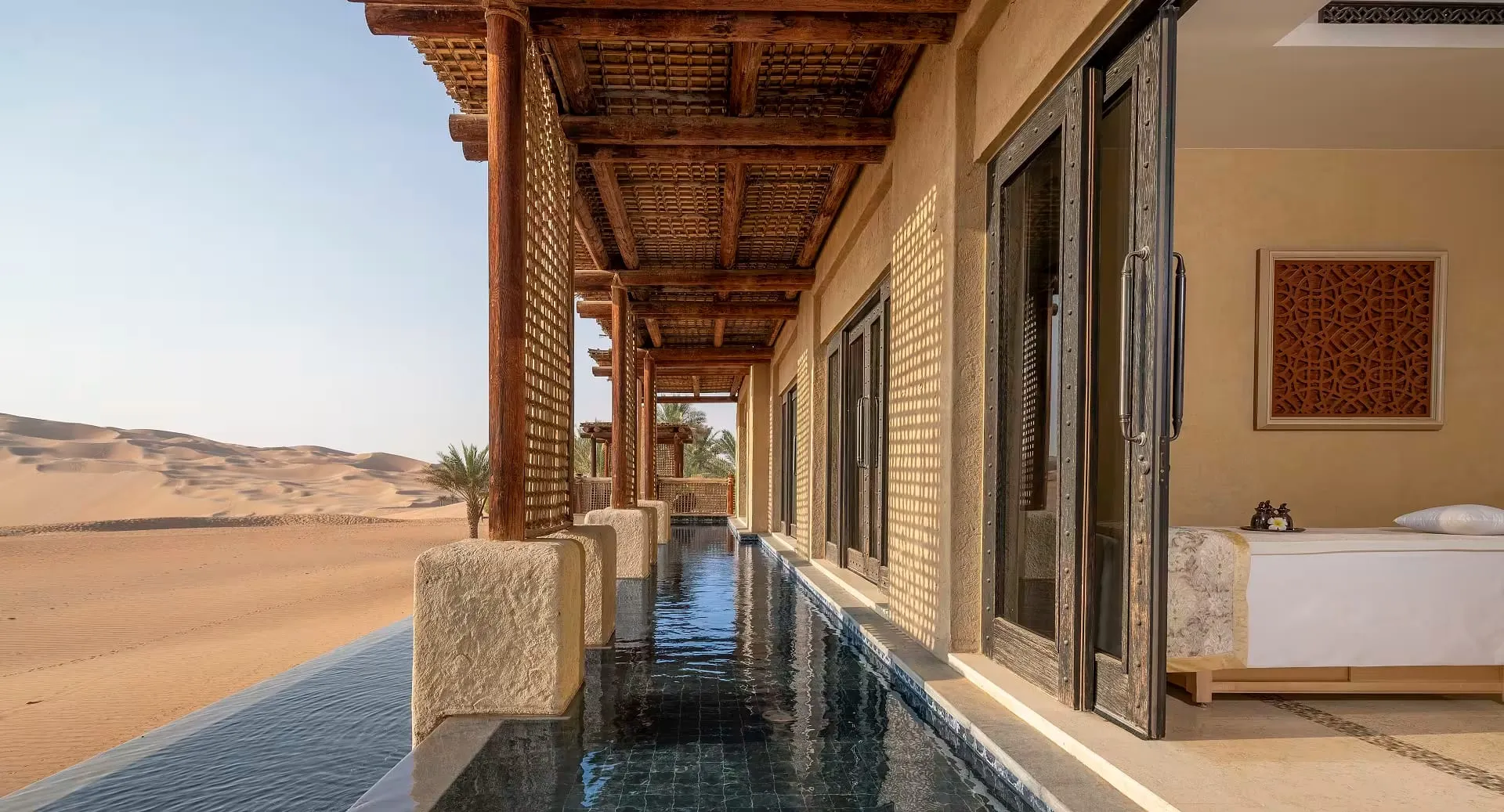
The public spaces, courtyards with fountains, shaded arched walkways, a main pool set against the dune line, are built for slow movement rather than a busy resort circuit. Guests staying in the Royal Pavilion Pool Villas, set half a kilometre from the main building, get an even more pronounced version of that isolation, with their own villa enclave facing directly onto open dunes. The overall register leans quiet and adult, though the presence of a kids’ club and family-configured suites and villas means it is not exclusively so; families visiting tend to gravitate toward the cooler months, when the desert itself is at its most hospitable for children spending time outdoors.
Rooms and Suites
Qasr Al Sarab has 207 total accommodations: 140 rooms, 14 suites and 53 pool villas. The room tier runs from the Deluxe Garden Room (45 square metres, garden terrace) through the Deluxe Balcony Room (48 square metres, private balcony) to the Deluxe Terrace Room (50 square metres, an upper-floor corner room with a wraparound outdoor terrace and desert panorama). All three include a sunken tub, Nespresso machine and an uninterrupted view of the desert valley surrounding the resort.
The suite tier consists of the Anantara Suite (106 square metres, with a separate indoor lounge and an outdoor terrace built for dining) and the Two Bedroom Family Suite (178 square metres, with a fully separate living room, built to sleep up to five adults and a child). The Luxury Villa Collection sits apart from the main building both physically and in character: the Anantara Pool Villa and the two-bedroom Anantara Family Pool Villa each come with a private pool and terrace, while the Royal Pavilion Pool Villas, the most secluded category, are set roughly half a kilometre from the main resort with their own butler service, private pool and terrace looking directly out over the dunes.
Dining
Qasr Al Sarab’s food program runs across three named restaurants plus private and in-room dining options. Al Waha, the resort’s main restaurant, serves breakfast and dinner with a menu built around Middle Eastern and international dishes carrying an Emirati inflection, and functions as the property’s principal all-day dining venue. Suhail is the resort’s rooftop lounge and grill, open for dinner and late-night drinks only, focused on prime cuts of meat and seafood, with sweeping views over the wadi below the fortress walls, a setting that makes it one of the more atmospheric dinner venues in the wider Abu Dhabi region.
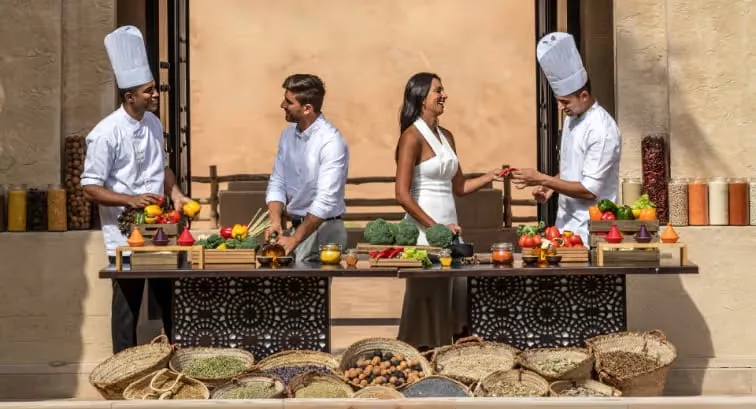
Ghadeer, positioned by the pool, runs a lighter, more flexible program: freshly made pizza and casual dishes during the day, transitioning into a globally inspired dinner menu after dark, reached by a candlelit bridge that the resort uses as one of its signature evening arrival moments. Beyond the three restaurants, Qasr Al Sarab offers private desert dining and traditional Bedouin-style feast setups out among the dunes, along with in-suite and in-villa dining for guests who prefer not to leave their own terrace.
Spa and Wellness
The Anantara Spa occupies a dedicated wing of the resort and centers on a Moroccan hammam with double-heated marble beds, a signature treatment format for the property, alongside jacuzzis, a steam room, sauna and an invigorating ice room. The spa has five treatment rooms in total, four of them configured as couples’ suites, and treatments range from traditional Thai massage and Ayurvedic techniques to holistic and beautifying facials, many built around desert rose and regional aromatherapy ingredients.
A separate space within the spa is dedicated to meditation, yoga and pranayama, positioned to take advantage of the same total quiet that defines the rest of the property after dark. For guests who want a workout beyond the resort’s outdoor activity program, there is also a Technogym-equipped fitness centre, and the resort’s main pool, distinct from the private pools attached to villas, sits within view of the dunes for guests who prefer to spend an afternoon simply looking out at the desert rather than moving through it.
Experiences
Qasr Al Sarab’s activity program is built almost entirely around the desert itself. Guided dune drives and self-drive dune bashing are the signature outdoor activities, alongside camel treks that head out into the Rub’ al Khali at the times of day, dawn and dusk, when the light and temperature both make the desert most approachable. Fat biking and Polaris off-road buggy riding offer a faster-paced way to cover the same terrain, and archery and horseback riding round out the more conventional resort activity roster.
Ezba, an on-site cultural and educational farmstead that opened in November 2023, is the resort’s most distinctive addition in recent years. Built around the traditional Emirati concept of a family farmstead where animals were raised and skills passed down between generations, Ezba houses camels, salukis (the traditional Arabian hunting dog) and falcons, including Saker and Peregrine falcons, alongside exhibits on nocturnal desert wildlife, the historic falaj irrigation system, and the region’s native flora. Cultural programming at Ezba includes oud music, henna, pottery workshops and Emirati craft demonstrations. Stargazing is effectively a built-in activity rather than a scheduled one: the resort’s distance from any significant source of light pollution makes the night sky, unaided, one of the more striking things most guests encounter during a stay.
Who It Is For
Qasr Al Sarab suits travelers who want a genuine, immersive desert experience rather than a desert-themed add-on to a city stay: couples, honeymooners, and anyone drawn to extreme landscapes, dark skies and architecture built to answer to its climate rather than ignore it. The resort’s distance from Abu Dhabi, two to two and a half hours each way, makes it a poor fit for a quick overnight but a strong fit for a dedicated two-or-three-night stay, either as a stand-alone trip or as the desert leg of a longer UAE itinerary that also includes Abu Dhabi or Dubai.
Families are genuinely accommodated, with family suites, family villas, a kids’ club and Ezba’s animal-focused programming, but the resort’s isolation and the physical intensity of the surrounding desert mean it rewards travelers, of any age, who are comfortable with heat, distance and a slower pace more than it rewards those looking for a conventional resort circuit of pools, shops and nightlife.
Best Time to Visit
The most comfortable window to visit is roughly November through March, when daytime temperatures in the Empty Quarter drop enough to make dune activities, outdoor dining and simply walking between courtyards genuinely pleasant rather than an endurance exercise. This period overlaps with the broader UAE high season, so rates rise accordingly, particularly around the December and January holiday weeks.
Summer months, roughly May through September, bring daytime temperatures that regularly exceed 45 degrees Celsius in this part of the Empty Quarter, among the hottest conditions anywhere the UAE’s hotel industry operates. Outdoor activity in summer is realistically confined to early morning or evening, and most of a stay’s daytime hours are spent by the pool or inside. Shoulder months, April and October, offer a reasonable middle ground of lower rates and still-manageable heat for travelers willing to plan around the cooler parts of the day.
How to Get There
The nearest airport is Abu Dhabi International Airport (AUH), roughly 205 kilometres and about 2 to 2.5 hours by road from the resort via the E11 and E65 highways. There is no public transport option; guests typically arrange a private transfer directly through the resort, and self-driving via rental car is straightforward, largely highway driving followed by a final stretch on desert access roads. For guests who prefer to skip the road journey entirely, a helicopter transfer from Abu Dhabi is available and takes roughly 50 minutes; a helicopter transfer from Dubai, around 3.5 hours by road, takes roughly 75 minutes.
Nearby Experiences
Qasr Al Sarab’s remoteness means that what there is to see and do sits almost entirely within the resort’s own grounds and the adjoining 308-square-kilometre Qasr Al Sarab Protected Area, rather than requiring a trip beyond it. The protected area is home to more than 30 bird species, 13 reptile species and 10 mammal species, most notably the reintroduced Arabian oryx, which is frequently visible near the hotel itself around dusk. The Liwa Oasis, a historic crescent of settlements and date-palm farms that gives the wider region its name, lies within range of a day trip for guests interested in the area’s pre-resort history and the traditional agriculture that has sustained communities on the edge of the Empty Quarter for generations.
For travelers looking to pair the resort with wider Abu Dhabi sightseeing, the city’s landmark attractions, including Sheikh Zayed Grand Mosque and the Louvre Abu Dhabi, sit at the two-to-two-and-a-half-hour drive back toward the coast, making Qasr Al Sarab a workable multi-night addition to a broader Abu Dhabi itinerary rather than a full replacement for a city stay.
Things to Know Before Booking
Rates and inclusions vary by room category and season; travelers should confirm current meal-plan options directly with the resort or through Anantara’s booking channels, as offerings have included both room-only and enhanced breakfast packages depending on the promotion. Given the extreme summer heat, roughly May through September, most outdoor activities are scheduled for early morning or evening during those months, and travelers booking a summer stay should set expectations accordingly rather than assuming a full daytime activity roster.
Because the resort sits roughly two to two and a half hours from Abu Dhabi with no public transport link, arrival transfers should be arranged in advance, whether by private car or the resort’s helicopter option, rather than assumed on arrival. Self-driving guests should allow extra buffer time beyond standard route estimates, since the final stretch runs through open desert terrain rather than conventional signed roads. Families traveling with young children should note the genuine remoteness of the property when planning; the nearest hospital-level medical care is in Abu Dhabi city, several hours away by road.
Sustainability
Qasr Al Sarab holds Gold-level Green Growth 2050 Certification and Green Globe Certification, recognizing both its energy-saving architectural design and its ongoing environmental program. Solar panels installed at the resort generate hot water for guest rooms and villas, a measure the property states reduces conventional energy use for that purpose by up to 80 percent and saves an estimated 97,000 kilowatt-hours per month. Ezba, the resort’s on-site cultural farmstead, has separately achieved Platinum-level Green Growth 2050 certification.
The resort’s most substantive sustainability claim, however, is its role in the Qasr Al Sarab Protected Area, a 308-square-kilometre reserve of dunes and sabkha managed in partnership with Abu Dhabi’s Environment Agency. The reserve supports a reintroduced population of Arabian oryx, a species that was hunted to the edge of extinction in the wild by the mid-20th century, along with more than 30 bird species, 13 reptile species and 10 mammal species. The resort has also worked with the Environment Agency on efforts to monitor and support the breeding of reem (sand) gazelles for eventual release into the wider Empty Quarter, extending its conservation role beyond the immediate hotel grounds.
Practical Information
Qasr Al Sarab Desert Resort by Anantara is located in the Liwa Desert, Al Dhafra Region, Abu Dhabi, roughly 205 kilometres and 2 to 2.5 hours by road from Abu Dhabi International Airport. Check-in is at 3:00 PM and check-out at 12:00 PM. The resort has 207 accommodations across rooms, suites and pool villas, three named restaurants (Al Waha, Suhail and Ghadeer) plus private desert dining, and the Anantara Spa. Current pricing, availability and any seasonal offers are best confirmed directly through Anantara’s official booking channels, given how significantly rates shift between the cooler peak season and the extreme summer months.
Editorial Conclusion
Qasr Al Sarab’s achievement is less about any single amenity than about commitment to a genuinely difficult premise: building an ultra-luxury resort two and a half hours from the nearest city, deep inside one of the most extreme landscapes on the planet, and making that distance the entire point rather than an inconvenience to be minimized. The fortress architecture, engineered as much for the climate as for effect, and the resort’s real, ongoing role in the Qasr Al Sarab Protected Area’s conservation work give the property a level of substance that many desert resorts, built closer to civilization and leaning harder on theming, simply cannot match. For travelers willing to make the drive, or take the helicopter, Qasr Al Sarab remains one of the more convincing arguments in the Gulf region that a hotel can function as a legitimate gateway into a genuinely wild place, rather than a comfortable simulation of one.
In pictures
On the map
Liwa Desert, Empty Quarter, United Arab Emirates
Questions
Frequently asked
How many rooms, suites and villas does Qasr Al Sarab have?
Qasr Al Sarab has 207 accommodations in total: 140 rooms across three categories (Deluxe Garden, Deluxe Balcony and Deluxe Terrace), 14 suites (Anantara Suite and Two Bedroom Family Suite), and 53 pool villas, including the more secluded Royal Pavilion Pool Villas, which sit roughly half a kilometre from the main resort building for additional privacy.
How far is Qasr Al Sarab from Abu Dhabi and its airport, and how do guests get there?
Qasr Al Sarab sits deep in the Liwa Desert, roughly 205 kilometres and about 2 to 2.5 hours by road southwest of Abu Dhabi city and Abu Dhabi International Airport (AUH), reached via the E11 and E65 highways. There is no public transport to the resort. Most guests arrange a private transfer through the hotel; a helicopter transfer, taking roughly 50 minutes from Abu Dhabi, is also available for guests who prefer to skip the road journey.
What is the Qasr Al Sarab Protected Area, and can guests see wildlife there?
The Qasr Al Sarab Protected Area is a 308-square-kilometre reserve of sand dunes and sabkha (salt flats) adjoining the resort, managed in partnership with Abu Dhabi's Environment Agency and home to more than 30 bird species, 13 reptile species and 10 mammal species. Its best-known resident is the Arabian oryx, a species reintroduced to the area after being hunted to the edge of extinction in the wild; oryx are frequently seen near the hotel itself, particularly around dusk, without needing to book a dedicated safari drive.
When did Qasr Al Sarab open and who designed it?
Qasr Al Sarab opened in October 2009 after roughly two years of construction. The fortress-inspired architecture, complete with turrets, crenellated parapets and wind towers referencing historic Arabian forts, was designed by the South African firm Northpoint, with interiors by Hirsch Bedner Associates (HBA) and guidance from the Abu Dhabi Authority for Culture and Heritage on regional architectural authenticity.
Is Qasr Al Sarab suitable for families with children?
Yes. The resort offers a Two Bedroom Family Suite and family-configured pool villas, a kids' club, and Ezba, an on-site cultural and educational farmstead with camels, salukis and falcons that appeals to children as much as adults. Families should note that summer daytime temperatures in the Empty Quarter are extreme, which pushes most outdoor activity, for guests of any age, into the early morning or evening for several months of the year.
Same destination
More hotel guides in United Arab Emirates
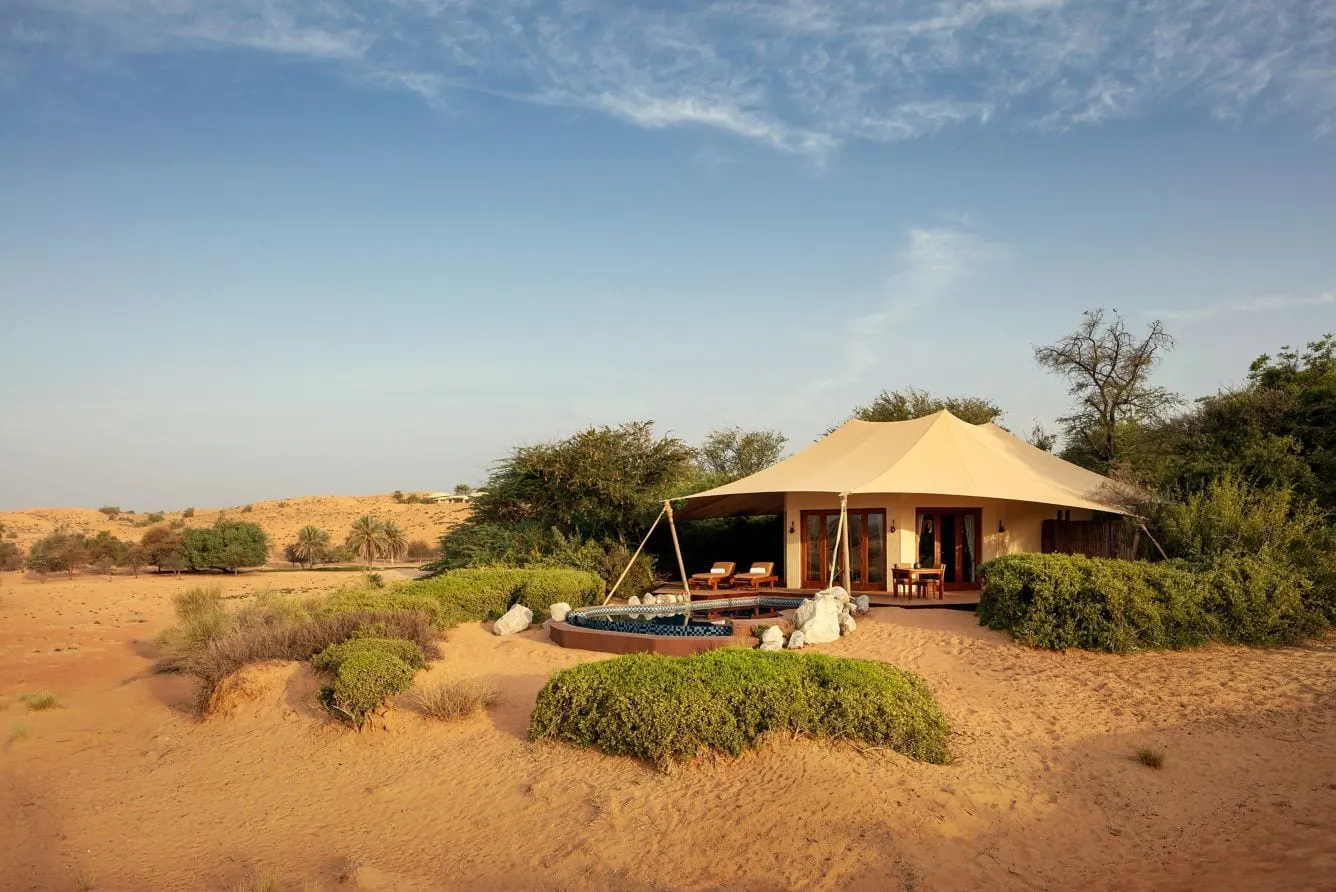
Dubai Desert Conservation Reserve, United Arab Emirates
Al Maha, A Luxury Collection Desert Resort & Spa
A fenced private reserve of freestanding, sand-colored tented suites where the return of the Arabian oryx to the wild is the whole point of the stay, not a footnote to it.
From $950 per night
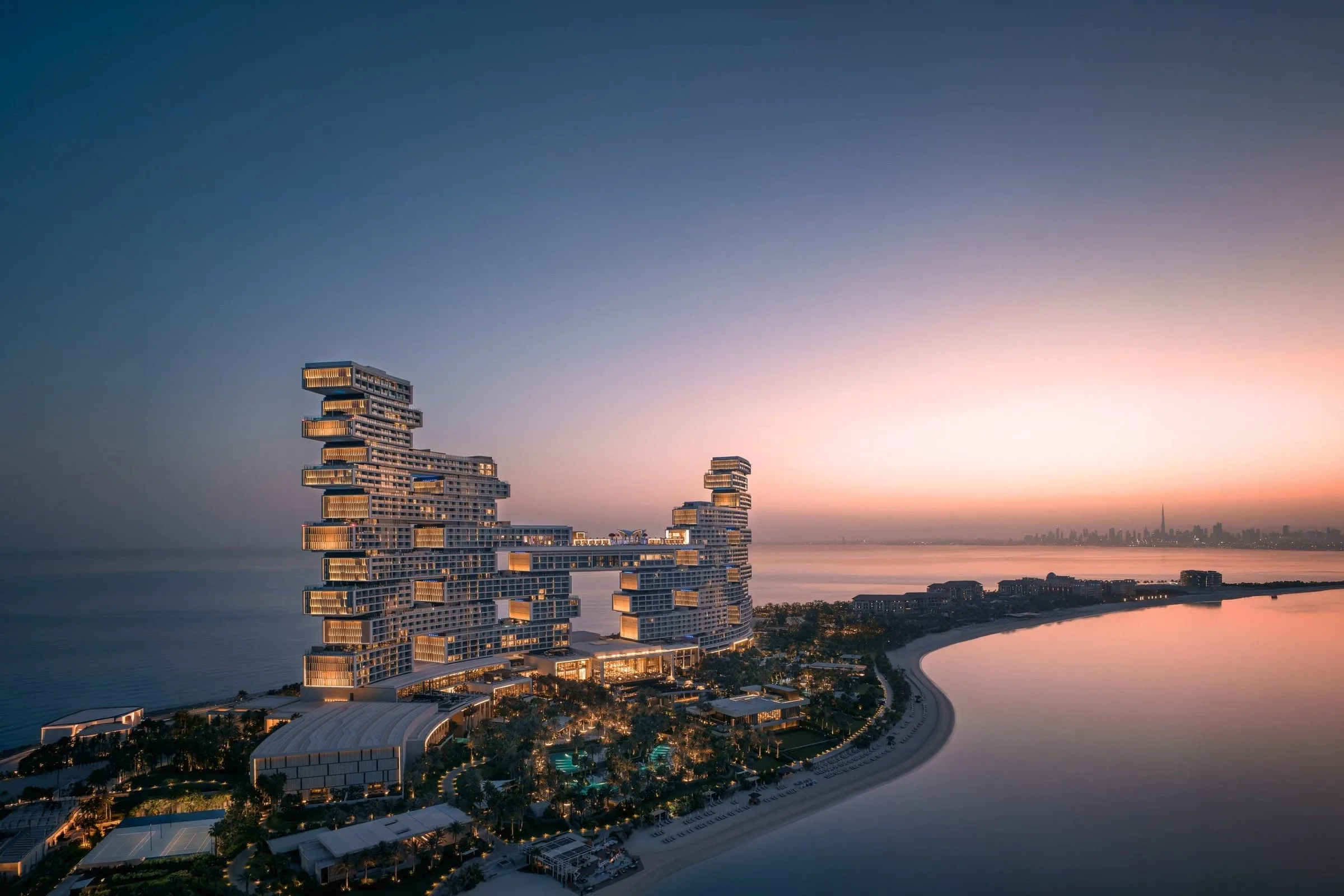
Palm Jumeirah, United Arab Emirates
Atlantis The Royal
Six stacked towers, a 90-metre sky pool bridging them at height, and 795 rooms and suites arranged like a deliberately imperfect skyline on Palm Jumeirah.
From $650 per night
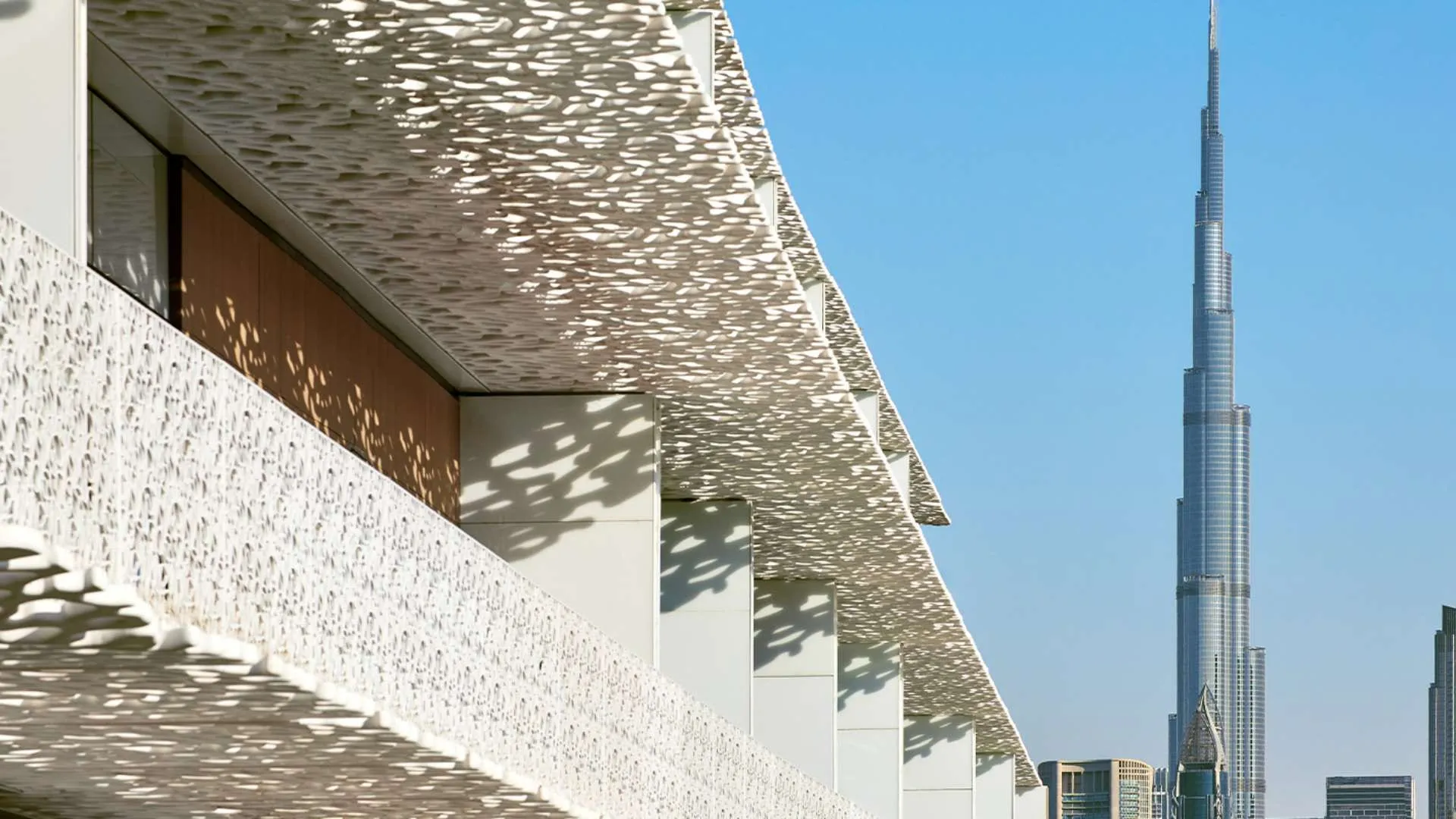
Jumeirah Bay Island, United Arab Emirates
Bulgari Resort Dubai
An Italian jeweller's idea of the Arabian Gulf, built on a seahorse-shaped island with its own marina, a two-Michelin-starred dining room, and 101 rooms that all face water.
From $950 per night