Knightsbridge, United Kingdom
The Berkeley
A Knightsbridge institution that traded its Michelin-starred kitchen and covered rooftop for a French Riviera dining room and an open sky, betting on reinvention over nostalgia.
- Rates from
- From £795 per night
- Nearest airport
- London Heathrow Airport (LHR)
- Transfer
- About 35-45 minutes by car, traffic permitting
- Best months
- Year-round, though May to September brings the rooftop pool's open-air season and late November to January coincides with Knightsbridge's Christmas lights and prime shopping season
There is a particular kind of confidence required to remove a landmark. For decades, the retractable roof over The Berkeley’s rooftop pool was one of the most photographed pieces of hotel infrastructure in London, the mechanism that let a heated swimming pool sit seven floors above Knightsbridge and still close itself against the English weather within minutes. In 2024, the hotel took it away. Gone too are the grand colonnades that once ringed the water, replaced by glass railings, soft-toned furnishings and an open sky. It is the kind of decision that only a hotel secure in its own identity would make, and it arrives at a moment when The Berkeley has been making a lot of decisions like it.
The past three years have brought more structural change to this address than at almost any point since it relocated to Knightsbridge in the 1970s. Marcus Wareing, whose Michelin-starred dining room had defined the hotel’s culinary reputation for two decades, departed at the end of 2023. The Bamford Haybarn Spa, a fixture since 2013, has given way to something considerably larger. A French Riviera restaurant transplanted from Cannes now occupies the space where a British culinary institution once stood. None of this happened quietly, and none of it was inevitable. What makes The Berkeley worth examining closely right now is not a settled, finished thing, but a hotel mid-transition, working out what it wants to be next while keeping the fundamentals, the terraces, the position between Knightsbridge and Belgravia, the open water on the roof, firmly in place.
Why It Stands Out
The Berkeley’s case rests on a combination few London hotels can match: private outdoor space on a scale that is genuinely unusual for the category, a heated rooftop pool that remains one of the only such amenities among the city’s grand hotels, and a position that puts Harrods, Harvey Nichols and Hyde Park within a few minutes’ walk rather than a taxi ride. It has also, more than its Maybourne stablemates, treated reinvention as a strategy rather than a last resort. Where The Connaught in Mayfair trades on continuity, and Claridge’s on art deco permanence, The Berkeley has spent the past several years actively rewriting its own script: a new restaurant concept, a new wellness operator, a stripped-back rooftop, an interior design roster that rotates through names like Andre Fu and Helen Green rather than settling on one voice. That willingness to change is itself the distinguishing feature, for better or worse, and it separates The Berkeley from hotels that treat their history as something to be preserved rather than built upon.
Architecture
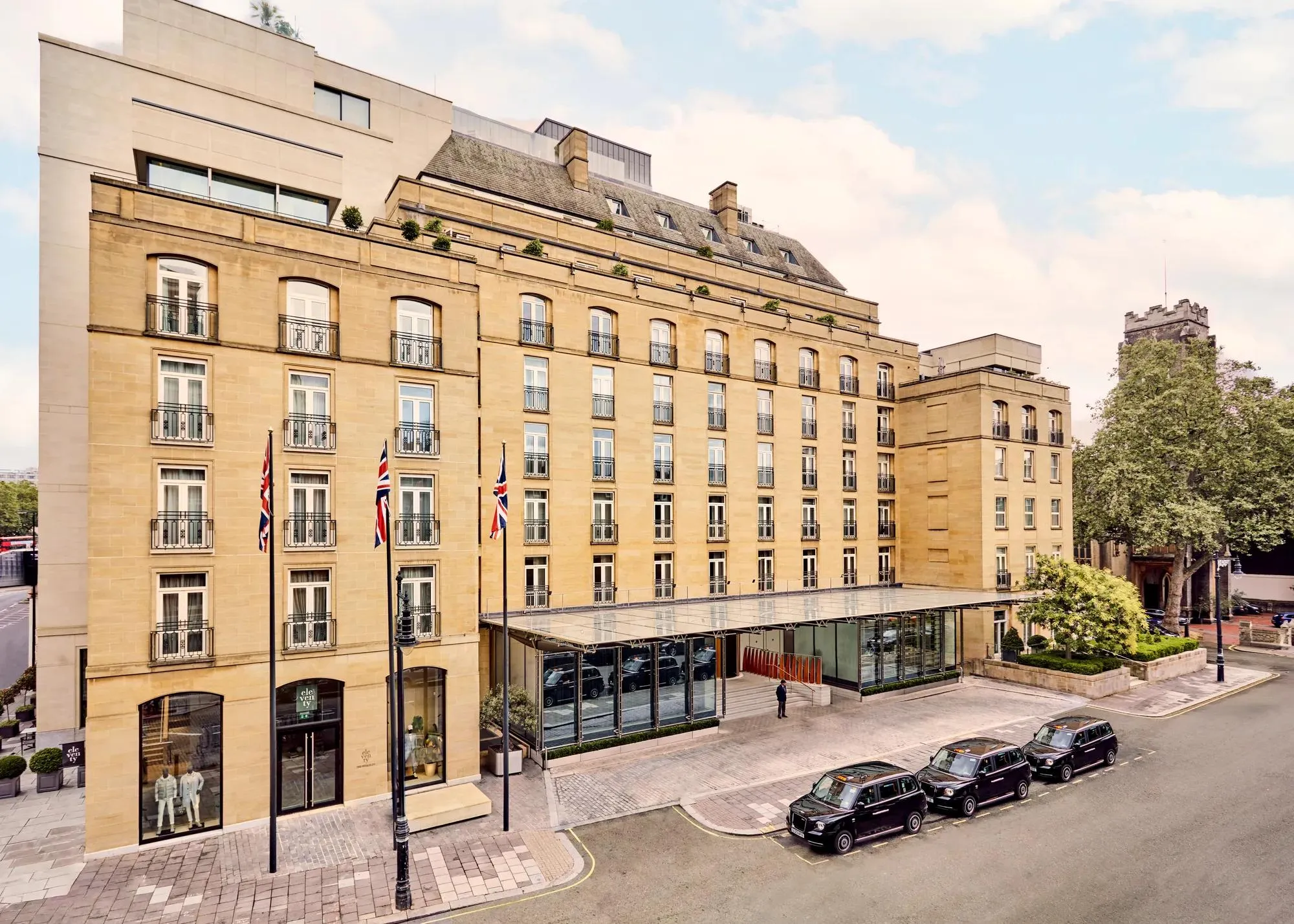
The Berkeley’s story begins a considerable distance from its current address. The original hotel traced its roots to the Gloucester coffee house at the corner of Piccadilly and Berkeley Street, a stopping point for mail coach drivers heading to the West Country, formally renamed The Berkeley Hotel in 1897. Richard D’Oyly Carte, the impresario behind the Savoy and a name synonymous with London hotel-keeping at the turn of the twentieth century, bought the property in 1900, and his family’s stewardship shaped it for close to a hundred years. In 1972, the hotel left its original Piccadilly site entirely, relocating to a purpose-built structure on Wilton Place in Knightsbridge, designed by the British architect Brian O’Rorke, who incorporated restored fixtures and decorative elements salvaged from the old building into the new one. That 1972 structure, low-rise by London hotel standards and wrapped around a series of internal courtyards and terraces, remains the building guests check into today, and it was this new site that first gave The Berkeley its rooftop pool, a genuine rarity among London hotels for decades afterward.
Ownership passed through several hands across the twentieth century. The Berkeley became part of the Savoy Group on 1 January 1901, shortly after D’Oyly Carte’s purchase, and the Savoy Group controlled it, alongside Claridge’s and The Connaught, for most of the century that followed, until Blackstone and Colony Capital bought the group in 1998. In 2004, an investor consortium led by the Irish financier Derek Quinlan acquired Claridge’s, The Connaught and The Berkeley from that group, and the three hotels were eventually brought together as the Maybourne Hotel Group. Control passed later to the Barclay family and, from 2019, to a structure backed by Qatari capital, which remains Maybourne’s owner today; the group has since added a fourth London hotel, the all-suite Emory, built on the site adjoining The Berkeley.
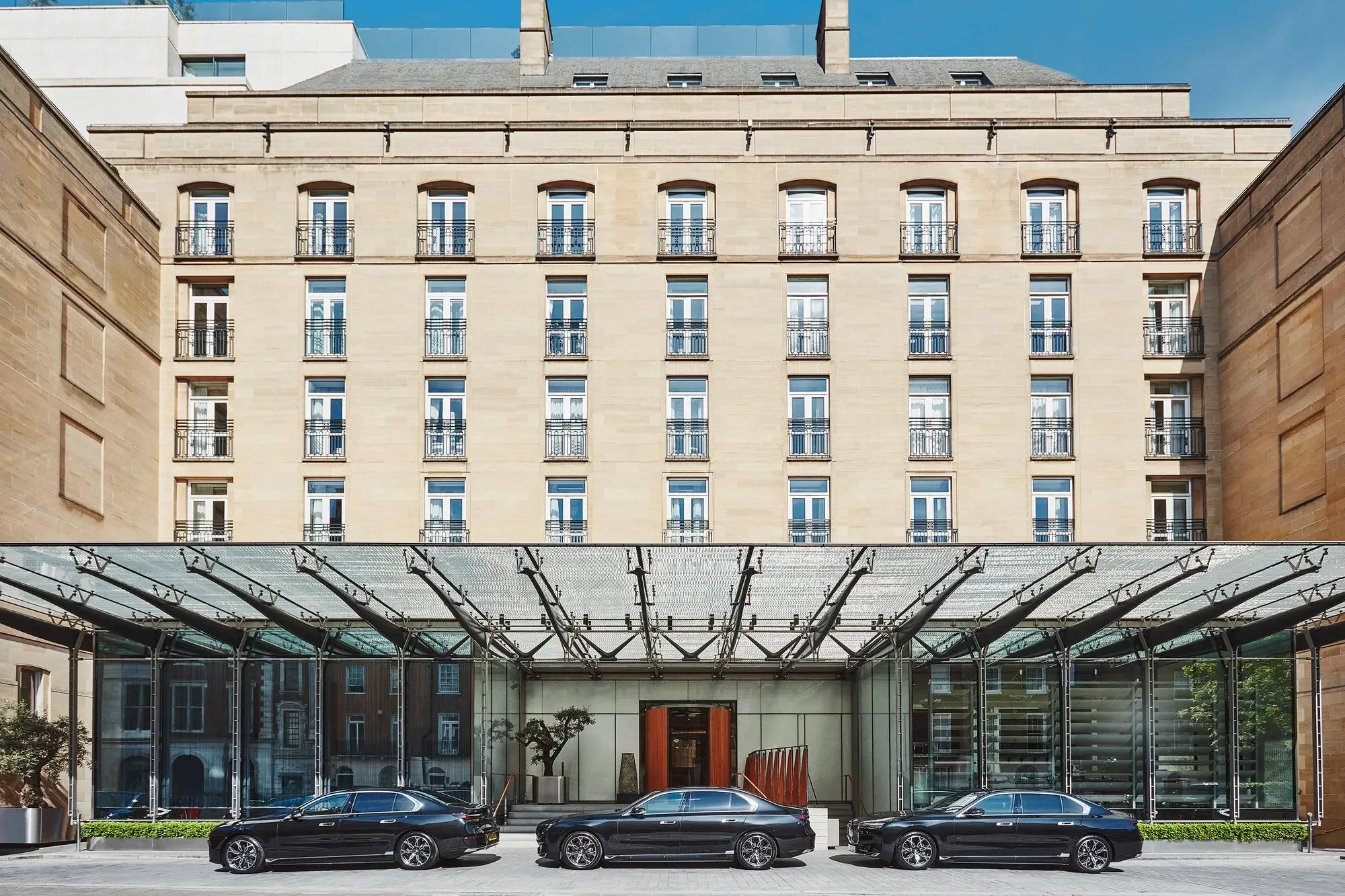
The building’s most significant recent architectural intervention came from Rogers Stirk Harbour + Partners, the practice founded by Richard Rogers, which began reworking the hotel’s ground floor and entrance from 2016 onward. RSHP’s contribution centres on a glazed, honeycomb-patterned entrance canopy that reframes the arrival sequence on Wilton Place, alongside a wider transformation of the ground-floor public rooms. The same practice later contributed a glass extension to what had been the Caramel Room, the hotel’s all-day dining space, opening it up to more natural light as part of its conversion into the Collins Room. Layered onto O’Rorke’s mid-century bones, RSHP’s glass-and-steel additions give the hotel a facade that reads as considerably more contemporary than its Mayfair neighbours, a deliberate point of differentiation for a hotel that has never tried to compete on Georgian or Victorian pedigree.
Interior Design
Where The Connaught and Claridge’s lean on a single historical design language, The Berkeley’s interiors are the product of an ongoing rotation of names, a strategy that keeps the hotel visually current at the cost of a single unifying aesthetic. The Blue Bar remains the clearest link to the hotel’s design history: created by the late David Collins in a custom shade the hotel calls Lutyens Blue, a nod to the architect Edwin Lutyens, it has barely changed since it opened and functions as something close to a house signature. Collins’s influence extends into the Collins Room, the hotel’s principal all-day dining and afternoon tea space, developed by his longtime protege and creative director Robert Angell in tandem with RSHP’s glass extension, carrying the Collins design vocabulary forward after his death.
More recently, the hotel has used its suites as a showcase for outside talent. The Hong Kong-based designer Andre Fu, known for hotel interiors from Hong Kong’s Upper House to the Waldorf Astoria Bangkok, has built a long-running relationship with The Berkeley that now spans four super-suites, including the Opus Suite, the hotel’s largest, a two-bedroom layout with 270-degree views over Hyde Park and Knightsbridge, and the Knightsbridge Pavilion Penthouse, built around a glass pavilion with floor-to-ceiling sliding walls, a wrap-around terrace and a sculptural green onyx bar. Helen Green Design has shaped further three-bedroom suites elsewhere in the hotel, layering bronze and brass accents into palettes of dusty pink, grey and petrol blue, while John Heah gave The Apartment, a two-bedroom suite in the hotel’s south-east corner, a deliberately more contemporary register. Outside the entrance, the Austrian sculptor Erwin Wurm’s Fat Convertible, a gleaming chrome and aluminium distortion of a classic sports car unveiled in 2019, sets an irreverent, art-world tone before guests even reach the honeycomb canopy, and Cedric Grolet’s glass-fronted patisserie counter, the pastry chef’s first location outside France, adds a further layer of craft-as-spectacle to the ground floor.
Atmosphere
The Berkeley reads younger and more design-literate than its Mayfair stablemates, a register shaped as much by Knightsbridge’s energy as by the hotel’s own choices. Where The Connaught cultivates a hushed, clubbish restraint and Claridge’s leans into art deco theatre, The Berkeley’s public rooms feel closer to a rotating gallery, contemporary art and sculpture set against a backdrop of glass, chrome and Lutyens Blue. The clientele mixes long-standing Knightsbridge regulars with a fashion and design-conscious crowd drawn by La Mome’s evening energy and the rooftop’s seasonal buzz, and the mood shifts noticeably by time of day: quieter and more residential in the morning, considerably livelier once the Rooftop Bar’s summer programming and La Mome’s live music get underway in the evening. It is not a hotel built around old-world hush, and guests expecting the deep formality of some of its neighbours may find The Berkeley’s temperament closer to a well-run private members’ club with an unusually good view.
Rooms and Suites
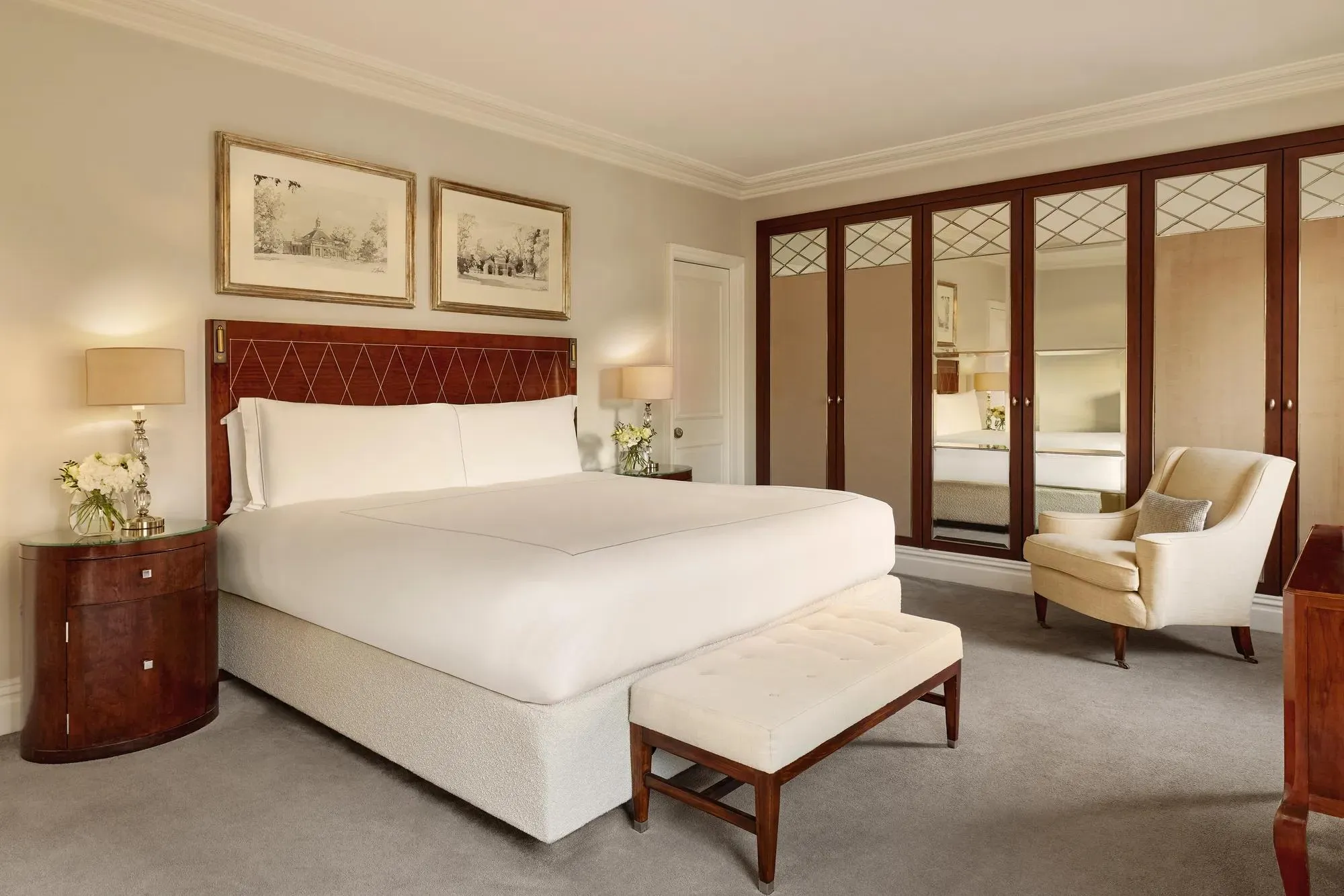
The Berkeley’s inventory runs to around 214 rooms and suites, and the hotel’s defining physical feature across the collection is private outdoor space: a significant share of categories include their own terrace, balcony or garden, a proportion unusual for a hotel of this size in central London. Entry-level Superior Rooms give way to Balcony Rooms, designed by Robert Angell with private balconies over the Knightsbridge and Belgravia rooftops, and from there the hierarchy moves through Superior and Deluxe Junior Suites into named suites including the one-bedroom Knightsbridge Suite and Angell’s Chelsea Suites, each adding scale and, in most cases, a clearer view toward Hyde Park.
At the top of the collection sit the hotel’s showcase accommodations, several of them the work of Andre Fu, whose long-running relationship with the hotel now spans four super-suites. The Opus Suite is the largest in the hotel, a two-bedroom layout with 270-degree views across Hyde Park and Knightsbridge and a 300-square-foot master bathroom finished entirely in marble, while the Knightsbridge Pavilion Penthouse, Fu’s most recent addition, unfolds around a glazed pavilion where sliding walls open onto a wrap-around terrace, with a green onyx bar and firepit built for entertaining as much as sleeping. The roughly 3,200-square-foot Crescent Pavilion Suite and the Grand Pavilion Suite add two further garden-facing residences behind a curved, solid-marble portal, and the Hyde Park Penthouse offers its own terrace and firepit with a dedicated dining room. The Apartment, designed by John Heah in a deliberately more contemporary register, occupies a quiet south-east corner of the hotel and can connect to two further rooms to form a self-contained, multi-room residence within the building.
Dining
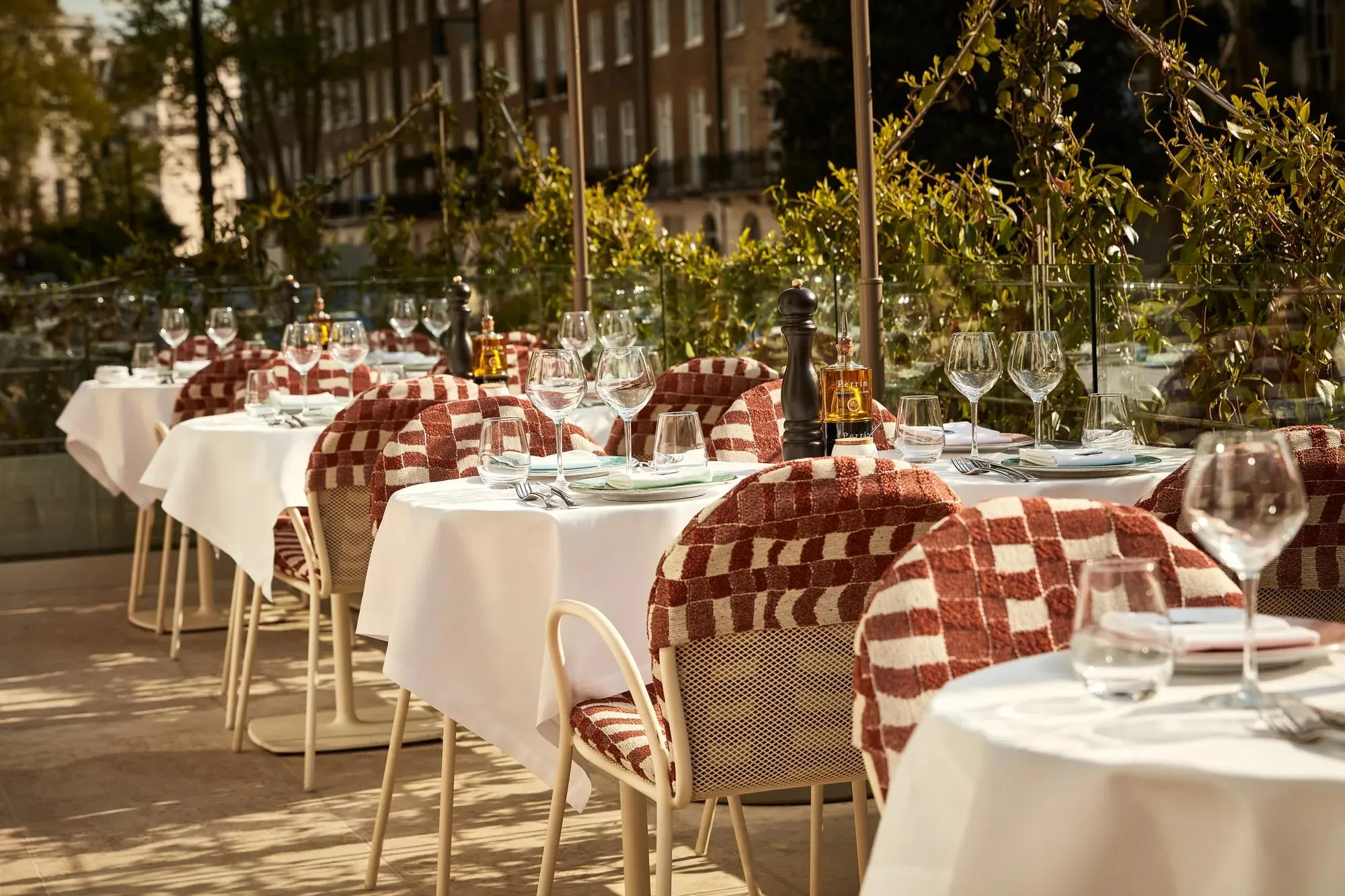
The most consequential recent change at The Berkeley sits squarely in its dining programme. Marcus Wareing’s restaurant, which had carried a Michelin star and defined the hotel’s culinary identity for twenty years, closed permanently on 26 December 2023 under its final name, Marcus Belgravia, ending Wareing’s two-decade tenure at the hotel; the chef, who was appointed MBE in the 2026 New Year Honours for services to the culinary arts, has not opened a successor restaurant since. The Berkeley’s former dining room stood empty through most of 2024 before reopening in January 2025 as La Mome London, a spin-off of the French Riviera institution with sister restaurants in Cannes and Monte Carlo, brought to London by restaurateurs Ugo and Antoine Lecorche. Interiors by the Cannes-based designer Samy Chams lean into a rich, theatrical Riviera palette, and the restaurant seats around 220 guests inside with room for a further 30 on a newly created terrace and a ten-seat bar, open seven days a week for lunch and dinner with live music, a pianist, a chanteur and occasional DJ sets, running through the evening. As of this guide, there is no Michelin-starred restaurant operating inside The Berkeley; the star that once anchored the hotel’s reputation left with Wareing’s restaurant when it closed, a distinction worth understanding before booking a stay here purely for the kitchen.
Beyond La Mome, Cedric Grolet at The Berkeley gives the pastry chef, already established in Paris, his first permanent outpost outside France, built around a glass-fronted counter where guests can watch his sculptural fruit-shaped desserts assembled to order, alongside a dedicated Counter dining experience and Goutea, a fusion of classic afternoon tea with Grolet’s pastry work. The Berkeley Cafe handles all-day, more casual dining, from breakfast through to desserts and light plates, while The Berkeley Bar & Terrace, anchored by the Blue Bar, serves vintage-leaning cocktails and rare wines, with The Snug available as a smaller private space for exclusive hire. In season, The Berkeley Rooftop Bar runs its own standalone concept open to non-residents as well as guests; the 2026 programme, “Capri in the City,” developed with Acqua di Parma, brings coastal Italian cocktails and sharing plates to the same rooftop that houses the pool.
Spa and Wellness
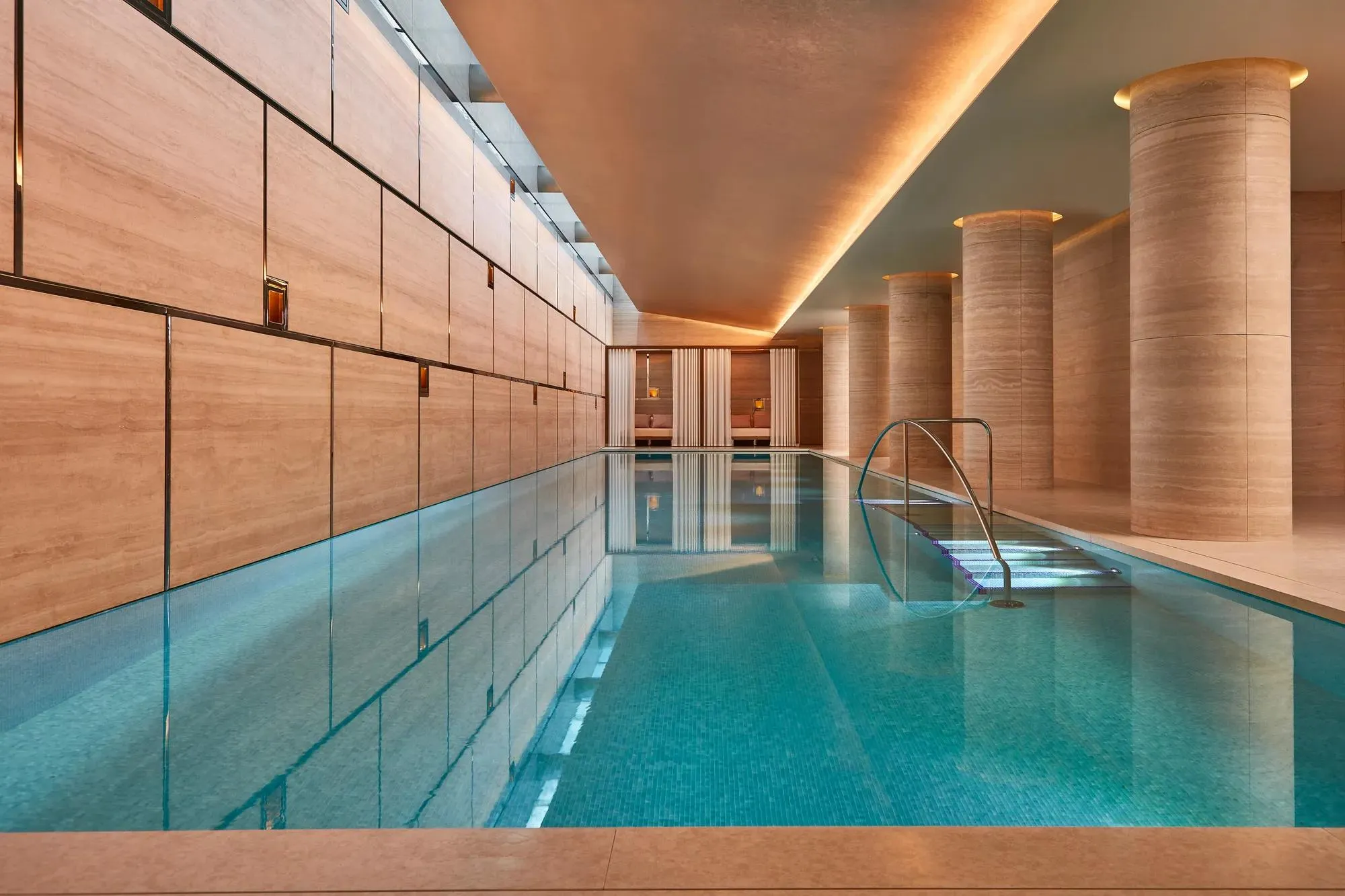
Wellness at The Berkeley is now organised around Surrenne Belgravia, which opened in 2024 as a four-floor, roughly 21,530-square-foot wellness and longevity club, replacing the Bamford Haybarn Spa that had occupied the seventh floor since 2013. Designed by Remi Tessier, Surrenne includes a 22-metre indoor lap pool fitted with a built-in sound system for underwater meditation, saunas, aromatic steam rooms and a snow shower, a hyperbaric chamber, a cardio and functional gym, and an entire floor given over to Tracy Anderson’s body-sculpting studio, the first of its kind in the UK. Treatments range from four-hands massages to Oxygeneo facials and physician-formulated intravenous therapy administered by qualified clinicians, and the club runs its own nutrition-focused Surrenne Cafe, developed with nutritionist Rose Ferguson, alongside an in-house product line sold under the ASCEND name. Access to Surrenne is included for guests staying at The Berkeley (as well as at Maybourne’s neighbouring all-suite hotel, The Emory), with treatments, classes and the Tracy Anderson studio booked and charged separately; Surrenne also operates as a members’ club for guests from outside the hotel.
The rooftop pool sits one floor above and now connects directly into the Surrenne building, part of the same 2024 renovation that reshaped both spaces. Historically, the pool was one of London’s few hotel rooftop pools of any kind, and for years its signature feature was a retractable roof that could close over the water within minutes, paired with grand colonnades that gave the space an almost cloistered, Mediterranean character; a small scented garden to one side doubled as a rooftop cinema in winter. The 2024 overhaul removed both the retractable roof and the colonnades in favour of an open-air design: glass railings in place of stone balustrades, striped sun loungers, marble tables and potted plants, and unobstructed views across the red-brick rooftops of Knightsbridge and Belgravia toward Hyde Park. The heated pool now operates seasonally, through spring and summer, is reserved for hotel guests rather than open to walk-ins, and can be reserved up to thirty days in advance; the adjoining Rooftop Bar runs its own seasonal food and drink programme, currently the Acqua di Parma-backed “Capri in the City,” which is separately open to the public during the summer season.
Experiences
Much of what The Berkeley offers beyond its rooms is built around its own set-piece amenities rather than an extensive external tour programme, reflecting its position as a city hotel rather than a resort. Cedric Grolet’s counter provides a genuine draw in its own right, watching pastry assembled to order being as close as most guests get to a live culinary performance during their stay, while La Mome’s evening programme of live music, a pianist, a chanteur, occasional DJ sets, turns dinner into something closer to a Riviera night out than a standard hotel restaurant service. The rooftop’s seasonal programming changes year to year, giving returning guests a reason to revisit even in a hotel they already know well, and Surrenne’s Tracy Anderson studio and broader class schedule give wellness-minded guests a structured reason to build a stay around fitness rather than sightseeing. For those who do want to leave the building, the hotel’s position gives near-instant access to Knightsbridge’s retail core and Hyde Park’s open space, both usable as extensions of the hotel’s own experience programme rather than separate excursions.
Who It Is For
The Berkeley suits travellers who want central London’s grand-hotel amenities without Mayfair’s more formal register: design and fashion-conscious guests who will appreciate the rotating cast of interior designers and the Grolet counter, wellness travellers building a stay around Surrenne’s facilities and classes, and shoppers for whom a few minutes’ walk to Harrods and Harvey Nichols matters more than any single amenity inside the hotel. Families are well served by the private terraces and multi-room suites, several of which include kitchens or connecting configurations, and by the rooftop pool itself, a genuine rarity for a London hotel that gives children (and adults) something to do that has nothing to do with sightseeing. It is a less natural fit for diners specifically chasing a Michelin-starred meal inside the hotel, given Marcus Wareing’s departure, or for guests who want the settled, unchanging register of a hotel like The Connaught; The Berkeley’s recent history of reinvention means the experience on offer today is meaningfully different from what regulars might remember from five years ago, and travellers should book based on what the hotel currently is rather than its old reputation.
Best Time to Visit
The Berkeley works as a year-round London base, but two windows bring out particular strengths. May through September is rooftop pool season, when the newly open-air deck and the Rooftop Bar’s seasonal programming, “Capri in the City” for 2026, are both running, making this the period to book if the pool is a primary draw. Late November through early January brings Knightsbridge’s Christmas lights and its concentrated shopping season, with Harrods a short walk away at its most theatrical time of year, alongside the West End’s wider festive programming. Shoulder seasons in spring and early autumn tend to combine milder weather with somewhat easier availability across both rooms and restaurant tables, particularly at La Mome, which has built demand quickly since its 2025 opening.
How to Get There
London Heathrow is the nearest major airport, roughly 35 to 45 minutes from the hotel by car depending on traffic and time of day; the hotel’s concierge can arrange a private chauffeur transfer, and the Piccadilly line’s Heathrow connections offer a rail-based alternative into central London for guests who prefer not to rely on a car. Within the city, Knightsbridge Underground station is a short walk from the hotel’s Wilton Place entrance, putting the Piccadilly line, and onward connections toward South Kensington, Hyde Park Corner and the wider network, within easy reach. London’s other airports, Gatwick, City, Stansted and Luton, are all viable depending on the originating flight, though each adds meaningfully to transfer time relative to Heathrow.
Nearby Experiences
Harrods sits a few minutes’ walk from the hotel, with Harvey Nichols close behind, making The Berkeley one of the best-placed grand hotels in London for guests prioritising shopping over sightseeing. Hyde Park is directly accessible on foot, offering the Serpentine, the Diana Memorial Fountain and the park’s wider network of paths as an easy counterpoint to Knightsbridge’s density, particularly useful for families or guests wanting to walk off a long lunch at La Mome. Sloane Street’s run of flagship luxury boutiques extends the shopping circuit south into Belgravia’s quieter, more residential streets, while the museums of South Kensington, the Victoria and Albert Museum, the Natural History Museum and the Science Museum, are all within a short walk or a very brief taxi ride, giving culturally minded guests a full day’s itinerary without needing to leave the immediate neighbourhood.
Things to Know Before Booking
Guests booking primarily for a Michelin-starred meal should know that no restaurant currently operating inside The Berkeley holds a Michelin star; Marcus Wareing’s Michelin-starred restaurant closed permanently at the end of 2023, and, as of this guide, he has not opened a replacement. The rooftop pool operates seasonally, broadly spring through summer, is reserved for hotel guests rather than the general public, and is bookable up to thirty days ahead, so guests hoping to swim should confirm both the season and availability before arrival rather than assuming year-round or walk-up access. Surrenne access is included with a stay, but treatments, fitness classes and the Tracy Anderson studio are booked and charged separately and can fill up during peak periods. Because room and suite categories vary considerably in layout, particularly the designer-specific super-suites by Andre Fu, guests with a strong preference for a particular aesthetic or terrace configuration should specify this when booking rather than assuming standardisation within a category.
Sustainability
The Berkeley runs its sustainability efforts through Planet Berkeley, a staff-led committee tasked with embedding environmental practice into daily hotel operations rather than treating it as a separate initiative. The hotel reported a 95 percent recycling rate by September 2024, managed across fifteen distinct waste streams covering food waste, textiles and electronic equipment, and received the Transformation Award at the National Sustainability Awards in October 2024 alongside an International Green Apple Environment Award the previous month. These property-level efforts sit within Maybourne Hotel Group’s wider commitments, which include a fifteen-year power purchase agreement securing renewable electricity, sourced through the developer Low Carbon, for its London hotels, part of a broader push across the group to cut single-use plastics and reduce energy consumption across its properties.
Practical Information
Standard check-in at The Berkeley is from 3:00 PM, with check-out at 12:00 PM; earlier arrival or later departure can often be arranged on request, subject to availability, through the concierge team. Rates begin from around £795 per night for an entry-level Superior Room, rising substantially for terrace rooms, named suites and the top-tier penthouse categories. The hotel’s Wilton Place address places it directly on the Knightsbridge and Belgravia border, a short walk from Hyde Park Corner and within easy reach of the wider Knightsbridge Underground station. The concierge team can arrange restaurant reservations across the hotel’s dining venues, rooftop pool bookings during the open season, Surrenne treatments and classes, and private transfers to and from Heathrow or other London airports.
Editorial Conclusion
The Berkeley in 2026 is a hotel in the middle of proving something: that a grand London address built its reputation around amenities, a starred restaurant, a storied spa, a singular rooftop, can lose or fundamentally alter all three within a few years and still hold its position. The early evidence is encouraging. La Mome has brought a different, livelier kind of energy to a dining room that risked standing empty after Wareing’s departure; Surrenne is a considerably larger and more ambitious wellness proposition than the spa it replaced; and the rooftop pool, stripped of its old roof and colonnades, reads as a more confident, better-resolved space than the one it succeeded, even if some longtime guests will miss the sense of enclosure the retractable roof once provided. What The Berkeley has not changed is the thing hardest to manufacture: its position, wedged between Knightsbridge’s shopping and Hyde Park’s open air, with more private outdoor space than almost any hotel of its kind in the city. For travellers drawn to that combination of location and reinvention in progress, rather than a hotel frozen in a single decade, The Berkeley remains one of the more interesting grand addresses London has to offer.
In pictures
On the map
Knightsbridge, United Kingdom
Questions
Frequently asked
Is Marcus Wareing's restaurant still at The Berkeley?
No. Marcus Wareing's Michelin-starred restaurant, latterly rebranded Marcus Belgravia, closed permanently at the hotel on 26 December 2023 after a twenty-year run, and Wareing has not opened a successor restaurant since. The Berkeley's former main dining room reopened in January 2025 as La Mome London, a French Riviera-themed restaurant transplanted from Cannes and Monte Carlo, and there is no Michelin-starred restaurant currently operating inside the hotel itself.
Does the rooftop pool still have its retractable roof?
No. The Berkeley's rooftop pool was historically known for a retractable roof and colonnaded surround, but a 2024 renovation removed both in favour of an open-air design with glass railings, striped loungers and natural materials. The pool is heated and operates seasonally through spring and summer, and is reserved for hotel guests, bookable up to thirty days in advance.
What happened to the Bamford spa at The Berkeley?
The Bamford Haybarn Spa, which had operated on the hotel's seventh floor since 2013, has been replaced by Surrenne Belgravia, a four-floor wellness and longevity club that opened in 2024. Surrenne includes a 22-metre indoor lap pool, a hyperbaric chamber, sauna and steam facilities, a Tracy Anderson Method studio and treatment rooms, with complimentary access included for Berkeley guests.
How many rooms and suites does The Berkeley have?
The hotel's inventory runs to around 214 rooms and suites, spanning Superior Rooms and Robert Angell-designed Balcony Rooms through to named suites such as the Knightsbridge Suite and the Chelsea Suites, up to multi-room penthouses including the Opus Suite, Hyde Park Penthouse and Knightsbridge Pavilion Penthouse, several of the latter designed by Andre Fu. Many categories include a private terrace, a rarity at this scale among London hotels.
How do you get to The Berkeley from Heathrow, and is it near the Tube?
London Heathrow is the nearest airport, roughly 35 to 45 minutes away by car depending on traffic; the hotel's concierge can arrange a private transfer. Knightsbridge Underground station, served by the Piccadilly line, is a short walk away, putting Hyde Park Corner, South Kensington and the wider Tube network within easy reach without needing a car for getting around central London.
Who owns The Berkeley today, and how does it relate to Claridge's and The Connaught?
The Berkeley is owned and operated by the Maybourne Hotel Group, alongside Claridge's, The Connaught and the newer all-suite Emory, all in London. All three older hotels were part of the Savoy Group for most of the twentieth century until Blackstone and Colony Capital bought the group in 1998; a 2004 acquisition by an investor consortium led by Derek Quinlan brought Claridge's, The Connaught and The Berkeley together as Maybourne, which passed later to the Barclay family and, from 2019, to a structure backed by Qatari capital. Unlike its two Mayfair sisters, both housed in late-Victorian buildings, The Berkeley occupies a 1972 purpose-built structure in Knightsbridge, a distinction that shapes much of how it differs from the rest of the group.
Same destination
More hotel guides in United Kingdom
near Leatherhead, United Kingdom
Beaverbrook
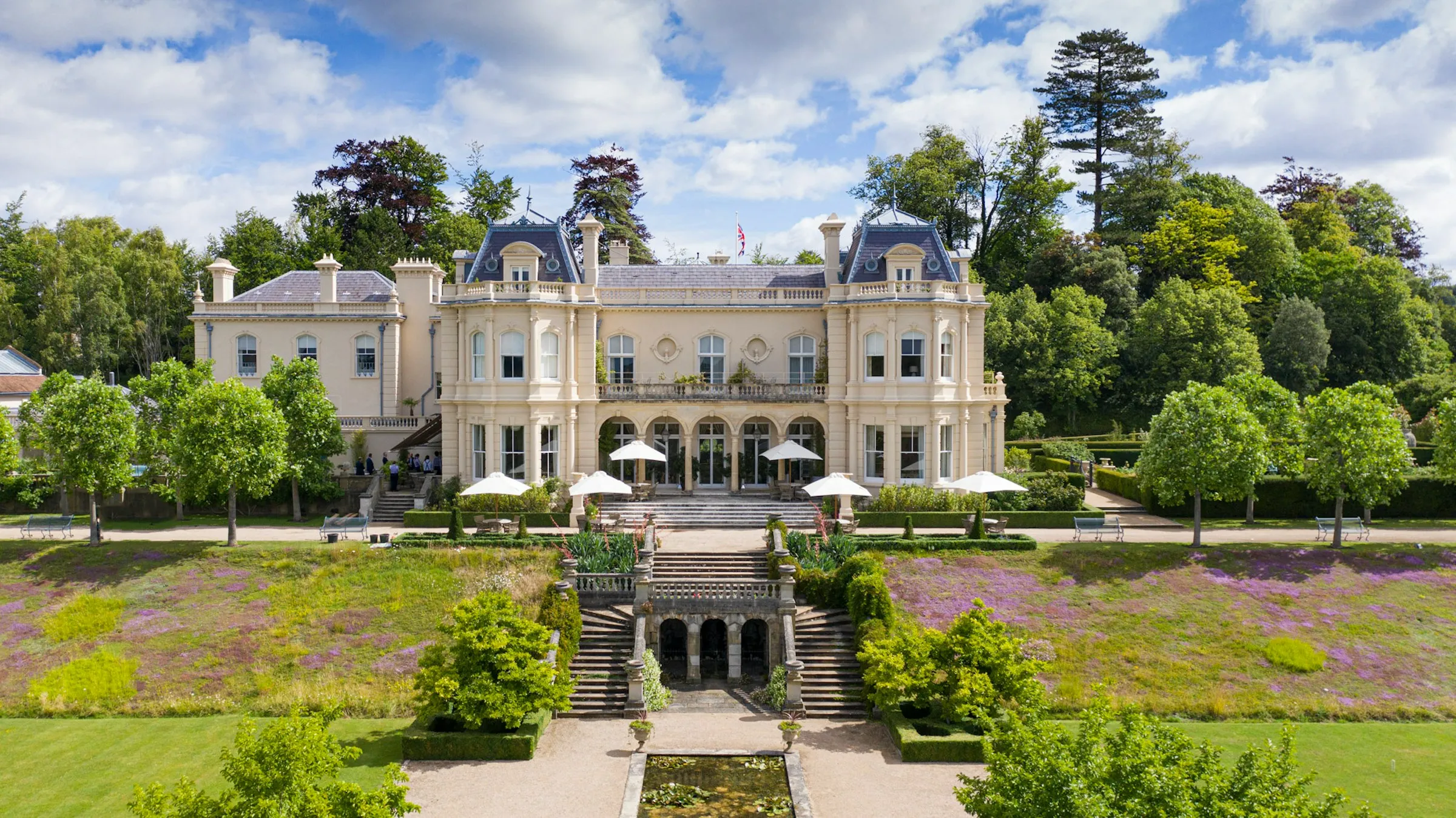
A press baron's Surrey estate, once Churchill's wartime refuge, run today as one of England's most quietly assured country house hotels.
From £475 per night
Mayfair, United Kingdom
Claridge's
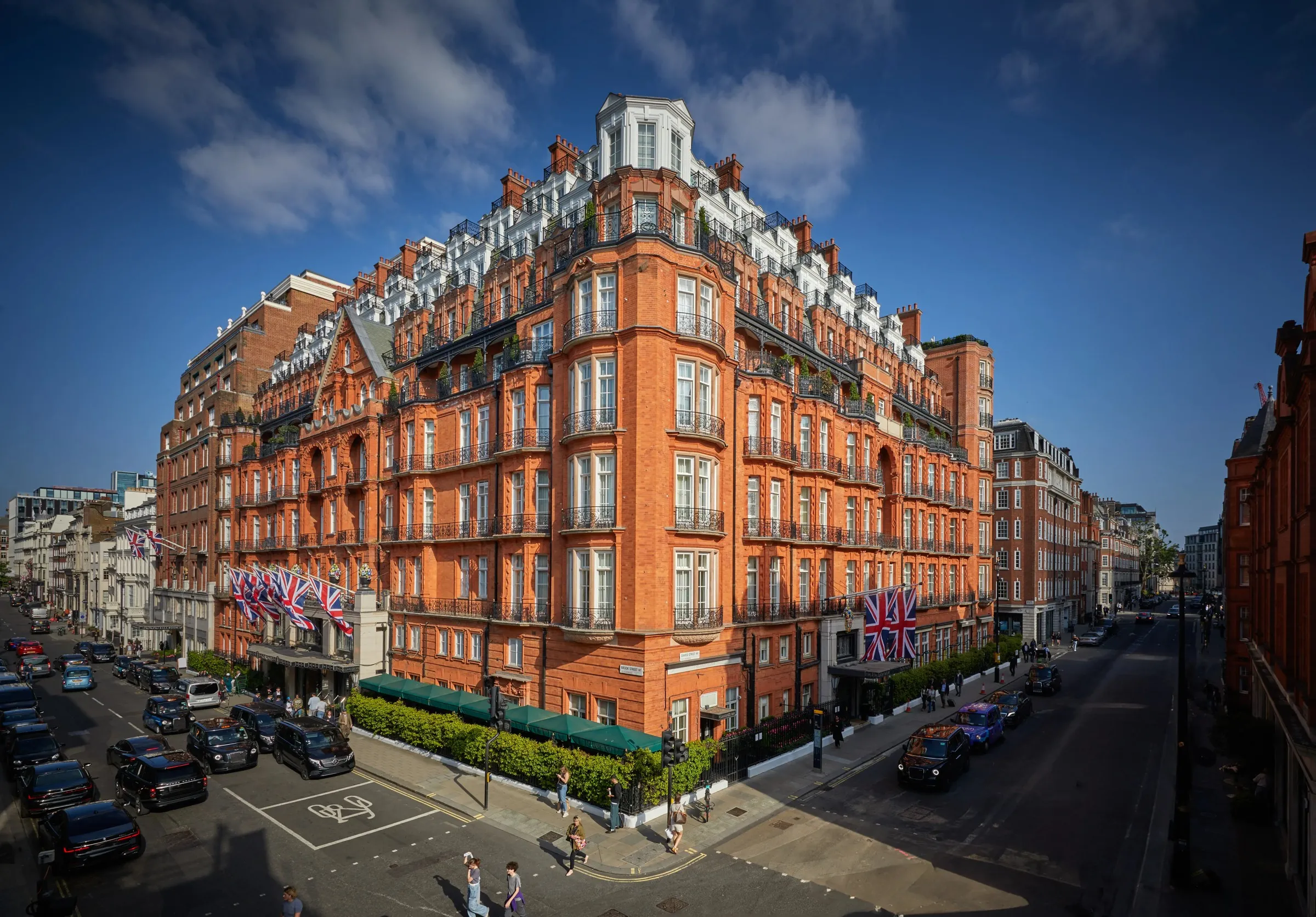
A 1930s Art Deco time capsule on a Mayfair corner, still the most self-assured address in London.
From £950 per night
near Witney, United Kingdom
Estelle Manor
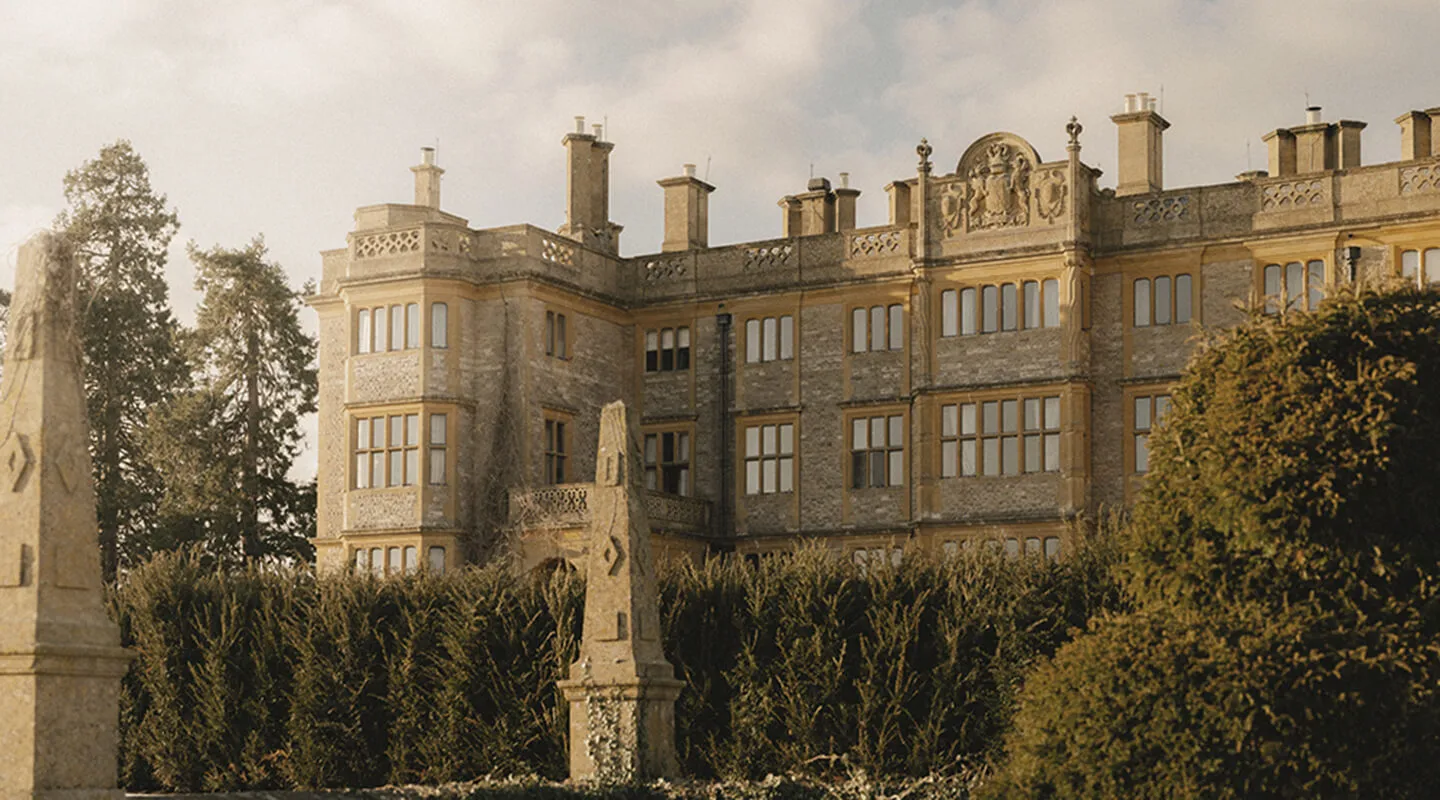
A Jacobethan manor turned country club, where a Roman-style bathhouse now sits where a police training centre once stood.
From £450 per night