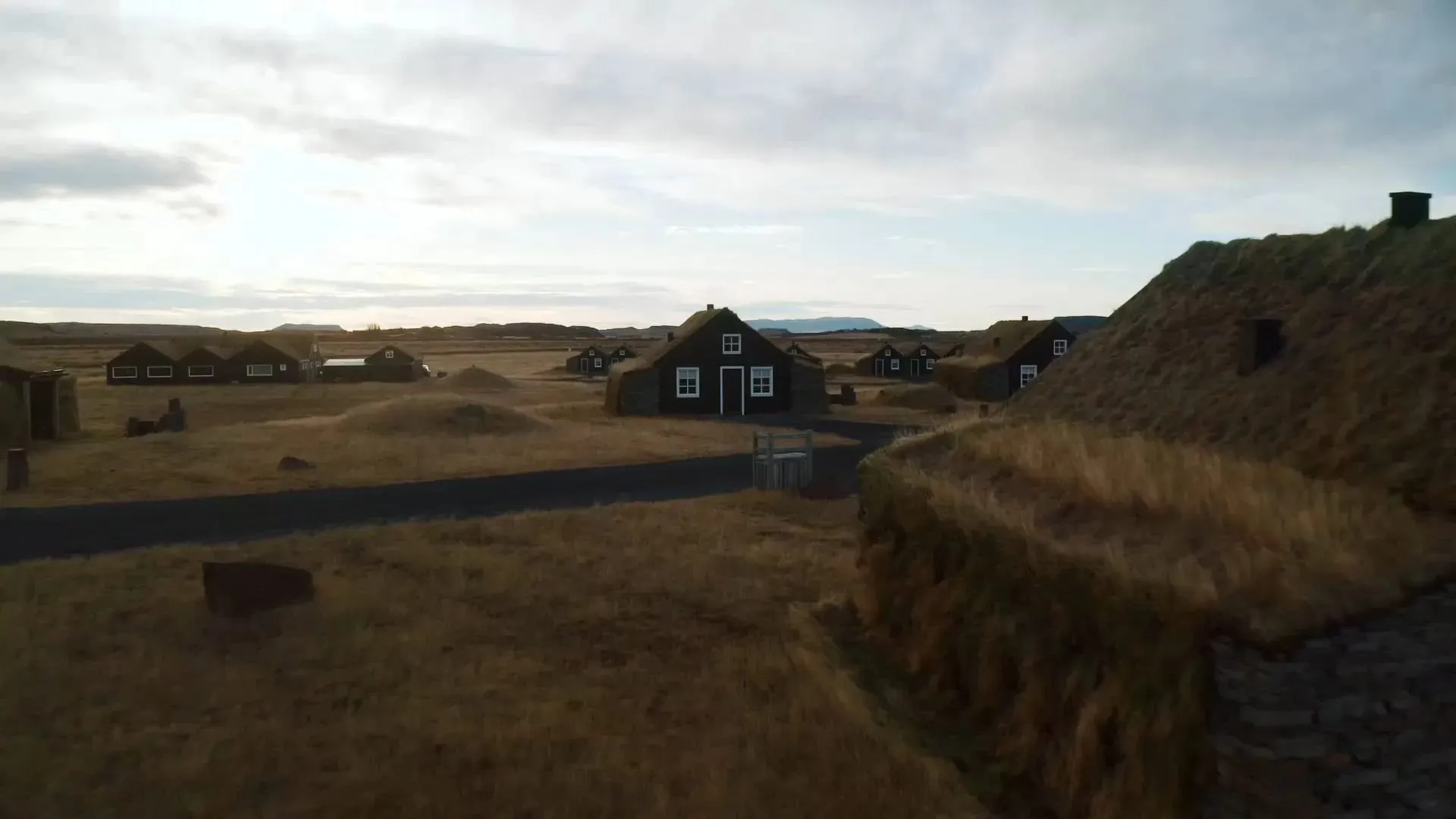
Near Thingvellir National Park, Iceland
Torfhus Retreat
A hamlet of grass-roofed suites on the Golden Circle, built on the memory of a Viking longhouse buried by a volcano nine centuries ago.
- Rates from
- From $750 per night
- Nearest airport
- Keflavik International Airport (KEF)
- Transfer
- About 2 hours (roughly 150km) by car via Reykjavik and Route 37; around 90 minutes from central Reykjavik
- Best months
- September to April for aurora viewing from the private geothermal pools, or June to August for long daylight and easier access to Golden Circle hiking
Iceland’s turf houses were, for most of the country’s history, a practical answer to a hard problem: almost no native timber, brutal winters, and volcanic stone and cut turf as the only materials at hand. By the twentieth century they had mostly disappeared, replaced by concrete and corrugated iron, preserved mainly as museum pieces at sites like Glaumbaer and Keldur. Torfhus Retreat, a small hotel scattered across a meadow in Iceland’s Golden Circle, resurrects the form for an entirely different purpose: not shelter born of scarcity, but a private geothermal hot tub, a Nespresso machine, and a stone-walled Viking-style dining hall.
The property takes its architectural cue from a specific, verifiable place: the excavated Viking-age longhouse at Stong, in the Thjorsardalur valley, a farm buried under ash when Mount Hekla erupted in 1104 and rediscovered by archaeologists in 1939. That buried longhouse, rather than a generic idea of “Iceland,” is the reference point for Torfhus Retreat’s roughly two dozen individual turf-roofed houses, suites, and villas, built from stone, reclaimed timber, and living turf roofs and set into open grassland roughly ninety minutes east of Reykjavik.
It is a family project as much as a hospitality one. The retreat was founded by Siggi Jensson, an Icelander, and Alex Hoop, whose roots are in Switzerland and Liechtenstein, two families whose shared interest in Icelandic horses runs through the property almost as strongly as its architecture does. Icelandic horses, a breed unique for its five natural gaits including the smooth tolt, graze the fields around the buildings, and guided rides can be arranged in the surrounding countryside.
What follows is a look at what that combination, archaeological reference, family ownership, and geothermal luxury, actually delivers on the ground: how the buildings work, what a night there involves, and where the property sits relative to the rest of the Golden Circle.
Why It Stands Out
Most hotels that invoke “Viking” imagery do it decoratively: a longship motif here, a rune-carved sign there. Torfhus Retreat’s claim is more specific and more structural. Its turf-house form is drawn directly from Stong, a real excavated farmstead, and the building method it revives, stone plinths, timber frames, cut-turf roofs and walls, was the dominant residential technology in Iceland for roughly a thousand years before it was largely abandoned. Layered onto that historical spine is a strictly contemporary hospitality proposition: geothermally heated basalt stone plunge pools outside nearly every unit, a single tasting-menu restaurant built on hyper-local sourcing, and total reliance on Iceland’s geothermal and hydroelectric grid. The combination of an archaeologically grounded architectural concept, private hot tubs positioned for aurora viewing, and a genuinely small, family-run scale (a few dozen keys rather than a few hundred) is not something replicated elsewhere on the Golden Circle circuit.
Architecture
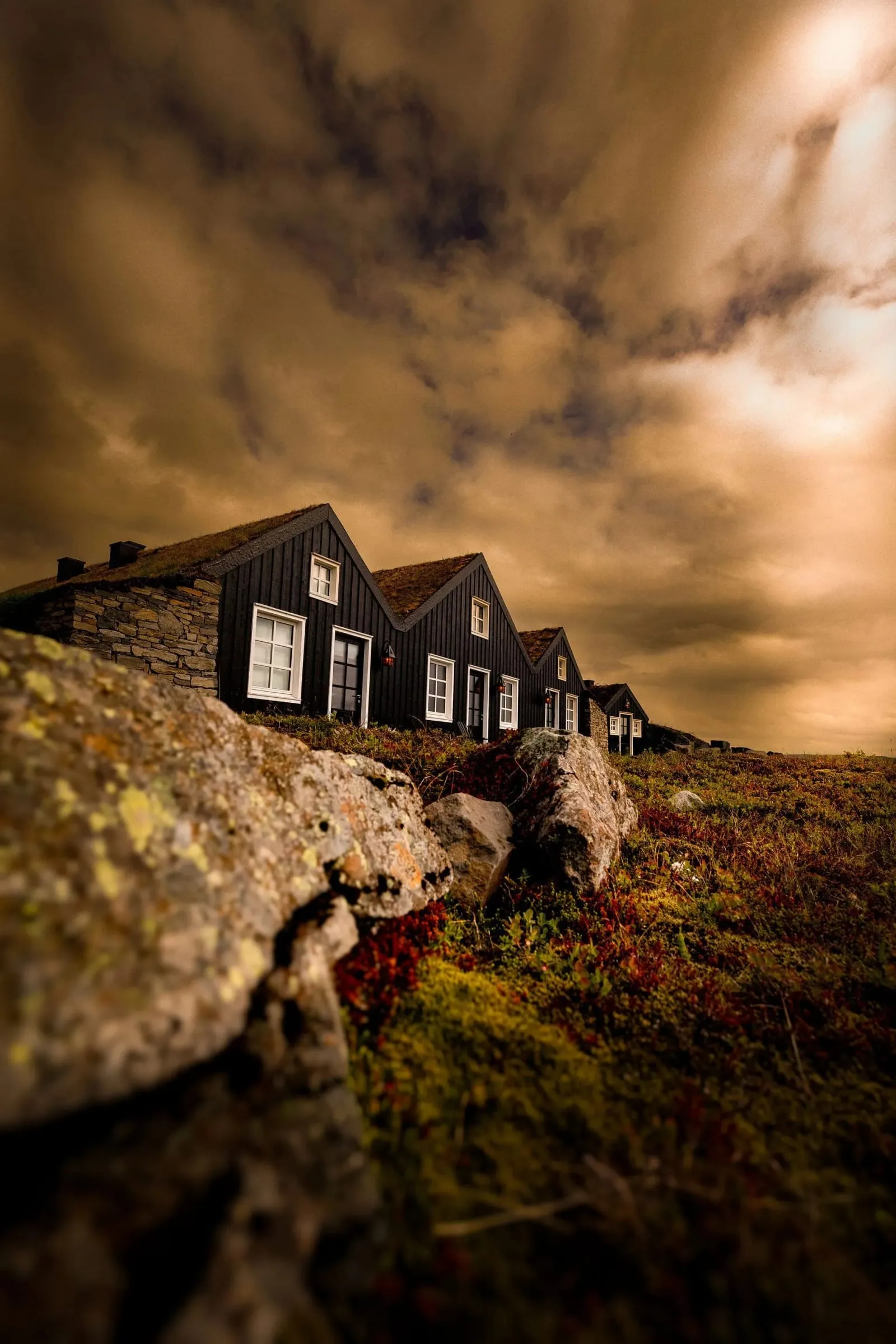
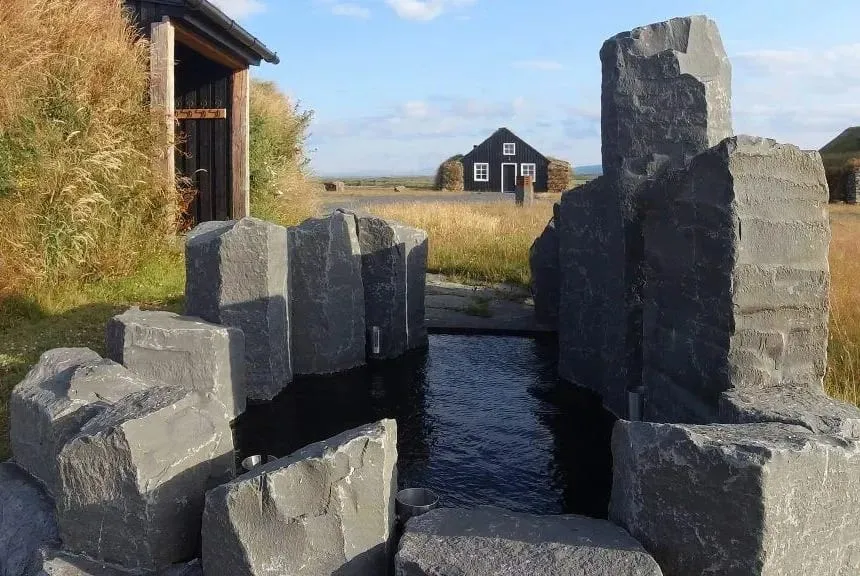
Torfhus Retreat’s buildings are modern interpretations of the Icelandic torfbaer, the turf farmhouse form that dominated Icelandic vernacular building from the settlement period into the twentieth century, and the design brief for the property drew specifically on the excavated Viking-age longhouse at Stong in the Thjorsardalur valley, a farm buried by tephra from Hekla’s 1104 eruption and excavated by archaeologists in 1939. Rather than a literal reconstruction, the architecture translates that longhouse language into a scattered village of low, freestanding structures: stone plinths and walls, timber frames using reclaimed oak and pine, and roofs and, in places, walls covered in living turf that lets the buildings visually recede into the meadow around them. The main house, which holds reception, the dining hall, and a lounge, is reported to be covered almost entirely in grass and wildflowers in summer, reinforcing the sense that the built structures are an extension of the landscape rather than an imposition on it.
That approach is also a practical response to a similar problem the original torfbaer solved: turf is an efficient insulator against Iceland’s climate, and building low and rounded reduces exposure to wind. The property is spread across open grassland in the Golden Circle, with individual houses positioned with enough separation to give each one a sense of privacy and an unobstructed view, a layout that reads more like a small hamlet than a conventional hotel block.
Interior Design
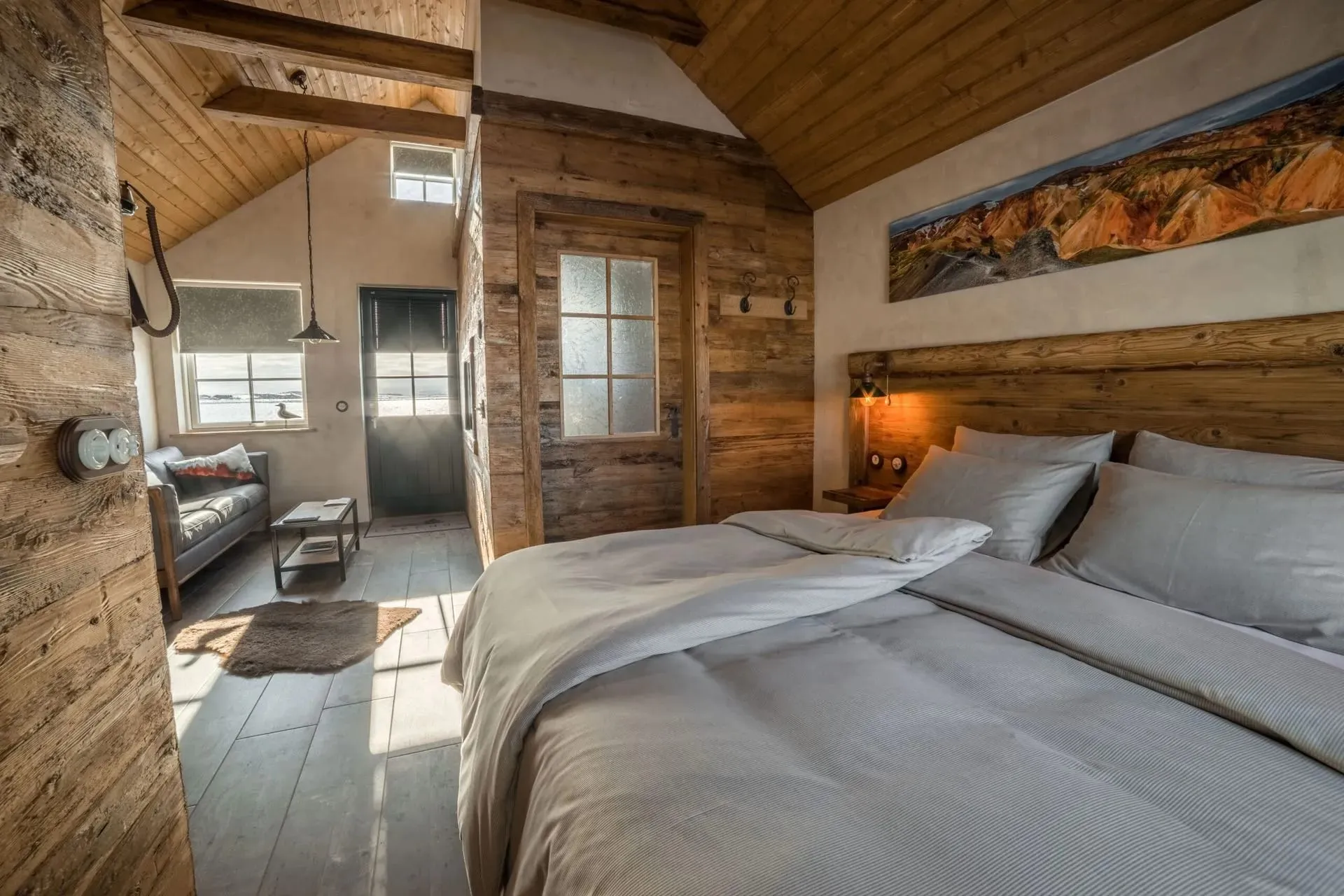
Inside, the turf and stone exterior gives way to a more restrained, materially warm interior language: reclaimed and vintage timber furniture, handcrafted and rustic detailing, and finishes that lean into a muted, natural palette rather than a themed “Viking” pastiche. Modern comforts, Smart TVs, high-speed WiFi, Nespresso machines, minibars, and premium toiletries, sit inside that frame without disrupting it. The Viking Langhus restaurant carries the strongest architectural statement among the interiors, styled after a traditional longhouse with heavy timber framing, built specifically to evoke a communal Viking-era hall rather than a conventional hotel dining room.
The design decisions throughout favor a kind of unfussy authenticity: exposed structural timber, local stone, and natural materials are left visible rather than dressed up, and the smaller Torfbaer suites and larger Torfhus houses share a common material vocabulary even as their footprints differ. It is an interior scheme built to support the architecture’s central idea, that guests are staying inside a contemporary reading of a historic Icelandic farm, rather than one designed to compete with it.
Atmosphere
The overriding sensation at Torfhus Retreat is quiet. The property sits on open grassland away from any town center, with individual houses spaced apart across the meadow, so there is little of the density or bustle associated with larger resort properties. Icelandic horses owned by the founders graze the surrounding fields and are visible from many of the units, adding a working-farm texture that is unusual among Iceland’s luxury properties, most of which lean either urban (Reykjavik hotels) or wilderness-lodge (glacier and highland retreats) rather than this pastoral, semi-domestic register.
At night, the absence of significant light pollution across the surrounding countryside is central to the experience: outdoor basalt stone hot pools, heated by geothermal water to roughly 38 to 42 degrees Celsius, are positioned specifically for guests to watch the sky, whether for stars in summer or the aurora borealis during the darker months from roughly September through April. That contrast, hot water against cold air, dark sky against the pool’s steam, is the property’s most consistently cited atmospheric signature across guest and press accounts alike.
Rooms and Suites
Torfhus Retreat’s accommodation is organized into three broad categories, with a total accommodation count that published sources put at roughly 25 to 27 units, a range that likely reflects the property’s gradual evolution since opening rather than any inconsistency on the ground; travelers should confirm exact current categories and counts directly with the hotel. Torfbaer suites are the entry-level category: one-bedroom units of around 30 square meters (roughly 320 square feet), each with a bedroom, bathroom, and a living area with a small kitchen, arranged three to a building and sharing a single geothermal basalt hot pool between the three neighboring suites.
Torfhus houses step up in scale: two-bedroom standalone units of around 60 square meters (roughly 650 square feet), each with its own bathroom, a fuller kitchen and living area, and, critically, a private geothermal hot pool rather than a shared one. A smaller number of larger Torfvilla units sit above that again, built for larger groups or families, reportedly sleeping up to around eight guests, with a private sauna and cold plunge pool added alongside the private hot tub.
Every category includes Nespresso machines, a Smart TV, high-speed WiFi, a minibar, and premium toiletries, and the basalt stone used to construct the plunge pools is sourced from the surrounding area, tying the wellness amenity back to the same local-materials logic used in the architecture. Given the shared-pool arrangement for Torfbaer suites, guests who consider a private hot tub essential to the experience should book a Torfhus house or Torfvilla rather than the entry-level category.
Dining
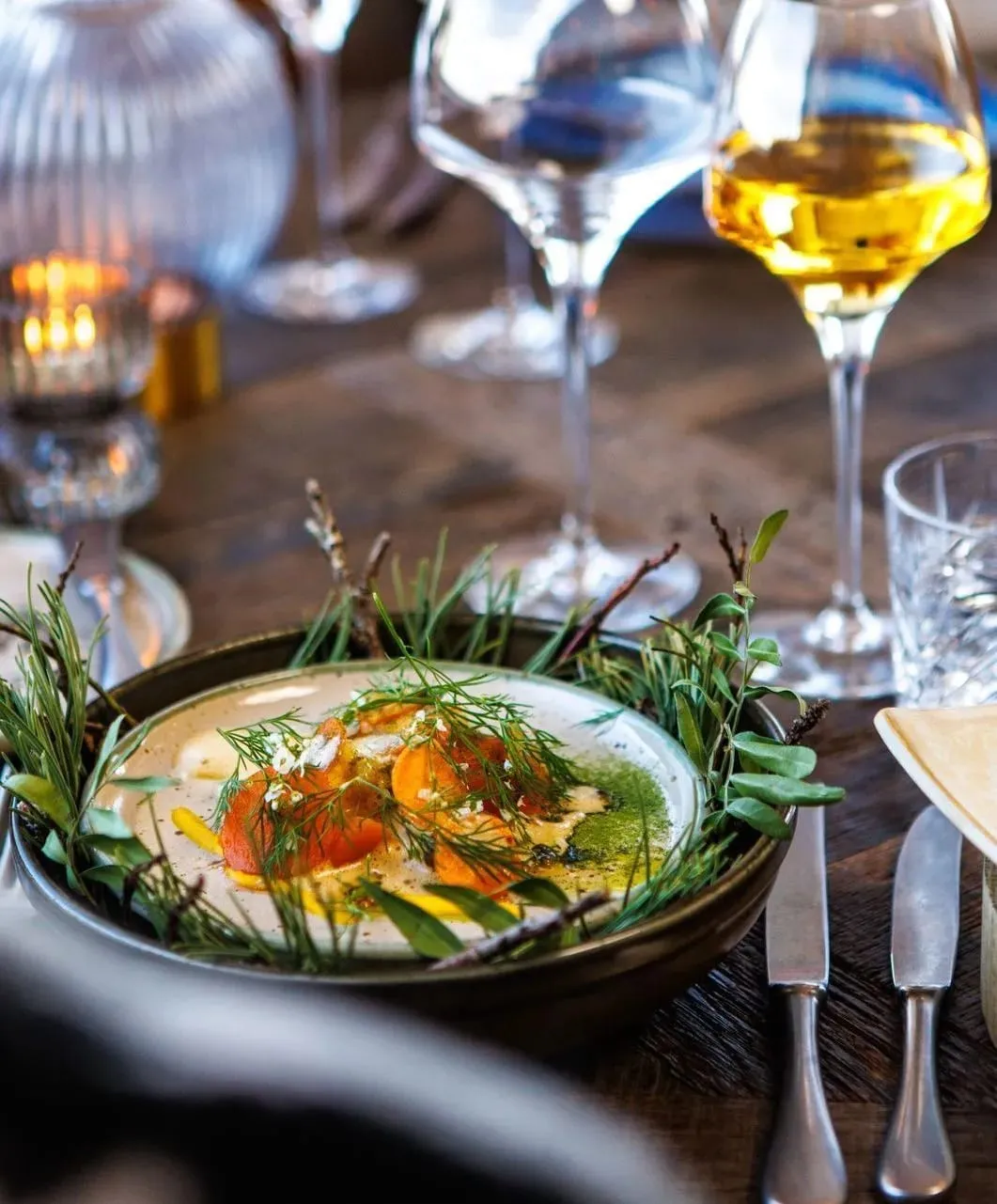
Food at Torfhus Retreat centers on a single restaurant, Viking Langhus, a timber-framed dining hall styled after a Viking longhouse and generally reserved for hotel guests rather than open to outside diners. The kitchen is led by chef Thorarinn Eggertsson, whose menu is built on ingredients reported to be sourced largely from within a ten-mile radius of the property: geothermally grown greenhouse vegetables, local salmon and Arctic char, lamb and other livestock raised on nearby land, and coastal seafood brought in from Iceland’s south coast. The tasting menu changes nightly and has been described in published accounts as running anywhere from three to eight courses depending on the night and season, generally served between 6pm and 9pm, with a full breakfast buffet, reported to run from around 7am to 10:30am, and lunch also available.
The restaurant’s presentation leans into the property’s rural, working-farm identity: breakfast service has been described by visiting press as staged from a reclaimed horse-drawn cart, a detail consistent with the founders’ broader emphasis on Icelandic horse culture across the property. Wine pairings are typically offered alongside the tasting menu at an additional cost. Because Torfhus Retreat sits in genuinely rural countryside with no significant restaurant alternatives nearby, most guests eat all meals on property for the length of their stay, which makes the kitchen’s consistency more central to the overall experience than it might be at a hotel embedded in a town or city.
Spa and Wellness
Torfhus Retreat does not operate a conventional spa with a treatment menu; its wellness offer is built instead around geothermal water and cold exposure. Every accommodation has access to a private or shared basalt stone plunge pool, filled with geothermal water and heated to roughly 38 to 42 degrees Celsius, and the main property additionally offers a hot pool, cold plunge, and traditional Icelandic sauna as a shared wellness trio, with Torfvilla units adding a private sauna and cold plunge of their own. The basalt stone used in the pools is mined locally, tying the wellness infrastructure back to the same regional-materials approach used throughout the property’s architecture.
This is wellness defined by Icelandic tradition rather than an imported spa-menu format: hot-cold contrast bathing, done outdoors, in private, under whatever sky the night offers. It is a deliberately narrower offer than a resort spa with facials and body treatments, and travelers expecting that kind of programmatic spa menu should set expectations accordingly; what Torfhus Retreat offers instead is one of the more private and elevated versions of a very Icelandic ritual.
Experiences
The retreat’s location inside the Golden Circle puts Geysir’s geothermal field and the Gullfoss waterfall within a 20 to 30 minute drive, and Thingvellir National Park, the UNESCO World Heritage site where the North American and Eurasian tectonic plates diverge and where Iceland’s medieval parliament, the Althing, was founded in 930, within roughly 40 minutes. On property, the founders’ Icelandic horses graze the surrounding land, and guided riding excursions can be arranged, both locally and at partner stables further afield, for guests who want to experience the breed’s distinctive tolt gait firsthand. Further afield, the retreat’s south Iceland location gives relatively easy access to Hekla and Thjorsardalur, the very valley where the Stong farm that inspired the property’s architecture was excavated, as well as the Haifoss waterfall and, depending on activity, Iceland’s volcanic sites on the Reykjanes peninsula. Aurora viewing from the private hot pools functions as an experience in its own right during the darker months, requiring no additional booking beyond clear skies and a spot in the water after dark.
Who It Is For
Torfhus Retreat suits couples marking an anniversary or honeymoon who want architectural distinctiveness and privacy over resort scale, and travelers whose primary interest in Iceland is the Golden Circle’s natural sites, Geysir, Gullfoss, and Thingvellir, rather than the more remote glacier or highland regions that require longer transfers. It particularly suits guests drawn to design and vernacular architecture, given the property’s grounding in a specific archaeological reference rather than generic styling, and anyone with an interest in Icelandic horses, which are woven into the property’s identity in a way few other luxury hotels in the country attempt. It is less suited to travelers who want an on-site spa menu, multiple dining venues, or a base with easy walkable access to a town, given the property’s rural, single-restaurant setting.
Best Time to Visit
Iceland’s aurora season runs roughly from late August or September through April, when nights are dark enough for the northern lights to be visible, weather and solar activity permitting, and Torfhus Retreat’s private outdoor hot pools are specifically positioned for that kind of viewing, making winter and shoulder season a strong argument for a visit despite colder temperatures and shorter days. Summer, roughly June through August, trades the aurora for near-continuous daylight, easier road conditions, and more comfortable hiking and horseback riding weather around the Golden Circle and further into the highlands. Neither season is objectively better; the choice largely comes down to whether the priority is the sky at night or the landscape by day.
How to Get There
Keflavik International Airport (KEF) is Iceland’s main international gateway and the effective starting point for most visitors, roughly two hours by car from the property, a route of about 150km that runs via Reykjavik and onward along Route 37 into the Golden Circle. From central Reykjavik itself, the drive is closer to 90 minutes. There is no meaningful public transit option to the property; guests typically arrive by rental car or by pre-arranged private transfer, which the hotel can help coordinate. Iceland’s road conditions can change quickly with weather, particularly outside summer, so travelers driving themselves, especially after dark or in winter, should check conditions via Iceland’s road authority before setting out.
Nearby Experiences
Geysir, the geothermal field that gave its name to the English word “geyser,” and the Gullfoss waterfall are both within a 20 to 30 minute drive, making them easily combined into a single day from the property. Thingvellir National Park, roughly 40 minutes away, offers both its geological significance, the visible rift between the North American and Eurasian tectonic plates, and its historical weight as the site of Iceland’s original parliament, founded in 930. The Secret Lagoon in Fludir and the Kerid volcanic crater are also within reasonable driving distance for travelers looking to extend beyond the three core Golden Circle stops, and the wider south coast, including Seljalandsfoss and Skogafoss waterfalls, is accessible as a longer day trip for guests staying multiple nights.
Things to Know Before Booking
The property enforces a minimum stay of two nights, and given its rural setting with a single on-site restaurant and no walkable town nearby, most guests should plan to eat all meals on property. Room categories differ meaningfully in what they include: only Torfhus houses and Torfvilla units come with a fully private hot tub, while Torfbaer suites share a pool between three neighboring units, so travelers who consider privacy in the water essential should book accordingly. There is no dedicated spa with a treatment menu; wellness here means geothermal hot pools, cold plunge, and sauna rather than facials or massage. Iceland’s weather and road conditions can shift quickly outside summer, and the roughly two-hour drive from Keflavik should be planned with that in mind, particularly for evening arrivals in winter.
Sustainability
Torfhus Retreat’s sustainability case rests on two pillars that are unusually well-documented for a property of its size: energy sourcing and food sourcing. The property is reported to run entirely on Iceland’s geothermal and hydroelectric energy, a national grid mix that is among the cleanest in the world and a natural fit for a hotel whose architecture and wellness offer are themselves built around geothermal water. On the food side, the kitchen’s practice of sourcing largely within a ten-mile radius, geothermal greenhouse produce, local salmon and Arctic char, regionally raised livestock, reduces the supply-chain footprint typical of remote luxury hotels that fly or truck in specialty ingredients. The ownership has also been reported to offset the carbon footprint associated with each guest’s stay, though specific published data on the scale or methodology of that offsetting was not found and is not claimed here in detail. The reuse of reclaimed timber in construction and the use of locally mined basalt stone for the plunge pools further tie the building process itself to a lower-impact, regionally sourced material palette.
Practical Information
Torfhus Retreat is located at Dalsholt, 806 Selfoss, in the Blaskogabyggd area of Iceland’s Golden Circle, the same municipality that contains Thingvellir National Park. Check-in is from 3:00pm and check-out by 11:00am, with a two-night minimum stay. Published nightly rates have varied by source and season, from roughly 600 euros for an entry-level Torfbaer suite including breakfast in earlier reporting to around 800 euros per night in more recent data and above 900 euros for larger categories in peak periods; the figure given above is an indicative starting point for the lowest suite category in lower-demand periods rather than a live quote, and travelers should confirm current rates directly with the property or its booking partners. The hotel can be reached at +354 788 8868 or booking@torfhus.is.
Editorial Conclusion
Torfhus Retreat’s strongest asset is the specificity of its idea: rather than a loosely Nordic-themed hotel, it is a contemporary reading of a documented, excavated Viking-age farm, built by two families with a genuine stake in Icelandic horse culture and Icelandic building tradition. That specificity, paired with private geothermal hot tubs pointed at some of the darkest skies within reach of Reykjavik, gives it a clear identity within a Golden Circle hotel landscape that otherwise runs heavily toward generic countryside comfort. It asks guests to trade spa menus and multiple restaurants for architectural coherence and quiet, a trade that will suit travelers drawn to Iceland for its landscape and history more than those seeking a full-service resort.
In pictures
On the map
Near Thingvellir National Park, Iceland
Questions
Frequently asked
What does torfhus mean, and why is the hotel built this way?
Torfhus (more precisely torfhus, from the Icelandic torf, turf, and hus, house) refers to the traditional Icelandic building method of stone and timber frames insulated and roofed with cut turf, used across the country for centuries because timber was scarce and turf provided effective insulation against the cold. Torfhus Retreat's architecture draws specifically on the excavated Viking-age farm at Stong in the Thjorsardalur valley, a longhouse buried by ash from Mount Hekla's 1104 eruption and excavated in 1939, reinterpreting that historic form in a contemporary, minimalist register rather than as a literal reconstruction.
How many suites does Torfhus Retreat have, and what is the difference between the room categories?
The property is built around roughly 25 to 27 individual accommodations across three categories. Torfbaer suites are one-bedroom units, arranged three to a building, sharing a geothermal basalt hot pool between them. Torfhus houses are larger two-bedroom units, each standalone with its own private geothermal pool. A smaller number of larger Torfvilla units sleep more guests and add a private sauna and cold plunge pool alongside the hot tub. Exact unit counts have varied slightly across published sources as the property has evolved since opening, so travelers should confirm current categories directly with the hotel.
Do all rooms have private hot tubs?
Every accommodation has access to a geothermally heated basalt stone plunge pool, but not every unit has one exclusively. Torfhus houses and Torfvilla units each have a private pool, while Torfbaer suites share one pool between three neighboring suites. Guests who want a fully private hot tub should book a Torfhus house or above rather than a Torfbaer suite.
How far is Torfhus Retreat from Reykjavik and Keflavik Airport?
Torfhus Retreat sits in the Bláskógabyggð area of the Golden Circle, roughly 90 minutes by car from central Reykjavik and around 2 hours (about 150km) from Keflavik International Airport, via Reykjavik and Route 37. There is no public transit option; guests arrive by rental car or a pre-booked private transfer.
Is Torfhus Retreat actually close to Thingvellir National Park?
It is within the same Golden Circle touring loop but not immediately adjacent: Thingvellir National Park is roughly a 40-minute drive from the property. The retreat sits closer to Geysir, about 8.5 miles away, and to Gullfoss, both reachable within 20 to 30 minutes, with Thingvellir forming the third and furthest point of the classic Golden Circle route from the hotel.
When is the best time to see the northern lights from the property?
Aurora activity in Iceland is generally visible from late August or September through April, when nights are dark enough, weather and solar activity permitting. Torfhus Retreat's private outdoor hot pools, set away from any significant light pollution, are positioned specifically for guests to watch for the aurora while soaking, though sightings are never guaranteed and depend on clear skies and geomagnetic conditions on any given night.
Same destination
More hotel guides in Iceland
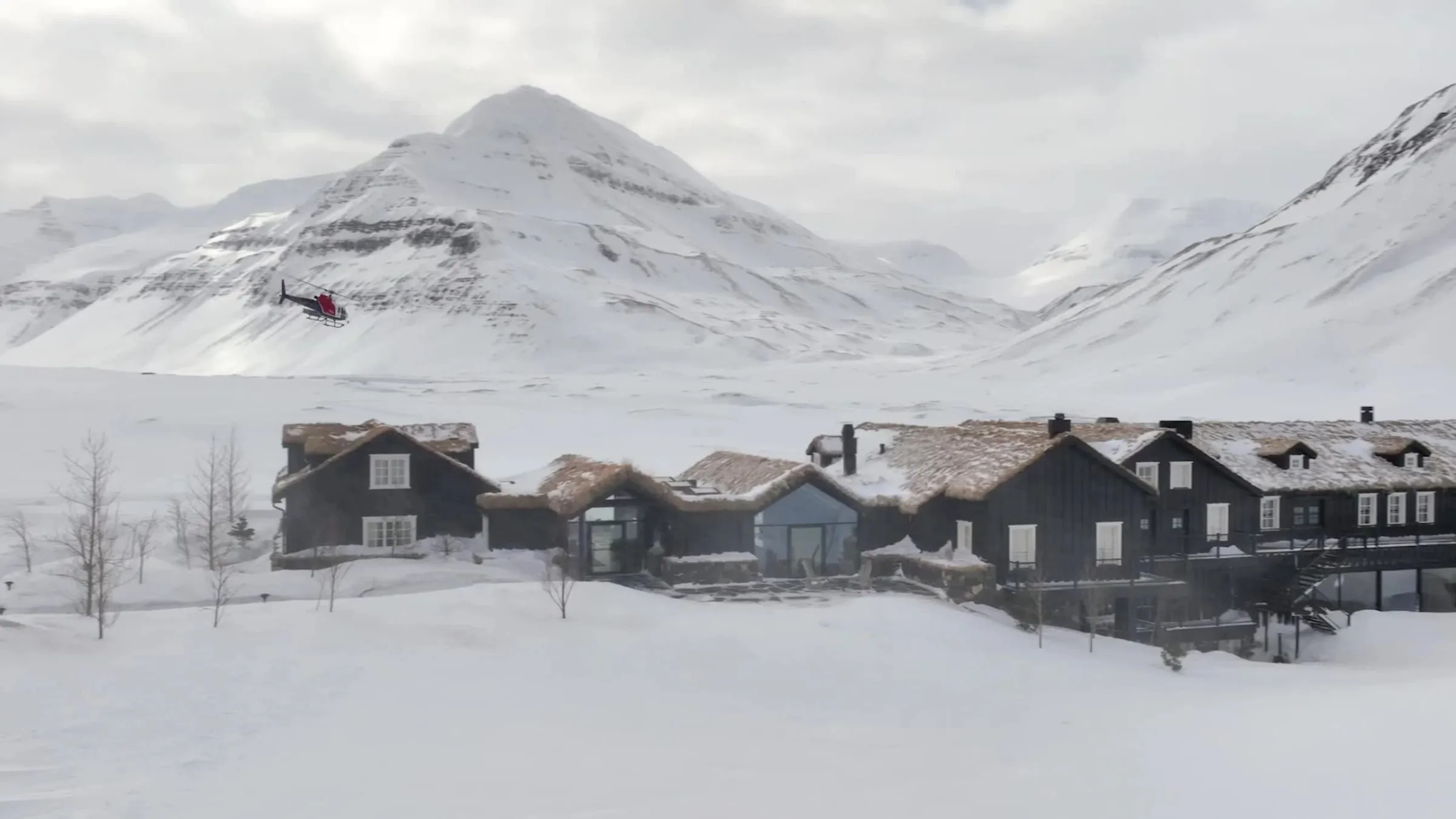
Fljot Valley, North Iceland, Iceland
Deplar Farm
A turf-roofed sheep farm on Iceland's remote Troll Peninsula, rebuilt into a 13-room adventure lodge where heli-skiing, fly fishing and a geothermal pool run on the same all-inclusive rhythm.
From $2,775 per night, all-inclusive
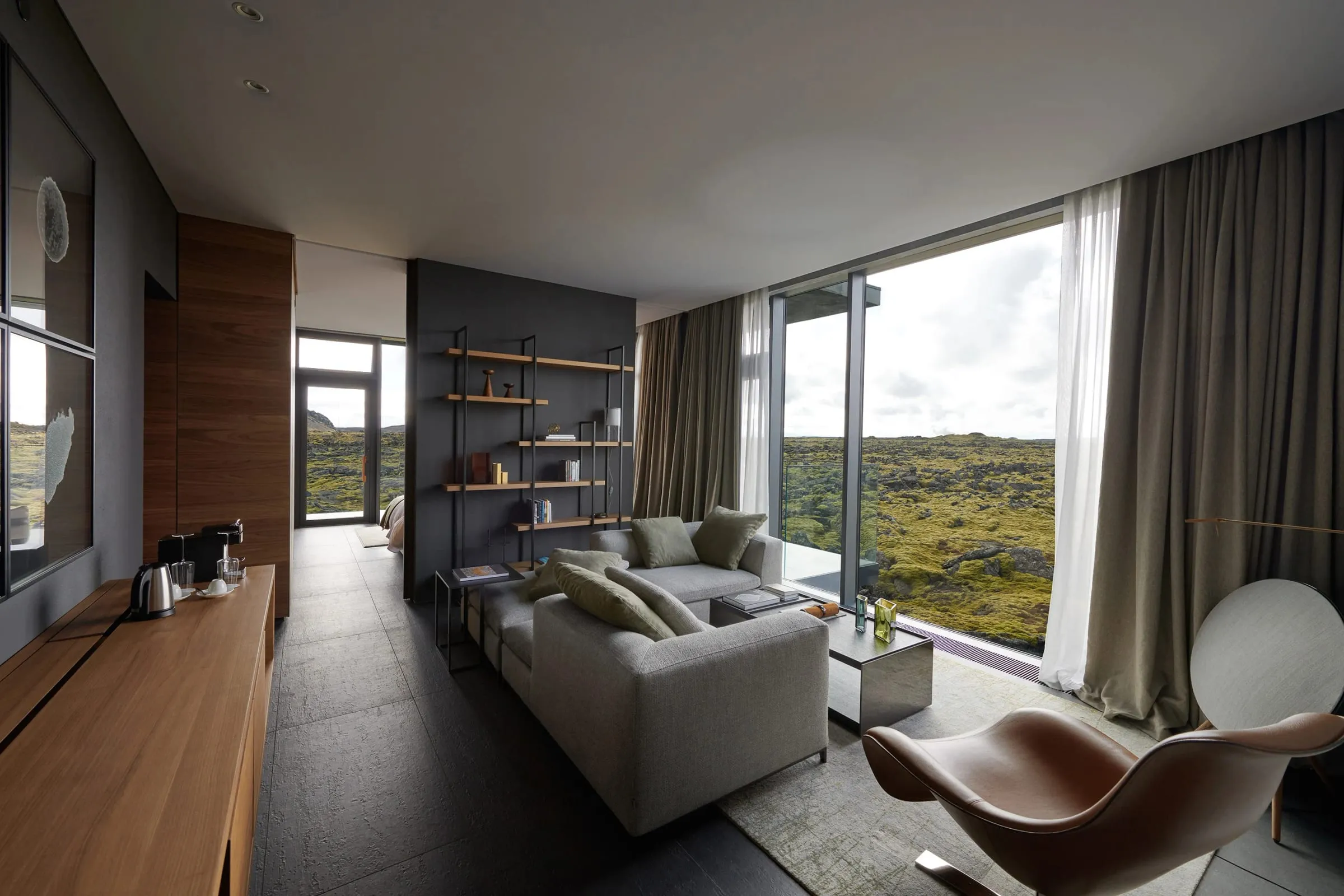
Grindavik, Iceland
The Retreat at Blue Lagoon
A 60-suite hotel built into an 800-year-old lava flow, with a private geothermal lagoon and Iceland's only Michelin-starred hotel restaurant.
From $1,844 per night