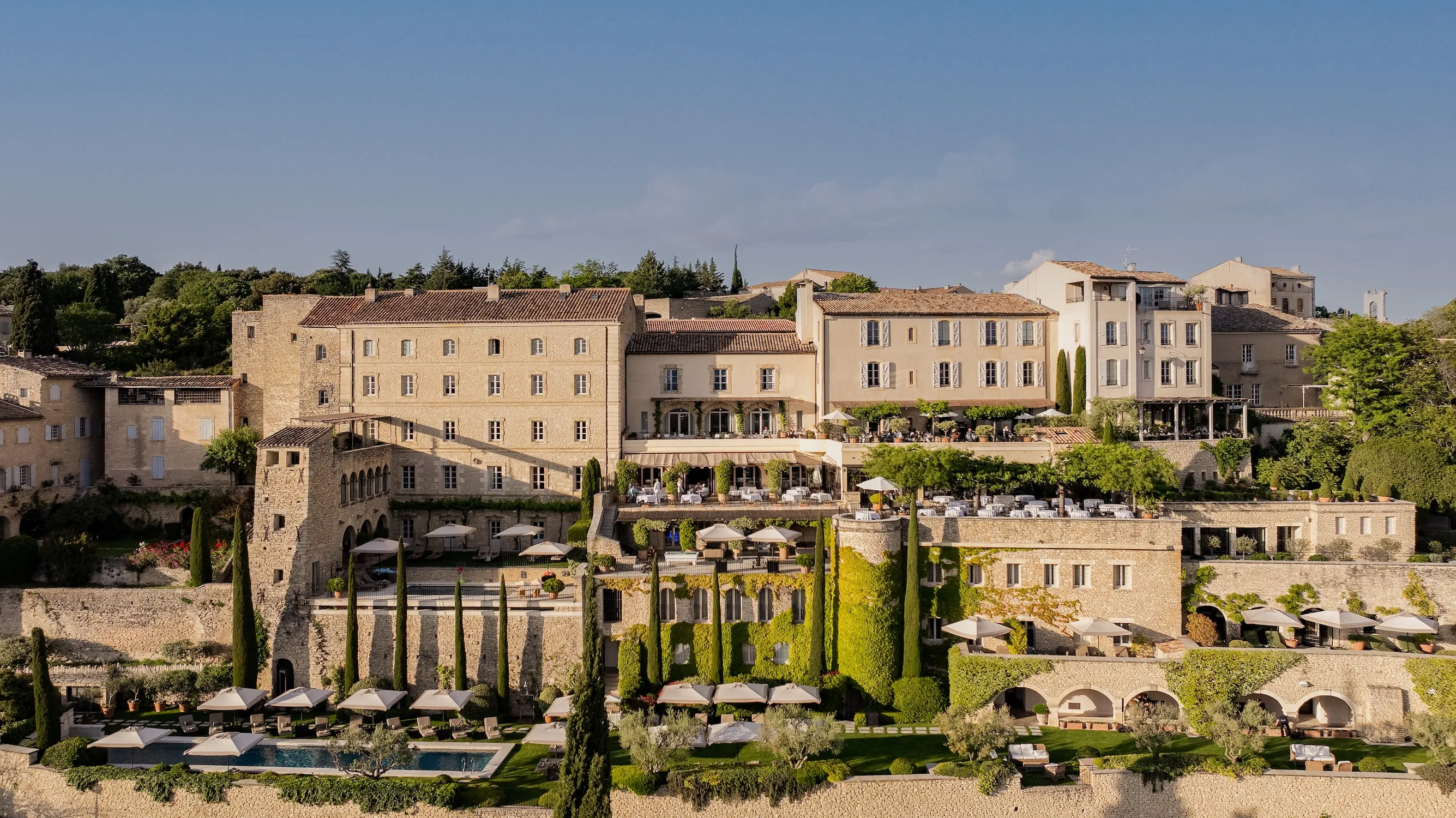
Gordes, Luberon, France
Airelles Gordes, La Bastide
A 16th-century manor built into the ramparts of a hilltop village, run as one of only two dozen hotels in France to hold the official Palace title.
- Rates from
- From €950 per night
- Nearest airport
- Avignon-Caumont Airport (AVN)
- Transfer
- 25 to 30min by road
- Best months
- May to September
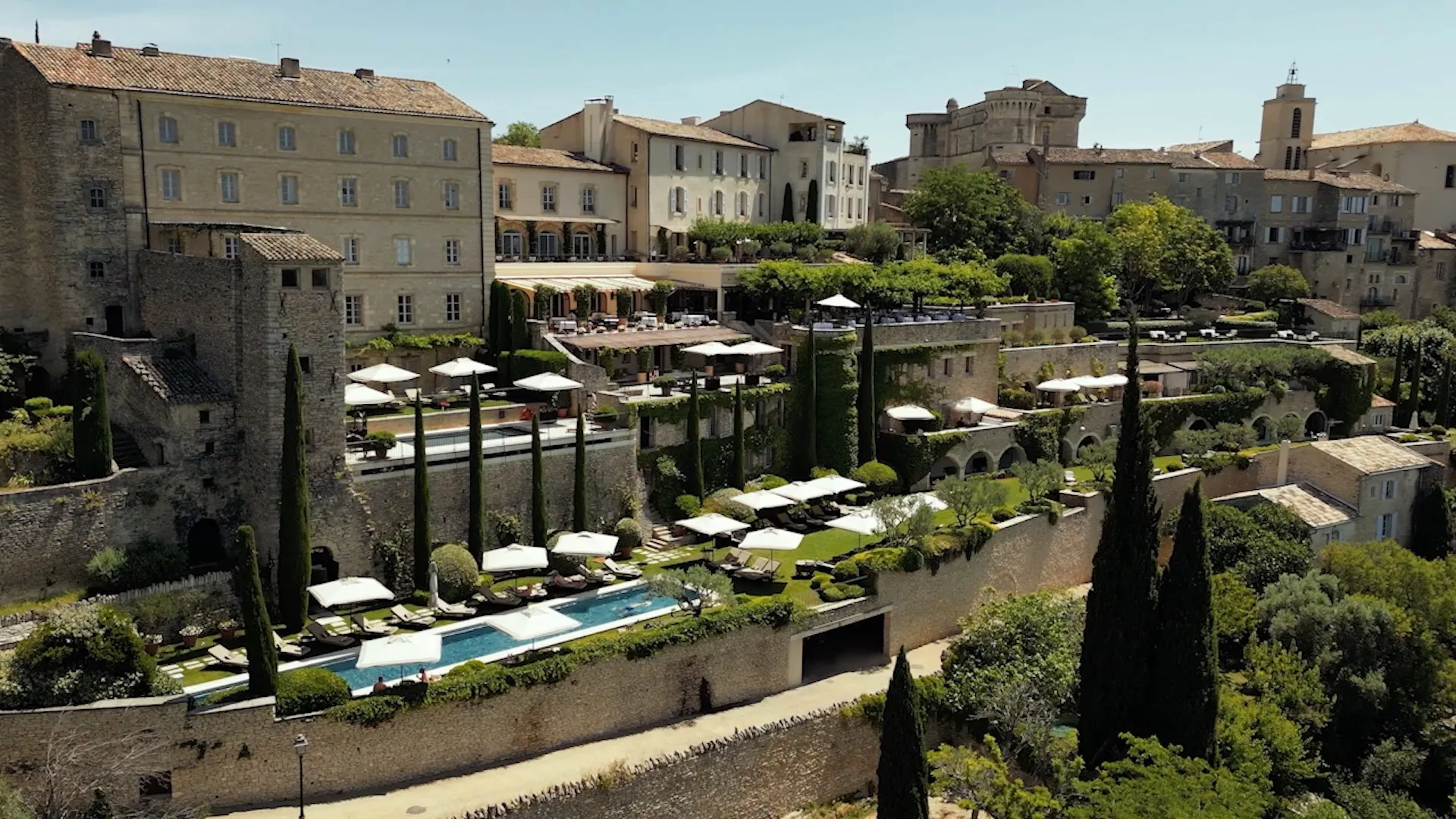
Gordes announces itself long before the road reaches it, a stack of pale stone rising out of the Luberon valley in tiers, church tower at the summit, terraces cascading down the hillside beneath it like something built by geology rather than masons. Somewhere in that stack, indistinguishable from the village at a distance, sits Airelles Gordes, La Bastide: not a hotel dropped into a beautiful setting, but a 16th-century manor house woven into the actual fabric of the ramparts the village was built to defend. It has been receiving guests as an Airelles property since 2015, and in November 2016 it became the 23rd hotel in France to receive the country’s official Palace distinction, a designation reserved for a small number of properties judged exceptional on location, heritage, aesthetics and service combined.
That distinction matters here less as a marketing line than as a fact about scale. Behind a modest street-level entrance in the old village, the hotel opens outward and downward across multiple linked buildings and garden terraces stepped into the hillside, arriving eventually at pools, a spa, and views that pull the entire Luberon valley into the frame. It is a large, complicated property disguised as a single stone house, and working out how it fits together is part of what makes a stay here feel like an event rather than a transaction.
Why It Stands Out
Most hotels that trade on “authentic village setting” mean they sit near one. La Bastide de Gordes is built from the village itself, its walls continuous with the 12th-century ramparts Gordes was fortified with, its floors following the terraces the hillside was already cut into centuries before anyone thought to run a hotel here. That is a genuinely rare proposition in French luxury hospitality: a Palace-rated property that cannot be separated from the medieval settlement around it, because structurally, it is the settlement.
The other distinguishing fact is culinary weight in a village of roughly 1,600 residents. Four restaurants operate under one hotel roof, anchored by Clover Gordes, the vegetable-forward, live-fire restaurant from Michelin-starred chef Jean-François Piège, alongside a flagship Mediterranean dining room, an Italian trattoria and a seasonal summer restaurant. Few hotels anywhere in rural Provence assemble that range of serious kitchens under a single ownership, and fewer still do it inside a building old enough to have watched the Luberon change hands between medieval lords.
The property also carries the pedigree of the wider Airelles group behind it. The Airelles name dates to 1988, when the original Les Airelles opened in Courchevel; Stéphane Courbit, the French entrepreneur behind LOV Group, took the brand over in 2007 and expanded it into the small, closely held collection it is today, spanning Courchevel, Val d’Isère, Gordes, Saint-Tropez and Le Grand Contrôle, the only hotel inside the grounds of the Château de Versailles. Michelin’s hotel-rating arm has recognised La Bastide with its top tier, Three Keys, denoting what the guide calls an extraordinary stay, and Forbes Travel Guide independently rates the property Five Star.
Architecture
The hotel’s footprint reads less like a single building than a small quarter of the village, assembled from structures built and rebuilt across roughly five centuries and connected by stairways, vaulted passages and stone terraces that follow the natural fall of the hillside. The oldest fabric, the ramparts the property is built into and against, dates to the 12th century, when Gordes was fortified as one of the Luberon’s defensive hilltop settlements; the main house above it is a 16th-century maison, the period most of the hotel’s public identity is anchored to.
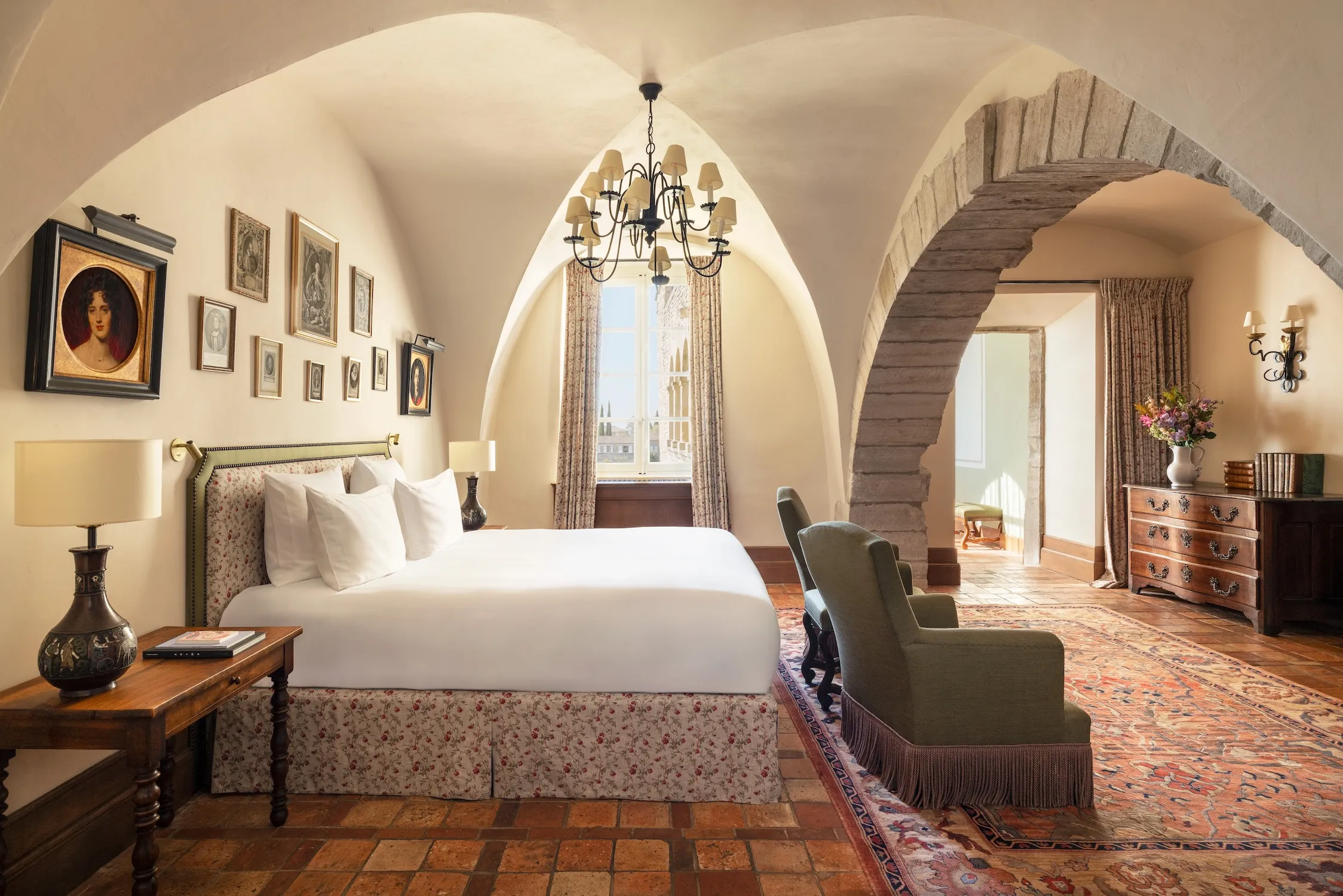
That layered history was largely obscured by the time Airelles took the property on. A full renovation closed the hotel from October 2014 to June 2015, employing more than 150 craftspeople to strip back later additions and restore stonework, vaulting and woodwork to something closer to its historical character, while quietly inserting the infrastructure a contemporary Palace hotel requires. The result keeps its medieval bones legible: thick stone walls, vaulted ceilings in the lower levels, narrow original stairwells opening onto wide garden terraces that were carved from the hillside rather than added to it.
Because the building follows the terracing of the village itself, guests move vertically through it as much as horizontally, descending from village-level entrances down through garden levels toward the pools and spa lower on the hillside, each level opening onto a different terrace and a different angle on the valley. It is an unusual way to organise a hotel, closer to navigating a hill town than a conventional floor plan, and it is the single clearest expression of the property’s central claim: this is not a hotel with a view of Gordes, but a genuine, structural piece of Gordes that happens to take guests.
Interior Design
The interiors were shaped by designer and architect Christophe Tollemer, working to an idea closer to a private family estate passed down through generations than a hotel decorated to a brief. Furniture, art and objects, several thousand pieces in total, were sourced from auction houses and antique dealers across France in the run-up to the 2015 reopening, and the resulting rooms carry the particular texture of things bought individually over what looks like decades rather than ordered as a matching set.
Provençal references run through the material choices rather than sitting on top of them: regional ceramics, hand-blocked and toile fabrics, wood panelling, wrought iron and stone floors that in places predate the current furniture by centuries. The overall palette stays warm and muted, plaster and stone tones, aged wood, worn textiles, in keeping with the building’s age rather than brightened for photography. Public rooms lean into that same logic, with vaulted stone passages, tapestries and period frescoes treated as structure rather than decoration, so the sense of an inherited house persists even in corridors most guests only pass through.
A handful of suites carry that inherited-house feeling furthest of all, each named for a figure associated with the property or the wider region: the Vasarely Suite, referencing the painter Victor Vasarely, who fell for the Luberon’s light in 1948 and returned to the valley for decades afterwards, and the Baron de Simiane and Duc de Soubise Suites, both named for families long associated with Provençal history, the former set beneath ancient stone vaults with its own winter garden and fireplace. It is a slower, more expensive way to fit out forty rooms and suites than a standardised design programme, and it shows in the particularity of the results.
Atmosphere
The mood at La Bastide de Gordes sits closer to a grand private house that occasionally receives guests than to a resort. Days move at the pace the terraces and the heat set: slow mornings on a private balcony, a break at the pool through the hottest hours, dinner that migrates outdoors as the light softens over the valley. Service throughout is formal by French Palace standards, attentive and precise, but the physical setting keeps the register from tipping into stiffness: stone underfoot, hanging gardens on every level, and a village of a few hundred year-round residents going about ordinary life just beyond the hotel’s walls.
That proximity to a lived-in village is part of what separates the atmosphere here from a purpose-built luxury compound. Guests hear the same church bells the village hears, share the same narrow lanes on the walk to dinner in town, and look out at the same valley that has drawn painters and writers to Gordes for the better part of a century. The hotel amplifies that setting rather than replacing it, which gives a stay here a slightly different emotional register than most large-scale Provençal luxury properties built on their own private land.
Rooms and Suites
The hotel holds 34 rooms and 6 suites, a relatively small count for a Palace-rated property, which keeps the ratio of staff and public space to guests noticeably generous. Every room is individually decorated with sourced antiques rather than assigned from a repeated design template, and categories are differentiated primarily by size, floor level and outlook rather than a fixed hierarchy of finishes.
Views split along two lines: rooms facing into the village look across Gordes’ stacked rooftops and the church tower above, an intimate, architectural outlook, while rooms and suites facing the other direction open onto the Luberon valley itself, a wide, largely uninterrupted sweep of countryside that changes colour through the day. Higher suite categories generally add private terraces and larger sitting areas, and at the top of the range sits La Maison de Constance, a private four-bedroom villa within the property that sleeps up to eight, with its own garden, swimming pool and a private link back into the village, effectively a house within the hotel for a family or group travelling together. Across all categories, the building’s age asserts itself in small ways any hotel of this vintage carries, sloped ceilings in some rooms, variation in proportions between what look on paper like comparable categories, features that read here as evidence of authenticity rather than inconsistency.
Dining
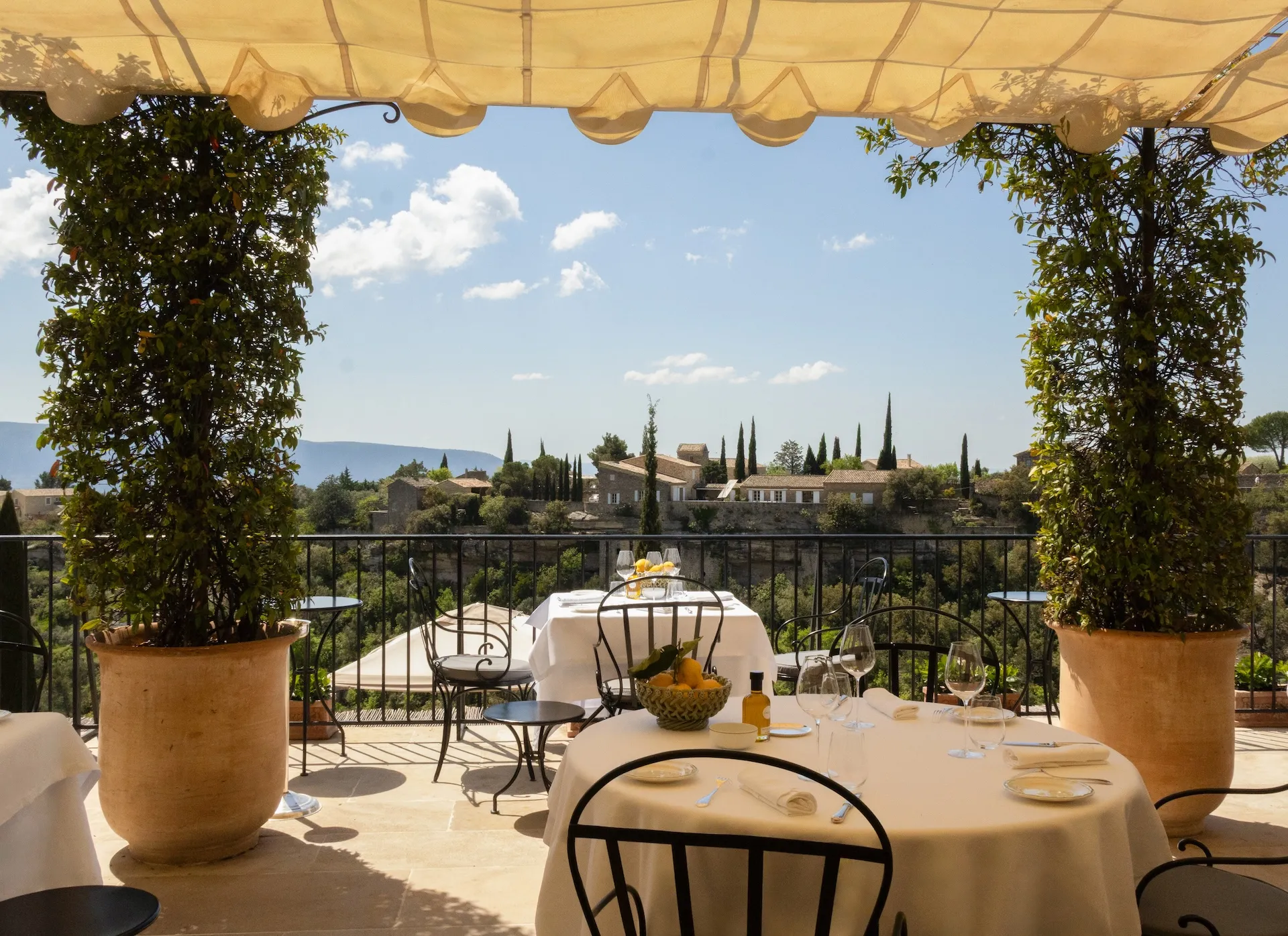
Four restaurants operate under the hotel’s roof, a substantial commitment for a single address in a village this size. La Table de la Bastide is the flagship, serving refined Mediterranean cooking built around Provençal produce, typically the anchor for both breakfast and formal evening service. Clover Gordes carries the most culinary weight: a vegetable-forward, live-fire restaurant from Michelin-starred chef Jean-François Piège, whose Clover concept, built around cooking vegetables with the same technical seriousness usually reserved for meat and fish, appears at several Airelles addresses. La Bastide de Pierres brings an Italian-leaning trattoria register to the property, more relaxed in tone, and Beefbar, part of the international steakhouse group of the same name, operates as a sun-drenched seasonal restaurant through the summer months.
Beyond the hotel’s own walls, two further venues extend the same ownership’s presence into the village itself: a Ladurée tea room serving pastries and afternoon tea with views over the valley, and Le TiGrr, an Asian-inspired restaurant and lounge with sibling outposts in Saint-Tropez and Megève, a short walk from the main property. Taken together, the offering gives guests a genuine choice of register across a single stay, formal Mediterranean, vegetable-driven fine dining, casual Italian, seasonal steakhouse, and a village tea room, without needing to leave Gordes at all.
Spa and Wellness
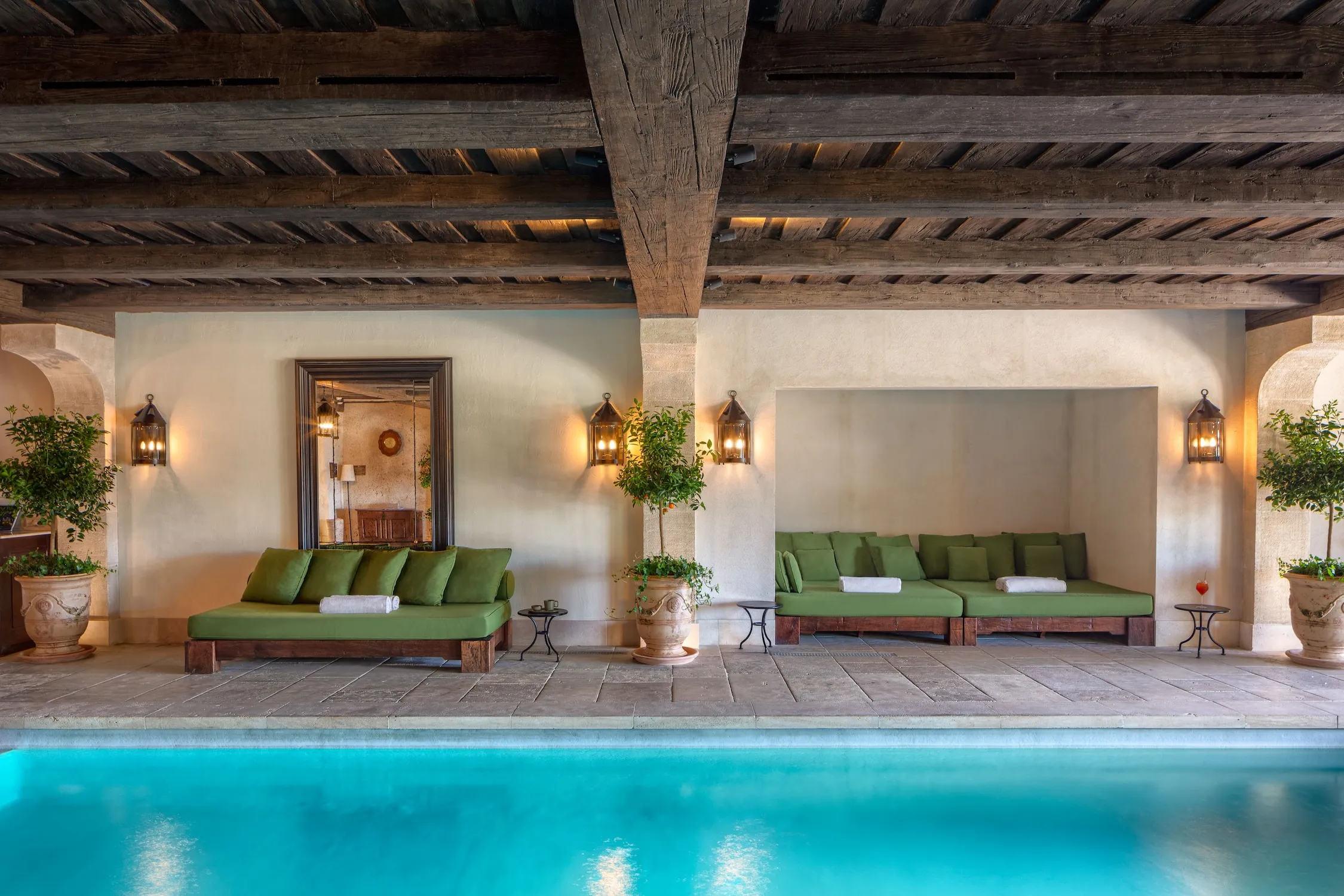
Wellness at the hotel centres on the Airelles Spa by Guerlain, a stone-vaulted space taking its architectural cues from the abbeys and bastides scattered across the Luberon, roofed in the same kind of ribbed stone vaulting found in religious buildings nearby. The spa houses an indoor swimming pool, hammam, sauna and several treatment suites, run in partnership with Guerlain, the French beauty house whose products and protocols shape the treatment menu.
Outside the spa building, the hotel’s terraced gardens hold multiple outdoor pools set at different levels of the hillside, each looking out over a slightly different angle of the valley, giving guests a choice of setting for the hours between activities rather than a single central pool deck. A fitness facility rounds out the offering. As with the architecture generally, the spa’s design leans on genuine regional references, stone vaulting, muted plaster tones, rather than importing a generic international spa language, so time spent there stays visually consistent with the rest of the property.
Experiences
Gordes itself is the hotel’s primary experience, and the property treats it that way, positioning guests within walking distance of a village consistently ranked among the most beautiful in France. A short drive away sits the Abbaye de Sénanque, a 12th-century Cistercian abbey whose lavender fields, blooming roughly from mid-June into early August, form one of the most photographed scenes in Provence; the hotel can arrange timed visits to catch the fields at their best, and the abbey itself remains an active, working monastery rather than a preserved museum piece.
Beyond Sénanque, the wider Luberon opens onto a run of villages each with a distinct character: Roussillon, built from and coloured by its ochre cliffs; Ménerbes and Bonnieux, both perched hill towns with their own markets and viewpoints; Lourmarin, looser and lower-lying at the valley’s southern edge. Isle-sur-la-Sorgue, known for its antiques trade and Sunday market built around canals diverted from the Sorgue river, sits within easy reach for a half-day trip. The hotel arranges guided excursions, private drivers and cycling routes through this landscape, alongside more property-based pursuits: cooking classes drawing on the same Provençal produce that shapes the restaurant menus, and wine-focused itineraries into the Luberon’s vineyards and the wider Rhône wine country beyond it.
Who It Is For
The hotel suits couples and pairs of friends drawn to architecture, history and serious dining more than to resort infrastructure: travellers who want a village they can walk out into, a spa built with genuine regional character rather than an imported template, and four kitchens worth choosing between over the course of a few days. Its scale, forty rooms and suites, several restaurants, a proper spa, without ever feeling like a resort, suits a couple’s escape or a small, well-heeled group better than a large family holiday, though La Maison de Constance gives larger families a self-contained option within the same property.
It is a less natural fit for travellers who want a conventional resort experience with extensive children’s programming and a single unhurried pool day as the centrepiece; the hotel’s vertical, terraced layout and formal Palace-level service both work better for adults moving at their own pace than for families managing young children across multiple levels and staircases. Anyone chasing beach or coastal scenery should also look elsewhere. Gordes and the Luberon are inland, hill and valley country, and the hotel’s entire identity depends on that landscape rather than the Mediterranean coastline an hour or two south.
Best Time to Visit
The hotel operates seasonally, broadly mid-April through October, so the visiting window is set for guests before any weather consideration comes into play. Within that season, May, June and September offer the most comfortable balance of warm days, manageable crowds in the village and reliably good light for the valley views the hotel is built around. July and August bring the fullest heat and the busiest villages, but also the lavender season at its peak around Sénanque and across the wider Luberon and Sault plateaux, a trade-off many travellers accept deliberately to see the fields in bloom. Early and late season, April and October, run quieter and cooler, better suited to travellers prioritising walking, cycling and market visits over pool time.
How to Get There
The hotel is reached most directly through Avignon-Caumont Airport (AVN), roughly 25 to 30 minutes away by road, though its scheduled flight network is limited. Marseille Provence Airport (MRS), about an hour’s drive, carries substantially more international connections and is the more commonly used gateway for travellers arriving from outside France. Nice Côte d’Azur, further east, is a viable third option for anyone combining a Provence stay with time on the Riviera. High-speed TGV rail service connects Paris to Avignon TGV station in roughly two and a half to three hours, from which a private transfer or hire car covers the remaining hour or so into the Luberon. However guests arrive, the final approach into Gordes climbs a narrow, winding hillside road, and the hotel can arrange private transfers from any of the three airports or from the Avignon TGV station on request.
Nearby Experiences
Within the Luberon itself, the villages of Roussillon, Ménerbes, Bonnieux and Lourmarin each offer a half-day’s worth of walking, markets and viewpoints, close enough to combine two or three into a single day trip from the hotel. The Abbaye de Sénanque, a few minutes from Gordes by road, remains the standout single excursion, particularly during the lavender bloom, but rewards a visit at any time of year for its architecture and setting alone. Closer still, the Village des Bories, a cluster of around twenty drystone shepherds’ huts built without mortar and preserved as an open-air museum, sits roughly 1.5 kilometres outside Gordes and makes an easy walk or short drive from the hotel. Isle-sur-la-Sorgue, roughly 30 minutes away, is worth a half-day for its antiques trade and Sunday market threaded through canals off the Sorgue river.
Further afield, the walled city of Avignon, with its Palais des Papes and ramparts intact, sits within an hour’s drive and makes a natural full-day excursion, as does the Roman theatre and old town of Orange to the north. The Luberon’s vineyards, part of the wider Rhône wine region, offer tastings and cellar visits within a short drive in almost any direction, and the hotel can arrange private guided routes through them for guests who want structure rather than a self-directed wine tour.
Things to Know Before Booking
The hotel’s seasonal calendar is the single most important practical fact to confirm before booking: it typically closes from November through mid-April, and exact dates shift year to year, so shoulder-season travellers should verify current opening and closing dates directly with the hotel rather than assume a fixed window. Gordes itself sits on a steep hillside with narrow medieval streets, and while the hotel’s internal layout uses lifts and staged terracing to manage the slope, guests with significant mobility constraints should discuss room location and access in advance.
Vehicle access into the old village is restricted in places, and the hotel can advise on parking and drop-off arrangements before arrival. Because the property draws heavily on its restaurants as a core part of the experience, particularly Clover Gordes, booking dinner reservations well ahead of arrival, especially in the busy July and August weeks, is worth doing at the same time as confirming the room. Finally, given the hotel’s dependence on outdoor terraces, gardens and valley views for much of its character, travellers chasing guaranteed sunshine and warm-water swimming should note that this is a landlocked, inland property built around hill-country scenery rather than coastal weather.
Sustainability
The hotel’s environmental practices lean toward the practical rather than the headline-grabbing: it promotes local producers across its kitchens, working with regional wine, juice, jam and bread suppliers, and uses organic cereals where available. Bath products are dispensed through an ecopump system designed to reduce single-use plastic, and the Airelles-branded amenities themselves, made in France, are formulated with between 92 and 97 percent natural ingredients and without parabens, silicones, synthetic colourants or animal-derived ingredients.
Used soaps are collected and recycled through Unisoap, a programme run through a French Sheltered Employment Centre that provides work for people with disabilities, tying the hotel’s waste stream to a specific social as well as environmental outcome. Low-energy lighting, eco-friendly cleaning products and glass bottles for table service round out the property’s day-to-day measures, and the hotel encourages guests toward low-impact transport around the village and valley, including bicycles and electric bikes available on site.
Practical Information
Check-in at Airelles Gordes, La Bastide is from 4:00 PM, with check-out by 12:00 PM. The hotel holds the official French Palace distinction, awarded in November 2016, alongside a Three Keys rating from the Michelin Guide and a Five-Star rating from Forbes Travel Guide. It operates seasonally, generally mid-April through October, and closes over the winter months. The nearest airport is Avignon-Caumont (AVN), around 25 to 30 minutes by road, with Marseille Provence (MRS), roughly an hour away, serving as the main international gateway; Nice Côte d’Azur is a further alternative. Most guests find three to four nights sufficient to settle into the property’s rhythm, work through more than one of its restaurants, and use it as a base for exploring the wider Luberon.
Editorial Conclusion
What Airelles Gordes, La Bastide sells, in the end, is not a room with a view of a beautiful village but genuine tenancy inside one, a 16th-century house built onto 12th-century ramparts, still structurally continuous with the medieval settlement climbing the hill around it. That is a difficult thing to manufacture and an easy thing to overstate, and the hotel’s real achievement is doing neither: the restoration reads as careful rather than reverent, the four restaurants earn their place rather than pad a brochure, and the official Palace distinction sits on a building that would likely deserve serious attention even without it. For travellers drawn to the Luberon’s stone villages, its lavender-lined abbeys and its slower register of luxury, this is among the most complete expressions of that landscape currently operating as a hotel.
In pictures
On the map
Gordes, Luberon, France
Questions
Frequently asked
Is Airelles Gordes, La Bastide open year-round?
No. The hotel operates seasonally, generally opening in mid-April and closing in November, in step with the rhythm of most luxury properties in the Luberon. Exact opening and closing dates shift slightly from year to year, so travellers planning a stay at either end of the season should confirm current dates directly with the hotel before booking.
What is the nearest airport, and how do guests reach the hotel?
Avignon-Caumont Airport (AVN) is the closest, about 25 to 30 minutes away by road, though it has limited scheduled service. Marseille Provence Airport (MRS), roughly an hour's drive, carries far more international connections and is the more common arrival point. Nice Côte d'Azur is a further option for travellers combining Provence with the Riviera. The hotel can arrange a private transfer from any of the three.
When is the best time to see the lavender fields near Gordes?
The Cistercian Abbaye de Sénanque, a few minutes from the hotel, fronts one of the most photographed lavender fields in France, and the wider Luberon and Sault plateaux bloom on a similar calendar. Flowering typically runs from mid-June into early August, with the deepest colour usually appearing across the first three weeks of July, though the exact bloom shifts a little with the season's weather.
What are the dining options at the hotel?
The hotel runs four restaurants: La Table de la Bastide, its flagship Mediterranean dining room; Clover Gordes, a vegetable-forward, live-fire restaurant from Michelin-starred chef Jean-François Piège; La Bastide de Pierres, an Italian-leaning trattoria; and Beefbar, a seasonal summer restaurant. A Ladurée tea room and Le TiGrr, an Asian-inspired restaurant and lounge, both operate nearby in the village under the same ownership.
What is La Maison de Constance, and is it possible to book the whole house?
It is the hotel's private villa option: a four-bedroom house within the property that sleeps up to eight, with its own garden, swimming pool and a private link back into the village, effectively a house within the hotel. It can be booked as a self-contained stay for a family or group travelling together, in addition to the hotel's standard rooms and suites.
Same destination
More hotel guides in France
Vence, above the Riviera coast, France
Chateau Saint-Martin & Spa
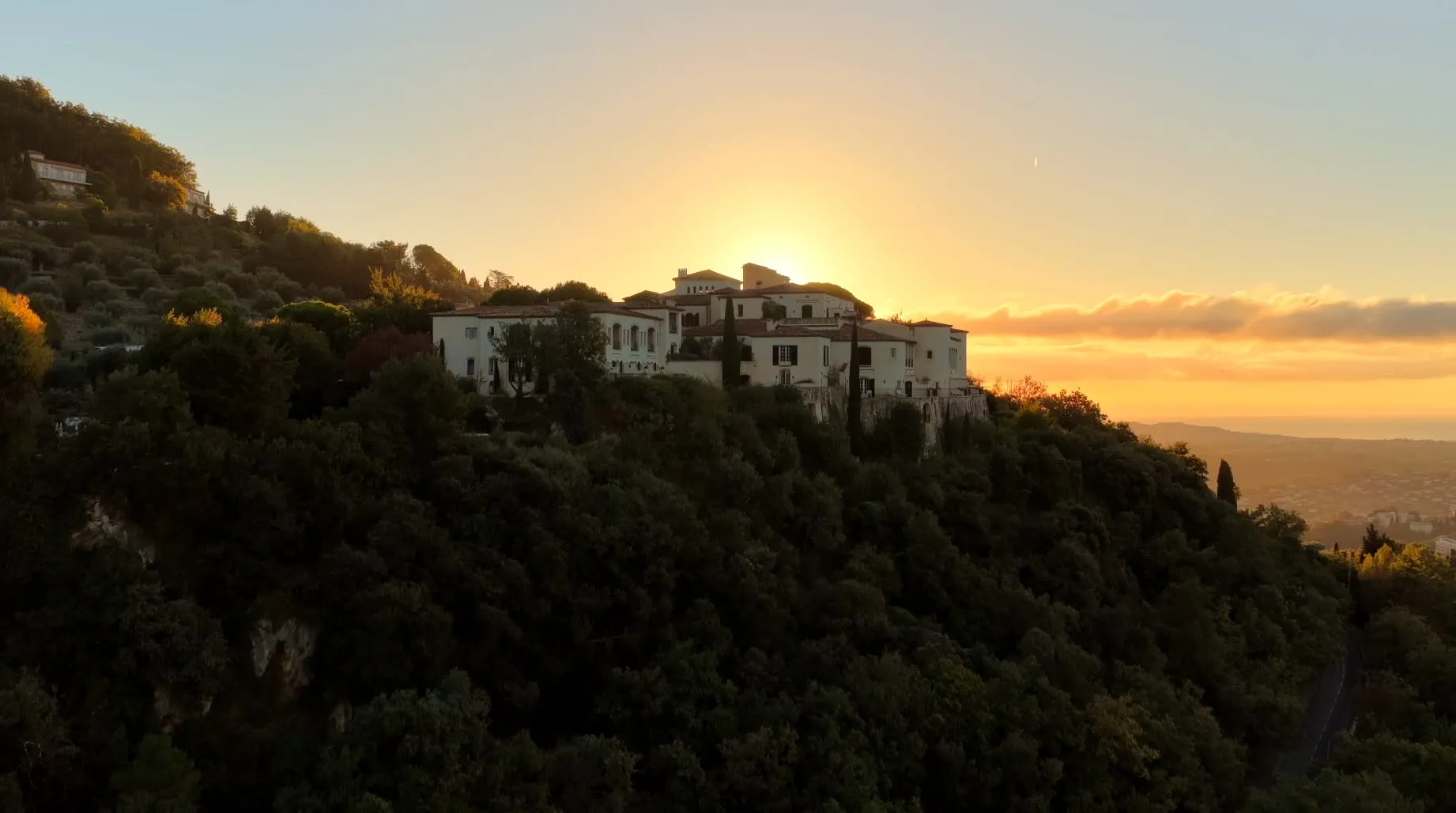
A 12th-century Knights Templar commandery turned Relais & Châteaux estate, its own olive groves and vineyards spread across a Vence hillside above the Mediterranean.
From €1,050 per night
1st arrondissement, Paris, France
Cheval Blanc Paris
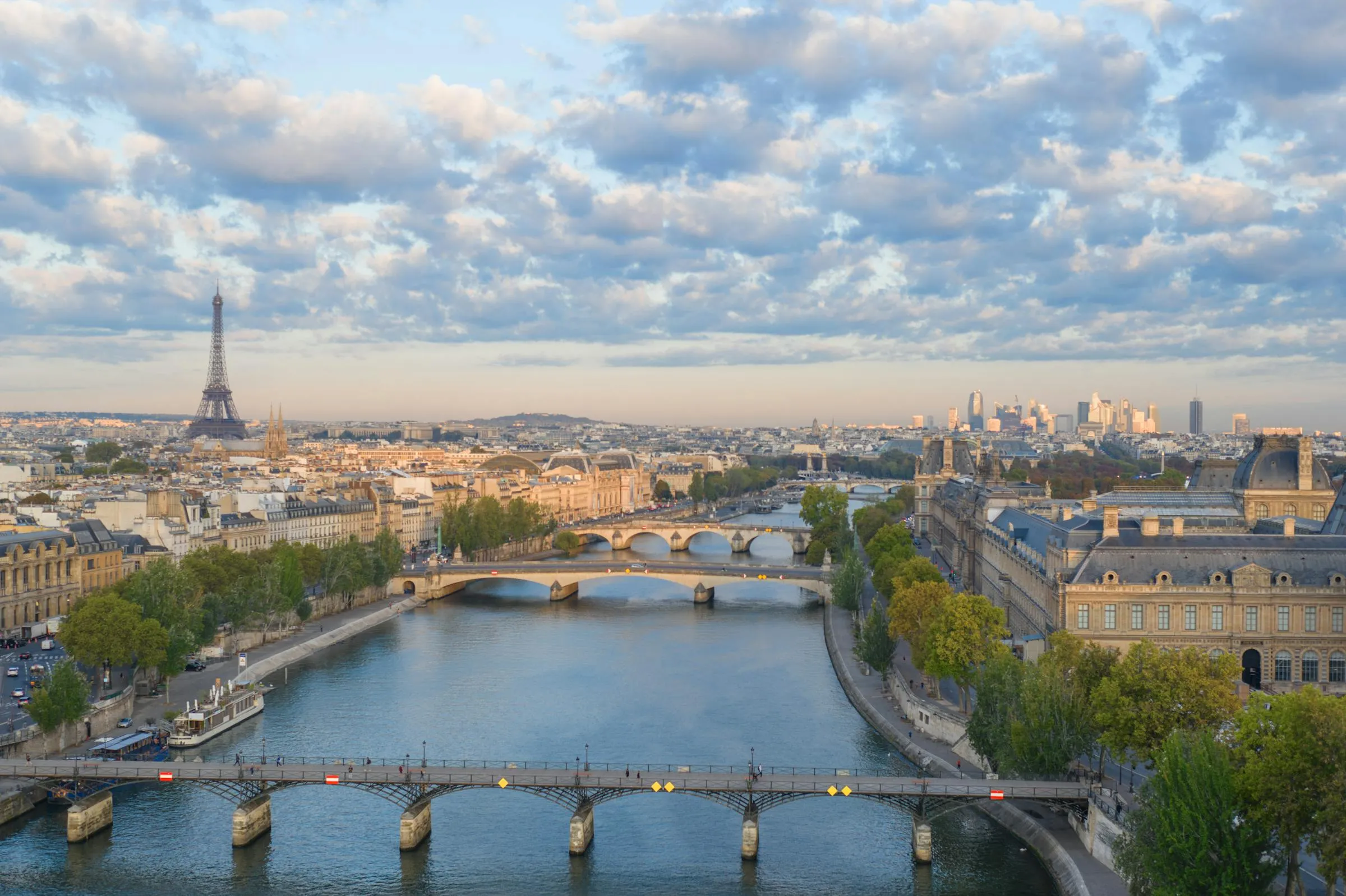
A Belle Epoque department store reborn as LVMH's most architecturally ambitious Paris address, with the Seine on one side and the Louvre on the other.
From €2,200 per night
8th arrondissement, Paris, France
Four Seasons Hotel George V Paris
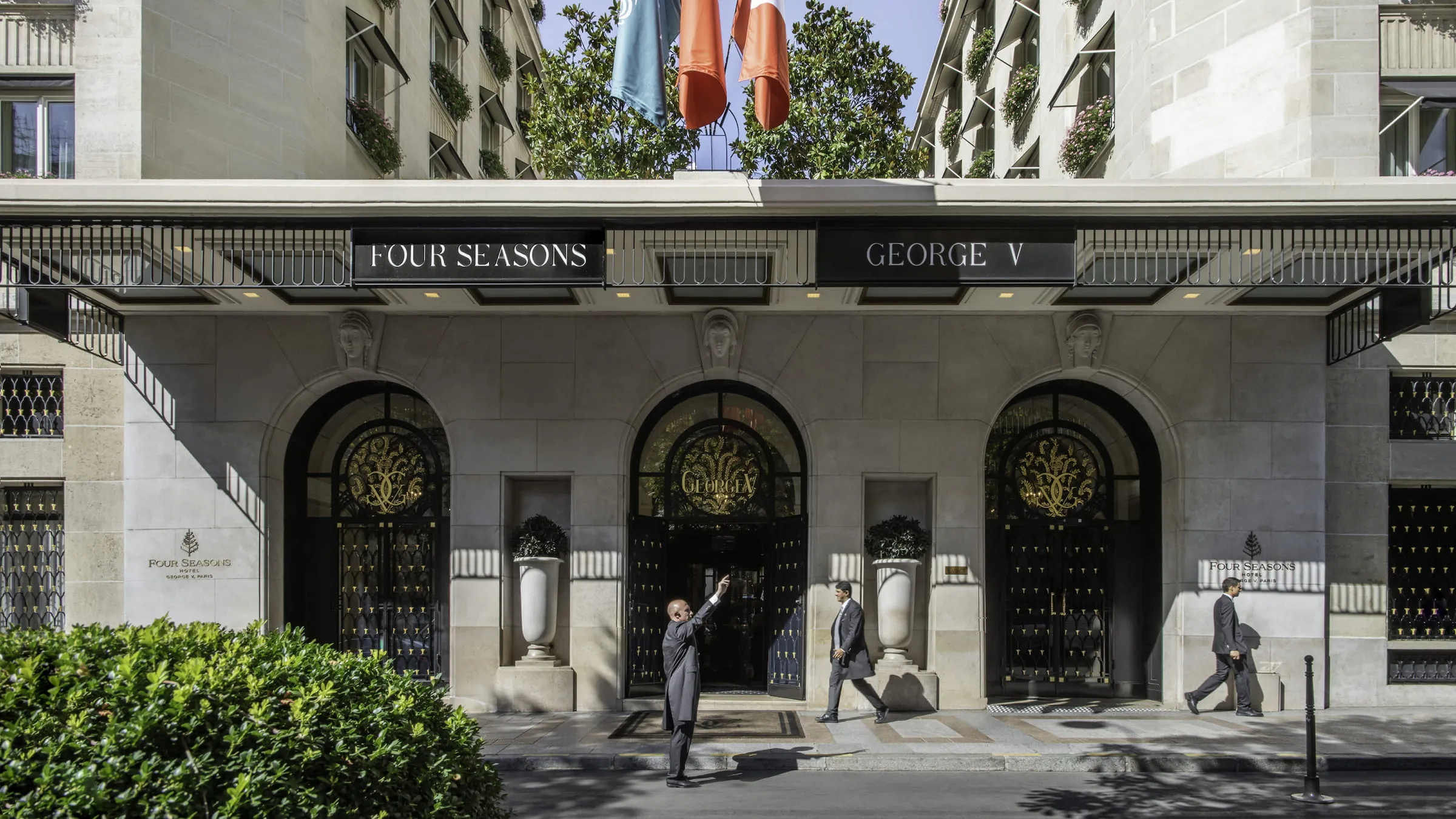
An Art Deco palace on the Golden Triangle where six Michelin stars, a legendary flower program and a newly reimagined set of rooms keep a century-old address at the front of Paris hospitality.
From €1,950 per night