Midtown Manhattan, New York City, United States
Aman New York
Eighty-three suites folded into a landmarked 1921 Beaux-Arts tower on Fifth Avenue, with a three-floor spa larger than any other Aman on earth.
- Rates from
- From $2,300 per night
- Nearest airport
- John F. Kennedy International (JFK), with LaGuardia (LGA) and Newark Liberty (EWR) as alternatives
- Transfer
- 45-60min from JFK or Newark by road, 30-40min from LaGuardia, depending on traffic
- Best months
- April to June and September to November, when Manhattan is at its most walkable and Central Park is at its best
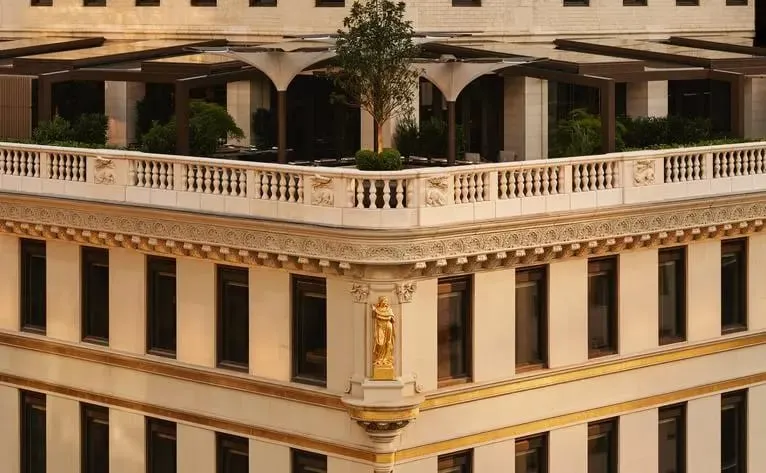
At the corner of Fifth Avenue and 57th Street, where midtown Manhattan’s retail intensity is at its most concentrated, a gilded pyramid roof marks a building that has spent more than a century changing what it does without changing what it looks like. The Crown Building went up in 1921 as an office tower, briefly housed the first home of the Museum of Modern Art in the 1930s, cycled through decades as commercial real estate, and in 2022 reopened as Aman New York: 83 suites and a small number of private residences folded into a shell that a great many New Yorkers have walked past for years without knowing its name.
That the city’s most understated ultra-luxury hotel brand chose one of Fifth Avenue’s most recognisable corners for its flagship American debut is, on its own, a small piece of hospitality news. What makes Aman New York worth a longer look is what happened inside: Jean-Michel Gathy, the Malaysia-based architect behind some of Aman’s most admired resort interiors, was tasked with translating a design language built for jungle canopies and desert plateaus into a landmarked, floor-plated office tower in the densest few blocks of Manhattan, and doing it without the hotel losing the sense of hush that the brand’s name is built on.
The result is a property that reads, from the sidewalk, almost exactly as it did a hundred years ago, and reads, from inside a suite eleven floors up, almost nothing like the city outside its windows. Aman built its reputation on remote sanctuaries in Bhutan, Cambodia and the Turks and Caicos; Aman New York asks whether that same idea of retreat can be built into the middle of the loudest possible location, and largely answers yes.
Why It Stands Out
Aman New York’s core claim is spatial rather than aesthetic: at 83 suites, spread across roughly a dozen upper floors of a building with a much larger total footprint, it has more square footage per key than almost any other hotel in Manhattan. There are no standard double rooms; the entry-level category, the Junior Suite, still runs to 775 square feet, generous even by suburban American hotel standards and remarkable inside a borough where hotel rooms are routinely measured in the low three hundreds.
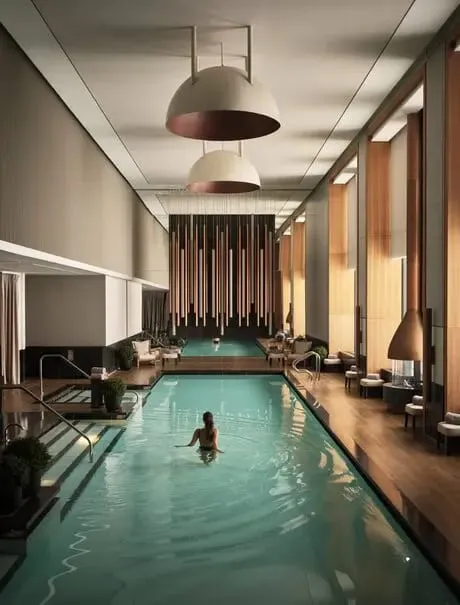
That same generosity extends to the spa, which occupies three full floors of the Crown Building, some 25,000 square feet built around an 80-foot indoor pool, making it, by Aman’s own account, the largest spa anywhere in its global portfolio, larger than the wellness facilities at any of its resort properties in Asia or the Middle East. Building a spa of that scale inside an existing 1920s office tower, rather than on a greenfield resort site, is a genuine feat of vertical planning, and it is the detail hospitality writers return to most often when describing what separates this Aman from its siblings.
The third distinguishing element is discretion inside one of the most surveilled retail corridors on the planet. Fifth Avenue at 57th Street sits a few steps from Bergdorf Goodman, Tiffany & Co. and the plaza in front of Trump Tower, yet Aman New York’s entrance, set back and unmarked by the branding conventions of a typical luxury hotel, functions closer to a private members’ club than a storefront. For a brand whose entire identity rests on privacy, placing that identity at the busiest intersection in the city was a considerable bet, and the design solves it by making the building’s ordinary appearance from the street do most of the work.
Architecture
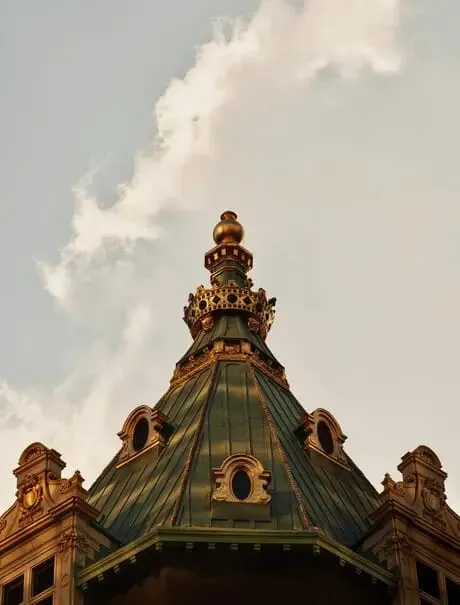
The Crown Building was completed in 1921 to designs by Warren and Wetmore, the architecture firm best known for Grand Central Terminal and the New York Central Building (now the Helmsley Building), and it stands as one of the more fully realised Beaux-Arts commercial towers remaining on Fifth Avenue. Its gilded pyramidal roof, visible from several blocks in any direction, and its dressed limestone base give it a presence disproportionate to its 26 storeys, and it holds individual landmark status from the New York City Landmarks Preservation Commission, a designation that shaped nearly every decision the hotel’s developers could make about the exterior.
For much of the twentieth century the building operated as commercial office space, with a notable interlude in the early 1930s when it briefly housed the first home of the Museum of Modern Art before that institution moved to its current site. Converting a landmarked 1921 office tower into a hotel and residences meant working almost entirely on the interior and structural systems: reported renovation costs run to roughly 1.45 billion US dollars, reflecting the scale of retrofitting new mechanical, plumbing and structural work into a century-old steel frame while leaving its protected exterior essentially untouched. The hotel occupies the lower-to-middle floors of the tower, roughly floors seven through twenty, with private branded residences on the upper levels above, a stacking arrangement that lets Aman run its public spaces and spa closer to street level while keeping the tower’s most valuable views for its residential component.
Interior Design
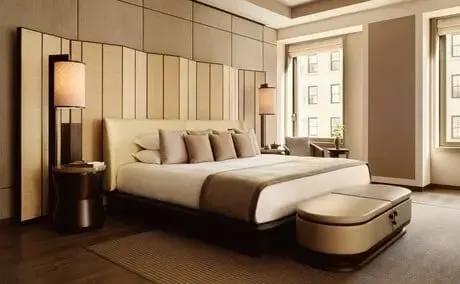
Jean-Michel Gathy, principal of the Denniston design studio and the architect behind several of Aman’s most recognised resort interiors elsewhere in the world, led the interior design, and the results carry his signature instinct for large, quiet volumes even where the building’s original floor plates worked against him. Rather than replicate the tropical materials of Aman’s resort properties, Gathy worked in a more restrained, Japanese-inflected register suited to a northern city: pale limestone and oak, deep soaking tubs finished in stone, muted neutral palettes, and functioning wood-burning fireplaces in every suite, an unusual amenity for any hotel room in Manhattan, let alone one inside a century-old tower with limited flue capacity to work with.
Ceilings throughout the guest floors run to 11 feet, well above the Manhattan hotel norm, a dimension made possible by the building’s original office-tower proportions and preserved deliberately through the conversion rather than sacrificed to squeeze in additional floor area. Public spaces carry the same restraint: stone floors, minimal signage, low lighting, and a general avoidance of the gilt-and-crystal vocabulary associated with New York’s older grand hotels. The spa continues the material language underground and up through its three floors, built around dark stone, timber-lined steam rooms and a banya-style sauna that nods toward the brand’s broader interest in bathing rituals from beyond the usual European spa template.
Atmosphere
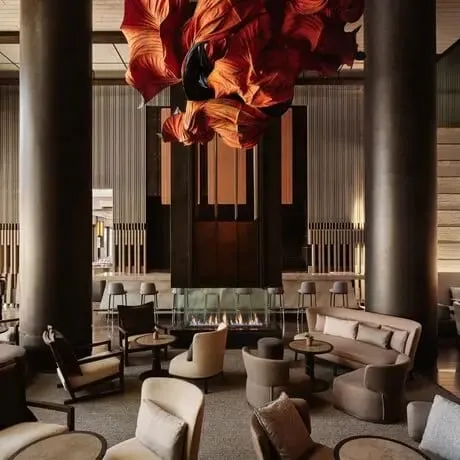
Aman New York’s atmosphere is built on contrast with its address. Fifth Avenue at 57th Street is one of the most heavily trafficked retail corners in the world, yet the hotel’s public rooms are kept deliberately sparse and quiet, with none of the visual noise of the boutiques at street level bleeding upward into the guest experience. Arrival is unhurried and largely unbranded from the outside; there is no grand porte-cochere or illuminated signage of the kind a traditional Manhattan luxury hotel would use to announce itself.
That hush extends through the guest floors and into the spa, where the three-floor wellness programme is engineered to feel closer to a private retreat than a hotel amenity squeezed into a basement. The trade-off is scale of a different kind: with 83 suites rather than several hundred rooms, Aman New York does not attempt the bustling lobby energy or multiple simultaneous events of its larger midtown neighbours, and guests looking for that kind of civic buzz are better served elsewhere. What it offers instead is a consistently low-key register from check-in through to The Jazz Club below ground, where even the venue’s liveliest programming plays out in a room designed for intimacy rather than spectacle.
Rooms and Suites
All 83 accommodations are suites; there is no conventional double-room category. The entry tier, Junior Suites, starts at 775 square feet, already among the largest standard hotel rooms in New York, while Premier Suites begin around 815 square feet and add a functioning fireplace and an oversized stone soaking bath. Corner Suites, positioned at the building’s actual corners with views along both Fifth Avenue and 57th Street, run from roughly 1,700 square feet in a one-bedroom configuration up to nearly 2,800 square feet across three bedrooms.
At the top of the range, Aman Suites occupy the tower’s corners on the upper guest floors, starting from around 2,000 square feet and reaching up to roughly 2,770 square feet, with the option to connect to an adjoining Junior Suite for a two-bedroom configuration. Every category shares the same material vocabulary, stone bathrooms, deep soaking tubs, 11-foot ceilings, working fireplaces and floor-to-ceiling windows, with the differences between tiers largely a matter of square footage, view and number of bedrooms rather than a change in finish quality. Above the hotel floors, a small number of privately owned One-, Two- and Three-Bedroom Homes occupy the building’s upper levels, sold separately from the hotel but sharing access to its amenities.
Dining
Arva, the hotel’s Italian restaurant, runs breakfast, brunch, lunch and dinner service and is arranged so that its indoor dining room flows into the adjoining Lounge Bar and out to the Garden Terrace, an outdoor space kept open across the seasons rather than only in summer. The kitchen’s brief is broadly Italian, calibrated to a Manhattan clientele that expects a degree of polish and produce sourcing consistent with the rest of the hotel.
Nama is the more distinctive of the two principal restaurants: a Japanese dining room centred on a hinoki-wood sushi and omakase counter, where chef Takuma Yonemaru serves a fifteen-to-eighteen-course tasting menu built on washoku principles, alongside an a la carte programme for guests who prefer to order individually. Below street level, The Jazz Club occupies a roughly 3,000-square-foot subterranean room reached via a discreet entrance on West 56th Street and a descent by service elevator, a deliberately theatrical arrival for a room built around nightly live jazz and other live music, with an audio system reported to rival the specification of dedicated concert venues elsewhere in the city. The Corner Bar and Lounge Bar round out the drinking options, positioned closer to the hotel’s day-to-day arrival and departure flow than to the evening programming of The Jazz Club.
Spa and Wellness
Aman Spa New York is the property’s headline amenity and, by the brand’s own description, the largest spa across the entire Aman portfolio, a notable claim for an urban hotel built inside an existing tower rather than a resort with unconstrained land to build on. The spa spans three full floors, roughly 25,000 square feet in total, organised around an 80-foot indoor pool flanked by daybeds and fire features, with a hammam, a banya-style sauna, hot and cold plunge pools, private spa suites with their own treatment and steam rooms, and a fitness centre for guests who want a conventional workout alongside the more ritual-oriented facilities.
The programming draws on a range of therapeutic traditions rather than a single house style, consistent with Aman’s broader wellness positioning, and the hotel has also been associated with a medical aesthetics and recovery-oriented programme linked to tennis player Novak Djokovic’s wellness brand. Given the scale of the facility relative to an 83-suite hotel, treatment availability is generous by Manhattan standards, though peak weekend slots and the pool’s quieter hours are still worth booking in advance through the spa concierge rather than assuming same-day availability.
Experiences
Aman New York leans on its address more than on a built-out excursion programme, since so much of what a guest might want from a New York stay, Central Park, the Museum of Modern Art a few blocks south, the flagship stores along Fifth Avenue, is within easy walking distance. The concierge team arranges the more curated version of that same list: private after-hours access to galleries and cultural institutions, made-to-measure shopping appointments at the surrounding luxury retailers, and tickets to Broadway and the city’s major performance venues.
Inside the building, The Jazz Club functions as the hotel’s own evening programming rather than an outsourced activity, with nightly live music that gives guests a reason to stay inside without feeling like they are missing the city outside. The spa’s scale also supports a wellness-first version of a New York stay for guests who would rather build a visit around treatments and the pool than around sightseeing, an option that a smaller hotel spa in Manhattan simply could not support in the same depth.
Who It Is For
Aman New York suits travellers who want a genuinely spacious, design-led base in the middle of Manhattan and are prepared to pay accordingly: design-conscious couples, wellness-focused guests drawn specifically to the three-floor spa, and business travellers who want privacy and generous suite space for meetings without leaving the hotel. Food-focused guests are well served by Nama’s omakase programme in particular, which stands on its own merits rather than functioning simply as a hotel restaurant.
It is a less natural fit for families needing multiple connecting rooms at accessible price points, or for first-time New York visitors who want a hotel with the animated public-space energy of some of the city’s larger grand hotels. With no standard double rooms and rates set well above the citywide average, Aman New York is built for guests already committed to a suite-level stay rather than those comparing it against a conventional midtown hotel room.
Best Time to Visit
Late spring, April through June, and autumn, September through November, are generally considered New York’s most comfortable stretches, with milder temperatures, Central Park at its most photogenic, and a full calendar of gallery openings and cultural programming. Both windows sit outside the peak heat and humidity of a New York summer and the coldest weeks of winter, while still offering long days and reliable outdoor access to the Garden Terrace.
Winter around the December holidays brings its own draw, with the nearby Rockefeller Center tree and Fifth Avenue’s holiday windows a short walk from the hotel’s door, though this period also brings the heaviest pedestrian crowds and the highest rates of the year along the immediate corridor. Guests prioritising a quieter, less congested version of the neighbourhood are generally better served by the shoulder-season months than by the holiday peak.
How to Get There
John F. Kennedy International Airport (JFK) is the primary gateway for long-haul arrivals, typically 45 to 60 minutes from the hotel by road depending on traffic and time of day, with private transfer arranged directly through the hotel the standard option at this level. Newark Liberty International (EWR) offers a comparable transfer time and serves a broad mix of domestic and international routes, while LaGuardia (LGA), used mainly for domestic connections, is usually the closest of the three at 30 to 40 minutes. Private jet travellers typically route through Teterboro Airport in New Jersey, also roughly 45 to 60 minutes from the hotel by road.
Within the city, the hotel’s corner position at Fifth Avenue and 57th Street places it within walking distance of Central Park, the Fifth Avenue retail corridor and the Museum of Modern Art, and most guests move around midtown on foot or by car service rather than the subway, though the F train’s 57th Street station sits a short walk away for those who prefer it.
Nearby Experiences
Central Park’s southeastern entrances lie a few minutes’ walk north of the hotel, offering immediate access to the park’s lake, zoo and the Central Park Mall without needing a car or taxi. The Museum of Modern Art sits a short walk south and east on 53rd Street, a fitting neighbour given the Crown Building’s own brief stint as MoMA’s first home in the 1930s, and St. Patrick’s Cathedral and Rockefeller Center are both within easy reach along Fifth Avenue heading south.
The Fifth Avenue retail corridor itself, anchored by Bergdorf Goodman directly across 57th Street and continuing past Tiffany & Co., the flagship Apple store and Trump Tower, is essentially the hotel’s front yard, while Carnegie Hall and the theatres of the Broadway corridor lie within a short cab or subway ride to the west for guests planning an evening out.
Things to Know Before Booking
Rates at Aman New York sit at the very top of the Manhattan hotel market, and with only 83 suites and no lower-priced double-room category, there is no lighter-weight way to book the property; guests should expect to pay a suite-level rate for even the shortest stay. The hotel’s understated street presence, deliberate rather than an oversight, means first-time guests arriving by car or on foot should confirm the exact entrance at 730 Fifth Avenue rather than expecting conventional hotel signage.
The spa, while large, is a genuine draw for New Yorkers and hotel guests from other properties as well as overnight guests, so weekend and peak-hour treatment slots are worth booking in advance rather than assuming walk-in availability. Nama’s omakase seating is limited by the size of its counter, and reservations, particularly at dinner, are best secured as early as possible, ideally at the time of booking the room itself.
Sustainability
Public information specific to Aman New York’s own environmental performance, energy systems or waste programmes is limited, and no property-level sustainability report or certification for the hotel itself was identified at the time of writing, so no specific claims are made here about its individual footprint. What can be said with more confidence is structural: the hotel occupies an existing, retrofitted 1921 tower rather than new-build construction, which by nature carries a different embodied-carbon profile than a ground-up hotel development, independent of any additional operational certification.
Aman as a global brand has published broader sustainability commitments across its portfolio, including initiatives at several of its resort properties, though these are not detailed enough at the individual New York property level to summarise with confidence here.
Practical Information
Rates at Aman New York start from around USD 2,300 per night for the entry-level Junior Suite category, rising substantially for Corner and Aman Suites and further for the multi-bedroom configurations, reflecting its position at the top of the Manhattan luxury hotel market. Check-in is from 3:00pm and check-out by 12:00pm, with flexible timing available on request, subject to availability.
The nearest airport is John F. Kennedy International (JFK), roughly 45 to 60 minutes away by road depending on traffic, with LaGuardia (LGA) typically the fastest option at 30 to 40 minutes for domestic connections. Most stays run two to four nights, enough time to make use of the three-floor spa, a dinner at Nama and one at Arva, and a walk through the surrounding blocks of Fifth Avenue and Central Park, while the best months to visit are April through June and September through November, when the city is at its most temperate and walkable.
Editorial Conclusion
Aman New York’s achievement is less a single amenity than a piece of spatial engineering: taking a landmarked, century-old office tower on the busiest corner of Fifth Avenue and extracting from it 83 outsized suites, functioning fireplaces, 11-foot ceilings and a three-floor spa larger than anything else in the Aman portfolio, all while keeping the building’s exterior essentially untouched. It is a demonstration that the brand’s core idea, retreat built through scale, material restraint and quiet, can survive transplantation from a private island or a Bhutanese valley into the middle of Manhattan’s most trafficked intersection.
What it will not offer is the animated public-room energy of New York’s larger grand hotels, a lower-priced room category for guests unwilling to book at suite level, or much in the way of published environmental detail at the property level. For travellers who want generous space, a genuinely exceptional spa, and a version of midtown Manhattan with the volume turned down, Aman New York remains one of the more considered luxury hotel projects to open in the city in recent years.
In pictures
On the map
Midtown Manhattan, New York City, United States
Questions
Frequently asked
When did Aman New York open, and where exactly is it?
Aman New York opened on 2 August 2022, occupying floors seven through twenty of the landmarked Crown Building at 730 Fifth Avenue, on the southwest corner of Fifth Avenue and 57th Street in Midtown Manhattan. Private branded residences occupy the upper floors of the same tower.
How many rooms does Aman New York have, and how big are they?
The hotel has 83 suites, no standard double rooms, ranging from 775-square-foot Junior Suites up to Aman Suites and multi-bedroom Corner Suites of roughly 1,700 to nearly 2,800 square feet. All suites carry 11-foot ceilings and a functioning fireplace, unusual for a Manhattan hotel of any size.
What makes the spa at Aman New York different from other city hotel spas?
Aman Spa New York occupies three full floors of the Crown Building, roughly 25,000 square feet in total, built around an 80-foot indoor pool, a hammam, a banya-style sauna, plunge pools and dedicated spa suites with their own treatment rooms and steam facilities. Aman states it as the largest spa within its global portfolio, a striking claim for a hotel built inside an existing 1920s tower rather than a purpose-built resort.
What restaurants and bars are inside the hotel?
Arva serves Italian cuisine across breakfast, brunch, lunch and dinner, with seating that flows between the Lounge Bar and the year-round Garden Terrace. Nama is the hotel's Japanese restaurant, built around a hinoki-wood counter where chef Takuma Yonemaru serves an omakase of fifteen to eighteen courses. Below street level, The Jazz Club is a 3,000-square-foot subterranean live music room reached through a discreet entrance on West 56th Street.
Who designed the hotel, and what happened to the original Crown Building?
Jean-Michel Gathy of the firm Denniston designed the interiors, working within a Beaux-Arts tower completed in 1921 by Warren and Wetmore, the architects behind Grand Central Terminal. The building, a New York City landmark, briefly housed the first home of the Museum of Modern Art in the 1930s and underwent a renovation reported at roughly 1.45 billion US dollars before reopening as Aman New York in 2022.
What is the nearest airport to Aman New York?
John F. Kennedy International (JFK) is the primary long-haul gateway, typically 45 to 60 minutes from the hotel by road depending on traffic. Newark Liberty (EWR) runs a similar transfer time, while LaGuardia (LGA), used mainly for domestic connections, is usually the closest at 30 to 40 minutes.
Same destination
More hotel guides in United States
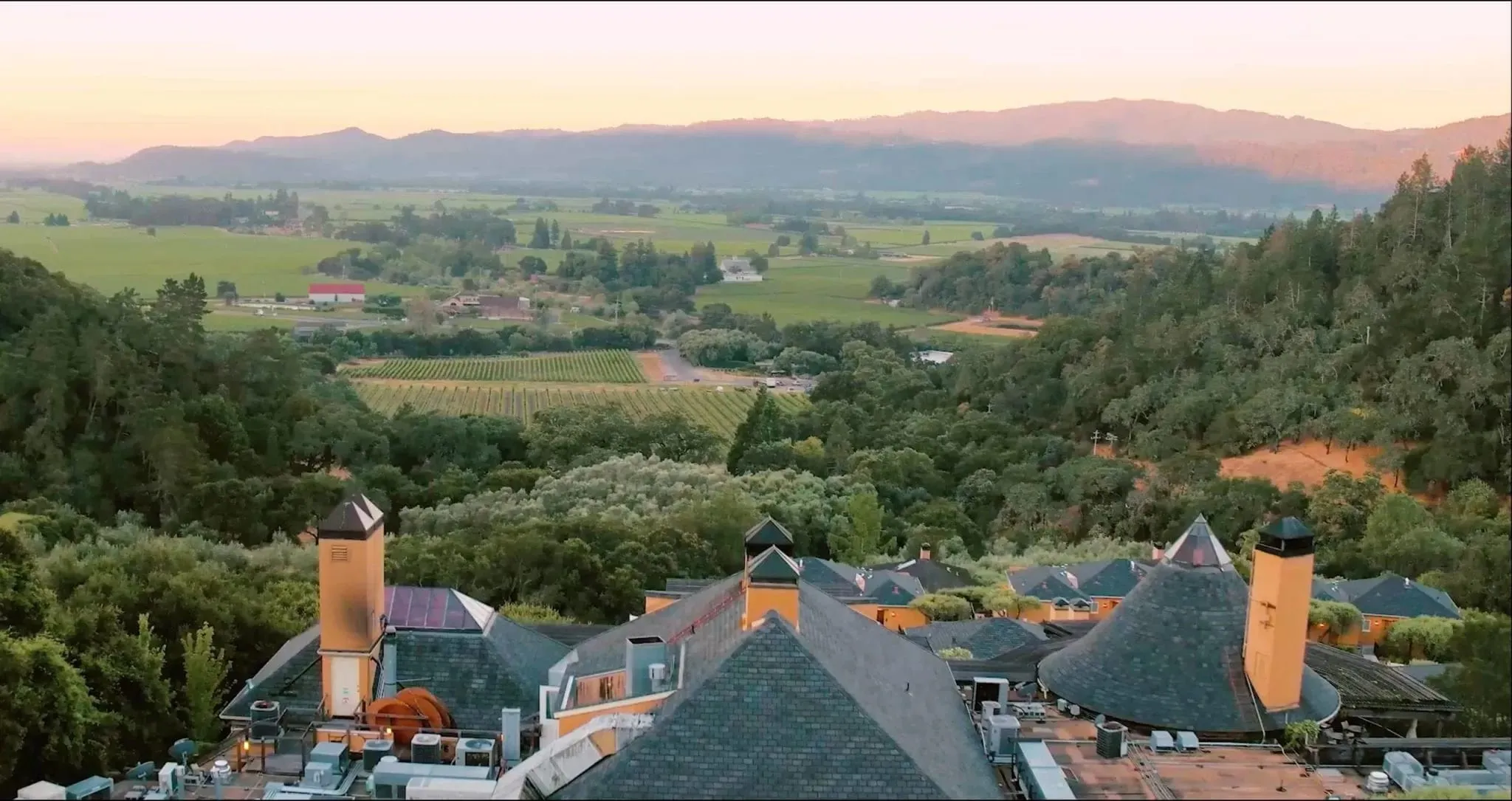
Rutherford, Napa Valley, United States
Auberge du Soleil
The Provence-inspired hillside inn that gave an entire hotel group its name, its philosophy, and one of Napa Valley's longest-running Michelin stars.
From $1,200 per night
Walland, Great Smoky Mountains foothills, United States
Blackberry Farm
A 4,200-acre working farm at the foot of the Great Smoky Mountains where the Beall family built an entire school of American cooking around cheese, garden and pasture.
From $1,145 per night
Bel Air, Los Angeles, United States
Hotel Bel-Air
Twelve acres of Mission-style bungalows and a private swan lake have kept Hollywood's most discreet address quietly out of sight since 1946.
From $1,250 per night