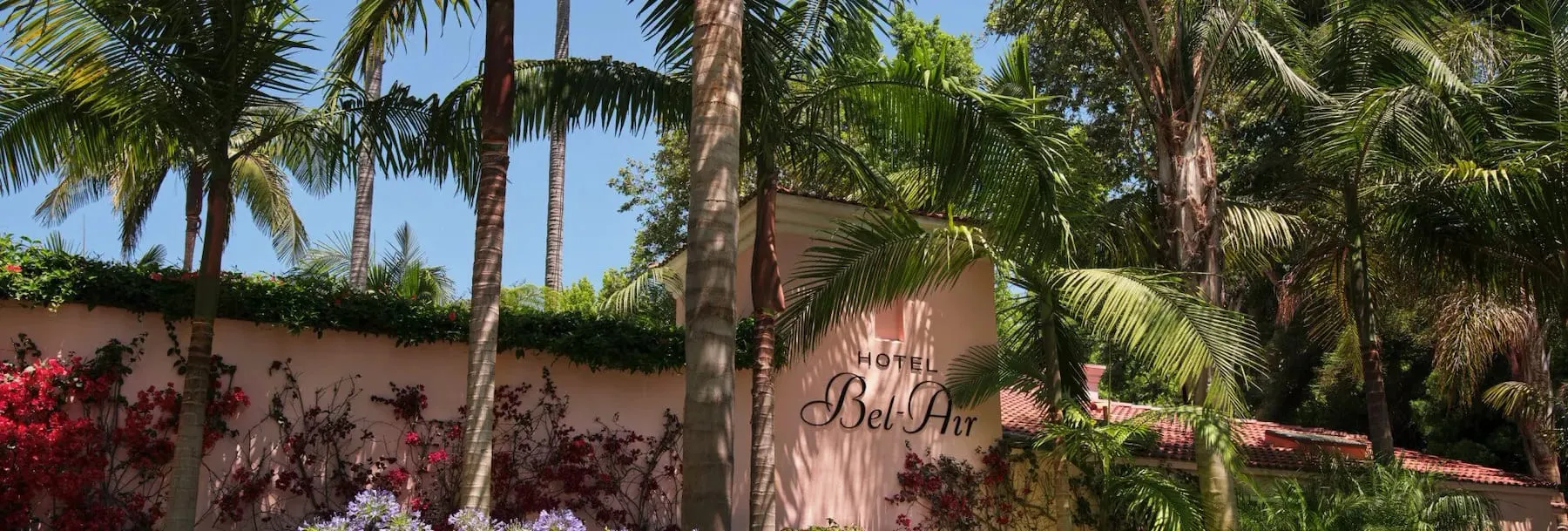
Bel Air, Los Angeles, United States
Hotel Bel-Air
Twelve acres of Mission-style bungalows and a private swan lake have kept Hollywood's most discreet address quietly out of sight since 1946.
- Rates from
- From $1,250 per night
- Nearest airport
- Los Angeles International Airport (LAX)
- Transfer
- About 30-40 minutes by car, traffic permitting
- Best months
- April through June and September through November, when Southern California's mild, dry weather suits the hotel's outdoor gardens, terrace dining and pool without the peak heat or crowds of midsummer
There is a specific kind of Los Angeles quiet that only money and acreage can buy, and Hotel Bel-Air has been selling it since 1946. Tucked into a fold of Stone Canyon Road less than two miles from the traffic of the 405, the hotel disappears behind twelve acres of mature gardens so thoroughly that first-time visitors often drive past the entrance without noticing it. That has always been the point. Where the Sunset Strip hotels of the same era were built to be seen, Hotel Bel-Air was built to hide the people who stayed there, and eight decades on, it is still one of the only genuinely private grand hotels in a city that runs on visibility.
The bones of the place are older than the hotel itself. Alphonzo Bell, the oil-money developer who carved the Bel-Air neighbourhood out of ranchland in the 1920s, built a Mission-style sales office and stables on the site in 1922 to sell house lots to Los Angeles’s new money. When the Depression stalled his ambitions, the buildings sat mostly idle until 1946, when Texan hotelier Joseph Drown bought roughly eighteen acres of the property and, working with architect Burton Schutt, converted Bell’s sales pavilion and stable blocks into a hotel of rose-pink, low-rise bungalows scattered through landscaped grounds rather than stacked into a single tower. It opened that August, and within a few years had become the default address for film stars who wanted to be left alone: Marilyn Monroe was a regular, Elizabeth Taylor spent part of her first honeymoon there, and Grace Kelly has a suite named for her.
What makes Hotel Bel-Air worth examining today, rather than simply admiring for its past, is how deliberately it has managed change. Dorchester Collection bought the property in 2008 and closed it for a two-year, ground-up renovation before reopening in 2011, adding the current spa and refreshing the interiors without altering the low-slung Mission Revival footprint. More recently, the departure of Wolfgang Puck, who had run the hotel’s food and beverage program for eleven years before an amicable split in 2023, forced a genuine reinvention of the dining program under a new culinary team. Both moments could have diluted what makes the hotel distinctive. Neither did, and that restraint, more than any single amenity, is the through-line of a stay here.
This guide sets out what the hotel actually is today: its architecture and gardens, its current room categories and dining program, its spa, and the practical detail a traveller needs before booking, drawn from verified, published information rather than nostalgia for its Old Hollywood reputation.
Why It Stands Out
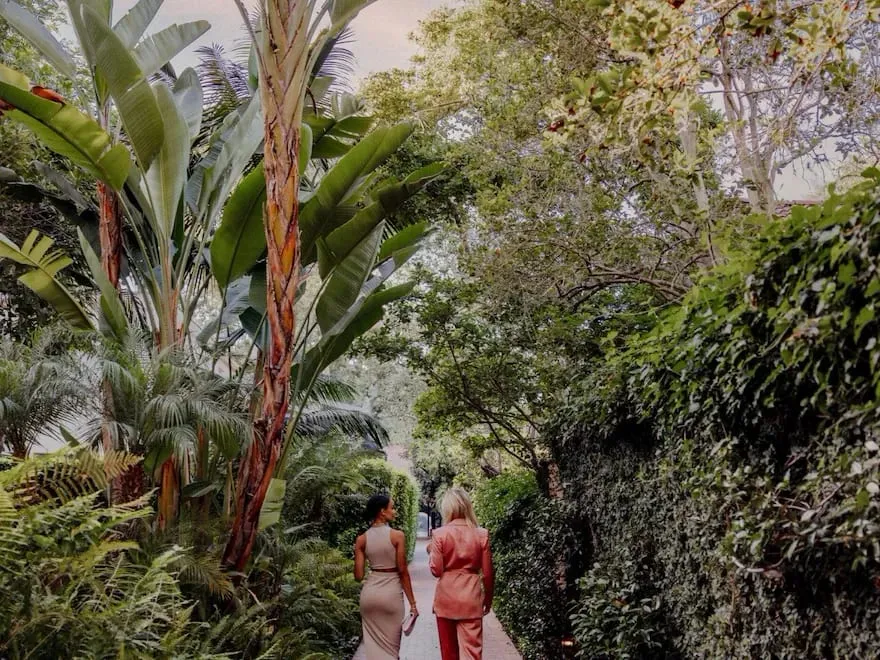
Hotel Bel-Air’s case rests on two things few Los Angeles hotels can genuinely offer at this scale: land and discretion. Twelve acres of gardens, home to more than 480 specimen trees and some 4,000 plants, separate the hotel’s 103 rooms and suites from Stone Canyon Road and from each other, so that a stay here feels closer to a private estate than a hotel property, even within a few miles of Rodeo Drive and the Sunset Strip. The hotel’s low-rise, bungalow-scattered layout, unchanged in its essential footprint since 1946, means there is no lobby to be photographed crossing and no single entrance where paparazzi can reliably wait, a design logic that has made the property a default for anyone in the entertainment industry who wants privacy rather than proximity to a scene. Add a working Swan Lake at the center of the grounds, a genuine rarity among hotel amenities anywhere, and a recent Three MICHELIN Key distinction (the Michelin Guide’s top hotel classification, awarded in 2025 alongside sister property The Beverly Hills Hotel, and held by only two Los Angeles hotels), and the result is a property whose reputation for old-money seclusion is still backed by current, verifiable substance rather than resting purely on its history.
Architecture
Hotel Bel-Air’s architectural story begins with a building it was never meant to be. In 1922, Alphonzo Bell, the developer who created the surrounding Bel-Air neighbourhood on land assembled from ranch holdings west of Beverly Hills, built a Mission Revival structure on the site to serve as a sales office for prospective homebuyers, alongside riding stables to entertain them. Bell’s project stalled through the Depression years, leaving the buildings underused until 1946, when Texan hotel entrepreneur Joseph Drown purchased roughly eighteen acres of the site, including the original structure, and set about converting it into a hotel proper. Drown worked with architect Burton Schutt, whose design carried forward the rose-pink stucco walls, red tile roofs, arched doorways and courtyard logic of Bell’s original Mission Revival building while expanding the property into a series of low-rise bungalows scattered through newly landscaped grounds rather than consolidated into a conventional multi-story hotel block. That decision, to build outward instead of upward, is the single architectural choice that has done the most to define the property: it produced a hotel with no dominant facade to photograph from the street, no central lobby that every guest must pass through, and a footprint that reads more like a private residential compound than a commercial hotel, a character that remains legible in the buildings guests check into today.
The hotel’s most significant architectural intervention since 1946 came under Dorchester Collection’s ownership. The group bought Hotel Bel-Air in 2008 and closed it entirely for a two-year renovation, reopening in 2011 with a rebuilt spa wing, refreshed guest room interiors and updated infrastructure, but the project was explicitly conservative about the exterior: Schutt’s Mission Revival massing, the rose-pink stucco and tile roofscape, and the low bungalow arrangement across the gardens were retained rather than reworked. The result is a hotel whose public-facing architecture has changed comparatively little in eighty years, a contrast with many of its Los Angeles contemporaries that have been rebuilt, expanded upward or substantially re-skinned over the same period.
Interior Design
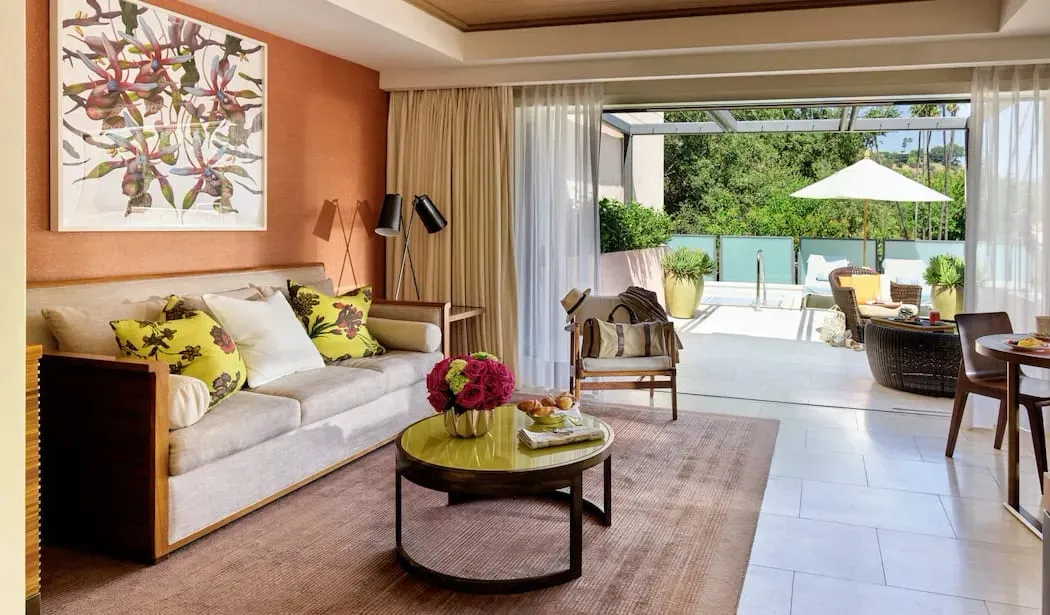
Where the hotel’s exterior has stayed close to its 1946 Mission Revival roots, its interiors have moved more visibly with the times. The 2009-2011 renovation under Dorchester Collection introduced what the hotel now describes as a residential, Hollywood Regency-inflected style, an attempt to translate old studio-era glamour into a warmer, less theatrical register than the phrase might suggest: soft, tonal palettes, mixed textures, and furnishings that read closer to a well-appointed private home than a formal hotel suite. Public rooms lean on the same instinct. The Bar & Lounge, one of the hotel’s more recent design refreshes, is built around an open fireplace and a grand piano, deliberately evoking a private club rather than a transient hotel bar, while The Living Room, added as part of the post-Wolfgang Puck dining overhaul, pairs an indoor-outdoor layout with its own fireplace for afternoon tea and small plates. Individual suites carry their own character: the Presidential Suite occupies a freestanding hacienda-style house with vaulted ceilings, a grand piano, a ten-seat dining room and a private kitchen, while smaller named suites like the Herb Garden Suite and Swan Lake Suite are styled around their specific garden outlooks rather than a single repeated template, reinforcing the sense that no two stays at Hotel Bel-Air look quite alike.
Atmosphere
The prevailing mood at Hotel Bel-Air is deliberate calm rather than event-driven energy, a register set as much by the gardens as by the staff. Because the hotel’s 103 rooms and suites are distributed across low bungalows rather than stacked around a central atrium, there is no single gathering point where the property’s clientele naturally congregates and performs for one another, an arrangement that reads as unusual in a city where hotel lobbies often function as informal industry stages. Guests move through twelve acres of mature landscaping, past Swan Lake’s footbridge and resident swans, to reach their rooms, and that walk does much of the work of slowing a stay down before a guest has even checked in. The clientele mixes entertainment industry regulars who have used the hotel for its discretion for decades, wedding and event parties drawn to the gardens and Swan Lake as a backdrop, and a broader luxury travel audience visiting Los Angeles who want a residential alternative to the city’s more see-and-be-seen hotels. It is a hotel that rewards guests who want to disappear for a few days rather than be seen doing so.
Rooms and Suites
Hotel Bel-Air’s inventory totals 103 rooms and suites, of which 45 are classified as suites, an unusually high suite ratio for a property of this size and a reflection of the low-rise, bungalow-based layout established in 1946. Entry-level Superior Rooms run to around 431 square feet, with Deluxe Rooms with a private patio at roughly 450 square feet and Grand Deluxe categories slightly larger again; most categories at this level include outdoor space, whether a patio, terrace or garden view, rather than treating it as an upgrade reserved for suites alone. From there, the hierarchy moves into named suites that draw their character from their setting: the Herb Garden Suite offers around 1,800 square feet with a private elevator entrance and a study overlooking the gardens, while the Swan Lake Suite takes its name and outlook from the property’s central water feature.
At the top of the collection, the Presidential Suite is a freestanding, hacienda-style house of roughly 6,775 square feet of indoor-outdoor living space, built around its own private, full-size swimming pool enclosed in a Spanish-style courtyard, with a living room featuring vaulted ceilings, a fireplace and grand piano, a dining room seating up to ten guests, a full kitchen with a separate staff entrance, and a private office; both the bedroom and living room open through French doors onto a 4,515-square-foot private courtyard. It is among the largest and most private hotel suites in Los Angeles, and its scale, effectively a stand-alone residence within the hotel grounds, illustrates how far Hotel Bel-Air’s room categories diverge from a conventional hotel floor plan.
Dining
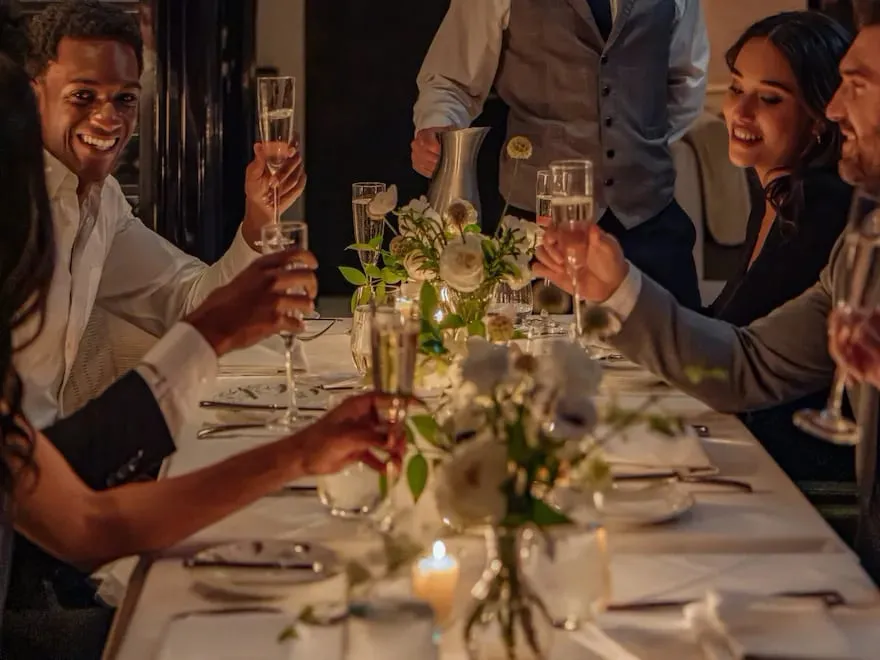
Dining at Hotel Bel-Air has been rebuilt around a new culinary identity since 2023. Wolfgang Puck, who had overseen the hotel’s food and beverage operations for eleven years, ended that partnership amicably on 31 March 2023, closing out an era in which his name restaurant was one of the property’s principal draws. The hotel has since installed culinary director Joe Garcia, previously of Thomas Keller’s The French Laundry, and rebranded its main dining room simply as The Restaurant at Hotel Bel-Air, serving modern Californian cuisine with Mediterranean influences, sourced in part from local farmers’ markets, across an indoor dining room, an al fresco terrace and the adjoining Bar & Lounge. The Bar & Lounge itself, anchored by a fireplace and grand piano, functions as the hotel’s principal evening gathering space for cocktails and lighter fare.
Alongside The Restaurant, the hotel operates The Living Room, a newer indoor-outdoor dining space added as part of the post-Puck overhaul, serving afternoon tea (built around savoury and sweet bites with champagne), specialty cocktails and a menu of signature small plates around its own fireplace. A stand-alone Patisserie, described by the hotel as Parisian-inspired with a California sensibility, operates under executive pastry chef Christophe Rull, offering pastries and sweets just beyond the Swan Lake bridge for both hotel guests and outside visitors. Together, the three venues give the hotel a more distributed dining program than it had during the single-restaurant Wolfgang Puck era, trading one headline chef’s name for a broader, in-house culinary team.
Spa and Wellness
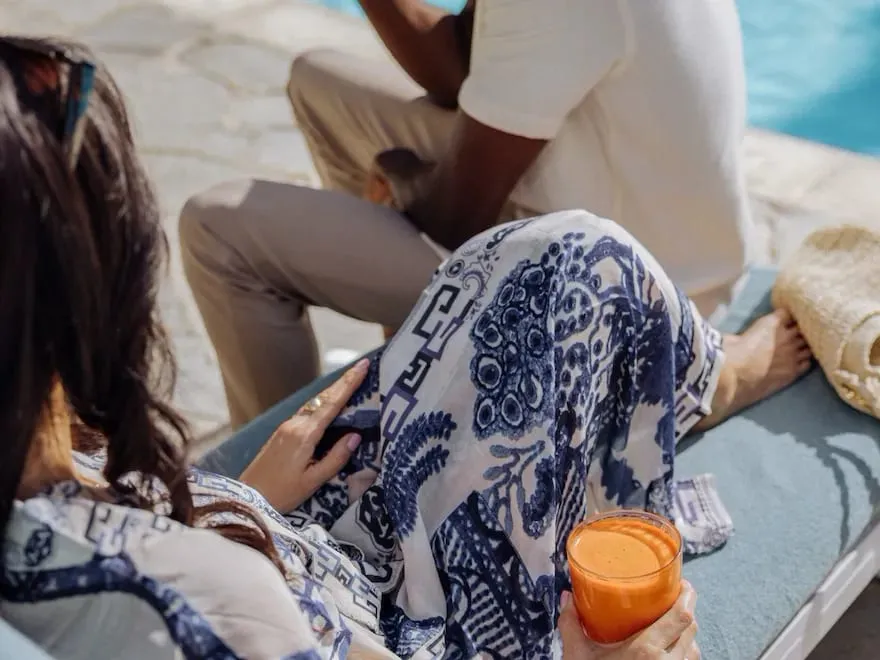
The Spa at Hotel Bel-Air was added during the property’s 2009-2011 renovation and is built around the same indoor-outdoor logic as the rest of the hotel, with seven garden-side treatment rooms and a relaxation lounge opening onto a private outdoor patio with a greenery wall and fountain. For over a decade the spa operated under a partnership with the Swiss skincare house La Prairie, running signature treatments built around La Prairie’s caviar and cellular skincare lines, including facials priced at the very top of the Los Angeles spa market; the arrangement made the spa a specific draw in its own right rather than a purely incidental hotel amenity. The hotel also operates a 24-hour gym and a family-friendly outdoor pool, set within the gardens and reserved exclusively for hotel guests rather than open to day visitors or spa-only guests, reinforcing the same privacy principle that runs through the rest of the property.
Experiences
Much of what distinguishes a stay at Hotel Bel-Air happens within its own twelve acres rather than through an extensive off-site tour program, in keeping with its identity as a private retreat rather than a sightseeing base. Swan Lake and its footbridge are usable as a private event and wedding backdrop, and the hotel’s gardens, home to more than 480 specimen trees and roughly 4,000 plants, are maintained as a destination in their own right, with pathways designed to be explored rather than simply walked through en route to a room. The Living Room’s afternoon tea service and The Patisserie’s counter give guests structured reasons to linger in the gardens across the day, while the Bar & Lounge’s evening programme, built around a working fireplace and grand piano, extends that same unhurried pace into the evening. For guests who do want to leave the grounds, the hotel’s concierge team can arrange access to Los Angeles’s wider luxury circuit, Rodeo Drive, the Sunset Strip and Century City are all a short drive away, but the hotel’s own case rests on giving guests very good reasons not to.
Who It Is For
Hotel Bel-Air suits travellers whose priority is privacy over spectacle: entertainment industry guests and public figures who have relied on the property’s low-visibility layout for decades, honeymooners and couples drawn to Swan Lake and the gardens as a romantic setting, and anyone who wants a genuinely residential feel to a Los Angeles stay rather than a high-rise hotel tower. Dog owners are well accommodated, with a formal policy allowing up to two small dogs per room, a detail that has become part of the hotel’s identity among its regular Los Angeles clientele. It is a somewhat less natural fit for travellers who want to be in the middle of the city’s energy, since the hotel’s entire design logic works against exactly that, or for guests specifically chasing a headline chef’s name restaurant, given Wolfgang Puck’s 2023 departure and the shift to an in-house culinary program under Joe Garcia; both groups may be better served by a more central Los Angeles address.
Best Time to Visit
Los Angeles’s climate makes Hotel Bel-Air workable as a year-round destination, but the shoulder seasons, roughly April through June and September through November, tend to offer the mildest, driest conditions for making full use of the gardens, the pool and terrace dining without the higher temperatures and larger crowds citywide that midsummer brings. Winter remains mild by most standards and can bring lower rates and easier availability, though December and January occasionally see rain, which is worth checking before booking a stay built around outdoor space. Because much of the hotel’s appeal, the gardens, Swan Lake, the outdoor pool and terrace dining, depends on being outside, travellers prioritising those elements should weight the shoulder seasons over midsummer in their planning.
How to Get There
Los Angeles International Airport (LAX) is the nearest major airport, typically 30 to 40 minutes from the hotel by car outside of peak traffic periods, and the hotel’s concierge team can arrange private transfers on request. Hotel Bel-Air sits about a mile west of Beverly Hills and roughly a ten-minute drive from Rodeo Drive, Sunset Boulevard and Century City, with the 405 freeway around two miles away, making a car, whether self-driven, hired or arranged through the hotel, effectively necessary for reaching the property and for onward exploration of the wider city. Los Angeles’s other commercial airports, Hollywood Burbank and Long Beach among them, can also work depending on the originating flight, though each typically adds to overall transfer time relative to LAX.
Nearby Experiences
Rodeo Drive and the wider Beverly Hills shopping district sit roughly ten minutes away by car, giving guests fast access to Los Angeles’s best-known luxury retail corridor without a long drive. The Getty Center, with its hilltop architecture, gardens and art collection, is a short drive from the hotel and pairs naturally with a stay built around gardens and quiet. Sunset Boulevard’s Sunset Strip section, with its restaurants, live music venues and nightlife, is close enough for an evening out while still allowing a return to the hotel’s calmer register afterward, and Century City’s shopping and business district extends the immediate area’s options for both retail and dining a short drive from the property.
Things to Know Before Booking
Guests who remember Hotel Bel-Air specifically for its Wolfgang Puck restaurant should know that partnership ended in March 2023, and dining today runs through an in-house team led by culinary director Joe Garcia across three venues, The Restaurant, The Living Room and The Patisserie, a genuinely different dining experience from the one many longtime visitors recall. Parking is valet-only and charged at $70 per day, a cost worth factoring into a stay’s total budget. Dogs are welcome, up to two small dogs (under 7kg/15lbs) per room for a $150 per-stay fee, but travellers with larger pets should check directly with the hotel, as the published policy is specific to smaller breeds. The hotel’s pool is reserved exclusively for overnight guests, so day-trip or spa-only visits do not include pool access, and given the hotel’s twelve-acre, low-rise layout, travellers who prioritise ease of walking or step-free access between buildings should confirm room location and mobility needs directly with reservations before booking.
Sustainability
As part of Dorchester Collection, Hotel Bel-Air operates within the group’s broader environmental commitments, which include efforts across its portfolio to reduce single-use plastics, manage waste streams more efficiently and lower energy consumption at a property level. The hotel’s twelve acres of gardens, maintained with more than 480 specimen trees and roughly 4,000 plants, represent a significant green space within central Los Angeles in their own right, functioning as a mature, established landscape rather than an added amenity. Specific, published sustainability certifications or measured environmental performance data for Hotel Bel-Air individually were not available at the time of writing, and this guide has omitted figures that could not be verified rather than estimate them.
Practical Information
Standard check-in at Hotel Bel-Air is from 3:00 PM, with check-out at 12:00 PM; express check-in and check-out are available, and a valid photo ID and credit card are required at check-in. Published rates start from around $1,250 per night for an entry-level Superior Room, though prices rise substantially through the suite categories and can vary considerably by season and demand. The hotel is located at 701 Stone Canyon Road, Los Angeles, CA 90077, in the Bel Air neighbourhood, about a mile west of Beverly Hills. Valet parking is available for $70 per day. The reservations office can be reached at +1 424 421 0070, or toll-free within the United States at +1 855 881 7009, and the concierge team can arrange restaurant bookings, spa treatments, private transfers and event bookings around Swan Lake.
Editorial Conclusion
Hotel Bel-Air’s achievement is not that it has stayed the same since 1946, it clearly hasn’t, but that its changes have consistently reinforced rather than diluted the thing that made the hotel worth visiting in the first place. Dorchester Collection’s 2009-2011 renovation modernised the property without touching Burton Schutt’s Mission Revival massing or the low-rise, garden-scattered layout that gives the hotel its privacy. The end of the Wolfgang Puck partnership in 2023 could have left a hole in the hotel’s identity; instead it produced a broader, three-venue dining program under an in-house culinary team, and the hotel’s recent Three MICHELIN Key distinction suggests the wider guest experience has held up under scrutiny. What has not changed, and what still does the most work in distinguishing Hotel Bel-Air from almost anything else in Los Angeles, is the combination of twelve acres, a private swan lake, and a layout designed from the outset to let guests disappear. For travellers who want Los Angeles’s resources within reach but no part of its visibility, that combination remains, eighty years on, close to unmatched.
In pictures
On the map
Bel Air, Los Angeles, United States
Questions
Frequently asked
When did Hotel Bel-Air open, and is it the same building today?
Hotel Bel-Air opened on 24 August 1946, developed by Texan hotelier Joseph Drown, who bought roughly 18 acres from Alphonzo Bell (the developer of the surrounding Bel-Air neighbourhood) and worked with architect Burton Schutt to convert what had been Bell's 1922 Mission-style sales office and riding stables into a hotel. The low-rise, rose-pink Mission Revival buildings guests see today are substantially that same 1946 property, though the hotel underwent a major two-year renovation between 2009 and 2011 that added the current spa and refreshed the interiors.
Is Wolfgang Puck still involved with the restaurant at Hotel Bel-Air?
No, not since 2023. Wolfgang Puck oversaw the hotel's food and beverage operations for eleven years, but the partnership ended amicably on 31 March 2023. The main dining room now operates simply as The Restaurant at Hotel Bel-Air under culinary director Joe Garcia, formerly of The French Laundry, alongside a newer all-day space called The Living Room and a stand-alone Patisserie led by pastry chef Christophe Rull. Travellers who remember the property from its Wolfgang Puck era should expect a different kitchen team today.
How many rooms and suites does Hotel Bel-Air have?
The hotel has 103 rooms and suites in total, of which 45 are suites, spread across low-rise bungalow-style buildings rather than a single hotel tower. Categories range from Superior Rooms of around 431 square feet up to named suites such as the Herb Garden Suite and the Swan Lake Suite, and the standalone Presidential Suite, a roughly 6,775-square-foot hacienda-style house with its own private pool and courtyard.
What is Swan Lake at Hotel Bel-Air?
Swan Lake is a small ornamental lake at the heart of the hotel's twelve acres of gardens, crossed by a wooden footbridge that has become one of the property's signature images since 1946. Resident swans, cared for daily by hotel staff, live on the lake, and the surrounding lawn is also used as a private event and wedding space bookable by hotel guests.
How far is Hotel Bel-Air from LAX and from Beverly Hills?
Los Angeles International Airport (LAX) is the nearest major airport, roughly 30 to 40 minutes away by car outside of peak traffic. The hotel is about a mile west of Beverly Hills and roughly a ten-minute drive from Rodeo Drive, Sunset Boulevard and Century City, with the 405 freeway about two miles away.
Is Hotel Bel-Air dog friendly?
Yes. The hotel allows up to two small dogs (under 7kg/15lbs) per room for a fee of $150 per stay to cover deep cleaning, and provides a bowl, bed and treats for canine guests, a policy that has become part of the hotel's identity among Los Angeles's pet-owning clientele.
Same destination
More hotel guides in United States
Midtown Manhattan, New York City, United States
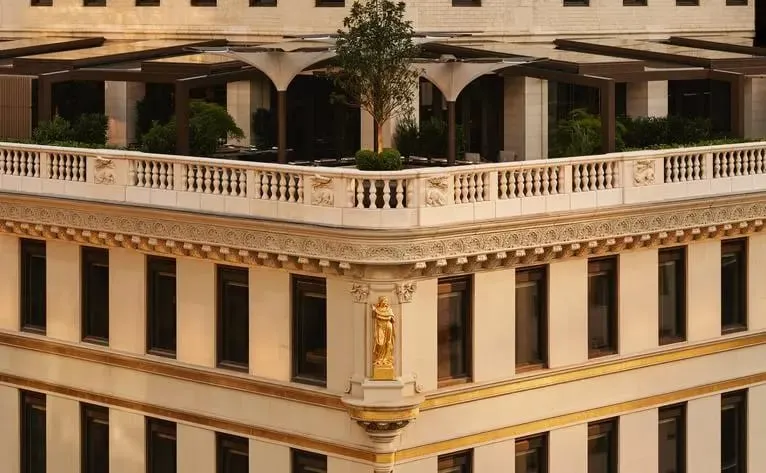
Aman New York
Eighty-three suites folded into a landmarked 1921 Beaux-Arts tower on Fifth Avenue, with a three-floor spa larger than any other Aman on earth.
From $2,300 per night
Rutherford, Napa Valley, United States
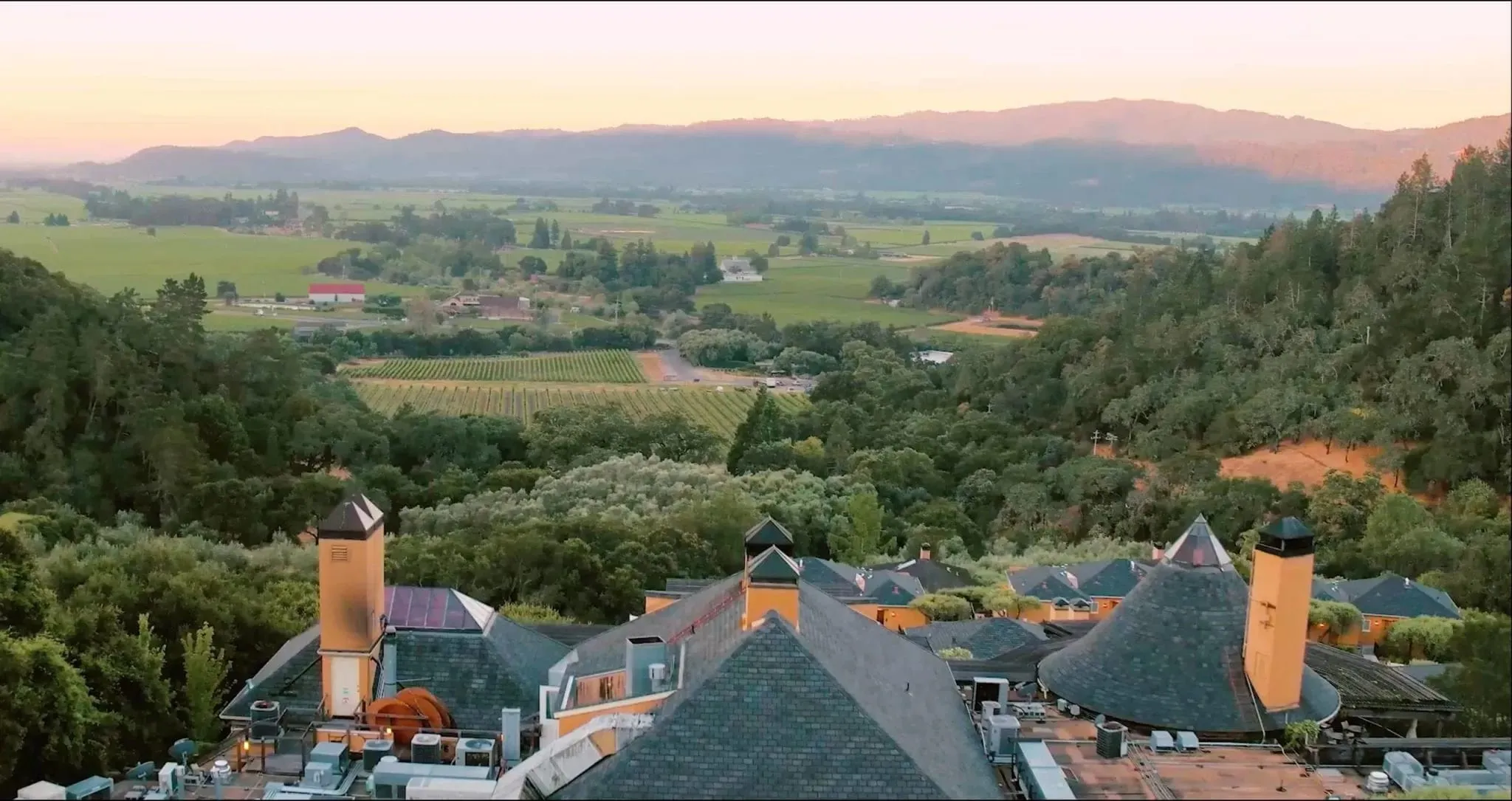
Auberge du Soleil
The Provence-inspired hillside inn that gave an entire hotel group its name, its philosophy, and one of Napa Valley's longest-running Michelin stars.
From $1,200 per night
Walland, Great Smoky Mountains foothills, United States
Blackberry Farm
A 4,200-acre working farm at the foot of the Great Smoky Mountains where the Beall family built an entire school of American cooking around cheese, garden and pasture.
From $1,145 per night