Otemachi, Chiyoda, Japan
Aman Tokyo
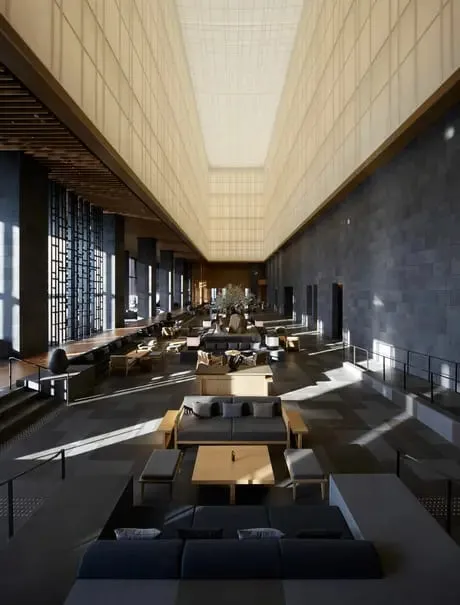
Six floors of dark basalt and washi paper, stacked atop a financial-district tower, where a giant paper lantern lobby turns the Otemachi skyline into a Japanese garden.
- Rates from
- From ¥250,000 per night
- Nearest airport
- Tokyo Haneda Airport (HND)
- Transfer
- Roughly 40 minutes by car from Haneda; about 60 minutes from Narita (NRT). The hotel is also directly connected to Otemachi Station and a five-minute walk from Tokyo Station's Marunouchi North Exit
- Best months
- March to May and October to November, for cherry blossom, mild temperatures and clear autumn skies
Tokyo does not lack for hotels with views, or for hotels that trade on scarcity of space, but Aman Tokyo built its reputation on a different kind of contrast: the jolt of stepping out of a high-speed lift on the 33rd floor of a glass office tower in the middle of the financial district, and finding, instead of another lobby of marble and gilt, a six-storey paper lantern glowing over a Japanese garden. The effect was deliberate. When it opened in December 2014, Aman Tokyo was the brand’s first Japanese property and its first true urban hotel of this scale, and it was built to prove that Aman’s language of restraint, natural materials, deliberate emptiness, a preference for shadow over spectacle, could survive the move from private islands and hillside retreats into 199 metres of steel and glass above one of the densest business districts on earth.
The site itself is almost aggressively urban. Otemachi Tower sits inside Tokyo’s government and banking core, ringed by the headquarters of trading houses and megabanks, a five-minute walk from Tokyo Station and close enough to the Imperial Palace moat to see its tree line from the upper floors. Aman occupies only the top six storeys, levels 33 through 38, of a much larger mixed-use tower designed by Kohn Pedersen Fox, which meant the late Kerry Hill, the Australian-born, Singapore-based architect responsible for six Aman properties, had to build a sense of arrival, calm and Japanese-ness inside a shell he did not design and could not alter structurally. What he produced instead, working with lighting designers Lighting Planners Associates, is widely regarded as one of the more successful reconciliations anywhere of skyscraper logistics with the spatial ideas of a traditional Japanese house.
More than a decade on, Aman Tokyo has settled into a specific role in the city’s hotel landscape: less a resort than a controlled sanctuary pitched directly against the noise of Otemachi, popular with design-minded travellers, business guests who want genuine quiet at the end of a working day, and Tokyo first-timers willing to trade proximity to Shibuya or Shinjuku’s nightlife for a calmer, more central base near the Imperial Palace and Marunouchi. Its scale, 84 suites spread across six floors of a tower with dozens more given over to offices, keeps footfall low in a way few hotels this centrally located manage.
Why It Stands Out
The single element most responsible for Aman Tokyo’s reputation is its lobby lounge, a 40-by-11-metre volume on level 33 topped by a six-storey ceiling made from layers of textured washi paper stretched over a shoji timber frame. Lit from within, it functions as a genuinely giant lantern, and the effect of arriving into it after a lift ride through an anonymous office tower is the kind of architectural surprise that gets written about on its own terms rather than as a footnote to the rooms. Few hotels anywhere manage a lobby this legible as a single idea, and fewer still manage it above the 30th floor of a working office building.
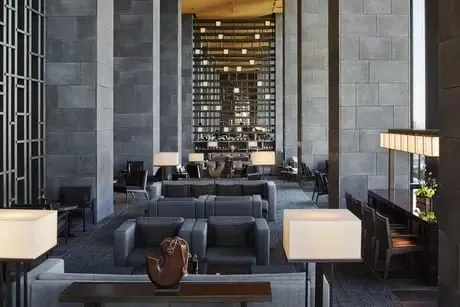
The second distinguishing factor is Kerry Hill’s handling of scale and material inside a constrained, pre-existing structure. Rather than trying to disguise the building’s identity as a modern tower, Hill leaned into it: dark basalt stone floors and walls, sen wood panelling, black granite, and a repeated use of the engawa, the traditional Japanese verandah linking interior and garden, translated here into a raised walkway that lets guests circulate around the lobby’s zen garden without cutting through it. The result reads as authentically Japanese without resorting to pastiche, an approach that has aged well against competitors that opened with more literal, decorative interpretations of “Japanese luxury.”
Architecture
Otemachi Tower, completed in April 2014 to a design by Kohn Pedersen Fox, rises 199.7 metres and 38 storeys above one of Tokyo’s most tightly regulated business districts. Aman’s hotel occupies only the building’s uppermost six floors, an arrangement that gave Kerry Hill Architects a fixed structural envelope, floor plates, columns, core position, already set by the base building’s office-tower brief, and asked them to insert a hospitality experience, and a distinctly Japanese one, inside it.
Hill’s response centred on verticality and threshold. The lobby lounge on level 33 was conceived as the building’s dramatic pivot point: guests arrive by dedicated lift from street level directly into the six-storey lantern volume, a transition engineered to feel less like checking into a hotel floor and more like passing through a gate into a separate world, physically still inside a tower but perceptually removed from it. Guest floors above and below extend the same material vocabulary, basalt, sen wood, washi, black granite, into more intimate, human-scaled spaces, while framed views and split-level room layouts are used throughout to manage the fact that every window looks out onto one of the world’s largest cities rather than a garden or coastline.
Interior Design
Kerry Hill Architects, working across the whole property until the firm’s founder died in 2018 shortly before its Tokyo-adjacent Aman Kyoto opened, treated Aman Tokyo’s interiors as an extended argument about restraint. Dark basalt stone dominates public floors and bathroom surfaces, chosen for the way it absorbs light rather than reflecting it, a deliberate counterpoint to the glowing washi ceiling above the lobby garden. Sen wood, a pale Japanese hardwood, panels walls and furniture throughout guest floors, while black granite lines the spa’s pool and several bathing areas.
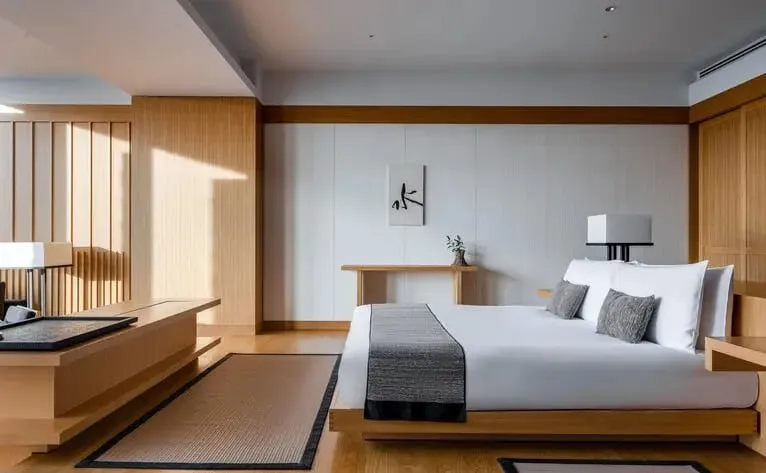
In the suites, the material language becomes quieter still: subdued, largely neutral colour palettes, shoji screens used to conceal or reveal the bathroom rather than as decoration, and a split-level plan that places the bed on a slightly raised platform with a lower sitting area set closer to the floor-to-ceiling glass, a layout designed, per Hill’s own stated intent, to give guests “a sense of being inside while also being outside” despite the total absence of any actual garden at that height. Every suite bathroom includes a deep stone furo, the traditional Japanese soaking tub, positioned as the room’s genuine centrepiece rather than an afterthought behind a door.
Atmosphere
For a hotel sitting inside one of the busiest financial districts in Asia, Aman Tokyo reads as remarkably still. That is largely a function of verticality and threshold: nothing about the lobby lounge, the guest floors or the spa signals proximity to the trading floors and bank headquarters filling the tower below, and the dedicated lift and small footprint (84 keys against a tower with dozens of office floors) keep guest traffic low even at full occupancy. Lighting is kept deliberately low and warm throughout the public spaces, a choice credited to the collaboration with Lighting Planners Associates, which favoured shadow and contrast over even, shadowless illumination, a strategy drawn explicitly from traditional Japanese aesthetics around light.
That calm extends to service style, which leans toward the unobtrusive rather than the theatrical, consistent with Aman’s broader house style. Guests tend to describe the atmosphere less in terms of any single amenity and more as an overall sense of having been extracted from the city below without ever actually leaving its centre, an unusual trick for a hotel with no grounds, no beach and no obvious buffer beyond thirty-plus floors of elevation.
Rooms and Suites
All 84 accommodations at Aman Tokyo are suites; there is no conventional double-room category. Entry-level categories, the Deluxe and Garden View Suites, each measure 71 square metres, with the Garden View category positioned on the hotel’s highest floor and the Deluxe facing west for sunset views across the skyline. The Tokyo Suite, at 77 square metres, faces east over the city. Moving up the range, the City Suite spans 121 square metres, the Corner Suite reaches up to 139 square metres, and the Grand Suite covers 141 square metres, before the top-tier Aman Suite at 157 square metres, among the largest single hotel suites in central Tokyo.
Every category follows the same underlying plan: a split-level layout with the bed set on a slightly raised platform, a lower lounge area closer to the floor-to-ceiling windows, shoji screens dividing or concealing the bathroom, and a deep stone furo soaking tub finished in the same dark basalt and sen wood palette used throughout the hotel. Views vary by orientation and floor rather than by category tier, taking in combinations of the Imperial Palace Gardens, the Tokyo skyline toward Shinjuku, and, on clear days, Mount Fuji on the horizon.
Dining
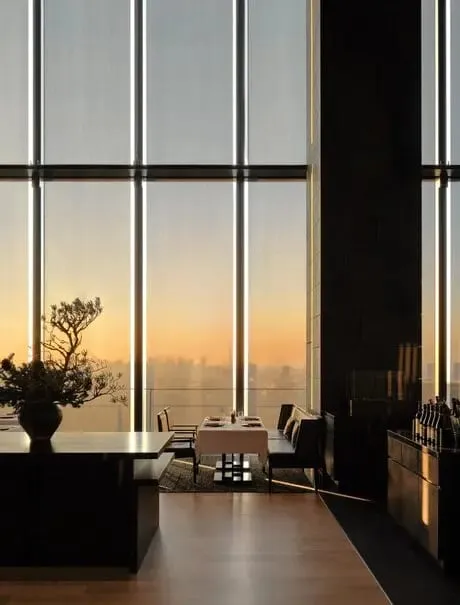
Aman Tokyo’s principal restaurant is Arva, occupying a double-height dining room with panoramic city views and serving refined southern Italian cooking under chef Masakazu Hiraki, who trained in Venice; the menu leans on bold, ingredient-forward dishes drawn from southern Italy’s culinary traditions rather than a more generic pan-European hotel menu.
The hotel’s most talked-about table is Musashi by Aman, a small, intimate room built around a hinoki cypress counter where chef Musashi prepares and serves Edomae-style omakase sushi, typically across an extended multi-course sequence of nigiri and other courses. Musashi grows his own rice at a farm roughly two hours outside Tokyo, a practice that has made the restaurant close to self-sufficient in rice for its own kitchens, and uses the same harvest to produce a house sake served alongside the meal. Beyond the two main restaurants, the hotel runs The Lounge for all-day dining and afternoon tea beneath the lantern ceiling, a Café for more casual service, and La Pâtisserie for pastries, bread and confectionery.
Spa and Wellness
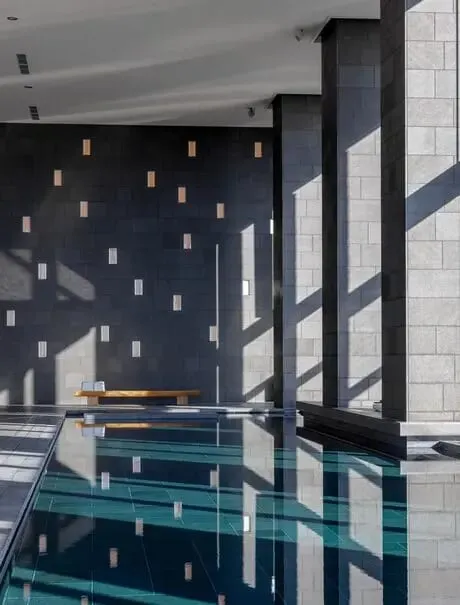
Aman Spa at Aman Tokyo occupies roughly 2,500 square metres on level 34, one of the largest hotel spa floors in central Tokyo, and centres on a 30-metre indoor pool lined in black granite with panoramic views over the city, alongside onsen-style hot baths, steam rooms and eight treatment rooms, each fitted with its own dressing area, treatment space, bathroom, steam shower and relaxation zone. A fitness centre and dedicated yoga and Pilates studios round out the facility.
Treatments draw explicitly on Japanese bathing tradition: each begins with a Misogi ritual, referencing the Shinto practice of water purification, before moving into the treatment itself, a structure intended to connect the spa’s contemporary programme back to centuries-old ofuro bathing customs rather than presenting it as an imported international spa menu. The spa’s relaxation rooms, on the same level, look out toward the Imperial Palace and, on clear days, Mount Fuji.
Experiences
Given its position inside Tokyo’s financial and administrative core, Aman Tokyo’s own experience programme leans toward curated access rather than on-property activity. The hotel arranges exclusive visits to the Ryogoku district for sumo culture, including access to training sessions (keiko) and the Kokugikan sumo arena, an experience built around preserving and explaining a tradition that can otherwise be difficult for visitors to access independently. Within the hotel, the spa’s yoga and Pilates studios run scheduled classes, and Musashi’s own rice fields and sake production offer a specific, food-focused thread for guests interested in the restaurant’s supply chain rather than simply its tasting menu.
The hotel’s own setting, immediately above the Imperial Palace Gardens and adjacent to the Otemachi Forest, a 3,600-square-metre urban green space beside the tower, also functions as a de facto experience for guests who simply want to look down on central Tokyo from height without leaving the building.
Who It Is For
Aman Tokyo suits design and architecture travellers specifically interested in Kerry Hill’s late work and in seeing Aman’s material language translated into a true high-rise context, a combination found nowhere else in the brand’s portfolio. It is equally well suited to business travellers who need a base inside Tokyo’s financial district but want genuine quiet and privacy at the end of the working day, given the hotel’s separation from the office floors below and its consistently low guest density.
Couples and first-time Tokyo visitors who prioritise a calm, centrally located hotel over proximity to nightlife will also find it a strong fit, particularly given the walking distance to the Imperial Palace, Marunouchi and Tokyo Station. It is less suited to travellers seeking a resort-style stay with extensive grounds or outdoor space, since the hotel has no garden, terrace or exterior amenity beyond its windows, or to guests who want to be based in Tokyo’s more nightlife-driven districts like Shibuya or Shinjuku.
Best Time to Visit
Tokyo’s most reliably pleasant weather runs from March through May, when cherry blossom season draws crowds to the nearby Imperial Palace moat and Chidorigafuchi, and again from October through November, when clear autumn skies improve the odds of Mount Fuji being visible from the hotel’s upper floors. Summer, June through September, brings high heat, humidity and typhoon risk, while winter is cold but generally dry and clear, which some travellers prefer for unobstructed skyline views from the suites and spa.
How to Get There
Aman Tokyo’s nearest international gateway is Tokyo Haneda Airport (HND), roughly 40 minutes away by car depending on traffic, and generally the preferred arrival point for its shorter transfer and closer proximity to central Tokyo. Narita International Airport (NRT), further from the city, takes closer to 60 minutes by car to reach the hotel. The hotel can arrange a private car transfer from either airport on request.
For guests already in the city, Aman Tokyo is directly connected to Otemachi Station, served by several Tokyo Metro and Toei subway lines, and is roughly a five-minute walk from the Marunouchi North Exit of Tokyo Station, the city’s main hub for the Shinkansen bullet train network, making the hotel a practical base for travellers combining Tokyo with onward rail journeys to Kyoto, Osaka or elsewhere in Japan.
Nearby Experiences
The hotel’s location places the Imperial Palace and its surrounding gardens within easy walking distance, along with the Otemachi Forest immediately beside the tower, a small but genuine pocket of urban woodland maintained as a public green space. Marunouchi’s shopping and dining streets, developed by Mitsubishi Estate around Tokyo Station, sit a short walk south, and Ginza’s flagship retail district is a short taxi or subway ride away.
Nihonbashi, one of Tokyo’s oldest commercial districts and home to several long-established department stores and craft retailers, borders Otemachi to the east, while Akihabara and the more traditional streets of Kanda lie within a similarly short distance to the north. Tokyo Station itself, beyond its rail function, houses a restored early-20th-century station building along with extensive underground shopping arcades, making the immediate area walkable well beyond the hotel’s own grounds.
Things to Know Before Booking
Aman Tokyo has no outdoor space, garden or terrace of its own; every amenity, including the spa’s pool, is contained within the tower’s upper six floors, which is worth factoring in for travellers who associate the Aman name primarily with resort-style, indoor-outdoor properties. Musashi by Aman seats very few guests each evening and is genuinely difficult to book, so reservations are worth arranging as early as possible, ideally at the time of booking the room.
The hotel’s location inside a working office tower means the surrounding streets are quiet in the evenings and at weekends, when the district’s banks and trading houses empty out, a contrast worth knowing in advance for guests expecting a livelier immediate neighbourhood. Suites, while generous by Tokyo standards, are priced accordingly, and rates rise steeply through the Corner, Grand and Aman Suite categories relative to the entry-level Deluxe and Garden View rooms.
Sustainability
Aman Tokyo’s sustainability programme is built most visibly around its dining operation. Chef Musashi cultivates organic rice on a farm roughly two hours outside Tokyo, a practice begun to ensure transparency over growing methods that has made the hotel’s kitchens close to 70 percent self-sufficient in rice, and the same harvest supplies a house-made sake produced on the property’s behalf. The hotel works with a network of small-scale local producers across its restaurants, listing supplier details on menus and sending chefs to visit growers directly, a practice intended to keep provenance traceable rather than abstract.
Beyond the kitchen, the hotel supports Second Harvest Japan, the country’s first food bank, and Caritas, which assists communities affected by disaster, and its staff take part in a volunteer programme maintaining the grounds around the nearby Imperial Palace. Aman Tokyo also backs conservation work on the UNESCO World Heritage-listed Ogasawara Islands, including protection of the critically endangered Bonin flying fox, through an Ogasawara-themed cocktail made with sustainably produced local rum, and the hotel positions the adjacent Otemachi Forest, the 3,600-square-metre green space beside the tower, as part of its case for urban biodiversity in the middle of the financial district.
Practical Information
Aman Tokyo is owned within the Otemachi Tower complex and has been operated by Aman since its opening in December 2014, the brand’s first hotel in Japan and the sixth property in the Aman portfolio designed by Kerry Hill Architects. Indicative rates for the entry-level Deluxe and Garden View suites start from roughly JPY 250,000 per night, rising substantially through the City, Corner and Grand Suite categories to the flagship Aman Suite. Check-in is from 3:00pm and check-out by noon, with both times available on request the day before, subject to availability.
The hotel sits at the top of Otemachi Tower, 1-5-6 Otemachi, Chiyoda-ku, Tokyo, directly above Otemachi subway station and roughly a five-minute walk from Tokyo Station. The nearest international airport is Haneda (HND), around 40 minutes away by car; Narita (NRT) is roughly 60 minutes away. Most stays run three to four nights, enough to make full use of the spa and dining programme while combining the hotel with the surrounding Imperial Palace and Marunouchi area, with March to May and October to November generally offering the clearest skies and mildest weather for the upper-floor views the hotel is built around.
Editorial Conclusion
Aman Tokyo’s achievement is less about any single amenity than about a piece of architectural sleight of hand: taking a fixed, thoroughly ordinary office-tower shell and using material, light and a six-storey paper lantern to convince guests, thirty-three floors up, that they have arrived somewhere quiet, deliberate and distinctly Japanese. More than a decade after Kerry Hill’s design opened as Aman’s first Japanese property, that trick still works, and it has aged into one of the clearer arguments in the brand’s portfolio for what happens when its resort-honed language of restraint is applied, without dilution, to a genuinely urban site. For travellers who want central Tokyo without its noise, and who are willing to trade garden and grounds for altitude and stillness, it remains a difficult hotel to match.
In pictures
On the map
Otemachi, Chiyoda, Japan
Questions
Frequently asked
Where exactly is Aman Tokyo located?
Aman Tokyo occupies the top six floors, levels 33 to 38, of the Otemachi Tower, a 199.7-metre skyscraper in Otemachi, Tokyo's financial district within Chiyoda ward. The hotel sits directly above Otemachi subway station, adjacent to the 3,600-square-metre Otemachi Forest, and is about a five-minute walk from Tokyo Station's Marunouchi North Exit, putting it within easy reach of the Imperial Palace, Marunouchi and Ginza.
How many rooms does Aman Tokyo have, and what are the categories?
The hotel has 84 suites in total, starting at 71 square metres for the entry-level Deluxe and Garden View categories and rising through the Tokyo Suite (77 square metres), City Suite (121 square metres), Corner Suite (up to 139 square metres) and Grand Suite (141 square metres), to the 157-square-metre Aman Suite. Every room is suite-format, with no standard double or twin-only category, and each includes a traditional stone furo soaking bath.
What is the paper lantern lobby everyone talks about?
It refers to the hotel's lobby lounge on level 33, where architect Kerry Hill built a six-storey-high ceiling by stretching layers of textured washi paper over a shoji frame, lighting it from within so the entire volume glows like a giant Japanese lantern. Below it sits a 40-by-11-metre space centred on a zen garden, water feature and a raised engawa walkway, a design meant to evoke a traditional Japanese verandah looking onto a garden, staged 33 storeys above street level.
What dining options does Aman Tokyo have?
The main restaurant is Arva, serving refined southern Italian cooking from a double-height dining room with panoramic city views. Musashi by Aman is the hotel's dedicated omakase counter, an intimate, few-seat room built around a hinoki cypress counter where chef Musashi serves Edomae-style sushi using rice he grows himself outside Tokyo. The hotel also runs a Lounge for all-day dining and afternoon tea, a Café, and La Pâtisserie for pastries and bread.
Is Aman Tokyo suitable for a first visit to Tokyo?
Yes. Its Otemachi location places it within walking distance of the Imperial Palace Gardens, Marunouchi and Tokyo Station, and its direct subway connection makes onward travel across the city straightforward. It suits travellers who want a quiet, design-led base near the city centre rather than a hotel embedded in the more frenetic entertainment districts, and its scale, 84 suites across six floors, keeps the experience calm even though the surrounding tower sits in the middle of Tokyo's busiest business district.
Same destination
More hotel guides in Japan
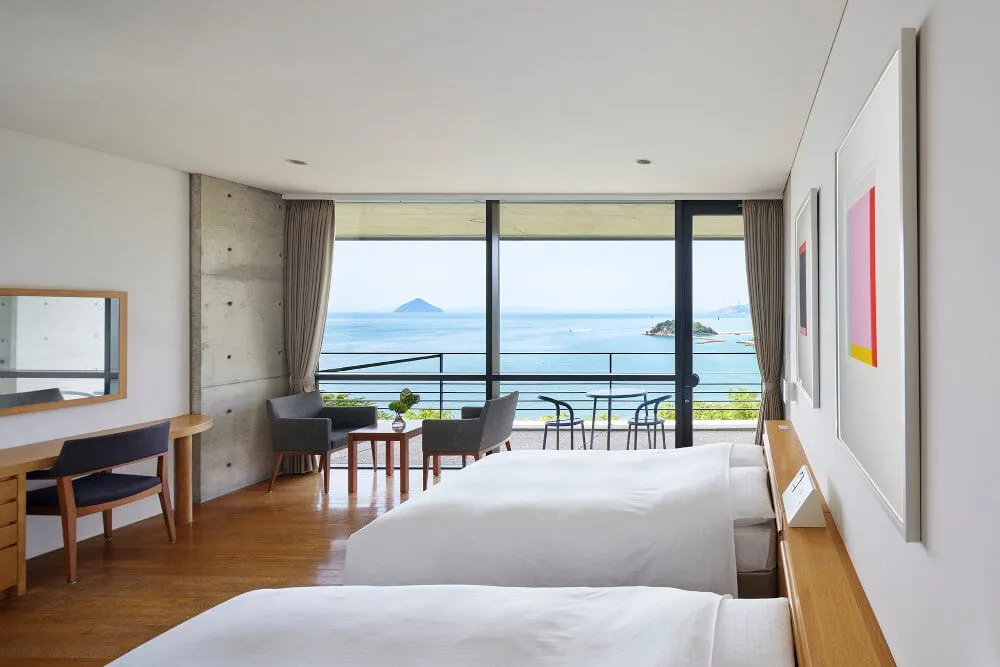
Naoshima, Seto Inland Sea, Japan
Benesse House
A Tadao Ando concrete museum with guest rooms built into its galleries, the founding building of the Seto Inland Sea's art-island movement.
From ¥40,000 per night
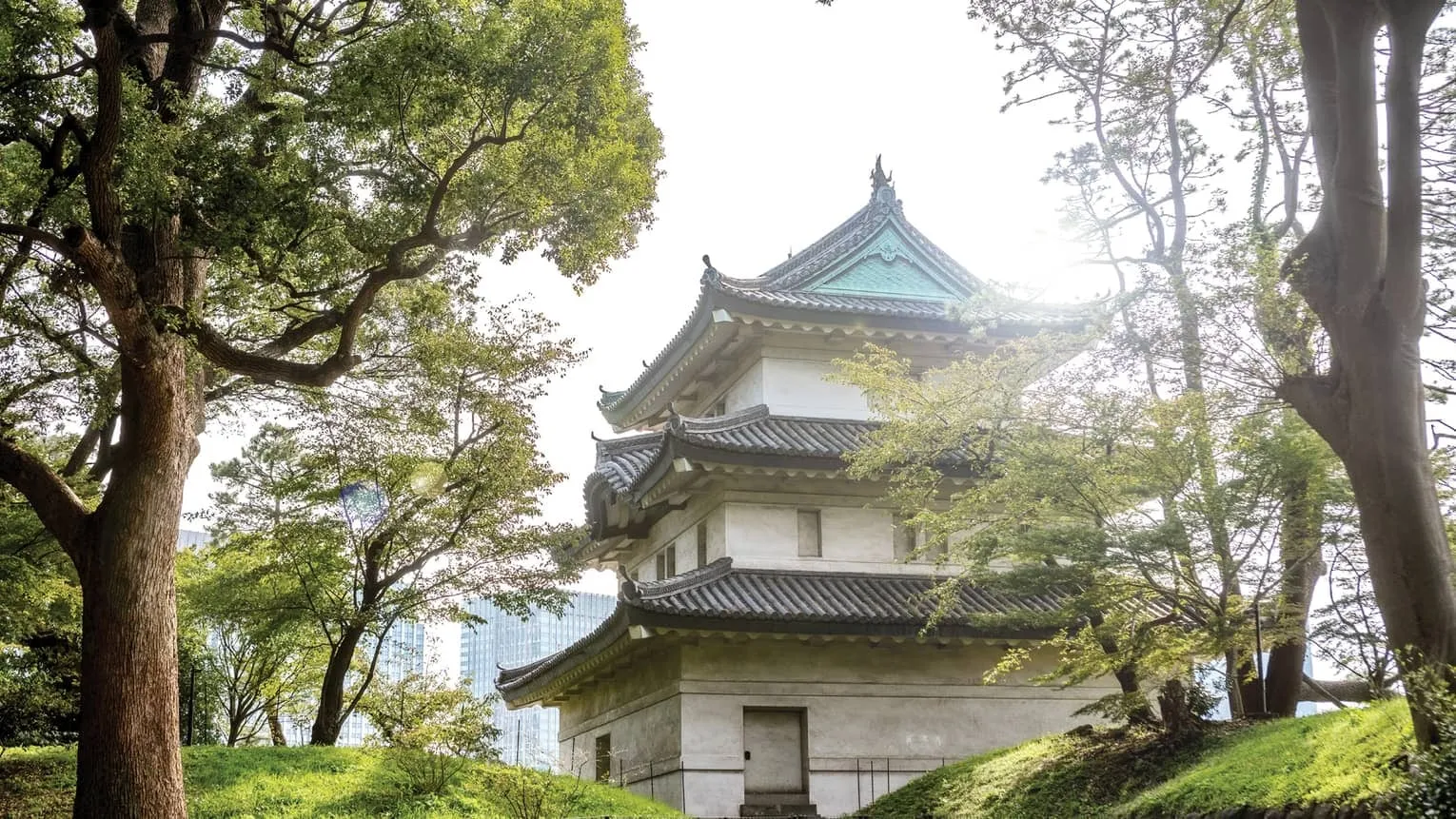
Otemachi, Chiyoda, Japan
Four Seasons Hotel Tokyo at Otemachi
A 190-room aerie stacked into the top six floors of a Tokyo financial-district tower, with the Imperial Palace moat on one side and a Michelin star in the kitchen.
From ¥145,000 per night
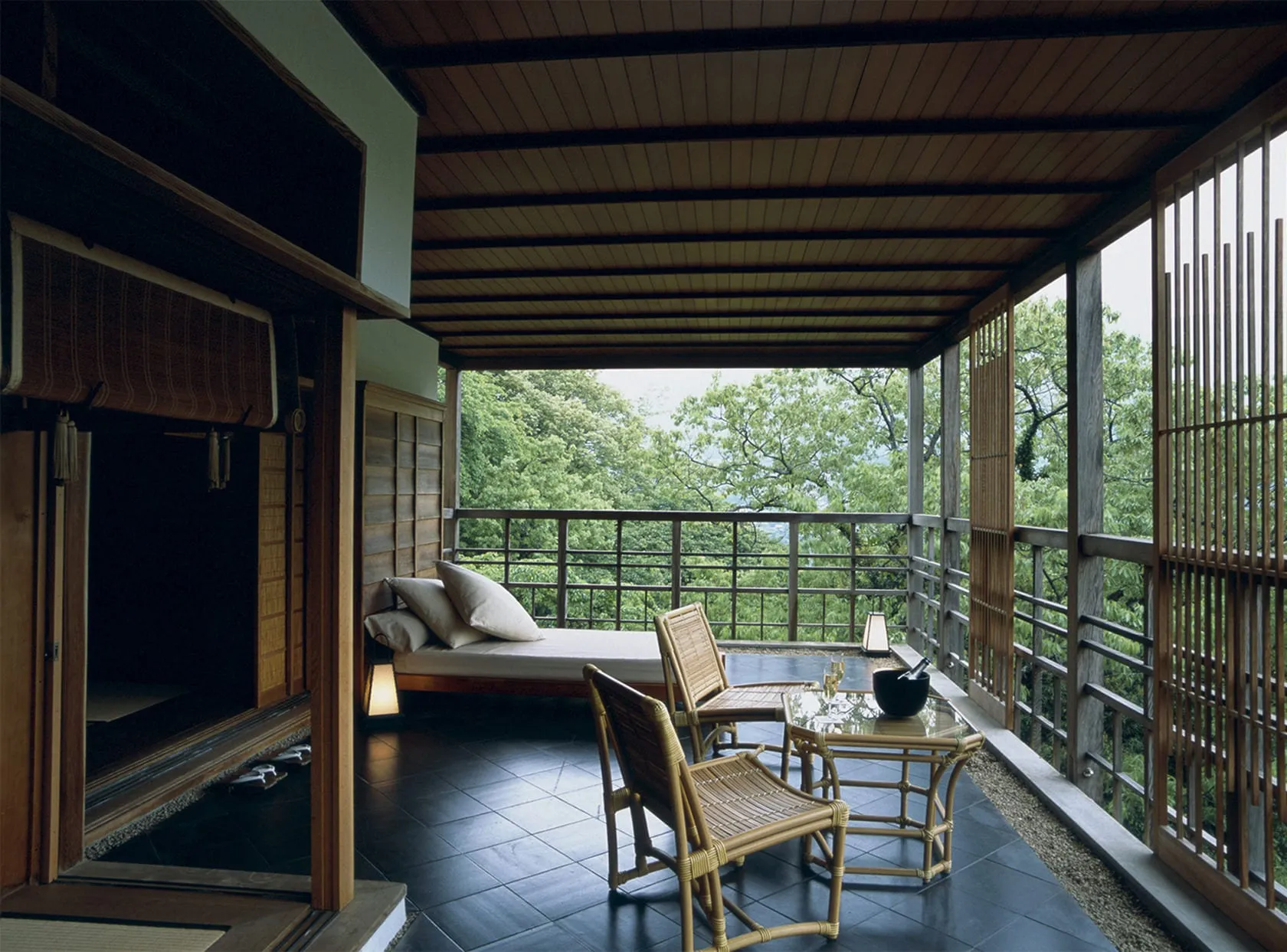
Gora, Hakone, Japan
Gora Kadan
A former Imperial villa in the hills above Hakone, rebuilt as a 38-room ryokan where private volcanic-spring baths and kaiseki dinners define the stay.
From ¥100,000 per night