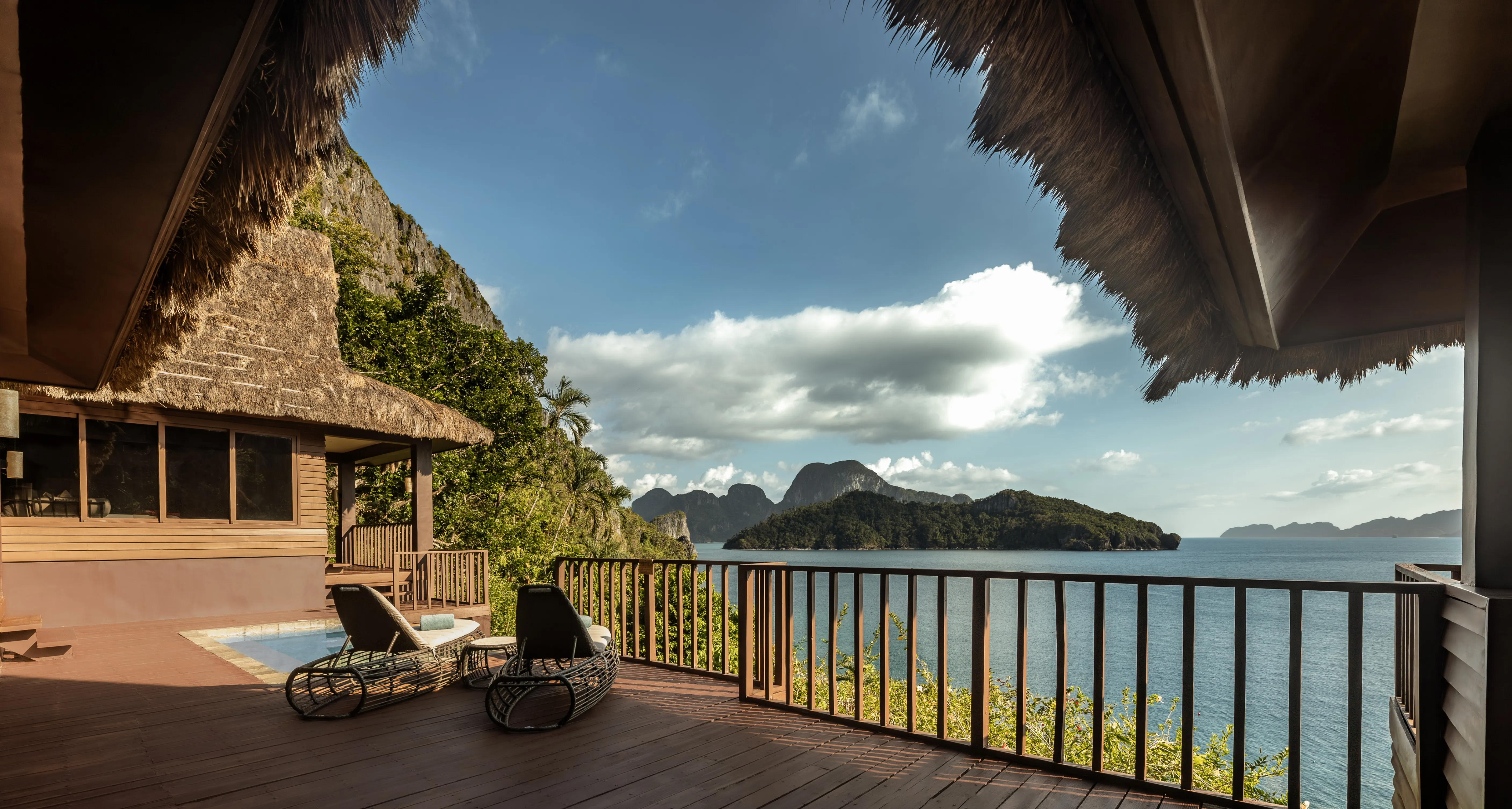
Cauayan Island, Bacuit Bay, El Nido, Philippines
Cauayan Island Resort
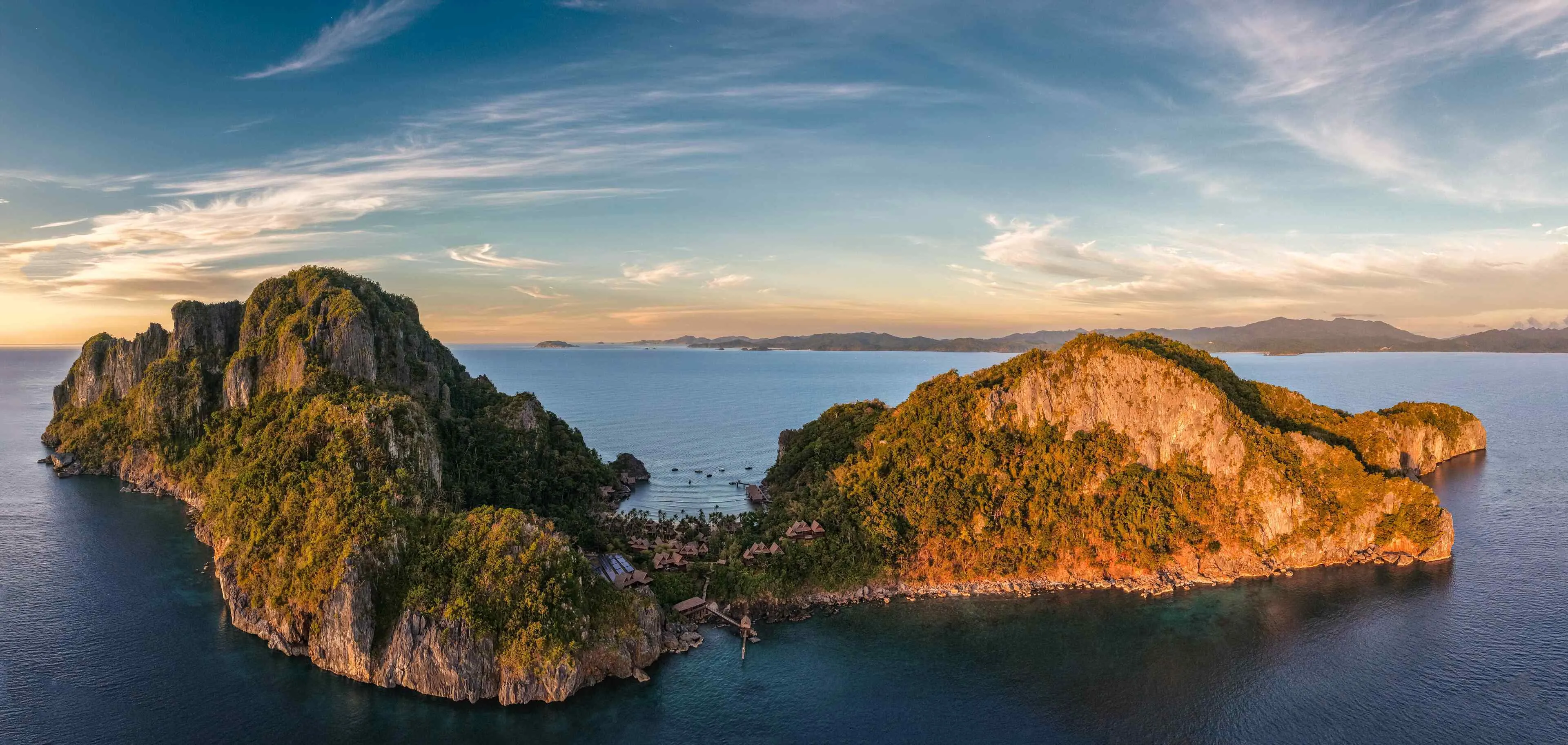
A privately owned island in Bacuit Bay, thirty stilt-raised villas set between limestone cliffs and open water, reachable only by boat.
- Rates from
- From $500 per night
- Nearest airport
- El Nido Airport (Lio Airport, ENI), with Puerto Princesa International Airport (PPS) as a secondary gateway
- Transfer
- About 20 minutes by road from El Nido Airport to El Nido Port, then 20 to 30 minutes by scheduled speedboat to the island, tide dependent
- Best months
- December to May, the dry season across northern Palawan
Bacuit Bay is where the Philippines’ private-island resort tradition began, a scatter of limestone karst rising sheer out of turquoise water off the town of El Nido, and Cauayan Island sits inside that same geography without belonging to any of the bay’s better-known names. There is no fixed jetty visible from the mainland, no signage in town pointing the way. Guests find it the way most of Bacuit Bay’s islands have always been found: by boat, across open water, with the resort itself only resolving into view in the final stretch of the crossing.
The island is genuinely private, owned outright by the resort rather than shared with a fishing village or a public beach, and small enough that its thirty villas and single restaurant constitute the whole of its built environment. That scale is the point. Cauayan was never positioned to compete with the archipelago’s largest resort brands on room count or spa square footage; its case for a stay rests instead on the island itself, on a specific stretch of Bacuit Bay’s reef and karst that a guest gets more or less to themselves for the length of a visit.
The resort’s own history is short and traceable. A group of Spanish owners first came across the island on a tourist visit in 2008, bought it in 2010, and spent the following years building what opened to guests in a soft launch in May 2016 as Cauayan Island Resort, initially with a smaller run of villas that has since grown to the current thirty. The property has more recently begun presenting itself on its own website as Cauayan Boutique Private Island, though most third-party booking platforms, review sites, and general recognition still run under the original name, and nothing about the island, ownership, or physical resort has changed in the rebrand. It remains, in every material sense, the same small, independently owned island resort that opened in 2016, simply with an updated name attached to the same address in Barangay Buena Suerte, El Nido.
Why It Stands Out
What separates Cauayan from the wider run of El Nido accommodation is the fact of the island itself. Bacuit Bay’s coastline is dotted with resorts that advertise sea views and boat access, but relatively few of them occupy an entire island with no other commercial development on it. Cauayan does, which means the usual frictions of a beach destination, other resorts’ jet skis, competing restaurants, a public beach a few hundred metres down the sand, simply do not apply here. The reef, the beach, and the limestone cliffs at the island’s edges belong to the property for the duration of a stay.
The second point of distinction is how the place was built. Much of the original construction avoided heavy machinery, relying instead on local boats to bring materials across and skilled Filipino craftspeople to raise the villas largely by hand, an approach that shaped both the pace of the build and the finished look of the resort: structures that sit close to the ground, clad and framed in local hardwood, thatch, and other materials suited to a site with no road access. It reads less like a resort dropped onto an island and more like one built in negotiation with it.
Architecture
The villas step down from the island’s higher ground toward the shoreline in a mix of settings, beachfront, lagoon-facing, and a run of water villas raised on stilts directly over the shallows, so that no two categories share quite the same relationship to the water. Construction leans on timber framing, thatched and shingled roofing, and open-sided living areas that favour cross-ventilation and shade over sealed, air-conditioned enclosure as the default experience, a practical response to a site reachable only by boat, where every non-essential material and system adds real cost and complexity to bring across.
The larger pool villas, at around 185 square metres, are built to a more contemporary resort vocabulary, glass, clean joinery, private plunge pools, while the smaller Lagoon and Beach View categories keep closer to the vernacular cottage form that shaped the resort’s earliest villas when it opened in 2016. Across categories, the island’s own topography, its rise from shoreline to interior ridge, and its fringe of limestone outcrops, does much of the work that a more manufactured resort layout would otherwise have to fake.
Interior Design
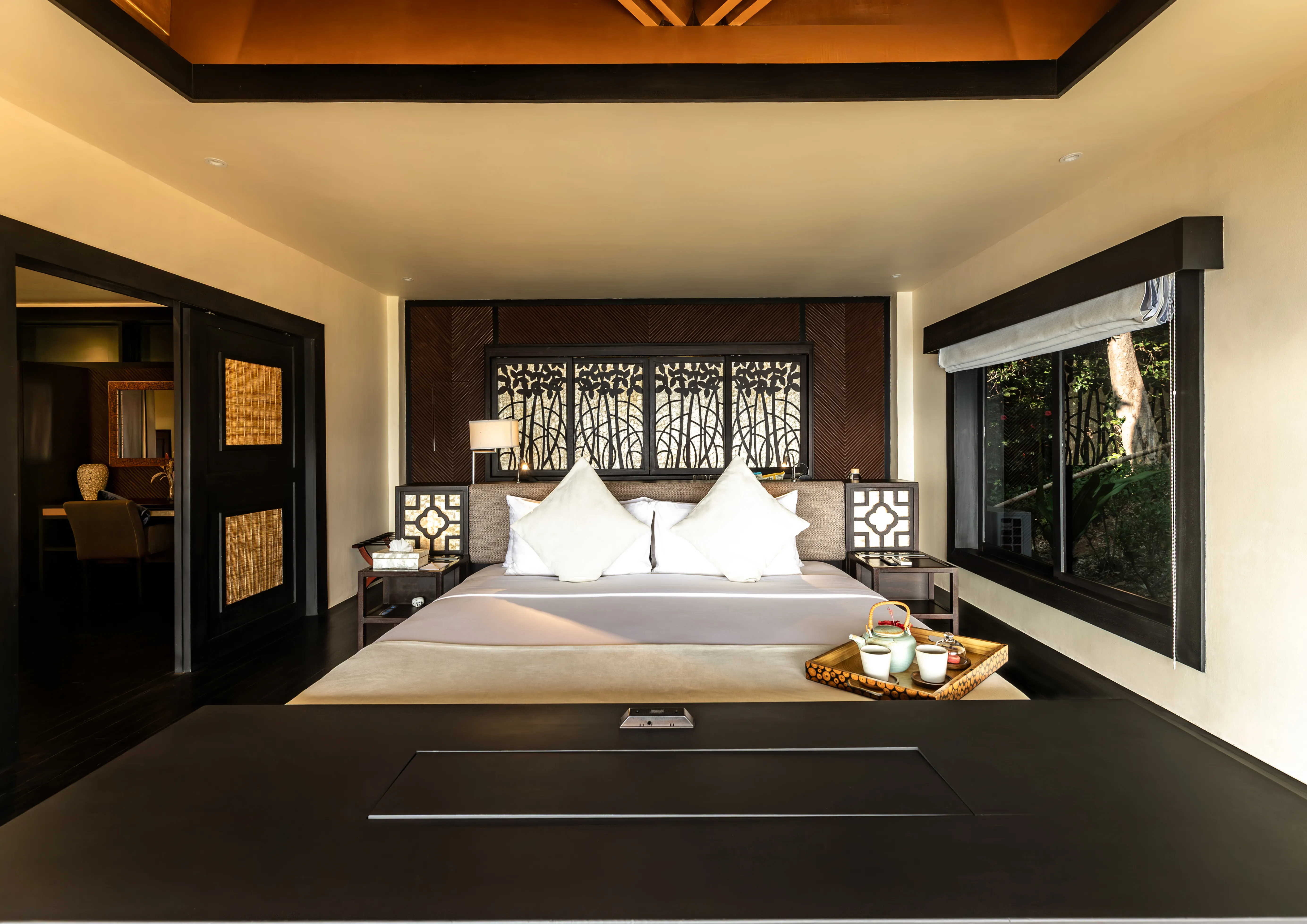
Interiors carry the same restraint as the exteriors: local hardwood floors and furniture, woven and thatched detailing overhead, and a material palette that keeps decoration secondary to the view through the room’s own openings. Filipino craftsmanship runs through the joinery and finishing in particular, a deliberate choice by the resort’s Spanish ownership to keep the build, and much of what furnishes it, sourced and made within the country rather than imported wholesale.
The larger pool villas trade some of that handmade cottage character for more conventional resort comforts, air conditioning, glazed openings, freestanding tubs, without abandoning the timber-and-thatch language that unifies the property. It is a look built for a hot, humid, boat-access island rather than for a photograph taken indoors: rooms are designed to be opened up, screened rather than sealed, for large parts of the day.
Atmosphere
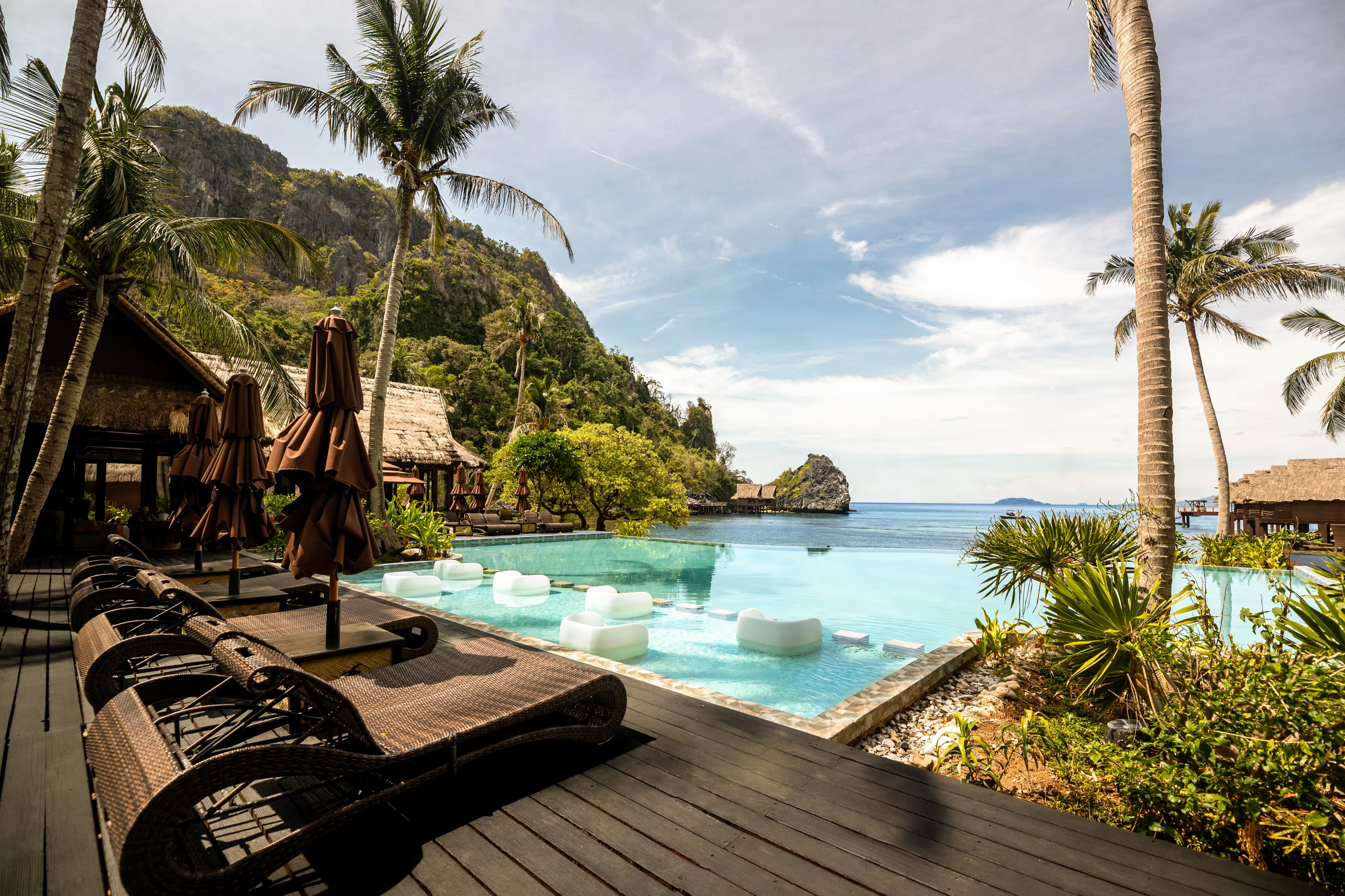
Cauayan runs at the pace a private island without a village or a bar strip tends to set: quiet by default, with the resort’s own restaurant, bar, and beach effectively the entirety of a guest’s social world for the length of a stay. There is no walk into town, no competing resort next door, which suits couples and honeymooners more naturally than groups looking for variety. The energy on site centres on the pool and the InOM sa Cauayan bar by day and the restaurant’s destination-dining setups, on the beach, over the water, under the stars, by night, rather than on any kind of programmed entertainment.
Rooms and Suites
The resort operates 30 villas across eight categories, each priced and sized distinctly rather than following a simple room-suite hierarchy. Lagoon Villas and Beach View Villas, both around 55 square metres and built for two guests, sit at the entry end of the range. Beach Front Villas step up to roughly 70 square metres and three guests, while Water Villas, at around 60 square metres, are raised over the shallows on stilts, the category that puts a guest most directly on the water.
At the top of the range, four pool villa categories, Resort View, Bay View, Premium Sunrise, and Premium Bay View, share a footprint of around 185 square metres and accommodate up to four guests, each with a private pool and, in most categories, the option of dedicated butler service. The Premium categories carry the highest rates on the property and the most favoured aspects, sunrise or open bay views depending on the villa’s position on the island. Across every category, the throughline is a private outdoor space, whether a terrace, a plunge pool, or direct water access, built into the room rather than added as an afterthought.
Families and small groups travelling together tend to gravitate toward the pool villa categories rather than the entry-level rooms, both for the extra space and for the added privacy of a plunge pool that does not require a walk to a shared resort pool. Couples, by contrast, are often just as well served by a Water Villa or Beach Front Villa, categories that put a guest closer to the sea itself even without a private pool attached, on the logic that a stilt-raised room over the shallows or a few steps from the sand offers its own kind of access that a pool cannot replicate. Wi-Fi reaches across the island, in-room air conditioning is standard from the Beach Front category upward, and every villa comes with the resort’s complimentary breakfast and round-trip land and boat transfers built into the nightly rate.
Dining
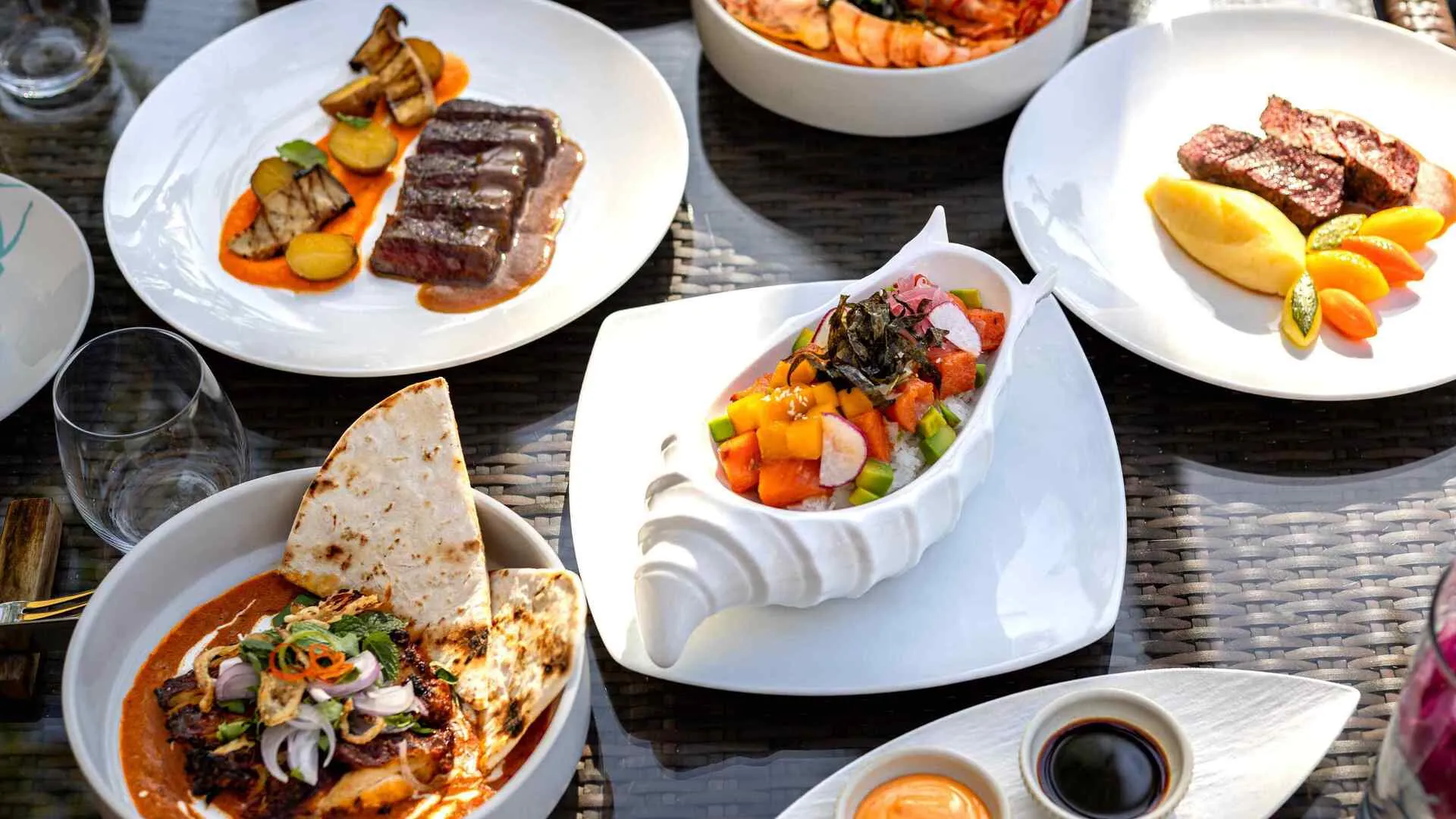
Dining centres on Hapag sa Cauayan, the resort’s main restaurant, whose name draws on the Filipino word for table and the idea of a shared gathering point for a meal. The kitchen, led by Executive Chef Paul Bautista, works a menu that blends local and international influences using fresh ingredients, including herbs and vegetables drawn from the resort’s own garden, served through set breakfast, lunch, and dinner hours. InOM sa Cauayan, the resort’s bar, sits where the pool and the ocean read as a single surface, pouring cocktails from early morning through the last guest’s evening.
Beyond the two fixed venues, the resort builds a rotating calendar of destination dining around the island’s own geography: a Floating Brunch served to pool villas, a Flame & Feast built around dry-aged steaks, a Lobster Indulgence focused on the day’s catch, a Smoke House Dinner with a private barbecue chef, straightforward Beach Dining and Overwater Villa Dining, and a Boodle Fight, the traditional communal Filipino feast eaten by hand off banana leaves. Meal plan options range from a full-board Hapag Signature package through an all-inclusive Infinity Indulgence tier to a premium Infinity Luxe Experience that bundles sunrise breakfast, a lobster dinner, a sunset hike with champagne, and private beachside dining, generally requiring a minimum three-night stay.
Spa and Wellness
The resort’s spa, Haplos sa Cauayan, operates three treatment rooms, including a dedicated couples’ room, offering a signature 90-minute Haplos massage alongside more conventional deep-tissue and Swedish massages, facials, and body wraps. It is a small, single-venue operation rather than a sprawling wellness centre, consistent with the scale of the rest of the property, built to serve guests already staying on the island rather than to draw day-trip spa traffic that, given the island’s private access, could not reach it anyway.
Experiences
Activities are grouped under the resort’s own Tuklas sa Cauayan banner, Filipino for discovery, and lean heavily on the water that surrounds the island: diving and snorkelling on the reef, island-hopping trips out into the wider Bacuit Bay to see the karst formations and lagoons that made El Nido’s reputation in the first place, and trekking for guests who want to see the island’s interior on foot. Because Cauayan is a single private island rather than a resort town, there is no independent nightlife or dining scene to step out to, so the destination-dining calendar and the reef itself carry most of the experiential weight of a stay.
Who It Is For
Cauayan suits couples and honeymooners looking for genuine seclusion rather than a resort with a private-island label attached loosely to a busier stretch of coast: the absence of any other development on the island is the property’s clearest point of difference. Divers and snorkellers will find the reef and the wider Bacuit Bay karst a serious draw, and travellers already committed to a slower, boat-access pace of travel will find the transfer itself, rather than a friction to plan around, part of the appeal. It is a less natural fit for large groups seeking variety in dining or nightlife, or for travellers unwilling to build tide-dependent boat schedules into their itinerary.
Best Time to Visit
December through May marks the dry season across northern Palawan, bringing the calmest water for the boat crossing to the island and the most reliable conditions for diving, snorkelling, and island-hopping around Bacuit Bay. The southwest monsoon, running roughly from June through November, brings heavier rain, rougher seas, and a real risk of typhoon-related disruption to both flights into El Nido and the boat transfers that connect the airport to the resort, which makes the shoulder months worth checking carefully against the season’s forecast before booking.
How to Get There
Access runs almost entirely through El Nido rather than Palawan’s provincial capital. Most guests fly into El Nido Airport, commonly known as Lio Airport (IATA code ENI), served by domestic carriers connecting from Manila and Cebu, then take a resort-arranged van transfer of about 20 minutes to El Nido Port. From there, a scheduled speedboat completes the journey to the island in roughly 20 to 30 minutes, with timing dependent on tides; the resort runs a limited number of daily arrival and departure slots between early morning and late afternoon, and avoids arrivals after mid-afternoon in line with local coast guard restrictions on night navigation.
Guests arriving instead through Puerto Princesa International Airport (PPS), Palawan’s main provincial gateway, face a considerably longer routing: roughly five to six hours by road to El Nido before the same boat crossing, making the direct El Nido Airport route the far more practical choice for most travellers. A faster, premium alternative is a private seaplane transfer direct from Puerto Princesa, a scenic option that avoids the road transfer entirely. Given the resort’s boat-dependent access and its coast guard-restricted arrival windows, guests are generally advised to confirm flight and transfer timing well in advance rather than book a same-day connection with little buffer.
Nearby Experiences
Bacuit Bay itself is the main draw beyond the resort’s own reef, a scatter of limestone islands, hidden lagoons, and sheltered beaches that has anchored the Philippines’ private-island resort tradition for decades. Island-hopping tours out of El Nido town typically visit a rotating set of these islands and lagoons, commonly grouped into fixed circuits that take in cliff-ringed lagoons, snorkelling sites, and small beaches accessible only by water, and the resort can arrange similar excursions directly from the island for guests who want to see the bay’s most photographed formations without routing back through town first.
El Nido’s own town beach, dive shops, and small restaurant scene are a short boat ride away for guests who want a change of scene from the island, and travellers extending a Palawan trip beyond Cauayan often pair a stay here with time further north in the Calamian Islands around Coron, known for its wreck diving and a starkly different limestone landscape, or with Puerto Princesa itself, gateway to the UNESCO-listed Subterranean River. Most of a stay at Cauayan, though, is built around staying on or immediately around the island itself, with the wider bay treated as a day’s excursion rather than the centre of the itinerary.
Things to Know Before Booking
Access to the resort runs on scheduled boat transfers tied to daylight and tide conditions rather than an on-demand water taxi, so guests should plan arrival and departure flights around the resort’s transfer windows rather than the other way round, and build in a buffer given the possibility of weather-related delays, particularly outside the December-to-May dry season. Villa categories vary substantially in size and price, from 55-square-metre entry villas to 185-square-metre pool villas, so it is worth confirming exactly which category is booked rather than assuming a standard room type. Meal plans range from complimentary breakfast only up to a fully inclusive premium package, and travellers should clarify which plan is attached to their rate, since the destination-dining experiences described above generally carry a supplement outside the higher-tier packages.
Sustainability
The resort’s environmental programme sits close to the core of how it operates rather than functioning as an add-on. A solar power plant supplies the island’s primary electricity, supplemented by LED lighting and deliberately restrained air conditioning use in non-guest areas, while a desalination facility converts seawater into the resort’s potable water supply and a sewage treatment plant recycles wastewater for irrigation and facility cleaning rather than discharging it untreated. Guests are invited into a standard towel and linen reuse programme, and the resort monitors its own water consumption as a matter of course.
On waste, the resort has moved away from single-use plastics in favour of reusable bottles, bamboo straws, and wooden signage, utensils, and plates, with staff trained on waste segregation and a composting facility converting biodegradable waste into soil used on site, including in the kitchen garden that supplies herbs and vegetables to Hapag sa Cauayan. Marine and wildlife programmes include partnerships with local organisations on coral reef restoration and turtle protection, guest education on responsible snorkelling and diving practice, and monthly beach clean-ups involving both staff and guests. The resort also sources from local businesses and artisans, employs locally, and runs community outreach programmes benefiting nearby indigenous families, tying the island’s environmental programme to the wider community around Bacuit Bay rather than confining it to the property boundary.
Practical Information
Rates at Cauayan Island Resort start from roughly USD 500 per night for the entry-level Lagoon and Beach View villa categories, rising through Beach Front and Water villas to the 185-square-metre pool villa categories at the top of the range; travellers should confirm current pricing, season, and meal-plan inclusions directly with the resort or a specialist agent, since rates on a small, boat-access island move with demand and availability. Check-in is from 2:00 PM and check-out by 12:30 PM, with early check-in or late check-out available on request depending on occupancy.
The nearest practical gateway is El Nido Airport (Lio Airport, ENI), roughly 20 minutes by van from El Nido Port followed by a 20-to-30-minute scheduled speedboat crossing to the island; Puerto Princesa International Airport is a secondary, considerably longer option. December through May is the most reliable weather window for both the flight and the boat transfer, with the June-to-November monsoon season bringing a higher chance of disruption. Most guests stay three to four nights, enough to settle into the island’s pace without exhausting its relatively contained list of on-site activities.
Editorial Conclusion
Cauayan Island Resort makes its case less on scale than on the fact of an island that belongs, in its entirety, to a single small resort. Bacuit Bay’s karst and reef are the backdrop for a great many Palawan hotels, but few of them can offer a guest an entire island, with the beach, the water villas, and the reef effectively private for the length of a stay, reached by a boat crossing that is itself part of the experience rather than a logistical inconvenience to be minimised. Set against that, the resort’s genuine investment in solar power, desalination, and reef and turtle conservation reads as consistent with the kind of low-density, high-privacy stay it is selling, rather than as a marketing layer applied on top of it. For travellers willing to plan around tide-dependent transfers and a boat-only relationship with the mainland, it offers a version of Bacuit Bay’s private-island tradition that remains, for now, comparatively undocumented and correspondingly quiet.
In pictures
On the map
Cauayan Island, Bacuit Bay, El Nido, Philippines
Questions
Frequently asked
Where exactly is Cauayan Island Resort?
The resort occupies its own small island, Cauayan Island, inside Bacuit Bay in the municipality of El Nido, on the northern tip of mainland Palawan, Philippines. It sits among the same scatter of limestone karst islands that gives El Nido its reputation, though as a private island it has no town, village, or public access of its own.
Is this the same property as the one sometimes listed as Cauayan Boutique Private Island?
Yes. The resort opened in 2016 as Cauayan Island Resort (also marketed at various points as Cauayan Island Resort and Spa) and has more recently rebranded on its own website as Cauayan Boutique Private Island. Third-party booking sites and review platforms still largely use the original name, and the underlying property, ownership, and island are the same.
How do guests actually get there?
Most guests fly into El Nido Airport (Lio Airport, ENI), served by domestic carriers from Manila and Cebu, then take a resort-arranged van of about 20 minutes to El Nido Port followed by a scheduled speedboat crossing of roughly 20 to 30 minutes to the island, timing dependent on tides. Guests arriving via Puerto Princesa International Airport face a longer road transfer of around five to six hours to El Nido before the same boat crossing, so flying directly into El Nido is the far more practical route. A private seaplane transfer direct from Puerto Princesa is also offered as a faster, premium alternative.
How many villas does the resort have, and what are the categories?
The resort operates 30 villas across eight categories, ranging from 55-square-metre Lagoon and Beach View villas up to 185-square-metre pool villas in Resort View, Bay View, Premium Sunrise, and Premium Bay View configurations, the last with the highest rates on the property. Beach Front and Water villa categories sit in between, the latter built out on stilts over the shallows.
What does the resort do on sustainability, beyond the usual marketing language?
Cauayan runs on a solar power plant as its primary energy source, desalinates its own seawater for potable use, and treats wastewater on site for irrigation and cleaning rather than discharging it. Single-use plastics are largely absent from guest areas, replaced with reusable bottles, bamboo straws, and wooden tableware, and the resort composts biodegradable waste and runs a kitchen garden that supplies herbs and vegetables to its restaurant. It also partners with local organisations on coral reef restoration and turtle protection, and holds regular beach clean-ups with staff and guests.
When is the best time to visit?
December through May is the reliable dry season across northern Palawan, with the calmest seas for the boat crossing and the most consistent conditions for diving and island-hopping. The southwest monsoon from roughly June through November brings more rain, rougher water, and a higher chance of typhoon-related disruption to boat and flight schedules.
Same destination
More hotel guides in Philippines
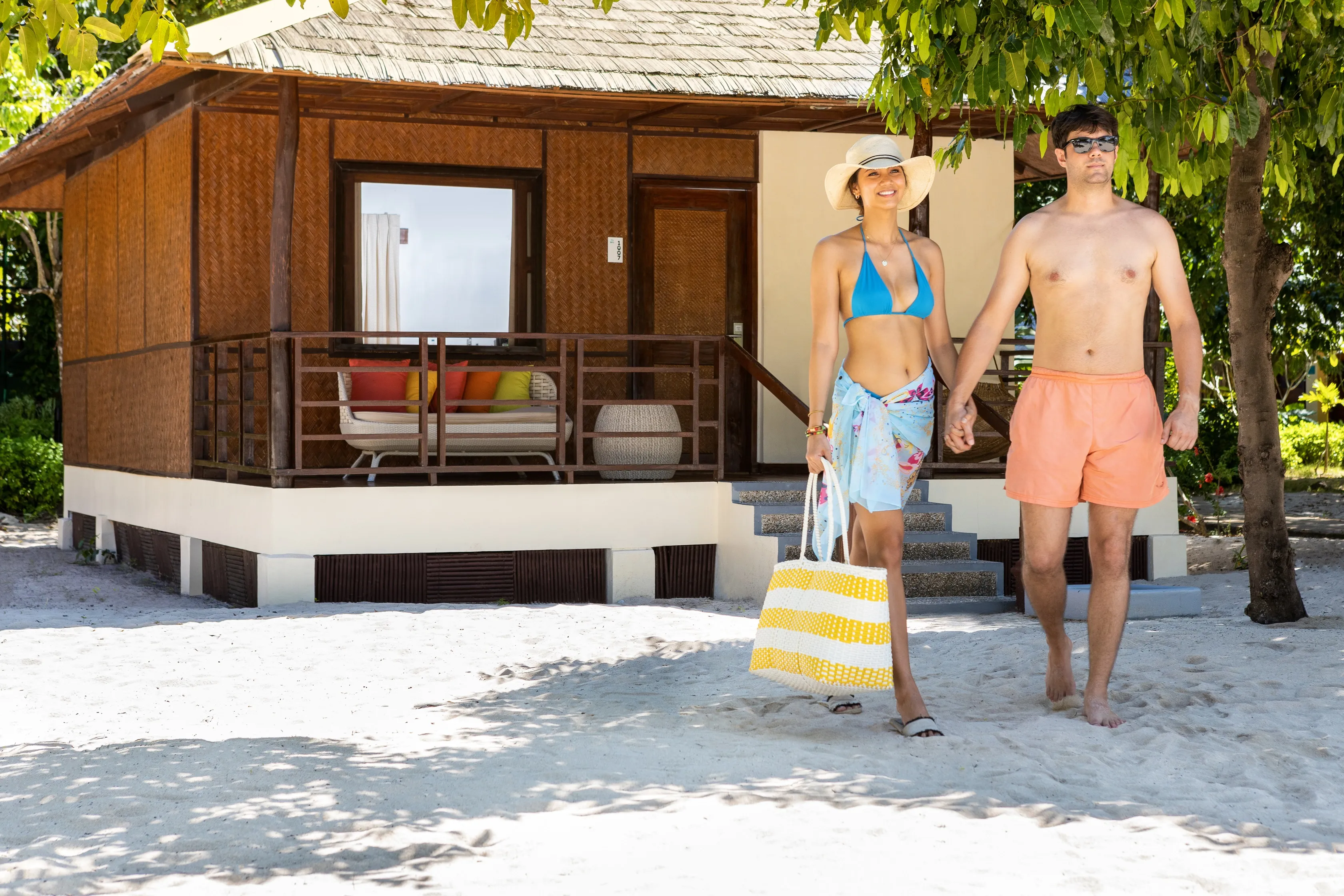
Dimakya Island, Busuanga, Coron, Philippines
Discovery Coron
A nineteen-hectare private island off northern Busuanga, diving Coron's Japanese wrecks by day and disconnecting from everything else after dark.
From $260 per night
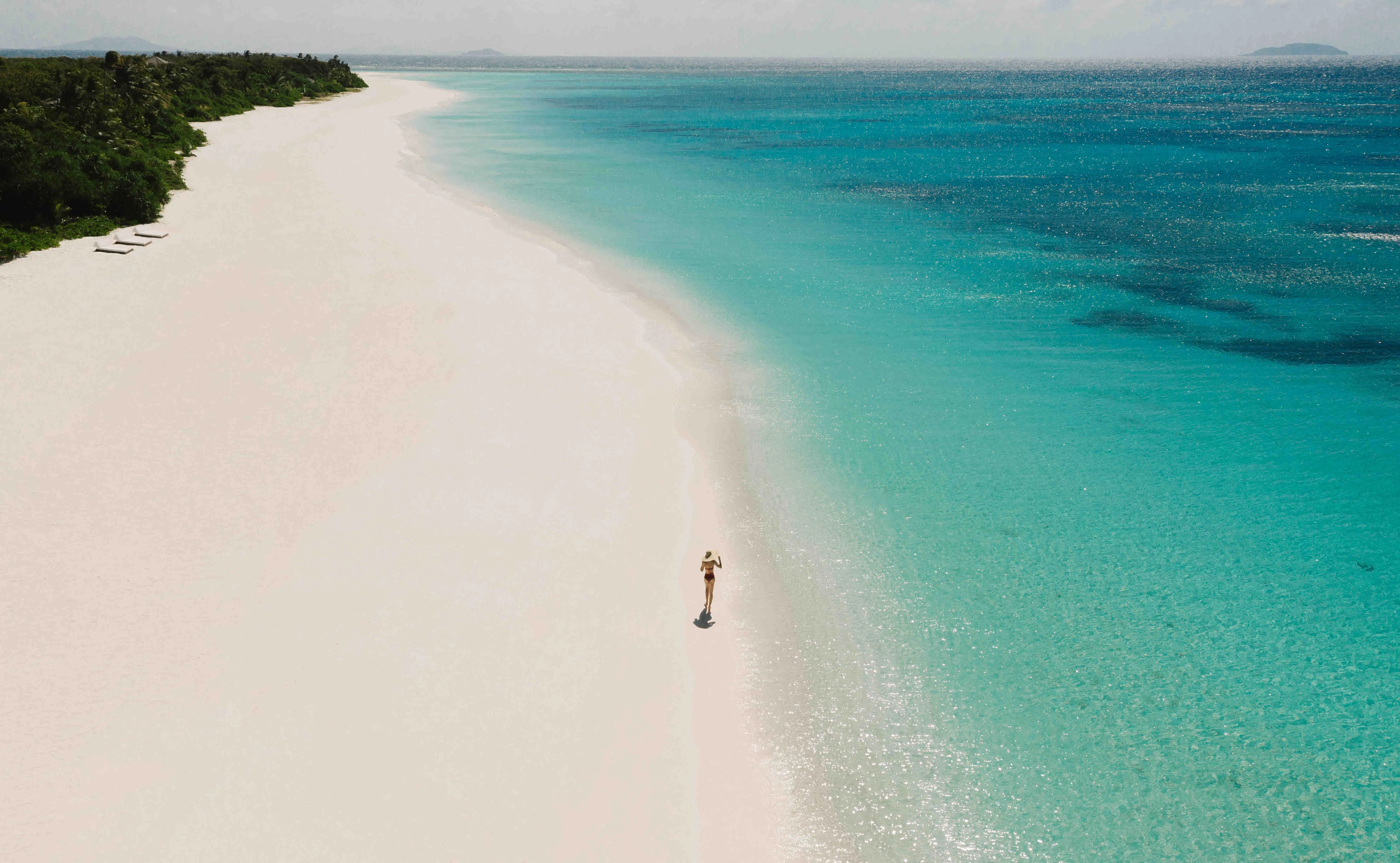
Pamalican Island, Cuyo Islands, Philippines
Amanpulo
A private island in the Cuyo archipelago, reachable only by Aman's own aircraft, built around bahay kubo-inspired casitas set beneath forty-year-old coconut palms.
From $1,900 per night
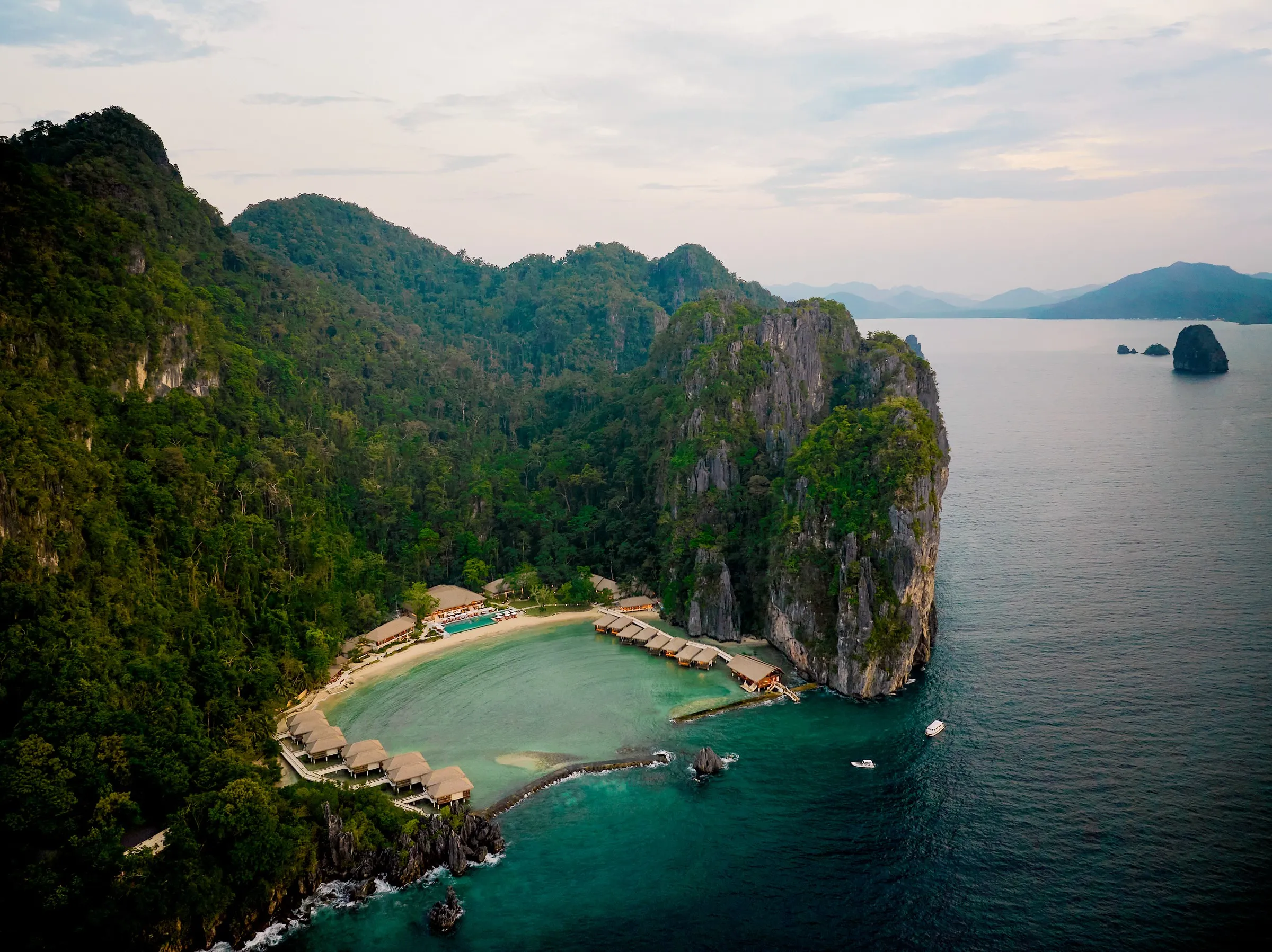
Lagen Island, Bacuit Bay, El Nido, Philippines
Lagen Island Resort
A four-hectare forest reserve wrapped around a lagoon, where the densest limestone forest in the Bacuit archipelago is the amenity, not the backdrop.
From $650 per night