Chem Chem concession, between Lake Manyara and Tarangire, Tanzania
Chem Chem Lodge
Seven tented suites and a family unit set in a palm-fringed private concession where a conservation project, not a marketing brief, first drew the wildlife back between Lake Manyara and Tarangire.
- Rates from
- From $1,420 per person, per night, all-inclusive (excludes mandatory conservation and community fee)
- Nearest airport
- Chem Chem Airstrip
- Transfer
- 10 to 45 minutes by road from Chem Chem Airstrip (complimentary), reached by scheduled or charter flight from Arusha or Kilimanjaro; road transfer from Arusha is roughly 1.5 to 2 hours, and from Kilimanjaro International Airport roughly 3.5 hours
- Best months
- June to October for the driest, most concentrated wildlife viewing; the lodge closes annually from 1 April to 14 May for the long rains
The word “chem chem” means spring in Swahili, and it is not a decorative name. The lodge sits over a scatter of natural springs that draw wildlife into an otherwise dry stretch of the Great Rift Valley, on a private concession wedged between two of northern Tanzania’s best-known national parks: Lake Manyara to the west, its groundwater forest and soda lake famous for tree-climbing lions and flamingos, and Tarangire to the east, known for its baobabs and some of Africa’s densest elephant populations outside the far south.
What makes Chem Chem worth a longer look than most lodges occupying similarly good ground is what happened to the land before the tents went up. The concession sits inside the Burunge Wildlife Management Area, across a stretch of country called the Kwakuchinja corridor, once a functioning migration route between Manyara and Tarangire that had been degraded by decades of poaching, settlement and cultivation to the point that elephants had stopped using it altogether. Fabia Bausch, a former Swiss investment banker, and Nicolas Negre, a French-born professional hunter turned safari guide, built the lodge and a conservation organisation, the Chem Chem Association, at the same time, in 2008, on the premise that the tourism and the corridor’s recovery would have to fund each other or neither would last.
Chem Chem Lodge opened in June 2011 as the first and, for years, the flagship expression of that idea, a small camp built to run on what its founders called Slow Safari: fewer scheduled game drives, more time left unstructured, and a house style that leans toward walking, listening and sitting still rather than covering ground. In May 2026, Chem Chem Safari’s three camps joined Auberge Resorts Collection’s newly launched Auberge Safari portfolio, alongside Legendary Expeditions further south, marking Auberge’s first move into Africa. Bausch has described the deal as being “about reach, not change,” with the lodge continuing to be run day to day by its founders.
The pitch, then, is not novelty. It is a lodge built on land that was actively being destroyed when the project began, now positioned as one of the more design-considered small camps on Tanzania’s northern circuit, with the corridor’s recovery as its actual, verifiable selling point.
Why It Stands Out
Chem Chem’s core claim rests on conservation outcomes that can be checked rather than taken on faith. Within roughly twelve years of the Chem Chem Association’s founding, elephants were documented using the Kwakuchinja corridor for the first time in around 40 years, moving between Tarangire and Lake Manyara to drink, alongside a broader return of buffalo, giraffe and lion to a landscape that anti-poaching patrols and community programmes had spent over a decade trying to stabilise. That is an unusually concrete metric for a safari lodge to be able to point to, and it distinguishes Chem Chem from operations that describe themselves as conservation-led without much to show for it.
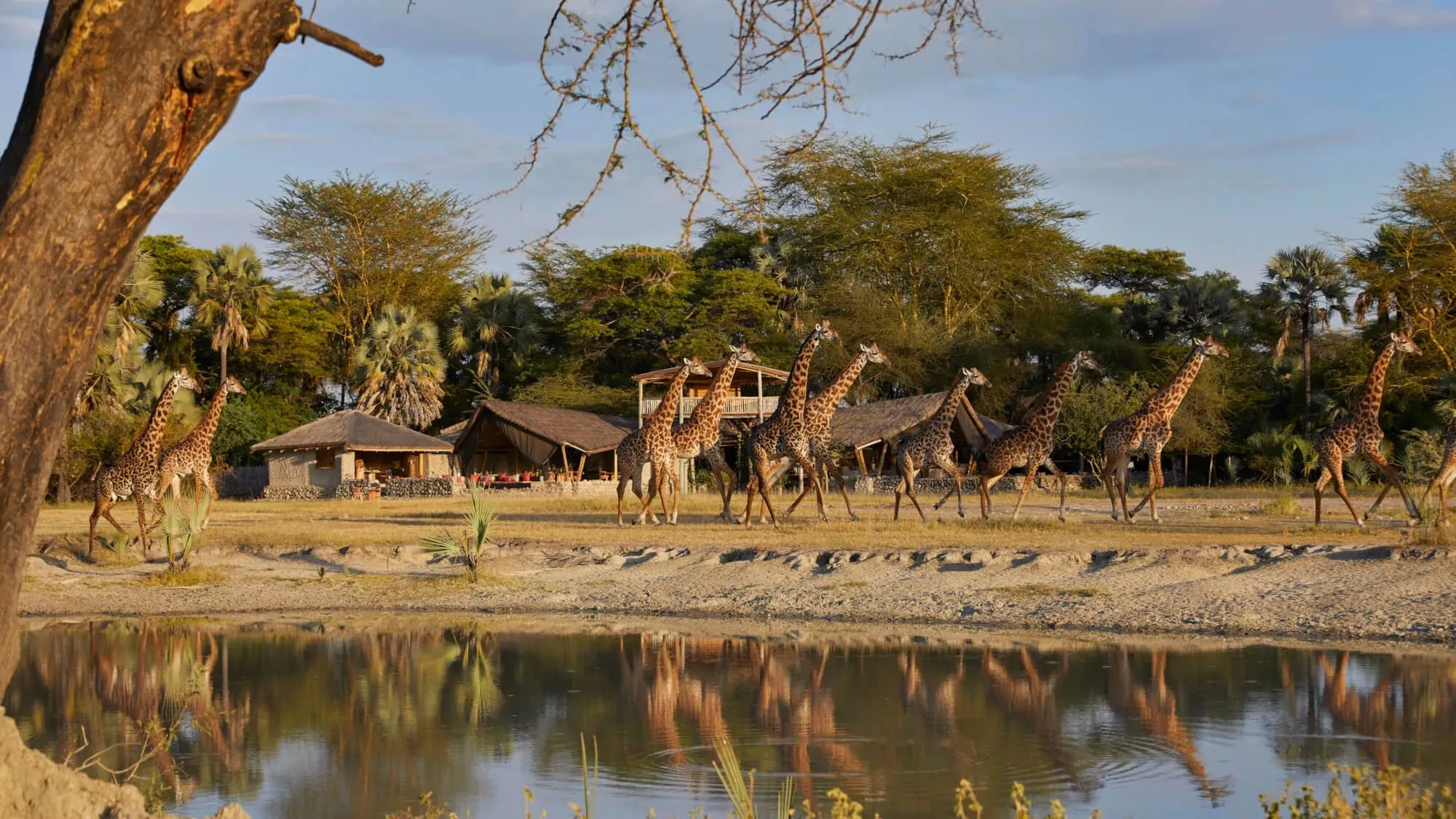
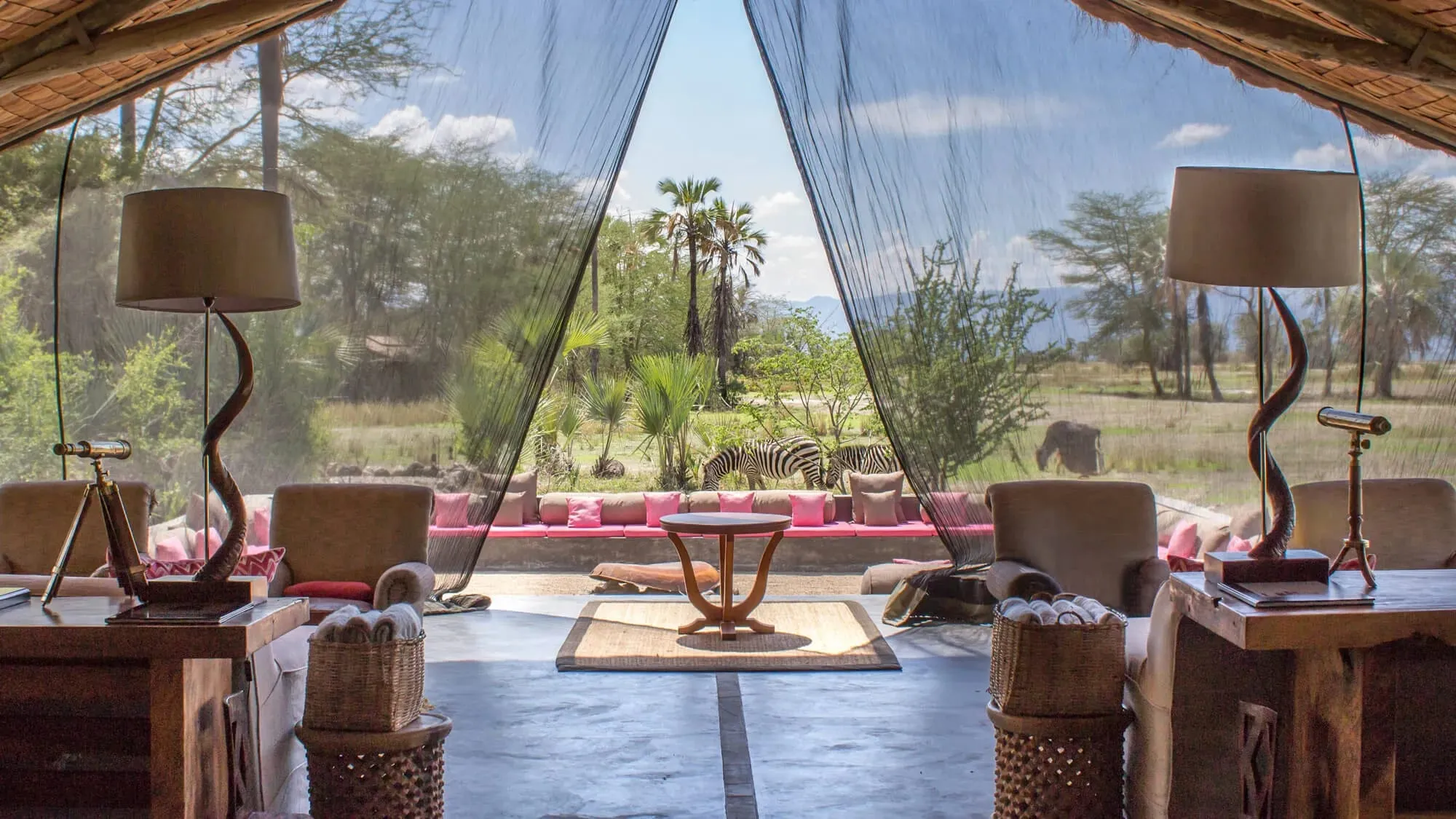
The second distinguishing fact is architectural. The main lodge building is laid out in the rough shape of a flamingo with its wings spread, a nod to the birds on Lake Manyara below: one wing holds the dining room and an outdoor fireplace, the other a bar, lounge and library, with a viewing platform between them looking over an active waterhole where giraffe, zebra, wildebeest and various antelope come to drink through the day. It is a specific, legible piece of design rather than a generic safari-lodge floor plan, and it gives the property’s public spaces a clear organising idea.
The third is scale, deliberately kept small. Seven tented suites and one family unit, capped at around 18 guests, sit inside a concession large enough that guests are rarely competing with each other for a sighting, on a corridor of land that, within living memory, had almost no wildlife left to see at all.
Architecture
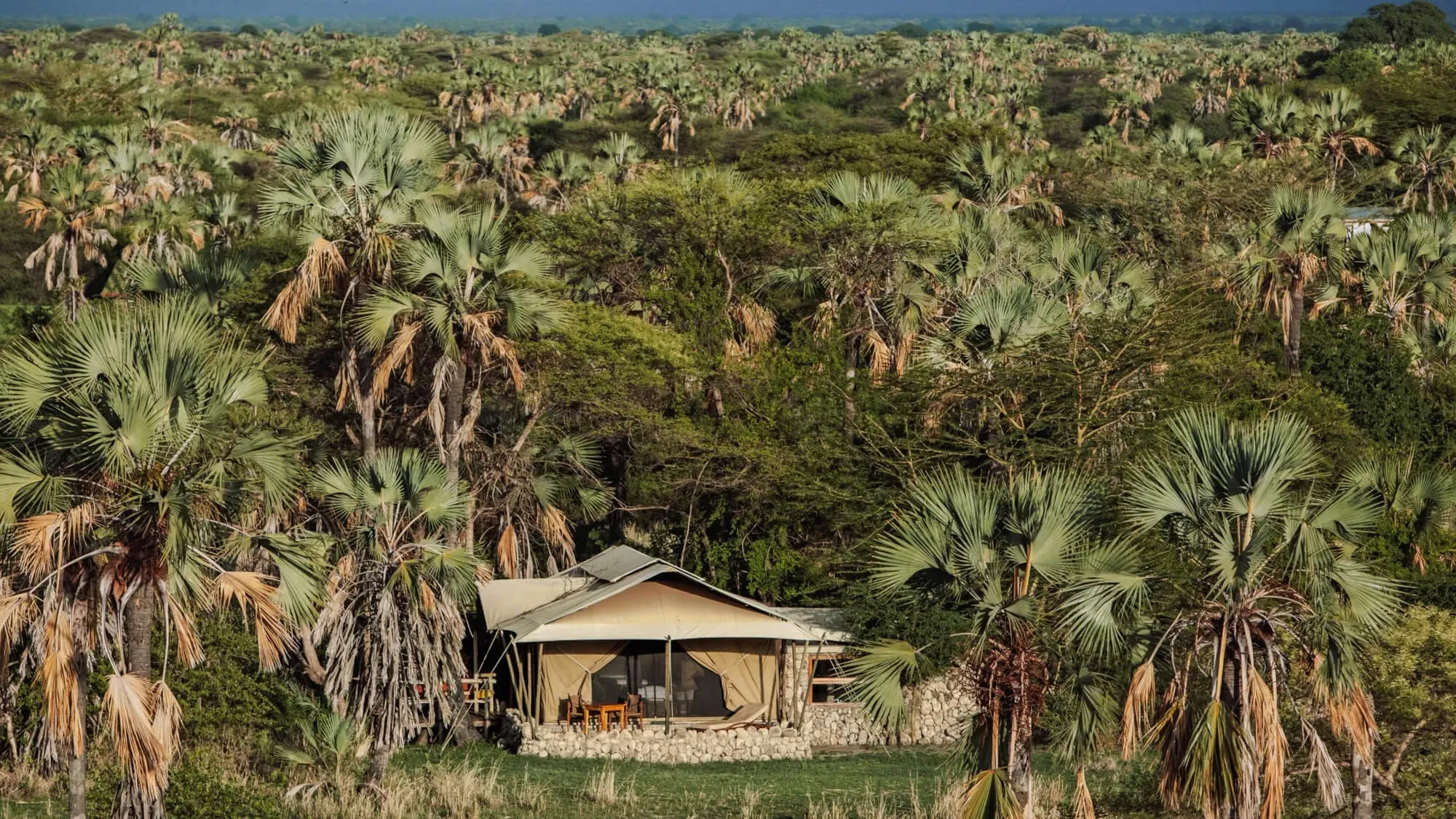
The lodge is built into a mixed belt of palm and acacia woodland close to the natural springs that give the property its name, with the main building’s flamingo-shaped footprint anchoring a layout of raised wooden walkways and pebbled pathways that connect it to the suites scattered through the surrounding trees. Structures combine stone, thatch and canvas, materials chosen to sit inside the woodland rather than clear it, with elevated platforms lifting rooms and walkways above ground level, partly for views over the waterhole and partly to keep a respectful distance from a landscape that, unfenced, is shared with the wildlife the corridor project has worked to bring back.
The pool, set beneath acacia and palm shade on a wooden deck, is positioned to look out over the same waterhole visible from the lodge’s viewing platform, so that swimming and simply watching game move through the trees are not treated as separate activities. A viewing tower gives an additional vantage point over Lake Manyara in the distance, a long view that ties the immediate camp back to the wider landscape it sits within.
None of this reads as showcase architecture built to be photographed from a drone. The scale stays modest, the materials stay local, and the flamingo-plan main lodge functions as the one clear formal idea in a building otherwise organised around practical concerns, shade, sightlines to the waterhole, and a layout gentle enough on the land it occupies.
Interior Design
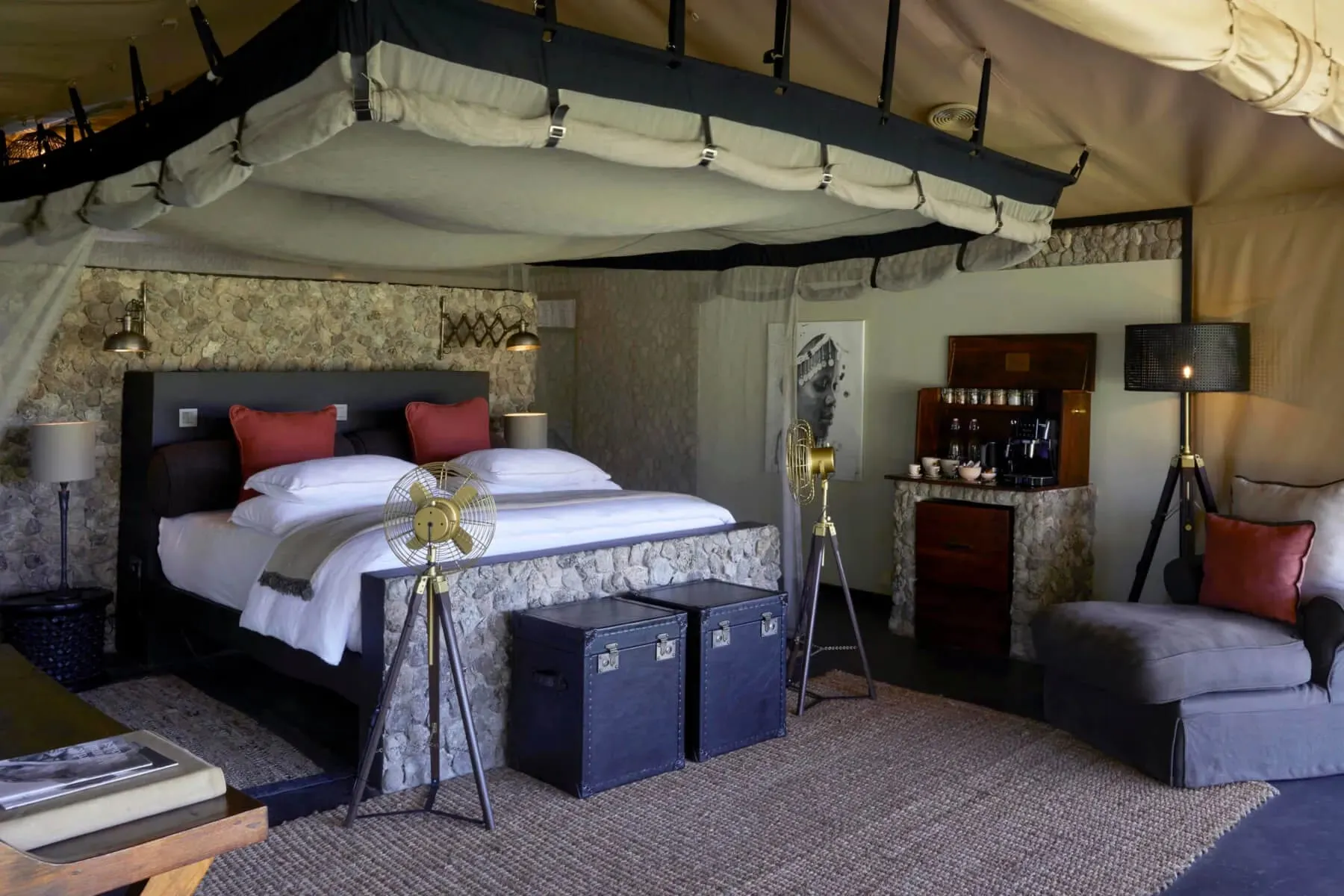
Inside the suites, stone meets canvas and sisal, with wood furnishings largely hand-carved on site rather than shipped in as ready-made pieces. King beds are dressed in bespoke linen, high ceilings and soft furnishings keep the tents from feeling cramped despite their canvas construction, and reading nooks are built into each suite as a deliberate, unhurried counterpoint to the game-drive schedule elsewhere on the property. Wide verandas open directly onto the plains, extending the living space of each suite outward rather than treating the canvas walls as a hard boundary between inside and out.
Bathrooms pair twin vanities and an indoor bath with an outdoor, lantern-lit shower and a private patio, a combination that gives guests both the enclosed comfort of a proper bathroom and the option of washing under open sky. Each suite also has its own wooden sala, a small covered platform set apart from the main tent, intended as a private spot for morning coffee or a quiet hour away from the main lodge’s communal spaces. Natural materials, wood, canvas, cotton and lava rock, run consistently through the furnishings, keeping the interior register close to the surrounding woodland rather than importing a more polished, urban aesthetic into the bush.
The public rooms carry the same material language at larger scale: a library stocked with books on the region’s wildlife, a bar and lounge built around an outdoor fireplace for cool evenings, and a dining room oriented toward the view rather than toward the kitchen. The overall effect favours texture and craft over polish, in keeping with a lodge whose stated identity is built around slowing down rather than showing off.
Atmosphere
Chem Chem trades on quiet in a fairly literal sense. The property is unfenced, with Askari night guards rather than a perimeter fence keeping watch, and the constant low presence of the waterhole below the main lodge means wildlife is often visible without a vehicle, a drive, or any scheduled activity at all. Days are built around genuine gaps rather than a tightly packed itinerary: a morning game drive, an unstructured afternoon around the pool or a suite’s private veranda and sala, and an evening that might involve a sundowner on the concession or a private dinner set up in a different spot each night.
That last detail, guests dining privately in a new location every evening rather than at a fixed table, is characteristic of how Chem Chem tries to keep a small property from feeling repetitive over a multi-night stay. The absence of air conditioning and the presence of standing fans rather than sealed climate control keep the tents connected to the outside temperature and sound in a way that, combined with open verandas and outdoor showers, makes the camp feel porous by design rather than as a cost-cutting compromise. For guests arriving from busier, higher-volume parks like the Serengeti in migration season, the shift in pace is usually the first thing they notice.
Rooms and Suites
Chem Chem Lodge has seven individual luxury tented suites plus one separate family unit, together accommodating a maximum of around 18 guests. Each of the seven suites is a raised canvas-and-stone tent with a king bed, an en-suite bathroom combining an indoor bath with an outdoor lantern-lit shower, a wide private veranda, and its own wooden sala set apart from the main structure. Suites are spaced with genuine distance between them along the property’s wooden walkways, prioritising privacy over proximity to the main lodge.
The family unit pairs a main tent, built to the same standard as the individual suites, with a second, adjoining tent intended for children, together able to accommodate up to three children under 16 alongside two adults, with some flexibility in how children are split between the two tents depending on their ages. Chem Chem Lodge accepts children aged four and over on standard bookings, with no minimum age when a group books the property on an exclusive-use basis.
None of the suites has a private plunge pool; the trade-off is the shared pool built into the main lodge area, positioned under acacia and palm shade with views over the waterhole. Suites are fitted with standing fans rather than air conditioning, in-room safes, mosquito netting at the windows, Wi-Fi, and full daily laundry service, and each has a private terrace deck rather than an enclosed balcony, keeping the boundary between room and bush intentionally soft.
Dining
Meals at Chem Chem run out of a kitchen trained annually by a visiting chef with Michelin-level credentials, producing food generally described as French and European in technique with a fair amount of Tanzanian character worked in, baobab and local greens alongside grilled meats and fresh salads. The main dining room sits in one wing of the flamingo-shaped lodge building, with an outdoor fireplace and a shared view toward the waterhole and, further off, Lake Manyara.
What sets the dining programme apart from a typical safari lodge’s single communal table is the property’s habit of moving meals around the concession rather than anchoring every dinner to one room. Guests are generally offered a different setting each evening, which over a multi-night stay might include a private dinner away from the main lodge, a Maasai-guided bush breakfast built around a baobab tree, or a bookable multi-course bush dinner for small groups. A rose-petal sundowner and candlelit dinner is a standard extra for honeymoon stays. Standard rates include house wines, beers and spirits alongside all meals; premium wine and Champagne are charged separately.
Spa and Wellness
Wellness at Chem Chem centres on the Amani Spa, a treatment room on site offering massage and body treatments, some of which can be taken outdoors rather than inside the treatment room itself. Stays of four nights or longer include a complimentary one-hour massage per person as part of the standard rate; shorter stays can book additional treatments at extra cost.
There is no large-scale spa complex or multi-room wellness wing here, and the pool functions as the property’s other main relaxation space, set in the shade of acacia and palm trees with a direct view over the waterhole below the lodge. Given the modest scale of the treatment offering, wellness at Chem Chem reads as a complement to the daily safari programme and the general slowness of the property’s pace, rather than as a primary reason to book.
Experiences
Each stay includes a private vehicle and guide, used for morning and afternoon game drives across Chem Chem’s own concession within the Burunge Wildlife Management Area as well as into Tarangire National Park; a day trip into Lake Manyara National Park can be arranged with advance notice. Guided walking safaris with Maasai trackers run on the concession, alongside interactive cultural walks and a Maasai-guided sunrise run for more active guests, and a baobab bush breakfast is a standard part of the Chem Chem Lodge programme.
Community visits to a local Maasai village and school are included in the standard rate, reflecting the lodge’s close working relationship with the villages inside the Burunge Wildlife Management Area. Beyond the included activities, guests can book a Tarangire hot-air balloon flight, a scenic helicopter flight, or a full day excursion to Ngorongoro Crater, all as separately charged extras requiring advance arrangement. For special occasions, the lodge offers a Maasai choir performance and, for couples, a Maasai blessing ceremony with a traditional choir, prosecco or Champagne, and rose petals, both bookable with a minimum three-night stay.
Who It Is For
Chem Chem suits travellers who want a genuinely small, design-considered camp within reasonably easy reach of Arusha, rather than a longer fly-in itinerary further into Tanzania’s more remote southern or western parks. The property’s proximity to two national parks in one stay, Tarangire’s elephants and baobabs, Manyara’s tree-climbing lions and groundwater forest, makes it a practical single base for guests who don’t want to move lodges to see both, and its relatively short transfer times make it a sensible first or last stop on a multi-camp northern-circuit itinerary.
Couples and honeymooners are well served by the private dining rotation, the sala platforms, and the honeymoon package’s complimentary extras, while families with children aged four and over have a purpose-built family unit to work with, though the unfenced, wildlife-adjacent setting is worth weighing for parents of very young children. It is a less obvious fit for travellers whose main priority is the Serengeti’s wildebeest migration, which falls well outside Chem Chem’s own ecosystem, or for guests seeking a large-scale spa or resort-style amenity list rather than a single treatment room and a shared pool.
Best Time to Visit
June through October, the long dry season, brings the most concentrated wildlife viewing, as vegetation thins across the concession and animals gather more predictably around the corridor’s springs and remaining water sources; this period overlaps with the property’s peak-season rates. The short rains, generally falling from November into early December, green up the landscape without significantly disrupting road access or game viewing, and are often a quieter, lower-rate alternative for travellers less fixed on peak dry-season conditions.
Chem Chem Lodge closes entirely each year from 1 April to 14 May, during the long rains, when many of the region’s roads become difficult to use and the corridor’s water sources are least scarce, reducing the predictability of sightings even where the lodge would otherwise remain open. Guests planning a visit in the shoulder months just before or after this closure should confirm the property’s operating dates directly when booking.
How to Get There
Most guests reach Chem Chem by flying into the lodge’s own private airstrip on a scheduled or chartered light aircraft from Arusha or Kilimanjaro International Airport, using carriers including Auric Air and Miracle Air, followed by a short, complimentary road transfer of 10 to 45 minutes to the lodge itself. Kilimanjaro remains the region’s main international gateway, roughly 3.5 hours from the lodge by road, with Arusha functioning as the more common regional hub and a shorter, roughly 1.5 to 2 hour road transfer.
A direct road transfer from Arusha is also offered for guests who prefer to skip the light-aircraft leg entirely, and Lake Manyara’s own airstrip sits about 1.5 to 2 hours from the lodge by road for travellers arriving via a different regional flight routing. There is no realistic self-drive option recommended for international visitors; nearly all guests arrive through one of Chem Chem’s arranged air or road transfers rather than independently.
Nearby Experiences
Lake Manyara National Park, a short drive from the lodge, is best known for its tree-climbing lions, a genuinely unusual behaviour shared with only a handful of other parks in East Africa, along with large flocks of flamingos on the alkaline lake itself and one of the densest elephant populations, by area, of any park in Tanzania. Chem Chem’s own concession borders the park directly, and the lodge’s guides run day trips there with advance booking.
Tarangire National Park, on the concession’s other flank, is known for its ancient baobabs and for concentrating some of the country’s largest elephant herds around the Tarangire River during the dry season, alongside good numbers of lion, leopard and a long list of resident and migratory birds. Guests can also visit Ngorongoro Crater as a full-day excursion from Chem Chem, though the distance makes this a longer add-on rather than a routine part of a standard stay, and it is worth booking well in advance given the additional vehicle permit and park fees involved.
Things to Know Before Booking
Chem Chem Lodge requires a minimum stay of two nights and closes annually from 1 April to 14 May, so travel dates should be planned around that window. Children aged four and over are welcome on standard bookings, with those under 12 generally expected to share a tent with an adult unless the property has been booked on an exclusive-use basis.
The all-inclusive nightly rate does not cover the mandatory Chem Chem conservation and community fee, currently US$210 per adult and US$180 per child under 15 per night, which is charged in addition to accommodation and should be factored into any budget comparison with other lodges quoting a single all-in rate. National park entry fees, premium wines and Champagne, spa treatments beyond the included stay-length massage, and scenic extras like ballooning or helicopter flights are also charged separately. The camp is unfenced, with guests escorted between suites and the main lodge after dark, a standard and expected safety measure in this kind of open, wildlife-adjacent setting rather than a special precaution unique to Chem Chem.
Sustainability
Chem Chem Lodge’s environmental case rests less on the building’s own materials or energy systems and more on what its existence has funded off-site. The lodge and the non-profit Chem Chem Association were founded together in 2008, with the Association working inside the Burunge Wildlife Management Area to protect the Kwakuchinja corridor, the migratory link between Tarangire and Lake Manyara, through anti-poaching patrols, GPS collaring used to track lion movements between Ngorongoro, Manyara and Tarangire, and sustained engagement with local authorities and villagers.
Over roughly twelve years, that work is credited with a documented return of species to the corridor, including elephants using the route for the first time in around 40 years, alongside recovering numbers of lion, buffalo and giraffe. The Association has also supported ten villages across the Burunge Wildlife Management Area since 2008 through community and education programmes, including work carried out under its LIVEWILDLIFE initiative, which funds environmental education in local schools and supports the rangers employed to protect the concession. Every guest stay contributes directly to this work through the mandatory nightly conservation and community fee, with an additional optional donation offered at booking.
Practical Information
Indicative rates at Chem Chem Lodge start at around US$1,420 per person per night in green season, rising to roughly US$1,740 in peak season (June to October) and US$1,905 over the December to early January premier period, on an all-inclusive basis covering accommodation, meals, house drinks, a private guide and vehicle, and the lodge’s standard activity programme. A mandatory conservation and community fee of US$210 per adult and US$180 per child per night is charged separately, along with national park fees, premium wines and Champagne, and additional spa treatments or scenic extras.
Check-in is from 2:00pm and check-out by 11:00am. A minimum stay of two nights applies to all bookings, and most guests plan for three to four nights to allow time for both the Chem Chem concession and day trips into Tarangire or Lake Manyara. The lodge is closed annually from 1 April to 14 May.
Editorial Conclusion
Chem Chem Lodge’s real distinction is not its flamingo-shaped main building or its wooden salas, memorable as both are, but the fact that its conservation claims can be checked against an actual before-and-after: a wildlife corridor that had lost its elephants for four decades, and a documented, if partial, recovery underwritten in part by what guests pay to stay here. Few small safari lodges can point to a metric that specific.
Now folded into Auberge Resorts Collection’s first African portfolio, the property’s daily character, small scale, unhurried pacing, a kitchen retrained each year, private dinners moved nightly around the concession, appears to have survived the change in ownership structure largely intact, at least for now. For travellers who want two of northern Tanzania’s defining landscapes, Manyara’s tree-climbing lions and groundwater forest, Tarangire’s baobabs and elephant herds, covered from a single, quietly considered base, Chem Chem remains one of the more coherent arguments on the northern circuit for what a small, conservation-funded lodge can actually accomplish.
In pictures
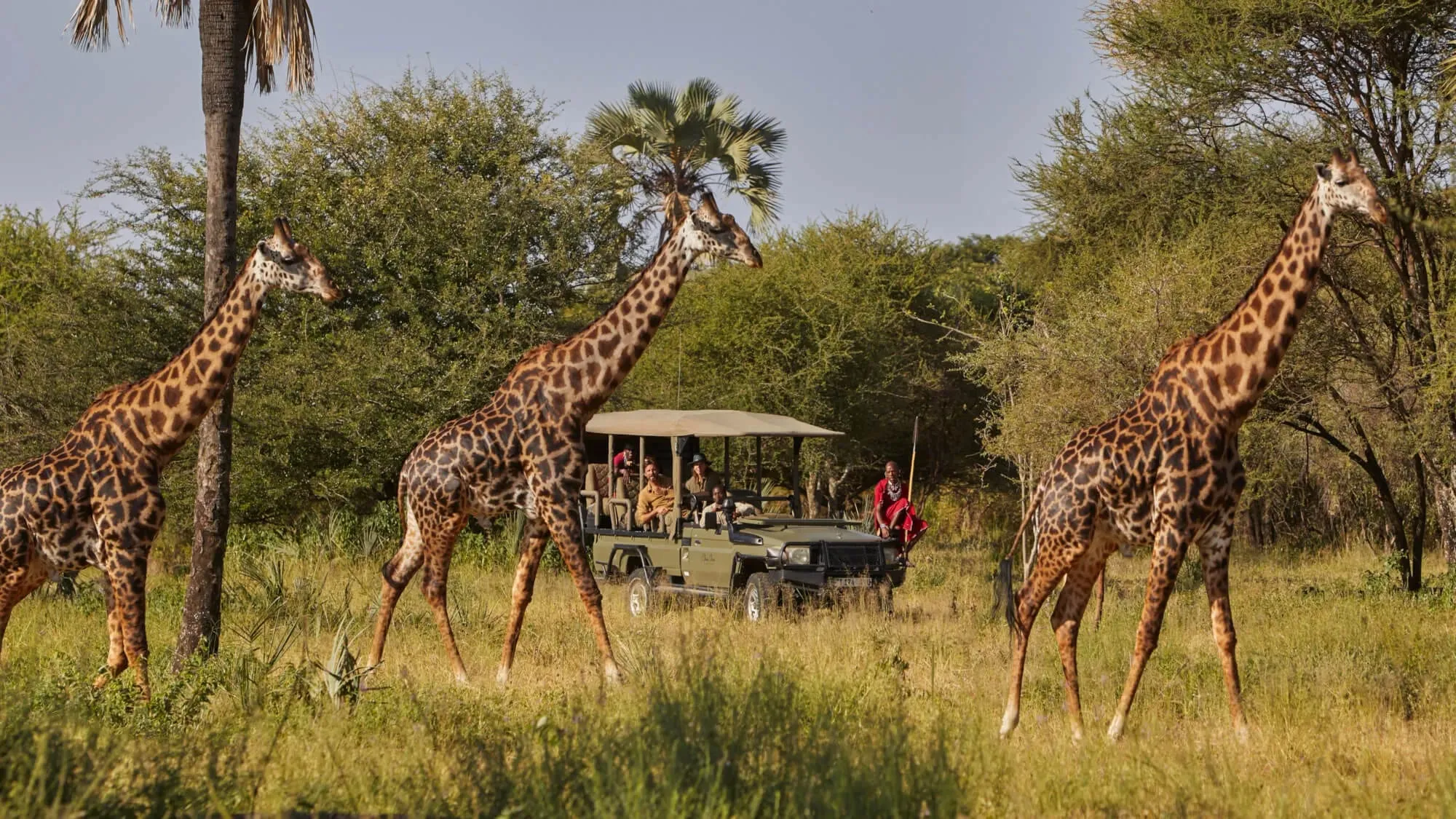
On the map
Chem Chem concession, between Lake Manyara and Tarangire, Tanzania
Questions
Frequently asked
How many suites does Chem Chem Lodge have?
Chem Chem Lodge has seven luxury tented suites plus one separate family unit, for a maximum of around 18 guests at any one time. Each suite has a king bed, indoor bath and outdoor shower, a private veranda, and its own wooden sala, a small covered platform used for morning coffee. The family unit pairs a main tent with a second, adjoining tent for children.
What is included in the nightly rate at Chem Chem Lodge?
Rates are all-inclusive of three meals a day, house wines, beers and spirits, a private guide and vehicle, and the lodge's standard safari programme: game drives on the private concession and into Tarangire National Park, guided walks with Maasai trackers, sundowners, a baobab bush breakfast, and cultural visits to a local village and school. A mandatory Chem Chem conservation and community fee (US$210 per adult, US$180 per child, per night) is charged separately, along with national park entry fees, premium wines, spa treatments and scenic extras like hot-air ballooning.
How do guests get to Chem Chem Lodge?
Most guests fly into Chem Chem's own private airstrip on scheduled or chartered light aircraft from Arusha or Kilimanjaro International Airport, then complete the final 10 to 45 minutes by road transfer, which the lodge provides free of charge. A direct road transfer from Arusha takes roughly 1.5 to 2 hours; from Kilimanjaro it is closer to 3.5 hours.
Is Chem Chem Lodge part of a larger group?
Chem Chem Lodge is one of three camps run by Chem Chem Safari within the Burunge Wildlife Management Area, alongside Little Chem Chem and Forest Chem Chem. In May 2026, Chem Chem Safari and Legendary Expeditions joined Auberge Resorts Collection's newly launched Auberge Safari portfolio, the group's first venture into Africa, though the properties continue to be run day to day by founders Fabia Bausch and Nicolas Negre.
What is the Chem Chem Association and how does a stay support it?
The Chem Chem Association is a registered non-profit, founded alongside the lodge in 2008, that works within the Burunge Wildlife Management Area to protect the Kwakuchinja Wildlife Corridor, the migratory link between Tarangire and Lake Manyara National Parks. Its work includes anti-poaching patrols, GPS lion-collaring, and community and education programmes across ten villages in the area. A nightly conservation and community fee charged to every guest, alongside an optional additional donation, funds this work directly.
Same destination
More hotel guides in Tanzania
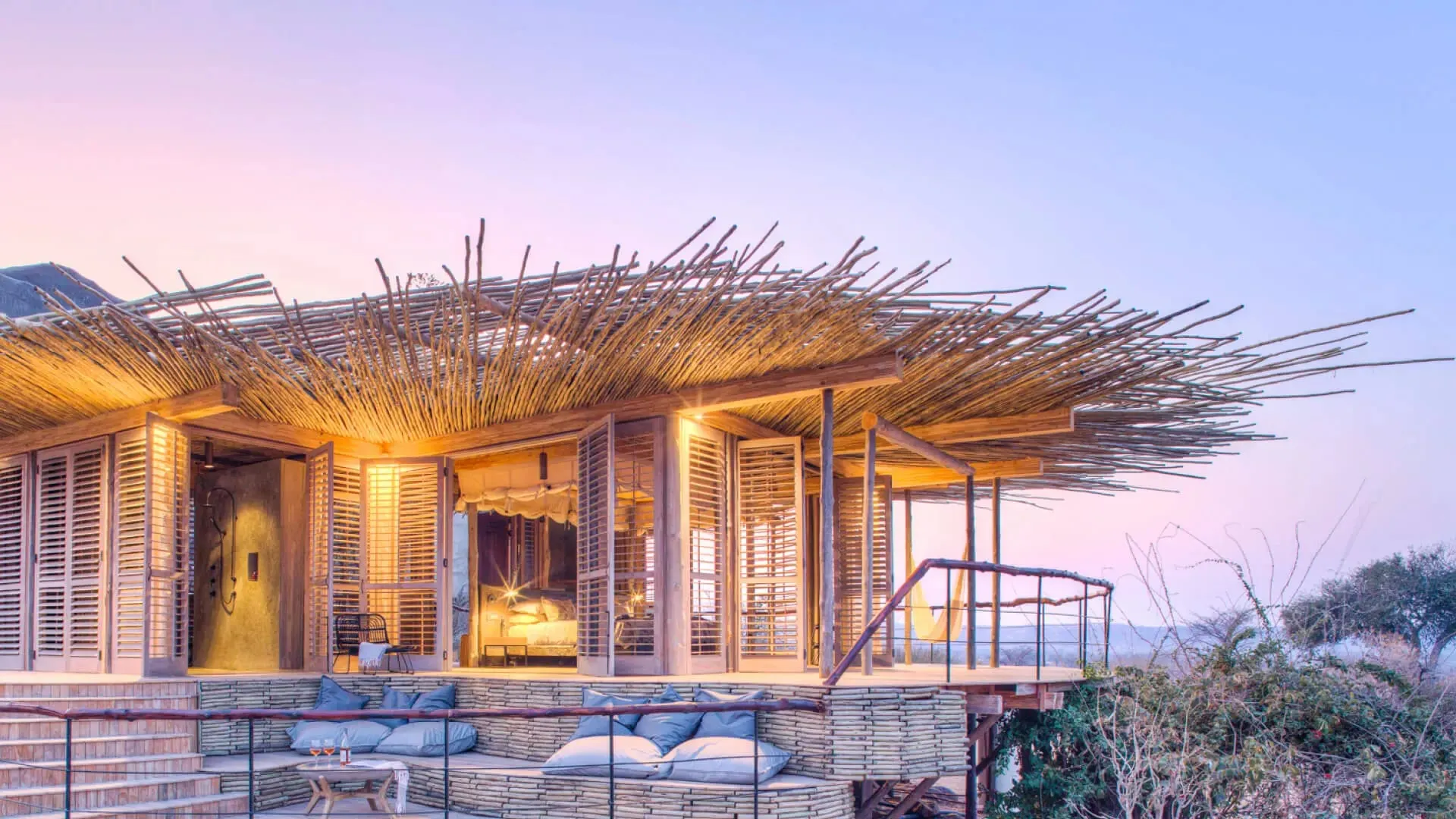
Ruaha National Park, Tanzania
Jabali Ridge
Eight suites threaded through a kopje of house-sized granite boulders in Ruaha, Tanzania's largest and least-visited major national park.
From $880 per person, per night, all-inclusive (low season)
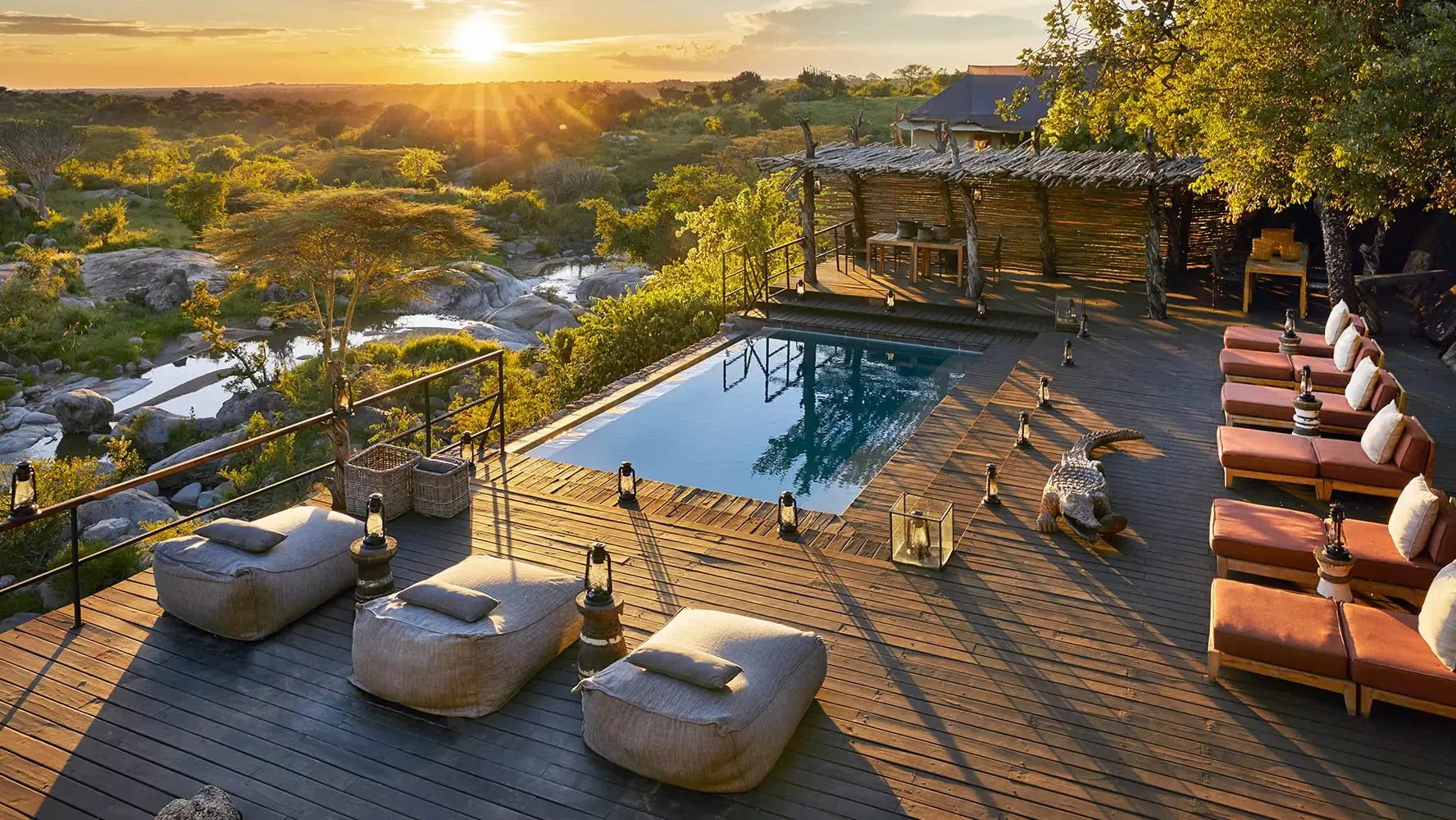
Mwiba Wildlife Reserve, Tanzania
Mwiba Lodge
Ten stone-and-canvas suites built into a granite outcrop above a river gorge in a private reserve that buys the Serengeti's southern migration corridor breathing room.
From $2,000 per person, per night, all-inclusive
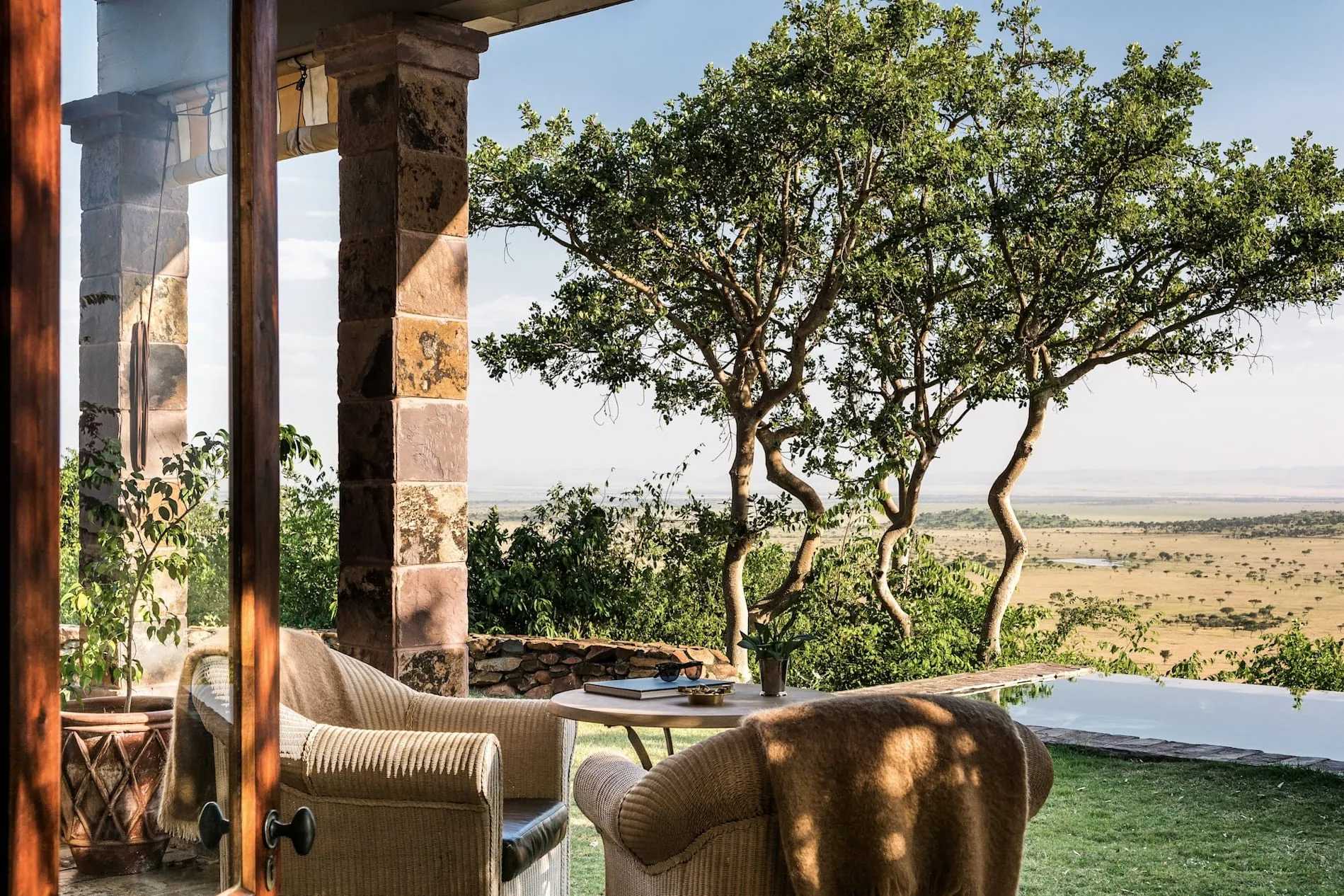
Grumeti Reserves, Serengeti, Tanzania
Singita Sasakwa Lodge
An Edwardian manor house on a Serengeti hilltop, built where a colonial-era settler once farmed, now run as the flagship of a 350,000-acre private reserve and its own rhino-recovery program.
From $2,550 per night, per person, all-inclusive