Mwiba Wildlife Reserve, Tanzania
Mwiba Lodge
Ten stone-and-canvas suites built into a granite outcrop above a river gorge in a private reserve that buys the Serengeti's southern migration corridor breathing room.
- Rates from
- From $2,000 per person, per night, all-inclusive
- Nearest airport
- Mwiba Airstrip, within the Mwiba Wildlife Reserve
- Transfer
- About 45-60 minutes by light aircraft from Arusha or Kilimanjaro to Mwiba Airstrip, then a short game-drive transfer of roughly 15-20 minutes to the lodge
- Best months
- June to October for dry-season game viewing; December to March for the southern plains calving season nearby, when the lodge is open (it typically closes from around April to mid-May for the long rains)
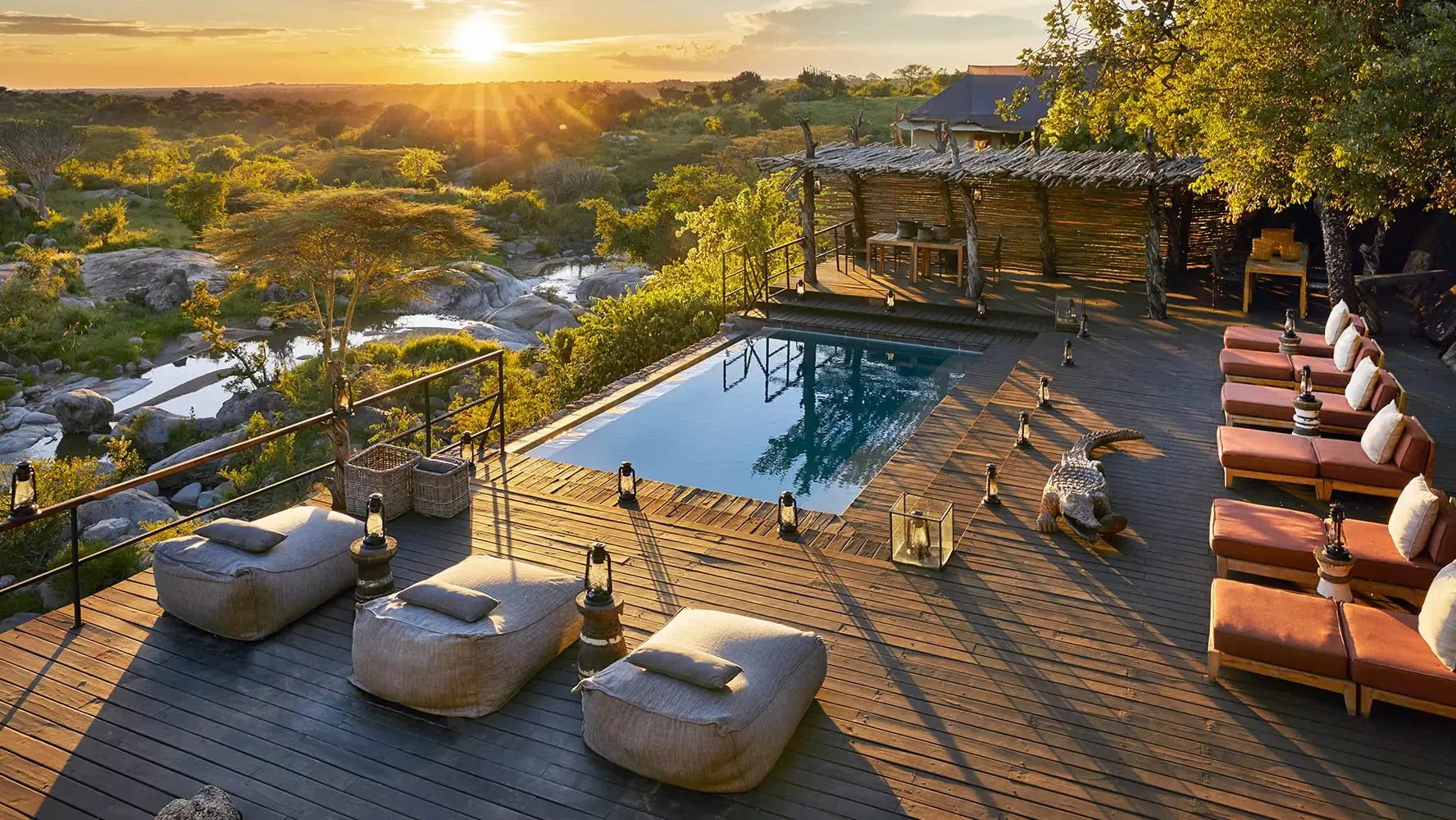
Mwiba Lodge is built into a granite outcrop rather than simply placed on one. Ten stone-and-canvas suites step down a boulder-strewn escarpment above the Arugusinyai River gorge, linked by wooden walkways that route around the rock rather than over it, so that the building reads less like a hotel dropped into wilderness and more like something that grew out of it. The site sits inside the Mwiba Wildlife Reserve, a privately managed conservation concession of roughly 125,000 to 130,000 acres bordering the southern edge of the Serengeti ecosystem, near the Ngorongoro Conservation Area, a landscape of rolling hills, kopjes, thicket and freshwater springs that draws wildlife year-round without the vehicle traffic of the more visited national park sectors nearby.
The lodge is the flagship property of a reserve whose purpose was never purely commercial. Mwiba was carved out in the late 2000s specifically to relieve pressure on the Serengeti’s western and southern boundaries, land under strain from encroachment and unregulated use, and it now operates as a working buffer between the park, the Ngorongoro Conservation Area and the surrounding villages. The Friedkin Conservation Fund, a non-profit established in 1994 and now protecting several million acres of Tanzania’s wider protected estate, uses lodge revenue and its own law-enforcement and community programmes to keep that model functioning.
That gives Mwiba a slightly different proposition than most of its Serengeti-adjacent peers: fewer beds spread across a much larger private area, a conservation story with real institutional weight behind it, and a location close enough to the southern plains and Ndutu’s calving grounds to make it a credible base for the migration’s green-season chapter, while still being its own distinct, lower-traffic destination for the rest of the year. In 2026, Mwiba Lodge’s long-time operator, Legendary Expeditions, joined Auberge Collection’s newly announced Auberge Safari group alongside Chem Chem Safari, a development that folds the lodge into a larger international hospitality network without disturbing its underlying ownership or conservation structure.
Why It Stands Out
Most travellers arrive in northern Tanzania choosing between the national parks’ concentrated wildlife density and a private conservancy’s lower guest numbers. Mwiba occupies a specific niche within that second category: a reserve large enough, and geologically distinctive enough, that its own boulder-and-gorge terrain becomes part of the draw rather than simply a backdrop to game drives. The lodge’s suites are cut directly into an ancient granite outcrop above the Arugusinyai River, giving Mwiba a topographic signature that flatter savanna camps elsewhere in the ecosystem cannot replicate.
The reserve’s conservation architecture is the other differentiator. Mwiba is not a marketing label applied to a commercial land holding; it is a functioning buffer zone, managed with the Friedkin Conservation Fund’s law-enforcement and anti-poaching capacity behind it, positioned specifically to protect migration corridors and community land bordering the Serengeti and the Ngorongoro Conservation Area. Guests staying at Mwiba are, in a fairly direct sense, funding that operation through their nightly rate, a proposition that carries more institutional substance than the conservation language many safari properties use more loosely.
Architecture
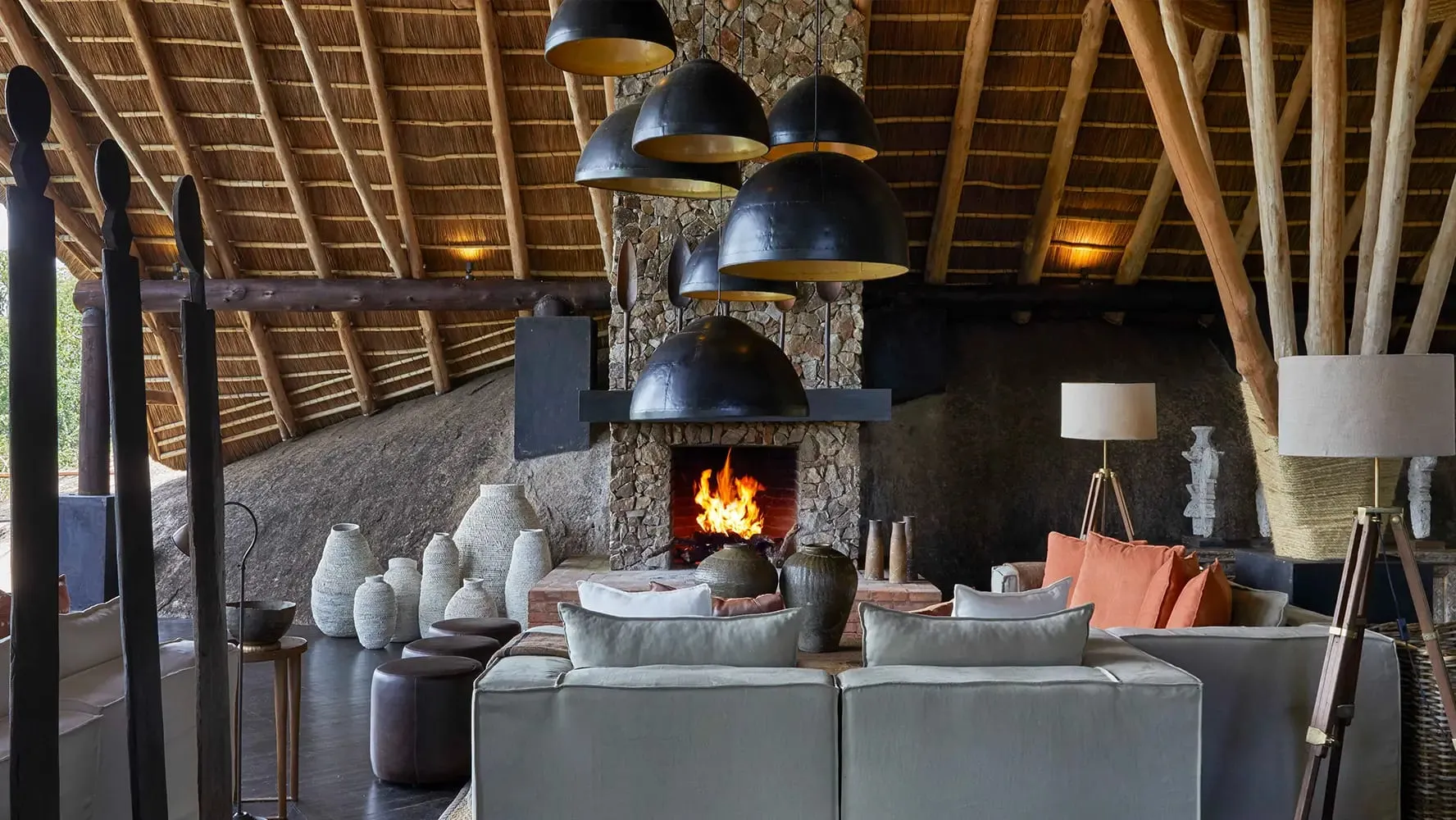
The lodge is built up and around a natural granite kopje overlooking the Arugusinyai River gorge, using the boulders as structural anchors rather than clearing them to build on flat ground. Suites are raised on platforms among the rock, roofed in thatch over a stone-and-canvas construction, and connected by a network of wooden walkways that thread between the outcrops rather than cutting straight lines across them. Ancient coral trees and acacias grow through and around the built structures, reinforcing the sense that the lodge was fitted into an existing landscape feature instead of the other way around.
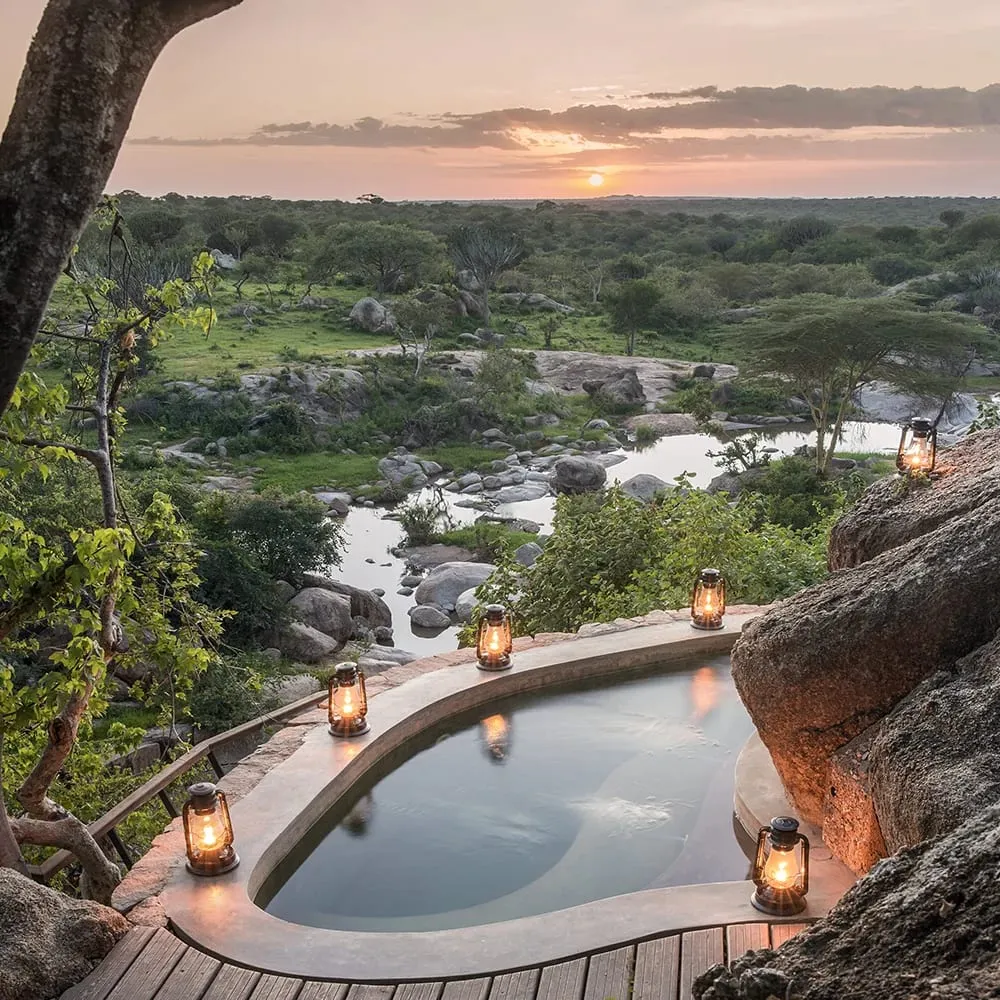
That approach extends to the public areas and pool. A slate-lined infinity pool and adjoining jacuzzi are set directly into the rockface above the gorge, positioned near several of the reserve’s freshwater springs, so that the same boulders that define the guest suites also define where guests swim and gather at sundown. The result is an architectural language built almost entirely from what the site already offered: stone, coral wood, thatch and gorge, rather than an imported design vocabulary layered on top.
Interior Design
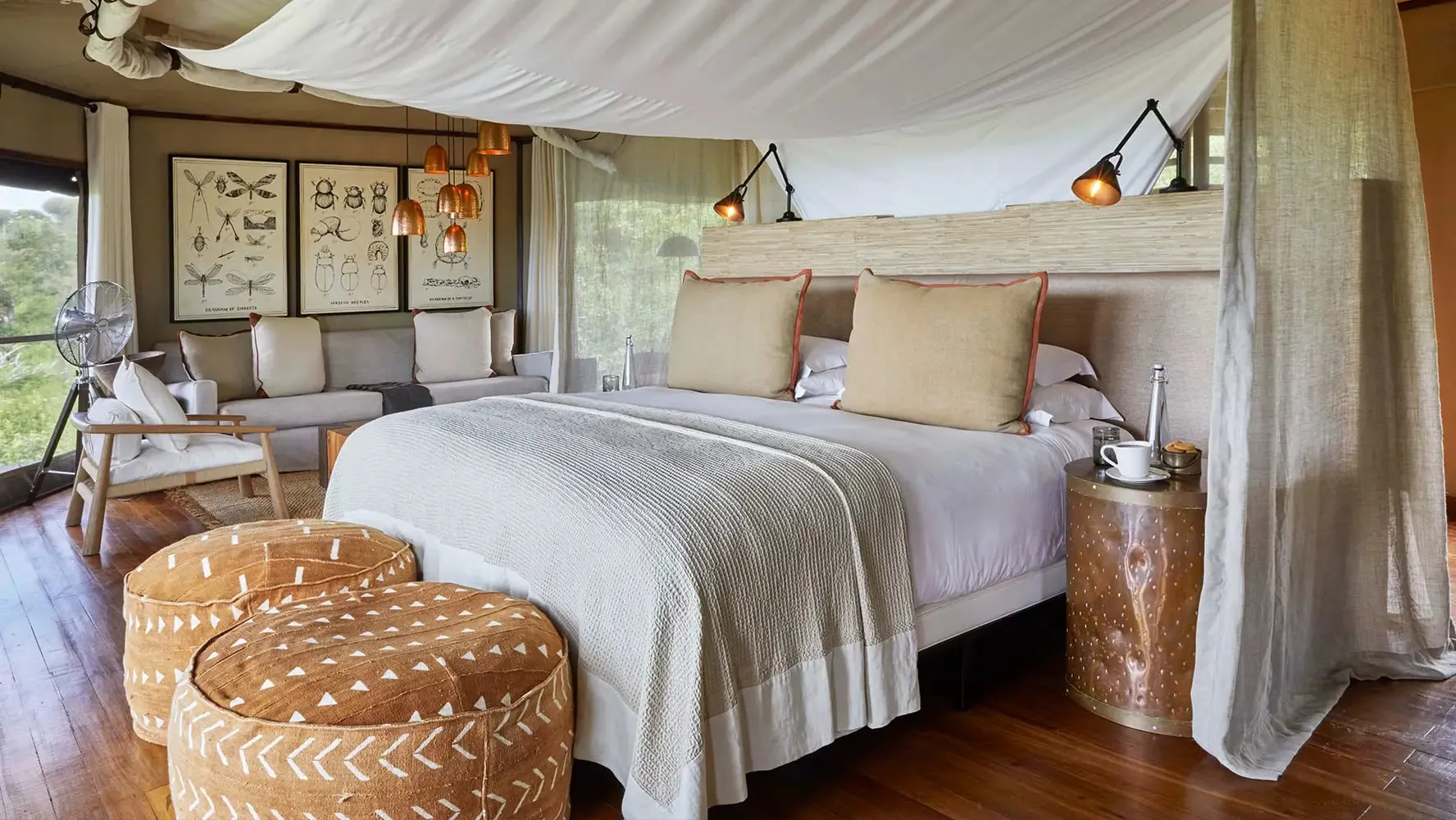
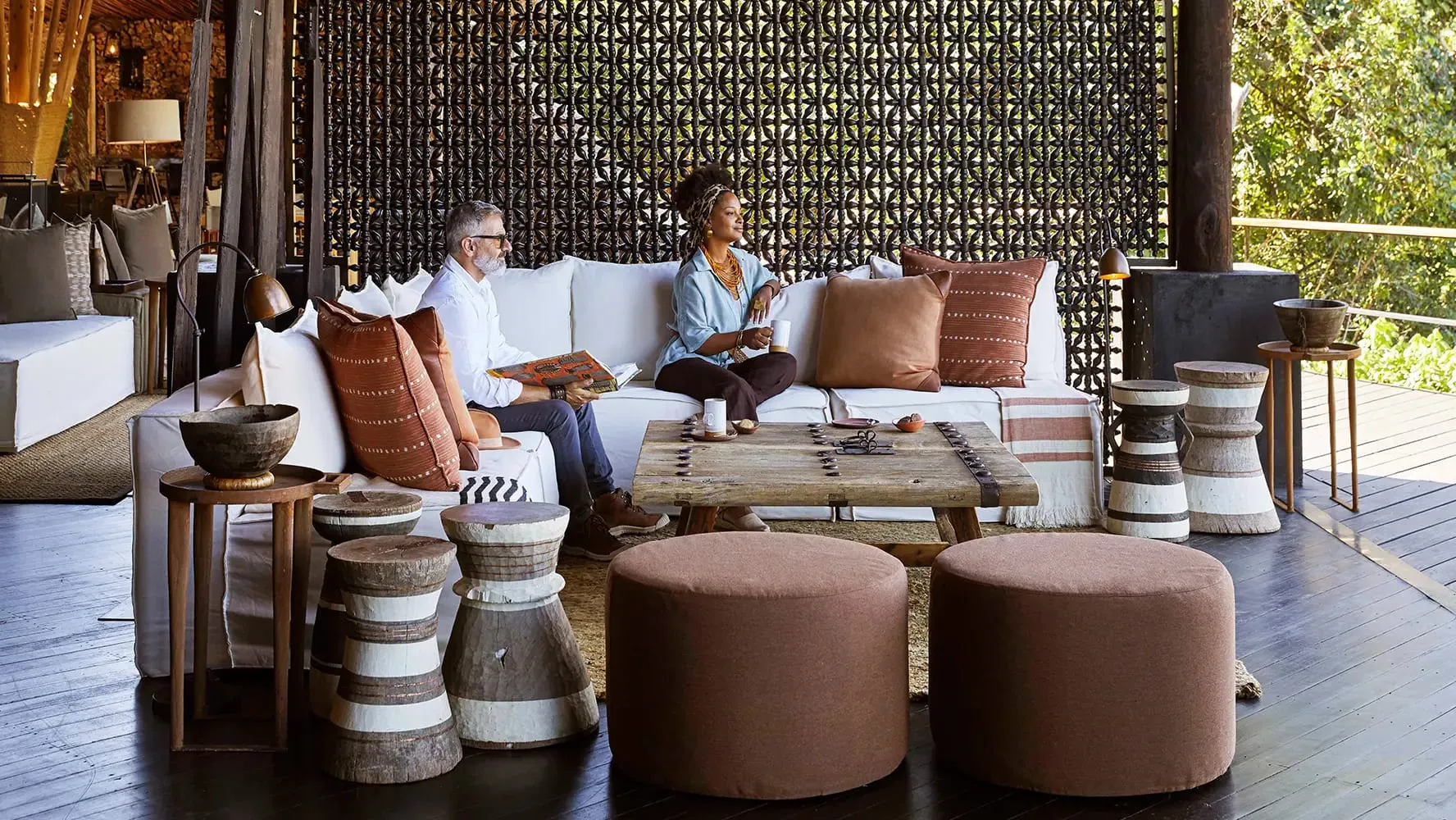
Inside, the suites lean into a warm, tactile safari register: textured creams, suede and tan fabrics offset with darker chocolate and charcoal accents, hand-carved wooden furniture and brass and copper fixtures. Canvas walls keep the tented-camp lineage visible even though the structures themselves are considerably more permanent than a classic mobile camp, and billowing linens and soft furnishings soften what could otherwise read as a fairly hard-edged, rock-built environment.
Bathrooms are a deliberate feature rather than an afterthought, built around oversized soaking tubs and outdoor rain showers positioned to take in the gorge view, a detail that recurs across most of the property’s marketing and guest commentary as one of the more memorable aspects of the room design. Furnishings throughout favour weight and craft, carved wood pieces, grounded silhouettes, over anything delicate or overtly contemporary, in keeping with a lodge whose architecture is already doing a lot of the visual work.
Atmosphere
Mwiba trades on a sense of remoteness and privacy considerably more pronounced than the national park circuit nearby. With only ten suites spread across a reserve of well over a hundred thousand acres, guest density stays low enough that the property reads as a private retreat with a conservation mission attached, rather than a stop on a busier circuit. Days are structured loosely around game drives, cultural excursions and time at the pool or spa, with evenings typically gathering around sundowners on the acacia-shaded terrace as the gorge falls into shadow.
The presence of the Friedkin Conservation Fund’s active management gives the property a slightly different register from a purely commercial camp: guides and staff tend to speak knowledgeably about the reserve’s anti-poaching work and community programmes alongside the standard wildlife commentary, and the cultural excursions to Hadzabe and Datoga communities are treated as a serious part of the offering rather than a token add-on. It suits travellers who want their safari experience layered with that context, rather than a purely game-drive-focused itinerary.
Rooms and Suites
Mwiba Lodge has ten suites in total, each with a private deck cantilevered over the river gorge, an oversized soaking tub, an outdoor rain shower, a minibar and a king or twin bed configuration. Two pairs of suites (commonly listed as suites two and three, and eight and nine) are built as adjoining units connected by their own wooden walkway, intended for families travelling with older children, generally those over roughly ten years old; portable cots and sofa-beds can be arranged for younger children and infants elsewhere in the lodge.
Beyond the main suites, Mwiba offers a small number of fly-camping and treehouse sleep-out options, including a raised “skybed” platform, for guests who want a night under open sky away from the main lodge structure, typically booked as an add-on rather than a primary stay. All rooms come with complimentary Wi-Fi, and the lodge overall is positioned toward couples, honeymooners and families rather than large groups, in keeping with its low total room count.
Dining
Meals at Mwiba are built around a mix of local and international dishes, served either in the lodge’s main dining areas or in smaller private settings arranged among the boulders. Bush lunches and sundowner service on the acacia terrace are a regular part of the daily rhythm, alongside a wine cellar built into the property that supports a more formal dinner service on request.
The kitchen’s approach favours generous, hearty safari cooking over minimalist plating, reflecting a guest base that has typically spent the day on a game drive or walking safari and wants a substantial meal at the end of it. Dietary requirements are generally accommodated with advance notice, standard practice across this tier of Tanzanian safari lodge.
Spa and Wellness
Wellness facilities are modest in scale but distinctive in setting: a spa built partly into the rockface offers massage and body treatments, paired with a small gym and the property’s signature rock-cut infinity pool and adjoining jacuzzi, positioned above the gorge and near several of the reserve’s year-round springs. All-inclusive packages typically bundle in one complimentary spa treatment per stay, with additional treatments available at extra cost.
The wellness offering here is secondary to the safari programme rather than a destination in its own right, more akin to a genuine amenity for unwinding between game drives than a structured multi-day programme. Guests looking for an extensive spa menu on the scale of a dedicated wellness retreat should treat Mwiba’s offering as a complement to the wildlife experience rather than the main draw.
Experiences
Game drives, run day and night, form the core of the Mwiba programme, typically included on an unlimited basis within the all-inclusive rate and led by private vehicle and guide. Walking safaris add a slower, more detail-oriented complement to the vehicle-based drives, and the reserve’s rocky terrain also supports rock climbing among the boulders near the lodge, an activity uncommon at most Tanzanian safari properties.
Cultural programming is a genuine differentiator here. Guests can join foraging walks with Hadzabe hunter-gatherers, among the last hunter-gatherer communities in East Africa, and visit Datoga communities near the reserve, with some itineraries extending to Maasai and Sukuma cultural encounters as well. Helicopter flights over the reserve and wider ecosystem, and fly-camping or skybed sleep-outs away from the main lodge, are available as premium add-ons for guests who want to extend the experience beyond the standard game-drive-and-culture itinerary.
Who It Is For
Mwiba suits travellers who want a private, lower-density alternative to the busier sectors of the national park circuit, without giving up proximity to the wider Serengeti ecosystem. It is a strong fit for first-time visitors who want a single, well-rounded base combining wildlife, culture and a distinctive setting, for photography-focused travellers drawn to the reserve’s boulder-and-gorge topography, and for couples and honeymooners who value the property’s intimacy, only ten suites, over the scale of a larger lodge.
It is a reasonable, though not ideal, choice for families, given the age-appropriate adjoining suites and moderate minimum ages on some activities, but it is a weaker fit for travellers whose primary goal is the dense predator sightings of the Serengeti’s core migration corridor during peak season, since Mwiba’s appeal rests more on privacy, terrain and cultural depth than on guaranteed high-volume game viewing.
Best Time to Visit
The dry season, roughly June to October, brings the most reliable wildlife viewing conditions across the wider ecosystem, with animals concentrating around the reserve’s permanent water sources as the surrounding bush dries out. Mwiba’s proximity to the southern Serengeti plains and the Ndutu area also makes it a credible base during the calving season, generally December through March, when large herds gather on the nearby short-grass plains to give birth, drawing predators in turn.
The lodge typically closes for a period around the long rains, roughly April to mid-May, when access roads within the reserve become difficult and wildlife disperses more widely across the landscape. Travellers should confirm exact opening dates for their travel year directly with the lodge or a specialist safari operator, since closure windows can shift slightly from year to year.
How to Get There
Access to Mwiba Lodge is by light aircraft. Scheduled or chartered flights, typically operated on turboprop Cessna Grand Caravan aircraft, run from Arusha or Kilimanjaro International Airport to Mwiba Airstrip, a private airstrip within the reserve, in roughly 45 minutes to an hour depending on routing and any intermediate stops. From the airstrip, it is a short game-drive transfer, generally 15 to 20 minutes, to the lodge itself, often doubling as an initial game drive through the reserve.
There is no practical road route for most travellers given the reserve’s remoteness and the distances involved from Arusha or the northern park circuit; a road transfer from the Ndutu area, where feasible, runs to roughly two hours each way. The lodge and specialist safari operators typically arrange flight bookings and transfers as part of a full itinerary.
Nearby Experiences
The Serengeti’s southern and western sectors, including the Ndutu area’s calving-season plains, lie within reach of Mwiba and are frequently combined with a stay here on a multi-camp safari itinerary, particularly during the December-to-March calving window. The Ngorongoro Conservation Area, home to the Ngorongoro Crater’s dense, contained wildlife population, sits within range for travellers extending their trip beyond the Mwiba reserve itself, generally as a separate leg rather than a day trip given the driving distances involved.
Within the reserve, Hadzabe and Datoga community visits offer a cultural counterpoint to the wildlife-focused itinerary, and the reserve’s own rock-climbing terrain and multiple freshwater springs give guests things to do without leaving Mwiba’s boundaries at all. Most guests build a Mwiba stay into a broader northern Tanzania circuit, pairing it with time in the Serengeti’s more classic sectors and, often, the Ngorongoro Crater.
Things to Know Before Booking
Mwiba operates on an all-inclusive, per-person, per-night rate that covers accommodation, meals, local drinks, unlimited game drives, bush walks, one complimentary spa treatment, cultural experiences, laundry and airport transfers to and from Mwiba Airstrip; premium spirits, helicopter flights, fly-camping add-ons and additional spa treatments are typically charged separately. Given the lodge’s remoteness, the flight to Mwiba Airstrip should be booked well ahead of travel, and it is worth confirming through a specialist operator whether the itinerary is best combined with time in Ndutu, the wider Serengeti or the Ngorongoro Crater.
The lodge accepts children from roughly age 4, with two pairs of adjoining suites designed for families with children generally over 10; some activities, including night drives and fly-camping, may carry their own minimum-age restrictions worth confirming at the time of booking. The lodge typically closes for a window around the long rains, roughly April to mid-May, so travellers planning a visit in that period should check current operating dates directly with the property.
Sustainability
Mwiba Lodge’s conservation credentials are structural rather than cosmetic. The Mwiba Wildlife Reserve itself exists as a purpose-built buffer zone, established to relieve development and encroachment pressure on the Serengeti’s southern and western boundaries and on land bordering the Ngorongoro Conservation Area, and it is managed in partnership with the Friedkin Conservation Fund, a non-profit organisation founded in 1994 that now supports conservation and anti-poaching work across several million acres of protected and community land in Tanzania.
Lodge revenue directly supports that fund’s law-enforcement and community-conservation programmes, and the reserve’s low guest density, ten suites across well over a hundred thousand acres, is itself a conservation choice, limiting the human footprint on a landscape that functions as a working wildlife corridor rather than only a tourism destination. The reserve’s relationship with the neighbouring Makao Village Council and Meatu District Council, whose land underpins the concession, also embeds a community-benefit component into the reserve’s operating model rather than treating conservation and local partnership as separate initiatives.
Practical Information
Mwiba Lodge is located within the Mwiba Wildlife Reserve, southern Serengeti ecosystem, Mara region, Tanzania, at approximately 3°26’51”S, 34°51’59”E. Check-in is at 2:00pm and check-out at 11:00am. The nearest airstrip is Mwiba Airstrip, inside the reserve, reached by light aircraft from Arusha or Kilimanjaro International Airport in roughly 45 minutes to an hour, followed by a short road transfer to the lodge.
Indicative rates run from around USD 2,000 per person per night on an all-inclusive basis in lower-demand periods, rising toward USD 2,900 per person per night in peak and premier season; travellers should confirm current seasonal pricing directly with the lodge or a specialist Africa safari operator given how significantly rates shift by season. The lodge is owned by Mwiba Holdings, part of the Friedkin Group, and has long been operated by Legendary Expeditions, which joined Auberge Collection’s newly formed Auberge Safari group in 2026.
Editorial Conclusion
Mwiba Lodge makes its case through terrain and infrastructure most safari properties simply do not have access to: a genuine granite outcrop to build into, a private reserve large enough to keep guest density low without sacrificing proximity to the Serengeti’s core ecosystem, and a conservation partner, the Friedkin Conservation Fund, with real operational history behind it rather than a decorative sustainability page. The lodge asks a premium price even by ultra-luxury safari standards, and its ten-suite scale means the experience it sells is intimacy and privacy as much as wildlife density. For travellers who want that combination, a distinctive rock-built lodge, a working conservation story, and cultural programming with genuine depth, layered onto rather than substituted for a solid game-drive itinerary, Mwiba offers a version of the northern Tanzania safari that few of its neighbours can quite replicate.
In pictures
On the map
Mwiba Wildlife Reserve, Tanzania
Questions
Frequently asked
Where exactly is Mwiba Lodge, and how does it relate to the Serengeti?
Mwiba Lodge sits inside the privately managed Mwiba Wildlife Reserve, a conservation concession of roughly 125,000 to 130,000 acres that borders the southern edge of the Serengeti ecosystem and lies near the Ngorongoro Conservation Area. It is not inside Serengeti National Park itself; it functions as an adjoining, lower-density buffer reserve that wildlife, including migration-linked herds, moves through seasonally, without the vehicle density found in the park's more visited sectors.
How many rooms does Mwiba Lodge have?
The lodge has ten stone-and-canvas suites, including two family-configured pairs of adjoining suites connected by wooden walkways, plus a small number of separate fly-camping and treehouse sleep-out options for guests who want a night away from the main lodge. Every suite has its own deck over the river gorge, an oversized soaking tub and an outdoor rain shower.
Who owns and operates Mwiba Lodge?
Mwiba Lodge is owned by Mwiba Holdings, part of the Friedkin Group, the American businessman Dan Friedkin's company, and has long been operated by Legendary Expeditions. In 2026, Auberge Collection announced Auberge Safari, a new collection uniting Legendary Expeditions and Chem Chem Safari, bringing Mwiba Lodge under the Auberge Safari umbrella while keeping its existing ownership and conservation structure in place. Guest revenue helps fund the Friedkin Conservation Fund, the non-profit that protects the reserve.
How do guests get to Mwiba Lodge?
Access is by light aircraft, typically a scheduled or chartered flight of roughly 45 minutes to an hour from Arusha or Kilimanjaro International Airport to Mwiba Airstrip, a private airstrip inside the reserve. From there it is a short game-drive transfer, generally 15 to 20 minutes, to the lodge itself. There is no practical road route for most travellers given the reserve's remoteness.
Is Mwiba Lodge suitable for families with children?
Yes, within limits. The lodge accepts children generally from around age 4 upward, and two pairs of suites are configured as adjoining units better suited to families with children over roughly 10. Portable cots and extra bedding can be arranged for younger children. Activities such as night drives, walking safaris and fly-camping typically carry their own minimum-age restrictions, which are worth confirming directly with the lodge when booking.
Same destination
More hotel guides in Tanzania
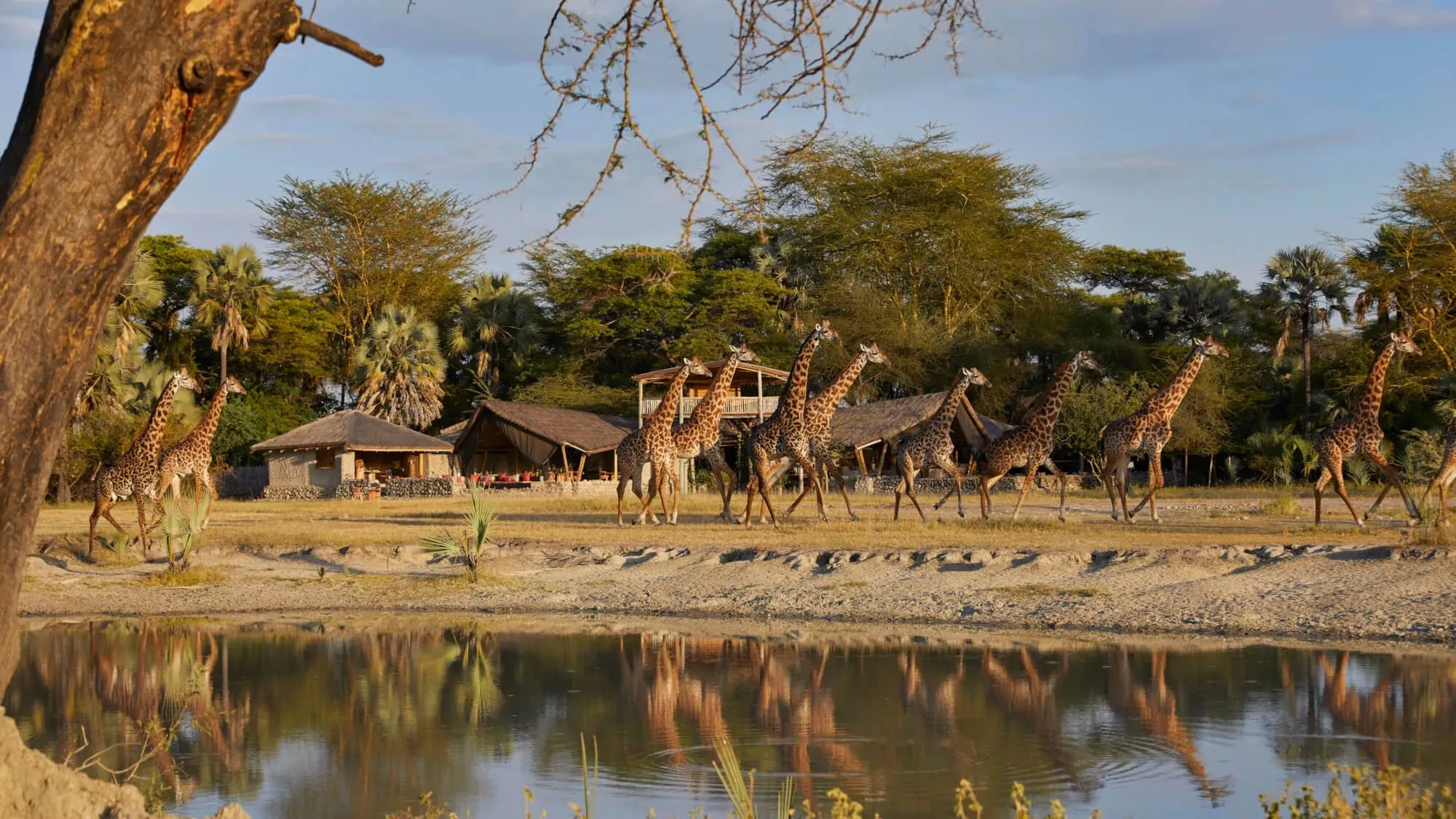
Chem Chem concession, between Lake Manyara and Tarangire, Tanzania
Chem Chem Lodge
Seven tented suites and a family unit set in a palm-fringed private concession where a conservation project, not a marketing brief, first drew the wildlife back between Lake Manyara and Tarangire.
From $1,420 per person, per night, all-inclusive (excludes mandatory conservation and community fee)
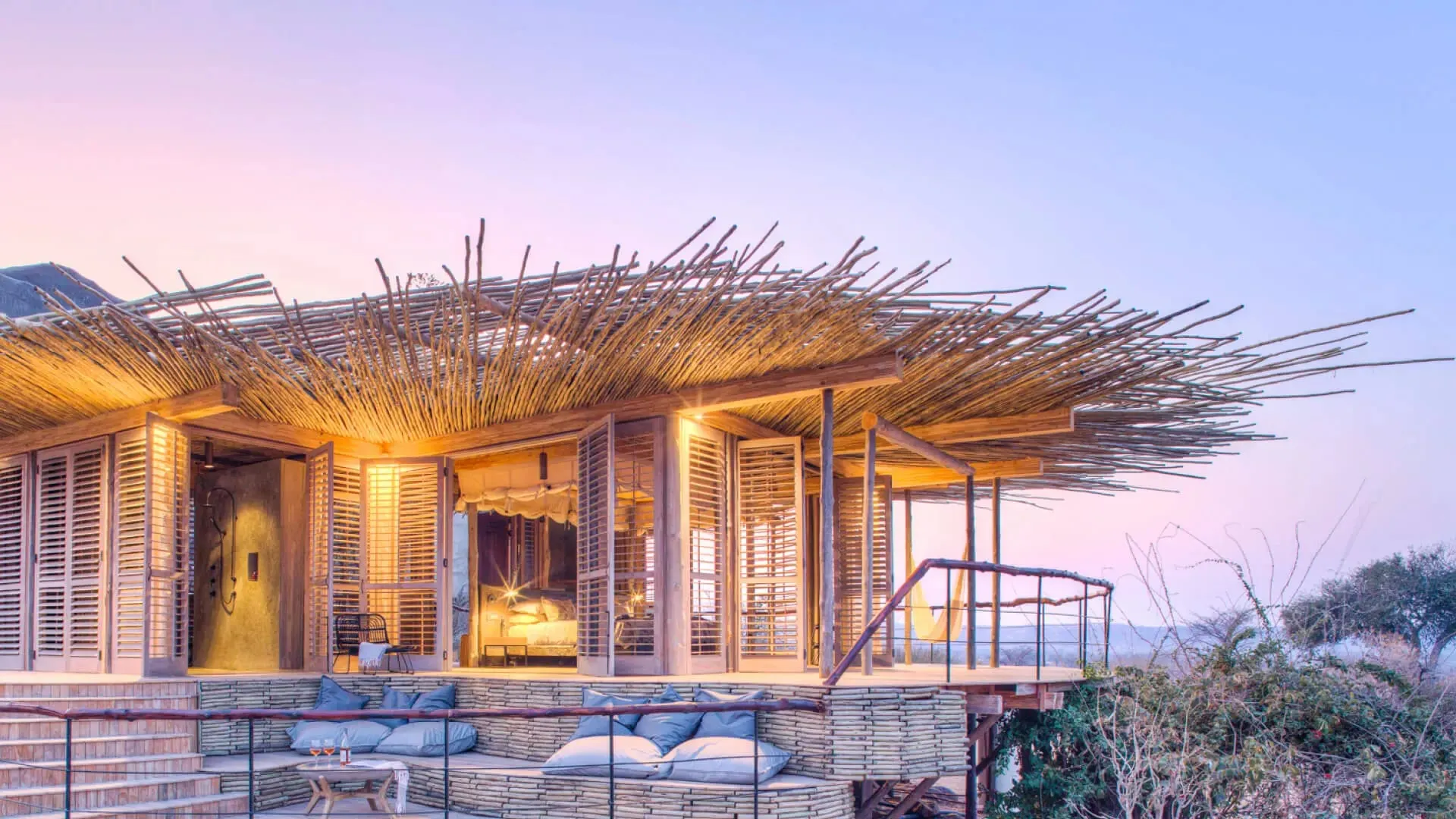
Ruaha National Park, Tanzania
Jabali Ridge
Eight suites threaded through a kopje of house-sized granite boulders in Ruaha, Tanzania's largest and least-visited major national park.
From $880 per person, per night, all-inclusive (low season)
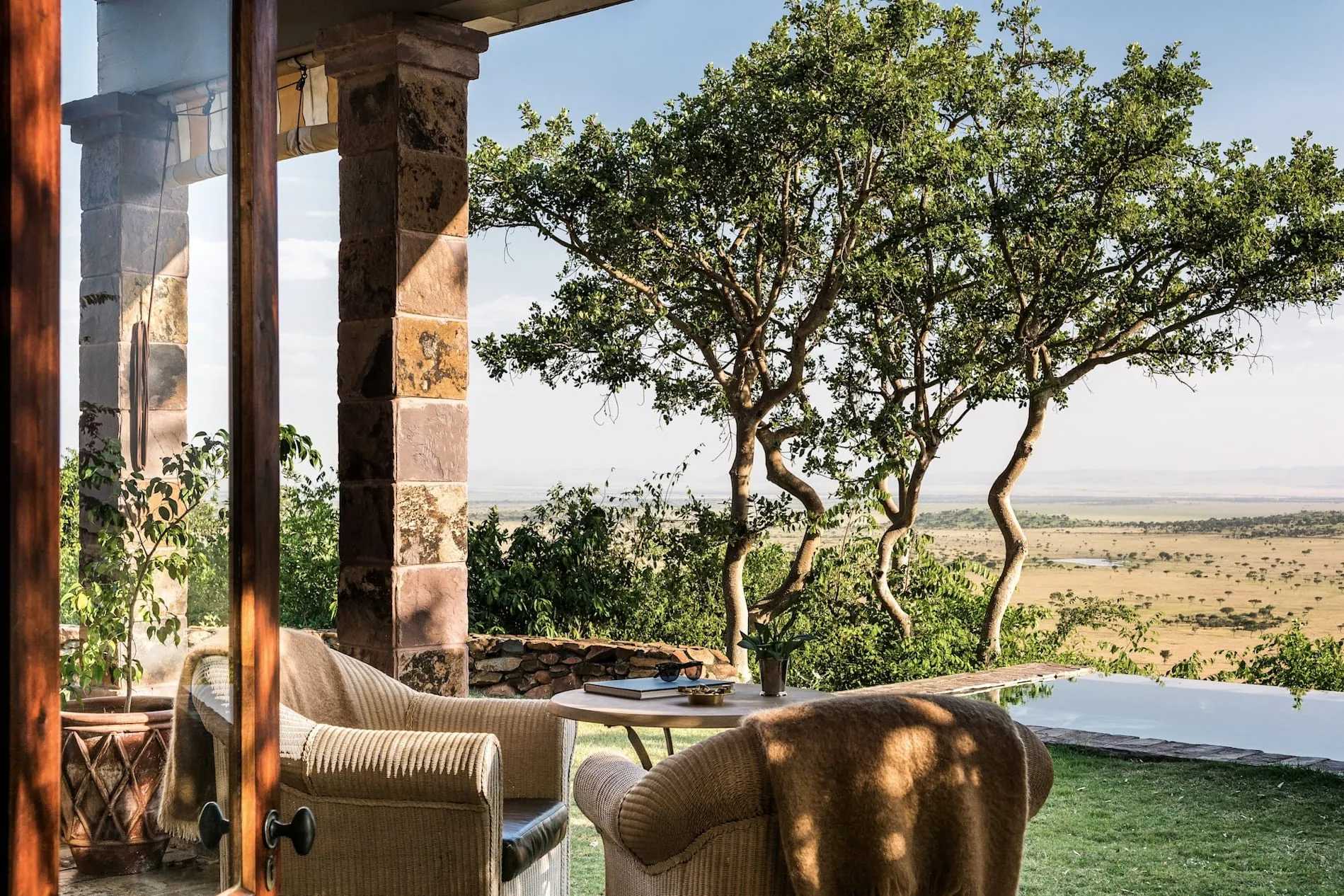
Grumeti Reserves, Serengeti, Tanzania
Singita Sasakwa Lodge
An Edwardian manor house on a Serengeti hilltop, built where a colonial-era settler once farmed, now run as the flagship of a 350,000-acre private reserve and its own rhino-recovery program.
From $2,550 per night, per person, all-inclusive