Randheli Island, Maldives
Cheval Blanc Randheli
Jean-Michel Gathy's private-island debut for LVMH's hotel house, forty minutes by seaplane into the Noonu Atoll.
- Rates from
- From $2,200 per night
- Nearest airport
- Velana International Airport (MLE), Male
- Transfer
- 40 minutes by seaplane, or a domestic flight to Maafaru International Airport followed by a 25-minute speedboat crossing
- Best months
- November to April
Forty minutes north of Male by seaplane, past the point where the last commercial resort clusters thin out into open water, the Noonu Atoll opens onto a run of islands that still feel genuinely remote. Randheli is one of them: a private island bought whole by LVMH’s hotel division and handed, without much in the way of a brief beyond scale and ambition, to the architect Jean-Michel Gathy. What he built there, opened in November 2013 as Cheval Blanc’s second Maison after the group’s original alpine chalet in Courchevel, reads less like a conventional beach resort than an architect’s uninterrupted thought experiment on the theme of a Maldivian island. It is a resort built by a fashion and spirits conglomerate with an obvious interest in craft and provenance, staffed and finished accordingly, and priced for travellers who have already tried most of the Maldives’ other private islands and are looking for the version built with the deepest pockets and the fewest compromises.
Cheval Blanc Randheli occupies a single island in its entirety: 45 villas, five restaurants, three bars, and a spa set on its own separate islet within the lagoon, all reachable within the resort’s boat network but spread out enough that neighbouring villas rarely intrude on one another. It is a young property by the standards of destinations with centuries of hotel history behind them, but the Maldives itself operates on a compressed timeline, and Randheli has had well over a decade to settle into its own rhythms, its own repeat clientele, and its own reputation as one of the atoll region’s more architecturally serious addresses.
Why It Stands Out
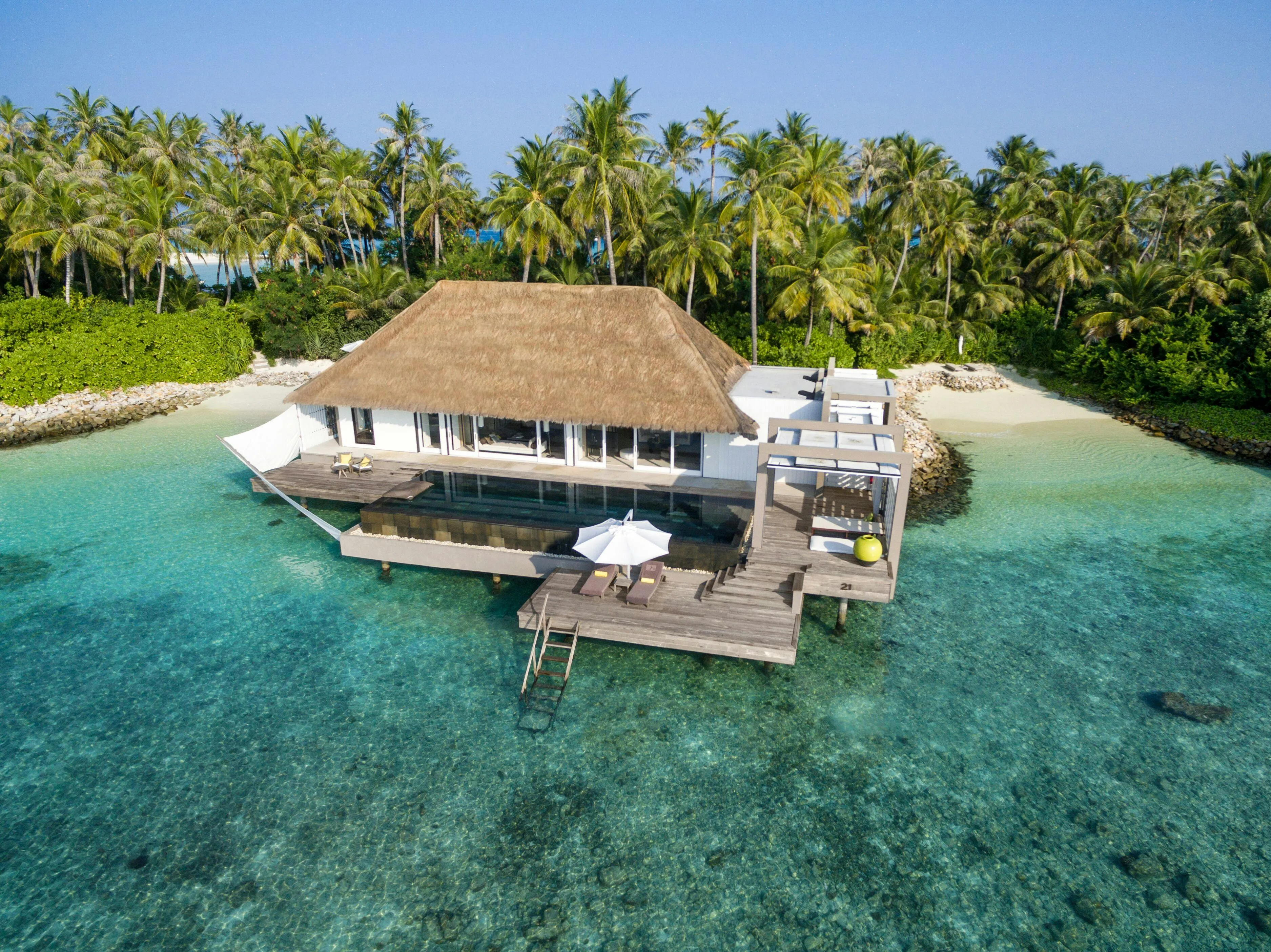
Most Maldivian resorts settle for a variation on the same brief: overwater villas, a house reef, a spa pavilion, a restaurant or two built around whatever the destination itself already supplies in abundance. Cheval Blanc Randheli’s point of difference is the degree to which LVMH treated the island as a design commission rather than a hospitality template. Jean-Michel Gathy was given the kind of freedom architects rarely get on a private island: an entire uninhabited landmass, a client with deep resources and a fashion-house sensibility, and no existing structures to work around. The result is a resort where the architecture itself, not just the amenities layered onto it, is the headline attraction.
The dining program is the other clear differentiator. Five restaurants and three bars is an unusually deep culinary bench for a single-island resort of this size, built around a genuine flagship in Le 1947, a seven-table fine-dining room that leans on the resources of a group that also owns Château Cheval Blanc itself. Few Maldivian properties can draw on an actual first-growth Bordeaux estate for their wine program’s framing, and Cheval Blanc Randheli does not let that connection go to waste.
The spa compounds the case. Cheval Blanc Spa by Guerlain is the only Guerlain rituals spa in the Maldives, set on its own dedicated island reachable by a short boat crossing from the main resort, a level of physical separation from the rest of the property that few competitors attempt. Between the architecture, the dining depth, and a spa brand rarely seen in this part of the world, Randheli occupies a specific niche: the private island built less around raw seclusion and more around the idea that design, food, and wellness can be executed at the same intensity as anywhere in Paris or Courchevel, just relocated to a coral atoll.
Architecture
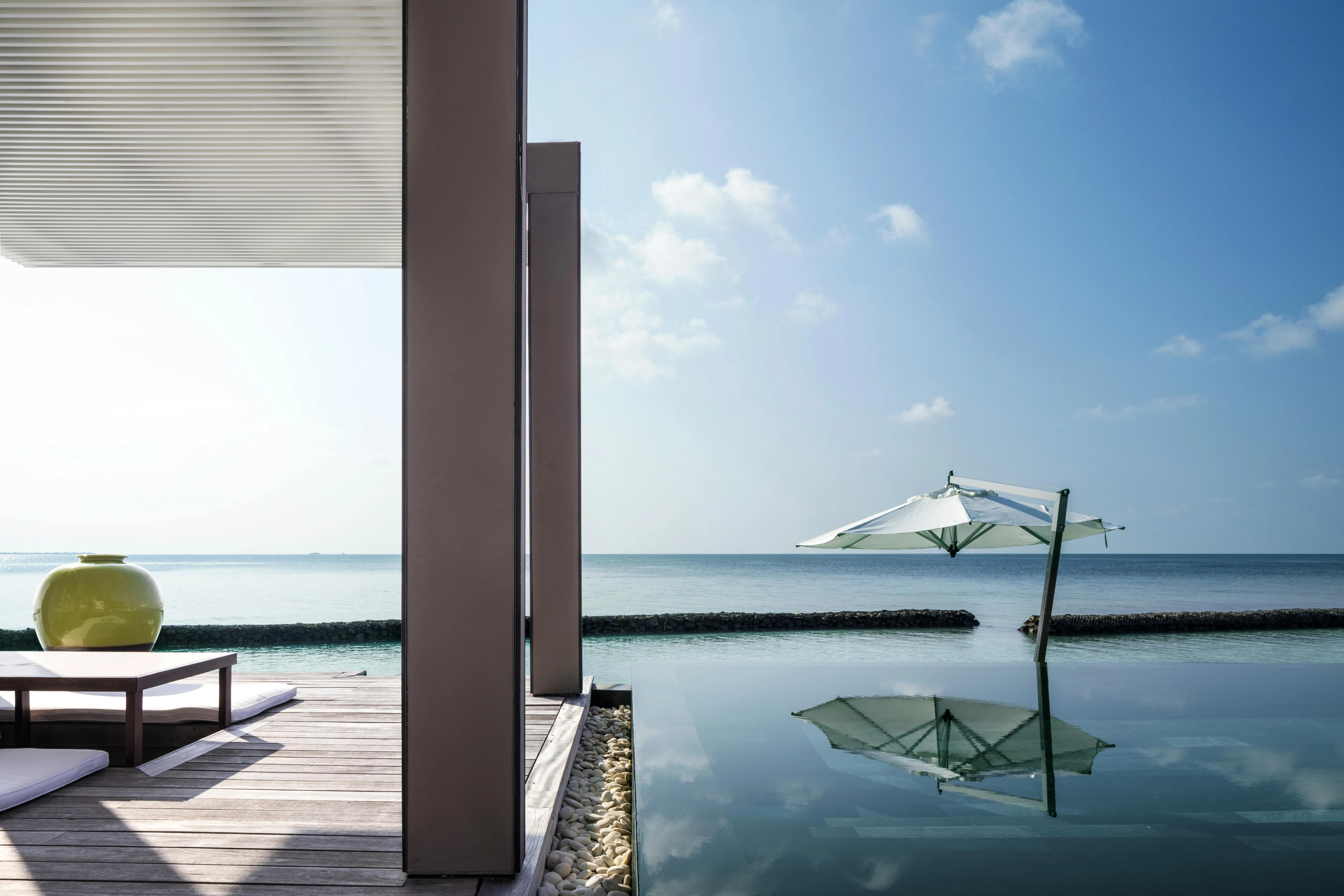
Jean-Michel Gathy is one of the resort industry’s most consistently cited architects, the name behind projects for Aman, One&Only, and a run of other high-end island and mountain resorts through his Malaysia-based practice, Denniston. Randheli was, by his own account and that of the press covering the opening, treated as close to a blank canvas as an architect gets: an entire private island, a client willing to fund an ambitious brief, and no legacy structures dictating the plan. Gathy’s response was to build big, both literally and in spirit. Villas are framed by cathedral-height ceilings and handcrafted doors that run as tall as seven metres, a scale choice that turns even the entry-level Water Villa into something closer to a small pavilion than a conventional hotel room.
The plan spreads villas widely around the island’s perimeter and out over the lagoon rather than stacking density near a central hub, which keeps sightlines uninterrupted between neighbouring structures and gives each villa a sense of standing alone on its stretch of reef. Roofs follow a traditional thatched form reworked in more durable materials suited to the tropical climate and the group’s sustainability commitments, an early example of the resort translating a vernacular Maldivian silhouette into something built to modern performance standards rather than importing an unrelated architectural language wholesale.
Beyond the villas, Gathy’s plan threads a single copper-clad landmark through the design: a monumental arch by the French artist Vincent Beaurin, rising from the lagoon as a kind of sculptural gatepost to the island, one of several art commissions folded into the architecture rather than added afterward as decoration. The overall geometry of the resort, restaurants and the spa pushed physically apart from the villa clusters and from each other, means a stay here involves genuine movement across and around the island by boat and buggy, part of Gathy’s evident intention that guests should experience Randheli as a series of distinct architectural moments rather than one continuous resort footprint.
Interior Design
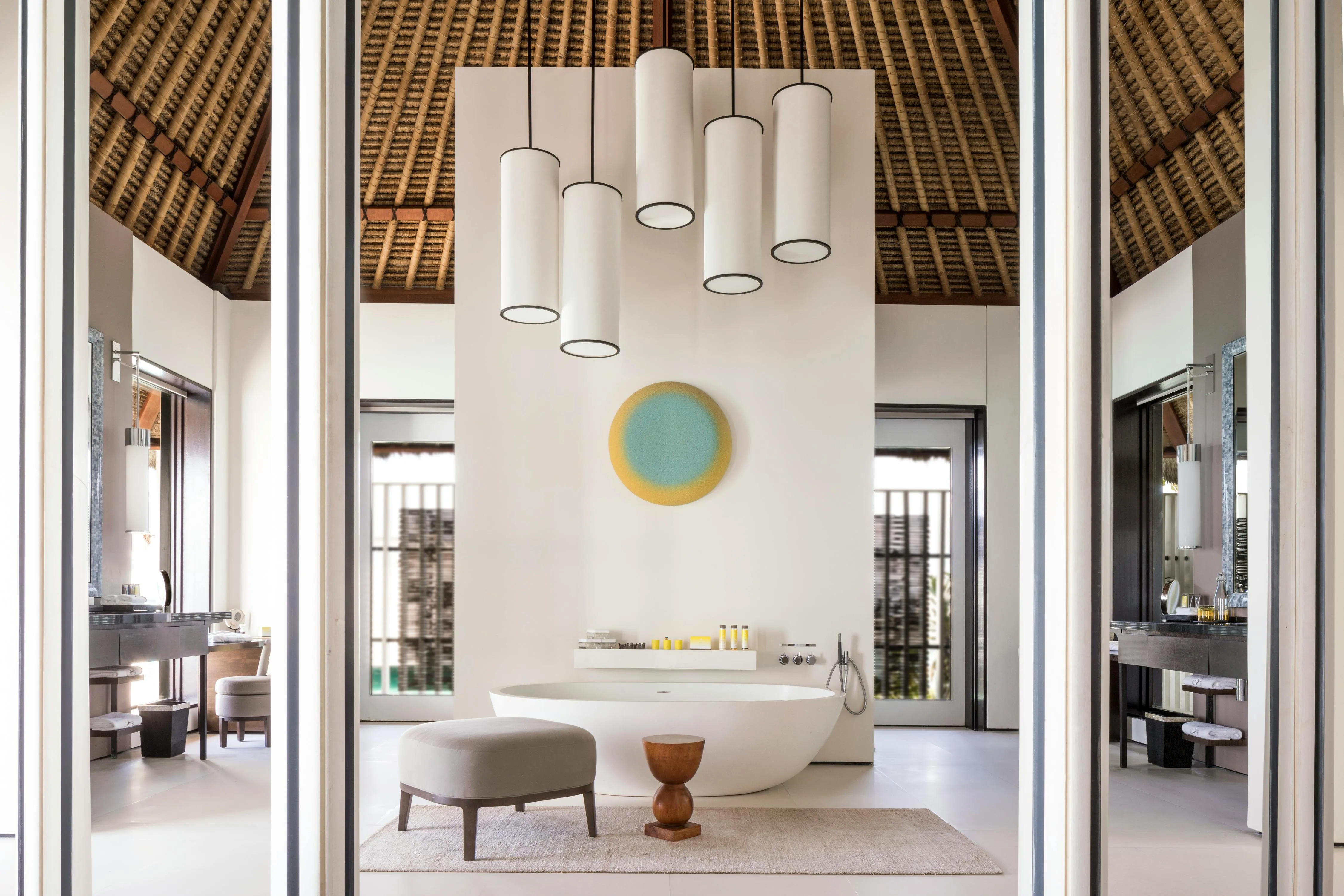
Where the exteriors work in scale and silhouette, the interiors work in material and colour. Denniston’s furnishing scheme leans hard on materials sourced from around the Indian Ocean: rattan, bamboo, teak, thatch, stone, and mother-of-pearl inlay recur across villas and public spaces, worked by both regional craftsmen and a roster of European furniture designers whose pieces sit alongside Denniston’s own custom work. Against that natural palette, the design team introduces a deliberately vivid accent: a signature pop yellow appears repeatedly against a base of demure taupe and airy white, a colour move confident enough to read as a genuine design signature rather than a seasonal styling choice.
The effect softens what could otherwise be an overwhelming sense of scale. Seven-metre doors and cathedral ceilings could easily tip into cold grandeur; instead, the material warmth of teak joinery, woven rattan panels, and stone detailing keeps the villas feeling handmade despite their size. Bathrooms lean on the same logic, built around freestanding stone and designer bathware set into interiors that still read as tropical rather than clinical. Furniture throughout draws from both custom Denniston pieces and outdoor and indoor collections from established European makers, giving villa gardens, decks, and patios a level of furnishing detail that extends the interior design language fully outdoors rather than treating terraces as an afterthought.
Art is woven through the property with the same intent, from Beaurin’s lagoon arch down to smaller commissioned pieces placed through public spaces, part of a broader art and design program the resort maintains as an ongoing feature rather than a one-time installation at opening. The net result is an interior identity that feels closer to a considered private residence, commissioned by someone with genuine design conviction, than to a standard resort fit-out assembled from a hospitality supplier catalogue.
Atmosphere
Cheval Blanc Randheli’s mood sits closer to a private French maison relocated to the tropics than to the barefoot-luxury register many Maldivian resorts default to. Service carries the polish associated with LVMH’s broader portfolio of hospitality and luxury goods brands, formal where it needs to be and relaxed where the setting calls for it, but rarely casual to the point of informality. The pacing of a stay reflects that: villas spaced for privacy, restaurants that operate as genuinely separate dining rooms rather than buffet stations, and a spa island set apart enough that reaching it already feels like an occasion rather than a short walk down a corridor.
At the same time, the island itself supplies the more familiar Maldivian textures: turquoise lagoon water visible from most villas, a house reef within reach of the property’s water sports program, and enough daylight given over to swimming, boating, and simply sitting on a private deck that the architecture and dining program never crowd out the basic pleasure of the setting. The result is a resort that reads as more considered and more formal than many of its Noonu Atoll neighbours, without losing the unhurried, water-focused rhythm that defines a Maldivian stay generally.
Rooms and Suites
Cheval Blanc Randheli has 45 villas spread across several categories, all built to Gathy’s cathedral-ceiling, seven-metre-door template but scaled and sited differently depending on the category. The entry point is the Water Villa, an overwater structure of around 240 square metres on stilts above the lagoon, with a private infinity pool, an outdoor deck, and uninterrupted views across open water. The Garden Water Villa runs a similar or slightly larger footprint, typically 240 to 300 square metres, and adds a private garden area behind the overwater structure, with some configurations offering dual master bedrooms for travelling pairs or small families who want two full suites under one villa.
On the beach, the Island Villa (One-Bedroom) runs a comparable 240 to 300 square metres with direct beach access and garden surrounds rather than lagoon frontage, suited to guests who prefer sand underfoot over an overwater deck. The Lagoon Garden Villa, at around 350 square metres, is a two-bedroom category that blends both settings, combining beach and lagoon access with more generous living space, a natural fit for two couples travelling together or a family wanting a shared but still spacious footprint.
At the top of the range, two multi-bedroom residences push well past the standard villa scale. The Private Island villa runs to more than 2,200 square metres across four bedrooms, effectively a resort within the resort, with its own dedicated Ambassadeurs team and a full slate of tailored services. The Owner’s Villa, also a four-bedroom residence, is described by the resort as its most exceptional accommodation, with its own private spa facility and an oversized outdoor pool among its exclusive amenities. Both top-tier villas are built for full buyouts by large families or groups wanting total privacy and their own dedicated staff, well beyond what even the standard villa categories offer.
Dining
Cheval Blanc Randheli runs five restaurants and three bars, an unusually deep program for a single-island Maldivian resort and one of the property’s clearest calling cards. The White is the all-day anchor, a brasserie-style restaurant open from sunrise to late evening, positioned with the ocean on one side and a large garden on the other, serving the kind of flexible, all-hours menu a resort of this scale needs to keep guests fed outside formal mealtimes. Alongside it, the White Bar operates as a poolside and beach club setting, with cabanas and a cocktail-forward menu built around the main pool.
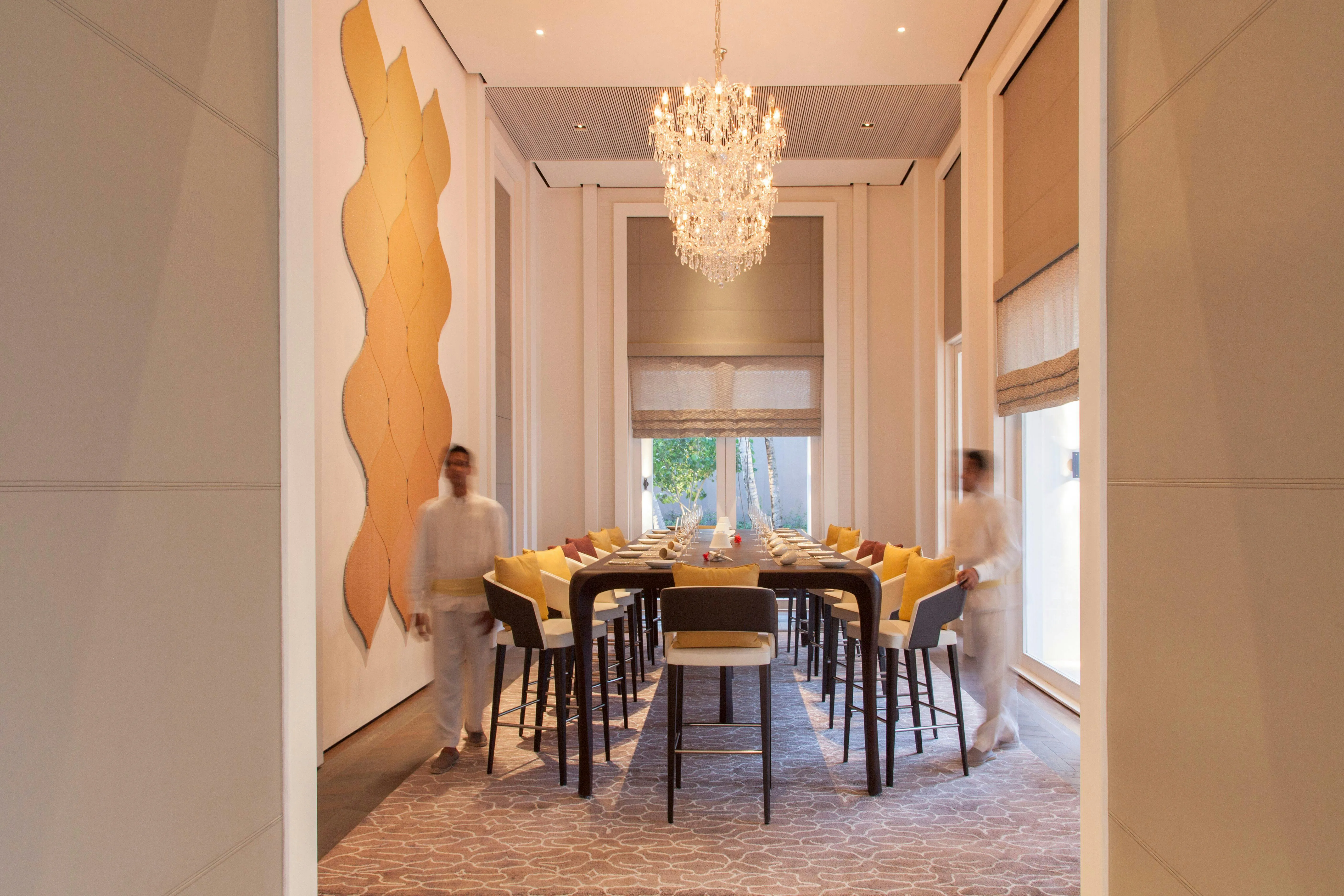
The centrepiece is Le 1947, named after Château Cheval Blanc’s most celebrated vintage and built as a genuinely intimate fine-dining room: an air-conditioned space constructed for only seven tables, opening onto a manicured garden, serving French-inspired cuisine built on the group’s own culinary heritage. Its attached bar draws on an exceptional list of wines, champagnes, and spirits, connected to a glass-walled wine cellar and cigar lounge. A shaded walkway links Le 1947 to La Table de Partage, a private dining room built to seat twelve to sixteen guests for groups wanting a dedicated space away from the main restaurants.
Diptyque brings a different register entirely: a live-cooking counter serving Japanese and Southeast Asian cuisine, seating only once each evening, built around theatre as much as the food itself. Deelani, named for a Maldivian breeze, is the resort’s Mediterranean-leaning seafood restaurant, serving fresh catch on an outdoor terrace with its own dedicated bar pouring Mediterranean-inspired cocktails. Rounding out the roster is an Italian restaurant suspended above the water, serving alfresco lunches and dinners with an obvious debt to the group’s European roots. Beyond the fixed venues, the resort’s Carte Blanche program brings private, in-villa dining to guests directly, with chefs available for live cooking in dedicated dining pavilions or beachside barbecues arranged around individual villas.
Spa and Wellness
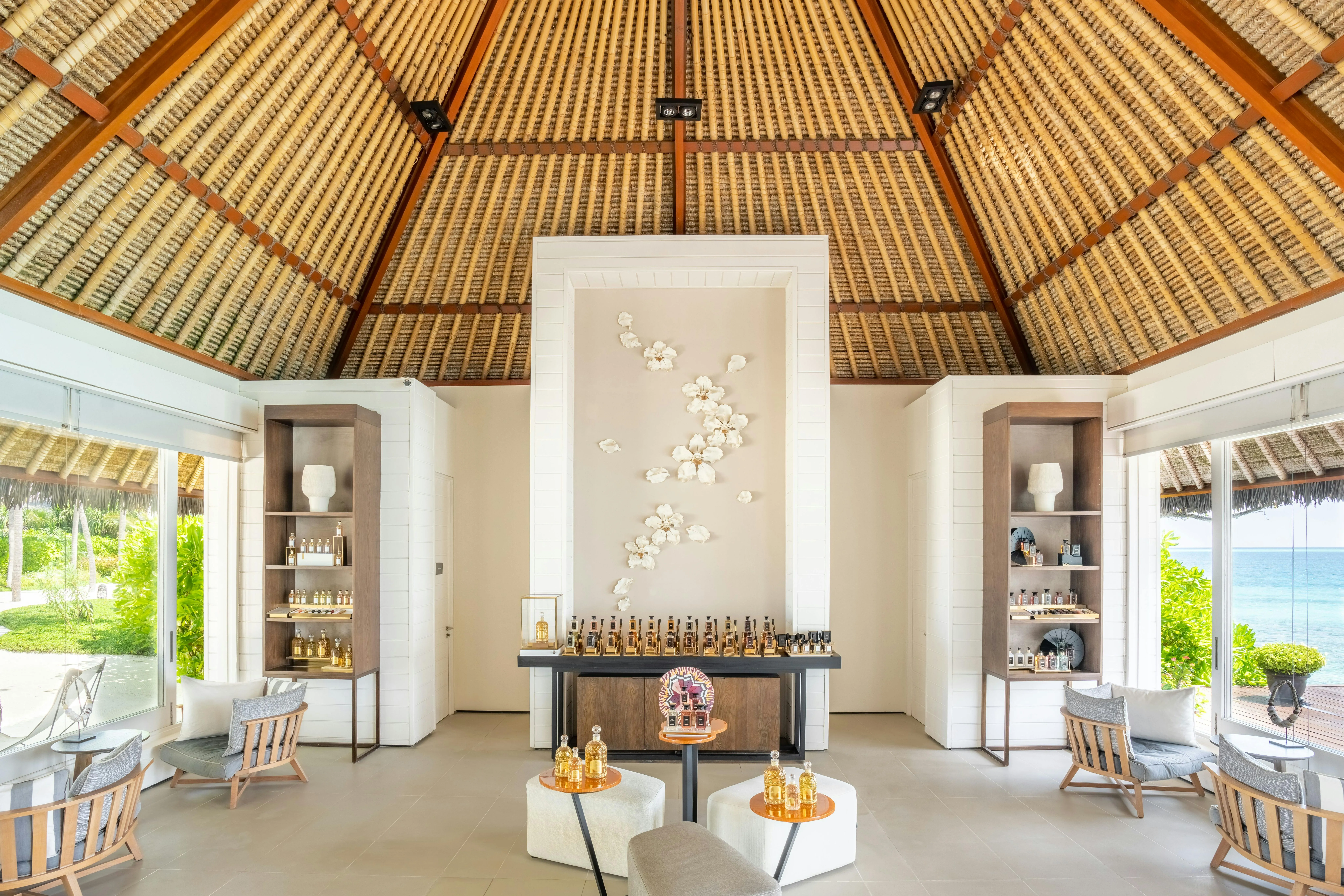
Cheval Blanc Spa by Guerlain sits on its own dedicated island within the resort’s lagoon, reached by a short boat crossing that turns even the trip to a treatment into a small excursion. It is the only Guerlain rituals spa in the Maldives, a genuine point of differentiation in a destination where nearly every major resort brand runs its own spa concept. The facility includes six treatment villas, two of them VIP doubles for couples, alongside an outdoor relaxation area, a steam room, a dry heat room, a cold plunge, and dedicated pavilions for Thai massage and yoga.
Guerlain has developed a signature treatment exclusive to the property, Ocean Treasures, working across body, face, and scalp with a focus on re-energising, soothing effects drawn from marine ingredients. The spa’s own bar looks out over a 25-metre infinity pool toward the atoll, serving a menu built around wholesome, lighter eating to match the wellness program rather than a standard poolside food menu. The spa operates daily from 10 am to 9 pm, giving guests a wide window to build treatments, yoga sessions, or simple pool time around the rest of the day’s plans.
Experiences
Randheli’s activity program runs through both the resort’s own lagoon and the wider Noonu Atoll beyond it. The resort maintains an on-site marine biology team dedicated to coral preservation and turtle conservation, and guests can join a coral propagation program that goes beyond passive observation, working alongside marine biologists on active reef restoration around the island. For an atoll that sits further from Male than the more heavily trafficked resort clusters closer to the capital, that relative distance has kept house reef and surrounding marine life in noticeably better condition than atolls nearer the airport.
Water sports and excursions follow the pattern typical of the Maldives’ upper tier: diving and snorkelling on the house reef and further afield sites around Noonu Atoll, sunset cruises, private sandbank picnics, and fishing trips arranged through the resort’s marine team. The island’s art and design program adds a less typical layer to the experience roster, with guided walks through the property’s commissioned artworks, Vincent Beaurin’s lagoon arch chief among them, framed as a genuine design tour rather than an afterthought tacked onto a standard activity sheet. Seasonal aggregations of manta rays and whale sharks in the wider Noonu and neighbouring atolls also draw specialist excursions during the right months, for guests willing to add a boat day specifically built around marine life rather than reef time close to the villa.
Who It Is For
Cheval Blanc Randheli suits travellers who already know what a private Maldivian island offers and are choosing specifically on the strength of architecture, dining, and brand pedigree rather than on price. Design-conscious couples and honeymooners are an obvious fit, given the scale of Gathy’s villas and the degree of privacy built into the site plan. Guests who treat a resort’s kitchen as seriously as its beach, the kind of traveller who would notice and care that Le 1947 draws on an actual first-growth Bordeaux estate’s name and heritage, will find the dining program deeper than almost anywhere else in the atoll region.
Large families and multi-generational groups are also well served, particularly by the Private Island and Owner’s Villa categories, which are built explicitly for full buyouts with dedicated staff rather than adjoining standard rooms. It is a less natural fit for travellers on a tighter budget or those who want a simpler, more rustic barefoot-luxury register: Randheli’s scale, formality, and price point put it firmly at the top of the Maldivian market, and its architectural ambition is part of what a guest is paying for, not an incidental bonus.
Best Time to Visit
The Maldives’ dry season, running roughly from November to April, is the most reliable window for calm seas, consistent sun, and the clearest water for diving and snorkelling around Randheli’s house reef and the wider Noonu Atoll. This period also coincides with the destination’s peak season generally, so rates and villa availability are tightest around the December and January holidays specifically. The wetter southwest monsoon period from May through October brings a higher chance of afternoon squalls and rougher seas, though it also tends to correspond with lower rates and thinner crowds, and seaplane transfers can occasionally be affected by weather during this stretch, a detail worth building slack into any itinerary around.
How to Get There
Nearly all guests arrive via Velana International Airport (MLE) near Male, the Maldives’ main international gateway. From there, Cheval Blanc Randheli operates its own seaplane transfer, a flight of around 40 minutes north into the Noonu Atoll, with a dedicated Cheval Blanc lounge available at Male’s seaplane terminal for guests waiting on their flight. Seaplane transfers operate during daylight hours only, which occasionally requires an overnight in Male for guests on very early or late international flights.
An alternative route runs through Maafaru International Airport, a smaller domestic airport within the Noonu Atoll itself. Guests flying into Maafaru on a domestic connection or private charter can reach Randheli by a considerably shorter speedboat transfer, roughly 25 minutes, which can be a useful option for travellers wanting to avoid the seaplane’s daylight-only restriction or simply prefer a faster final leg.
Nearby Experiences
Because the Maldives’ private-island model puts each resort on its own dedicated landmass, there is no town or neighbouring property to visit from Randheli in the way a mainland destination might offer. The relevant “nearby” experiences instead sit within the wider Noonu Atoll and the broader northern Maldives: dive sites and channels beyond the house reef, sandbanks reachable by short boat trips for private picnics, and, seasonally, the manta ray and whale shark aggregations that draw specialist excursions across this stretch of atolls. Guests wanting a genuine change of scenery mid-stay can arrange inter-island boat excursions to uninhabited sandbanks or nearby reef systems through the resort’s marine and excursions team, the closest equivalent this destination offers to an off-property day trip.
Things to Know Before Booking
Rates at this level of the Maldivian market start in the low thousands of dollars per night for entry-level Water Villas and climb substantially for the Lagoon Garden, Private Island, and Owner’s Villa categories, so travellers should confirm current pricing, meal-plan inclusions, and transfer costs directly with the resort or a specialist agent before booking, since figures move with season and availability. Seaplane transfers are weather-dependent and operate only during daylight hours, a detail worth factoring into international flight timing on both ends of the stay. Given the property’s scale and the depth of its restaurant program, guests planning to sample multiple venues across a short stay should discuss dining reservations with their villa host early, since the smaller rooms, Le 1947’s seven tables and Diptyque’s single nightly seating chief among them, can book out during peak season.
Sustainability
Cheval Blanc Randheli’s environmental program centres on energy, water, and marine conservation. The resort has invested in a large-scale floating solar system as part of an ongoing clean energy transition, reducing reliance on diesel generation that remains common across the Maldivian resort industry. A strict no-single-use-plastic policy runs across guest operations, and the property prioritises local sourcing from Maldivian farmers and fishermen wherever possible, both to support the domestic supply chain and to reduce the footprint associated with imported goods.
Marine conservation is handled by an on-site team of marine biologists dedicated specifically to coral preservation and turtle conservation, running an active coral propagation program that guests can join rather than simply observe. Construction choices reflect the same priorities: the resort’s thatched roofing uses a recycled material made from reclaimed plastic and fibre, chosen for durability and to reduce the harvesting of natural thatching material that a resort of this scale would otherwise require. Together, the program reflects a broader shift across the upper end of the Maldivian resort industry toward treating sustainability as core infrastructure rather than a marketing addendum, a shift Randheli’s LVMH ownership has had the resources to pursue at meaningful scale.
Practical Information
Rates at Cheval Blanc Randheli start from an indicative USD 2,200 per night for entry-level Water Villas, rising substantially through the Garden Water, Island, and Lagoon Garden categories to the multi-bedroom Private Island and Owner’s Villa residences; travellers should confirm current pricing and meal-plan inclusions directly with the resort or a specialist agent, since rates at this level move with season and demand. Check-in is from 2:00 PM and check-out by 12:00 PM, with early check-in or late check-out available on request, subject to villa availability.
The nearest international gateway is Velana International Airport (MLE) near Male, reached from Randheli by a roughly 40-minute seaplane transfer, or via a domestic flight to Maafaru International Airport followed by a 25-minute speedboat crossing. November through April is the most reliable dry-season window for calm seas and consistent sun, with the wetter southwest monsoon running from May through October. Most guests plan four to five nights, enough time to move through the resort’s five restaurants, the Guerlain spa island, and at least one full day given over to the house reef or a wider atoll excursion.
Editorial Conclusion
Cheval Blanc Randheli makes its case less through raw seclusion, which nearly every Maldivian private island can claim in some form, and more through the depth of what LVMH built once that seclusion was secured. Jean-Michel Gathy’s architecture gives the resort a genuine design identity, cathedral ceilings, seven-metre doors, and a material and colour language carried consistently from villa interiors out to the gardens and decks around them, rather than a generic tropical-luxury shell. The five-restaurant, three-bar dining program and a spa built around the Maldives’ only Guerlain rituals concept both push the property’s ambitions well past the standard private-island brief, into territory closer to what a guest might expect from a flagship urban hotel, just relocated to a coral atoll in the Noonu Atoll. For travellers weighing where to spend a five-figure Maldivian stay, Randheli’s argument is straightforward: the seclusion is a given at this level of the market, and what separates one private island from the next is everything LVMH chose to build on top of it.
In pictures
On the map
Randheli Island, Maldives
Questions
Frequently asked
Who designed Cheval Blanc Randheli, and when did it open?
The resort was designed by the Belgian architect Jean-Michel Gathy, working through his Malaysia-based practice Denniston, and opened in November 2013 as the second Maison in the Cheval Blanc group, following Cheval Blanc Courchevel. It is owned and operated by LVMH Hotel Management, the hospitality arm of LVMH.
How do guests get from Male to Cheval Blanc Randheli?
Most guests transfer by seaplane directly from Velana International Airport (MLE) near Male, a flight of around 40 minutes into the Noonu Atoll, with a dedicated Cheval Blanc lounge available at the seaplane terminal while waiting. An alternative route is a short domestic flight to Maafaru International Airport, followed by a roughly 25-minute speedboat transfer to the island.
What villa categories does Cheval Blanc Randheli offer?
The resort has 45 villas across several categories: overwater Water Villas and Garden Water Villas, beachfront one-bedroom Island Villas, a two-bedroom Lagoon Garden Villa, and two multi-bedroom top-tier residences, the Private Island villa and the four-bedroom Owner's Villa, each with its own dedicated pool and service team.
How many restaurants does Cheval Blanc Randheli have?
There are five restaurants and three bars. They include The White, the all-day brasserie; Le 1947, the resort's fine-dining French room; Diptyque, a Japanese and Southeast Asian live-cooking counter; Deelani, a Mediterranean-leaning seafood restaurant; and an overwater Italian restaurant, alongside the White Bar, the Deelani Bar, and a wine cellar and cigar lounge attached to Le 1947.
Is there a spa, and what is it known for?
Cheval Blanc Spa by Guerlain occupies its own dedicated island within the resort's lagoon, reachable by boat, and is the Maldives' only Guerlain rituals spa. It has six treatment villas, including two VIP doubles, along with a steam room, cold plunge, yoga and Thai massage pavilions, and a 25-metre infinity pool at its spa bar.
Same destination
More hotel guides in Maldives
Lankanfushi Island, Maldives
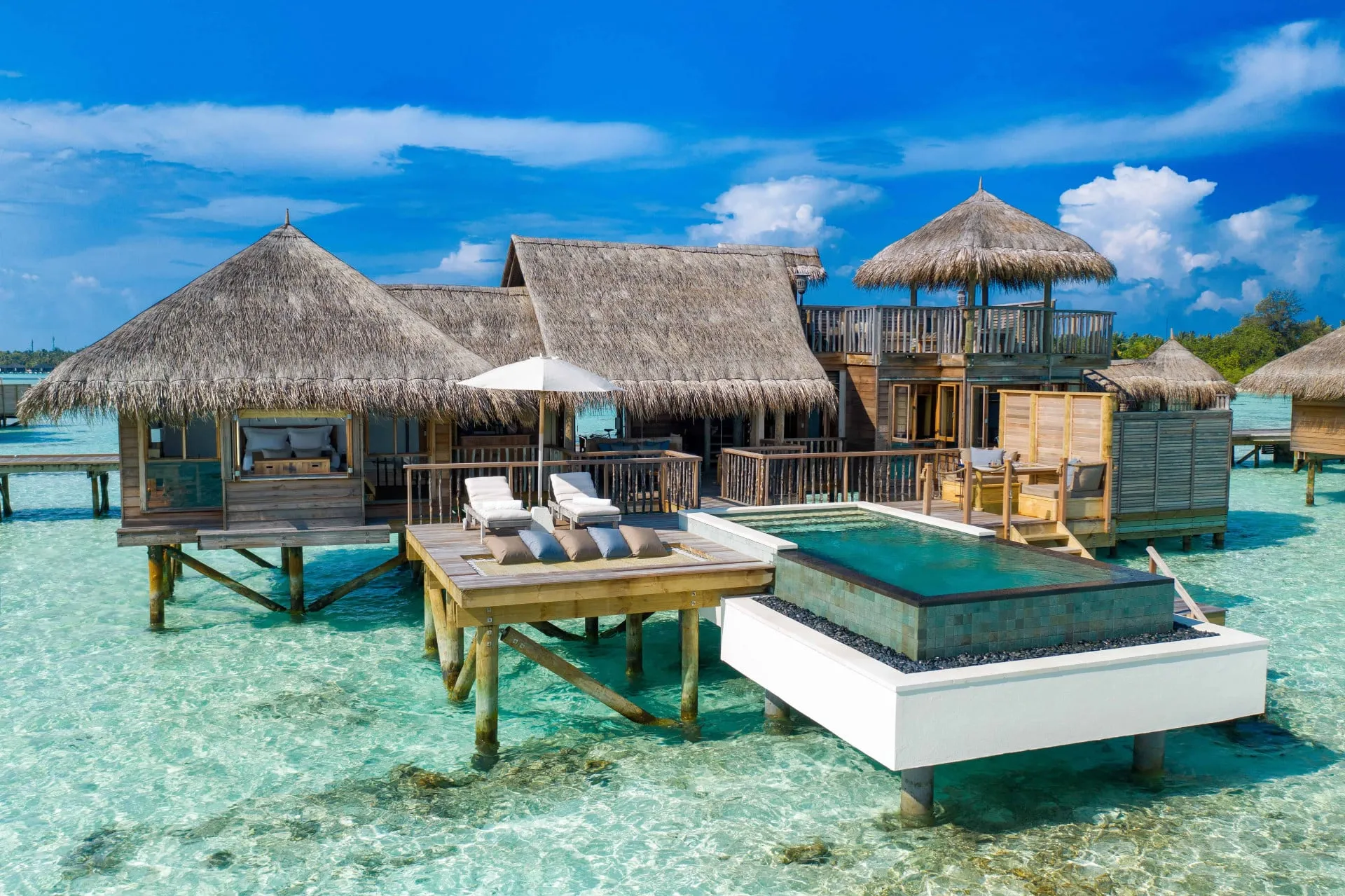
Gili Lankanfushi
The Maldives resort that invented barefoot luxury and has spent two decades refusing to put its shoes back on.
From $1,550 per night
Muravandhoo Island, Maldives
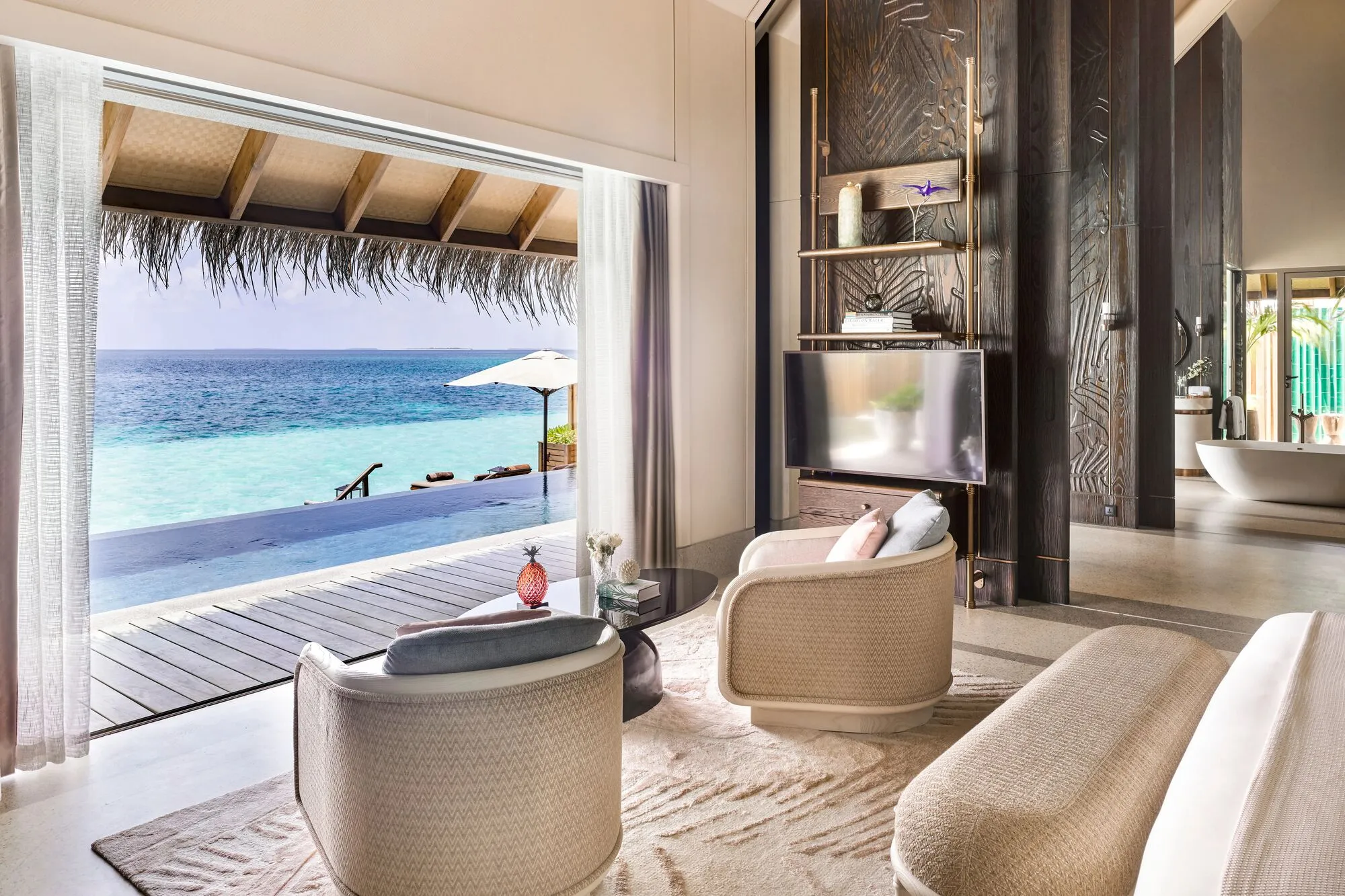
JOALI Maldives
An art-immersive private island in Raa Atoll where more than forty commissioned installations sit alongside 73 villas and a working coral restoration reef.
From $1,600 per night
Fari Islands, Maldives
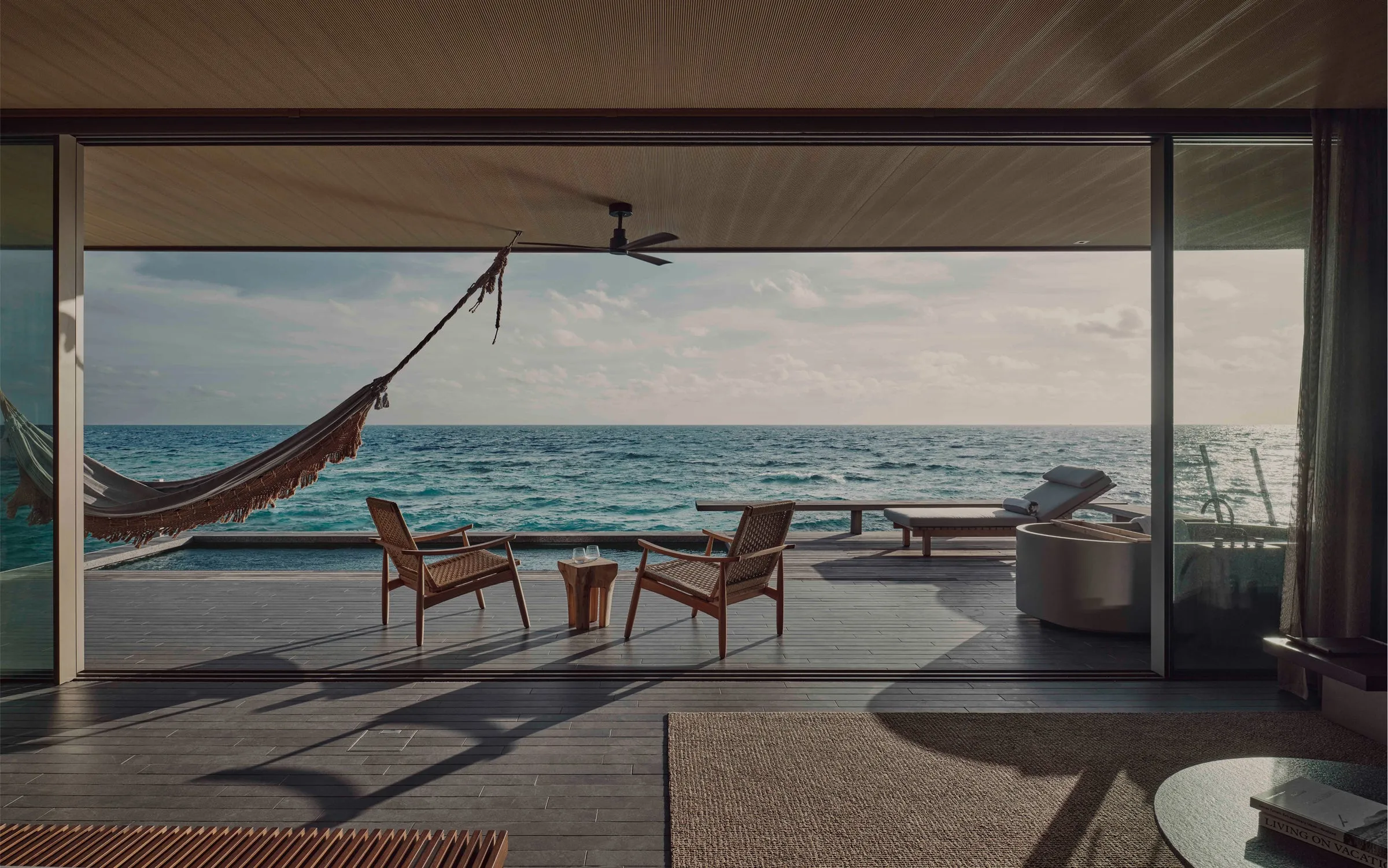
Patina Maldives
A Brazilian architect's low, canopy-height villas and a shared four-island marina make this the Maldives resort built for people who find most private-island luxury a little too private.
From $1,600 per night