Muravandhoo Island, Maldives
JOALI Maldives
An art-immersive private island in Raa Atoll where more than forty commissioned installations sit alongside 73 villas and a working coral restoration reef.
- Rates from
- From $1,600 per night
- Nearest airport
- Velana International Airport, Male (MLE)
- Transfer
- 45min seaplane, or domestic flight to Ifuru Airport followed by a short speedboat transfer
- Best months
- November to April, the Maldives' dry season with calmer seas and consistent sun
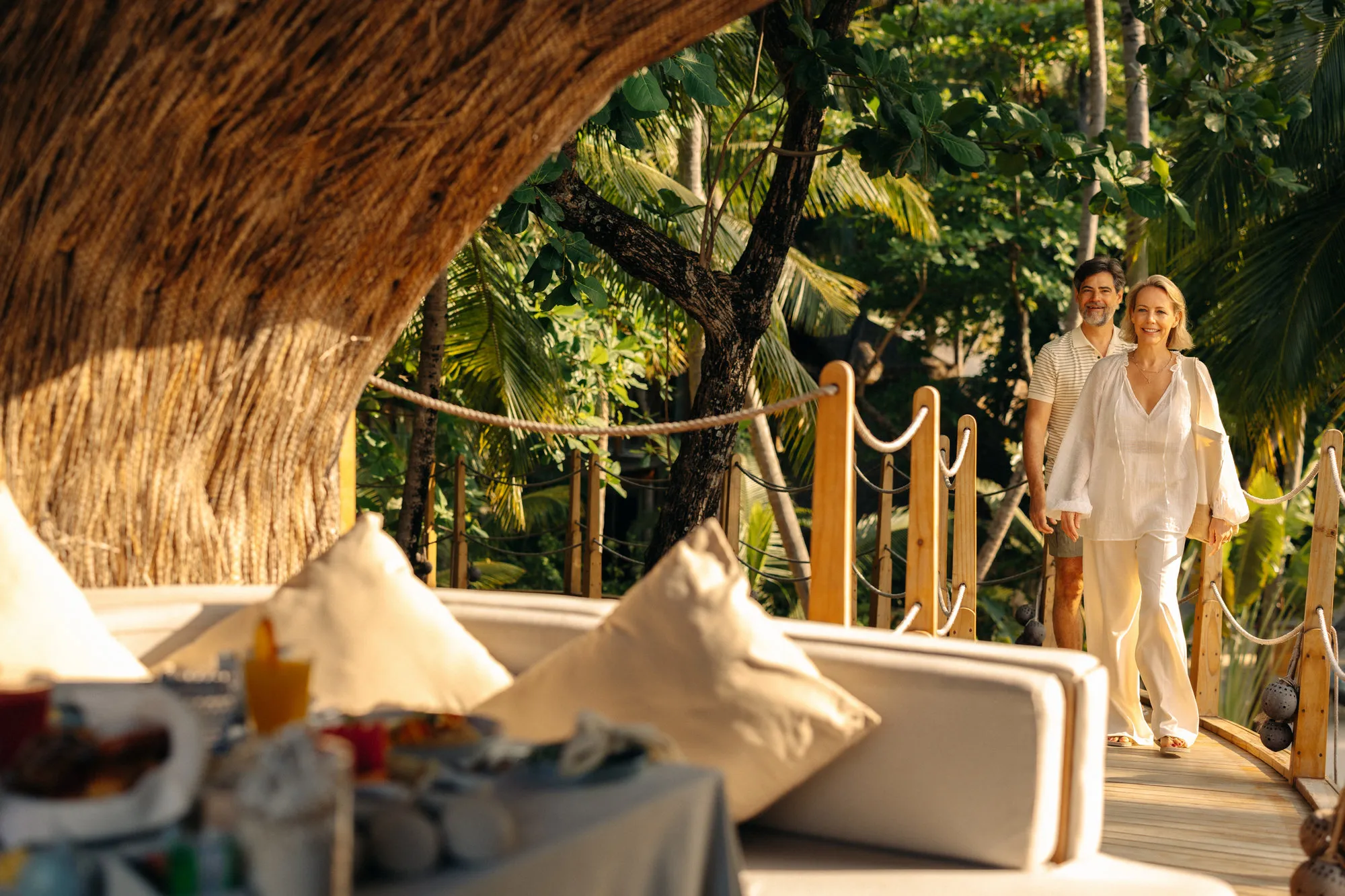
There is a moment on the long boardwalk out to JOALI Maldives’ water villas when the resort’s whole premise becomes obvious without a word of explanation: underfoot, timber decking undulates gently, rising and falling like a wave frozen mid-motion, and off to one side a sculptural nest of woven palm sits suspended above the sand, occupied by nobody and photographed by everybody. This is not a beach resort that happens to display some art. It is a resort conceived, from the architectural plan up, as a vehicle for more than forty commissioned works, on an island in one of the Maldives’ quieter northern atolls where the nearest other resort is a speck on the horizon.
JOALI opened on Muravandhoo Island in Raa Atoll in 2018, the debut Maldivian property of the Turkish company Gürallar, founded by the entrepreneur Esin Güral Argat, and it arrived in a market already crowded with private-island luxury making a specific, differentiated claim: that an island resort could function as something closer to an open-air museum, with pieces made for the site by international and Maldivian artists rather than acquired off a gallery wall and shipped in. Nearly a decade on, that premise has held up well enough that JOALI is now routinely cited as one of the reference points for design-led hospitality in the region, its name borrowed by a second, wellness-focused sister property, JOALI BEING, on a neighbouring island in the same atoll.
The island itself is small, a little under ten hectares, which is part of what makes the density of the art programme legible rather than overwhelming: a boardwalk of just over a kilometre connects everything, so a guest can move from a beach villa to the spa to dinner and pass a meaningful share of the resort’s forty-plus commissioned works along the way, without ever needing a buggy to cover the distance.
Why It Stands Out
Most luxury resorts in the Maldives compete on villa size, pool depth and reef quality, all of which JOALI holds up reasonably well against its peers. What separates it is the decision to treat art as structural rather than decorative: the pieces here were commissioned specifically for this island, worked into the architecture rather than added afterward, and the resort maintains an on-site studio and gallery, Artscape, along with a curatorial relationship with the Istanbul-based firm No LaB that has run since before the property opened. Few resorts anywhere sustain that kind of commitment past an opening-week press release, and JOALI’s continues to expand years into operation.
The second differentiator is less visible but arguably more durable: a coral restoration programme run by the country’s first Maldivian senior marine biologist, using mineral accretion technology to speed coral growth in nurseries planted around the island. In a destination where reef health varies enormously from resort to resort and is rarely disclosed with much rigour, JOALI’s willingness to name the person running the programme and describe the method is unusual, and it gives the property’s sustainability claims a specificity that is harder to find elsewhere in the category.
A third, quieter distinction is how deliberately JOALI ties its art programme back into the local community rather than treating it purely as an imported curatorial exercise. The resort’s Women in Arts initiative gives Maldivian women, including working artists, a route into a professional art practice through on-site training and exhibition space, which is a more structural form of local engagement than the workshops-for-guests format common to much of the industry.
Architecture
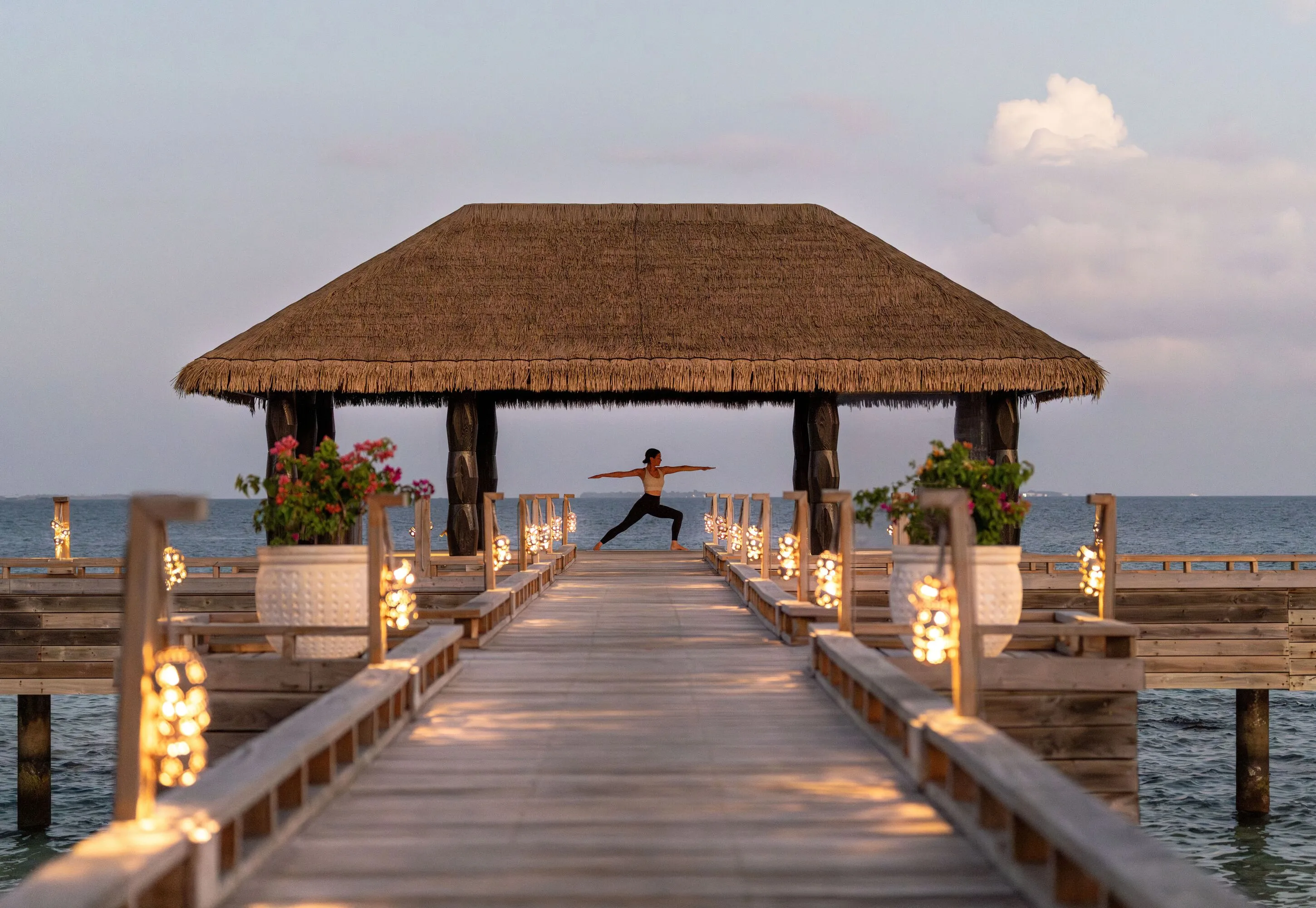
The resort’s architectural plan was designed by Cüneyt Bükülmez of the Istanbul-based practice Atölye4N, whose defining move is the 1.3-kilometre boardwalk that threads the island together, connecting the beach villas to the overwater villas and on to the restaurants and spa without a single straight run. The jetty at the arrival point sets the tone immediately, its undulating thatched roofline built to echo the rise and fall of the ocean it stands over, and that same biophilic language, rounded forms, soft edges, deep eaves, extends across the rest of the built environment. Rather than a single dominant building, JOALI reads as a scatter of individual structures tucked into the island’s vegetation, a layout that owes as much to protecting privacy between villas as it does to aesthetics.
Construction leaned on local and regional materials: timber, thatch and bamboo dominate, chosen partly for their visual softness against the sand and lagoon and partly because they allow buildings to sit lightly on a small, ecologically sensitive island rather than imposing on it. The result favours horizontal lines and low profiles over height, keeping sightlines to the water largely uninterrupted from most points on the property.
The island’s tree cover was treated as a constraint to design around rather than clear, and the masterplan is credited with preserving well over a thousand existing trees during construction, a decision that shows up directly in how the boardwalk and villas weave between established palms and coastal vegetation rather than sitting on a cleared, replanted lot. That approach also explains why so much of the property reads as shaded and enclosed by greenery even at midday, an unusual quality on a resort island of this size.
Interior Design
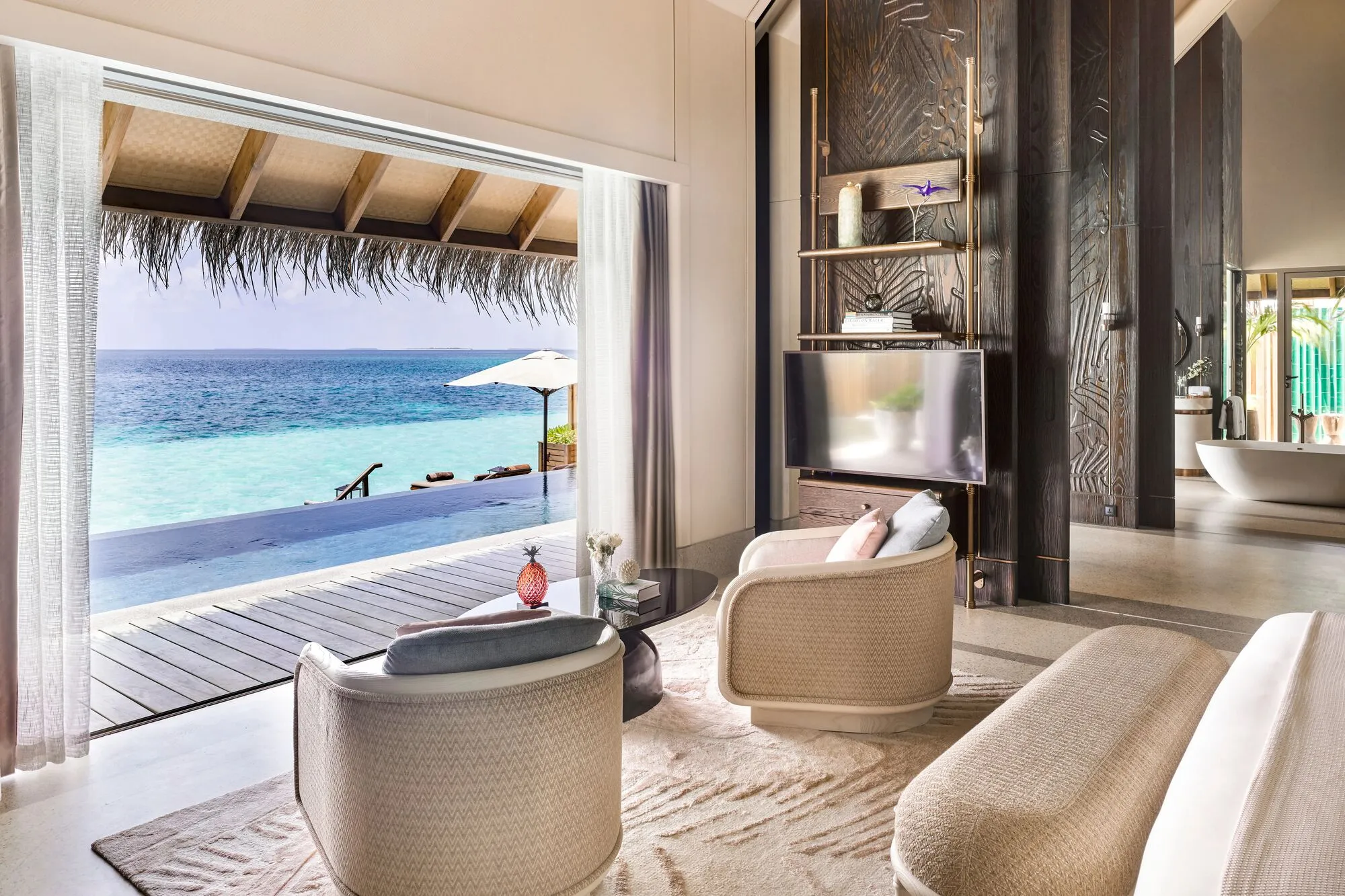
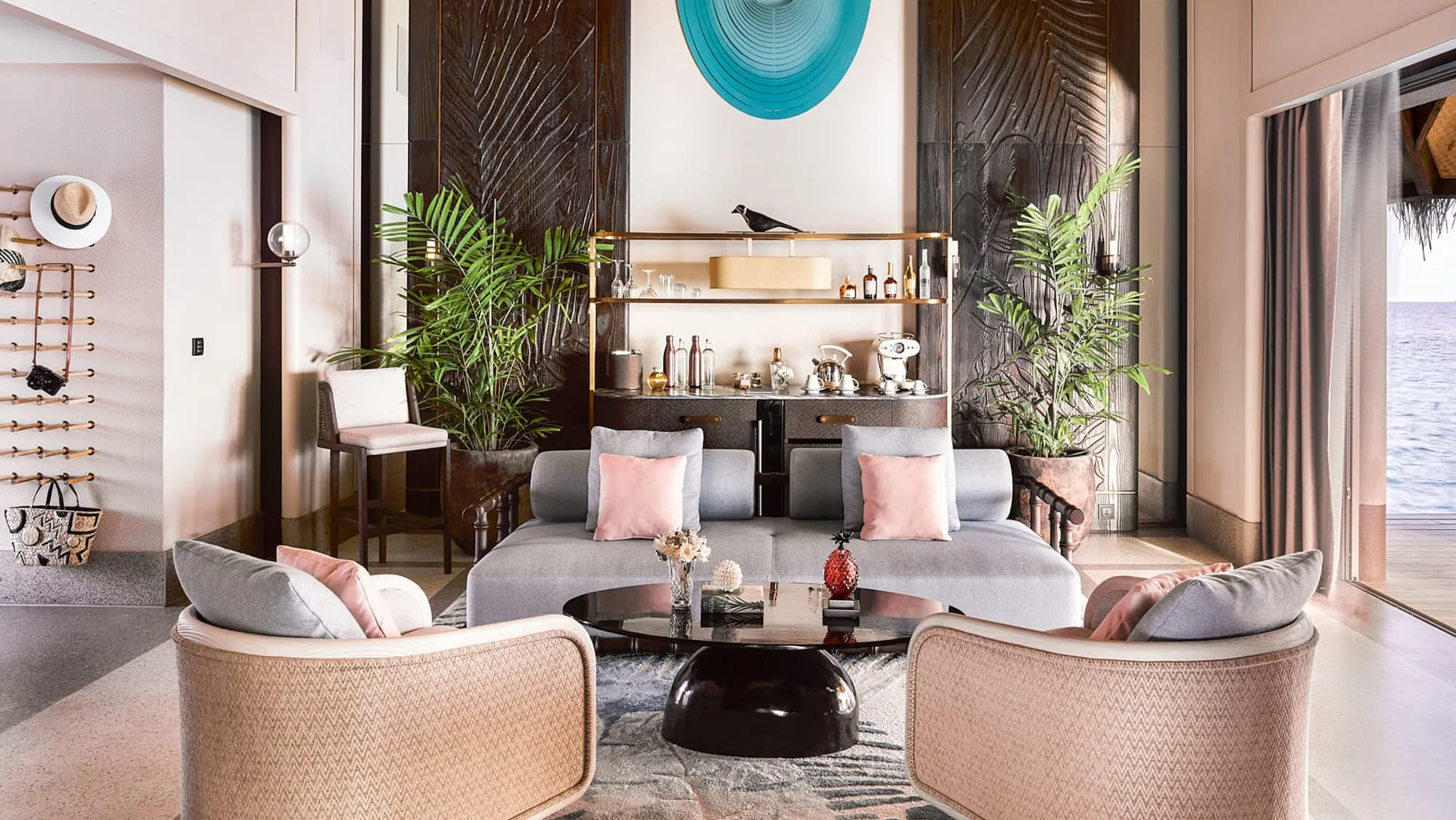
Interiors were realised by Autoban, the Istanbul-based multidisciplinary design studio, working alongside the architecture team to carry the same restrained, natural material palette from the exterior into the villas and public spaces: pale timbers, woven textures, stone and linen, with colour used sparingly so that the commissioned artworks, rather than the furniture, register as the accent. Villas favour an open, indoor-outdoor plan, with dressing rooms, freestanding stone bathtubs and marble-finished bathrooms recurring across most categories, and each unit incorporates specific art pieces, sculptural lighting, ceramics, glasswork, so that no two villas display quite the same collection.
Public spaces follow the same logic at a larger scale. Maison de JOALI, the arrival and lobby building, doubles as an informal gallery, its furniture and fittings drawn in part from the same commissioned collection that populates the villas, while the restaurants and bars each carry a distinct design identity tied to their individual artist collaborations rather than a single resort-wide house style.
Atmosphere
JOALI trades the hushed, minimalist restraint common to much of the upper end of Maldivian hospitality for something more textured and conversational. Between the boardwalk’s constant gentle rhythm, the density of sculptural work at every turn and an events calendar built around art, music and culinary programming, the island has a livelier, more curated energy than the classic model of total, silent isolation. That said, the fundamentals of a private-island resort still apply: one property, one reef, no town to walk to, and long stretches of beach and lagoon where the art recedes into the background and the setting simply does the work.
The overall register sits closer to a boutique art hotel that happens to be on a Maldivian island than to a conventional five-star beach resort, a distinction that shapes who is likely to feel most at home here.
Rooms and Suites
JOALI’s 73 villas and residences run across beach and overwater categories, all built with a private pool as a near-universal standard. Beach Villas with Pool, at roughly 680 square metres of plot including garden and terrace, open the collection with a king-bed configuration (a twin-bed layout is also offered), a dressing room and an indoor-outdoor bathroom finished in green marble. The Luxury Beach Villa with Pool steps up to around 865 square metres with a larger infinity pool and an added living room and library.
Overwater, the Water Villa with Pool and the Luxury Water Villa with Pool sit directly above the lagoon on sundecks with plunge or infinity pools, and a Luxury Sunset Water Villa variant is oriented specifically for evening light. Family-oriented configurations include a Two-Bedroom Beach Villa with two pools, built as a pair of thatch-roofed structures around a shared outdoor dining area, and a Two-Bedroom Water Villa with a private pool and open-plan living space.
At the top of the range, multi-bedroom residences are built for larger groups: a Four-Bedroom Beach Residence with its own pool, library and dedicated buggy and driver service, and the Three-Bedroom Ocean Residence, the resort’s largest overwater configuration, with two infinity pools, a private spa suite and sauna, and separate living structures connected by their own stretch of boardwalk. Butler service is included across the villa collection, and most units display works from the resort’s commissioned art programme as part of their furnishing.
The bathrooms across the collection are worth calling out on their own terms: green-marble finishes, indoor-outdoor layouts that open partially to the garden or lagoon, and freestanding tubs recur through most categories, which keeps the bathing experience consistent even as villa size and privacy scale up through the range. Selected villas and residences also carry specific art commissions, glasswork, ceramics or sculptural lighting, so choosing a villa category at JOALI is, in a small way, also choosing which piece of the art collection a guest lives alongside for the length of the stay.
Dining
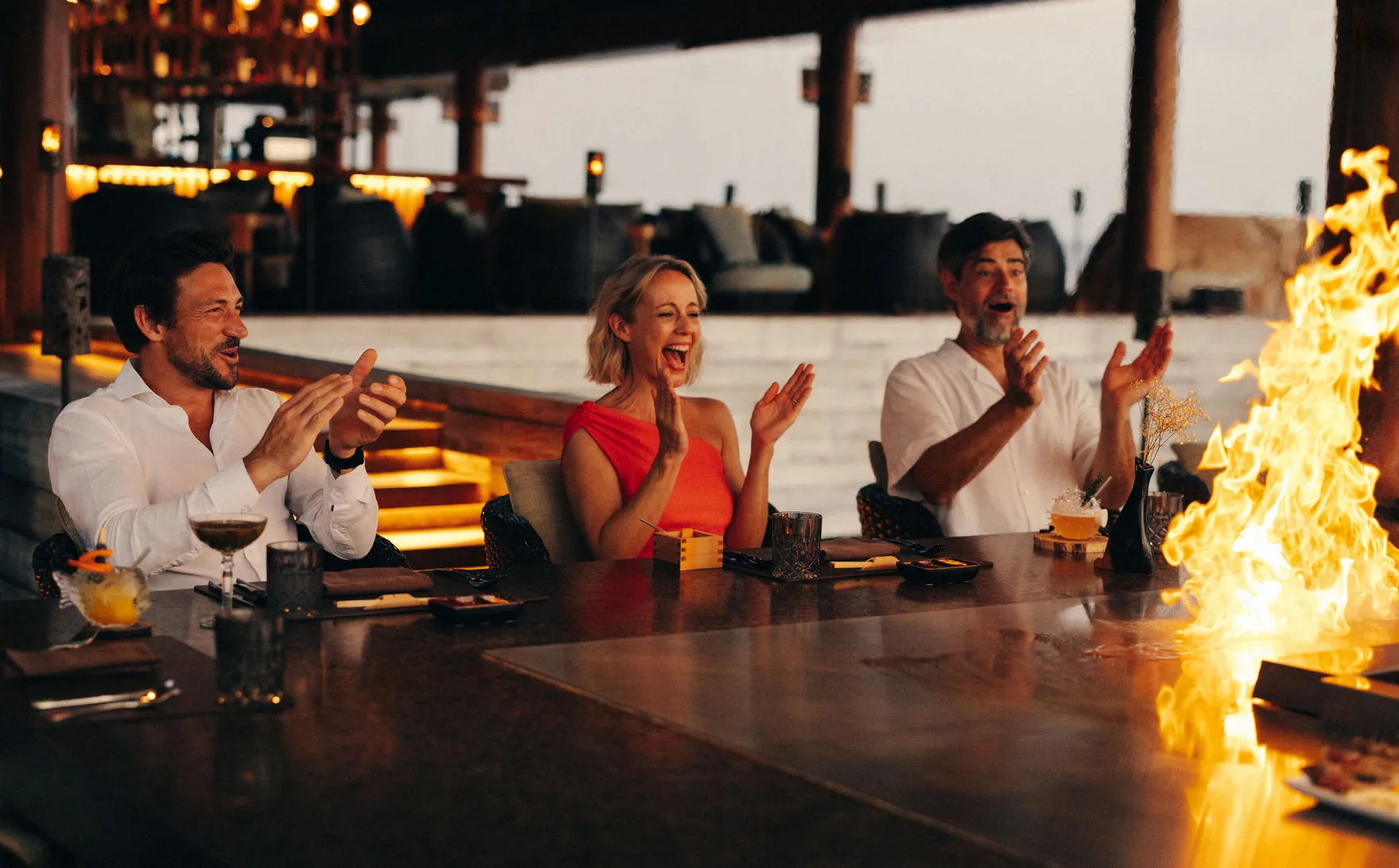
Vandhoo functions as JOALI’s main restaurant, serving breakfast and dinner built around Southeast Asian, Chinese and Indian influences in an open-air pavilion planted with tropical vegetation; it is also where the property’s included breakfast is served. Saoke, designed by the Japanese restaurant architect Noriyoshi Muramatsu, sits over the water and focuses on Nikkei-inflected Japanese cooking, with sushi, sake and teppanyaki seating for guests who want to watch their meal cooked in front of them.
Bellinis takes a different register entirely, an Italian-leaning venue built around cocktails, particularly Bellinis and house-made limoncello, alongside a food menu drawn from Italian cuisine. Her Kitchen offers a more participatory format, an interactive cooking experience where guests prepare local and international dishes alongside the resort’s chefs rather than simply being served. Mura, the resort’s beachside bar, doubles as a gathering point for sunset drinks and carries several of the property’s commissioned art pieces, including seating and tables designed by participating artists.
As at most resorts of this scale, each restaurant carries its own visual identity rather than a single house look, which fits JOALI’s broader habit of pairing culinary and artistic concepts venue by venue instead of applying one designer’s language across the board. Beyond the named venues, JOALI runs a rotating programme of destination dining, private beach and boardwalk dinners set up around the island depending on season and occasion, giving repeat guests a reason to keep booking a table somewhere new even on a longer stay.
Spa and Wellness
The JOALI Spa by ESPA operates eight treatment rooms, three built directly over the lagoon and five set within the island’s tropical gardens, including overwater VIP pavilions with private saunas and a Turkish-inspired hammam. Treatments draw on ESPA’s therapies alongside signature options such as a Maldivian-inspired massage using coconut oil and warm seashells, and the spa’s programme extends to sound healing and chakra-focused sessions for guests seeking something beyond a conventional massage menu.
The wider wellness offering includes a fitness centre, dedicated yoga and Pilates studios, an overwater meditation deck and a healing garden, alongside the more standard sauna, steam room and vitality pool. As with the rest of the resort, the spa’s overwater rooms lean on glass flooring and open sightlines to keep the lagoon itself part of the treatment experience rather than a view glimpsed on the way in.
Experiences
Art is the organising idea behind JOALI’s experience programme, and it runs deeper than the installations scattered around the island. More than forty site-specific works, curated with the Istanbul design and art firm No LaB, populate the resort’s villas, restaurants and public spaces, made in collaboration between international artists and local Maldivian artisans, with each piece intended to be made from or inspired by the Maldives’ own natural materials. Documented pieces include Porky Hefer’s woven Manta Ray Tree House rising from the jungle and beach and a companion giant heron-head swing near the beach bar, sculptural furniture by artists such as Chris Wolston and Misha Kahn placed around the bars and restaurants, glasswork and ceramics worked into individual villas, and porcelain pieces marking the entrance to the spa. The resort’s Artscape studio and gallery sits at the centre of this programme, open to guests as a working space and exhibition venue, with rotating shows and, at points in the calendar, visiting artist residencies.
The pieces are deliberately spread across functional and decorative registers rather than confined to a gallery wing: a lighting sculpture stitched from fabric hangs inside the arrival lounge, terracotta furniture sits outside the main dining pavilion, and small ceramic stools and vases surface inside individual bars and restaurants, so the art becomes something guests sit on, eat beside or walk past on the way to dinner rather than something viewed at a remove. For guests who want context rather than just proximity, the Artscape team can talk through the collection’s individual commissions and the artisanal techniques, glass, ceramic, textile, behind each one.
That commitment extends to a Women in Arts initiative, which gives local Maldivian women, including the contemporary painter Raya Mansoor, a platform and on-site training to develop and show their own work, connecting the resort’s art identity to the wider island community rather than keeping it purely an imported curatorial exercise.
Beyond the galleries, the JOALI Reef Restoration Programme gives guests a hands-on way into the resort’s marine conservation work, with coral planting sessions run under the guidance of the resort’s marine biology team, alongside standard excursions such as snorkelling and diving trips out to the wider reefs of Raa Atoll. Family programming runs through JOALI BEING’s children’s and teen activities, covering ages roughly three to seventeen, with structured, age-appropriate content rather than a single catch-all kids’ club.
Who It Is For
JOALI is best suited to design- and culture-minded travellers, the kind of guest who wants a Maldivian holiday that engages the eye and the mind as much as it does the body. Couples and honeymooners are well served by the one-bedroom villa categories and the spa’s overwater pavilions, while the multi-bedroom beach and ocean residences make a credible case for families or groups travelling together without sacrificing privacy.
It is a less natural fit for travellers who want their Maldives stay stripped of any stimulus beyond sun, sand and water; the density of installations and the resort’s more active events calendar give JOALI a busier visual and social register than the most pared-back, minimalist private islands in the same price bracket. Divers and reef-focused travellers will find a genuine, well-documented conservation programme to engage with, rather than a marketing gesture.
Best Time to Visit
The Maldives’ dry season, running roughly from November through April, brings the calmest seas, the least rainfall and the most reliable conditions for diving, snorkelling and simply sitting on the boardwalk at sunset, and it is JOALI’s busiest and most expensive period as a result. The intervening wet season, May through October, brings a higher chance of afternoon rain and rougher water but is by no means a washout, with plenty of sunny days and lower rates for travellers willing to build in some flexibility.
How to Get There
Guests arrive via Velana International Airport (MLE) near Male, the country’s main international gateway, followed by a seaplane transfer of around 45 minutes directly to JOALI’s own jetty. When seaplane operating hours do not align with a flight’s arrival, the resort also arranges transfers via a domestic flight to Ifuru Airport, followed by a short speedboat crossing to the island. Both routes are arranged through the resort as part of the booking process.
Nearby Experiences
Raa Atoll sits further from Male than the more heavily resorted Male atolls, which is part of what keeps its reefs and waters quieter, and excursions from JOALI lean into that relative remoteness: boat trips out to neighbouring reefs and sandbanks for snorkelling and diving, and, depending on season, the chance of encountering manta rays and reef sharks in the atoll’s wider waters. Because each Maldivian resort occupies its own private island, there is no town or second property to visit nearby; the excursion programme is built entirely around the reef, the lagoon and the open water beyond it, run directly through the resort’s dive and watersports team.
Things to Know Before Booking
Villa rates are quoted per villa, per night, and typically include breakfast at Vandhoo, but government charges are added on top: a 10 percent service charge, a 17 percent T-GST tax, and a Green Tax currently set at USD 12 per person, per night, all of which should be factored into a total budget rather than assumed to be included in the headline rate. As with most private-island resorts, the seaplane or domestic-flight transfer adds meaningful time and cost on either end of a stay and is worth booking well ahead, particularly in the high season between November and April when demand for seaplane slots peaks alongside room rates.
Sustainability
JOALI’s most substantive, independently verifiable sustainability initiative is the JOALI Reef Restoration Programme, led by the country’s first Maldivian senior marine biologist and built around coral nurseries planted in the waters around Muravandhoo Island. The programme uses mineral accretion technology in at least one of its nurseries, a technique that runs a low-voltage current through a submerged structure to encourage faster calcium carbonate accumulation and, with it, faster coral growth, and it has been running long enough to report meaningful numbers of coral fragments planted. The resort also engages guests directly in this work through coral planting sessions rather than treating conservation purely as a back-of-house function.
Beyond the reef programme, JOALI’s Women in Arts initiative ties the resort’s art identity to a social commitment, giving local Maldivian women, including practising artists, training and a platform connected to the property’s Artscape programme. The original construction masterplan also factored conservation in from the outset, with the resort crediting its design process for preserving more than a thousand of the island’s existing trees rather than clearing the site and replanting afterward, a decision that continues to shape how shaded and vegetated the property feels a near-decade into operation.
As with most single-resort sustainability claims, a fully independent audit of the property’s broader environmental footprint, energy use, waste management and supply chain is not publicly available, so this guide describes only what is documented and attributable rather than extending those specific, verified programmes into a wider claim about the resort’s overall environmental performance.
Practical Information
Rates at JOALI Maldives start from around USD 1,600 per villa, per night, and rise substantially for the larger water villa and residence categories, particularly during the November-to-April high season. Check-in is from 2:00pm and check-out by 12:00pm, with early arrival or late departure available on request, subject to availability and, in some cases, an additional charge.
The nearest airport is Velana International Airport (MLE) near Male, reached from the resort by a roughly 45-minute seaplane transfer, with a domestic flight to Ifuru Airport and a short speedboat crossing offered as an alternative route. Most stays run four to five nights, long enough to settle into the boardwalk’s rhythm, work through the spa’s overwater treatment rooms, and spend a proper afternoon in the Artscape gallery without feeling rushed.
Editorial Conclusion
JOALI Maldives makes a specific, sustained argument that a private-island resort can hold two identities at once: a conventional, well-appointed Maldivian escape of overwater villas, house reef and spa pavilions, and a working art institution, with a curatorial programme and a resident gallery that most hotels of any size would struggle to match. Not every guest wants that second layer on top of their beach holiday, and JOALI is honest, structurally, about which kind of traveller it is built for. For those who do want it, the pairing of a genuine, well-documented reef restoration effort with more than forty commissioned works spread across a single small island gives JOALI a claim to originality in a category where most differentiation is cosmetic.
In pictures
On the map
Muravandhoo Island, Maldives
Questions
Frequently asked
Where exactly is JOALI Maldives, and how do you get there?
JOALI Maldives occupies the whole of Muravandhoo Island in Raa Atoll, in the northern Maldives. Most guests fly into Velana International Airport near Male and take a seaplane transfer of around 45 minutes directly to the resort. A domestic flight to Ifuru Airport followed by a short speedboat transfer is also used, particularly when seaplane operating hours do not suit an arrival time.
How many villas does JOALI Maldives have, and what categories are there?
The resort has villas and residences spread across beach and overwater categories, from one-bedroom Beach Villas and Water Villas with private pools up to multi-bedroom beach and ocean residences built for families or groups, including a three-bedroom Ocean Residence with two infinity pools. Every category includes a private pool as standard.
What is the art programme at JOALI Maldives, and can guests visit the artists' studio?
JOALI describes itself as an art-immersive resort, with more than forty site-specific works commissioned from international and Maldivian artists and curated with the Istanbul-based firm No LaB. Pieces range from Porky Hefer's woven Manta Ray Tree House to smaller sculptural and ceramic works placed throughout the villas and public spaces. The resort's Artscape studio and gallery hosts rotating exhibitions and is open for guests to visit, and a Women in Arts programme works with local Maldivian women, including artist Raya Mansoor, on skills training and creative platforms.
Does JOALI Maldives have a house reef and diving or snorkelling programme?
Yes. The resort runs the JOALI Reef Restoration Programme, led by the country's first Maldivian senior marine biologist, which propagates coral fragments in nurseries around the island, including a nursery using mineral accretion technology to speed growth. Guests can join coral planting sessions and reef excursions, and a dive centre arranges snorkelling and diving trips to the wider atoll.
What is included in the room rate, and are there taxes or service charges on top?
Published rates are per villa, per night, and typically include breakfast at Vandhoo restaurant. Maldives government charges apply on top: a 10 percent service charge, a 17 percent T-GST tax on goods and services, and a Green Tax currently set at USD 12 per person, per night.
Same destination
More hotel guides in Maldives
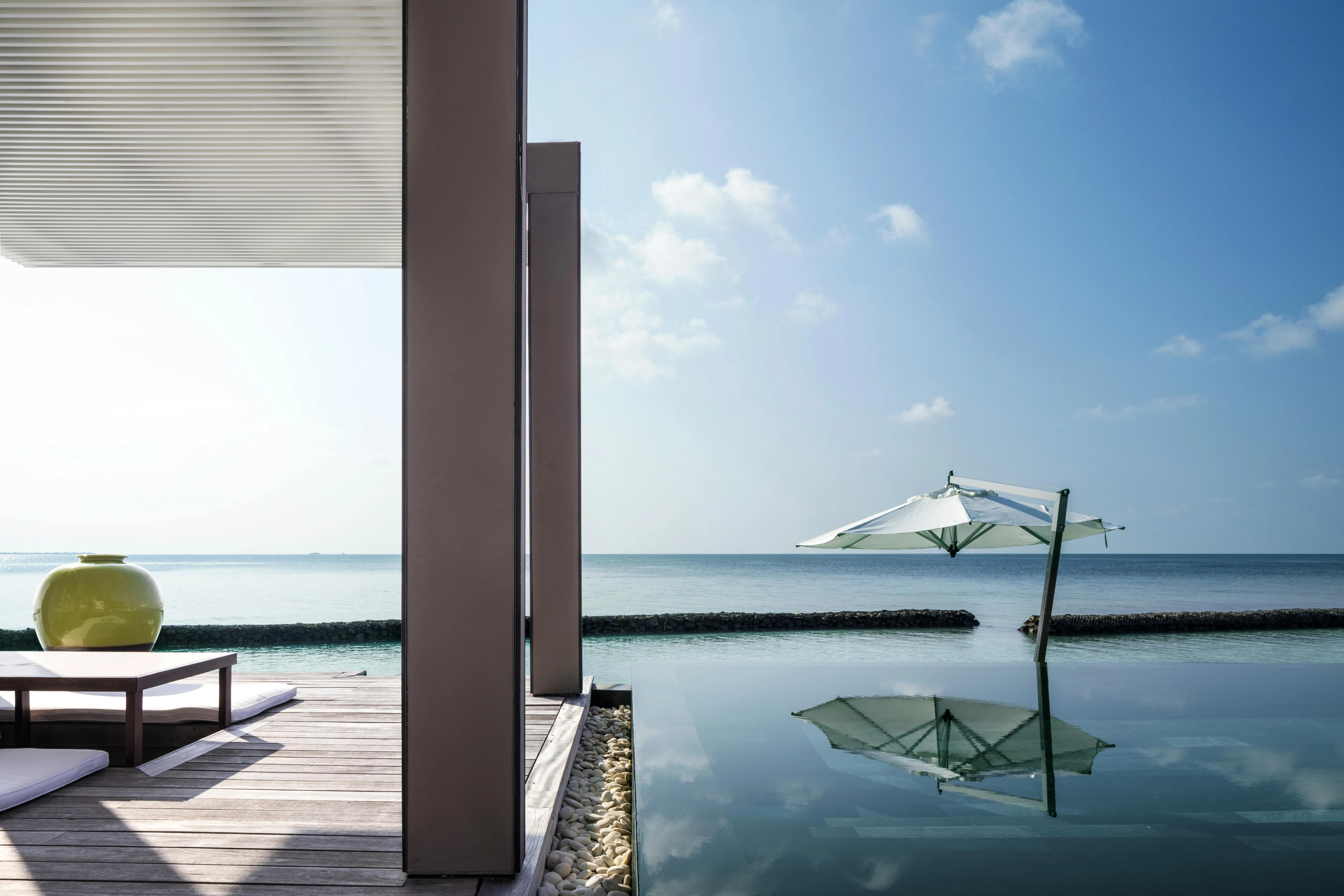
Randheli Island, Maldives
Cheval Blanc Randheli
Jean-Michel Gathy's private-island debut for LVMH's hotel house, forty minutes by seaplane into the Noonu Atoll.
From $2,200 per night
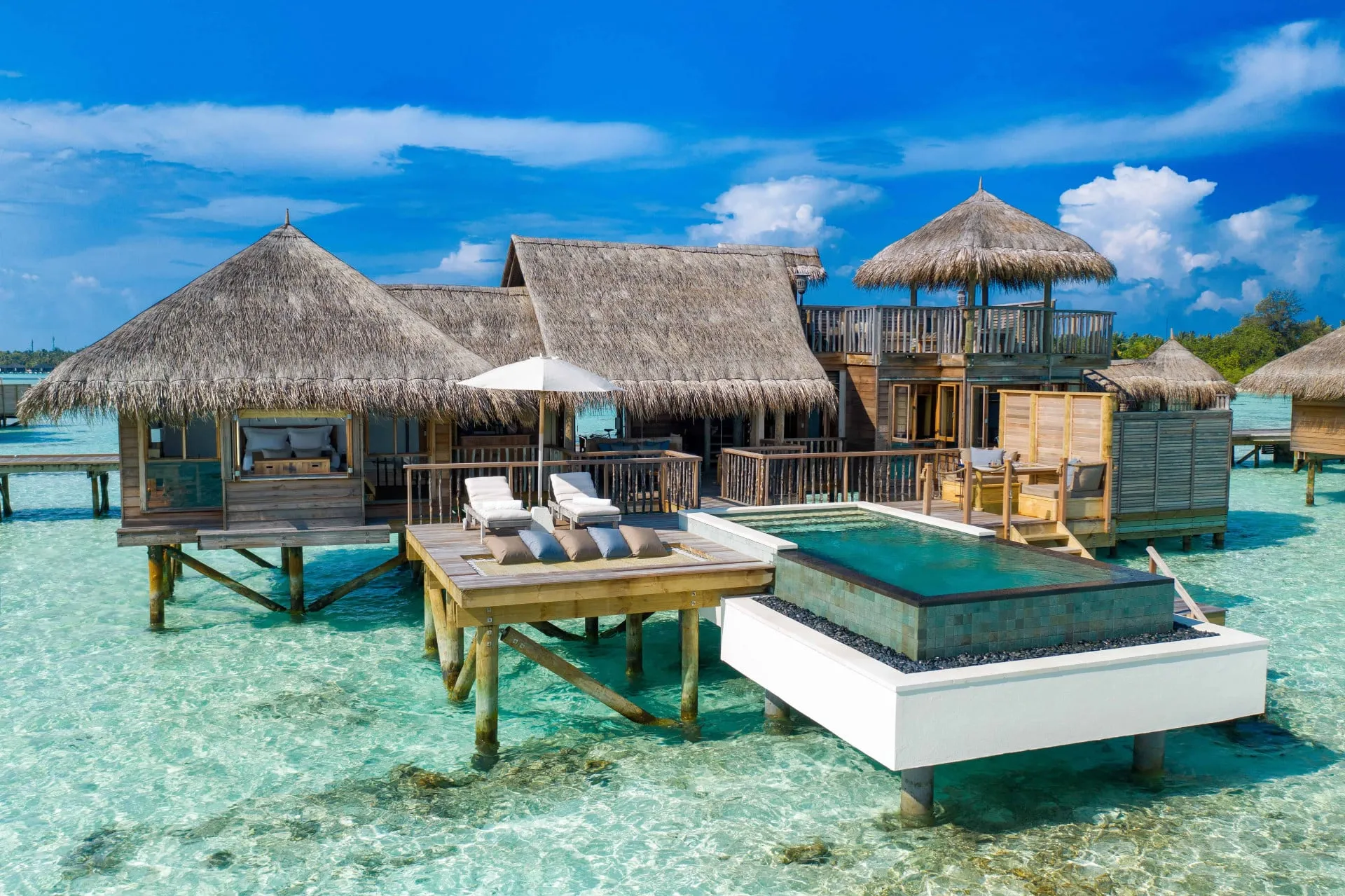
Lankanfushi Island, Maldives
Gili Lankanfushi
The Maldives resort that invented barefoot luxury and has spent two decades refusing to put its shoes back on.
From $1,550 per night
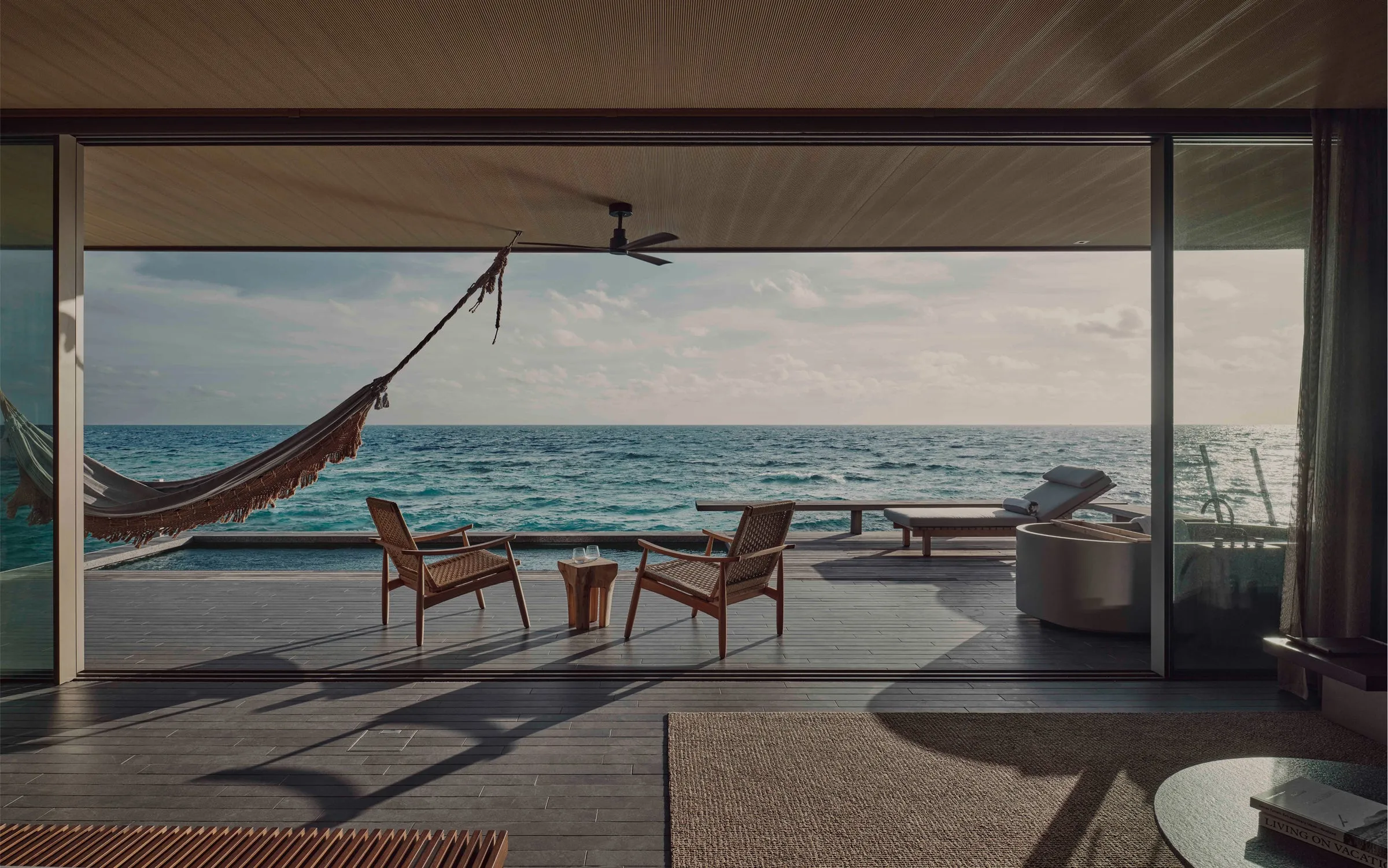
Fari Islands, Maldives
Patina Maldives
A Brazilian architect's low, canopy-height villas and a shared four-island marina make this the Maldives resort built for people who find most private-island luxury a little too private.
From $1,600 per night