Fari Islands, Maldives
Patina Maldives
A Brazilian architect's low, canopy-height villas and a shared four-island marina make this the Maldives resort built for people who find most private-island luxury a little too private.
- Rates from
- From $1,600 per night
- Nearest airport
- Velana International Airport, Male (MLE)
- Transfer
- 45 minutes by private speedboat
- Best months
- November to April, the dry northeast monsoon season with the calmest seas and lowest rainfall
Most Maldives resorts sell isolation as the entire product: one island, one hotel, one closed world for the length of a stay. Patina Maldives, which opened on Fari Islands in North Male Atoll in 2021, was built on a different premise. It shares its four-island development with a neighbouring Ritz-Carlton, a marina village of restaurants and shops, and a growing calendar of art and festival programming that guests from either resort can wander into. The result is a property that still delivers the private-pool, overwater-villa fantasy the destination is known for, but drops the single biggest structural complaint about that fantasy: that after the second or third day, there is nowhere new to walk.
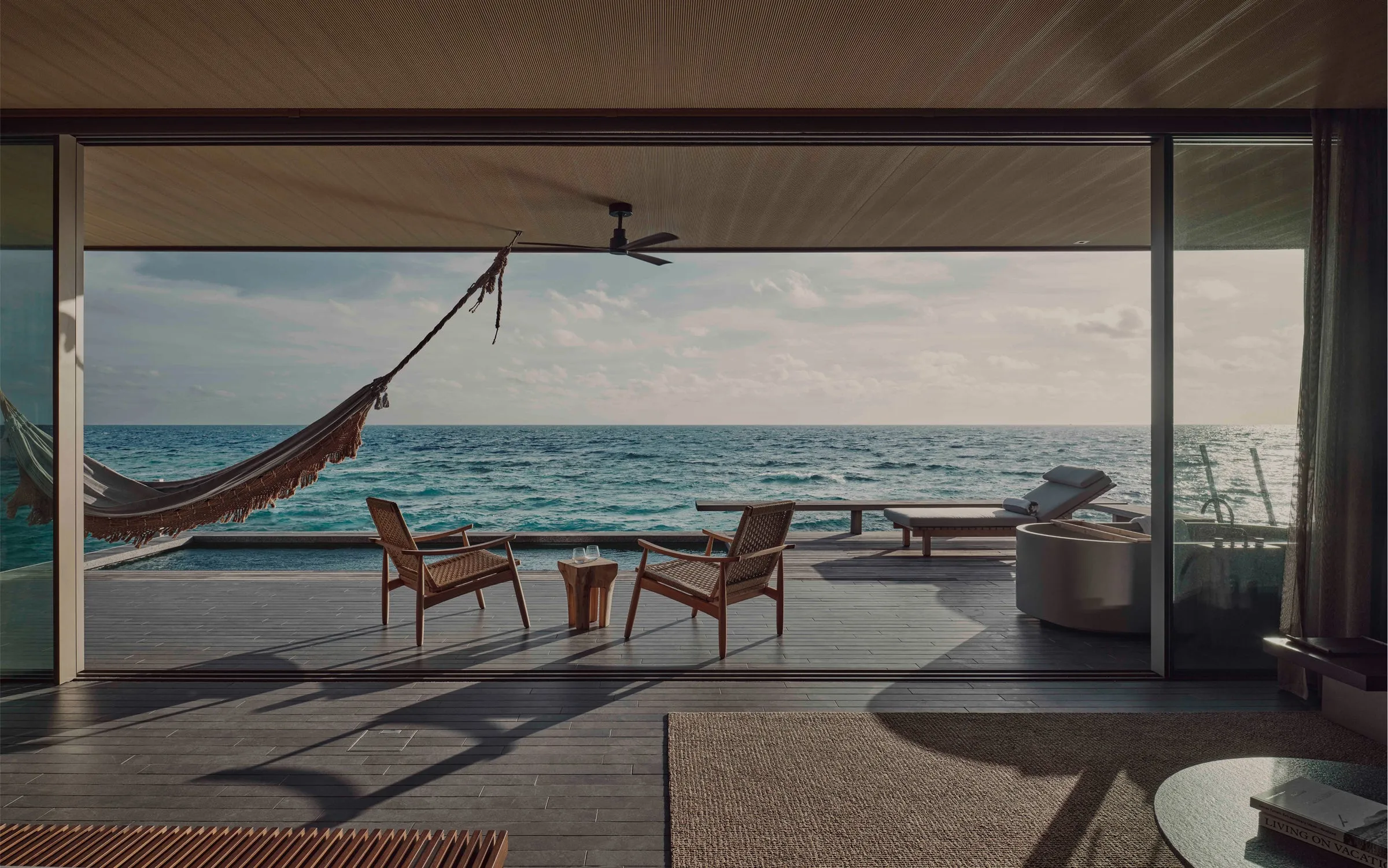
The resort is the debut property of Patina Hotels & Resorts, a lifestyle brand launched by Singapore’s Capella Hotel Group specifically for this island. It was designed from the ground up by Studio MK27, the Sao Paulo architecture practice led by Marcio Kogan and Renata Furlanetto, whose buildings across the 90-villa, 20-studio resort deliberately stay below the height of the surrounding tree canopy. That single design constraint, more than any styling choice, is what gives Patina its particular character among Maldives properties: low, shaded, threaded with brick-grille shadow patterns, and built to disappear into its own landscaping rather than announce itself against the horizon.
Why It Stands Out
Patina’s central distinction is structural, not decorative. It was conceived as one node within Fari Islands, a purpose-built archipelago developed by Pontiac Land Group, rather than as a stand-alone private island. Guests staying at Patina have access to Fari Marina Village and Fari Beach Club, a shared hub of restaurants, retail and a James Turrell Skyspace installation, alongside the option to cross to the neighbouring Ritz-Carlton’s own venues. In a destination where a guest is typically confined to a single kitchen and a single beach for the length of a stay, that shared infrastructure changes the calculus of a multi-night visit meaningfully.
The second distinction is architectural discipline. Studio MK27’s brief was to keep every structure at or below canopy height, a constraint that shapes everything from villa silhouettes to the resort’s low-rise spa and reception pavilion. Combined with a construction method built substantially from prefabricated Mass Engineered Timber components, which the resort states reduced construction-related carbon emissions by roughly 6,000 tonnes compared with conventional building methods, the environmental logic and the aesthetic logic point in the same direction: light-footprint, natural-material, horizon-respecting design, rather than the more common Maldives approach of a signature overwater restaurant reaching as far out to sea as engineering allows.
The third is scale of dining. Ten distinct venues on one resort island is an unusually deep programme for the Maldives, where many properties, even five-star ones, run two or three kitchens for the length of a stay. Patina’s spread, Patagonian steakhouse to Aegean grill to Lebanese mezze, means a five-night stay does not require repeating a restaurant, a genuine rarity in a destination guests typically cannot leave.
Architecture
Studio MK27’s masterplan for Patina reads as a settlement of low, tree-shaded pavilions rather than a single dominant hotel building, connected by paths that deliberately alternate between areas of social density, restaurants, the reception pavilion, the beach club, and pockets of near-total seclusion around the villas themselves. Marcio Kogan and Renata Furlanetto have spoken about designing against the idea that privacy and social life are mutually exclusive in resort architecture; the island’s layout tries to hold both conditions simultaneously rather than choosing one.
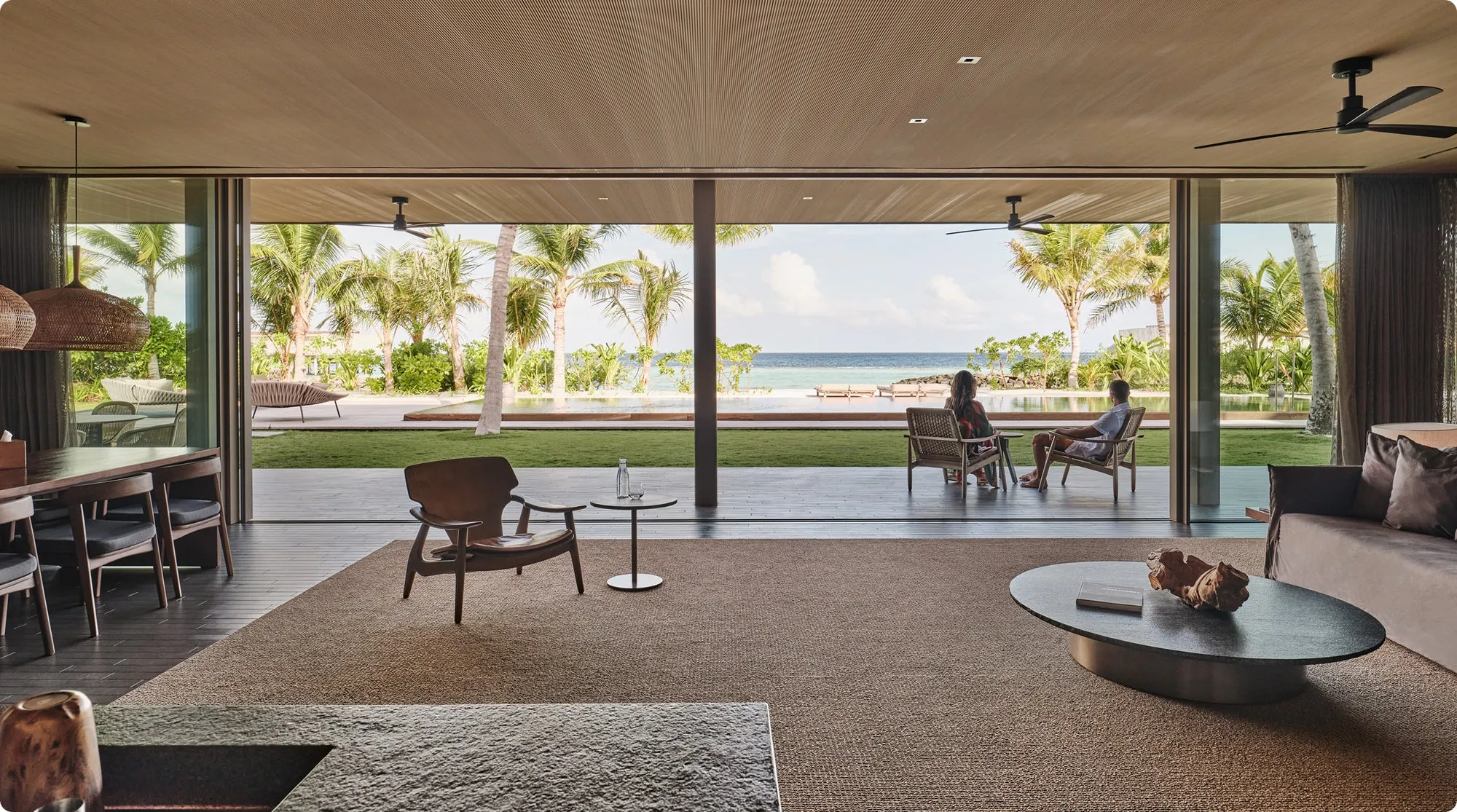
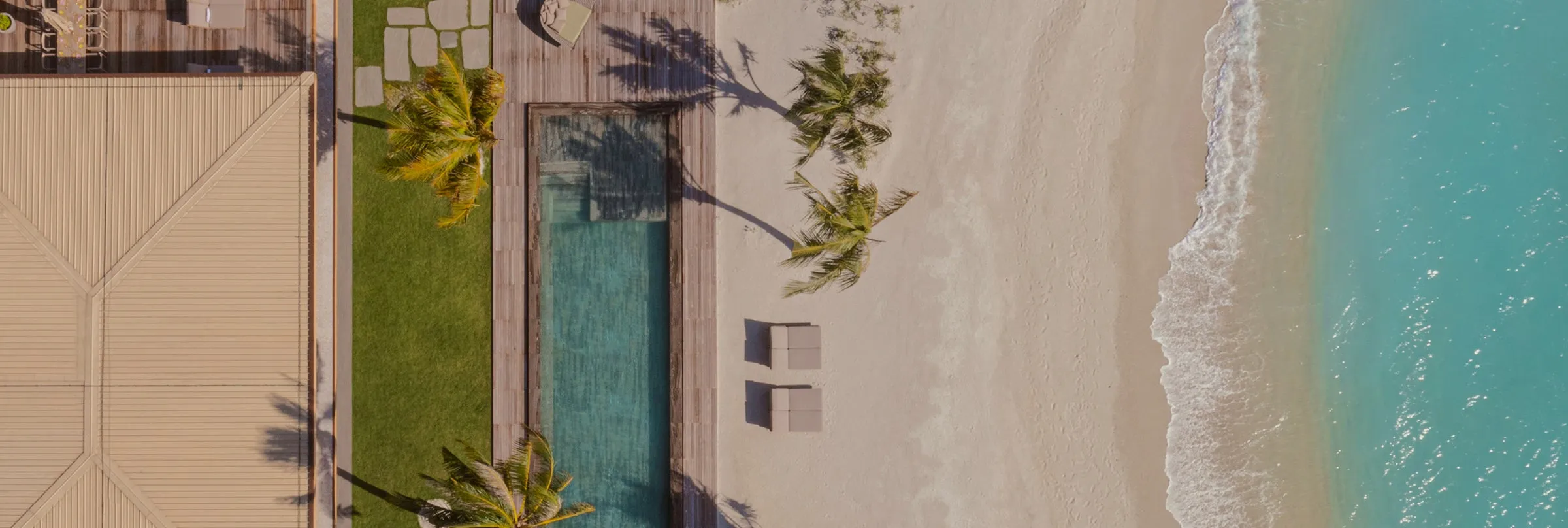
Villas are arranged across three settings. Beach Pool Villas sit directly on the shoreline with private gardens; Water Pool Villas project out over the lagoon in small clusters, reached by snake-like timber walkways with direct ladder access down into the sea; and a run of more compact Fari Studios cluster closer to the marina for guests who want a shorter walk to the restaurants and less villa to themselves. The signature is a floor-to-ceiling, three-sided sliding glass wall system fitted to the larger villas, which lets a guest open the entire structure to the outdoors on three sides at once, an engineering choice that required close coordination between the architecture and the interior fit-out to keep sightlines and shading consistent.
The most singular architectural feature on the island is Skyspace Amarta, a James Turrell light installation built in close collaboration between the artist and Studio MK27 to achieve the razor-thin ceiling aperture Turrell’s Skyspace works depend on. It is a rare piece of serious international art commissioned specifically for a resort setting, and it has become a recurring venue for Patina’s cultural programming, including performances during the Fari Islands Festival.
Interior Design
Interiors carry the same restraint as the building envelopes: a material palette of wood, stone, rattan, paper cord and other natural fibres, in matte, earthy tones intended to read as an extension of the island rather than an imported aesthetic. Studio MK27 designed the millwork furniture in-house for each villa category, and control panels for lighting and climate are integrated directly into the bedframes rather than mounted separately, a small but deliberate choice to keep surfaces uncluttered.
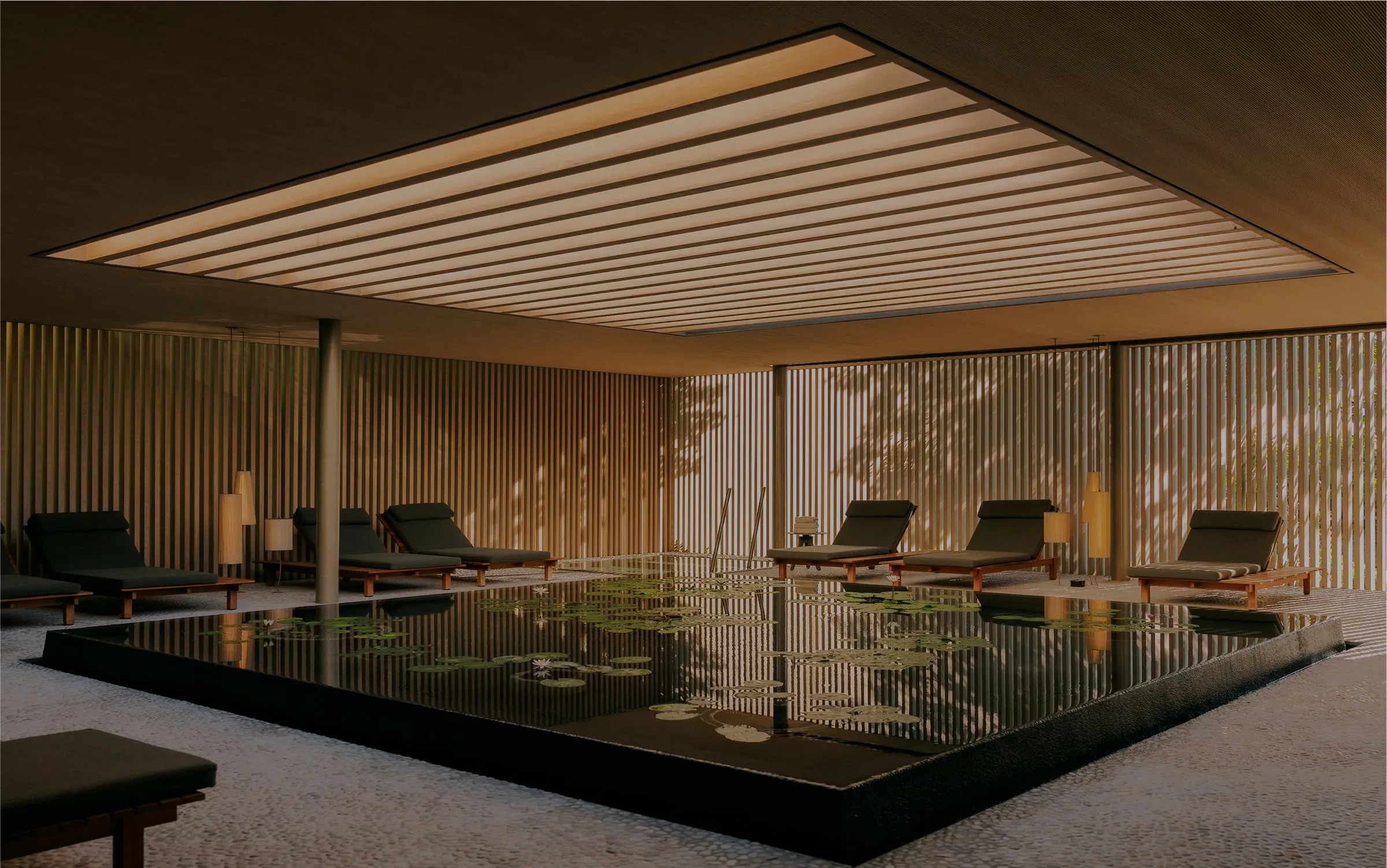
Villa bathrooms and outdoor decks lean into the resort’s indoor-outdoor premise: oversized outdoor tubs, private pools sized to each villa category (from 6.2 metres in the one-bedroom villas up to 21 metres at the three-bedroom Beach House), and woven light fixtures and wooden shelving that soften the otherwise contemporary lines of the architecture. Brick grilles and wooden trellises recur throughout the public areas, used less for ornament than for controlling daylight, casting moving shadow patterns across walkways and dining terraces as the sun tracks across the island through the day.
Atmosphere
Patina reads as calmer and more design-literate than the classic Maldives overwater-villa resort, in part because the low-rise architecture keeps sightlines open and unhurried rather than stacking visual drama into a single grand structure. The presence of a genuine art programme, Skyspace Amarta, a rotating Fari Art Atelier residency (past artists have included Daniel Arsham), and an annual Fari Islands Festival shared with the Ritz-Carlton, gives the resort a cultural register that is unusual in a destination built mostly around water sport and spa time.
At the same time, the shared marina and beach club introduce a level of social energy, live music, a wider spread of guests crossing between the two resorts, that a fully private island simply does not have. Guests who choose Patina specifically for the isolation of a single-resort island should know this in advance; those drawn to a livelier, more varied few days will likely find it one of the property’s better features rather than a compromise.
Rooms and Suites
Patina’s 90 villas run across one, two and three-bedroom configurations, in Beach Pool and Water Pool categories, plus 20 smaller Fari Studios near the marina.
The One-Bedroom Beach Pool Villa and its sunset-facing sister category are each around 240 square metres, with a private 6.2-metre pool, garden setting and direct beach access, sized for two adults and a child. The equivalent One-Bedroom Water Pool Villa and Sunset Water Pool Villa are more compact at roughly 170 square metres, built out over the lagoon with the same private pool and outdoor tub format.
Stepping up, the Two-Bedroom Beach Pool Villa and its sunset variant reach 600 square metres with a 9.6-metre pool and a 157-square-metre private deck, sized for up to six guests, while the Two-Bedroom Water Pool Villa and Sunset Water Pool Villa cover around 405 square metres over the water, with floor-to-ceiling glass walls that move on all sides for full indoor-outdoor living.
At the top of the range, the Beach House is a two-storey, three-bedroom villa of roughly 1,800 square metres, the only multi-level structure on the island, with a rooftop terrace, a 21-metre private pool set in its own garden, a full kitchen and bar, and outdoor dining and fire-pit space, built to sleep up to nine adults across its bedrooms. It functions as the resort’s dedicated option for a family taking over its own compound or a small group booking out a self-contained residence.
The 20 Fari Studios, at around 60 square metres, sit apart from the villa categories, closer to the marina and without a private pool, and have become the base for the resort’s newer solo wellness retreat packages, aimed at travellers coming alone rather than as a couple or family.
Dining
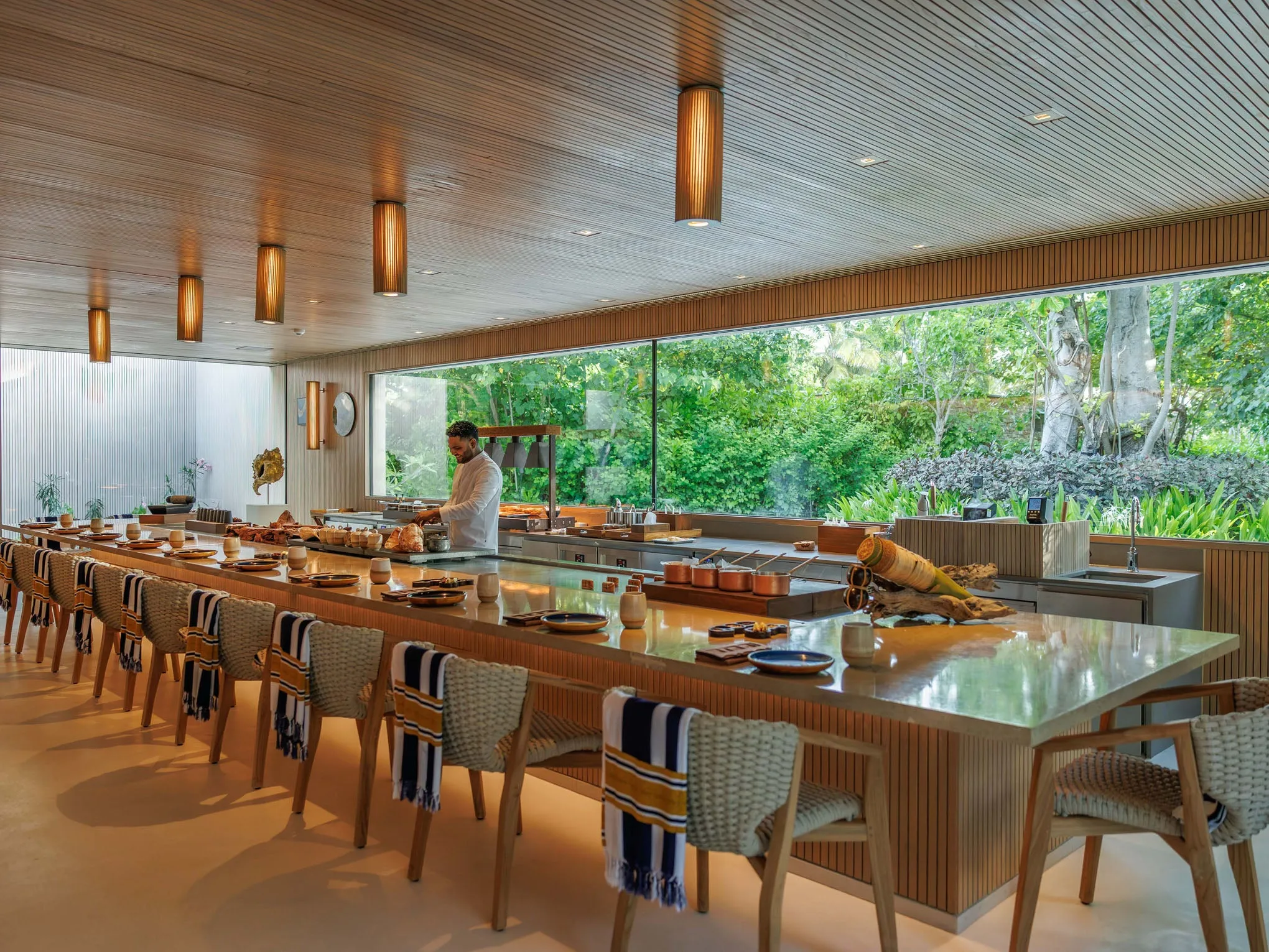
Patina Maldives runs ten named dining venues, an unusually deep spread for a single Maldives resort, alongside shared access to Fari Marina Village’s casual food trucks and the neighbouring Fari Beach Club.
Portico is the all-day dining anchor, built around Indian Ocean-inspired, unpretentious cooking for breakfast, lunch and dinner. Wok Society leans into bold, wok-fired Asian dishes and handmade dumplings. KANDU takes Maldivian cuisine as its base, built around the rhythm of the surrounding sea and local ingredients. Brasa is the resort’s Patagonian-style open-fire steakhouse, cooking over embers in a format built for occasion dinners. Helios serves Aegean food in a setting oriented toward sunset. Farine is the Italian venue, built around artisanal bread, handmade pasta and house-made desserts. Arabesque offers Lebanese cuisine served beneath hanging lanterns and fabric, and Veli Bar is the laid-back poolside bar for casual bites and cocktails through the day.
Beyond Patina’s own venues, guests have access to Fari Beach Club, the shared beachfront restaurant and live-music venue at the centre of the wider Fari Islands development, and to the food trucks and gelato counters of Fari Marina Village. That cross-resort dining access, standard for guests at either Patina or the neighbouring Ritz-Carlton, is one of the more genuinely differentiating features of staying on Fari Islands rather than a single-resort island elsewhere in the Maldives.
Spa and Wellness
Wellness at Patina is centred on Flow, a spa built with an emphasis on water-based therapy rather than a conventional treatment-room model alone. Its signature facilities include a Watsu pool, used for a form of aquatic bodywork performed in warm water, and a flotation pod for sensory-deprivation relaxation, alongside a broader treatment menu, a fully equipped gymnasium and dedicated yoga studios.
The resort has extended its wellness programming beyond the spa itself with structured solo retreat packages based at the Fari Studios, built around movement, breathwork and spa treatments for guests travelling without a partner or family, a format that is still relatively unusual among Maldives resorts, most of which are designed almost entirely around couples and families. Guests with children are separately served by Footprints, the resort’s eco-conscious kids’ club for ages four to eleven, which runs a daily schedule that includes 3D printing and laser-cutting sessions, cooking classes and toy-making from recycled plastic, alongside more conventional pool and beach activities.
Experiences
Patina’s experience programme splits fairly evenly between water, art and conservation. On the water, the resort offers snorkelling, kayaking, stand-up paddleboarding and diving out to North Male Atoll’s reefs and channels, with bicycles, snorkelling equipment and paddleboards included as a standard amenity rather than a paid add-on.
The resort’s marine conservation programme is one of its more distinctive offerings: a dedicated marine biology team runs a coral restoration project using ceramic structures seeded with coral fragments, and guests can join hands-on workshops molding and placing these structures on the reef, work that has so far produced several hundred ceramic plates and coral frames now hosting thousands of coral fragments and a range of resident fish species.
On the art side, the Fari Art Atelier hosts rotating artist residencies (Daniel Arsham has been among past participants), and Skyspace Amarta, the James Turrell light installation built with Studio MK27, anchors the island’s cultural programming, including performances during the annual Fari Islands Festival, a multi-day event of art, music and culinary programming shared across Patina and the Ritz-Carlton. The resort maintains a no-drone policy across the island, a detail worth knowing for guests hoping to capture aerial footage of their stay.
Who It Is For
Patina suits travellers who want the private-pool-villa fantasy of the Maldives without giving up variety in where they eat and what they do each evening; the ten-restaurant spread and shared marina access address one of the most common frustrations with single-resort islands directly. Design-minded guests, particularly those with an interest in contemporary architecture, will find Studio MK27’s canopy-height masterplan and the Turrell Skyspace a genuinely unusual proposition in a destination where architectural ambition often means height and drama rather than restraint.
Families are well served by the range of villa sizes, from interconnecting-style two-bedroom villas up to the nine-adult Beach House, plus the Footprints kids’ club. Honeymooners and couples get the more conventional Maldives villa experience in the one and two-bedroom Water and Beach Pool categories. The newer solo retreat packages at the Fari Studios also make Patina a workable choice for a wellness-focused traveller coming alone, a segment most Maldives resorts do not actively court. It is a less natural fit for guests whose primary reason for choosing the Maldives is total, uninterrupted seclusion from other resorts and other guests, given the shared island model at the centre of Fari Islands.
Best Time to Visit
The Maldives runs on two monsoon seasons, and North Male Atoll follows the broader national pattern. November through April brings the dry, northeast monsoon, with the calmest seas, lowest rainfall and the most reliable conditions for diving, snorkelling and simple pool time, making it the peak season across the destination, Patina included. The southwest monsoon from May through October brings more rain and rougher water in spells, along with lower rates and thinner crowds, and is not without its own appeal for travellers less committed to guaranteed sunshine, since squalls in this destination tend to be short and dramatic rather than day-long washouts.
How to Get There
Patina Maldives is reached via Velana International Airport (MLE), the country’s main gateway near the capital, Male. From there, the resort arranges a private speedboat transfer, a closed, air-conditioned boat with cabin seating, running approximately 45 minutes across North Male Atoll to Fari Islands. Cold towels, refreshments and mineral water are typically provided on board. Because Fari Islands sits close to the airport relative to more distant atolls, the journey does not require a seaplane leg, which shortens total travel time and removes the daylight and baggage-weight restrictions that seaplane transfers elsewhere in the Maldives can impose.
Nearby Experiences
The defining “nearby” feature of a stay at Patina is Fari Islands itself: guests can cross to the neighbouring Ritz-Carlton Maldives for its own restaurants and facilities, and both resorts share Fari Marina Village and Fari Beach Club, a hub of retail, casual dining and live entertainment that functions as a genuine change of scene without leaving the archipelago. Skyspace Amarta and the Fari Art Atelier add a cultural dimension not usually available within walking distance in this destination.
Beyond the island group, North Male Atoll’s reefs and channels offer a working base for dive and snorkelling excursions to nearby house reefs and drift sites, and the atoll’s proximity to Male itself makes half-day excursions into the capital a realistic addition to a stay, an option not available from many of the country’s more remote resort islands.
Things to Know Before Booking
The resort’s shared-island model is a genuine trade-off, not simply a bonus feature: guests seeking total isolation from other travellers should weigh Fari Islands’ marina and beach club energy against a more conventional single-resort island elsewhere in the country. A no-drone policy is enforced across the property, so guests planning to capture aerial photography or video should arrange this through the resort’s own channels rather than bringing personal equipment. Villa categories vary substantially in size and pool dimensions, from the compact, pool-less Fari Studios up to the 1,800-square-metre Beach House, so it is worth matching the category carefully to the trip’s purpose, whether that is a solo wellness reset, a couples’ stay, or a full family or group booking. As with most Maldives resorts, the room rate is only part of the total cost; flights to Male and the 45-minute speedboat transfer should be budgeted as a meaningful addition to any quoted nightly rate.
Sustainability
Patina’s sustainability programme runs across construction, energy and marine conservation. The resort’s villas and public buildings were built substantially using prefabricated Mass Engineered Timber components, a method the resort states reduced construction-related carbon emissions by approximately 6,000 tonnes compared with conventional building, while also minimising physical disruption to the reef and island during construction. On energy, the resort has targeted supplying half of daytime power across guest accommodation, restaurants and bars from solar generation by 2025, with a stated goal of reaching full daytime solar coverage by 2026, supported by flat villa roofs designed specifically to carry solar panelling as part of one of the larger solar installations in the Maldives.
Marine conservation is led by a dedicated in-house marine biology team, whose coral restoration programme uses ceramic structures, several hundred of them made in guest workshops, to nurture coral fragments back onto the reef; the resort reports the programme now supports several thousand coral fragments and a range of resident reef fish species. Regular beach and reef cleanups have recovered discarded fishing nets and other marine debris from surrounding waters. The resort holds EarthCheck Silver certification, a third-party sustainability benchmarking standard, and in 2023 became a beneficiary of one of the Maldives’ first green loans, tying its financing directly to environmental performance targets, an unusual structural commitment beyond the more common marketing language of hotel sustainability programmes.
Practical Information
Rates at Patina Maldives start from around USD 1,600 per night, rising through the villa categories to the multi-bedroom Beach House, with pricing that moves seasonally around the destination’s November-to-April dry season peak. Check-in is from 2:00pm and check-out by 12:00pm noon, standard for the category.
The nearest airport is Velana International Airport (MLE) near Male, and the standard transfer is a private, air-conditioned speedboat of approximately 45 minutes. Most stays run four to five nights, long enough to work through the resort’s ten dining venues, a spa treatment or two, and at least one excursion, whether a coral workshop, a crossing to Fari Marina Village, or a dive trip out to North Male Atoll’s wider reef system. Best months to visit are November through April, when the northeast monsoon brings the calmest seas and most consistent sunshine to this stretch of the atoll.
Editorial Conclusion
Patina Maldives makes a specific, well-argued bet: that a resort built around low, canopy-height architecture and genuine variety, in restaurants, in art, in the option to cross to a neighbouring hotel, can compete with the more conventional Maldives formula of a single, self-contained luxury island. Studio MK27’s design discipline, the ten-restaurant spread, and the shared Fari Islands infrastructure give it a distinct identity in a destination where most resorts are, by design, difficult to tell apart once the villa door closes. For travellers who have found the classic single-island Maldives stay beautiful but eventually monotonous, Patina offers a genuine alternative rather than a simple change of logo.
In pictures
On the map
Fari Islands, Maldives
Questions
Frequently asked
Where exactly is Patina Maldives, and how do you get there?
Patina Maldives sits on Fari Islands, a purpose-built, four-island archipelago in North Male Atoll, one of the closest atolls to the country's main airport. Guests fly into Velana International Airport (MLE) near the capital, Male, and complete the journey by private speedboat, a closed, air-conditioned transfer of about 45 minutes across open water. There is no seaplane leg required, which makes the door-to-door journey markedly shorter than many other Maldives resorts.
How many villas does Patina Maldives have, and what are the main categories?
The resort has 90 villas across one, two and three-bedroom configurations, split between Beach Pool Villas and overwater Water Pool Villas, plus 20 more compact Fari Studios near the marina and a two-storey, three-bedroom Beach House with its own rooftop terrace and 21-metre pool. Every villa was designed by Studio MK27, the Brazilian architecture practice behind the resort's overall masterplan, with a private pool built into every category above the studios.
What is dining like at Patina Maldives?
The resort runs ten distinct dining venues rather than one or two large restaurants, ranging from Portico, an all-day Indian Ocean-inspired restaurant, to Brasa, a Patagonian open-fire steakhouse, KANDU for Maldivian cuisine, Helios for Aegean food, Farine for Italian, and Arabesque for Lebanese, alongside the shared Fari Beach Club and Fari Marina Village's casual food trucks. Guests can generally dine at any venue across the wider Fari Islands development, not only at Patina's own restaurants.
Is Patina Maldives part of a larger development shared with other resorts?
Yes. Patina occupies one part of Fari Islands, a four-island archipelago developed by Singapore's Pontiac Land Group that also holds The Ritz-Carlton Maldives on a neighbouring island, plus Fari Marina Village and Fari Beach Club, a shared social hub with its own retail, dining and a James Turrell Skyspace, open to guests of both resorts. It is an unusual model in a destination where most resorts occupy a single, self-contained island.
What wellness and spa facilities does the resort have?
Flow, the resort's spa, is built around water-based therapies including a Watsu pool for underwater massage and a flotation pod for sensory-deprivation relaxation, alongside a full treatment menu, a gymnasium and yoga studios. Patina Maldives has also introduced solo wellness retreat packages based at the Fari Studios, aimed at guests travelling alone for a structured reset built around movement, breathwork and spa treatments.
Same destination
More hotel guides in Maldives
Randheli Island, Maldives
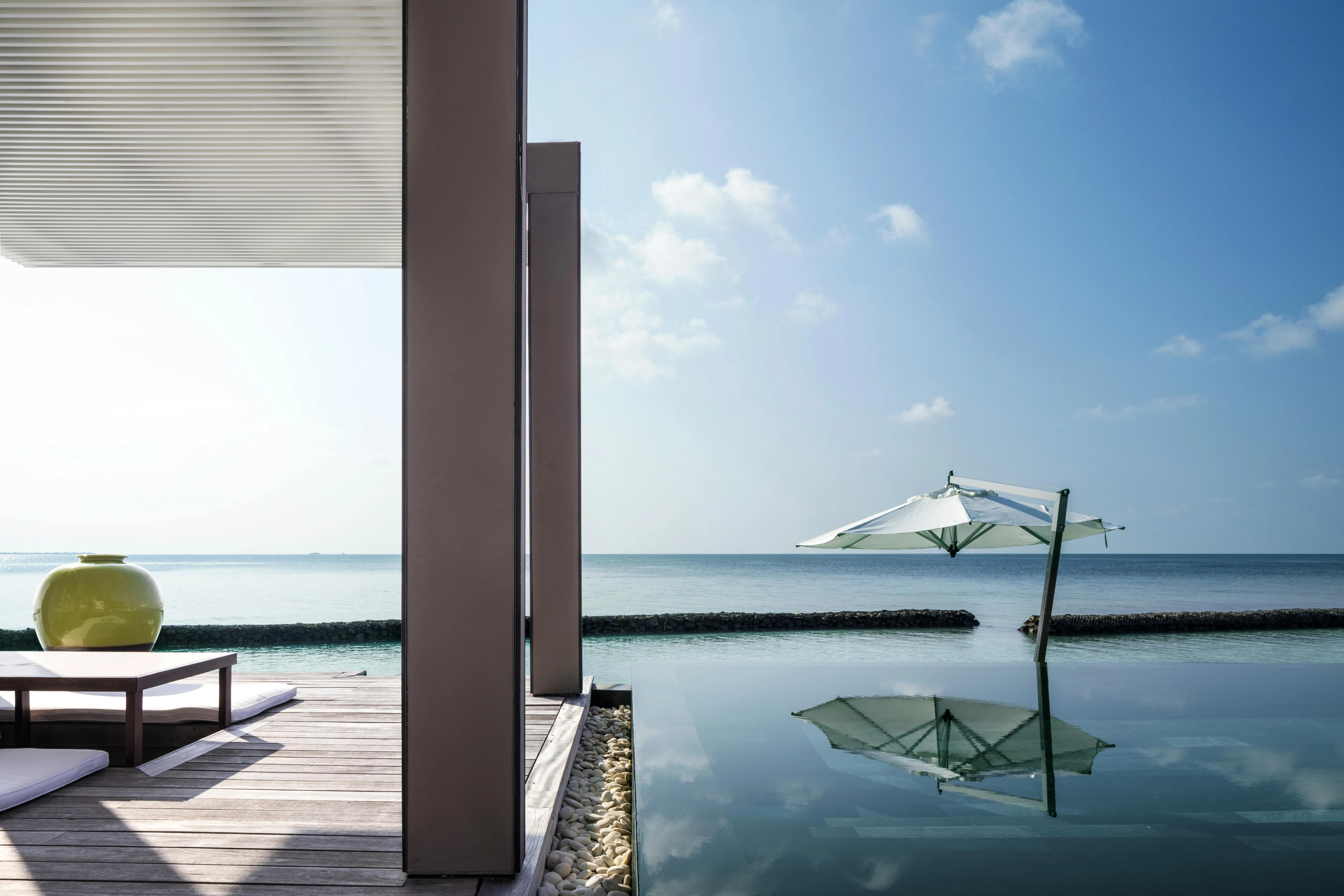
Cheval Blanc Randheli
Jean-Michel Gathy's private-island debut for LVMH's hotel house, forty minutes by seaplane into the Noonu Atoll.
From $2,200 per night
Lankanfushi Island, Maldives
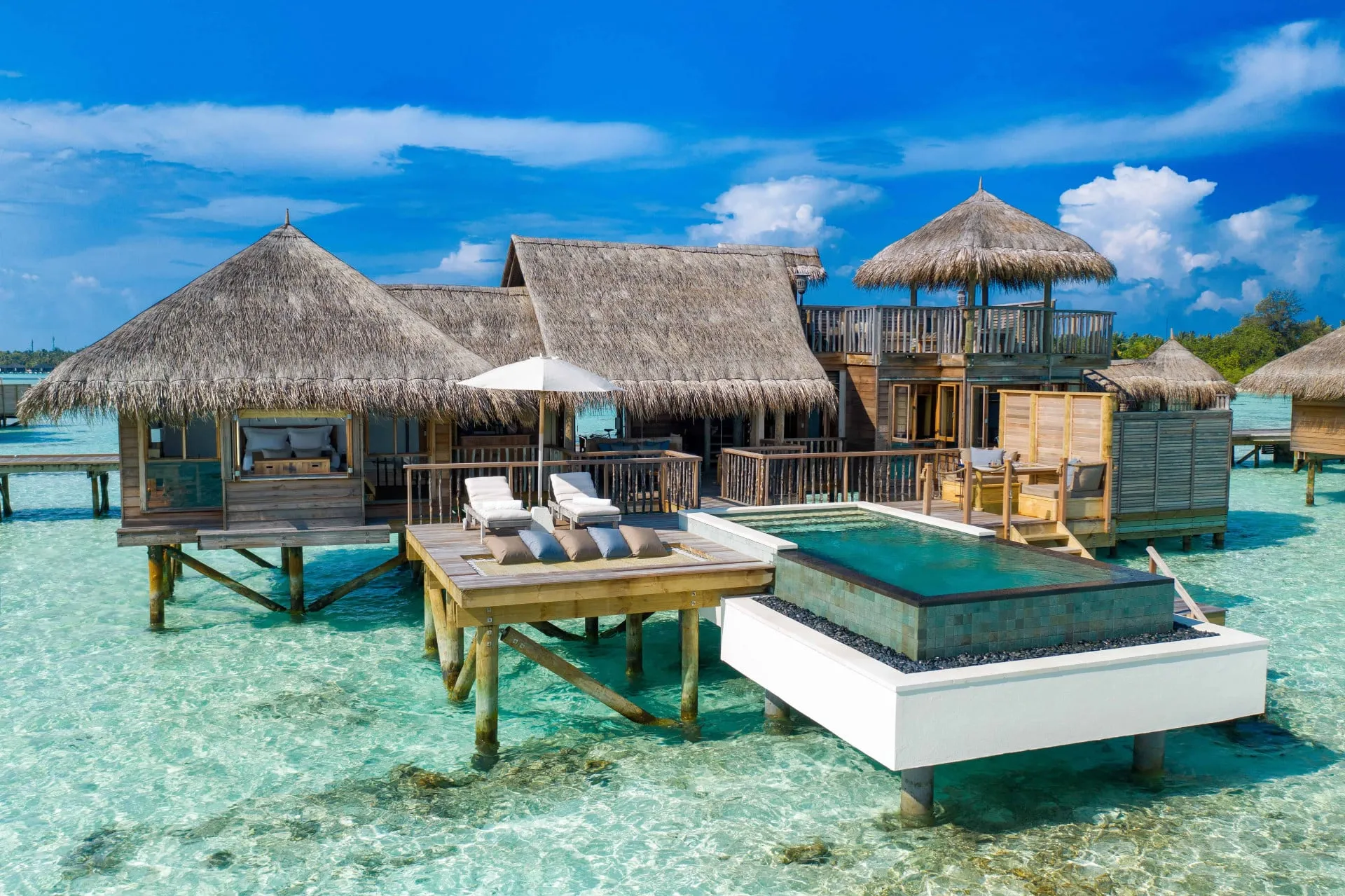
Gili Lankanfushi
The Maldives resort that invented barefoot luxury and has spent two decades refusing to put its shoes back on.
From $1,550 per night
Muravandhoo Island, Maldives
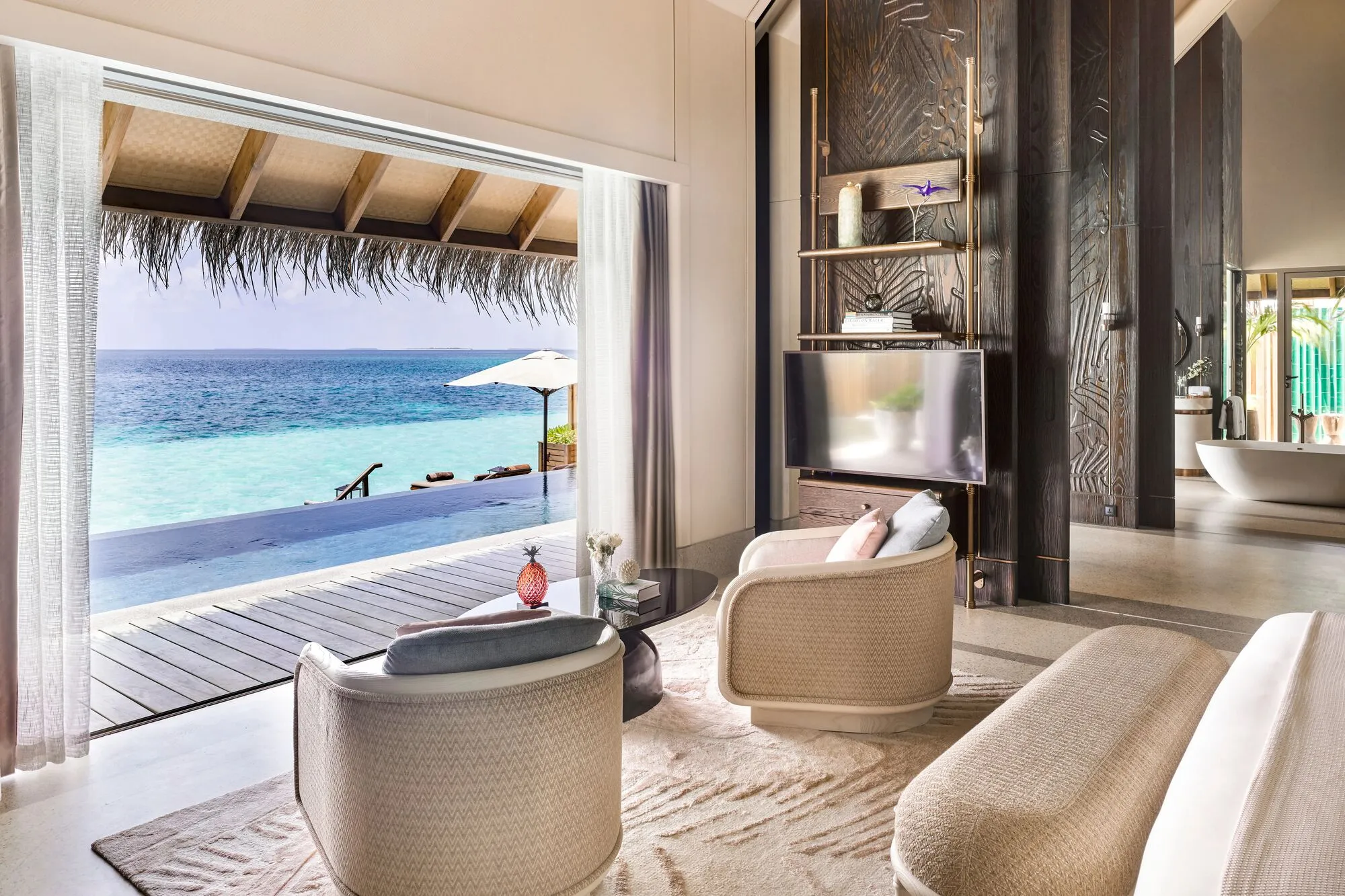
JOALI Maldives
An art-immersive private island in Raa Atoll where more than forty commissioned installations sit alongside 73 villas and a working coral restoration reef.
From $1,600 per night