Mae Rim Valley, Chiang Mai, Thailand
Four Seasons Resort Chiang Mai
A working rice valley reimagined as a resort, where teak pavilions and a Michelin-starred kitchen sit inside paddies still farmed by hand.
- Rates from
- From $850 per night
- Nearest airport
- Chiang Mai International Airport (CNX)
- Transfer
- Approx. 30 minutes by road from Chiang Mai International Airport
- Best months
- November to February, Northern Thailand's cool, dry season
Thirty minutes north of Chiang Mai’s old city, the road narrows past orchid nurseries and butterfly farms before dropping into a shallow valley where the land does something unexpected for a five-star resort: it keeps working. The rice paddies that fan out below Four Seasons Resort Chiang Mai are not landscaping. They are farmed, by hand, on a planting and harvest calendar that has nothing to do with hotel occupancy, and the resort’s teak pavilions are arranged around them rather than the other way around.
That inversion, valley first, hotel second, is the property’s defining idea, and it has held for three decades. What opened in 1995 as the Regent Chiang Mai and became a Four Seasons in 2003 was built on the site of a former quarry, reshaped by the landscape architect Bill Bensley into his first resort garden, a project he modelled on a small Northern Thai farming village complete with terraced paddies and water buffalo. Bensley has returned to tend it periodically ever since, which is part of why the grounds read less like a fixed masterplan than a living one.
The resort has since built a reputation well beyond its setting: Khao, its principal restaurant, has carried a Michelin star since the first Michelin Guide Thailand in 2020, and the property itself holds Michelin’s Three Keys distinction, its top rating for hotels, retained in both 2024 and 2025. For a resort of only 98 keys spread across pavilions, pool villas and private residences, that combination of a working agricultural setting, serious Lanna craftsmanship and a genuinely decorated kitchen is unusual, and it is the reason the property keeps appearing on best-of-Asia lists two decades after it opened.
This guide covers what the resort actually offers, room by room and restaurant by restaurant, along with the practical detail (transfer times, seasonal weather, what is and is not on the grounds) needed to plan a stay with clear eyes.
Why It Stands Out
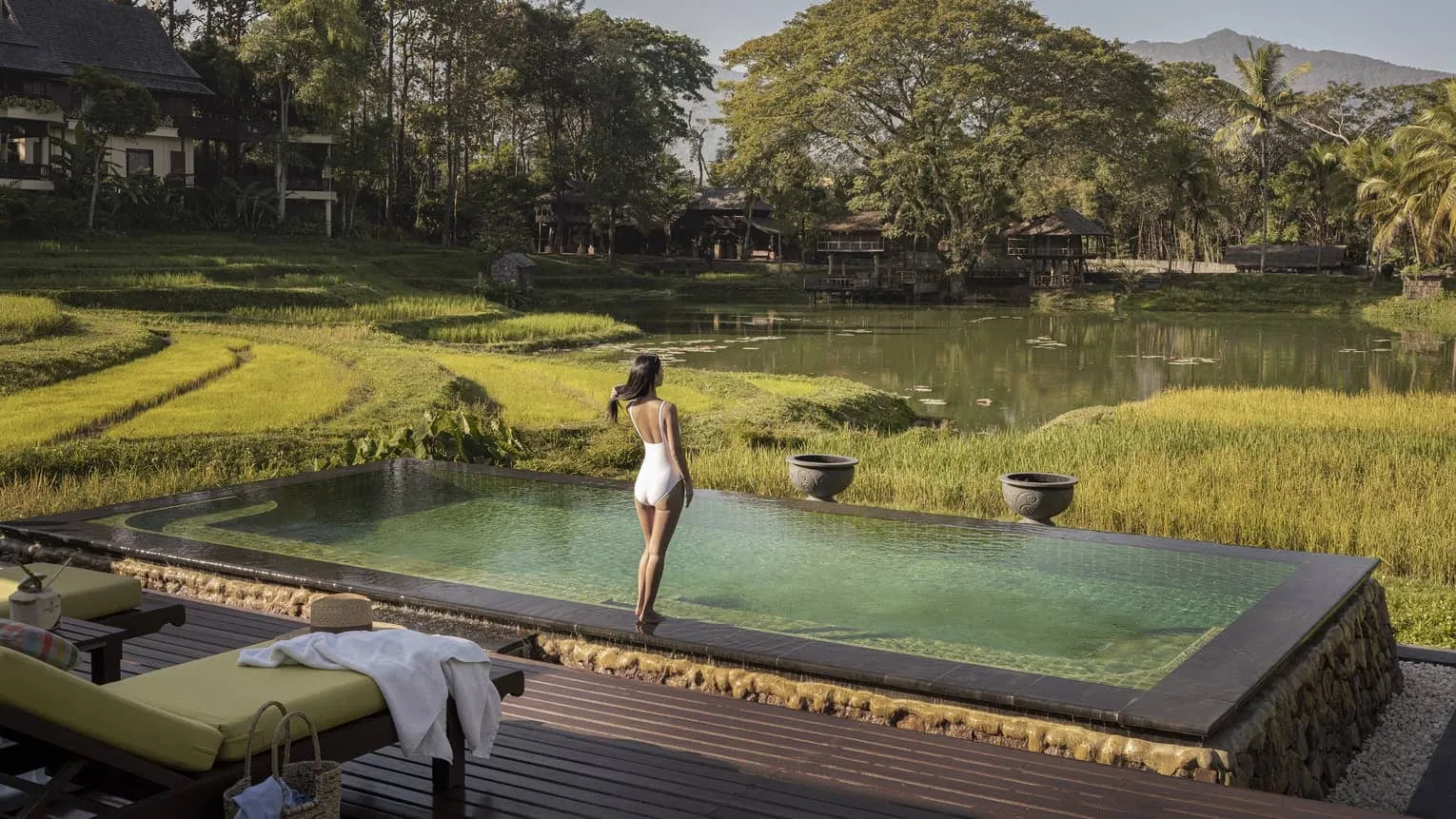
Most valley resorts in Northeast Asia landscape around a view. Four Seasons Resort Chiang Mai landscaped around a livelihood. The 13-hectare property was built into and around active rice terraces that are still sown, tended and harvested using traditional methods, without machinery or chemical inputs, and guests can walk out from a pavilion terrace to watch, or in season join, that work in progress. It is a rare case of a luxury resort’s signature view being an actual food system rather than an ornamental one.
The second distinguishing factor is culinary seriousness that has outgrown “resort dining” as a category. Khao by Four Seasons, in its current form built out of what was formerly known as The Terraces, has held a Michelin star since 2020, a rare credential for a restaurant inside a resort rather than a standalone city address. Paired with Rim Tai Kitchen’s cooking school in its own Lanna teak house and North by Four Seasons’ open-fire grill programme, the resort runs three genuinely distinct kitchens rather than one flagship and two afterthoughts.
Finally, there is scale and privacy. At 98 keys across 32 acres, with accommodation split between pavilions, freestanding pool villas and multi-bedroom residences, the resort never feels dense, and the residence category in particular gives it a option most single-building luxury hotels cannot match: a full, private, multi-bedroom home with its own living and dining space, set inside the same valley and service structure as the main resort.
Architecture
The architectural team behind the resort combined Chiang Mai Architects Collaborative and Bunnag Architects for the buildings, with Bill Bensley’s studio responsible for the landscape and, over time, an expanding number of structures within it, including later villa additions and the rebuilding of several dining venues. The brief throughout has been Lanna vernacular: the historic architectural tradition of the old Lanna Kingdom that once covered this part of Northern Thailand, distinct from the temple and palace architecture of Bangkok further south.
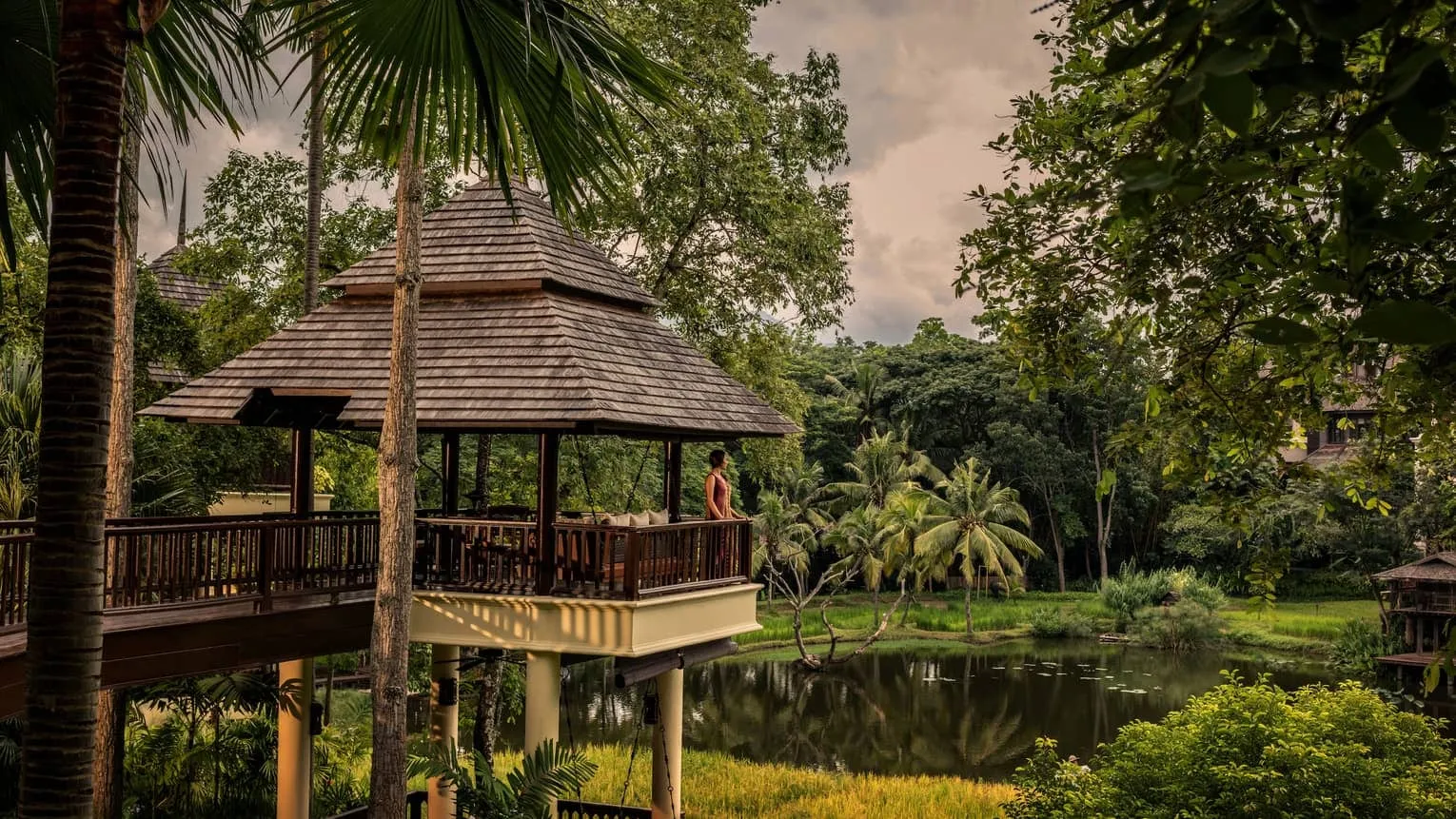
That shows up most clearly in roofline and material. Pavilions and villas use steep, layered teak roofs, generous covered outdoor salas (open-sided pavilions that function as a second living room), and dark hardwood structural framing left exposed rather than boxed in. Buildings are deliberately low-rise and spread out across the valley floor and lower slopes rather than stacked, so the terraced rice fields remain the dominant visual element from almost every vantage point on the property, including from inside many rooms.
Rim Tai Kitchen, the resort’s dedicated cooking-school restaurant, is the clearest single expression of this approach: a freestanding Lanna-style teak house, built to the same proportions and joinery techniques as a traditional Northern Thai home, seating over a hundred guests for its street-food dinners while functioning as a working teaching kitchen by day. It is less a themed restaurant than an actual piece of vernacular building put to a new use.
Interior Design
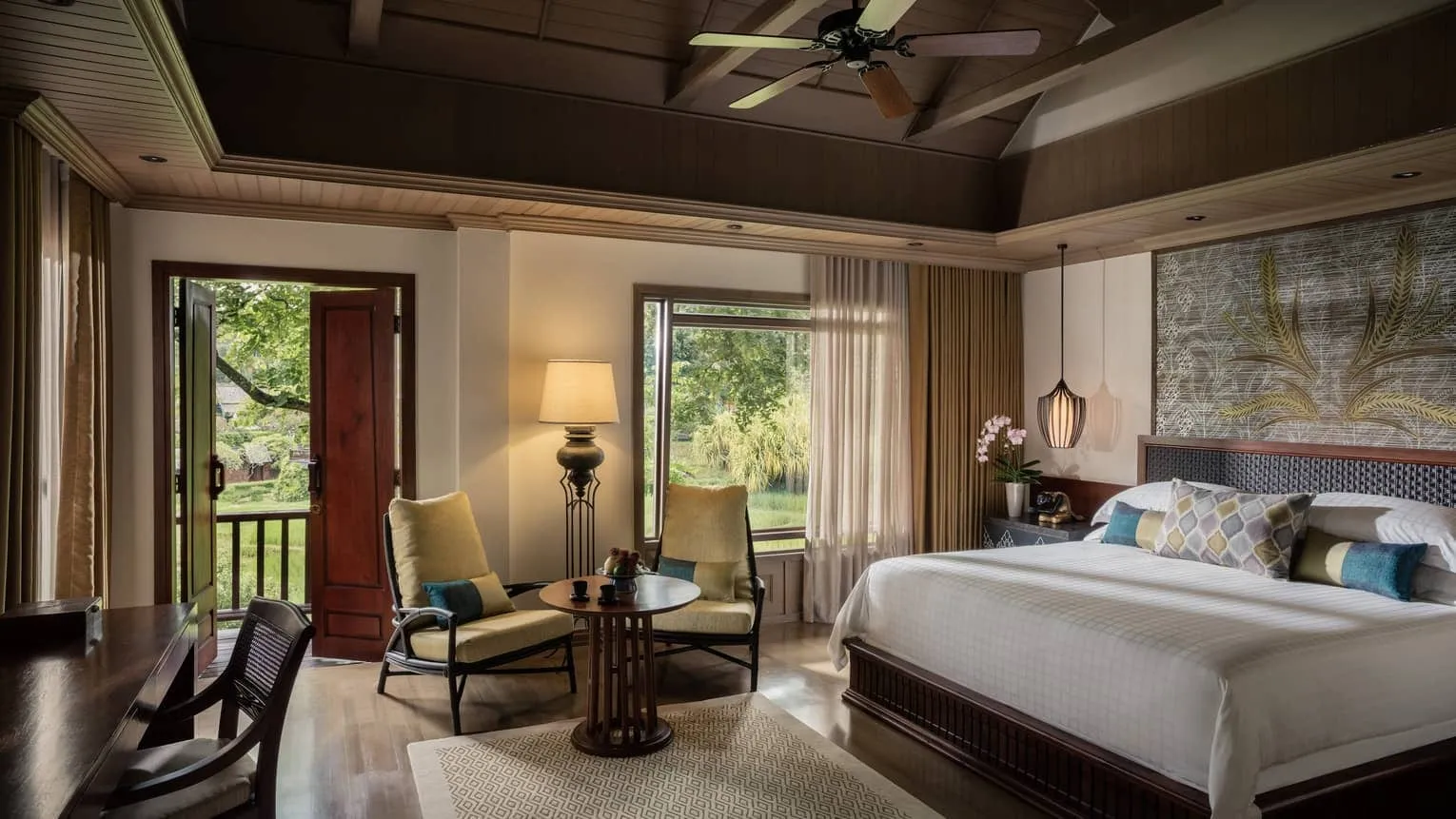
Interiors were developed by ABACUS Design, working from the same regional well as the architecture: Lanna craft traditions rather than a generic pan-Asian resort look. Expect teak flooring throughout, hand-woven Northern Thai cotton and silk in upholstery and soft furnishings, and carved wood detailing on doors, screens and furniture pieces, often sourced from or made in collaboration with local artisans.
The material palette stays warm and textured rather than minimal: dark timber against cream and ochre walls, brass and ceramic accents, and enough pattern in the textiles to read as specifically Northern Thai rather than interchangeable with a resort in Bali or Phuket. Bathrooms and living areas open generously to the outdoor sala in most categories, so the interior and exterior effectively function as one continuous living space during the dry season, a design decision that suits Chiang Mai’s climate far better than a fully air-conditioned, sealed-room approach would.
Khao’s dining room carries the same instinct into a more formal register: contemporary furniture and crystal fixtures set against carved teak panelling, a combination that reads as considered rather than clashing, and one that has helped the restaurant hold its Michelin recognition on ambience as well as cooking.
Atmosphere
The valley setting shapes the pace of a stay more than any single amenity does. Mornings bring low mist over the paddies and the sound of birdlife the resort has deliberately preserved through its landscaping choices; by mid-morning, farmers are often visibly at work in the fields below the pool terraces, a detail that keeps the property feeling connected to an actual place rather than a stage set. Evenings shift toward Rim Tai Kitchen’s lantern-lit teak house and Ratree Bar and Lounge’s open-air cocktail programme, with Doi Suthep’s silhouette visible from several vantage points at sunset.
It is a resort built for slowing down rather than for a packed activity sheet: spread over 32 acres with only 98 keys, distances between pavilions, restaurants and the spa are walkable but unhurried, and buggies are on hand for guests who prefer not to cover them on foot in the heat of the day. The overall register sits closer to a private countryside retreat than an urban resort, appropriate given how deliberately the buildings defer to the rice terraces around them.
Rooms and Suites
Accommodation is organised into three tiers: Pavilions, Pool Villas and privately owned Residences available for rental, 98 keys in total.
The Pavilions, 64 in number, are the resort’s entry category and its most numerous, arranged in small clusters rather than a single block. A typical Pavilion runs to around 70 square metres and includes an outdoor sala with a swing sofa or daybed, positioned to look out over the rice terraces, tropical planting or the resort’s lily ponds depending on location. Interiors follow the resort-wide material language of teak flooring, carved wood detailing and Lanna textiles, and bathrooms are generously proportioned with both a soaking tub and separate shower in most configurations.
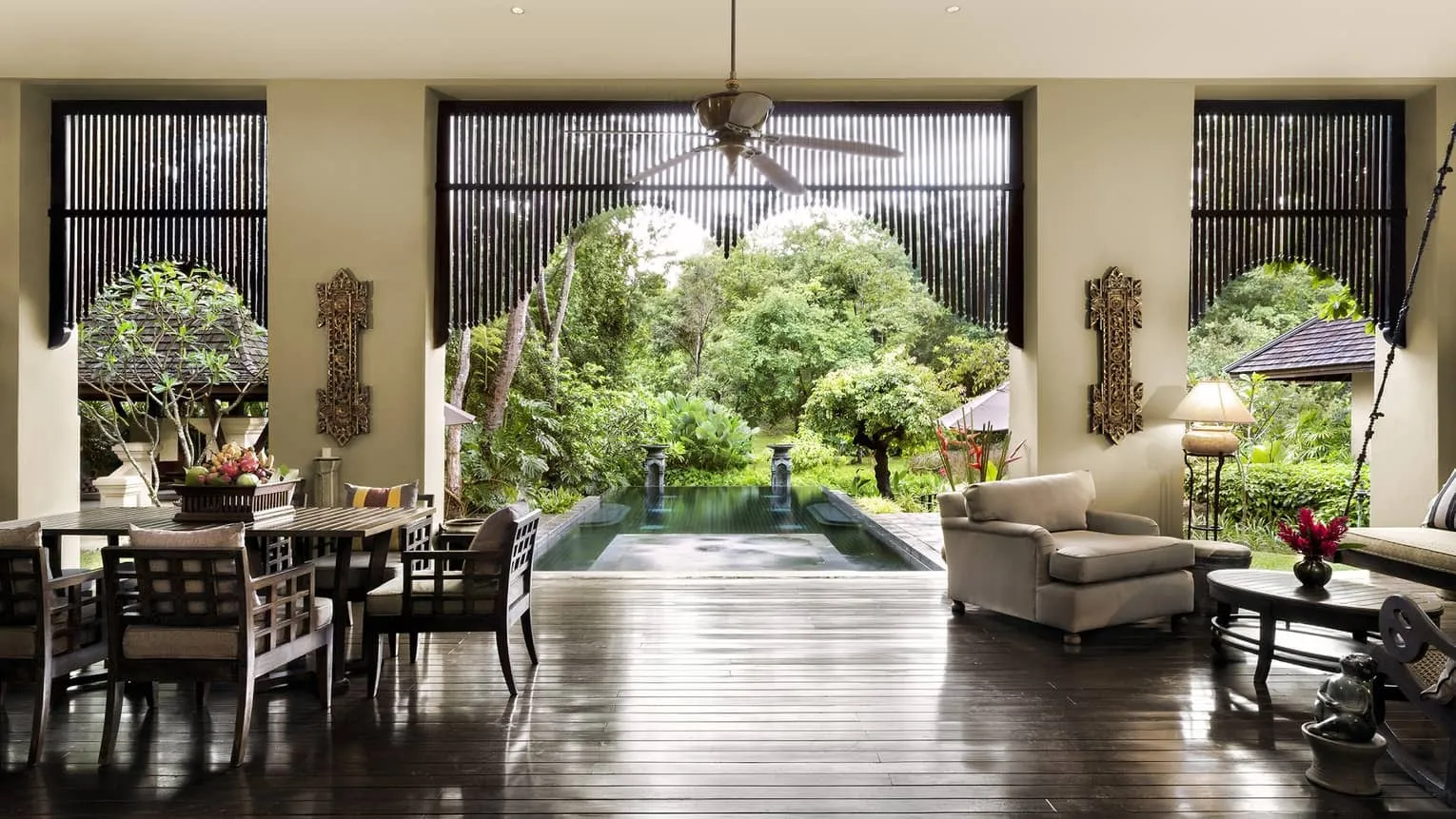
The 12 Pool Villas step up substantially in both scale and privacy, at roughly 400 square metres each. Built as freestanding structures with water on multiple sides for seclusion, each has its own private plunge pool and outdoor sala, aimed at couples and honeymooners who want a fully self-contained stay rather than shared resort circulation.
At the top of the range, the 22 Residences are multi-bedroom private homes, ranging from two to four bedrooms, with their own living and dining rooms furnished in a more contemporary Thai register than the pavilions, and views that typically take in both the mountains and the surrounding countryside rather than the paddies directly. Because these are individually owned properties placed into the resort’s rental programme, exact configurations and finishes vary slightly unit to unit, though all draw on the same service standard and grounds access as the rest of the resort. The Residence category is the property’s clearest answer for a family or multi-couple group wanting a private home base inside a full-service resort.
Dining
The resort runs three restaurants plus two bar venues, a genuinely differentiated spread for a property of this size.
Khao by Four Seasons is the flagship, serving Pan-Thai and Northern Thai cuisine across indoor seating with carved teak panelling and crystal fixtures, and an outdoor terrace looking over the rice fields and hills. Built from what was previously known as The Terraces, Khao earned its first Michelin star in the inaugural Michelin Guide Thailand in 2020 and has held that recognition since, a distinction that puts it in rare company among resort restaurants in the region.
North by Four Seasons takes the opposite register: open-air, fire-grilled cooking built around wood-fired technique and premium cuts, farm-to-table where possible, seating around 52 guests.
Rim Tai Kitchen occupies its own dedicated Lanna teak house and does double duty as the resort’s cooking school and as a Northern Thai street-food dinner venue in the evenings, seating over a hundred guests when running as a restaurant. By day, the cooking programme typically starts with a walk through the property’s own kitchen garden to examine ingredients before guests return to the teak house for hands-on preparation of regional dishes.
Khao Bar and Ratree Bar and Lounge round out the offering: Khao Bar for Thai snacks and lighter bites, Ratree for an open-air cocktail and international-snacks programme in the evening, both smaller, more casual counterpoints to the two main kitchens.
Spa and Wellness
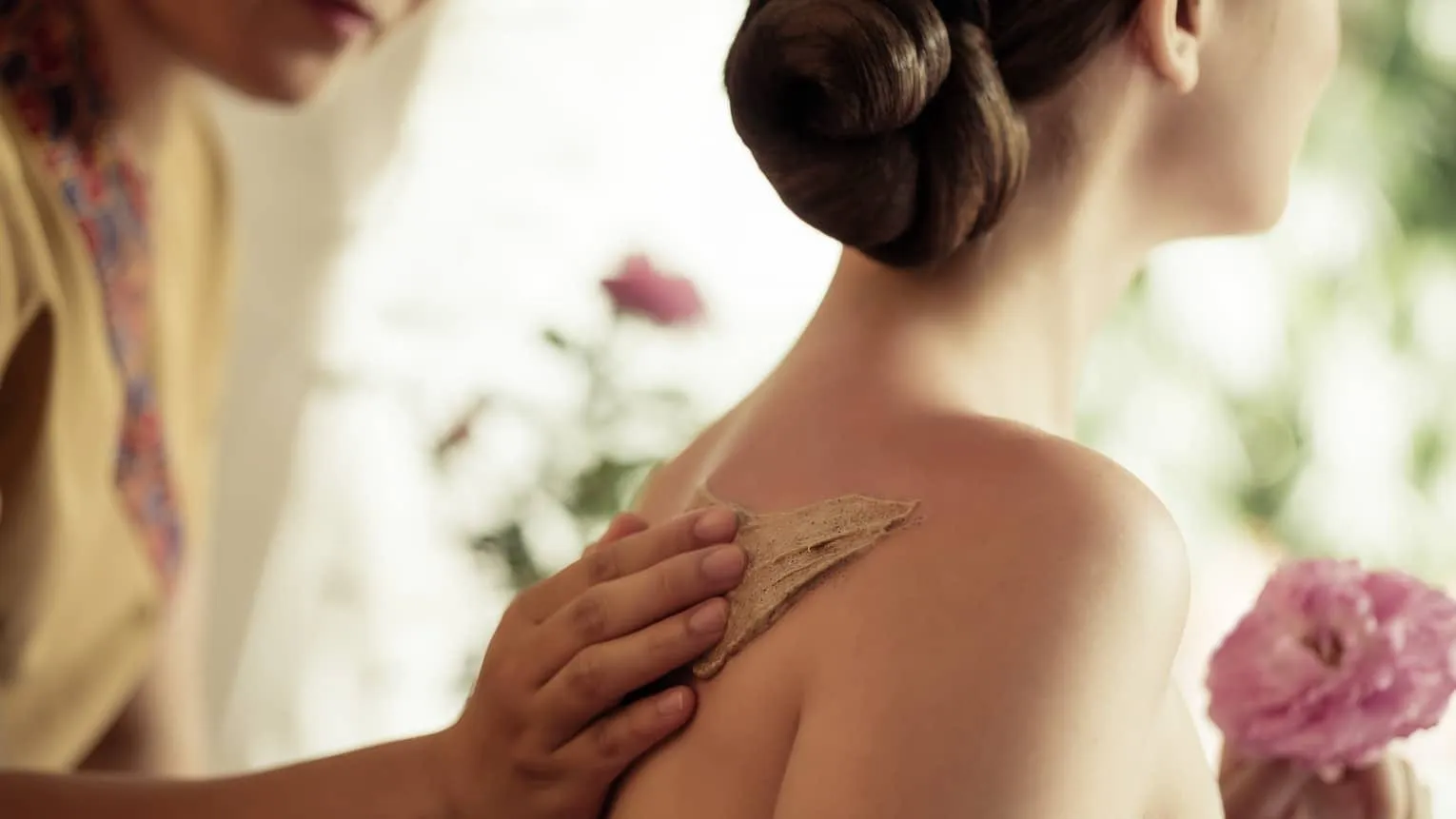
Wellness is centred on the Wara Cheewa Spa, a purpose-built pavilion with seven treatment suites, each fitted with a rain-shower massage table and a private herbal steam room, a level of individual infrastructure that is unusual even among resort spas of comparable size. Signature treatments draw on Thai therapeutic traditions, including herbal compress massage, a harmonic hand massage and a nourishing facial, alongside a broader menu built around the same Northern Thai herbal ingredients used in the resort’s kitchens.
Beyond the spa building itself, the resort runs a dedicated Yoga Barn open from sunrise to sunset for both scheduled classes and self-directed practice, positioned to look out over the rice terraces, plus sound healing sessions as part of its broader wellness programming. Two infinity-edge pools, one of them 20 metres long and 2.6 metres at its deepest point with hot and cold whirlpools attached, double as recreational and wellness spaces, both positioned to frame views across the paddies toward the Doi Suthep-Pui range. Two tennis courts are also available for guests who want a more active break from the spa’s slower pace.
Experiences
The valley setting is the basis for most of the resort’s signature activities. Guests can join local farmers in the resort’s own paddies for seasonal rice planting or harvesting, working alongside people for whom this is an actual livelihood rather than a staged demonstration, a rare, direct point of contact with Northern Thai agricultural life that few resorts anywhere can offer on their own grounds. Guided nature walks through the property’s preserved planting introduce the birdlife and indigenous vegetation the landscaping was designed to support.
Rim Tai Kitchen’s cooking classes extend the food-focused programming into the kitchen itself, moving from the resort’s own garden to hands-on preparation of Northern Thai dishes such as the region’s curries. Cycling routes through and beyond the grounds take in wider views of the Doi Suthep range, and the resort has developed a cultural partnership with the nearby Wat Pa Darapirom temple, alongside activities such as pottery and traditional paper-making that connect guests to regional craft.
For excursions further afield, Wat Phra That Doi Suthep, one of Northern Thailand’s most significant temples, sits roughly 45 minutes away, with a Lanna-style golden chedi at the summit of a 1,053-metre peak reached by a stairway or funicular tram. The resort can also arrange transport to Elephant Nature Park, an established rescue and rehabilitation sanctuary about 60 kilometres away; there is no elephant camp on the resort’s own grounds, and that experience belongs specifically to Four Seasons Tented Camp Golden Triangle, a sister property several hours away in Chiang Rai.
Who It Is For
The Pool Villas and the overall pace of the property make it a natural honeymoon and anniversary choice: private plunge pools, a genuinely quiet valley setting, and dining strong enough to build an evening around rather than default to. Design-minded travellers with an interest in vernacular architecture and craft will find more substance here than at a resort with an imported aesthetic, given how consistently the Lanna material language carries through buildings, interiors and even the cooking-school teak house.
Food-focused travellers get an unusually serious reason to choose this property over comparable countryside resorts nearby: a Michelin-starred kitchen, a dedicated cooking school in its own building, and a wood-fired grill restaurant, a spread that goes well past the usual one-restaurant-plus-poolside-grill resort formula. Wellness travellers are well served by the Wara Cheewa Spa’s seven-suite scale and its sunrise-to-sunset yoga programme, and families or small groups will find the multi-bedroom Residences a genuinely private, self-contained option rather than a compromise between a suite and a villa.
It is a less natural fit for travellers who want beach access, nightlife, or a base for exploring Chiang Mai’s old city on foot; the resort sits a deliberate half-hour outside the city, and that distance is part of the point, not an inconvenience to be worked around.
Best Time to Visit
November through February is Northern Thailand’s cool, dry season, and the period most travellers choose: lower humidity, clear mountain views toward Doi Suthep, and comfortable temperatures for walking the grounds or joining the rice-farming activities. This is also the region’s peak travel season, so rates and availability tighten accordingly.
March through May turns hot, with temperatures regularly climbing into the mid-30s Celsius, and in some years brings seasonal haze from agricultural burning across the wider region, a known regional air-quality issue worth checking ahead of a spring visit. The rainy season, roughly June through October, brings the rice terraces to their most vividly green, along with the valley’s most dramatic light, but also short, often heavy afternoon downpours; these tend to be brief rather than day-long, and gardens and paddies are arguably at their photogenic best during this window, but travellers prioritising uninterrupted outdoor time should weigh the trade-off.
How to Get There
The resort is reached via Chiang Mai International Airport (CNX), which receives domestic connections from Bangkok and other Thai cities as well as a growing number of direct international routes from across Asia. From the airport, it is a road transfer of roughly 30 minutes to the resort, heading north out of the city on the Mae Rim-Samoeng Old Road; the resort’s own transfer service, arranged through guest services, is the most straightforward option, with taxis and ride-hailing apps also viable for independent travellers.
The property’s full address is 502 Moo 1, Mae Rim-Samoeng Old Road, Chiang Mai 50180, Thailand, and its position places it closer to the Mae Sa valley’s orchid and butterfly attractions than to Chiang Mai’s old city itself, a detail worth factoring in for travellers planning to split a trip between the resort and downtown sightseeing.
Nearby Experiences
The Mae Sa valley immediately surrounding the resort has its own small cluster of attractions built up over decades of tourism to the area, including orchid and butterfly farms and the Mae Sa waterfall, generally reachable within a short drive. Wat Phra That Doi Suthep, arguably Northern Thailand’s most significant Buddhist temple, sits around 45 minutes away atop its namesake mountain within Doi Suthep-Pui National Park, and a nearby Hmong hill-tribe community within the same national park is open to visitors interested in the region’s ethnic minority cultures and craft.
Chiang Mai’s old city, with its moat-ringed grid of temples, night markets and the weekend Sunday Walking Street market, is roughly half an hour away and works well as a half-day or full-day excursion rather than a base in itself, given the resort’s deliberately rural setting. For travellers with more time, Doi Inthanon, Thailand’s highest peak, is about a three-hour drive south, with waterfalls, terraced fields, hill-tribe villages and a royal chedi complex at the summit; it is a full-day trip best arranged as a single excursion rather than a casual add-on.
Things to Know Before Booking
The resort’s rural setting, roughly 30 minutes outside Chiang Mai’s old city, is a deliberate trade-off: it delivers the valley views and quiet that define the property, but it means guests wanting easy, repeated access to the city’s temples, markets and street food scene should budget transfer time accordingly rather than expect walkable proximity.
There is no elephant camp on the property itself. Guests interested in an ethical elephant encounter should ask the concierge about arranging a visit to Elephant Nature Park, roughly 90 minutes away, rather than expecting an on-site programme; the well-known Four Seasons elephant camp experience belongs to the group’s separate Golden Triangle property in Chiang Rai.
Seasonal haze from agricultural burning is a known regional issue across Northern Thailand, typically most likely between February and April; travellers with respiratory sensitivities or strong views on air quality may want to time a visit outside that window or check current conditions before booking. Finally, because the Residences are individually owned units placed into a rental pool rather than a uniform hotel category, it is worth confirming exact bedroom count, layout and current furnishings with the resort directly when booking that category.
Sustainability
Sustainability at Four Seasons Resort Chiang Mai is built into the working landscape rather than treated as a separate programme. The rice grown in the resort’s own terraces is a local variety, sown and harvested entirely by hand using traditional methods, without machinery or chemical inputs, and the paddies are maintained organically; a portion of each harvest is donated to the surrounding community as part of an annual rice donation programme, while the remainder that is not collected is deliberately left for local birdlife and wildlife.
Water management follows a closed-loop model as far as possible: wastewater from the resort is treated on-site and recycled for garden and landscape irrigation rather than discharged, reducing pressure on local water sources. Food waste is tracked and reduced through production monitoring, with organic scraps composted into fertiliser used across the grounds. The landscaping itself, following Bill Bensley’s original brief, has deliberately preserved indigenous plants and broad-leafed trees to support the birds, insects and small mammals native to the valley, with guided nature walks built around that biodiversity.
The resort’s culinary team sources seasonally from local growers and communities where possible, and its cultural partnership with the nearby Wat Pa Darapirom temple, along with craft-based activities like pottery and traditional paper-making, extends the sustainability framing beyond the environmental into the social and cultural fabric of the valley the resort occupies.
Practical Information
Rates at Four Seasons Resort Chiang Mai start from around USD 850 per night for an entry-level Pavilion, based on published third-party rate data, and climb substantially for Pool Villas and the multi-bedroom Residences, with pricing that moves seasonally and peaks during the November-to-February dry season. Check-in is from 3:00pm and check-out by 12:00pm noon; early check-in and late check-out can typically be requested through the resort directly, subject to availability, and guests wanting guaranteed early access are advised to book the preceding night.
The nearest airport is Chiang Mai International Airport (CNX), roughly 30 minutes away by road via the Mae Rim-Samoeng Old Road; most stays run three to four nights, long enough to work through the spa, both main restaurants and the cooking school while still leaving time for at least one excursion to Doi Suthep or into Chiang Mai’s old city. The resort’s full address is 502 Moo 1, Mae Rim-Samoeng Old Road, Chiang Mai 50180, Thailand.
Editorial Conclusion
Four Seasons Resort Chiang Mai’s case rests on a genuinely unusual premise for a luxury property: that the most valuable thing on a resort’s grounds might be the working rice paddy it was built around, not despite. Three decades after Bill Bensley shaped a former quarry into that idea, the resort has added a Michelin-starred kitchen, a serious spa and a residence category that few countryside properties in the region can match, without diluting the original concept. For travellers who want a slower, more agrarian register to a Thailand trip, paired with cooking, craft and wellness programming built to match, it remains one of the more coherent luxury resorts in Northern Thailand, and one that rewards staying long enough to notice the farmers in the fields below the pool.
In pictures
On the map
Mae Rim Valley, Chiang Mai, Thailand
Questions
Frequently asked
Where exactly is Four Seasons Resort Chiang Mai, and how far is it from the city?
The resort sits in the Mae Rim valley, on the Mae Rim-Samoeng Old Road roughly 17 kilometres (about 30 minutes by road) north of Chiang Mai's old city, in a stretch of countryside known for orchid farms, butterfly parks and the Mae Sa waterfall. It occupies about 13 hectares (32 acres) of gardens and working rice terraces set below the Doi Suthep-Pui mountain range.
How many rooms does the resort have, and what is the difference between a Pavilion, a Pool Villa and a Residence?
There are 98 keys in total: 64 Pavilions, 12 Pool Villas and 22 privately owned Residences available for rental. Pavilions are the entry category, built in pairs or small clusters with teak floors and an outdoor sala looking over the rice paddies. Pool Villas are freestanding and considerably larger, each with its own private plunge pool. The Residences are multi-bedroom homes, typically two to four bedrooms, with private living and dining space, built for families or groups travelling together.
Is the food at Four Seasons Resort Chiang Mai worth planning a stay around?
Yes. Khao by Four Seasons, the resort's fine-dining restaurant, has held a Michelin star since the first Michelin Guide Thailand in 2020, serving a modern take on Northern Thai cooking in a dining room that pairs carved teak panelling with rice-field views. Rim Tai Kitchen, a separate Lanna-style teak house, runs the resort's hands-on cooking school and a Northern Thai street-food dinner, and North by Four Seasons handles open-fire, farm-to-table grilling. The property was awarded Michelin's Three Keys distinction for Thailand, its top tier for hotels, in 2024 and retained it in 2025.
Does the resort offer elephant experiences on-site?
No. The elephant sanctuary experience associated with Four Seasons in Northern Thailand belongs to a separate sister property, Four Seasons Tented Camp Golden Triangle in Chiang Rai, several hours away. From Chiang Mai, the resort can arrange transport to Elephant Nature Park, an established rescue and rehabilitation sanctuary roughly 60 kilometres (around 1.5 hours by road) from the property, but there is no elephant camp on the resort grounds itself.
What is the best time of year to visit?
November through February is Northern Thailand's cool, dry season, with lower humidity, clearer mountain views and comfortable evening temperatures, making it the most popular window to visit. March to May turns hot and, in some years, hazy from regional agricultural burning, while the rainy season from roughly June to October brings the rice paddies to their most vivid green, along with short, heavy afternoon showers rather than continuous rain.
Same destination
More hotel guides in Thailand
Pansea Beach, Phuket, Thailand
Amanpuri
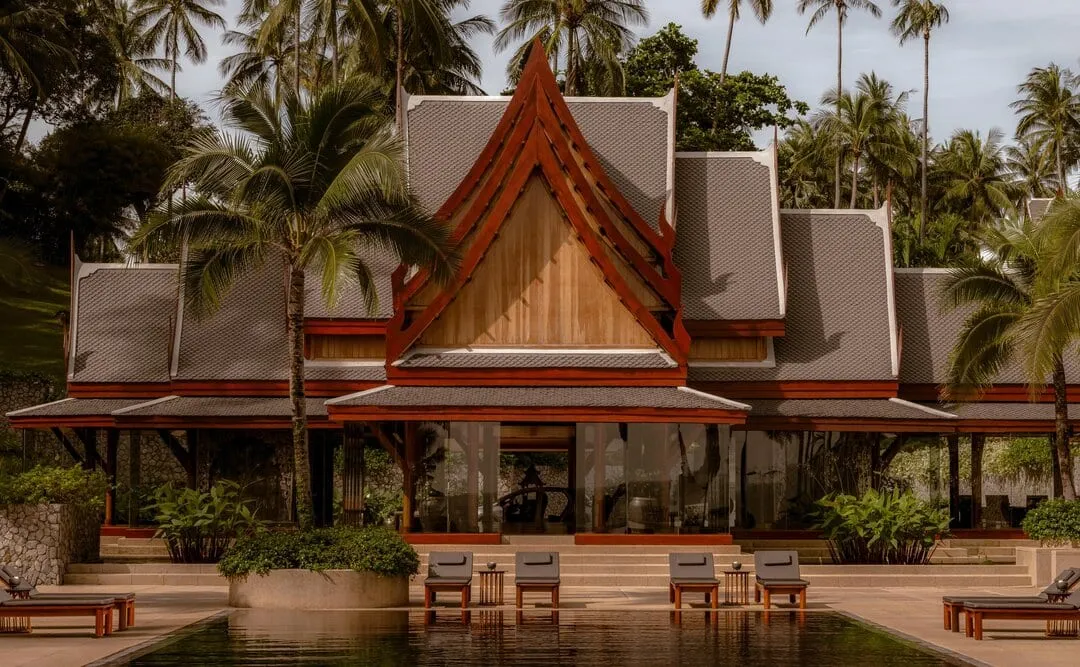
Opened in 1988 on a former coconut plantation on Phuket's Pansea Beach, Amanpuri is the founding property of the entire Aman brand, a village of temple-inspired teak pavilions that set the template every Aman since has followed.
From $1,200 per night
Charoen Krung, Chao Phraya riverside, Bangkok, Thailand
Capella Bangkok
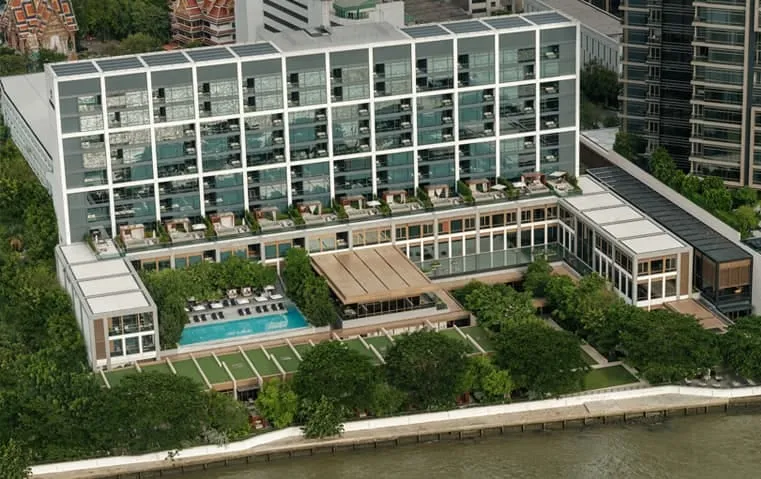
A low-rise riverside sanctuary on the Chao Phraya, where Thai pavilion architecture, a two-Michelin-starred Riviera table and only 101 keys have made a decade-old promenade site into the hotel the rest of Bangkok is measured against.
From $850 per night
Tab Kaek Beach, Krabi, Thailand
Phulay Bay, A Ritz-Carlton Reserve
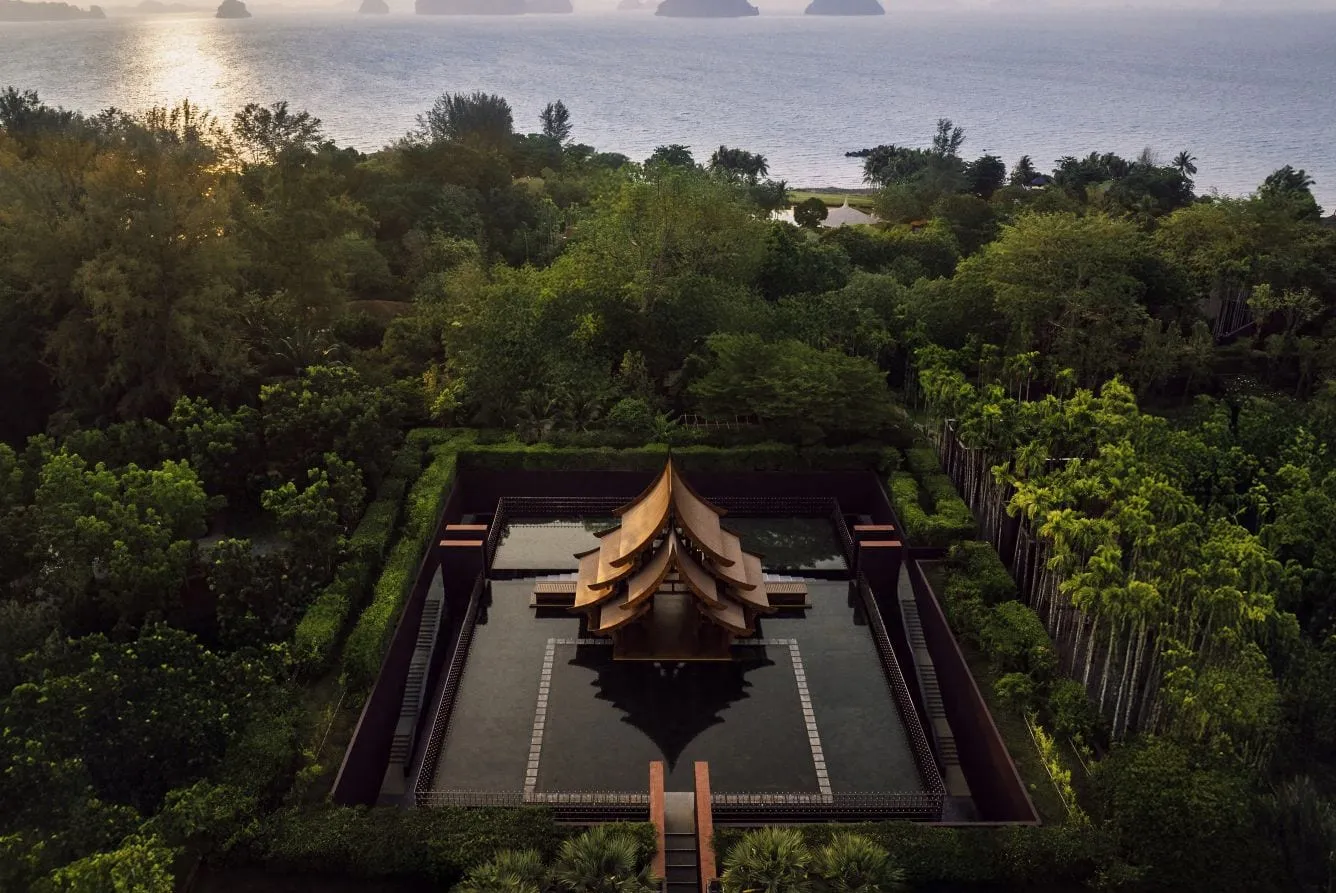
The resort that launched the Ritz-Carlton Reserve brand in 2009, a cluster of Thai-pavilion villas set against Krabi's limestone karsts on the Andaman Sea.
From $650 per night