Thiranagama, Sri Lanka
Haritha Villas + Spa
Nine keys on a forested hilltop above Thiranagama, built around private saltwater plunge pools rather than a stretch of sand.
- Rates from
- From $460 per night
- Nearest airport
- Bandaranaike International Airport (CMB), Colombo
- Transfer
- About 2hr by road from Colombo
- Best months
- November to April, the south coast's dry season
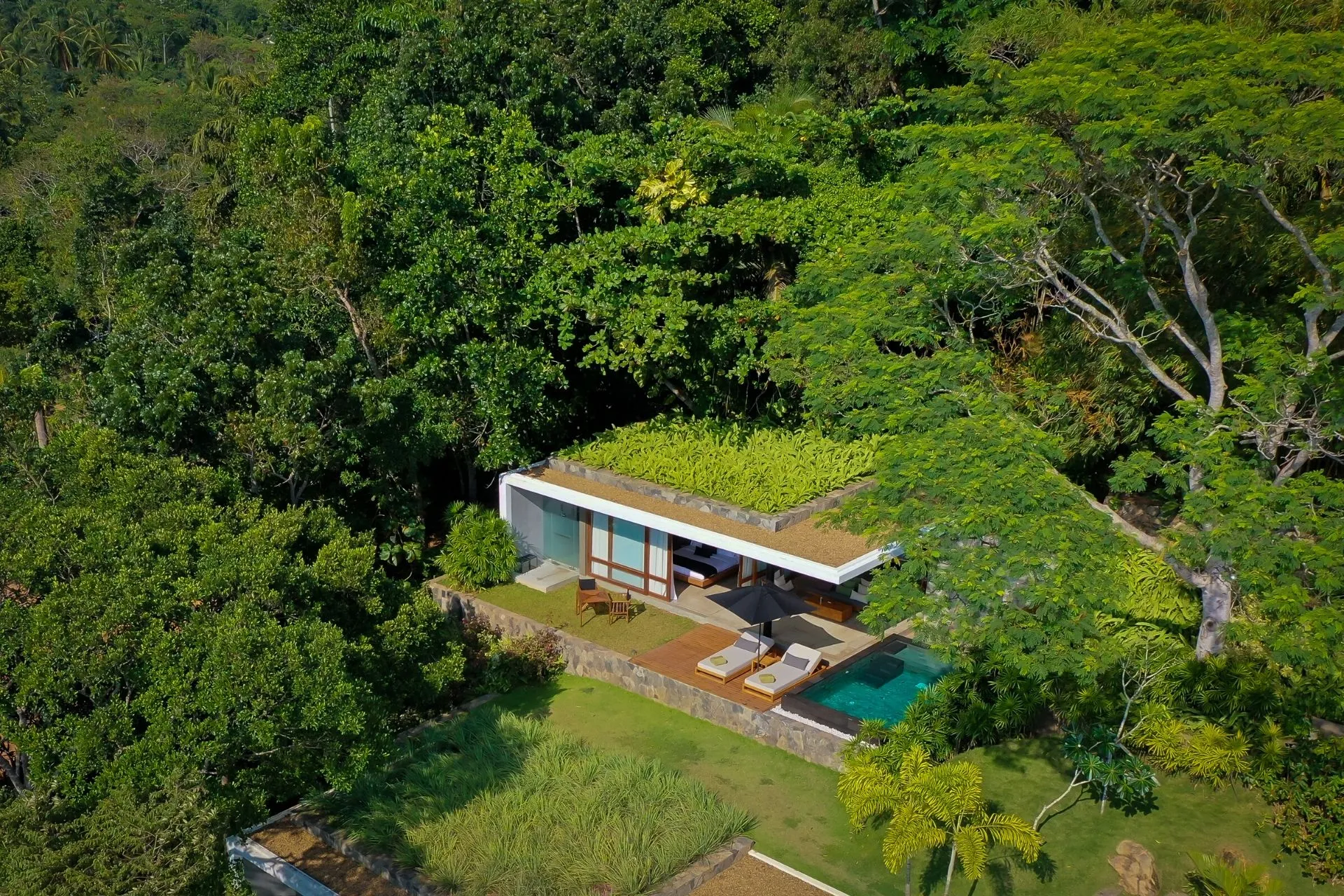
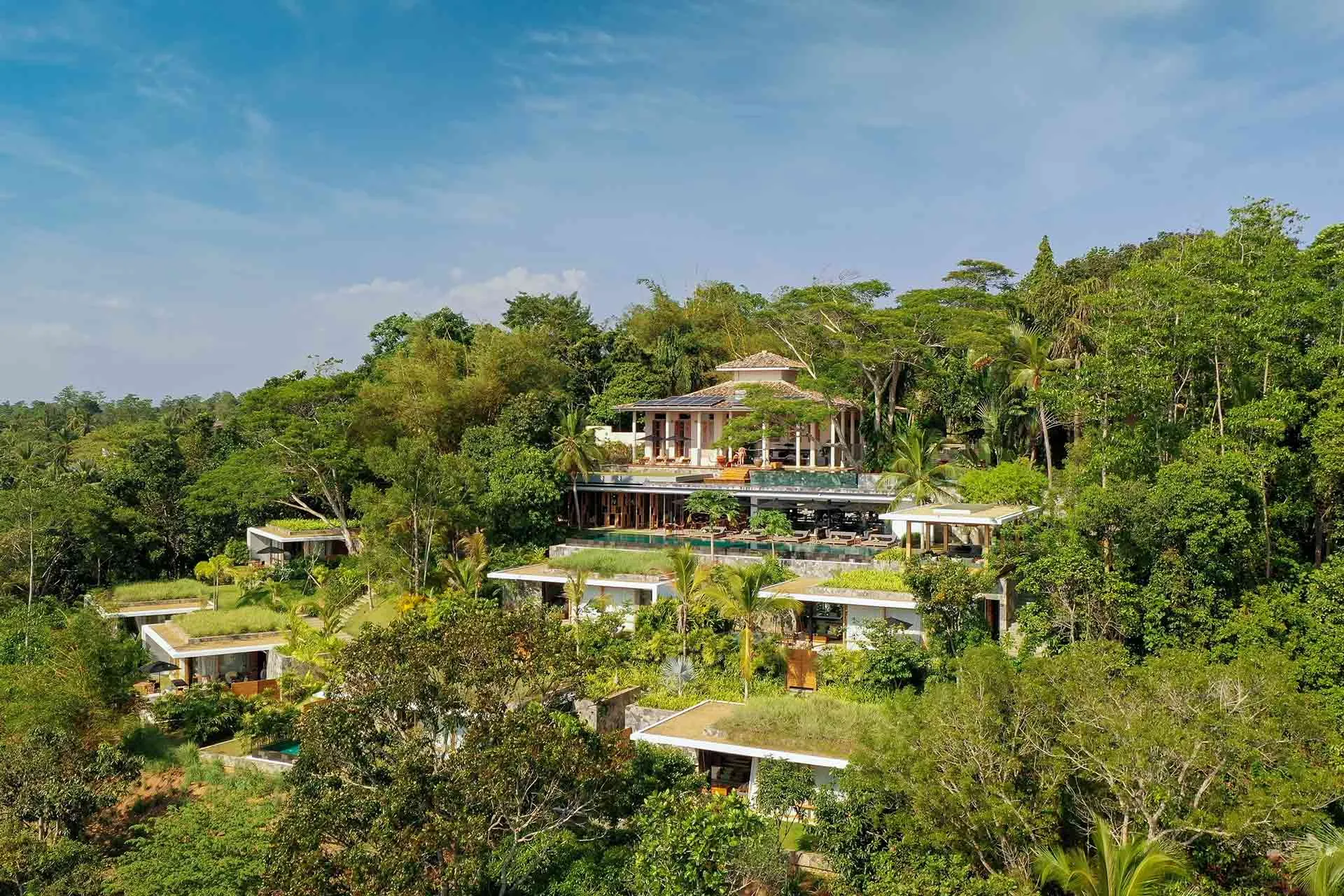
The approach to Haritha Villas + Spa runs uphill, away from the coast road and its procession of surf shacks and guesthouses, into a stand of trees that closes over the driveway before the property itself comes into view. There is no ocean glimpsed from the entrance, no beachfront terrace waiting at reception. What arrives instead is quieter: nine keys scattered across a forested hilltop above Thiranagama, each villa built around its own private saltwater plunge pool rather than a shared stretch of sand.
That is a deliberate departure from the template most travellers associate with Sri Lanka’s south coast, where the better-known names tend to compete for the most dramatic clifftop or beachfront position. Haritha sits inland and up, roughly a kilometre from the shoreline, and treats that distance as a feature rather than a compromise. The trade is straightforward: no direct sea frontage, but genuine quiet, tree cover instead of open sun, and a scale, nine rooms, that keeps the property closer to a private estate than a resort.
For a stretch of coast built largely around Hikkaduwa’s reef and surf culture just to the south, and Galle’s fort walls a short drive further on, Haritha’s hilltop position offers something slightly different: a base that is close enough to both to use them as day trips, without asking guests to stay directly on top of either one.
About Haritha Villas + Spa
Haritha Villas + Spa opened on 15 December 2019, on a hilltop forest estate in Thiranagama, a small coastal village in the Hikkaduwa area of Sri Lanka’s Galle District. The architecture is the work of Gary Fell, of the Colombo-based practice GFAB Architects, whose contemporary tropical designs appear at a handful of other independent Sri Lankan properties. At Haritha, that vocabulary shows up as clean-lined, open-plan villas set into the hilltop’s existing tree cover, with the kind of deep eaves, cross-ventilation and indoor-outdoor thresholds that mark most of Fell’s residential and hospitality work on the island.
The property is built around two accommodation types that sit on opposite ends of a design spectrum. Seven one-bedroom villas are unambiguously contemporary: pared-back, glass-fronted, each with a private saltwater plunge pool on its own terrace, screened from its neighbours by the forest planting. Alongside them stand two colonial-style mansions, a more traditional counterpoint in the same grounds, giving the small property two distinct architectural registers rather than one repeated unit type. Nine keys in total is a genuinely small count for a full-service property with its own restaurant and spa, and that scale is arguably the estate’s defining characteristic: there is no convention space, no large pool deck, and no meaningful crowd to avoid.
The forest setting is not incidental to the design. Rather than clearing the hilltop for uninterrupted views, the villas and mansions are worked into the existing tree cover, which keeps the property shaded, private between units, and visually calmer than a fully landscaped resort garden would be. It is a hotel that reads, on arrival, more like a scattering of private houses in a forest than a single hospitality building.
Independent, architect-led properties of this size are a recognisable category on Sri Lanka’s south coast, where a handful of small-footprint hotels have built a reputation for design quality precisely because they are not trying to compete on scale with the region’s larger resort brands. Haritha fits that pattern: a single owner-operated estate, built around a specific design idea rather than a chain’s standard room template, and sized deliberately to stay that way. The pairing of contemporary villas with colonial-style mansions on the same hilltop also gives the property a range it would otherwise lack at nine keys, letting a single small estate offer two genuinely different stays rather than nine variations on one.
Location
Haritha sits in Thiranagama, a village in the Hikkaduwa area of the Galle District, Southern Province, on Sri Lanka’s south coast. The estate occupies a forested hilltop set back from the shoreline, roughly 900 metres to a kilometre from the beach, which puts it within easy reach of the coast without being on it. Galle, the fortified colonial-era port town and one of the south coast’s principal landmarks, is about 16km to the south, generally a straightforward drive of well under an hour.
The property is reached from Bandaranaike International Airport (CMB) near Colombo, a journey of roughly two hours by road down the island’s western and southern coastline. That transfer time places Haritha comfortably within the same general travel radius as most of the south coast’s other well-known hotels, close enough for a single transfer on arrival without a long day spent in the car.
Climate on this stretch of coast follows the south-west monsoon pattern common to the whole south and west of the island: a dry season running roughly from November to April, with calmer seas, more consistent sunshine and generally lower humidity, followed by a wetter, rougher period through the mid-year months when the monsoon sets in. The dry season is the more reliable window for both beach days and any boat-based activity along the coast, and is generally considered the better time to visit.
The road transfer from Colombo runs largely along the Southern Expressway before joining the coast road for the final stretch into the Hikkaduwa area, the same general route used to reach most of the south coast’s better-known hotels. Because Haritha sits inland of that coast road rather than directly on it, the last few minutes of the drive climb away from the beachfront traffic and shopfronts into the quieter, tree-covered hilltop that gives the property its setting. Guests arriving without a private transfer can also reach the area by rail, on the coastal line that runs from Colombo Fort down through Hikkaduwa and on to Galle, though the final leg up to the estate itself still needs to be done by road.
Rooms & Suites
Accommodation at Haritha splits into two categories, both capped at a small number of keys, which keeps the whole property feeling more like a private compound than a hotel with room inventory to fill.
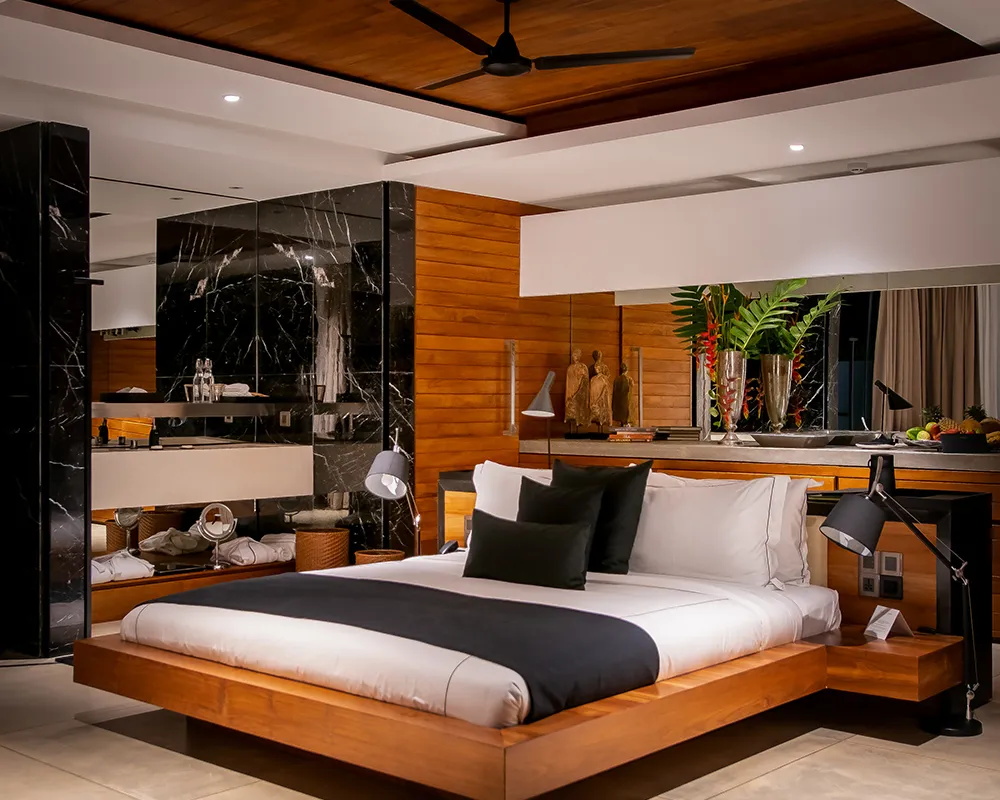
The one-bedroom villas, seven in total, are the contemporary core of the property. Each is a standalone structure with its own private saltwater plunge pool on an attached terrace, set apart from the others by forest planting that limits sightlines between units. The saltwater treatment is worth noting on its own terms: it is a gentler, lower-chemical alternative to standard chlorinated pools, and increasingly common at design-conscious properties that want a plunge pool to read as a natural feature rather than a mechanical one. Fell’s architecture keeps the villas open-plan and glass-fronted, oriented to draw the surrounding tree cover into the living space rather than screening it out.
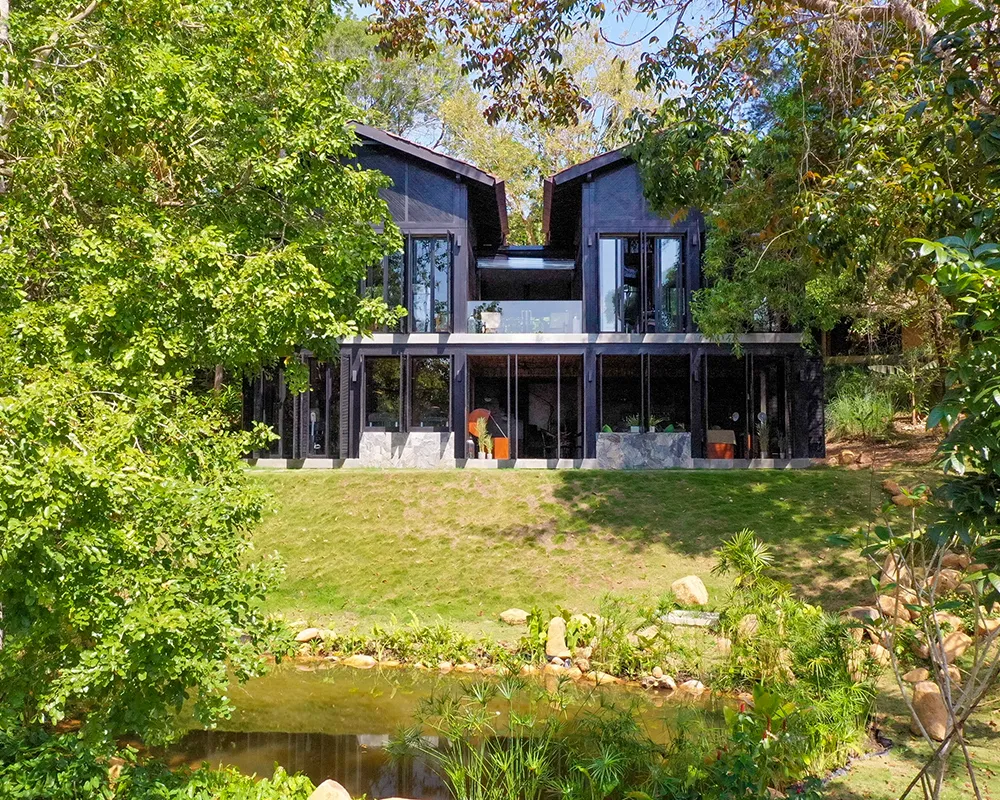
The two colonial-style mansions offer a different register entirely, drawing on the plantation and townhouse architecture more commonly associated with Sri Lanka’s colonial-era south coast. Set within the same hilltop grounds as the villas, they give the property a second accommodation type without breaking its overall scale or its forest setting, and suit guests who prefer a more traditional aesthetic to the villas’ contemporary lines.
Across both categories, the through-line is privacy: nine keys spread across a wooded hilltop, rather than nine rooms stacked along a single corridor or pool deck, means most stays here are built around the villa or mansion itself as a private retreat, with the property’s shared spaces, the restaurant and spa, used more occasionally than continuously.
That layout also shapes who the property suits at a practical level. A honeymooning couple booking one of the one-bedroom villas can expect to spend much of a stay without needing to leave their own terrace and pool at all, meals aside. Guests in one of the two mansions, meanwhile, get a larger footprint and a different architectural mood, useful for a couple who want more interior space, or for the rare case of a small group willing to share a single, larger structure rather than book adjoining villas. What the property does not offer, by virtue of its size, is the room-category ladder found at larger resorts, family suites, multi-bedroom residences, connecting rooms, so travellers with those specific needs are better served elsewhere on the coast.
Restaurants & Bars
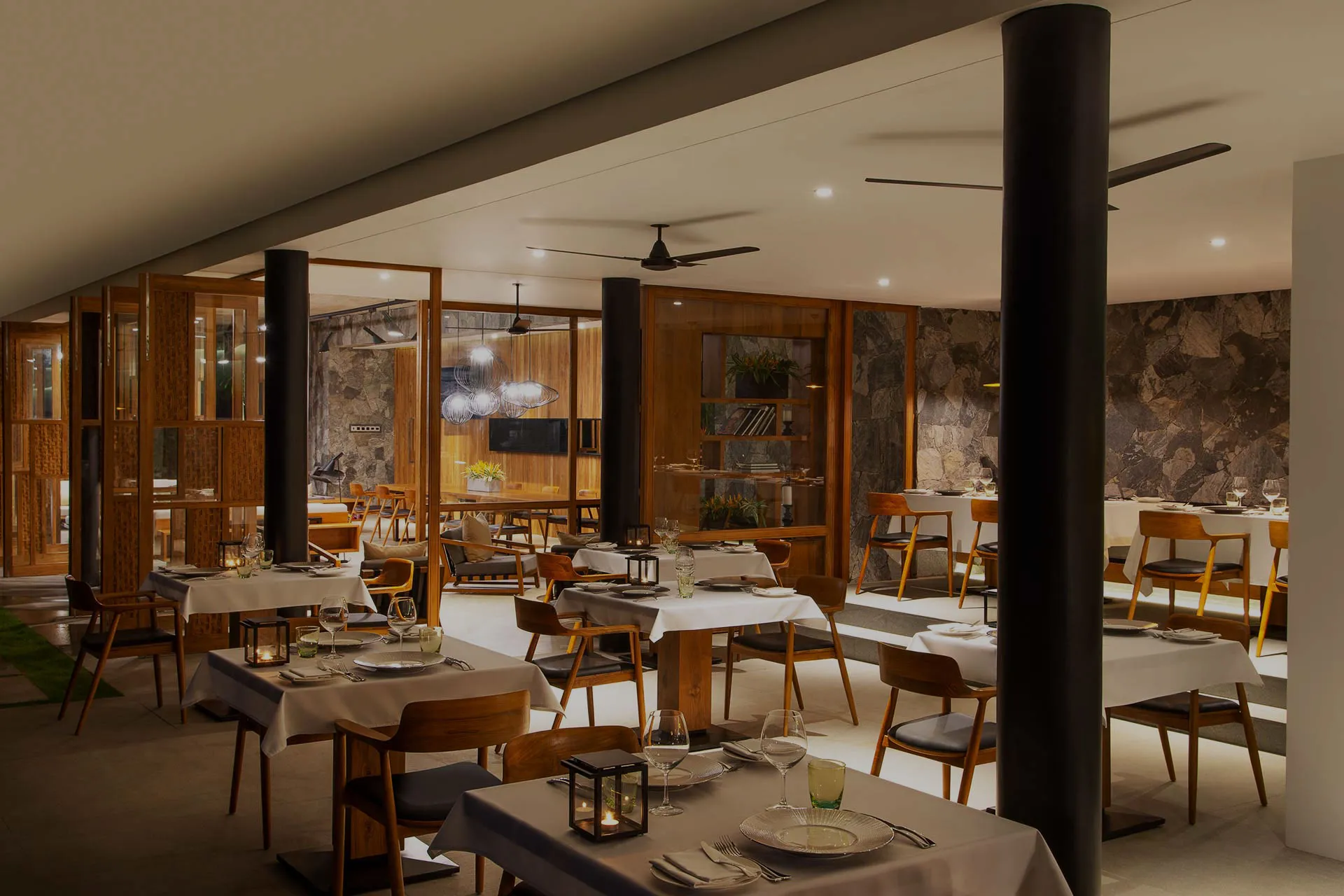
The View is Haritha’s restaurant, and its name is a fair description of its position: set at the highest point of the hilltop estate, above the surrounding tree canopy. As the property’s single dining venue, it carries the full run of meal service, and functions as the natural gathering point for a stay otherwise built around private villas and plunge pools.
Given the estate’s small scale, dining at Haritha leans toward an intimate, single-venue experience rather than a resort’s usual spread of multiple restaurants and bars. That suits the property’s overall positioning: a quiet hilltop retreat rather than a large-scale resort built for constant movement between venues. For guests wanting more variety across a longer stay, the beach towns just down the hill, Hikkaduwa in particular, offer an easy change of scene for a lunch or dinner out without any real disruption to the day.
Wellness
Jungle Spa, the property’s on-site wellness facility, is staffed with Ayurvedic doctors alongside more conventional massage and body treatment offerings. Its name reflects its setting: treatment rooms sit within the estate’s forest grounds, a short walk from the villas, rather than in a purpose-built spa block set apart from the rest of the property.
The presence of Ayurvedic doctors, rather than only spa therapists trained in Ayurvedic-style treatments, points to a more clinical approach to the practice than is typical at resort spas that offer Ayurveda as one menu option among many. Ayurveda in Sri Lanka is a formally regulated medical system with its own government registration for practitioners, distinct from the imported, wellness-branded version of Ayurveda found at many international spas, and a property staffing actual doctors rather than therapists is generally signalling that distinction deliberately. For guests specifically interested in Ayurvedic consultation and treatment rather than a general massage menu, that difference is worth knowing ahead of booking, and it is worth asking the hotel directly what a consultation involves and how far in advance it needs to be arranged.
The forest setting doubles as a practical asset for this kind of programme: shade, quiet, and separation from the villas all make Jungle Spa’s grounds a more natural fit for treatments that are meant to run over an hour or more, compared with a spa wedged into a resort’s central pool complex.
Experiences
Haritha’s own programming centres on its wellness offering and its hilltop forest setting, a quieter proposition than the activity-dense resorts further along the coast. The estate’s position, close to but not on the beach, makes it a workable base for exploring the surrounding area without the property itself needing to run a full excursions desk: Hikkaduwa’s beach and reef are a short drive away, and Galle’s fort a little further beyond that.
Given the small scale of the property, much of a stay here is likely to be built around the villa itself, the plunge pool, the forest setting, and a treatment or two at Jungle Spa, with day trips to the coast and to Galle providing the change of pace. Sri Lanka’s south coast more broadly is well set up for this kind of base-and-explore itinerary: surfing and swimming off Hikkaduwa, snorkelling or a glass-bottom boat trip over its reef, and the fort walls, boutiques and cafes of Galle a short drive south. Divers and snorkellers based on this stretch of coast also have the wider Hikkaduwa Marine National Park to work with, one of the more accessible reef systems on the island for beginners.
Sustainability
Haritha’s hilltop forest setting shapes its environmental footprint in a few identifiable ways, even without a published sustainability programme to point to. The villas and mansions were built into existing tree cover on the hilltop rather than on a cleared beachfront site, which keeps a meaningful stand of forest intact around the accommodation. The plunge pools attached to each villa use saltwater rather than standard chlorination, a lower-chemical approach that has become more common at design-led independent properties. And the property’s small scale, nine keys in total, inherently limits its density and resource draw relative to a larger resort on the same footprint.
Beyond those structural characteristics, no specific certifications, energy or water programmes could be independently verified for this guide, so none are claimed here.
Who Is It For
Haritha suits travellers who want privacy and a small, design-conscious property over beachfront convenience: couples and honeymooners in particular will find the combination of a private plunge pool, forest screening, and a nine-key property genuinely quiet in a way that larger south-coast resorts, however well run, generally cannot match. Guests prioritising Ayurveda and a more clinical wellness offering, rather than a broad spa menu, are well served by Jungle Spa’s resident doctors. And travellers drawn to contemporary Sri Lankan architecture will find Gary Fell’s design work, alongside the counterpoint of the two colonial-style mansions, a considered example of the genre at a manageable scale.
It is less suited to travellers who want to step directly from their room onto sand, or who are looking for a resort with multiple restaurants, extensive activity programming, or facilities built for larger groups. The property’s whole identity rests on its small size and its distance from the shoreline, and that will read as a limitation for guests specifically shopping for beachfront.
Practical Information
Rates at Haritha Villas + Spa generally start from around $460 to $480 per night, varying by room category, season and any package inclusions. Check-in is from 2:00 PM and check-out by 12:00 PM. The property is reached via Bandaranaike International Airport (CMB) near Colombo, roughly two hours away by road, whether by private transfer arranged through the hotel or a pre-booked taxi. The most reliable weather falls within the south coast’s dry season, from November through April, when seas are calmer and rainfall lower; the mid-year monsoon months bring rougher conditions better suited to a hill-country or east-coast leg of a wider itinerary, since the two coasts run on opposite monsoon calendars. Most guests build a stay of three to four nights around the property, enough time to settle into the villa itself, take a treatment or two at Jungle Spa, and make at least one day trip to Hikkaduwa or Galle.
Because Haritha sits away from the beachfront strip, it is worth planning transport for anything beyond a walk into Thiranagama itself; the hotel can generally arrange tuk-tuks or private cars for trips down to Hikkaduwa’s beach and reef, or further south to Galle, rather than guests relying on flagging down transport on the coast road.
Nearby
Hikkaduwa, just south of Thiranagama, is one of the south coast’s longest-running beach and surf towns, known for its coral reef and marine sanctuary just offshore, popular with snorkellers and glass-bottom boat trips, alongside a well-established strip of beach bars and surf breaks. Galle Fort, roughly 16km south, is a UNESCO World Heritage Site and one of the best-preserved examples of a fortified colonial-era town in Asia, its ramparts, churches and merchant houses now home to boutiques, cafes and small museums, and generally worth a half-day at minimum.
Dodanduwa, a short drive south of Thiranagama, sits beside Ratgama Lake, a mangrove-lined lagoon known for its island-based Buddhist forest hermitage, a quieter, more contemplative stop than the beach towns on either side of it. Further along the same coast road, Unawatuna offers a more sheltered, family-oriented beach, while the wider Galle District’s fishing harbours round out the options for travellers using Haritha as a base for a few days of south-coast exploring before moving on elsewhere in the island. Travellers continuing further south can reach Mirissa and Weligama, both within a manageable drive, for whale-watching boat trips and beginner surf breaks respectively, common add-ons to a south-coast itinerary built around a Hikkaduwa-area base.
In pictures
On the map
Thiranagama, Sri Lanka
Questions
Frequently asked
Is Haritha Villas + Spa on the beach?
No. The property sits on a forested hilltop estate roughly 900 metres to a kilometre from the shoreline, in Thiranagama, just north of Hikkaduwa on Sri Lanka's south coast. It is a hilltop retreat set back in tree cover rather than a beachfront resort, and guests reach the coast by a short drive or walk rather than stepping straight off the terrace onto sand.
How many rooms does Haritha Villas + Spa have?
Nine keys in total: seven one-bedroom contemporary villas, each with its own private saltwater plunge pool, plus two colonial-style mansions. The small scale is central to the property's identity, with no large room blocks or shared pool decks.
Where exactly is the hotel, and how far is it from Colombo?
The estate is in Thiranagama, Galle District, Southern Province, about 16km north of the fortified town of Galle and just north of Hikkaduwa. From Bandaranaike International Airport (CMB) near Colombo, the drive south takes roughly two hours by road.
Who designed Haritha Villas + Spa, and when did it open?
The property was designed by architect Gary Fell of GFAB Architects and opened on 15 December 2019. Fell is known for contemporary tropical architecture elsewhere in Sri Lanka, and the villas here follow that same clean-lined, open-plan approach, set into the hilltop's existing tree cover rather than cleared for construction.
What dining and spa facilities does the hotel have?
The View is the property's restaurant, positioned at the highest point of the estate. Jungle Spa, the on-site wellness facility, is staffed with Ayurvedic doctors alongside more conventional massage and body treatments, with treatment rooms set within the forest grounds.
When is the best time to visit, and what does a night cost?
The south coast's dry season, roughly November to April, brings the calmest seas and most reliable sunshine, and is generally considered the best window for a stay. Rates typically start from around $460 to $480 per night, varying by room category, season and any package inclusions.
Same destination
More hotel guides in Sri Lanka
Tangalle, Sri Lanka
Kayaam House
Nine keys, a resident Ayurvedic doctor and a private stretch of turtle-nesting coastline near Tangalle.
From $700 per night
Alawatugoda, Kandy, Sri Lanka
Aarunya Nature Resort
A regenerative hillside estate above Kandy, where private-pool villas sit inside a working tea and spice garden facing the Knuckles range.
From $520 per night
Weligama, Sri Lanka
Cape Weligama
A Thai-designed clifftop village of suites and villas on Sri Lanka's south coast, built around a sixty-metre pool that seems to hang above the Indian Ocean.
From $650 per night