Otemachi, Chiyoda, Japan
Hoshinoya Tokyo
A ryokan stacked seventeen storeys into an Otemachi tower, tatami underfoot from the lobby to the elevator to a hot-spring bath fed from 1,500 metres below the financial district.
- Rates from
- From ¥80,000 per night
- Nearest airport
- Haneda Airport (HND)
- Transfer
- About 20 minutes by taxi or 40 minutes by train from Haneda; roughly 60 to 70 minutes from Narita (NRT)
- Best months
- Late March to April for cherry blossom, October to November for autumn colour; year-round given the indoor onsen
There is a particular disorientation to removing your shoes in the lobby of a nineteen-storey office-district tower and being led, in stockinged feet, across a tatami mat to a waiting elevator. Hoshinoya Tokyo builds its entire identity around that disorientation, and around resolving it as quickly and gracefully as possible. Opened in July 2016 by Hoshino Resorts, a company whose history runs back to a hot spring inn founded in Karuizawa in 1914, it was conceived as an answer to a fairly specific question: what would a ryokan, the traditional Japanese inn built around tatami rooms, shared bathing and seasonal kaiseki dinners, look like if it had to be stacked vertically into a dense financial district rather than spread across a mountainside or a river valley.
The answer sits in Otemachi, in the shadow of the Imperial Palace moat and a ten-minute walk from Tokyo Station, a neighbourhood better known for the headquarters of Japanese megabanks than for overnight stays. Hoshinoya Tokyo occupies two basement levels and seventeen floors above ground, arranged so that each residential floor functions as its own self-contained inn: six guest rooms opening off a shared tatami corridor, gathered around a communal lounge, the whole sequence repeated floor after floor up the tower until it reaches a hot spring bath on the roof, fed by water drawn from 1,500 metres underground.
That combination, the vertical stacking of a horizontal architectural tradition, the presence of a genuine geothermal onsen inside a Tokyo office tower, and a house kimono guests are actively encouraged to wear through the corridors and out onto the street, has made the hotel something of a reference point for what a contemporary Japanese luxury hotel can look like when it declines to imitate the international five-star template. It has picked up a run of industry recognition since opening, including a place in Condé Nast Traveler’s Gold List and Reader’s Choice Awards across multiple years, a number 39 ranking on the World’s 50 Best Hotels list in 2023, and Tatler Best Awards in both 2024 and 2025, but its reputation rests less on any single accolade than on the sustained argument that a ryokan does not need mountains or a river to work, only a coherent idea about how guests should move through a building.
Why It Stands Out
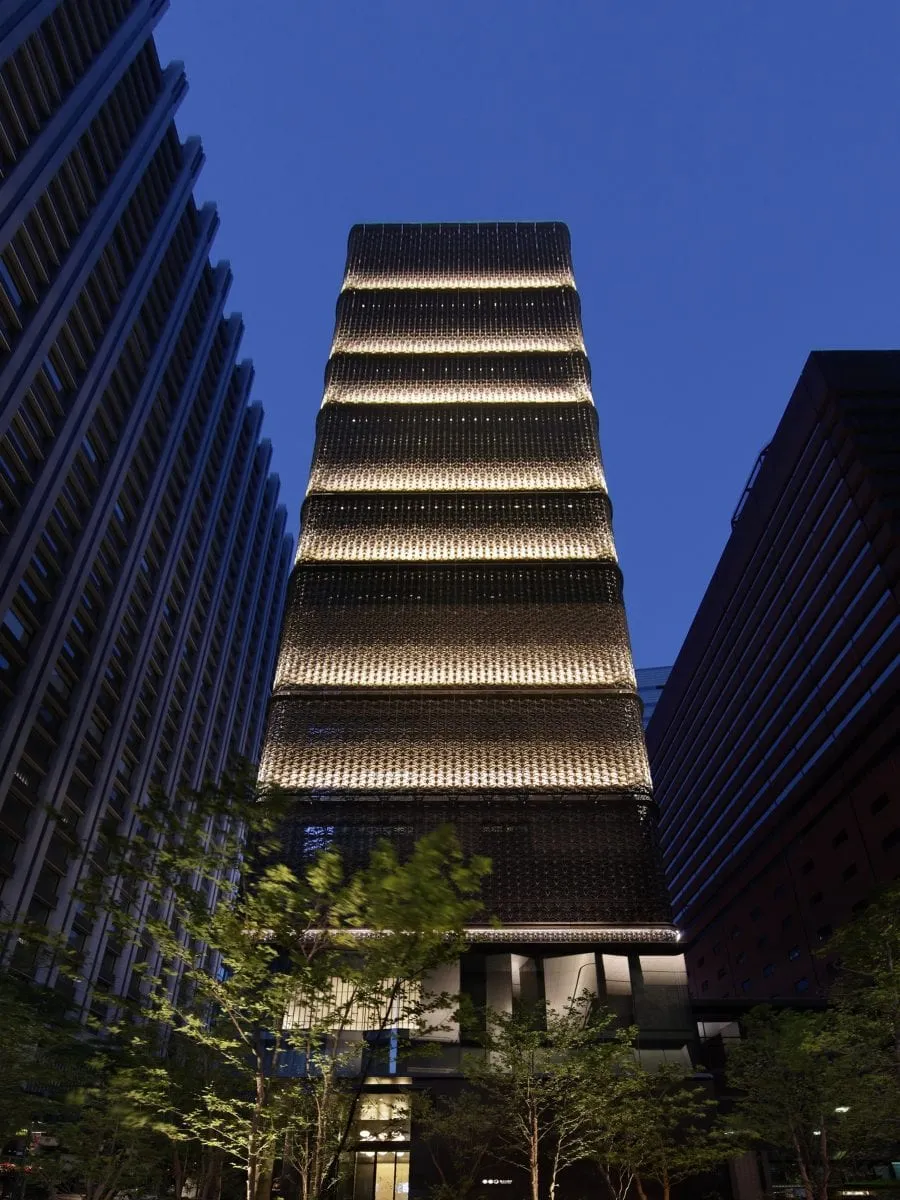
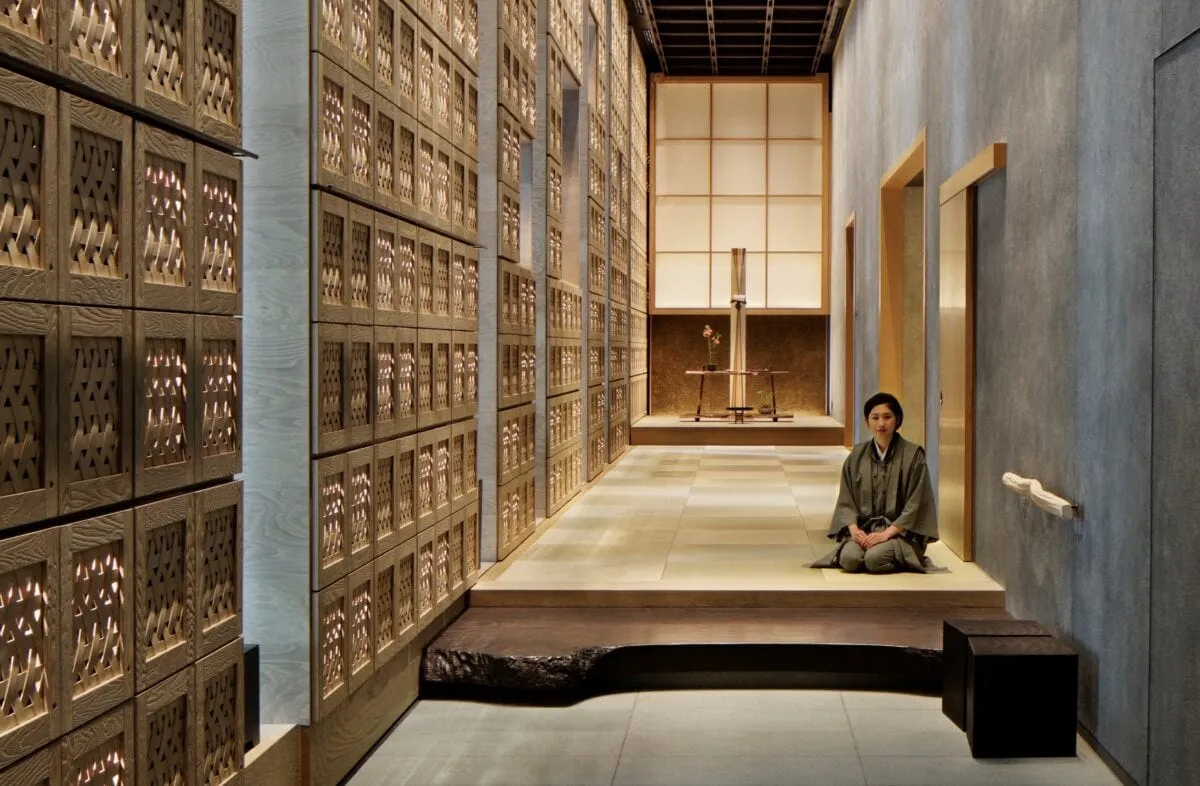
Tokyo has no shortage of towers with hotel floors near the top, and no shortage of hotels that borrow ryokan vocabulary, a robe here, a tatami accent there, without committing to the format. Hoshinoya Tokyo’s distinction is that it commits completely. The architect Rie Azuma, working with landscape designer Hiroki Hasegawa and the Kyoto gardening house Ueyakato Landscape, treated the building’s seventeen above-ground floors not as a stack of identical hotel rooms but as fourteen separate small inns, each with six rooms and its own shared lounge, connected by tatami-matted corridors that run, without interruption, from the ground-floor entrance into the elevators and up to the guest room doors. Shoes come off once, at street level, and stay off for the length of the stay.
The building’s exterior carries the same logic outward: a metal lattice screen patterned on Edo Komon, a centuries-old fine-dot dyeing technique traditionally used for kimono fabric, wraps the tower so that what reads from a distance as a restrained grey facade resolves, on approach, into a dense, deliberately old-fashioned textile motif. Layered onto a steel-and-concrete high-rise, in a district defined by glass curtain walls and bank logos, the effect is closer to a piece of clothing draped over the building than a conventional facade treatment, and it is the clearest single signal, before a guest ever reaches the door, that the hotel intends to be read as a ryokan first and a skyscraper second.
Architecture
Hoshinoya Tokyo was developed as part of a wider Otemachi urban renewal effort and completed in 2016 on a compact site of roughly 1,335 square metres, built in a mix of reinforced and steel-reinforced concrete. The tower’s above-ground floors are organised in a way that has little precedent in Japanese hotel design: rather than a repeated corridor of identical rooms, each level is treated as its own small ryokan, six rooms and a lounge, so that the building reads less as a single 84-room hotel and more as fourteen inns sharing an address. The design team, led by architect Rie Azuma of the Azuma Environmental Design and Architecture Institute, worked in collaboration with Mitsubishi Jisho Sekkei, the design arm of the Mitsubishi Estate group with deep experience building in the Otemachi district, and with NTT Facilities on the building’s services.
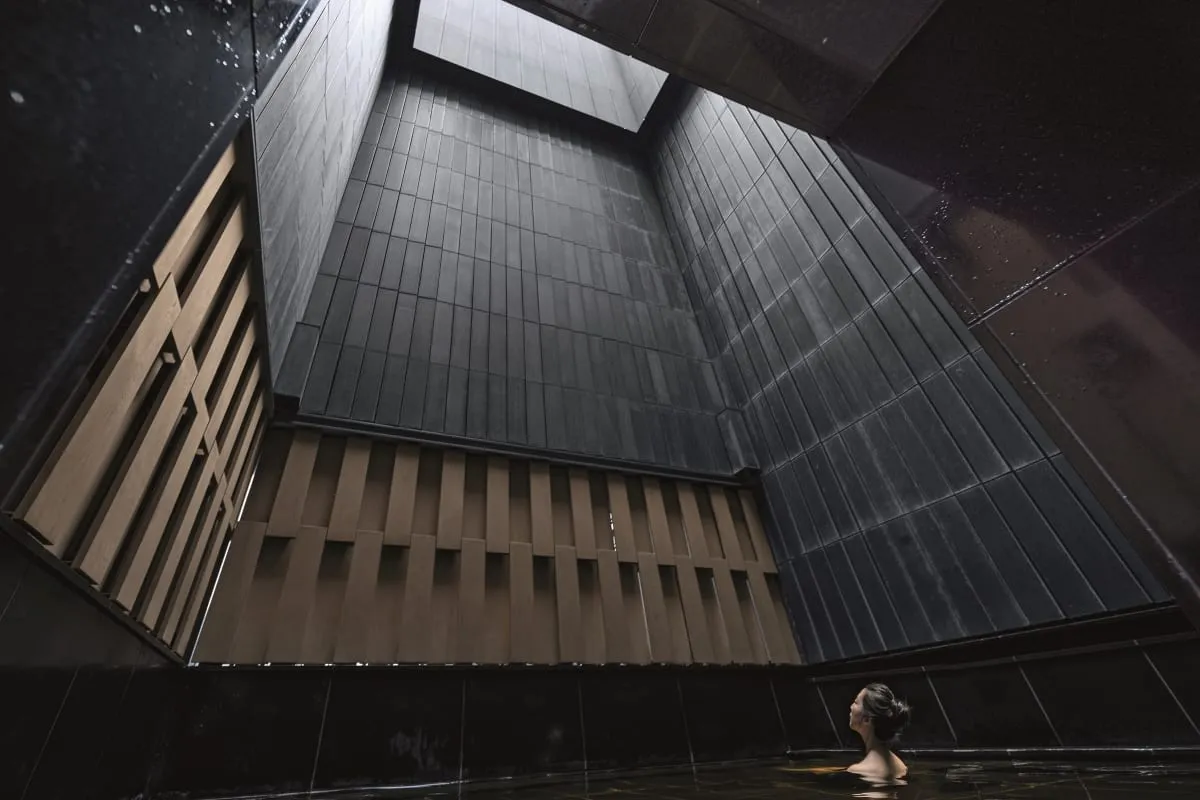
The hot spring bath occupies the top of the tower, on the 17th floor, an architectural decision that inverts the usual hierarchy of a high-rise, where the most valuable views are typically reserved for the most expensive suites. Here, the building’s crown is given over to a communal bathing floor open to every guest regardless of room category, framed by a tall stone wall roughly fifteen metres high that shields the open-air bath from the surrounding office towers while still admitting Tokyo’s sky overhead.
Interior Design
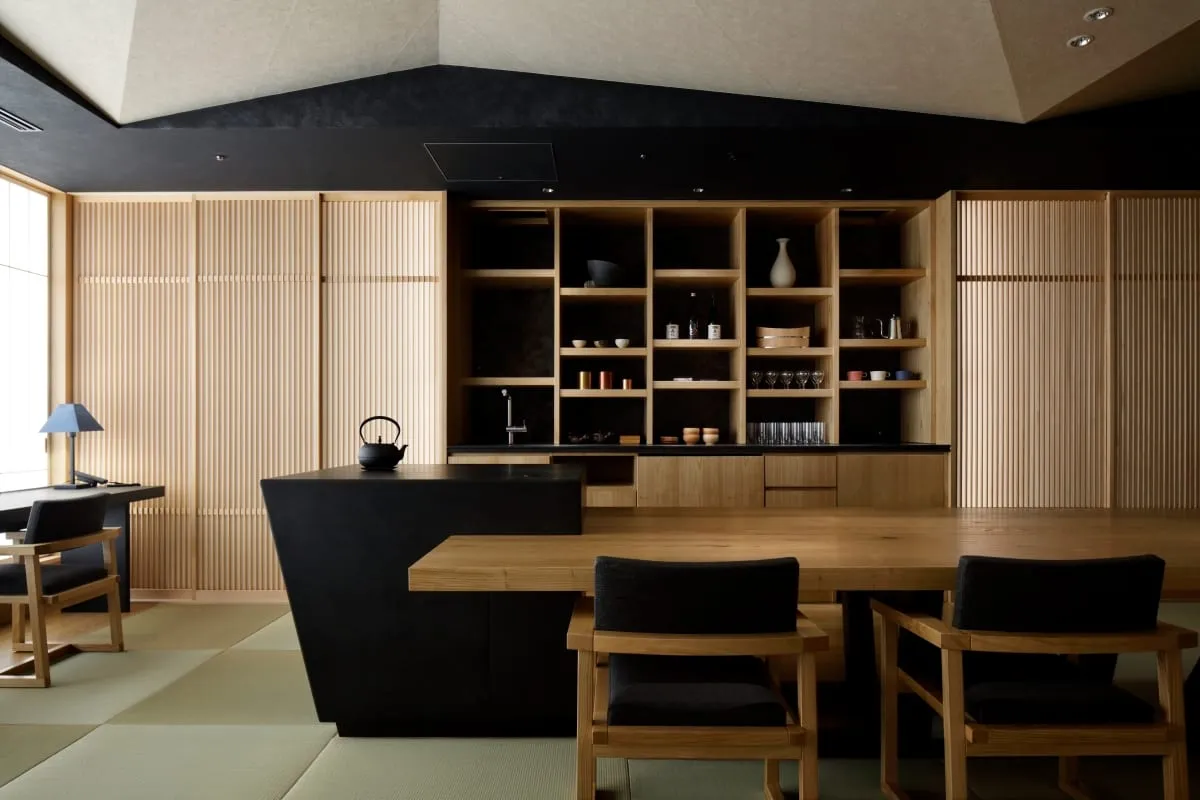
Tatami is the interior’s organising material, used not as an accent in a handful of rooms but as the flooring for guest rooms, corridors, communal lounges and, notably, the elevators themselves, a detail frequently singled out by visitors precisely because it is so easy to overlook how unusual it is. The choice commits the hotel to a genuinely tactile, barefoot experience of the building rather than a merely visual reference to ryokan style, and it shapes everything downstream of it: door heights, corridor widths, the low-slung furniture in guest rooms, all calibrated to a way of moving through a space that assumes bare or stockinged feet rather than shoes.
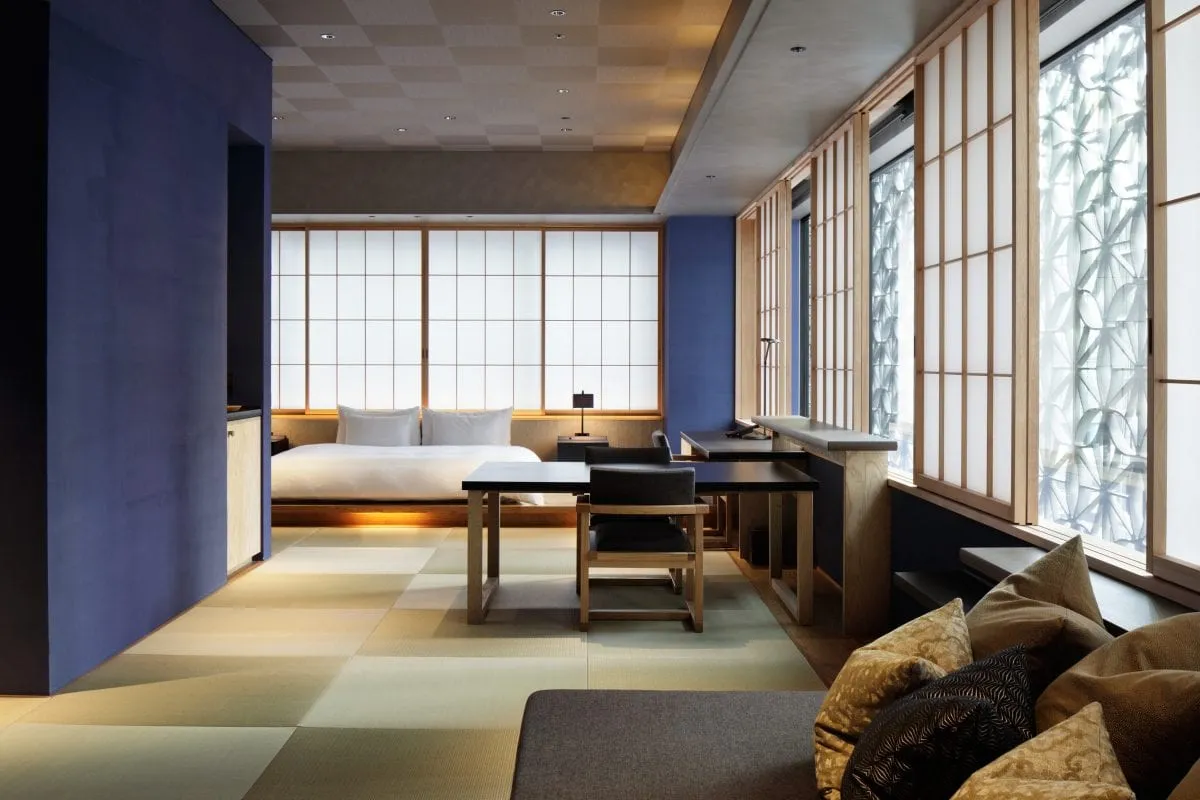
Each of the hotel’s small lounges, called ochanoma, functions as the shared living room for its floor’s six rooms, furnished for guests to read, take tea or simply pass through on the way to the bath, an explicit borrowing of the ryokan convention where guests of a small inn share common space rather than retreating exclusively to a private room. Guest rooms themselves lean toward restraint rather than ornament: paper-toned walls, low furniture, shoji-filtered light and quiet material choices that let the tatami and the building’s own Edo Komon motif, echoed in smaller details throughout the interior, carry most of the visual interest. The custom kimono every guest is given on arrival, designed by dye artisan Jotaro Saito, extends the same textile language from the building’s facade onto the guests themselves, a piece of clothing that functions as both room wear and, in the hotel’s own framing, an invitation to step outside into the neighbourhood still dressed for the ryokan rather than the city.
Atmosphere
The prevailing sensation inside Hoshinoya Tokyo is of a controlled hush, deliberately at odds with Otemachi’s identity as one of the busiest business districts in Japan. Guests arrive from a neighbourhood of bank headquarters and trading floors, remove their shoes, and step onto tatami that does not change in character again until they leave. That transition is the hotel’s central trick, and it is sustained by small, consistent choices: soft lighting in the corridors, the quiet clatter of the ochanoma lounges rather than a busy lobby bar, staff who move through the tatami floors in the same stockinged-foot manner as guests. It reads less like checking into a hotel and more like being received into a private house that happens to be seventeen storeys tall, an effect reinforced by the small scale of each floor, six rooms rather than sixty, which keeps the building from ever feeling like a conventional high-rise property no matter how tall it stands.
Rooms and Suites
The hotel holds 84 rooms across three categories, each accommodating between one and three guests. Sakura rooms, offered as either a deluxe king or deluxe twin configuration, and Yuri rooms, a corner deluxe king with additional window exposure, both run to roughly 45 square metres. Kiku, the hotel’s executive triple category, is considerably larger at around 80 square metres and is designed for parties of up to three. Every room type opens directly onto its floor’s shared tatami corridor and ochanoma lounge, so the distinction between categories lies mainly in size, configuration and view rather than in a fundamentally different design language; the low furniture, shoji screening and restrained palette carry through the whole range. All rooms come with the custom jersey kimono for use during the stay.
Dining
Dining at Hoshinoya Tokyo runs through a small number of tightly focused outlets rather than a sprawling food and beverage programme. The hotel’s principal dining room serves a seasonal Japanese dinner course built, in the kitchen’s own description, around recipes drawn from Japan’s nostalgic, increasingly rare home cooking traditions, reinterpreted for a formal tasting menu format. Sushi Otemon, an eight-seat counter restaurant that relaunched within the hotel in 2025, pairs traditional Edomae sushi technique with more contemporary nigiri preparations across two nightly seatings, giving the hotel a genuine specialist sushi counter rather than a generalist hotel restaurant with sushi on the menu. Breakfast is offered in both Japanese and Western formats, and a basement dining room mixes tatami seating with conventional tables to accommodate different parties. In summer, a limited seasonal kakigori (shaved ice) service, styled after Edo-period refreshments and dressed with amazake and seasonal fruit, runs for a few months and is capped at a small number of servings a day. In-room dining is available throughout the day for guests who prefer to eat within their floor’s own quiet rather than descend to the dining rooms.
Spa and Wellness
Otemachi Onsen, the hotel’s 17th-floor hot spring, is the property’s defining piece of infrastructure and the clearest expression of its ryokan ambitions. The water is drawn from a natural source roughly 1,500 metres beneath the building, a genuine sodium-chloride spring with iodine content, rather than a heated municipal supply dressed up as an onsen, which puts Hoshinoya Tokyo in a genuinely small category of hotels able to offer a real geothermal bathing experience inside central Tokyo rather than requiring a trip out to Hakone or another hot spring town. The bathing floor includes both an open-air pool, screened by a stone wall roughly fifteen metres high that blocks sightlines from neighbouring office towers while leaving the sky open above, and indoor bathing rooms, with the facility open from mid-afternoon through to late morning the following day so that guests can bathe well outside conventional hotel spa hours.
Beyond the onsen itself, the hotel offers a spa treatment menu drawing on Japanese therapeutic traditions, and the emphasis throughout is on bathing and ritual rather than a Western-style gym-and-treatment-room wellness centre. Access to Otemachi Onsen is included for hotel guests, which, combined with its scale and the authenticity of its water source, is what most consistently draws praise from visitors and critics comparing it to hot spring facilities at conventional Tokyo hotels.
Experiences
The hotel runs a rotating programme of Japanese cultural activities aimed at guests who want structured access to traditions that can otherwise be difficult for visitors to find on their own, including tea ceremony, incense appreciation (kodo), kenjutsu swordsmanship demonstrations, gagaku court music performances, moss garden workshops, river cruises along the waterways near the Imperial Palace, and rickshaw tours of the surrounding historic streets. These sit alongside the simpler, unstructured experience the hotel is arguably best known for: wearing the house kimono out of the building and into the neighbourhood, whether for a short walk around the Imperial Palace moat or a coffee nearby, an activity the hotel actively encourages rather than merely tolerates.
Who It Is For
Hoshinoya Tokyo suits travellers who want a genuine ryokan experience, tatami floors, communal bathing, kaiseki-style dining, without leaving central Tokyo for a hot spring town, as well as design-minded guests drawn to a building that treats Japanese craft and architectural tradition as its central material rather than a decorative overlay. It works well for couples and solo travellers seeking a quiet counterpoint to Tokyo’s density, and less well for large families or groups who might find the small, floor-by-floor room counts and shared corridor lounges more suited to two people than four or five sharing a single stay.
Best Time to Visit
Tokyo’s late March to April cherry blossom season and its October to November autumn foliage are the two peak windows for the city generally, both worth booking well in advance given demand across every category of hotel in the capital. Hoshinoya Tokyo’s indoor and covered bathing facilities and its position within a climate-controlled tower mean it does not depend on good weather the way a rural ryokan might, so the hotel functions comfortably as a year-round option, including during Tokyo’s hot, humid summer months and its cooler winter season, when the open-air bath’s contrast with the outside air is, if anything, part of the appeal.
How to Get There
The hotel sits in Otemachi, Chiyoda, close enough to Otemachi Station that its entrances double as unofficial exits from the subway, and about a ten-minute walk from Tokyo Station’s Marunouchi North exit. Haneda Airport, the nearer of Tokyo’s two main airports, is roughly 20 minutes away by taxi or about 40 minutes by train. Narita Airport is considerably further out, at around 60 to 70 minutes by taxi and a broadly similar duration by train depending on the specific rail connection used. The hotel does not run its own airport shuttle, but private transfer service can be arranged in advance through the property.
Nearby Experiences
The Imperial Palace and its surrounding parkland sit within easy walking distance, offering one of central Tokyo’s few large green spaces and a natural extension of a stroll taken in the hotel’s own kimono. The Otemachi and Marunouchi districts immediately around the hotel hold a dense concentration of contemporary art spaces, high-end retail and restaurants housed in the same wave of office towers that replaced the area’s older low-rise streets, while Tokyo Station itself, a short walk away, gives direct rail access to the rest of the city and to destinations further afield, including the shinkansen network for day trips beyond Tokyo.
Things to Know Before Booking
Guests should expect a genuinely shoes-off building: footwear comes off at the ground-floor entrance and stays off until departure, which is worth knowing in advance for anyone who finds that adjustment unusual. Pets are not permitted. Wi-Fi is complimentary throughout guest rooms and in most public areas. The property does not offer a shuttle service or EV charging, and payment is accepted by major credit cards as well as cash on-site. Given the hotel’s small floor plates, six rooms per level, availability during peak cherry blossom and autumn foliage periods can be tight, and booking well ahead is advisable.
Sustainability
Hoshino Resorts has set a group-wide energy policy targeting at least a 40 percent reduction in greenhouse gas emissions by 2030 against a 2020 baseline, working toward net-zero operations by 2050, and the company reports its properties against recognised building environmental standards including CASBEE and BELS. Specific building-level certification details for Hoshinoya Tokyo were not published at the time of writing, and travellers who want confirmation of the property’s current environmental credentials are best placed contacting the hotel directly.
Practical Information
Check-in is from 3:00 PM and check-out by 12:00 PM. The hotel has 84 rooms across Sakura, Yuri and Kiku categories, spread over two basement levels and 17 floors above ground. Otemachi Onsen, the 17th-floor hot spring, is open to guests from mid-afternoon through late morning the following day. Complimentary Wi-Fi is available throughout the property. The hotel is smoke-free, and pets are not permitted. Indicative rates run from roughly JPY 80,000 per night for entry-level Sakura or Yuri rooms, rising well beyond that for Kiku and for peak-season dates; current pricing should always be confirmed directly with the hotel or through its official booking channel.
Editorial Conclusion
What Hoshinoya Tokyo ultimately proves is that a ryokan is a set of ideas about how to move through a building, not a set of physical conditions that only exist in a mountain valley or beside a river. Tatami from the entrance to the elevator, a floor plan built from six-room inns rather than a single sprawling corridor, a genuine hot spring pumped from a mile and a half beneath a financial district, and a kimono guests are trusted to wear out the front door: none of it is a museum reconstruction of a historical form, and none of it pretends the surrounding city isn’t there. It is, instead, a fairly rigorous argument that the ryokan’s underlying logic, of scale, of shared space, of bathing as ritual, travels intact into a Tokyo office tower, which is a more interesting achievement than simply building another well-appointed luxury hotel in the capital.
In pictures
On the map
Otemachi, Chiyoda, Japan
Questions
Frequently asked
What makes Hoshinoya Tokyo different from a typical Tokyo luxury hotel?
It is built as a vertical ryokan rather than a conventional hotel. Each of its residential floors holds just six rooms arranged around a shared tatami-matted corridor and an ochanoma lounge, echoing the layout of a traditional Japanese inn, and guests remove their shoes at the ground-floor entrance and walk on tatami the rest of the way to their room. That format, applied inside a 19-storey Otemachi tower, is what the hotel and most critics point to as its defining idea rather than any single amenity.
Is the hot spring at Hoshinoya Tokyo a real onsen?
Yes. The hotel's 17th-floor bath, Otemachi Onsen, is supplied by natural hot spring water pumped from roughly 1,500 metres below the building, a genuine iron- and sodium-chloride spring rather than heated tap water. It includes an open-air bath enclosed by a tall stone wall as well as indoor bathing rooms, open to guests through the night and into the following morning.
Do guests have to wear a kimono at Hoshinoya Tokyo?
It is not mandatory, but it is very much part of the experience the hotel designs for. Every guest is given a custom jersey-fabric kimono created with dye artisan Jotaro Saito, comfortable enough to wear around the hotel's communal floors, in the ochanoma lounges, and even on short walks in the neighbourhood, and most guests do wear it for at least part of their stay.
How far is Hoshinoya Tokyo from the airport and from Tokyo Station?
The hotel sits in Otemachi, Chiyoda, essentially on top of Otemachi Station and about a ten-minute walk from Tokyo Station's Marunouchi North exit. From Haneda Airport it is roughly 20 minutes by taxi or about 40 minutes by train; from Narita it is closer to 60 to 70 minutes depending on traffic and route.
Who is Hoshino Resorts and how many rooms does Hoshinoya Tokyo have?
Hoshino Resorts is a Japanese hospitality company that traces its roots to a hot spring inn founded in Karuizawa in 1914, now run by fourth-generation president Yoshiharu Hoshino and operating the Hoshinoya, Kai and Risonare brands across Japan and abroad. Hoshinoya Tokyo, which opened on 20 July 2016 as the brand's fifth property and its first in central Tokyo, has 84 rooms across three categories: Sakura, Yuri and Kiku.
Same destination
More hotel guides in Japan
Otemachi, Chiyoda, Japan
Aman Tokyo
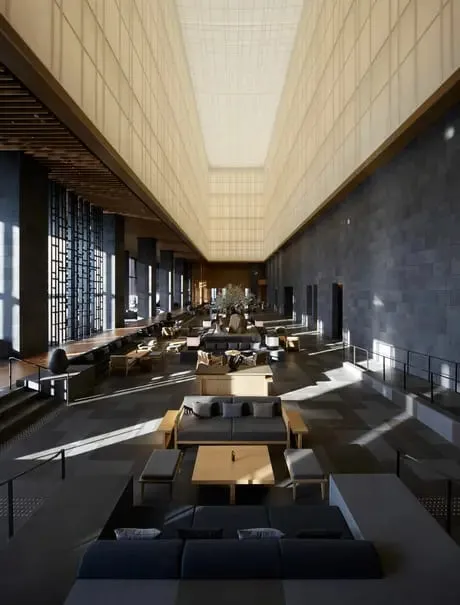
Six floors of dark basalt and washi paper, stacked atop a financial-district tower, where a giant paper lantern lobby turns the Otemachi skyline into a Japanese garden.
From ¥250,000 per night
Naoshima, Seto Inland Sea, Japan
Benesse House
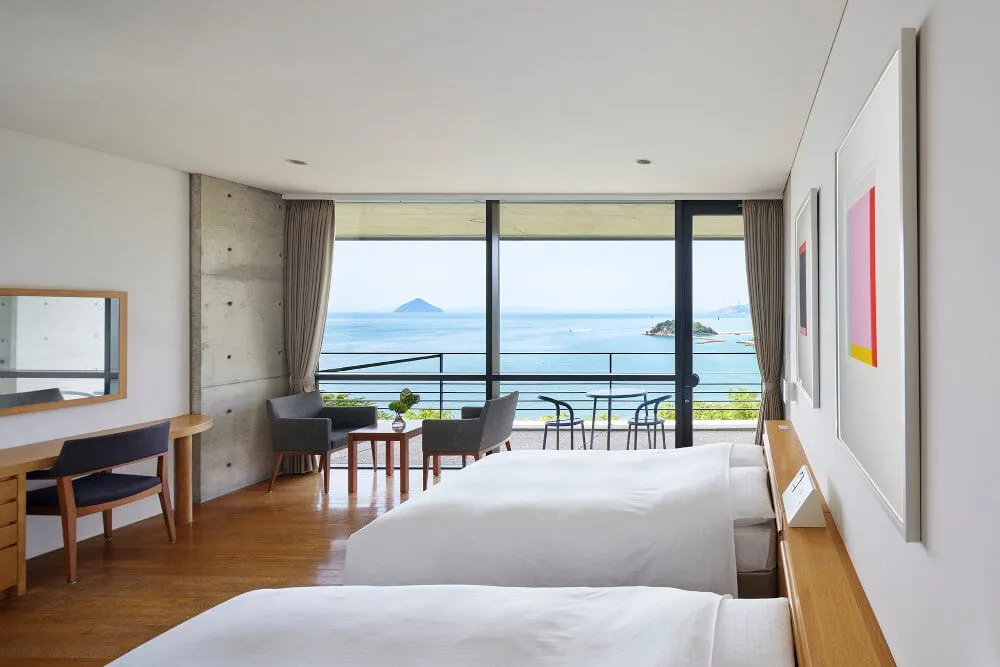
A Tadao Ando concrete museum with guest rooms built into its galleries, the founding building of the Seto Inland Sea's art-island movement.
From ¥40,000 per night
Otemachi, Chiyoda, Japan
Four Seasons Hotel Tokyo at Otemachi
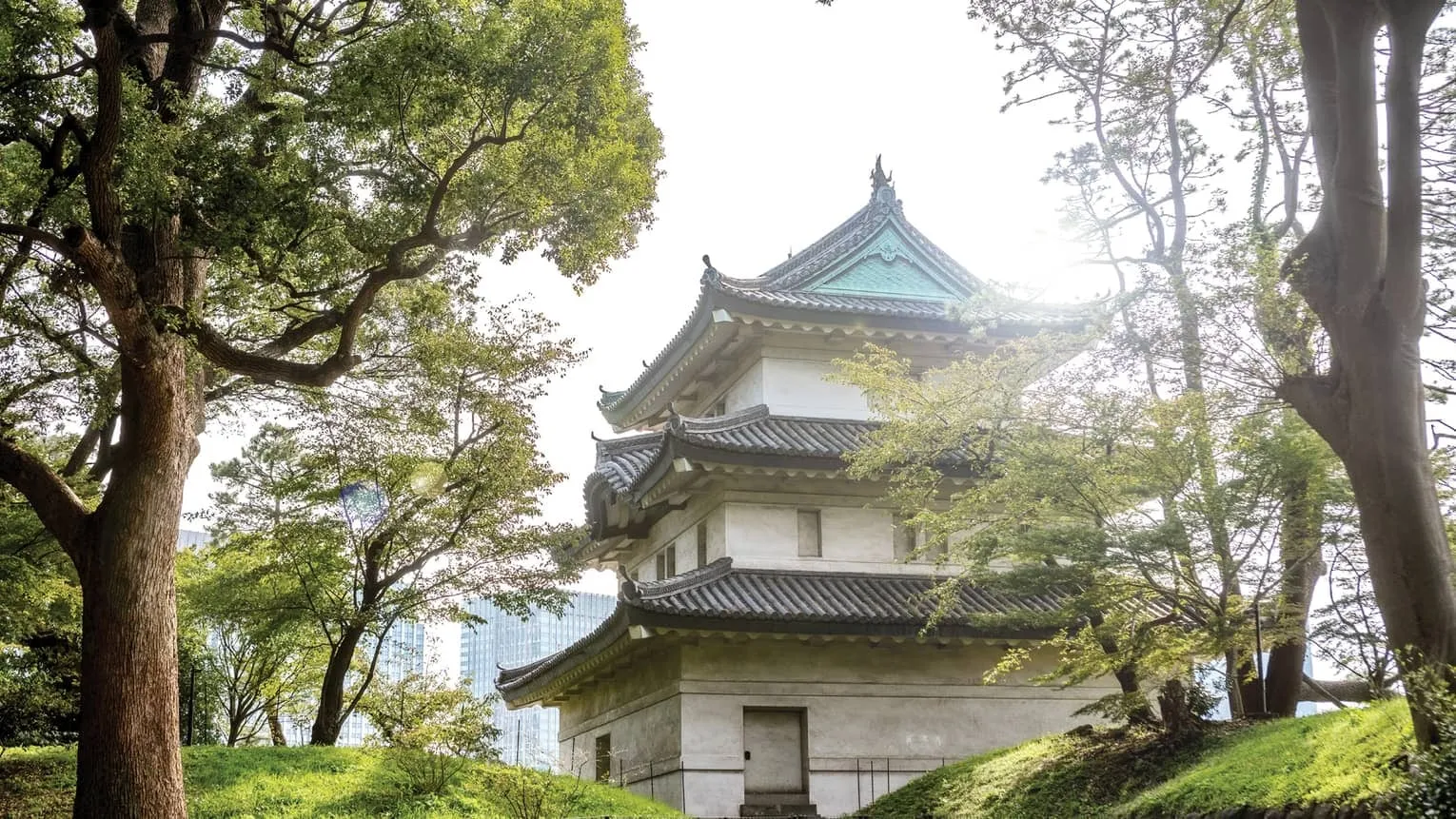
A 190-room aerie stacked into the top six floors of a Tokyo financial-district tower, with the Imperial Palace moat on one side and a Michelin star in the kitchen.
From ¥145,000 per night