Little Torch Key, Florida Keys, United States
Little Palm Island Resort & Spa
America's only private island resort, reachable solely by boat or seaplane, where thirty thatched-roof bungalows keep televisions and telephones deliberately out of reach.
- Rates from
- From $2,150 per night
- Nearest airport
- Key West International Airport (EYW)
- Transfer
- About 30 minutes by car from Key West International Airport to the Little Torch Key marina, then a 20 to 30 minute boat transfer by private motor yacht (direct seaplane service to the island's own marina is also available from South Florida)
- Best months
- November through April, the Florida Keys' cooler, drier season with the calmest seas for boat and seaplane transfers
There is exactly one way to reach Little Palm Island that does not involve a boat, and it involves a seaplane instead. That single fact does more to define the resort than any amenity list could: this is the only private island resort in the continental United States, a four-to-five-acre speck in the Lower Florida Keys that guests cannot drive to, walk to, or arrive at by any means that touches a bridge. The nearest solid ground, Little Torch Key, sits close enough to see, but the gap is crossed exclusively by water or by air, on the resort’s own schedule.
The island itself has a longer history than its polished, post-hurricane present suggests. It was known for decades as Munson Island, after Charles Newton Munson, who settled there in the 1920s and planted the Jamaican coconut palms that gave the resort its eventual name. It sheltered rum-runners during Prohibition, hosted a fishing-mad Harry Truman in the 1940s (the resort’s motor yacht still carries his name), and in 1962 stood in for the Solomon Islands as a film set for Warner Bros.’ PT-109, with Cliff Robertson playing a young John F. Kennedy. The resort proper opened in 1988, was flattened by Hurricane Irma in September 2017, and reopened in March 2020 after a reported 34 million dollar rebuild.
What guests find today is a compact village of thatched-roof bungalows, thirty suites in total, spread across fifteen buildings and capped at sixty guests at any one time, a density low enough that the island rarely feels like it is being shared with anyone beyond the staff and the Key deer that occasionally swim ashore at dusk. There are no televisions or telephones in any suite, a policy the resort has maintained through its rebuild rather than softened, and Wi-Fi is confined to the communal Great Room. The effect, by design, is a resort where the ocean and the schedule of the boat, not a screen, set the pace of a stay.
This guide sets out what a prospective guest actually needs to know: the architecture and design behind the current, post-Irma incarnation, the suite categories and what distinguishes them, the dining program now anchored by a partnership with a two-Michelin-starred Chicago chef, the spa, and the practical mechanics of getting on and off an island with no road to it.
Why It Stands Out
Little Palm Island’s central claim, that it is the only private island resort in the United States, is not marketing shorthand so much as a literal description of its access model. Guests reach the property exclusively by the resort’s own motor yacht from a mainland marina on Little Torch Key, or by seaplane landing directly at the island’s marina; there is no vehicular access at all. That single structural fact shapes almost everything else about the place: occupancy is capped near sixty guests, the island’s footprint is under five acres, and there is no possibility of day-trippers, event traffic, or a public restaurant crowd wandering in from a nearby road.
The resort has also rebuilt its credibility since Hurricane Irma’s 2017 destruction in ways that go beyond a fresh coat of paint. It holds Three Michelin Keys, a distinction awarded to relatively few properties globally, and became a Relais & Chateaux member in March 2024. In 2026 it added a culinary partnership with Chef Curtis Duffy, the chef-owner of Ever in Chicago (holder of two Michelin stars annually since opening, and seven Michelin stars across his career), working alongside Executive Chef Rodrigo Albornoz on The Dining Room’s menus. Combined with the enduring no-TV, no-phone policy in every suite, the net effect is a resort that has used its forced rebuild to sharpen, rather than dilute, its original premise: total seclusion, delivered with serious culinary and design ambition rather than rustic simplicity.
Architecture
The current buildings date to the resort’s post-Irma reconstruction, completed by Rossi Architecture working alongside the design firm AvroKO, with the property reopening in March 2020. The brief threaded British West Indies architectural references, louvered shutters, weathered teak, plantation-style detailing, through a more contemporary sensibility rather than a straight historical pastiche. Thirty suites are distributed across fifteen separate thatched-roof bungalow buildings, each suite built with a vaulted bamboo ceiling under its palm-thatch roof, a construction detail that nods directly toward the South Pacific bungalow tradition the resort has long referenced, even though the island itself sits in the Florida Straits rather than the Pacific.
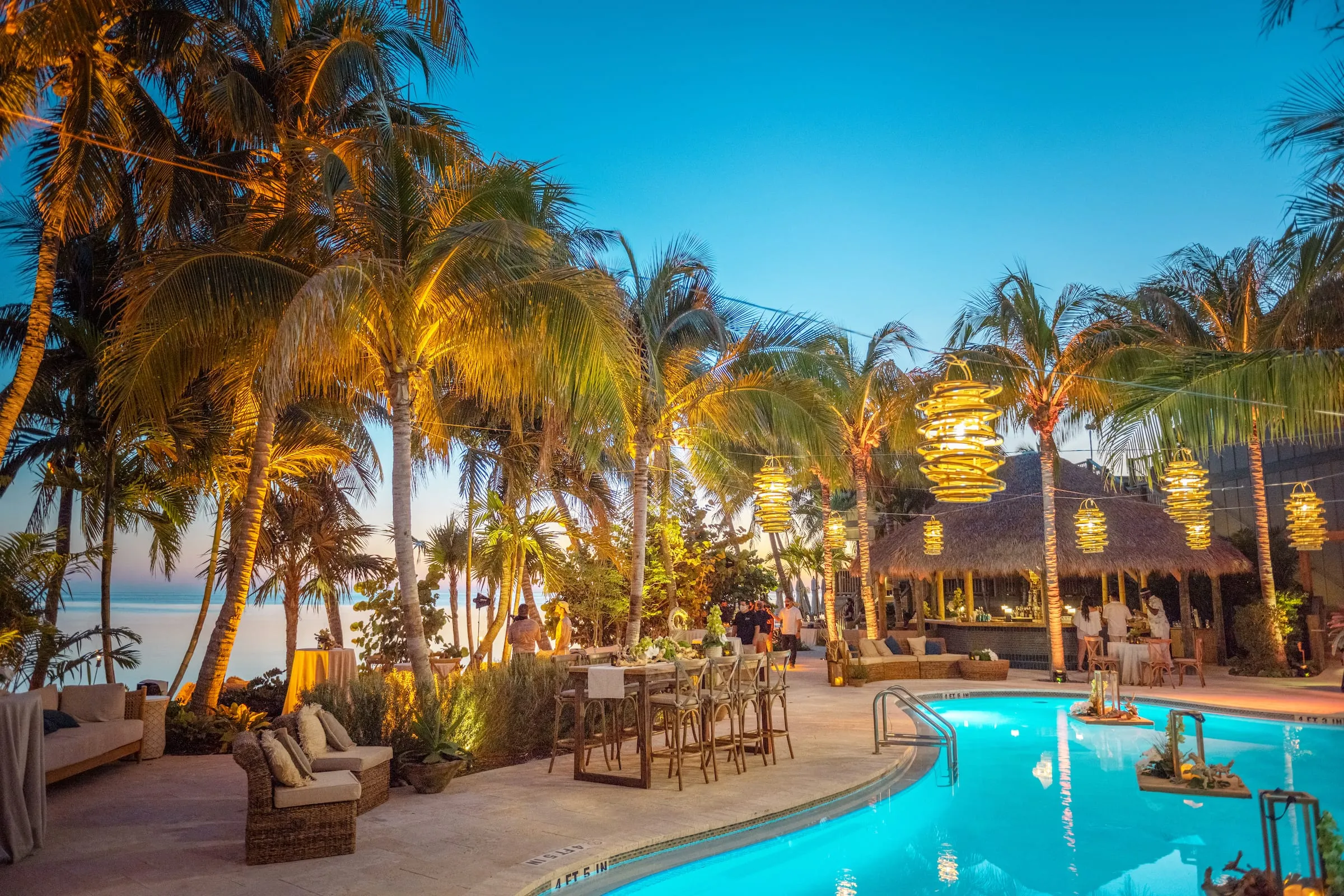
The buildings are deliberately low and dispersed rather than stacked or clustered, connected by crushed-shell paths that wind between palms rather than a formal streetscape, which keeps the built environment from ever dominating the island’s small footprint. Common structures, the Great Room, the Dining Room, SpaTerre, follow the same architectural language at a larger scale: raised, open-sided, thatched or shingled rooflines, and a material palette, teak, travertine, copper, rattan, that carries through from the guest bungalows into the shared spaces.
Interior Design
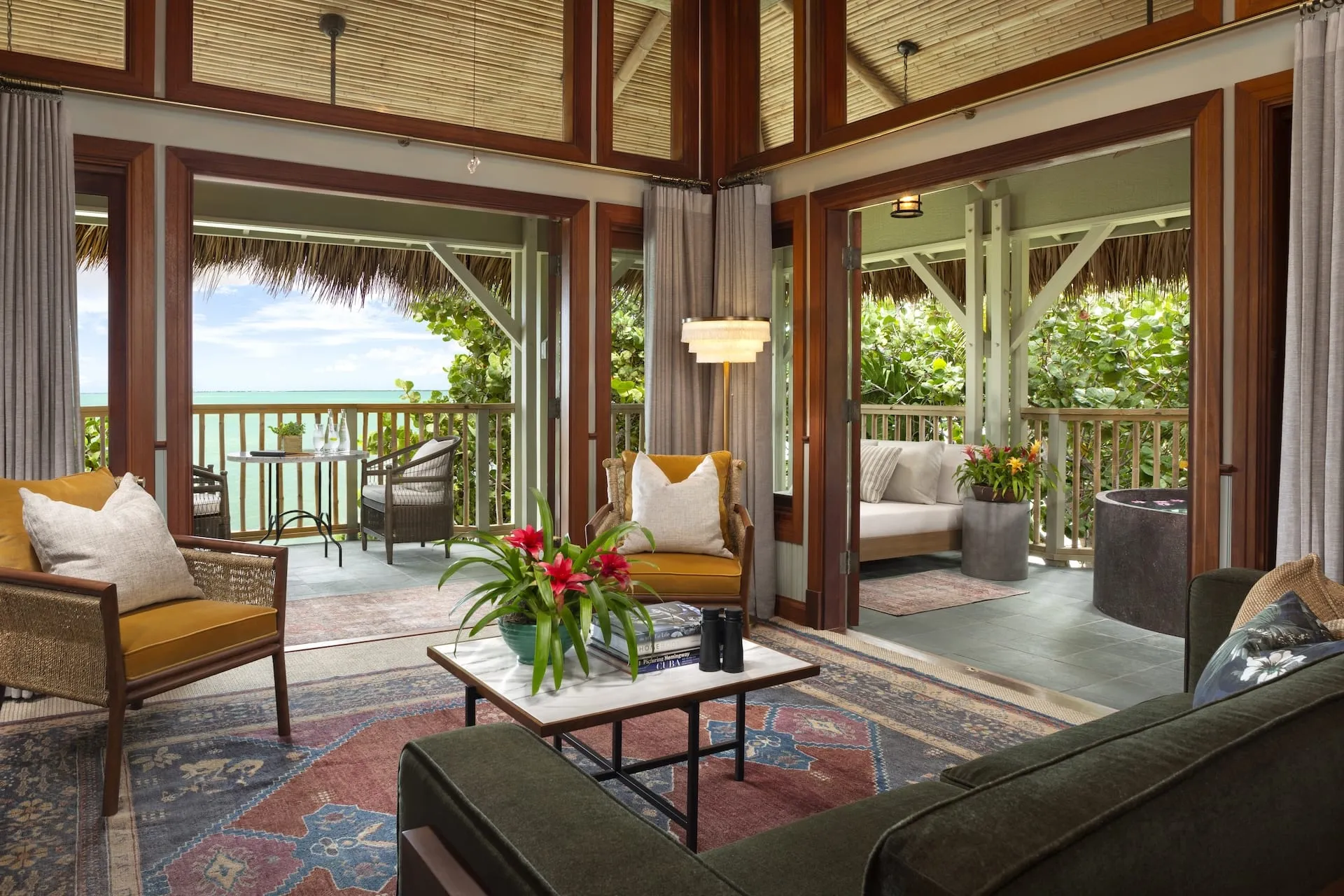
Inside the suites, the rebuild leaned into what one design writer described as an eclectic, elevated bohemian sensibility: custom lighting fixtures, found vintage pieces, and artwork depicting the region’s flora and fauna, layered over the British West Indies architectural bones. Four-poster beds draped in mosquito-net-style butterfly netting anchor each room, paired with Bluetooth speakers and a complimentary, restocked non-alcoholic minibar in place of a conventional television console, since none of the suites contain a TV or a telephone by design.
The four suite categories differ mainly in scale and specific features rather than in overall style. Island Romance Suites, the resort’s largest category by count, add outdoor copper soaking tubs and private firepits to the standard footprint; the newer Island Premier Suites, positioned on a second floor, were finished with floor-to-ceiling glass doors in every room to maximize the ocean views their elevated position affords. Throughout, the interior brief keeps the room’s own furnishings relatively restrained so that large window and door openings, rather than decor, remain the visual focus, a strategy that keeps the ocean, rather than the room, as the subject.
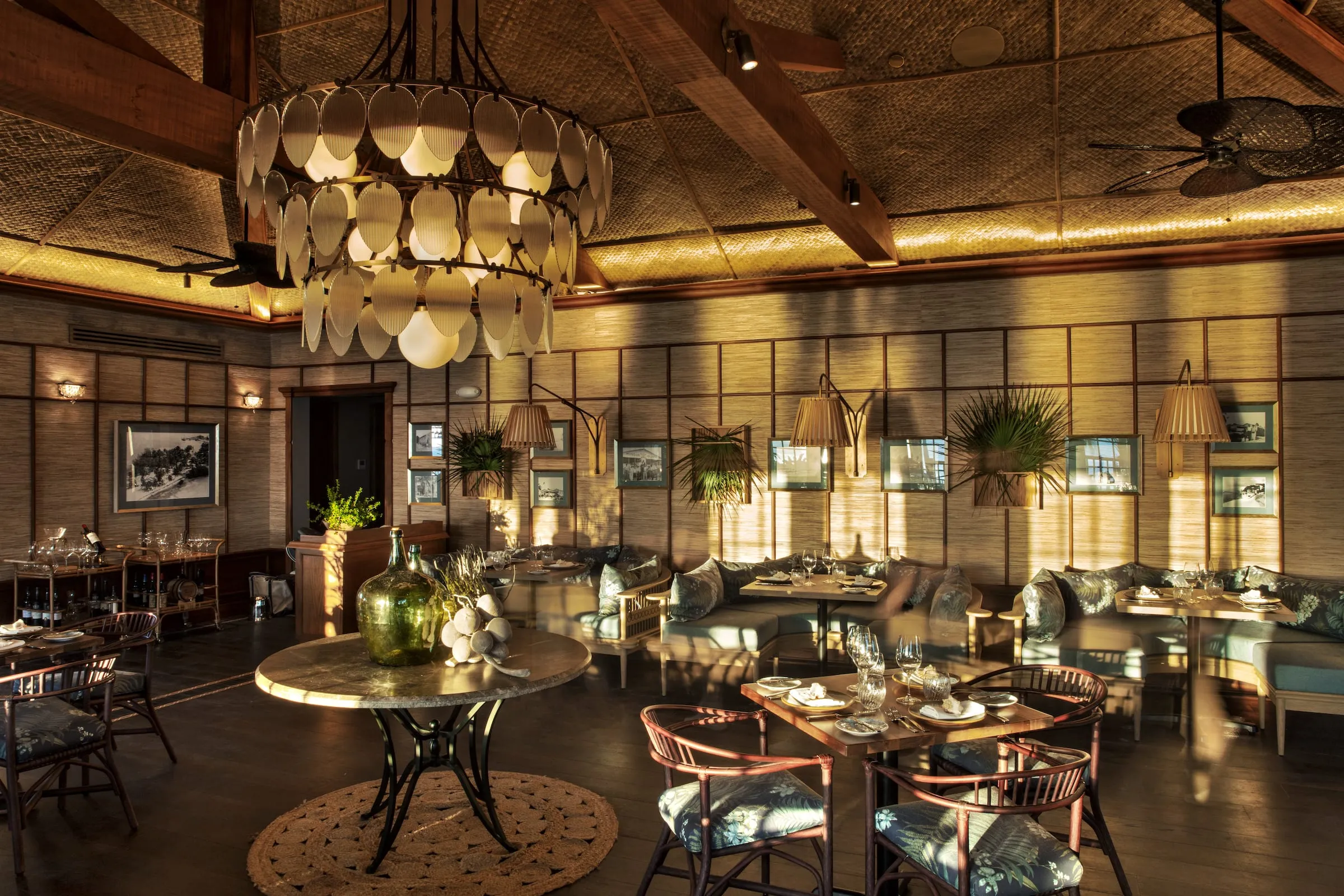
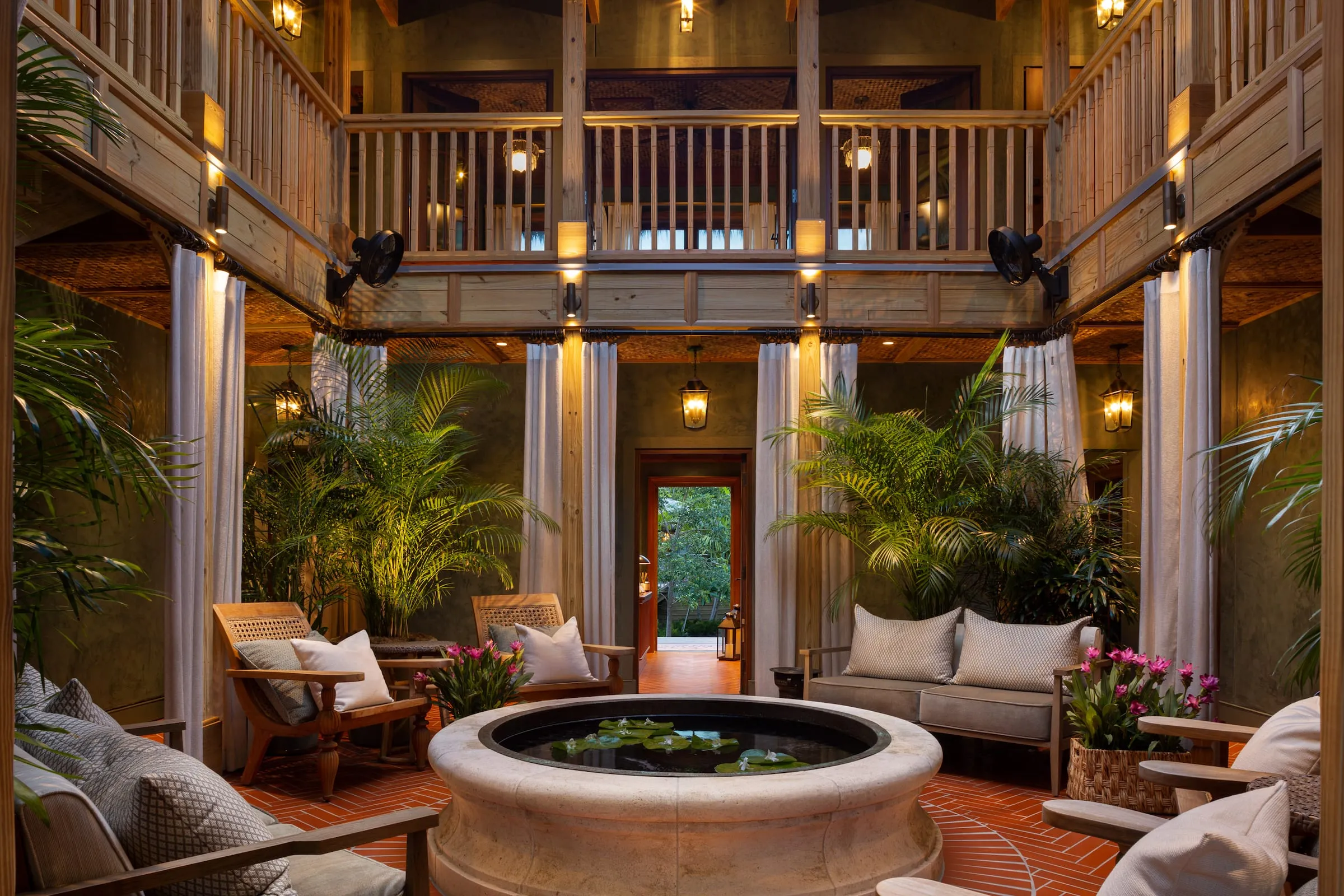
Common areas push the design further: SpaTerre’s two-story atrium is built around carved architectural detailing and a reflecting pool, and the Dining Room’s renovation was aimed specifically at opening up sweeping ocean views from the interior seating, rather than treating the water as something guests had to step outside to see.
Atmosphere
Little Palm Island trades in a particular kind of quiet that is difficult to manufacture on a resort with road access. With guest numbers capped near sixty and the island itself under five acres, there is rarely a sense of crowding, even at what counts as full occupancy; paths between bungalows are shell-lined and shaded rather than paved thoroughfares, and communal spaces are sized for a small island rather than a convention-scale resort. The absence of televisions and telephones in every suite, and the restriction of Wi-Fi to the Great Room alone, is the atmosphere’s clearest structural expression: the resort has built its entire guest experience around the assumption that disconnection is the point, not an inconvenience to be quietly undone on request.
That seclusion has a wilder edge to it than most private-island resorts manage. The island sits inside the Florida Keys National Marine Sanctuary and close to the National Key Deer Refuge, and the diminutive, endangered Key deer native to the surrounding keys are known to swim across to the island at dusk, an unscripted encounter that regularly features in guest and press accounts of a stay. Dinners are sometimes staged directly on a sandbar extending into the Straits of Florida, with nothing but water on every side, which is as close as the resort comes to a signature, unrepeatable-elsewhere moment. The overall tone sits closer to a barefoot, adults-only retreat than a formal grand hotel, but the dress expectations at dinner, collared shirts for men in the Dining Room, no beachwear, keep it from tipping into pure rusticity.
Rooms and Suites
All accommodation at Little Palm Island takes the form of a thatched-roof bungalow suite; there are 30 in total, none of them standard hotel rooms in the conventional sense, and none fitted with a television or telephone. The categories run as follows: Island Escape Suites, 11 of them, at roughly 550 square feet with ocean views and a separate living area, form the resort’s entry tier. Island Romance Suites, 15 in number and also around 550 square feet, are the resort’s largest category by count and add an outdoor copper soaking tub and a private firepit to the same basic footprint. At the top of the range sit two Island Grand Suites, roughly 1,000 square feet with dual full bathrooms, and two Island Premier Suites, around 1,020 square feet, set on a second floor with floor-to-ceiling glass doors and the island’s most panoramic ocean views.
Across every category, the shared features matter as much as the differences: four-poster beds with butterfly netting, Bluetooth speakers, a complimentary non-alcoholic minibar restocked daily, and, per house policy, no in-room television or phone. Given the small total count, only two suites each in the Grand and Premier tiers, travelers with a specific category in mind, particularly those two top tiers, should expect to book well ahead, especially across the November-to-April high season.
Dining
The Dining Room is Little Palm Island’s principal restaurant, and as of 2026 it operates under a new culinary partnership between Chef Curtis Duffy, the chef-owner of the two-Michelin-starred Ever in Chicago, and Executive Chef Rodrigo Albornoz, who runs the kitchen day to day. Duffy’s role is to guide the broader evolution of the menu, technique and presentation rather than to cook nightly on property, a structure common to chef-partnership arrangements at destination resorts. The restaurant has also earned Wine Spectator’s Best of Award of Excellence for four consecutive years, 2021 through 2024, ahead of the Duffy partnership’s launch. Seating options include an indoor dining room with newly opened-up ocean views following the post-Irma renovation, an oceanfront veranda, and, for a more informal setting, tables set directly on the sand.
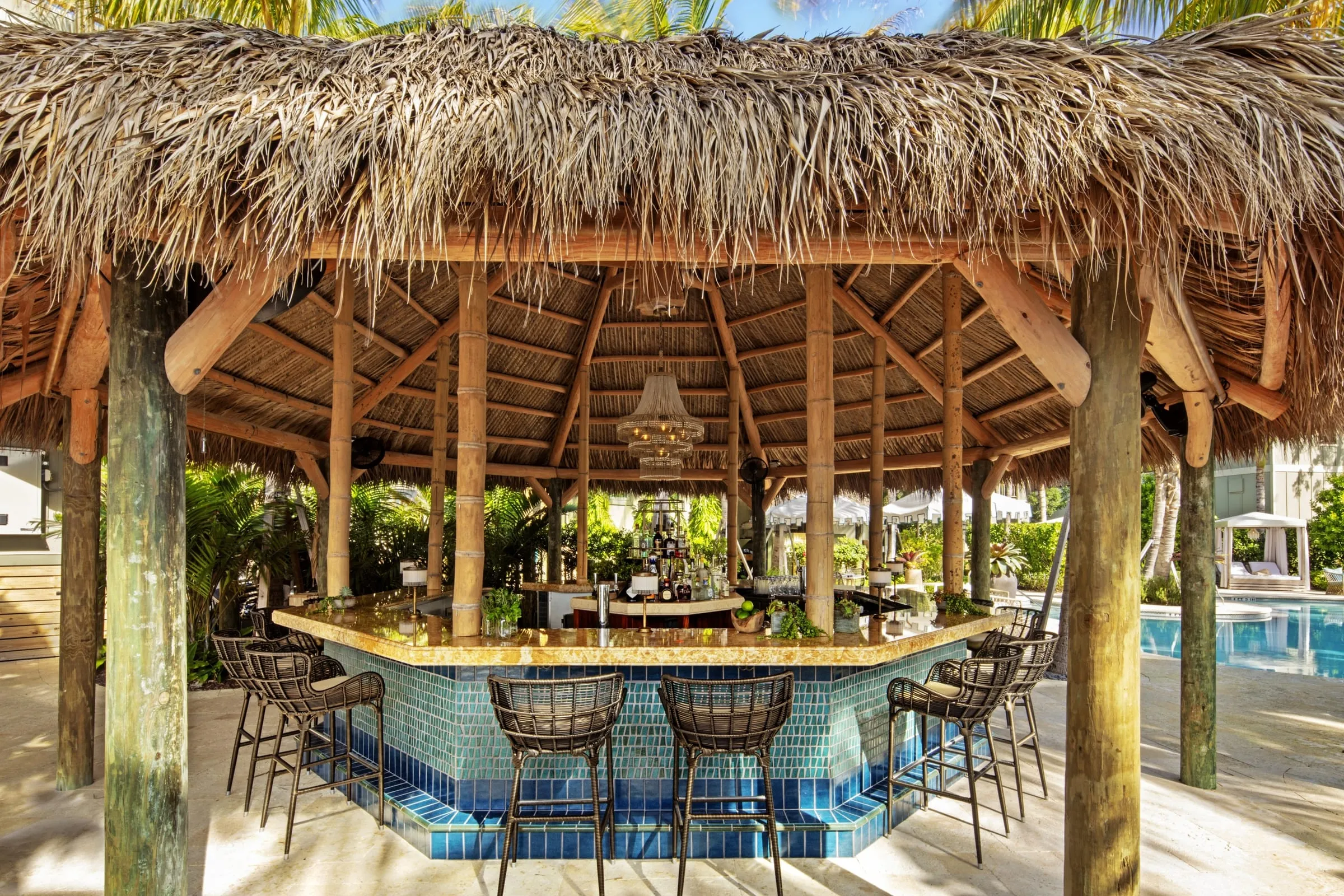
Beyond The Dining Room, the Pool & Palapa Bar serves a more casual, thatched-roof tiki-style menu and drinks through the day. The resort’s best-known dining format, though, is its private sandbar dinner, a table set on a sandbar that extends into the Straits of Florida, lit by candles or firelight with open water on every side; it is the kind of experience that shows up repeatedly in independent guest accounts as the single most memorable meal of a stay, and it typically needs to be arranged in advance through the resort.
Spa and Wellness
SpaTerre is Little Palm Island’s spa, housed in a 3,800-square-foot, two-story open-air atrium built around a reflecting pool, one of the more architecturally ambitious spa spaces among small Florida Keys resorts. It is open daily from 9 a.m. to 6 p.m. Signature treatments lean into the island setting directly: the Madrugada In-Ocean Sunrise Massage is performed in the water at dawn, and the Ocean Wave Four-Hands Massage uses two therapists working in tandem. The broader treatment menu includes seaweed wraps, facials using the French skincare line Biologique Recherche, and CBD-infused treatments, alongside more conventional massage and body-treatment options.
Wellness programming extends beyond the treatment rooms to include beach yoga and other nature-based sessions that take advantage of the island’s setting rather than confining wellness to an indoor studio. Given the spa’s relatively compact size and the resort’s overall exclusivity, guests with a specific treatment or time slot in mind, particularly the sunrise in-ocean massage, are generally advised to book ahead of arrival rather than on property.
Experiences
Because the island itself is small, most of Little Palm Island’s activity program moves guests off it and into the surrounding water. Snorkeling trips run out to Looe Key Reef, part of the Florida Reef, often cited as the third-largest barrier reef system in the world, and a short boat ride from the resort. Complimentary use of kayaks and paddleboards is included in the resort’s daily fee, encouraging guests to explore the shallow flats and mangrove channels around the island independently rather than only through guided excursions.
The most singular experience, though, is not a booked activity at all: Key deer, the smallest subspecies of white-tailed deer and native only to a small cluster of islands in the Lower Florida Keys, are known to swim across to Little Palm Island at dusk, an unscripted wildlife encounter tied directly to the resort’s proximity to the National Key Deer Refuge. The resort also arranges more conventional set-piece moments, sandbar picnics, fireside gatherings after dark, and private beach or sandbar dinners, all of which lean on the same asset: an island small and quiet enough that these experiences can be staged without competing for space or attention with other guests.
Fishing, a pursuit with deep roots on the island going back to Truman’s own visits, remains available through the resort, along with boat charters into the surrounding backcountry and reef.
Who It Is For
Little Palm Island is built for couples first. It is a strictly adults-only resort (no guests under 18, and a minimum age of 21 to check into a room), and its defining features, no televisions or phones, candlelit sandbar dinners, an in-water sunrise massage, are aimed squarely at honeymooners, anniversary travelers and couples seeking a genuinely private escape rather than families or large groups. Its Michelin Key status, Relais & Chateaux membership and new Curtis Duffy culinary partnership will also appeal to travelers who want serious dining alongside the seclusion, rather than a purely rustic castaway experience.
It is a poor fit for anyone who wants connectivity as a baseline: Wi-Fi is confined to the Great Room, suites have no TV or phone, and reaching the mainland at all requires waiting for the yacht’s hourly schedule or arranging a seaplane, so this is not a resort for guests who need to stay reachable by phone through a stay. Families with children are explicitly excluded by house policy, and travelers who prioritize an extensive activity roster or nightlife over quiet and water will likely find the island’s small scale limiting rather than charming.
Best Time to Visit
November through April covers the Florida Keys’ dry season: lower humidity, calmer seas and more reliable weather for the boat and seaplane transfers that every guest depends on to reach the island at all, which makes the seasonal calendar more consequential here than at a mainland resort. This window also overlaps with the region’s broader high season, so the top suite categories, particularly the two-room Island Grand and Island Premier suites, are worth booking well in advance for winter and spring dates.
Summer and early autumn bring higher heat and humidity, more frequent afternoon thunderstorms, and, from June through the end of November, Atlantic hurricane season, a genuinely material consideration given that the resort was destroyed by Hurricane Irma in September 2017 and closed for over two years during its rebuild. Travelers booking during hurricane season should factor in the possibility of storm-related transfer disruptions and consider the cancellation terms carefully, since bookings within 30 days of arrival are generally non-refundable.
How to Get There
Every route to Little Palm Island ends at open water. Most guests fly into Key West International Airport, about a 30-minute drive from the resort’s Welcome Station at 28500 Overseas Highway on Little Torch Key (Mile Marker 28.5), or into Miami International Airport, roughly two and a half hours away by car. From the Welcome Station, guests board The Truman, the resort’s wooden motor yacht named for the former president who once fished from the island, for a 20-to-30-minute crossing through mangrove channels and shallow flats; the yacht departs on the half hour between 11:30 a.m. and 9:30 p.m.
Guests who prefer to skip the drive to Little Torch Key altogether can arrive by seaplane instead, with several regional operators, including Tropic Ocean Airways, Miami Seaplane and Keys Seaplanes, landing directly at the resort’s own marina from airports in South Florida. Private yacht owners can also navigate directly to the island, which sits about four nautical miles north of the Looe Key Light at coordinates 24°36.78 N, 81°23.63 W. Whichever route is chosen, transfer timing should be built into the wider travel plan, since both the yacht and seaplane schedules depend on daylight and weather.
Nearby Experiences
The waters immediately around Little Palm Island are themselves the main nearby attraction. Looe Key Reef, part of the Florida Reef, sits a short boat trip away and offers some of the clearest snorkeling and diving in the Lower Keys, while the mangrove channels and shallow flats surrounding the island reward guests exploring independently by kayak or paddleboard, both included in the resort’s daily amenities. The National Key Deer Refuge, spread across Big Pine Key and No Name Key just north of Little Torch Key, protects the diminutive Key deer that occasionally swim to the resort’s own shore, and is accessible to guests who arrange a mainland excursion.
Key West, roughly 30 minutes from the Little Torch Key marina by car, offers the nearest concentration of restaurants, galleries and nightlife beyond the resort itself, a useful option for guests who want a day of mainland variety without giving up their island base. Sport fishing charters, a pursuit with a direct historical link to the island through Truman’s own visits, can be arranged from the resort into the surrounding backcountry and blue water beyond the reef.
Things to Know Before Booking
The absence of in-room televisions and phones is a fixed house policy, not an optional add-on, so guests who need to stay reachable through a stay should plan around the Great Room’s Wi-Fi rather than expect in-suite connectivity. The resort is strictly adults-only, with no guests under 18 permitted on the island and a minimum age of 21 required to check into a room, and pets are not permitted. Dress codes are enforced at dinner: collared shirts and no swimwear for men in The Dining Room, with more relaxed but still non-beachwear standards for casual dining.
A mandatory resort fee, quoted at around 15 percent, covers items such as minibar restocking, use of kayaks and paddleboards, nightly turndown, the yacht transfers themselves, Wi-Fi and fitness center access, and should be factored into any budget alongside the quoted room rate. Cancellations within 30 days of arrival are generally non-refundable, and early departures are typically billed for the full originally booked stay, terms worth reading closely given the resort’s location in an active hurricane zone. Because every arrival and departure depends on a boat or seaplane schedule, guests should avoid booking same-day onward international flights immediately after checkout.
Sustainability
Little Palm Island sits within the Florida Keys National Marine Sanctuary, a federally protected marine environment that governs activity across the surrounding reef, seagrass beds and mangrove habitat, and near the National Key Deer Refuge, home to the endangered Key deer subspecies that occasionally reaches the island itself. The resort’s small scale, a footprint under five acres and a hard cap near sixty guests, keeps its physical impact modest relative to a conventional mainland resort of comparable rate positioning, and the standing no-television, no-phone policy in every suite reduces in-room energy use by removing a category of amenity most comparable resorts retain by default.
The resort has not published a detailed, third-party-certified sustainability program, and travelers who want specifics, on water treatment, waste management, or reef-safe practices around the surrounding sanctuary waters, should confirm current initiatives directly with the resort rather than assume a formal certification exists. What is independently verifiable is the sensitivity of the setting itself: the Florida Reef beyond the island is commonly cited as the third-largest barrier reef system in the world, and its long-term health is the subject of active, ongoing federal restoration efforts through NOAA’s management of the surrounding sanctuary.
Practical Information
Rates at Little Palm Island sit firmly in the ultra-luxury tier, with entry-level Island Escape Suites commonly starting in the low two-thousand-dollar range per night in standard season and rising well beyond four thousand dollars for peak dates and the top two suite categories; this guide prices the resort from an indicative $2,150 per night as a general orientation rather than a live rate, and travelers should always confirm current pricing and the mandatory resort fee, quoted at around 15 percent, directly with the resort.
Check-in is at 4:00 p.m. and check-out at 12:00 p.m. The gateway airport is Key West International Airport (EYW), about 30 minutes by car from the Little Torch Key marina, with Miami International Airport a roughly two-and-a-half-hour drive away as an alternative. From the marina, the resort’s own motor yacht makes the 20-to-30-minute crossing to the island on the half hour between 11:30 a.m. and 9:30 p.m., and direct seaplane service is available from several regional operators. November through April is the recommended window for the calmest transfers and driest weather, and a stay of three to five nights gives most guests enough time to settle into the island’s slower pace without the crossing itself dominating a shorter visit.
Editorial Conclusion
Little Palm Island’s whole identity rests on a single structural fact: there is no road to it. That absence of ordinary access, reinforced by a standing policy against in-room televisions and phones, turns what could be a gimmick into something closer to a genuine operating philosophy, one the resort has kept intact through a full, forced rebuild after Hurricane Irma. What has changed since that 2017 destruction is the level of ambition layered on top of the seclusion: Three Michelin Keys, a Relais & Chateaux membership, and a 2026 culinary partnership with a two-Michelin-starred Chicago chef all suggest a resort using its rebuilt footing to sharpen its dining and design credentials rather than simply restoring what existed before.
It will not suit every traveler. Families are excluded outright, connectivity is deliberately scarce, and the whole experience depends on a boat or seaplane schedule that adds friction most resorts spend money to remove. For couples willing to accept that friction as part of the appeal, though, few properties in the continental United States offer anything comparable: a five-acre island, thirty thatched bungalows, a table set on a sandbar in open water, and, at dusk, the odd sight of a Key deer swimming home.
In pictures
On the map
Little Torch Key, Florida Keys, United States
Questions
Frequently asked
How do you actually get to Little Palm Island?
There is no bridge and no road. Guests drive to the resort's Welcome Station at 28500 Overseas Highway on Little Torch Key (Mile Marker 28.5), roughly 30 minutes from Key West International Airport or about two and a half hours from Miami, and then board The Truman, the resort's wooden motor yacht, for a 20 to 30 minute crossing through mangroves and shallow flats to the island itself. The yacht departs on the hour and half hour between 11:30 a.m. and 9:30 p.m. Guests can also arrive by seaplane, with several regional operators, including Tropic Ocean Airways, Miami Seaplane and Keys Seaplanes, landing directly at the resort's own marina.
Why don't the suites have televisions or telephones?
It is a deliberate, long-standing house policy rather than an oversight. All 30 suites are built without in-room TVs or phones, part of what the resort calls its 'No News, No Shoes' philosophy, and Wi-Fi is available only in the Great Room, not in the bungalows themselves. The idea is to make disconnection the default rather than an opt-in, which is unusual even among high-end private-island resorts, most of which quietly retrofit televisions back into rooms guests request them for.
Is Little Palm Island suitable for families with children?
No. Little Palm Island is a strictly adults-only property; the resort does not permit children under 18 on the island, and guests must be at least 21 to check into a room. Couples, honeymooners and small adult groups are the intended audience, and the resort's programming, from candlelit sandbar dinners to spa treatments, is built around that expectation.
What is the best time of year to visit?
November through April is generally the most favourable window, coinciding with the Florida Keys' dry season, lower humidity and calmer seas, which matters more here than at a mainland resort since every arrival and departure crosses open water. Summer and early autumn bring higher heat, more frequent afternoon storms and, particularly from June through November, hurricane season, which is directly relevant given the resort's history of being destroyed by Hurricane Irma in 2017.
Does Little Palm Island have any current culinary or hospitality accolades?
Yes. The resort holds Three Michelin Keys, one of relatively few properties worldwide to be awarded the distinction, and has been a member of Relais & Chateaux since March 2024. In 2026 it announced a culinary partnership pairing Chef Curtis Duffy, chef-owner of the two-Michelin-starred Ever in Chicago, with Executive Chef Rodrigo Albornoz to guide The Dining Room's menus going forward.
Same destination
More hotel guides in United States
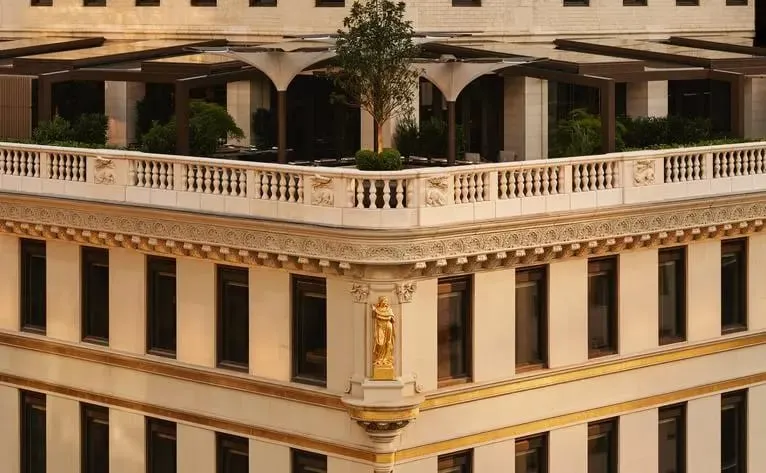
Midtown Manhattan, New York City, United States
Aman New York
Eighty-three suites folded into a landmarked 1921 Beaux-Arts tower on Fifth Avenue, with a three-floor spa larger than any other Aman on earth.
From $2,300 per night
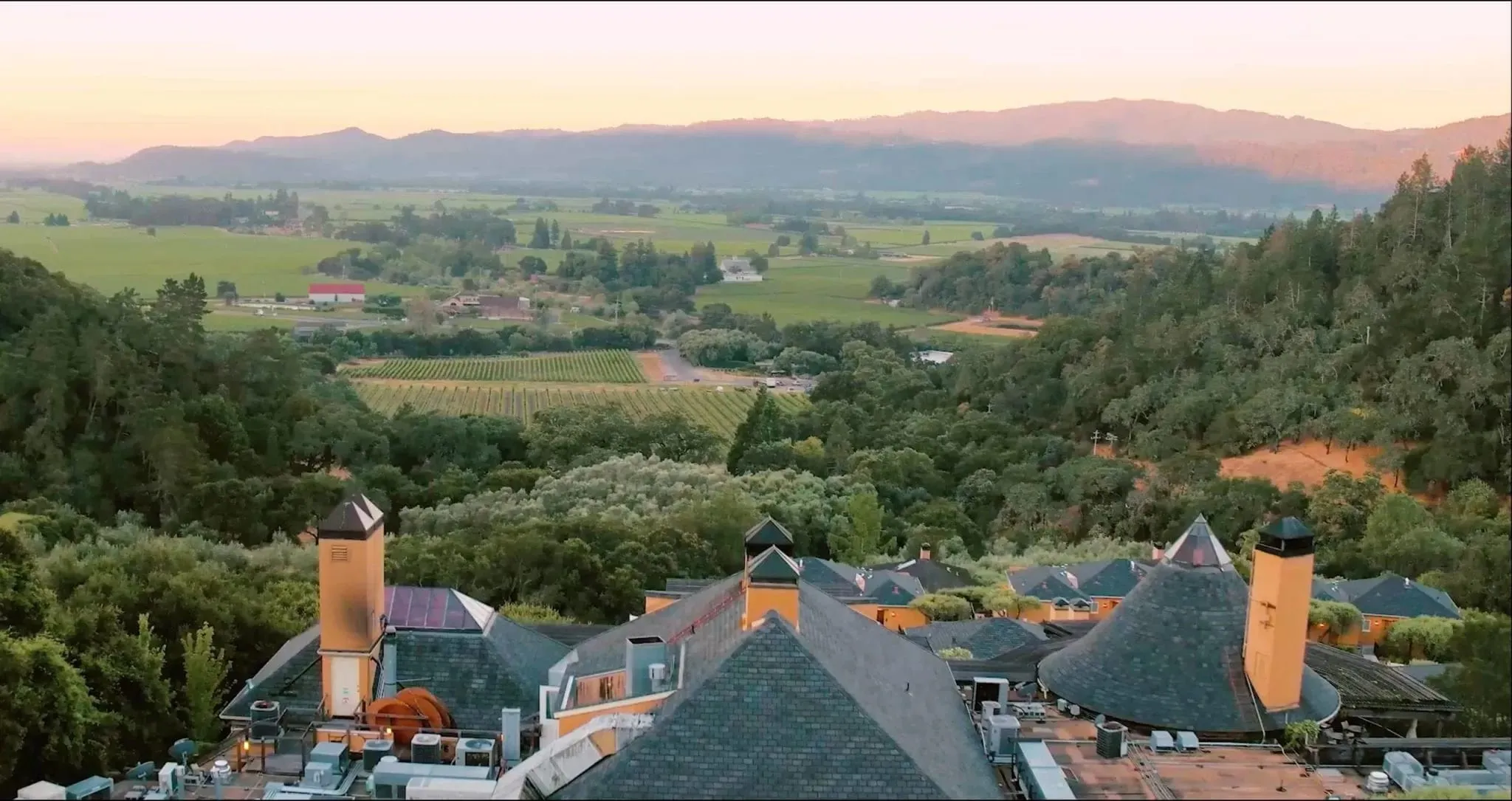
Rutherford, Napa Valley, United States
Auberge du Soleil
The Provence-inspired hillside inn that gave an entire hotel group its name, its philosophy, and one of Napa Valley's longest-running Michelin stars.
From $1,200 per night

Walland, Great Smoky Mountains foothills, United States
Blackberry Farm
A 4,200-acre working farm at the foot of the Great Smoky Mountains where the Beall family built an entire school of American cooking around cheese, garden and pasture.
From $1,145 per night