General Luna, Siargao Island, Philippines
Nay Palad Hideaway
Ten thatched villas between an ancient mangrove forest and the Pacific, rebuilt from a typhoon into Siargao's most deliberate barefoot-luxury address.
- Rates from
- From $2,500 per night
- Nearest airport
- Sayak Airport, Siargao (IAO)
- Transfer
- Approx. 40min by road (roughly 35km) via private jeepney or luxury van, included in the rate
- Best months
- November to May, Siargao's dry season with the calmest seas and the most reliable weather
On the southeastern tip of Siargao Island, where the Pacific-facing sand gives way within a few hundred metres to one of the region’s oldest surviving mangrove forests, ten thatched villas sit spaced far enough apart that a guest can walk from breakfast to the beach without seeing another. Nay Palad Hideaway is small by design, a barefoot-luxury resort built and then rebuilt on the same patch of coastline, and its current form owes as much to a 2021 typhoon as it does to the two architects who shaped it. The result is a property that reads less like a conventional five-star hotel and more like a private compound: no menus, no name tags, and a working relationship with the mangroves, farmers and fishermen next door that goes well beyond the usual resort sustainability page.
The resort’s location, in the barangay of Malinao within General Luna, puts it a short run from Cloud 9, the barrelling reef break that made Siargao a fixture on the international surf calendar, while remaining deliberately apart from the strip of hostels, cafes and surf schools that has grown up around it. That combination, genuine proximity to one of the world’s better-known waves alongside real physical distance from its crowds, is close to the whole thesis of the place: a resort built around Siargao’s raw appeal rather than its increasingly busy tourist centre.
Why It Stands Out
Most resorts describe an origin story in a single sentence. Nay Palad Hideaway’s is more layered, and the layers matter. The site was first developed as Dedon Island Resort, opened in 2012 by Bobby Dekeyser, the German entrepreneur who founded the outdoor furniture brand DEDON, working with the French architect and designer Jean-Marie Massaud and his studio partner Daniel Pouzet. In December 2021, Typhoon Rai, known locally as Odette, tore through Siargao and devastated the property along with much of the island. Rather than simply patch the damage, Dekeyser rebuilt from the ground up with Pouzet returning as architect, and reopened the resort under a new name and a more explicitly local identity: Nay Palad, a Filipino phrase built from the words for “mother” and “palm,” chosen to signal a more nurturing, hands-on style of hospitality than the property’s earlier incarnation.
That history gives Nay Palad Hideaway two things that are hard to manufacture from scratch. The first is design continuity: DEDON’s own outdoor furniture, developed over two decades with input from designers including Massaud, still furnishes much of the property, so the connection between resort and furniture brand runs deeper than a sponsorship arrangement. The second is a rebuild that leaned almost entirely on Filipino labour and materials, which gives the current property a more grounded, locally authored feel than its first version, and underpins a sustainability programme, membership of The Long Run since 2016, that predates the rebuild and has continued through it.
The resort’s scale is the other clear differentiator. Ten villas, split across four categories and capped, at the largest, at nine guests, keeps Nay Palad Hideaway firmly in boutique territory in a country where many beach resorts run to hundreds of rooms. Its all-inclusive, no-menu dining model, where the kitchen cooks to a guest’s stated preferences rather than from a fixed card, is a genuine point of difference in a destination where all-inclusive more often means a buffet line.
Architecture
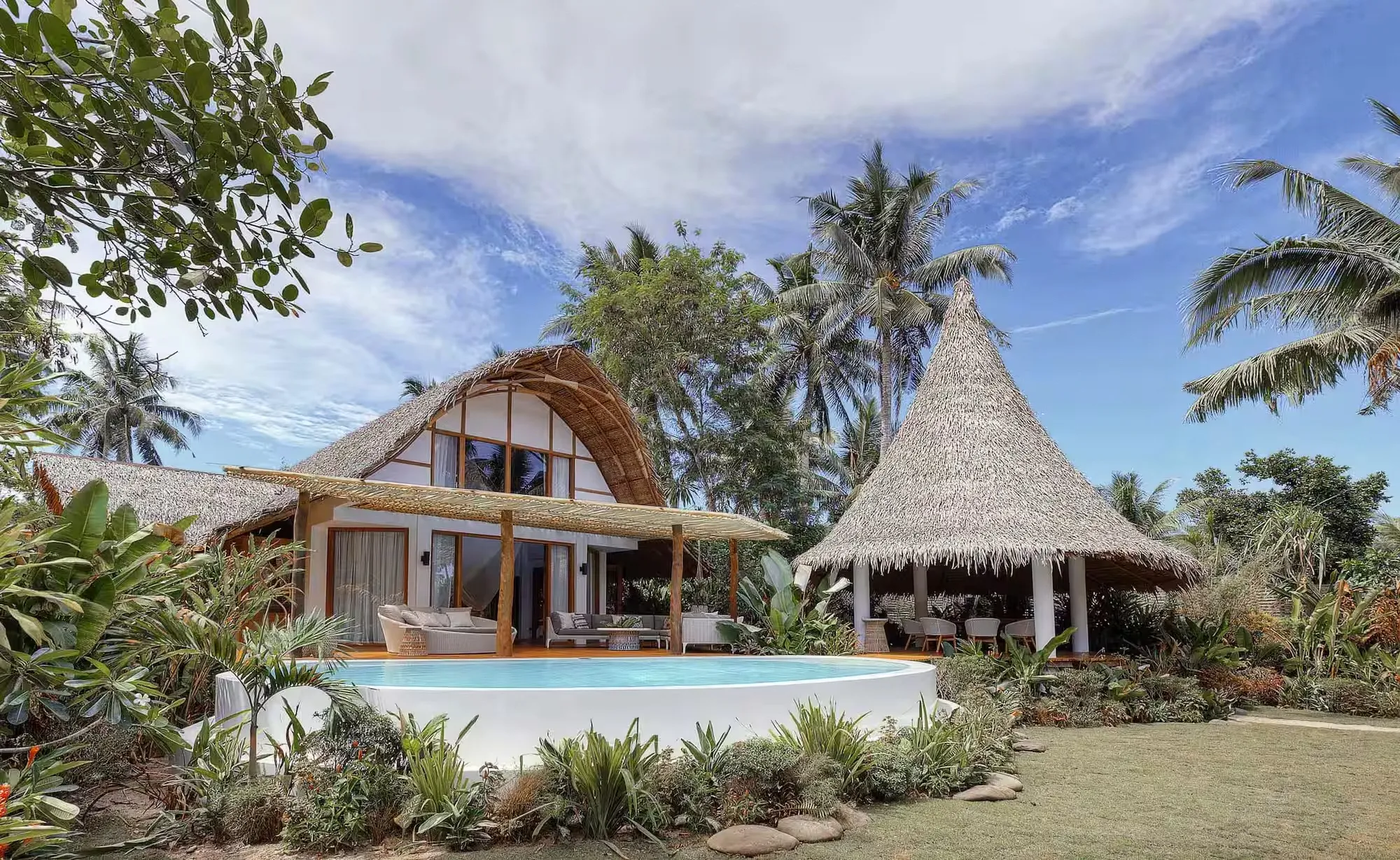
The current buildings were designed by Daniel Pouzet, who returned to lead the post-typhoon rebuild after co-designing the original 2012 resort with Jean-Marie Massaud. The architectural language draws directly on traditional Filipino building methods: steep, high-pitched double roofs thatched in nipa palm over bamboo framing, a construction system chosen both for its visual character and for its practical suitability to a wet, cyclone-prone tropical climate. Villas sit low and are spaced generously through the property’s tree cover rather than clustered into a dense village, an arrangement that prioritises privacy and airflow over density.
Open-air construction runs through the property: living pavilions, dining decks and, in several villa categories, showers are designed as indoor-outdoor spaces rather than fully enclosed rooms, so the sound of the sea or the mangroves is rarely far away. The rebuild used locally sourced materials throughout, worked by Filipino artisans rather than imported wholesale, which grounds the architecture in the island’s own building traditions rather than treating them as decorative reference points.
Interior Design
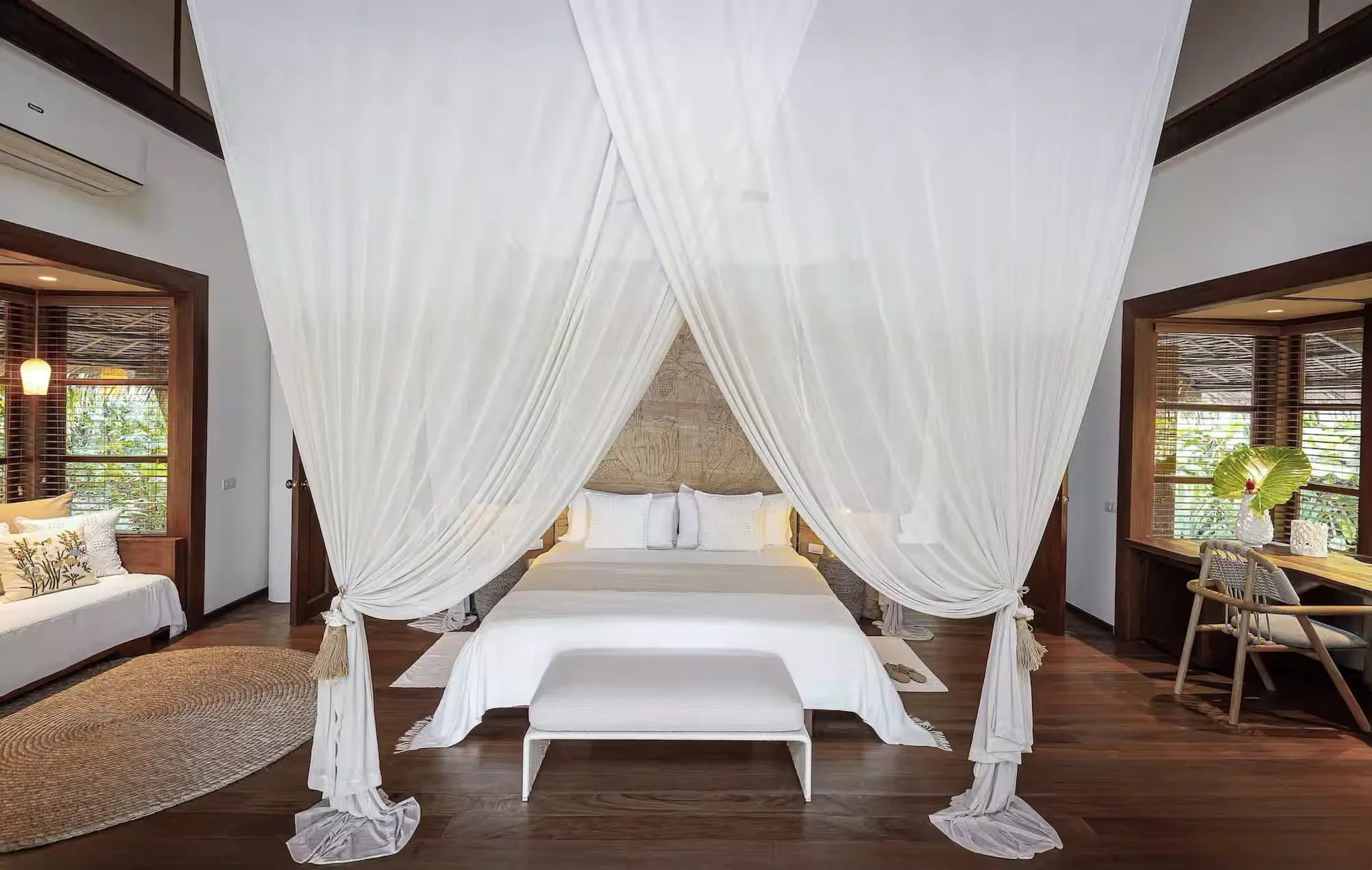
Interiors carry the same material language as the architecture into the furnished spaces: bamboo, rattan and narra wood worked by local craftspeople, alongside woven banana-fibre textiles used in cushions and soft furnishings. DEDON’s outdoor furniture collections, several developed with Massaud’s design studio, appear throughout the villas and common areas, a legacy of the resort’s origin as a project connected to the furniture brand’s own production facilities on the island, which Dekeyser first established in the 1990s.
The overall palette stays close to natural tones, timber, woven fibre, stone, with colour introduced sparingly through textiles and the occasional piece of Filipino craft, letting the material honesty of the construction rather than a decorator’s flourish carry the visual identity. Each villa is fitted with practical, unfussy extras, a Nespresso machine, an iPad, sound system, organic bathroom products, a safe and mosquito netting, that keep the interiors comfortable without pulling the eye away from the setting outside.
Atmosphere
Nay Palad Hideaway trades conventional five-star polish for something more textured and slower-paced. There is no formal lobby to check in through, no fixed restaurant seating, and the resort’s own language for its approach, “barefoot luxury,” is a fair description of how a stay actually unfolds: guests move between the beach, the mangrove edge, the pool and the spa village on their own schedule, with staff working around that rhythm rather than imposing one.
The setting itself does much of the atmospheric work. On one side, open Pacific swell and a private beach; on the other, a 104-hectare stretch of centuries-old mangrove forest, home to trees recorded at more than 350 years old, that borders the property rather than sitting somewhere off in the distance. That juxtaposition, ocean energy on one flank and still, green water on the other, gives Nay Palad Hideaway a more varied sense of place than a typical single-aspect beach resort, and it is close enough to Cloud 9 for a surf culture to run through the property without letting that culture dominate the whole experience.
Rooms and Suites
Accommodation runs across four categories, ten villas in total, each built with the same thatched, open-air architectural language but scaled differently for the number of guests.
Garden View Villas and Ocean View Villas, four of each, form the entry point to the collection. Both are two-level, roughly 100 to 105 square metres, with a ground-floor master bedroom and a second bedroom upstairs, sleeping up to six guests. Garden View Villas sit within the property’s planted grounds; Ocean View Villas face the Pacific directly, with an outdoor shower and a generous deck built for watching the swell. Both categories share a consistent set of in-villa extras: essential-oil diffusers, homemade dried fruit, a Nespresso machine, an iPad, a sound system, organic bathroom products, wireless internet, a safe, mosquito netting and natural insect repellent.
The Coral Villa is the resort’s mid-tier private retreat, a roughly 135-square-metre villa with two master bedrooms and a mezzanine sleeping area for children, sleeping up to seven guests, set within its own garden with a private pool, two outdoor lounge terraces and a home cinema, a configuration built for a family or small group who want a self-contained compound rather than a room.
At the top of the collection sits the Perlah Villa, the resort’s flagship, a roughly 270-square-metre estate with two master bedrooms, two further double bedrooms and three bathrooms, sleeping up to nine guests. It is bordered by water ponds and glass walls, with its own private pool, a raised tree platform, a fireplace, direct private beach access and both indoor and outdoor dining pavilions, effectively a stand-alone villa compound for a family or group that wants to book the whole resort’s most private corner without leaving its grounds.
Dining
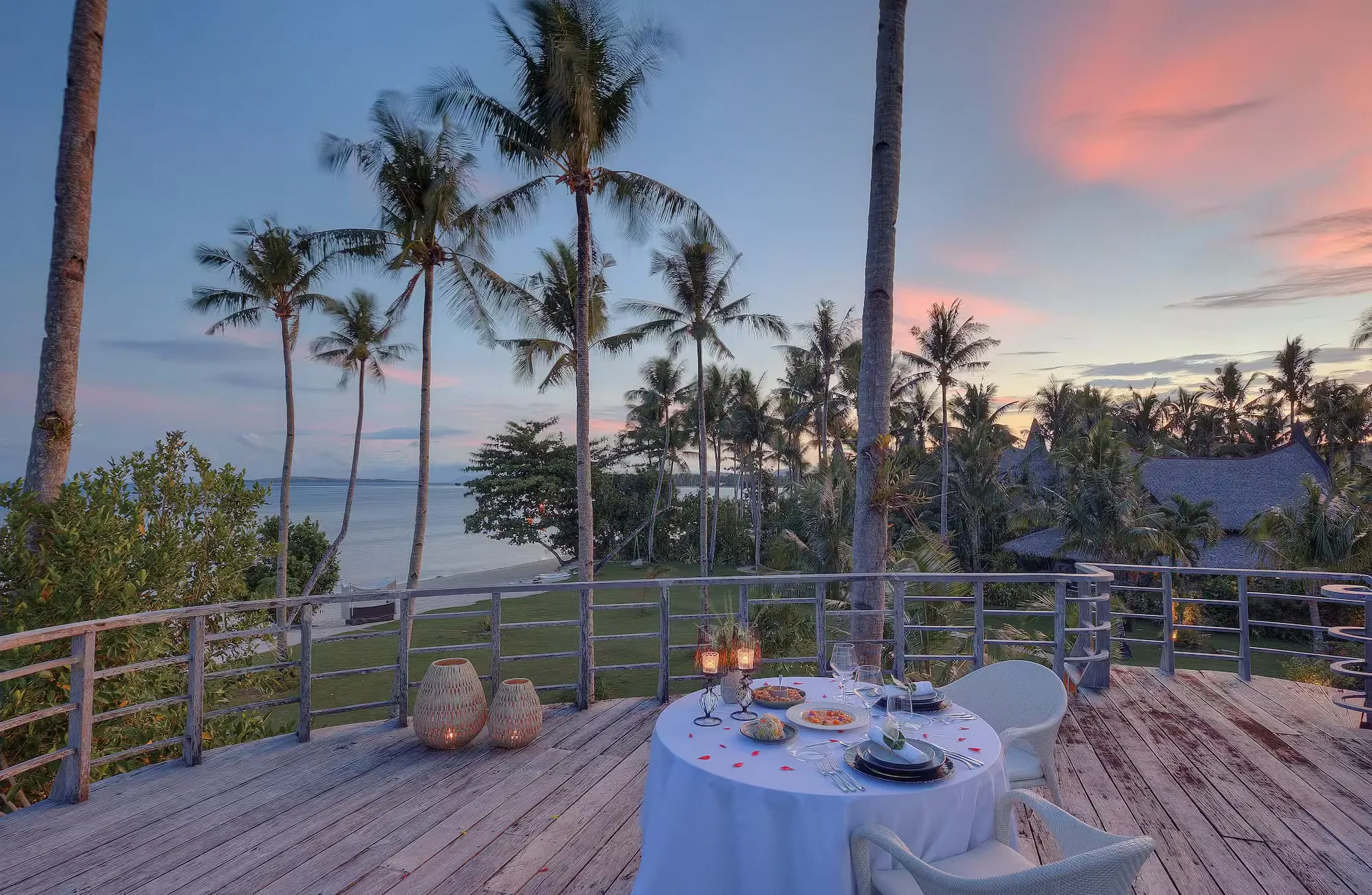
Nay Palad Hideaway runs on a no-menu, all-inclusive dining model: rather than choosing from a fixed card, guests tell the kitchen their preferences and the day’s catch or garden harvest fills in the rest. Meals are staged across a rotating set of locations rather than a single dining room, among them the beach, a treehouse, a pool-side hut, lantern-lit garden settings and an open fire pit, with a central bamboo-built bar as the resort’s main gathering point for drinks. Lunch tends toward a relaxed, family-style format; dinner is typically built as a multi-course meal drawing on fresh local catch, herbs and produce grown in the resort’s own organic garden, prepared with input from Siargao’s fishermen, foragers and farmers.
The all-inclusive rate covers a selection of cocktails, spirits, beer and wine alongside the meals themselves, and guests can book a cooking class to work alongside the kitchen team rather than simply be served. As with any small, single-kitchen resort, the exact chef and specific dish list vary over time and are best confirmed directly with the resort ahead of a stay rather than assumed from published material.
Spa and Wellness
Wellness at Nay Palad Hideaway is organised as a spa village rather than a single treatment building: a scatter of thatch-roofed huts set among the trees, connected by raised walkways, each treatment room built as its own small structure rather than a corridor of doors. The signature offering is Hilot, a traditional Filipino healing massage with roots that predate the resort by centuries, delivered here with homemade organic oils blended from locally sourced ingredients. Romantic bath rituals, using sampaguita essential oil and coconut milk, or an Epsom salt alternative, are offered for couples, alongside body scrubs and more conventional massage and treatment options.
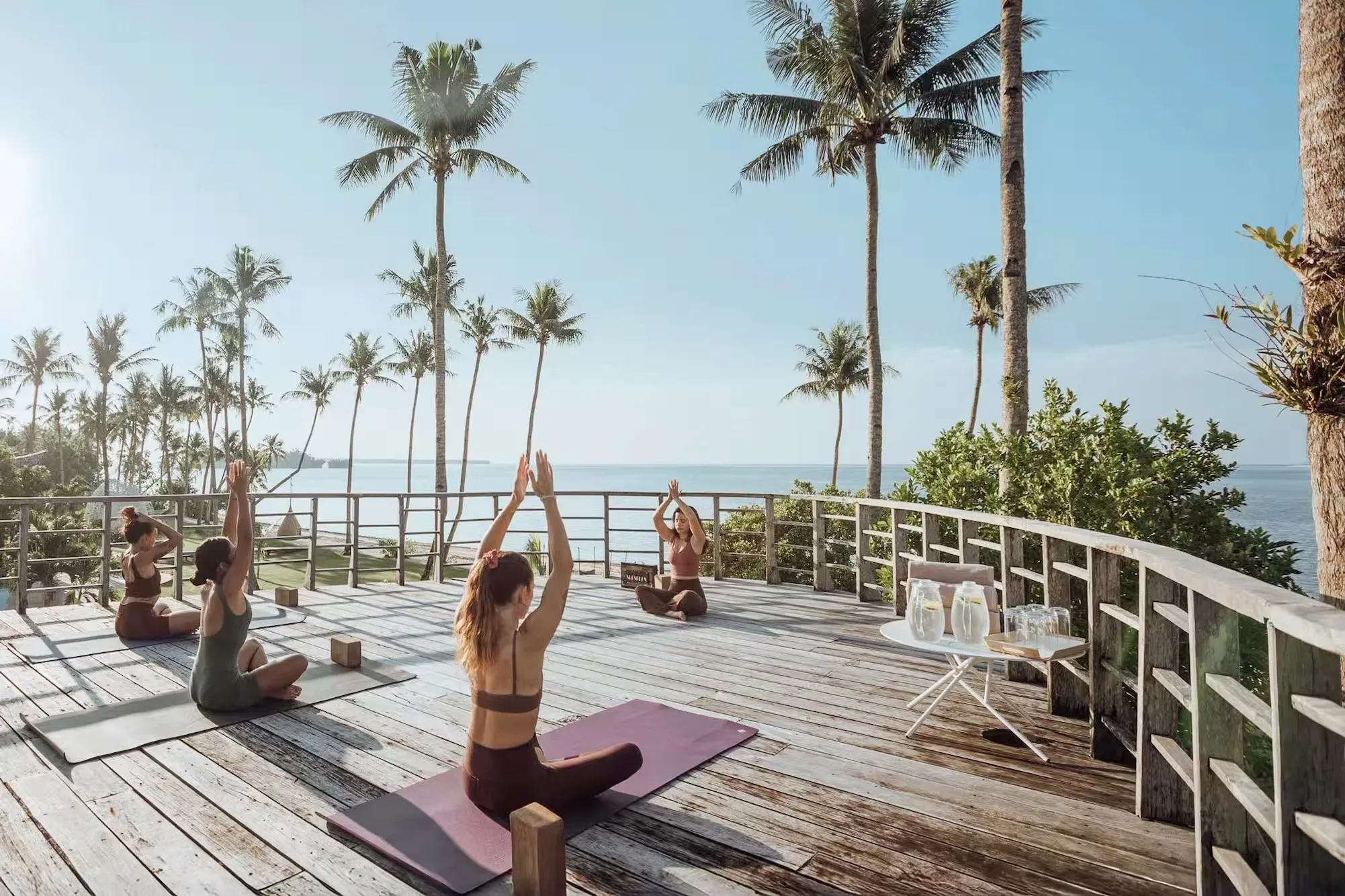
A dedicated yoga pavilion, raised roughly four metres into the tree canopy with views out to the sea, anchors the daily yoga programme, though sessions rotate through several settings depending on the day, among them a sea-facing pagoda, an ocean pagoda, a treehouse platform, stand-up paddleboards floating in the pool, and the mangrove forest itself. A ground-floor fitness studio beneath the yoga pavilion carries a small but functional equipment set, a treadmill, a cross-trainer, a multi-station gym system, dumbbells and an exercise ball, with beach views built in rather than an enclosed gym box. Meditation sessions and custom yoga retreats can be arranged for guests who want a more structured wellness stay.
Experiences
Surfing is the experience most closely associated with this stretch of Siargao, and Nay Palad Hideaway has built a genuine, structured programme around it rather than simply pointing guests toward Cloud 9. An in-house team working with Tropicsurf runs a tiered coaching system, supported by a digital progress app, and the resort keeps its own boats on hand to reach breaks along an undeveloped stretch of coastline that includes more than twenty local spots and, across the wider region, closer to a hundred, ranging from mellow longboard-friendly waves to serious reef breaks for advanced surfers. Cloud 9 itself, a short boat or road trip north, remains reachable for guests who want to surf it, while the resort’s own position several kilometres south keeps day-to-day life away from the crowds that gather around the break’s main viewing tower.
Beyond surfing, the resort runs a full slate of water-based activity: kayaking through the adjoining mangrove forest, snorkelling and diving trips, stand-up paddleboarding, and island-hopping excursions with picnic lunches packed for the day. On land, guided jeepney tours cover Siargao’s inland attractions, including cave systems and natural rock pools, and a dedicated Children’s Village gives younger guests their own space, with trampolines, a treehouse, swings and slides, along with simpler diversions like table tennis and table football for the wider group.
Who It Is For
Nay Palad Hideaway suits travellers who want genuine remoteness paired with a high level of service, and who are comfortable with an itinerary built loosely around the tide, the surf report and the kitchen’s mood rather than a fixed daily schedule. Surfers, in particular intermediate to advanced surfers who want structured access to a serious wave without staying in the middle of General Luna’s busiest strip, are well served by the Tropicsurf programme and the resort’s deliberate distance from Cloud 9’s crowds. Couples and honeymooners will find the smaller villa categories, the spa village and the flexible, request-based dining model naturally suited to a quieter, more private stay.
Families and multi-generational groups have real options here too, particularly in the Coral and Perlah villas, both built as self-contained compounds with enough separate sleeping space and shared living area to keep several generations comfortable under one roof, backed by the Children’s Village for younger guests. It is a less obvious fit for travellers who want the reassurance of a large resort’s amenity list, multiple restaurants, an extensive kids’ club, an all-day buffet, since Nay Palad Hideaway’s whole premise rests on scale being small and service being personal rather than programmatic.
Best Time to Visit
Siargao’s dry season, running roughly from November through May, brings the calmest seas, the most reliable sun and the easiest conditions for the resort’s water-based activities, and it is correspondingly the property’s busiest and most expensive stretch of the year. The intervening months, June through October, coincide with the Philippines’ wider southwest monsoon season and carry a higher chance of rain and rougher seas, with typhoon risk at its most pronounced from around July through October, the same window that produced the storm that forced the resort’s 2021 rebuild. Surf conditions do not map neatly onto this dry-season logic; some of Siargao’s more consistent swell arrives outside the calmest months, so surf-focused travellers may want to weigh wave conditions against weather risk when picking dates, ideally in consultation with the resort’s own team.
How to Get There
Access begins at Sayak Airport (IAO) on Siargao, served by short domestic flights from Manila, Cebu and Clark on carriers including Philippine Airlines, Cebu Pacific and Sunlight Air. From the airport, the resort arranges a road transfer of around 40 minutes, covering roughly 35 kilometres, typically by private jeepney, the distinctive Filipino jeep-minibus hybrid customised for the resort, or by a more conventional luxury van. This transfer is included in the room rate and arranged directly by the resort’s guest experience team, who coordinate arrival timing in advance. For guests who prefer to bypass the domestic flight connection, private charter plane, helicopter and seaplane transfers can also be arranged from Cebu or Manila, at additional cost and subject to availability.
Nearby Experiences
Siargao’s main draw beyond the resort’s own grounds is its surf coast, and Cloud 9, a short trip north of the property, remains the island’s best-known break and a worthwhile visit even for non-surfers curious to see the wave and its boardwalk viewing tower. General Luna itself offers a more developed stretch of restaurants, bars and shops for guests who want a change of scene from the resort’s self-contained rhythm, while the wider island holds a string of natural attractions reachable on a day trip: lagoons and rock pools, island-hopping routes through the Sugba and Naked Island group further north, and cave systems inland. The mangrove forest bordering Nay Palad Hideaway is itself a destination rather than simply a backdrop, with guided kayaking trips through its channels forming one of the resort’s more distinctive included excursions.
Things to Know Before Booking
This is a genuinely remote, small-scale resort, and its all-inclusive structure covers the essentials, meals, a selection of drinks, most non-motorised watersports, daily yoga, a cooking class, laundry and the airport transfer, but certain experiences, among them some diving trips, spa treatments, private boat charters and premium wine, are typically quoted separately, and it is worth confirming current inclusions directly with the resort at the time of booking, since packages and policies can shift between seasons. The property’s paths and grounds are naturally landscaped rather than paved throughout, a detail worth factoring in for guests travelling with very young children or limited mobility. Because the resort sits an hour or more from Siargao’s airport by design, a stay here works best built around several unhurried nights rather than a quick overnight stop, and the surf and weather conditions worth planning around, described above, are worth weighing against specific travel dates before booking.
Sustainability
Nay Palad Hideaway’s sustainability commitments predate its 2021 rebuild and have continued through it: the resort has been a member of The Long Run, a global alliance of nature-based tourism businesses, since May 2016, and holds the alliance’s GSTC-accredited Global Ecosphere Retreat certification, built around a four-part framework the organisation calls Conservation, Community, Culture and Commerce.
On the conservation side, the resort manages stewardship responsibilities across the adjoining 104-hectare mangrove forest, home to fourteen recorded species and trees documented at more than 350 years old, and runs a coral nursery and reef restoration initiative that engages guests directly, including activities that build fish-dome structures to create habitat and coral-attachment substrate in damaged reef areas. An onsite organic farm supplies part of the kitchen’s produce, using vermicomposting, seaweed-based fertiliser and bokashi fermentation to turn food waste back into usable compost rather than sending it off-site.
On the community side, the resort partners with the local Malinao Elementary School on infrastructure, gardens and nutrition support, has assisted local fishermen with boat rebuilding following typhoon damage, and supports the Compostela Rehousing Project in Cebu, run through the Dekeyser & Friends Foundation, which works with families transitioning out of informal settlement housing near a landfill site toward more stable livelihoods in farming, animal husbandry, crafts and small enterprise. Culturally, the resort leans on local artisans for its banana-fibre textiles, hand-carved furniture and nipa-thatched roofing, and stocks handcrafted goods from the Compostela project in its guest shop. As with most single-resort sustainability programmes, a fully independent, resort-wide audit of energy use, waste management and supply-chain footprint is not publicly available, so this account describes only the specific, documented initiatives above rather than extending them into a broader claim about the property’s total environmental performance.
Practical Information
Nightly rates at Nay Palad Hideaway run from around USD 2,500 for the entry-level villa categories, rising into the higher thousands for the multi-bedroom Coral and Perlah villas, particularly during the November-to-May high season; rates are all-inclusive of meals and a selection of drinks, as described above, and current pricing and inclusions are best confirmed directly with the resort given the seasonal variation typical of a property this size. Check-in is from 2:00pm and check-out by 11:00am, with both times treated with some flexibility subject to availability, arranged in advance with the guest experience team. The nearest airport is Sayak Airport (IAO) on Siargao, roughly 40 minutes from the resort by an included road transfer. Most stays run four to five nights, enough time to work through the surf programme or spa village, spend a proper day exploring the mangroves, and still have room for an excursion out to Cloud 9 or the wider island.
Editorial Conclusion
Nay Palad Hideaway’s rebuild gives it a rarer credential than most resort backstories offer: proof that its stated commitment to place, to local materials, local labour and a genuine conservation programme, held up under the pressure of having to start over. What emerged from that process is a small, unhurried property that leans into Siargao’s two defining natural features, a serious surf coast and an old-growth mangrove forest, without asking guests to choose between them, and that treats its sustainability programme as a decade-old, ongoing commitment rather than a line added to a rebuild press release. For travellers who want a Philippine beach stay with real scale to its remoteness, and who are happy to let a kitchen, a tide chart and a spa schedule set the pace rather than a fixed itinerary, it is one of the more considered addresses on this particular stretch of coastline.
In pictures
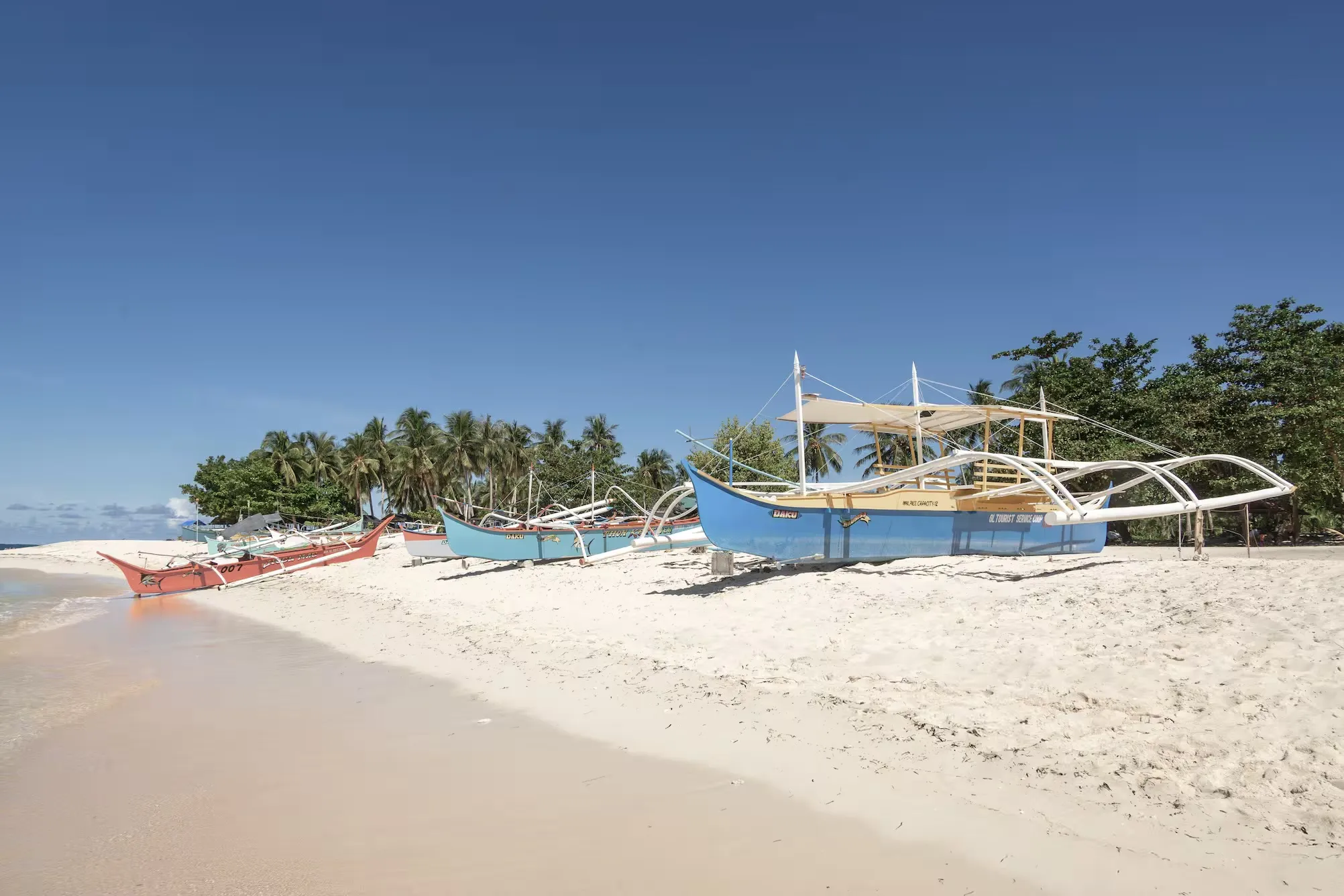
On the map
General Luna, Siargao Island, Philippines
Questions
Frequently asked
Where exactly is Nay Palad Hideaway, and how do you get there?
Nay Palad Hideaway sits in Malinao, General Luna, on the southeastern tip of Siargao Island in Surigao del Norte, Philippines, between a private stretch of Pacific-facing beach and an ancient mangrove forest. Guests fly into Sayak Airport (IAO) on Siargao, reached via short domestic connections from Manila, Cebu or Clark, then complete a roughly 40-minute road transfer by private jeepney or luxury van, arranged and included by the resort. Private charter plane, helicopter and seaplane transfers can also be arranged for guests who prefer to skip the domestic connection.
How many villas does Nay Palad Hideaway have, and what categories are there?
The resort has ten villas across four categories. Garden View and Ocean View Villas (four of each) are two-level, one-bedroom units sleeping up to six guests. The one-off Coral Villa sleeps up to seven with two master bedrooms, a private pool and a home cinema, and the one-off Perlah Villa is the flagship, a roughly 270-square-metre, four-bedroom compound with its own pool, dining pavilion and direct beach access, sleeping up to nine.
Is Nay Palad Hideaway close to Cloud 9, and is it a good fit for non-surfers?
The resort sits several kilometres south of Cloud 9, Siargao's famous barrelling reef break, close enough for an easy speedboat or road trip out to it but far enough to sit apart from the crowds around General Luna's main surf strip. An in-house surf programme, run with Tropicsurf, gives guests structured access to Cloud 9 and more than twenty other local breaks for a range of ability levels. Non-surfers are well served too: the all-inclusive stay covers mangrove kayaking, snorkelling, diving, paddleboarding, a spa village and daily yoga, so a stay does not depend on wanting to surf.
What is included in an all-inclusive stay at Nay Palad Hideaway?
Rates are built on a no-menu, all-inclusive format covering all meals, a selection of cocktails, spirits, beer and wine, most non-motorised watersports, yoga classes, a cooking class, laundry and the airport transfer. Specialist experiences such as certain diving trips, spa treatments, private charters and premium wine selections are generally quoted separately; the resort confirms current inclusions at the time of booking.
What is Nay Palad Hideaway's sustainability programme?
The resort has been a member of The Long Run, a global alliance of nature-based tourism businesses built around a Conservation, Community, Culture and Commerce framework, since May 2016, and holds Long Run's GSTC-accredited Global Ecosphere Retreat certification. Its programme includes stewardship of an adjoining 104-hectare mangrove forest, an onsite organic farm using vermicomposting and other waste-to-compost methods, a coral nursery and reef restoration initiative, and support for a Cebu-based livelihoods project for families transitioning out of informal settlement housing, run through the Dekeyser & Friends Foundation.
Same destination
More hotel guides in Philippines
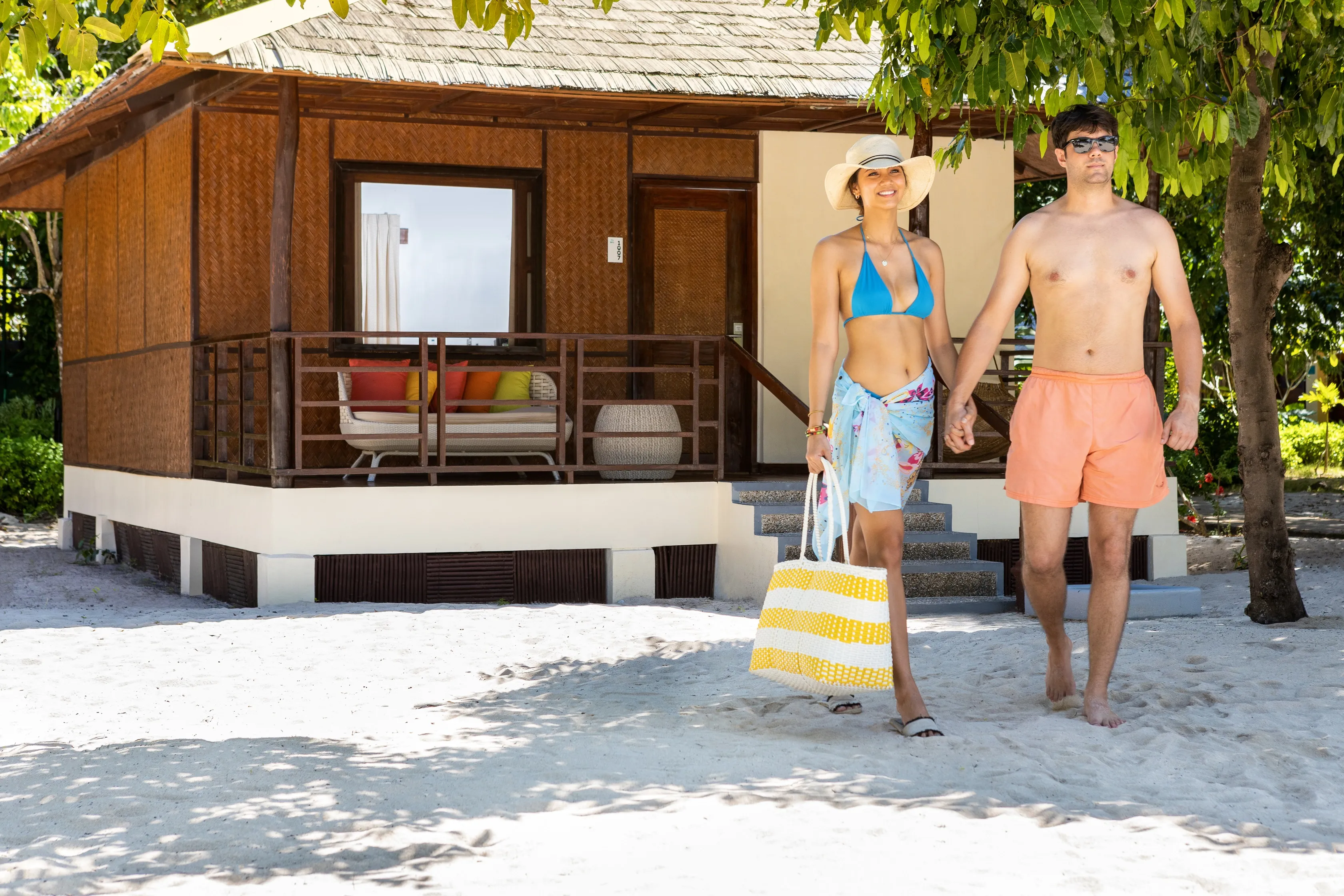
Dimakya Island, Busuanga, Coron, Philippines
Discovery Coron
A nineteen-hectare private island off northern Busuanga, diving Coron's Japanese wrecks by day and disconnecting from everything else after dark.
From $260 per night
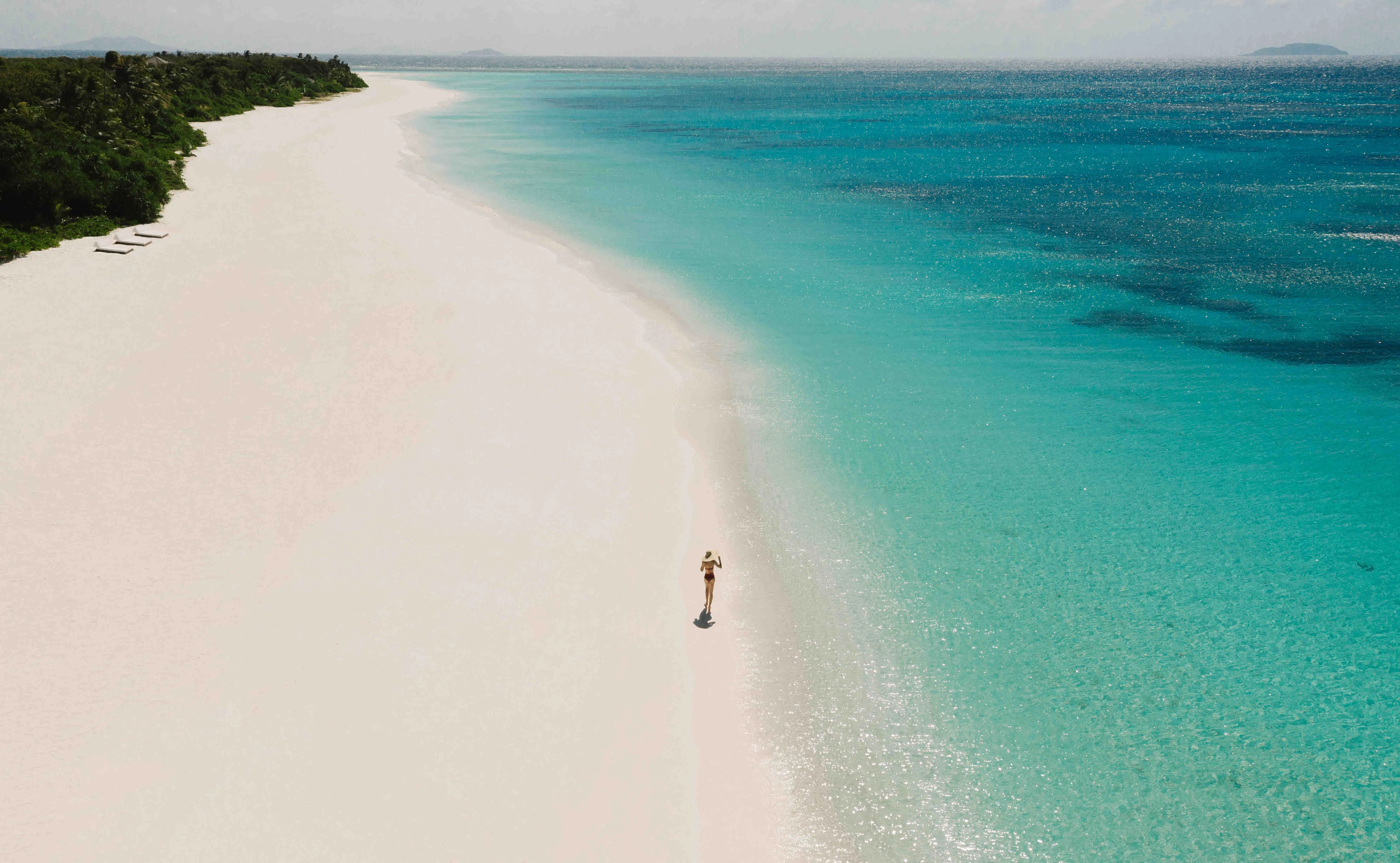
Pamalican Island, Cuyo Islands, Philippines
Amanpulo
A private island in the Cuyo archipelago, reachable only by Aman's own aircraft, built around bahay kubo-inspired casitas set beneath forty-year-old coconut palms.
From $1,900 per night
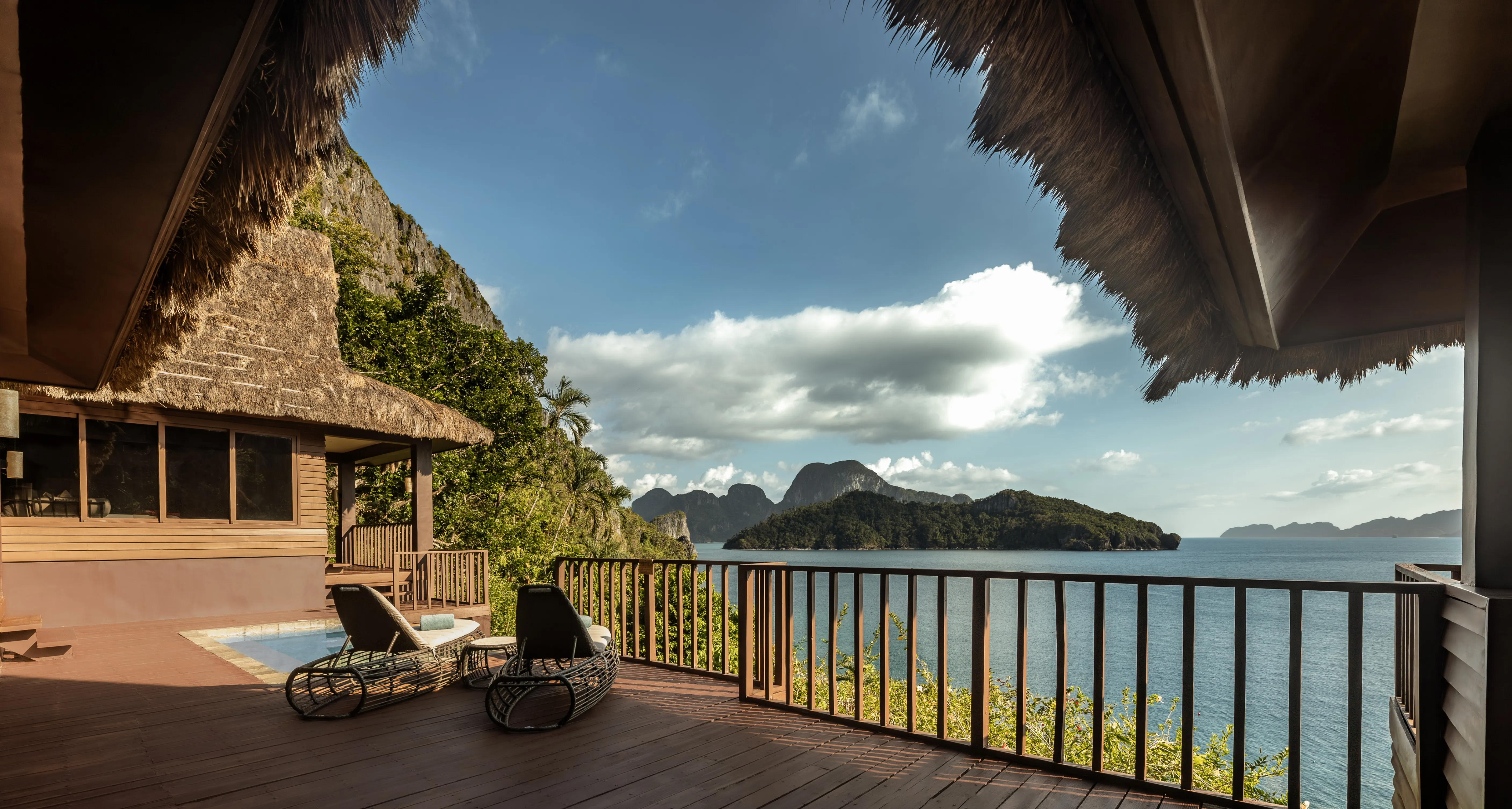
Cauayan Island, Bacuit Bay, El Nido, Philippines
Cauayan Island Resort
A privately owned island in Bacuit Bay, thirty stilt-raised villas set between limestone cliffs and open water, reachable only by boat.
From $500 per night