Fari Islands, Maldives
The Ritz-Carlton Maldives, Fari Islands
A resort built almost entirely from circles, the last major commission of architect Kerry Hill, where geometry does the work most Maldives properties leave to thatch and timber.
- Rates from
- From $2,500 per night
- Nearest airport
- Velana International Airport, Male (MLE)
- Transfer
- About 45 minutes by speedboat, roughly 42km from the airport
- Best months
- November to April, the Maldives' dry season with the calmest seas and most reliable sun
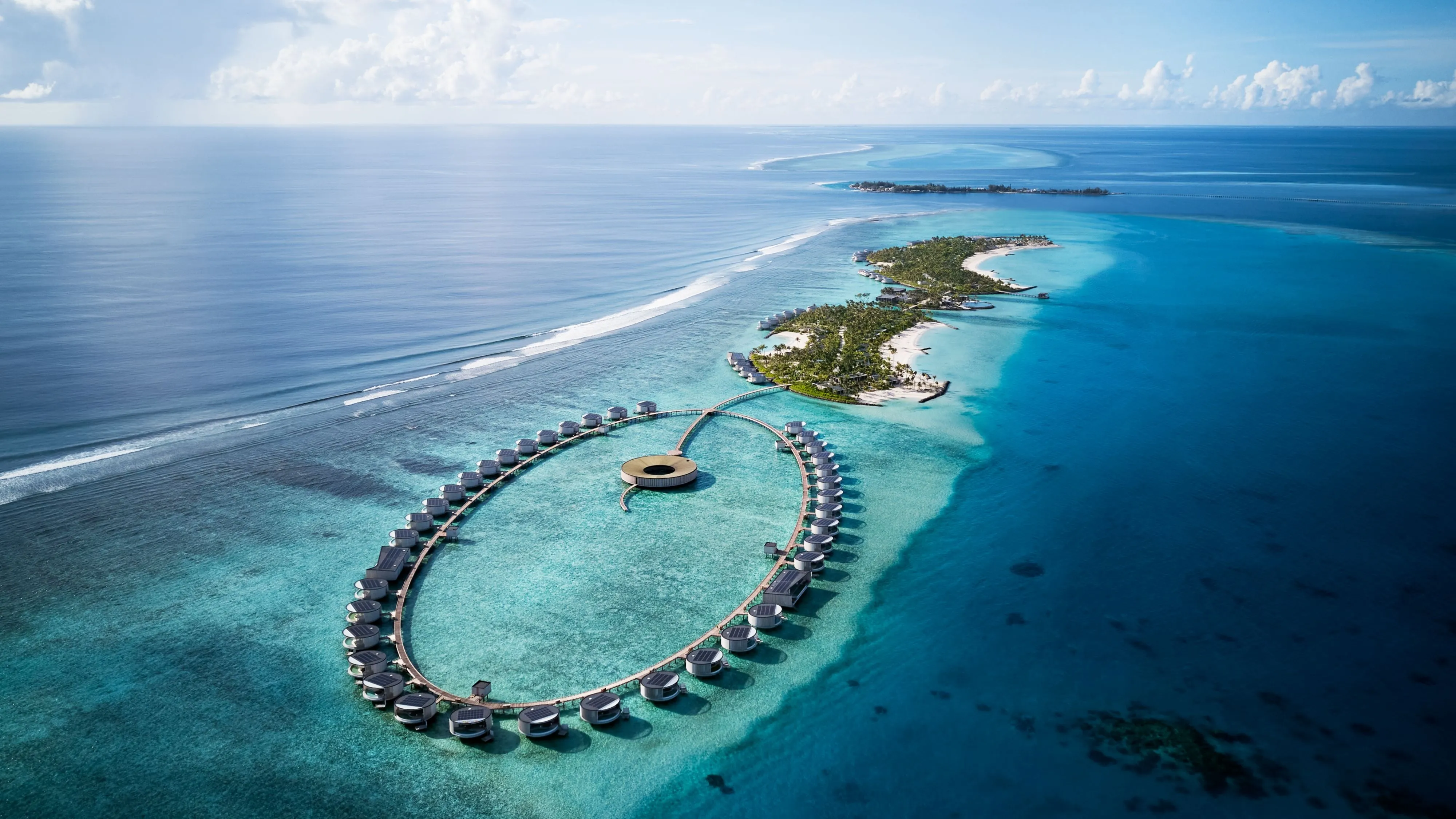
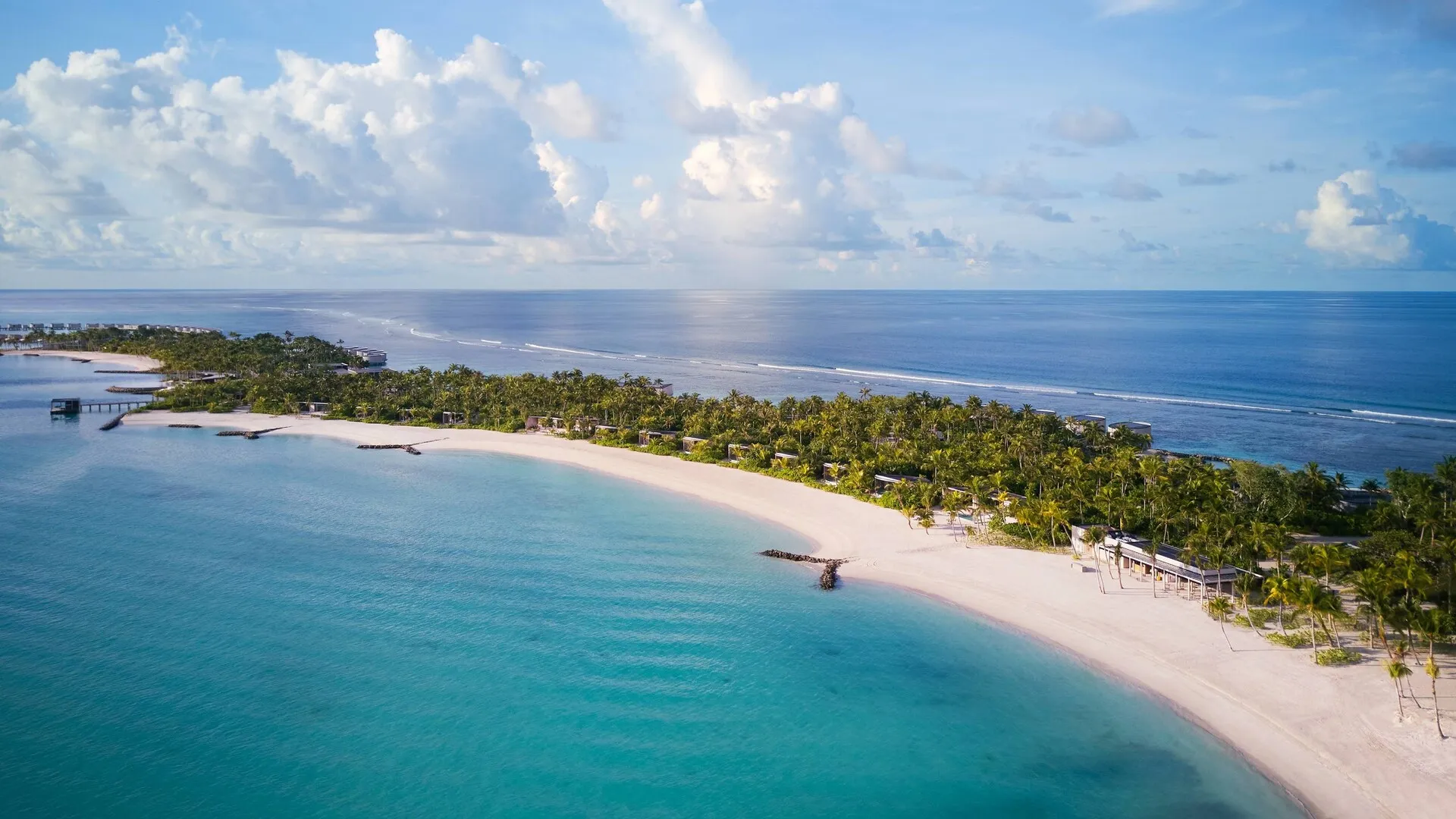
There is a specific kind of Maldives resort that photographs beautifully because it disappears: thatched roofs, timber walkways, a design vocabulary borrowed so faithfully from the traditional Maldivian bodu vaaru fishing village that the architecture reads as background to the water. The Ritz-Carlton Maldives, Fari Islands does the opposite. Its villas are round. Its spa is a ring floating over the lagoon. Its kids’ club is a sphere. Seen from the air, the whole island reads less like a village than a diagram, a set of circles and arcs laid across turquoise water with almost mathematical intent. That is not an accident of branding; it is the final built statement of one of Asia’s most influential resort architects, and it turns a stay here into something closer to walking through a piece of considered, site-specific design than checking into a hotel.
The resort opened in June 2021 as one of three ultra-luxury properties on Fari Islands, a man-made cluster in North Male Atoll developed by Singapore’s Pontiac Land Group. Where its neighbours, Capella Maldives and Patina Maldives, pursue their own distinct architectural ideas, The Ritz-Carlton’s island belongs entirely to Kerry Hill Architects, the practice founded by the late Kerry Hill, an Australian architect whose four-decade career reshaped resort design across Southeast Asia. This was among the firm’s last major commissions before his death in 2018, completed by his studio in the years that followed, and it shows a level of formal discipline that few large resorts attempt, let alone sustain across 100 individual villas.
Why It Stands Out
Most Maldives resorts sell isolation and let the architecture recede into it. This one sells the architecture itself as a reason to come. The circular language, drawn from the shape of the lagoon, the swirl of trade winds and the traditional Maldivian boduberu drum, repeats at every scale, from the curved decks of individual villas to the ring-shaped spa to the resort’s own circular main pool set on black rock above the ocean, and the consistency is the point: nothing here reads as an afterthought or a generic add-on.
The second thing that sets it apart is proximity without the usual Maldives trade-off. Fari Islands sits close enough to Velana International Airport that the transfer is a 45-minute speedboat run rather than the half-day seaplane journeys that define many far-atoll resorts, so a stay here front-loads far less travel fatigue than its price point might suggest. And because it shares its development with Capella and Patina, plus the shared Fari Marina Village, guests get a version of inter-island variety, more restaurants, more bars, a proper retail strip, that a single stand-alone resort island cannot offer on its own.
Architecture
Kerry Hill Architects built its reputation on a particular kind of restraint: strong, simple forms, deep verandas, a close reading of climate and site, and a refusal to over-decorate. At Fari Islands, given a blank sandbank and a brief to design an entire resort island from first principles, the practice pushed that restraint toward pure geometry. The masterplan is organised around circles and arcs rather than the grid or cluster layouts typical of the genre: villas curve around the island’s perimeter and out over the lagoon on their own circular decks, the central spa forms a complete ring with overwater villas radiating from it, and even the children’s club takes the shape of a sphere. The inspiration, per the practice’s own design brief, drew on the circular form of the surrounding lagoon itself, the swirling patterns of the trade winds that shape the atoll’s weather, and the cyclical rhythm of island life, with a nod to the traditional Maldivian hand drum, the boduberu, as a recurring motif.
What makes the architecture more than a formal exercise is how it was built. Rather than construct on-site in the conventional way, which in a fragile reef environment risks significant ecological disruption, Kerry Hill Architects worked with prefabricated cross-laminated timber and modular construction methods, fabricating major building components off-site and assembling them on the island with a far lighter construction footprint than a conventional poured-concrete build would require. The firm has described the approach as aiming for zero waste and pollution during construction, with full traceability through the timber supply chain, an unusual level of rigour for a resort of this scale and one that ties the building method directly to the same sustainability ambitions that run through the resort’s operations.
Passive design carries much of the climate load. Deep overhangs, cross-ventilation and carefully considered glazing are used to reduce reliance on air conditioning, while the timber-slatted screening that wraps many of the villa exteriors filters direct sun without blocking the sea breeze, a detail drawn from the same climate-responsive thinking that defined Kerry Hill’s earlier resort work across Southeast Asia. The result is architecture that photographs as sculptural and reads, on the ground, as genuinely suited to its site rather than merely striking from a drone.
Interior Design
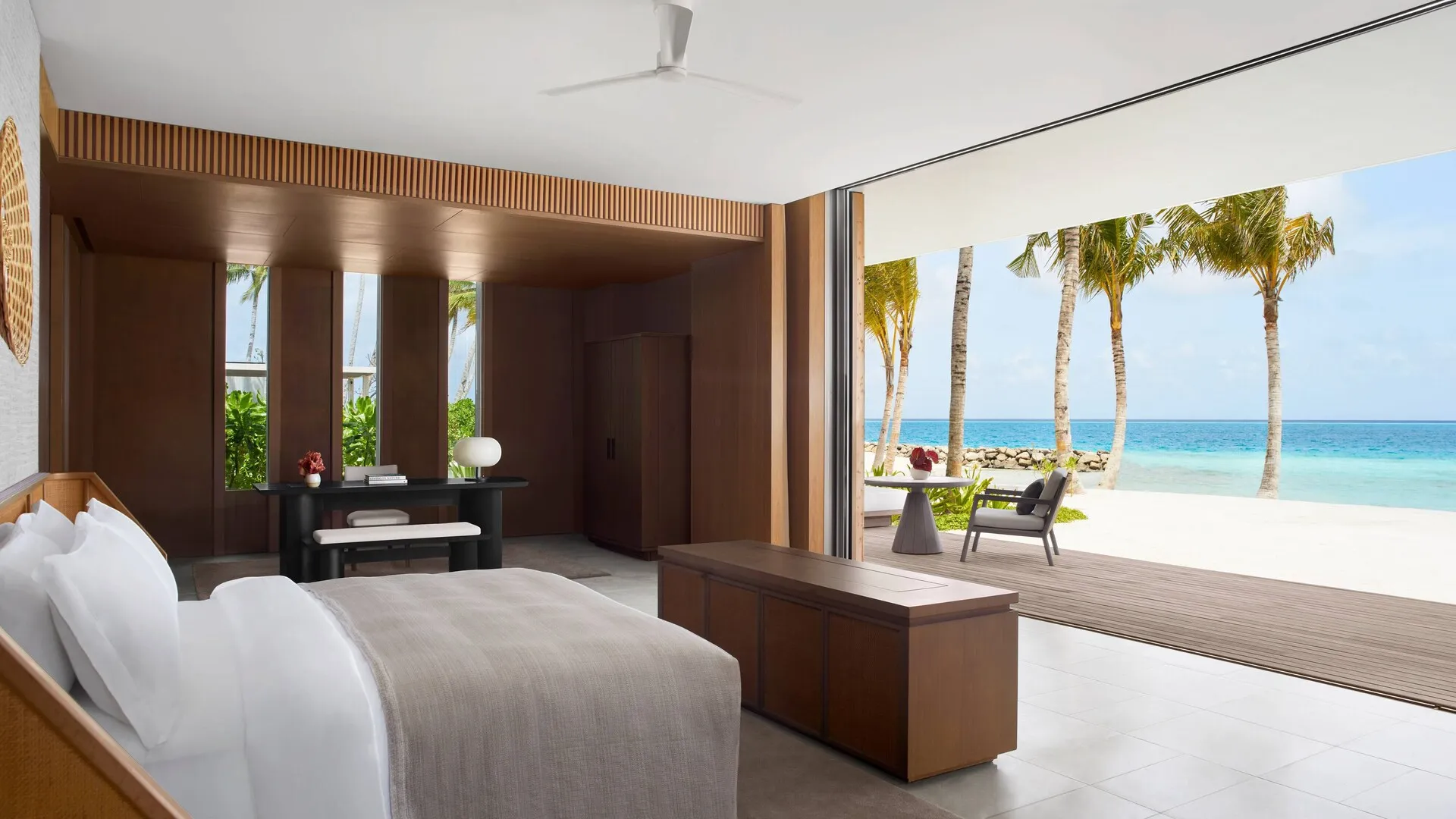
Inside the villas, the material palette stays disciplined and close to nature: pale timber walls and ceilings, stone flooring, and a restrained, earthy colour range designed to sit quietly against the turquoise of the lagoon rather than compete with it. Furniture, rugs and textiles throughout the resort were custom designed by Kerry Hill Architects rather than sourced from a standard hospitality catalogue, developed in collaboration with Maldivian and international artisans and craftspeople, which gives the interiors a specificity that resorts working from off-the-shelf furnishing packages generally lack.
The effect is closer to a well-edited private house than a hotel room: minimal ornament, generous use of natural light through the curved glazing, and a consistent material logic that carries from the entry hall through to the bathroom, where stone and timber recur rather than giving way to marble and gilt. It is a deliberately quiet interior register, one that lets the view, the private pool and the sound of water do more of the emotional work than pattern or colour would in a more maximalist Maldives property. Public spaces, including the spa and the restaurants, extend the same vocabulary at a larger scale, with curved timber ceilings and open-air structures that keep the boundary between inside and outside as thin as the climate allows.
Atmosphere
The overall mood is closer to a design retreat than a conventional beach-resort holiday, without losing the loose, barefoot informality the Maldives is known for. Days move between a villa’s private pool, one of the shared pools, the reef immediately offshore and the spa, with the island’s compact scale, three linked circular land masses plus the overwater villa ring, keeping most of the resort within a short walk or a quick buggy ride of any given point. Evenings lean into the architecture directly: the resort runs a daily sunset ceremony with traditional Bodu Beru drumming and a flaming ritual marking the transition from afternoon to evening, staged in a way that treats the setting sun as scheduled entertainment rather than an incidental backdrop.
Because Fari Islands shares its marina village with Capella and Patina, the atmosphere also has a social layer that solo-island Maldives resorts cannot replicate: guests can walk or take a short boat ride to Fari Marina Village for its shops, restaurants and art installations without leaving the wider development, giving an evening out a genuine change of scene that would otherwise require a full inter-resort speedboat transfer.
Rooms and Suites
The resort has 100 villas across five broad categories, all built to the same core standard: a private infinity pool, a furnished sundeck, round-the-clock service from a dedicated island butler known here as an Aris Meeha, high-speed Wi-Fi and feather beds dressed in high-thread-count linens. What differs between categories is position, size and privacy rather than the basic amenity set.
The Ocean Pool Villa and its one-bedroom counterpart sit out over the lagoon on the resort’s signature circular overwater decks, offering direct water access, uninterrupted horizon views and the sound of the sea beneath the floor, a configuration that remains the entry point into the overwater collection. On land, the Sunset Beach Pool Villa faces the resort’s western shoreline, positioned to catch the evening light directly, while the Two-Bedroom Beach Pool Villa extends that footprint for families or two couples travelling together, offering a choice of ocean or lagoon-facing orientation alongside its own private pool.
At the top of the range, The Ritz-Carlton Estate is a four-bedroom property tucked into its own secluded beach cove, with two private pools, a dedicated stretch of beach, a full kitchen and expansive indoor and outdoor living and dining space, built as a self-contained residence for a large family or group rather than a conventional hotel suite. Across every category, the round floor plans and curved sliding glass mean bedrooms and living areas open onto outdoor space from multiple angles rather than a single fixed balcony, a direct benefit of the architecture’s circular logic playing out at the scale of daily life.
Dining
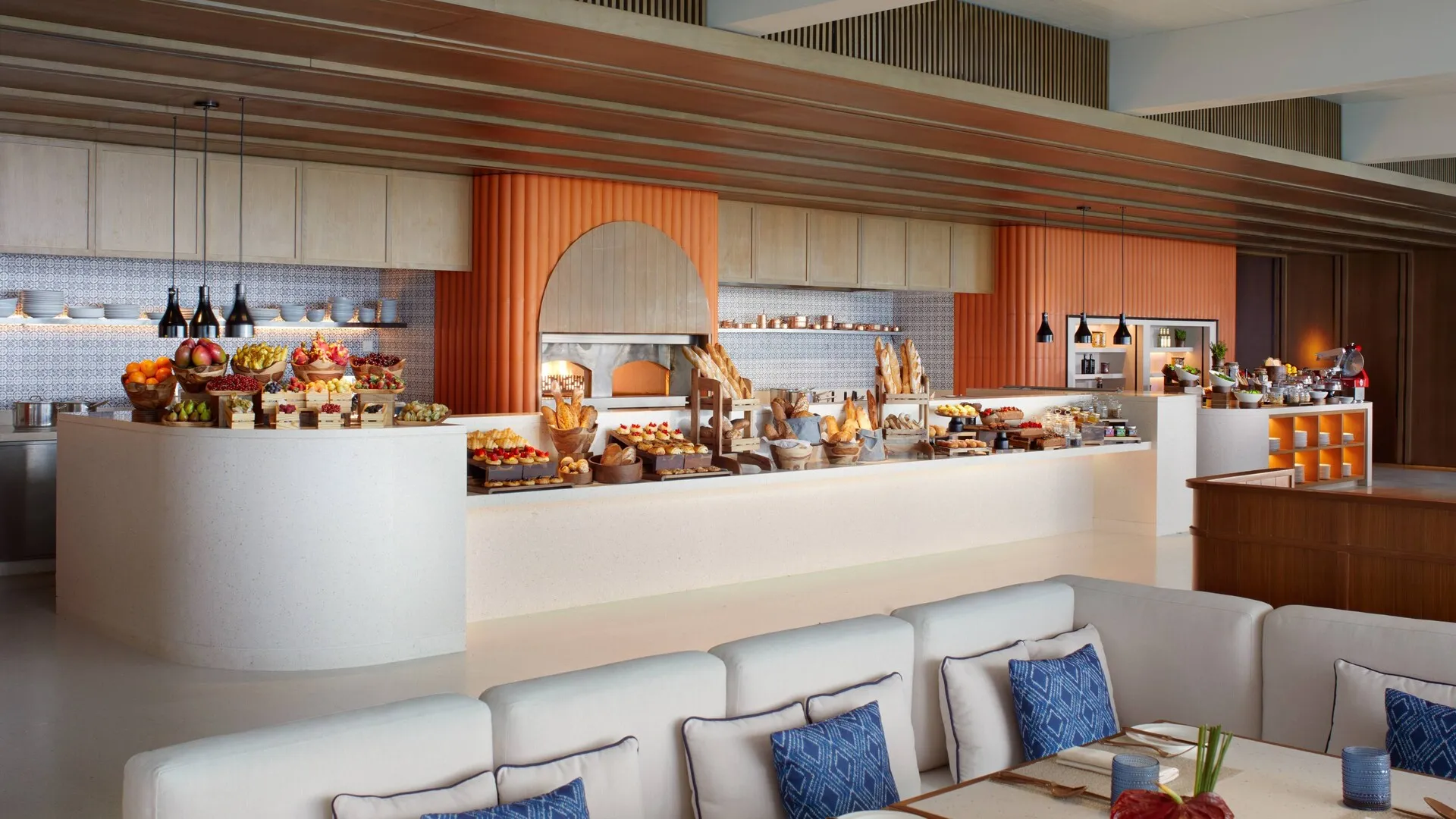
Food at the resort is spread across seven distinct restaurants and bars, deliberately varied in cuisine rather than built around a single signature chef’s table. La Locanda serves Southern Italian cooking, Summer Pavilion is dedicated to Cantonese cuisine, and IWAU offers Japanese food built around chef’s-table seating for a more theatrical, close-up dining format. EAU Bar runs a cocktail programme with Japanese-inspired touches, Beach Shack keeps things casual and family-friendly with Mediterranean dishes suited to a swimsuit-and-sarong lunch, and Arabesque brings Levantine mezze and North Indian kebabs to the table. Tum Tum, the resort’s Asian street food venue, sits apart from the main island in Fari Marina Village, giving guests a reason to make the short trip over.
Beyond the fixed venues, the resort’s private dining programme uses four separate outdoor settings, including a garden staged beneath a thirty-metre banyan tree, a private sandbank, a secluded beach cove and Grand Sunset Beach, drawing menus from the main kitchens plus barbecue and Maldivian-specific options, with Cinema Under the Stars available as an add-on for an evening screening beside the water. Guided Maldivian cooking and mixology classes run alongside the restaurant programme, and the resort has developed a collaboration with a local chef, Chef Aminath, around handcrafted Maldivian treats, tying the dining programme back to the destination rather than treating it purely as an international hotel kitchen.
Spa and Wellness
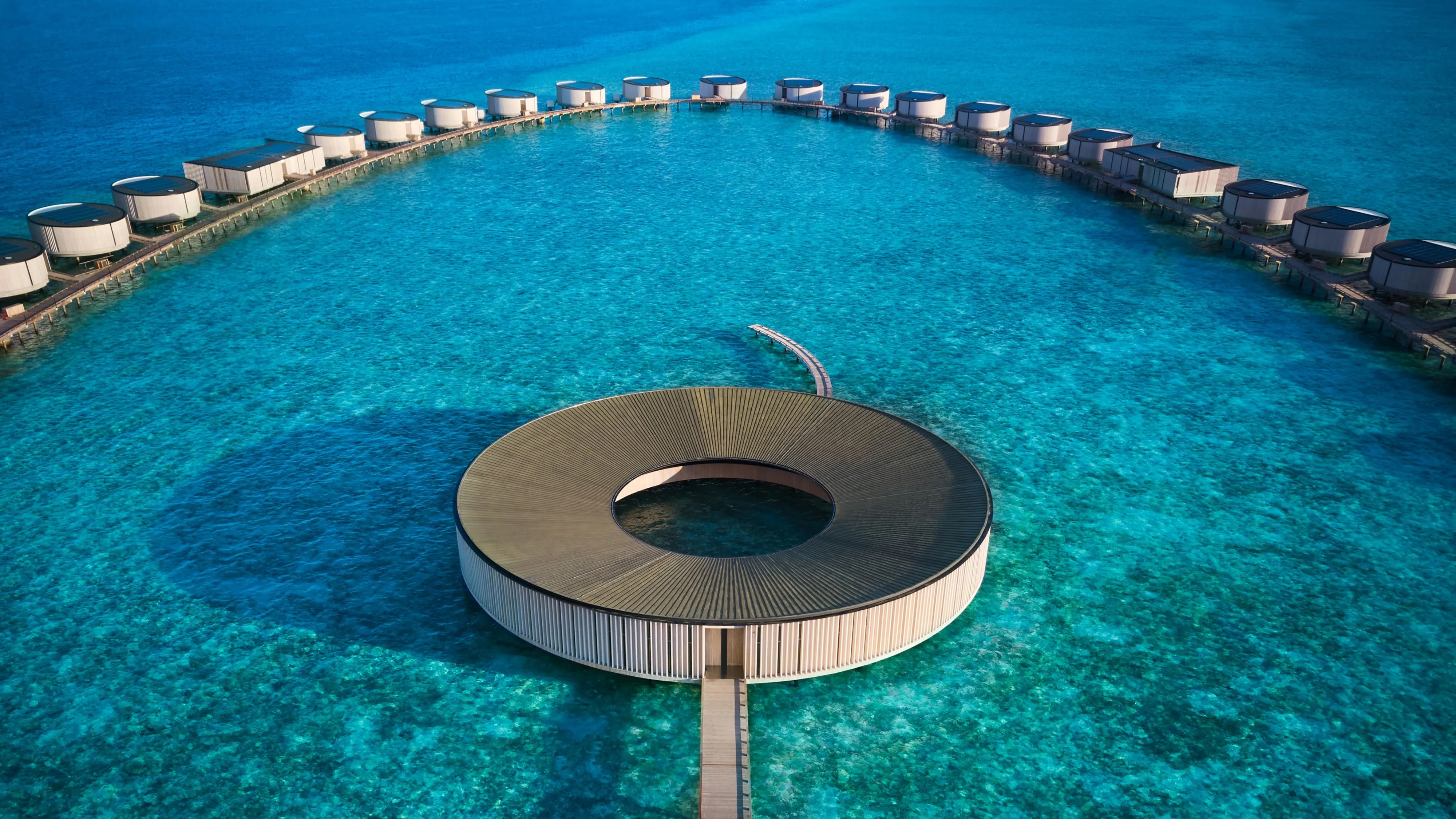
The Ritz-Carlton Spa occupies its own ring-shaped overwater structure, one of Kerry Hill Architects’ most photographed pieces of design on the island, with nine treatment rooms, a dedicated spa suite for couples or longer rituals, a salon and a boutique. Treatments are built around Bamford, the British organic skincare and wellness brand known for its plant-based formulations, giving the spa a specific product identity rather than a generic in-house treatment menu. The circular plan means most treatment rooms open onto their own water views, continuing the architectural logic that defines the rest of the resort into its most restorative spaces.
Fitness facilities include a 24-hour gym with cardiovascular equipment, free weights and strength machines, and the wellness programme extends outdoors with sunrise and aerial yoga sessions run against the lagoon. The resort’s main and family pools add a further, more social layer of water-based downtime alongside the spa itself, and the calm, current-free lagoon that wraps the island functions as an easy extension of the wellness offering for guests who prefer a swim to a scheduled class.
Experiences
Water is the organising activity here, unsurprisingly given the setting. The resort runs diving and snorkelling excursions out to the surrounding reefs, including a guided “Cities Under the Sea” programme that pairs snorkelling with a marine biologist for a more informed look at the atoll’s ecosystem, alongside kayaking, stand-up paddleboarding, windsurfing, waterskiing, surfing, fishing trips, private boat charters and dolphin-watching cruises. On land, the resort maintains a tennis academy with professional coaching for various skill levels, plus volleyball, badminton and pétanque for guests wanting a lower-key way to fill an afternoon.
Families are directed toward the Ritz Kids Club, the resort’s spherical building given over to children aged four to twelve, structured around four pillars, land, water, environmental responsibility and culture, with its own pool complete with slides and jets, playgrounds, napping pods and an indoors area for games and films; babysitting can be arranged separately for younger children or evenings out. On the conservation side, the resort runs a drone-based rescue initiative that monitors the surrounding waters for turtles entangled in abandoned fishing gear, with four documented rescues logged since the resort’s 2021 opening, a concrete example of the environmental programme extending beyond signage and into active fieldwork guests can hear about directly from the team running it.
Who It Is For
This is a strong fit for travellers who care about architecture and design as much as they care about the beach itself: the consistency of Kerry Hill Architects’ circular language, carried through from villa to spa to kids’ club, rewards attention in a way that a more conventional thatch-and-timber resort does not ask for. Honeymooners and couples are well served by the privacy of the individual villa pools and the spa’s overwater ring, while the close-in North Male Atoll location, with its short 45-minute speedboat transfer, suits shorter stays or first-time Maldives visitors who want the destination’s signature overwater-villa experience without a half-day seaplane journey on either end of the trip.
Families travelling with children have real infrastructure here, from the Two-Bedroom Beach Pool Villa and four-bedroom Estate down to the dedicated Kids Club and family-friendly Beach Shack restaurant, and the shared Fari Islands development adds a variety of restaurants and a marina village that a single stand-alone resort island cannot offer. It is less suited to travellers seeking total seclusion on an otherwise empty island; because Fari Islands hosts three resorts and a marina village on one compact development, the sense of having an island entirely to oneself, which some competing Maldives properties trade on directly, is not really what this resort is selling.
Best Time to Visit
The Maldives runs on a two-season monsoon calendar, and the dry, north-east monsoon from November through April brings the calmest seas, the most consistent sunshine and the best underwater visibility for diving and snorkelling around Fari Islands’ house reef, making it the most reliable window for a first visit. The wetter south-west monsoon, running roughly May through October, brings more frequent afternoon showers and a livelier sea state, though rain in this climate tends to arrive in short, heavy bursts rather than settling in for entire days, and the shoulder months can bring lower rates alongside still-good conditions for guests willing to build some flexibility into a beach-and-pool-focused itinerary.
How to Get There
Almost all international arrivals land at Velana International Airport (MLE), on the edge of Male, the Maldivian capital. From there, the standard route to the resort is a speedboat transfer of about 45 minutes, covering roughly 42km of open water to Fari Islands in North Male Atoll. The resort runs this transfer on an on-demand, 24-hour basis rather than a fixed timetable, which means it can be coordinated around most flight arrival times without the multi-hour waits that seaplane-dependent resorts in farther atolls sometimes require. The comparative closeness of North Male Atoll to the airport is one of the resort’s clearer practical advantages over more remote Maldives properties, cutting a transfer that can otherwise consume half a travel day down to well under an hour.
Nearby Experiences
The most immediate “nearby” for guests here is the rest of the Fari Islands development itself. Fari Marina Village, the fourth island in the cluster, functions as a shared retail and dining hub for all three resorts, with boutiques, restaurants, including the resort’s own Tum Tum, and public art installations that give the whole development more variety than a typical single-island Maldives resort. Guests can also arrange visits across to Capella Maldives and Patina Maldives, the other two resorts sharing the development, for a change of architectural scenery or a different restaurant, a genuinely unusual option in a country where resort islands are normally strictly private.
Further afield, North Male Atoll offers the excursions typical of the region: reef and channel dive sites within a short boat ride, sandbank picnics on uninhabited islets nearby, and, for those wanting a look at contemporary Maldivian life beyond the resort bubble, day trips into Male itself, the world’s most densely populated capital, a striking contrast to the calm of the atoll’s resort islands.
Things to Know Before Booking
Rates here sit at the upper end of the Maldives market, with entry-level Ocean and Lagoon Pool Villas starting from around USD 2,500 per night and climbing substantially for beach and overwater categories in peak season, before the four-bedroom Estate, which runs into five figures a night. The speedboat transfer is priced separately from the room rate and adds a meaningful cost on top, so it is worth budgeting for as a distinct line item rather than assuming it is bundled in, along with the government tax and service charge applied to all Maldives resort bills.
Because the resort’s architecture leans so heavily on its circular villa decks and overwater walkways, guests who want maximum privacy and minimum walking should pay attention to villa placement relative to the spa, restaurants and jetty when booking, since the ring-shaped masterplan spreads amenities around the island’s perimeter rather than clustering them at its centre. Given the shared Fari Islands development, it is also worth deciding in advance how much cross-resort variety matters for a given trip, since guests who want the sense of a fully private island might find the presence of two neighbouring resorts on the same development less to their taste than those who welcome the extra dining and social options it brings.
Sustainability
Sustainability at the resort begins with how it was built rather than how it operates day to day. Kerry Hill Architects’ use of prefabricated, cross-laminated timber construction, with major elements fabricated off-site and assembled on the island, was chosen specifically to reduce the disruption a conventional build would cause to the surrounding reef and lagoon ecosystem, with the firm citing full traceability through its timber supply chain. Passive cooling strategies, deep overhangs, cross-ventilation and considered glazing, reduce the building’s reliance on air conditioning across the property.
Operationally, the resort holds Green Globe certification, runs a solar energy programme, maintains an on-site water purification plant to reduce dependence on imported bottled water, and has moved amenities toward plastic-free, bamboo-based alternatives. Coral restoration work is underway around the house reef, and the drone-based turtle rescue initiative described above gives the conservation programme a visible, ongoing field component rather than a one-off installation. The kitchens have also worked toward reducing food waste through more deliberate sourcing and portioning, part of a broader effort across Marriott’s Ritz-Carlton portfolio to bring measurable environmental practice into properties built in ecologically sensitive locations like this one.
Practical Information
Check-in is from 3:00pm and check-out by 12:00pm. Rates start from around USD 2,500 per night for the resort’s entry-level pool villa categories, rising significantly for overwater, multi-bedroom and Estate configurations, particularly in the November-to-April high season. The nearest airport is Velana International Airport (MLE), reached from the resort by an on-demand speedboat transfer of about 45 minutes, priced separately from the room rate. Most stays run four to five nights, enough time to move between the villa’s private pool, the spa, the reef and at least one or two of the resort’s seven restaurants without feeling rushed, while still leaving room for a day trip across to the shared Fari Marina Village or one of the neighbouring resort islands.
Editorial Conclusion
The Ritz-Carlton Maldives, Fari Islands is, at heart, an architecture story that happens to also be a very good resort. Kerry Hill Architects took a blank sandbank and a brief that could easily have defaulted to the same thatched-roof formula used across the rest of the Maldives, and instead built one of the destination’s most formally disciplined resorts, a place where the circle, drawn from the lagoon, the wind and a traditional drum, structures everything from a villa’s floor plan to the shape of the spa. For a country built almost entirely on the promise of privacy and water, that is a genuinely distinctive way to make a case for one island over another, and it is worth choosing this one specifically for guests who want their Maldives stay to double as time inside a real, coherent piece of design.
In pictures
On the map
Fari Islands, Maldives
Questions
Frequently asked
Who designed The Ritz-Carlton Maldives, Fari Islands, and is it part of a larger development?
The resort was designed by Kerry Hill Architects, the Singapore-based practice founded by the late Australian architect Kerry Hill, and it was among the firm's final major commissions before his death in 2018. It occupies one of three resort islands on Fari Islands, a purpose-built development by Singapore's Pontiac Land Group in North Male Atoll. The other two islands hold Capella Maldives, designed by Kengo Kuma & Associates with WATG, and Patina Maldives, designed by Studio MK27, with a fourth island, Fari Marina Village, serving all three as a shared dining, retail and staff hub.
How many villas does the resort have, and are they overwater or on the beach?
There are 100 villas in total, split between overwater villas built on stilts over the lagoon and beach villas set along the island's sand. Categories run from the entry-level Ocean Pool Villa and Sunset Beach Pool Villa through One-Bedroom and Two-Bedroom configurations up to The Ritz-Carlton Estate, a four-bedroom property with two private pools and its own kitchen. Every villa, regardless of category, has its own private infinity pool and sundeck.
How do guests get from the airport to the resort?
The resort sits roughly 42km from Velana International Airport (MLE) near Male, and the standard transfer is a speedboat journey of about 45 minutes, run on an on-demand, 24-hour basis so it can be timed to most flight arrivals rather than a fixed schedule. This is faster and simpler than the seaplane transfers used by many far-flung Maldives resorts, one advantage of the Fari Islands' relatively close-in North Male Atoll location.
What is the food like, and how many restaurants are there?
The resort runs seven restaurants and bars covering Southern Italian at La Locanda, Cantonese at Summer Pavilion, Japanese cuisine and chef's tables at IWAU, a Japanese-inflected cocktail programme at EAU Bar, Mediterranean food at the family-oriented Beach Shack, Levantine and North Indian dishes at Arabesque, and Asian street food at Tum Tum in Fari Marina Village. Beyond the fixed venues, the resort also sets up private dining at four outdoor locations, including a Banyan tree garden, a sandbank and a beach cove.
Is the resort suitable for families with children?
Yes. The Ritz Kids Club, itself one of the resort's circular buildings, takes children aged four to twelve through a programme built around land, water, environmental responsibility and culture, with its own pool, playgrounds and indoor games areas, and babysitting can be arranged separately for younger children. The Beach Shack restaurant and several of the villa categories, including the two-bedroom villas and the four-bedroom Estate, are built with family groups specifically in mind.
Same destination
More hotel guides in Maldives
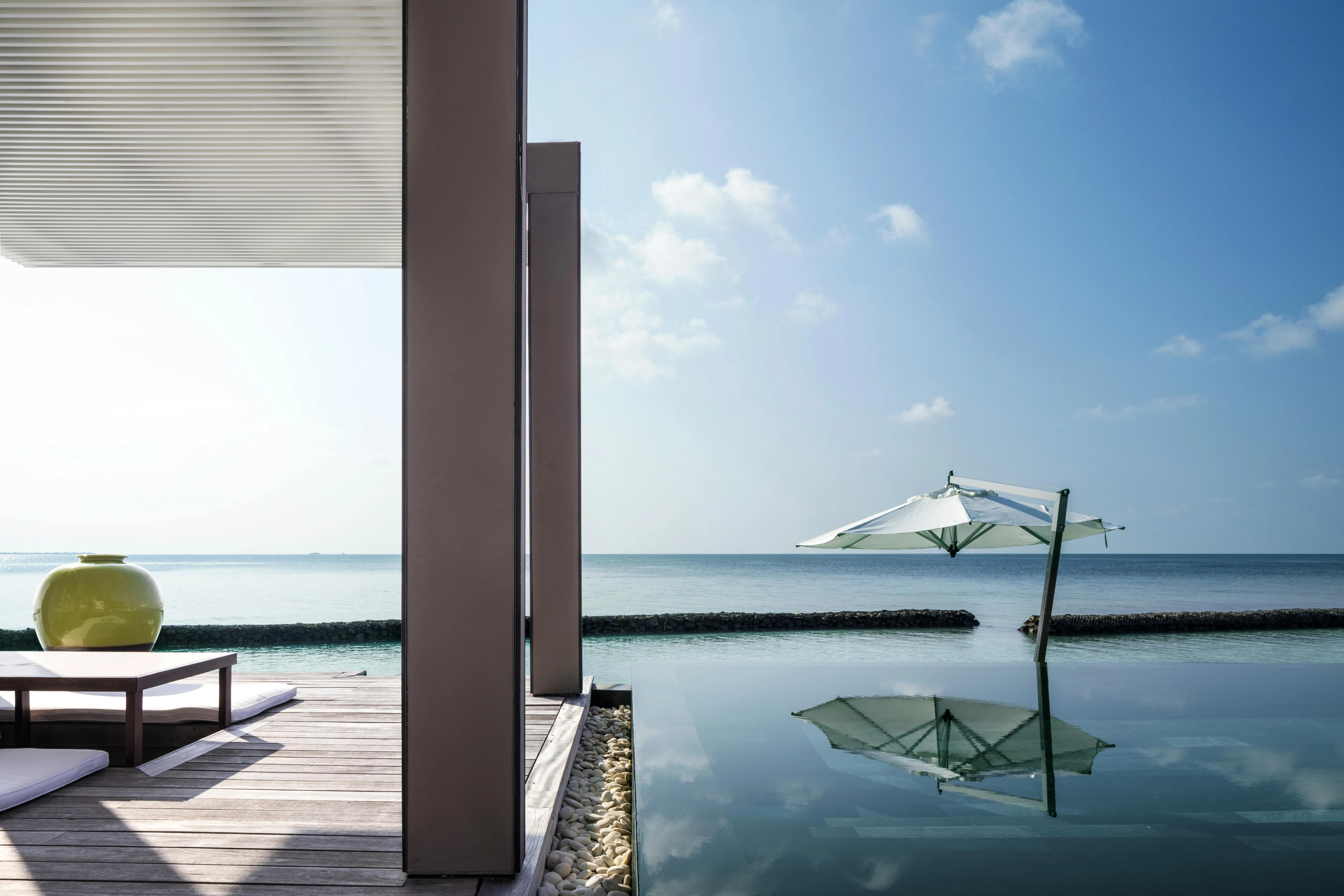
Randheli Island, Maldives
Cheval Blanc Randheli
Jean-Michel Gathy's private-island debut for LVMH's hotel house, forty minutes by seaplane into the Noonu Atoll.
From $2,200 per night
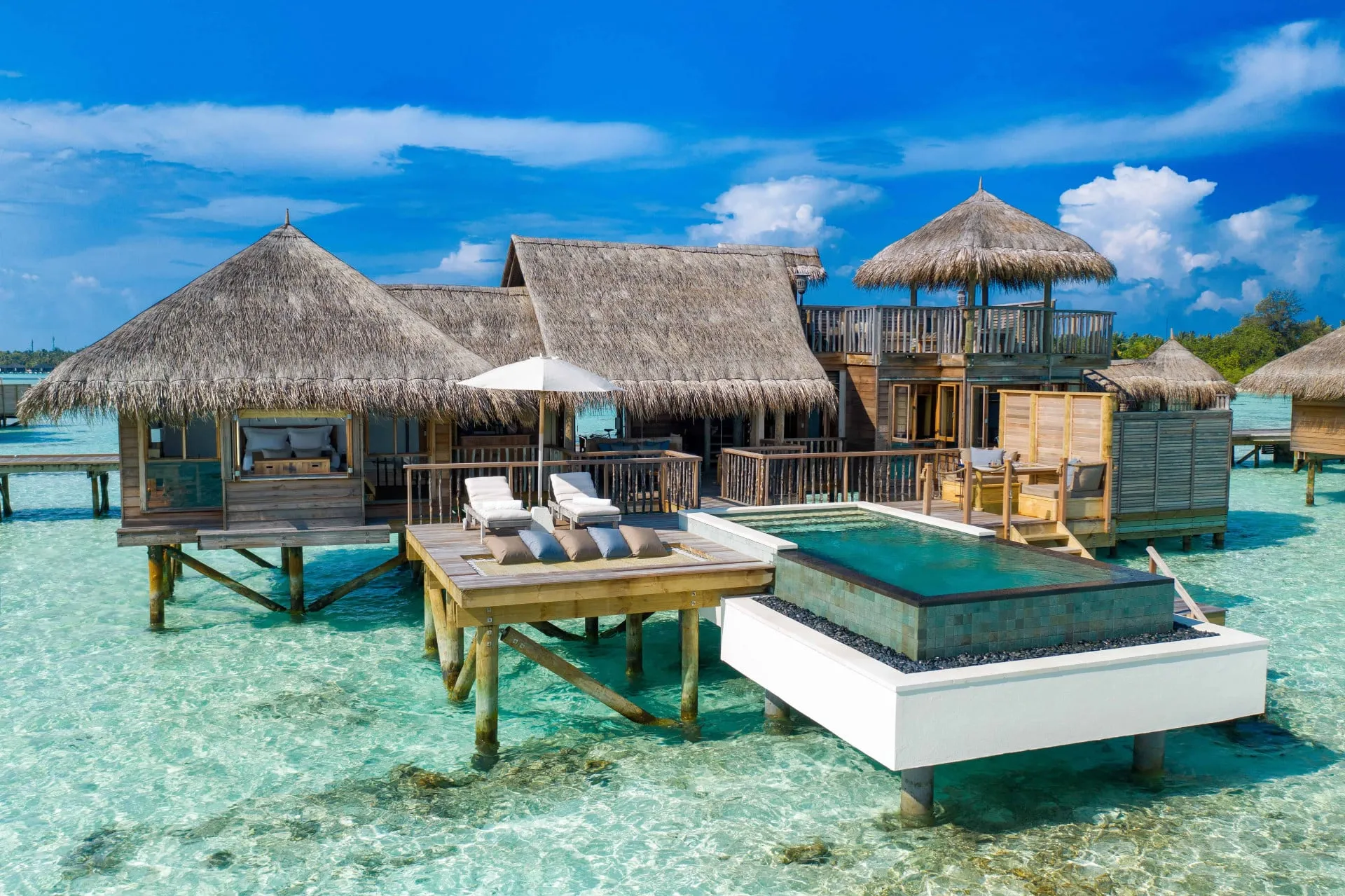
Lankanfushi Island, Maldives
Gili Lankanfushi
The Maldives resort that invented barefoot luxury and has spent two decades refusing to put its shoes back on.
From $1,550 per night
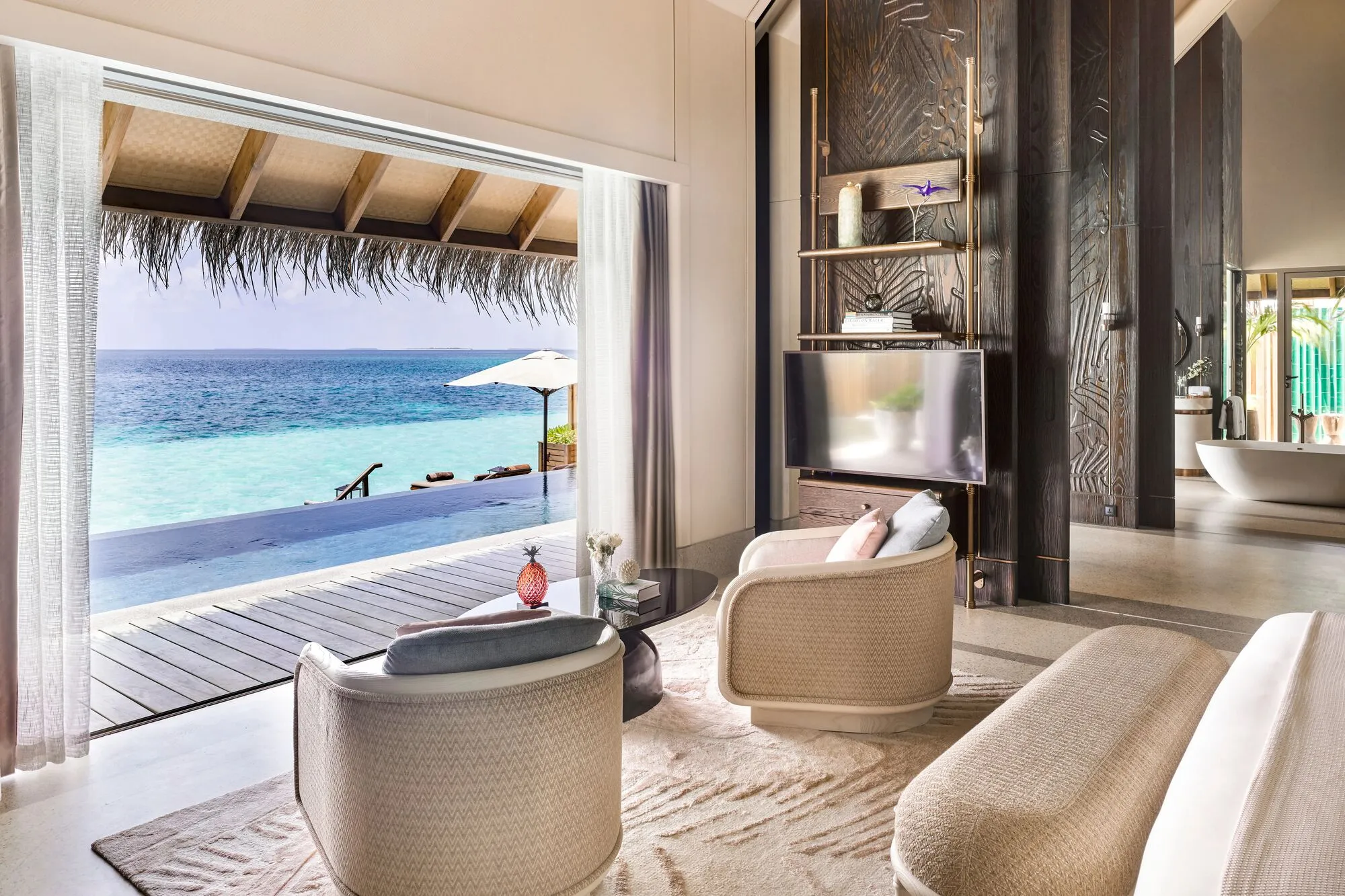
Muravandhoo Island, Maldives
JOALI Maldives
An art-immersive private island in Raa Atoll where more than forty commissioned installations sit alongside 73 villas and a working coral restoration reef.
From $1,600 per night