Olhuveli, Maldives
Six Senses Laamu
The only resort on its atoll, built on stilts over a lagoon and staffed, in part, by resident marine biologists.
- Rates from
- From $950 per night
- Nearest airport
- Kadhdhoo Airport, via domestic flight from Velana International Airport (Male)
- Transfer
- About 65-70min by Six Senses' own seaplane, or a 35-40min domestic flight to Kadhdhoo plus a 15-30min speedboat
- Best months
- November to April for calm seas; March to October for the most consistent surf swell
Laamu Atoll sits far enough south of Male that it barely registers on the standard Maldives resort map, one atoll among the string of southern outliers that most itineraries skip in favour of the shorter, more crowded hops closer to the capital. Six Senses Laamu is the only resort on it. That solitude is not incidental to the property’s identity, it is close to the whole point: a single island, Olhuveli, built out onto its lagoon on a long procession of timber stilts, with nothing else on the atoll to compete with it for reef, swell or attention.
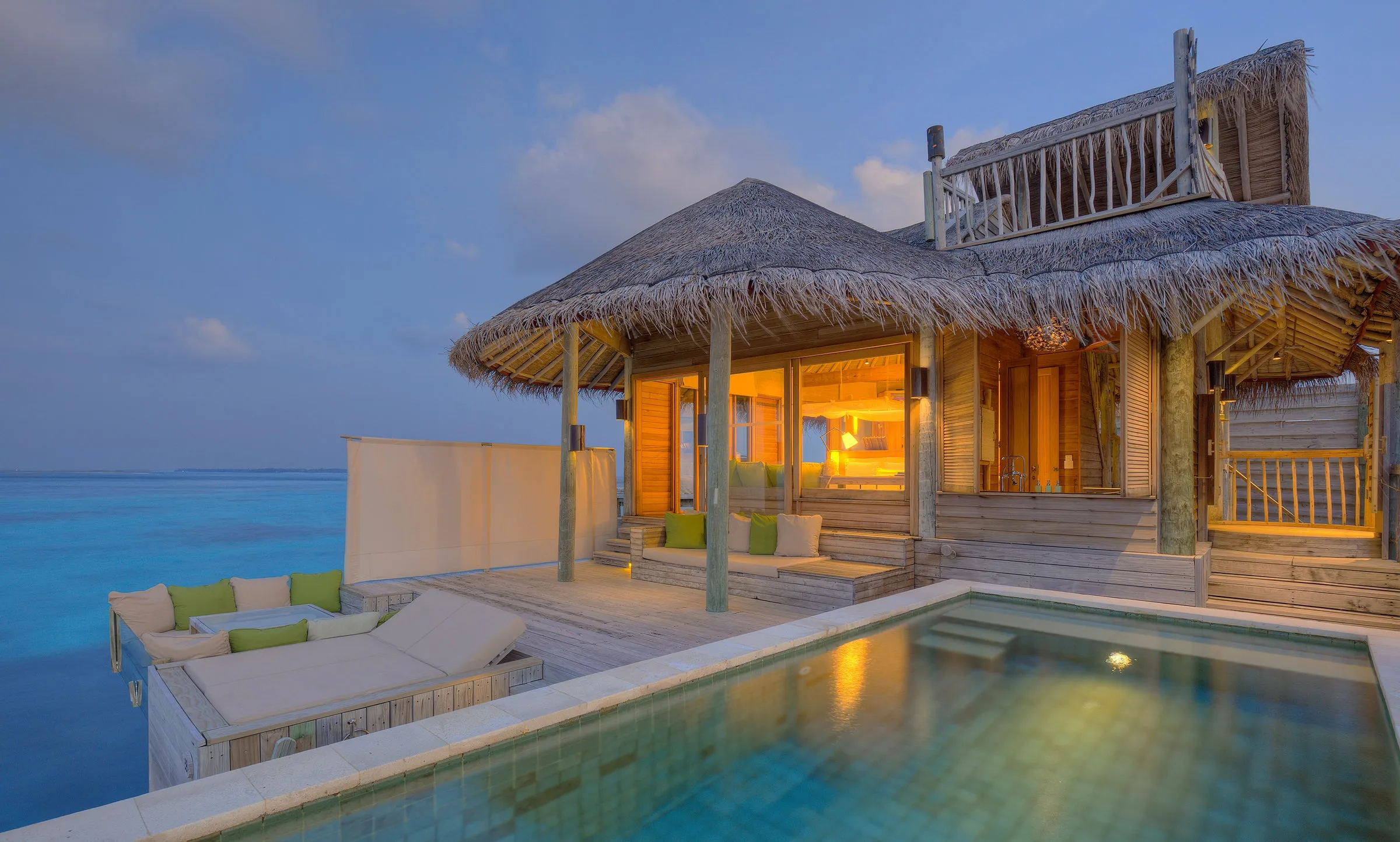
The resort opened in April 2011, after a construction process reportedly slowed by its own founding premise, building almost entirely from local and sustainable materials on a remote island with no easy supply chain. Ninety-seven villas spread across the beach and the lagoon, threaded by one of the longest continuous overwater walkways in the Maldives, itself lined with restaurants, a bar, a dive centre and a boutique before it reaches the villas proper. What distinguishes Six Senses Laamu within its own brand, and within the wider Maldives resort category, is less the villa count than what happens underneath and around them: a resident team of marine biologists running an active research programme, and six named surf breaks within ten minutes of the jetty by boat.
Why It Stands Out
Most Maldives resorts sell proximity or spectacle: a short seaplane hop from Male, a retractable roof, a golf simulator, an art collection. Six Senses Laamu sells distance and depth instead. The transfer alone, whether by the resort’s own seaplane or the domestic-flight-and-speedboat alternative, takes the better part of an hour and a half from Male, longer than the typical thirty-minute hop to the Male-atoll properties, and that extra remove is precisely why Laamu Atoll’s reef and surf breaks remain comparatively uncrowded.
The Maldives Underwater Initiative, the resort’s in-house marine research programme, is the other genuine point of difference. This is not a single dive instructor doubling as a conservation officer; it is a resident team of marine biologists working in formal partnership with three established NGOs, running actual field research on coral, seagrass, mangroves and the atoll’s resident and migratory species. Layered onto that is a serious surf programme, built around a partnership with the surf-travel specialist Tropicsurf, that treats the atoll’s breaks as a primary reason to visit rather than an afterthought for guests who happen to bring a board. Few Maldives properties combine research-grade marine science with genuine surf credentials in the same package, and Six Senses Laamu’s whole layout, from the dive centre’s position on the jetty to the boat access built into daily programming, is arranged around both.
Architecture
The resort was designed by Habita Architects, working within a brief that pushed hard toward sustainable, low-impact construction rather than a conventional resort footprint. Buildings are dispersed rather than clustered: the design begins at the island’s southwestern tip and extends northeast over the lagoon, so that the built environment reads less as a single resort compound and more as a settlement that has grown gradually outward from land into water. Structures are raised on timber stilts, connected by a long network of elevated walkways rather than ground-level paths, an approach that limits the resort’s physical footprint on the island itself and keeps the overwater facilities, including four restaurants, a wine cellar, the resort’s signature bar, the dive centre, an ice cream parlour and a boutique, threaded along a single continuous route between land and open lagoon.
Local and sustainable materials define the palette throughout: timber, thatch and natural fibre roofing rather than poured concrete or imported stone, chosen deliberately to limit the resort’s environmental footprint even where it meant a longer, more complicated build. The result is a resort that avoids a single dominant architectural statement in favour of a repeated, modular language: raised timber villas, thatched roofs, open-sided pavilions, applied consistently enough across dozens of structures that the overall effect reads as a considered ecosystem rather than a series of one-off villas.
Interior Design
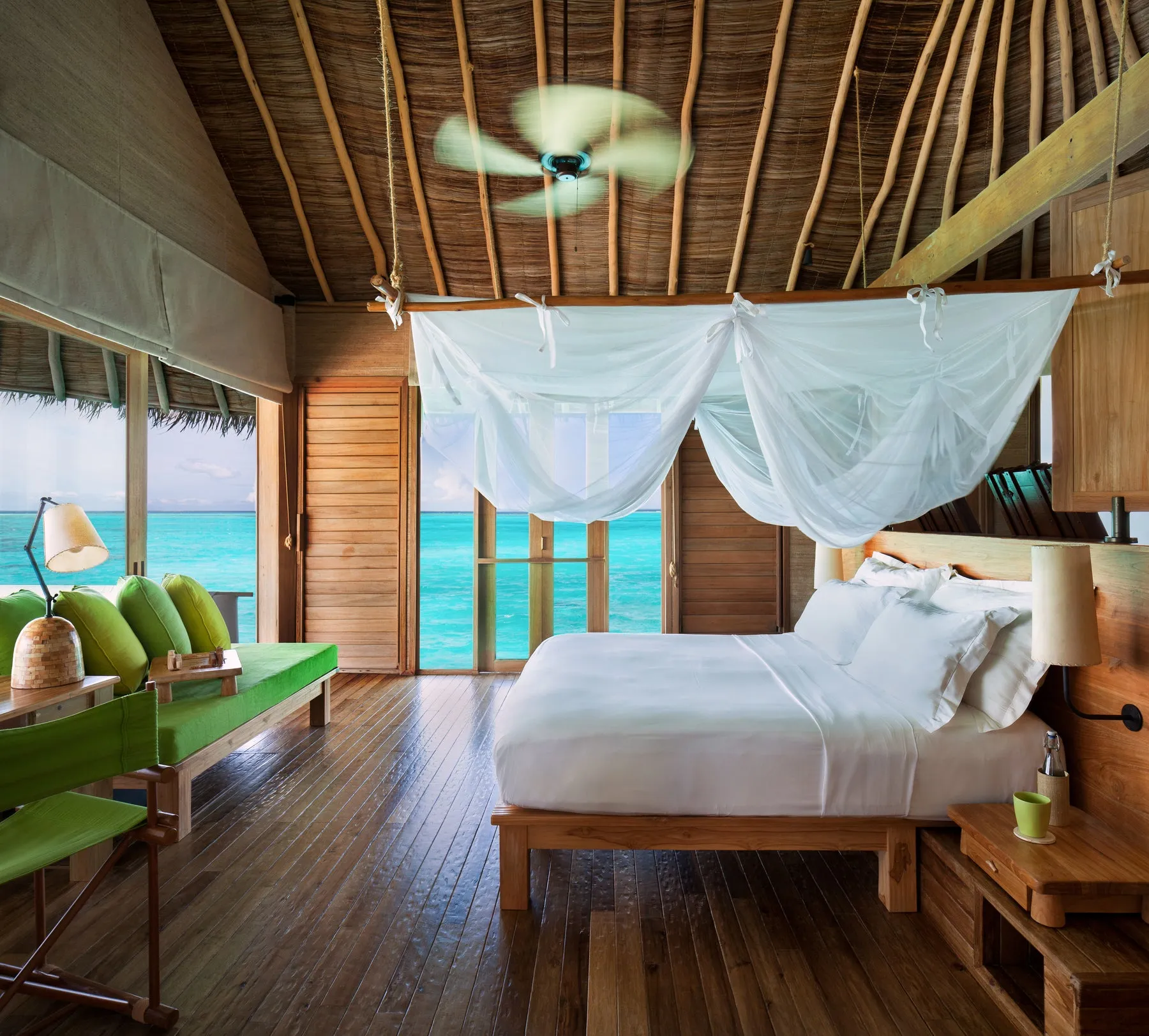
Interiors carry the same restraint as the architecture: natural timber, woven and thatched textures, and a material palette drawn from what the region can supply rather than an imported design language. Overwater villas are the clearest expression of the resort’s design ambitions, built with sunken glass-sided bathtubs positioned to look down into the lagoon, aquarium-style dining decks, and panoramic upper-deck platforms that give each villa its own private lookout over open water. The intent throughout is indoor-outdoor continuity rather than a hard boundary between room and reef, with large openings, outdoor bathing areas and deck space treated as extensions of the living area rather than separate amenities.
Furnishings lean unfussy and tactile rather than ornate, favouring natural fibres, muted tones and locally sourced materials that keep the interiors from competing with the water views that are, in every villa category, the real subject of the design. It is a style consistent with Six Senses’ broader brand identity: understated, materials-led, and built to age well in a marine environment rather than styled for a single photograph.
Atmosphere
The defining sensation at Six Senses Laamu is remoteness, both from the mainland Maldives resort circuit and, within the resort itself, from other guests. The long jetty structure spreads accommodation and facilities across a genuinely large footprint, which keeps the property from ever feeling dense even at full occupancy, and the atoll’s status as home to a single resort means there is no competing development, no neighbouring jetty or beach club within view, no sense of sharing the reef with anyone beyond fellow guests and the resident research team.
That isolation shapes the pace of a stay more than any single amenity does. Days tend to organise themselves around water, whether that means a boat out to a surf break, a guided reef snorkel with a marine biologist, or simply time on an overwater deck watching the lagoon change colour through the afternoon. The tone throughout skews toward barefoot informality over full-dress luxury, in keeping with Six Senses’ house style, though the level of service and the sophistication of the dining programme keep it from reading as rustic. It is a resort built for guests who want the Maldives at its most elemental, water, reef and sky, delivered with real infrastructure rather than performative simplicity.
Rooms and Suites
Accommodation is organised into two broad families: villas set on the beach and villas built out over the lagoon, with 97 units across both. Beach categories begin with the Lagoon Beach Villa with Pool and the Ocean Beach Villa with Pool, the resort’s entry-level offerings, each with a private pool and direct beach access, and extend up through Beach Family Villas with Pool and two-bedroom Lagoon and Ocean Beach Villas with Pool for families or two couples travelling together.
The water villas run along the resort’s long overwater jetty in a deliberate hierarchy: Lagoon Water Villas sit closest to shore, without a private pool; Ocean Water Villas occupy the middle stretch of the jetty, some with a plunge pool set into the deck; and the Sunset Laamu Water Villas, including a pool version, sit at the jetty’s furthest point, positioned for the most open, uninterrupted lagoon views and the best privacy of the water categories. Across the water villas generally, the design signature is the sunken glass-sided bathtub and the aquarium-style dining deck, both built to frame the lagoon and its marine life as part of the room rather than a view seen from a window.
Guests weighing categories should treat proximity to the main island as the key trade-off: beach villas sit closest to the restaurants, spa and dive centre, while the far end of the water villa jetty offers the most seclusion at the cost of a longer walk (or buggy ride) back to the resort’s core facilities.
Dining
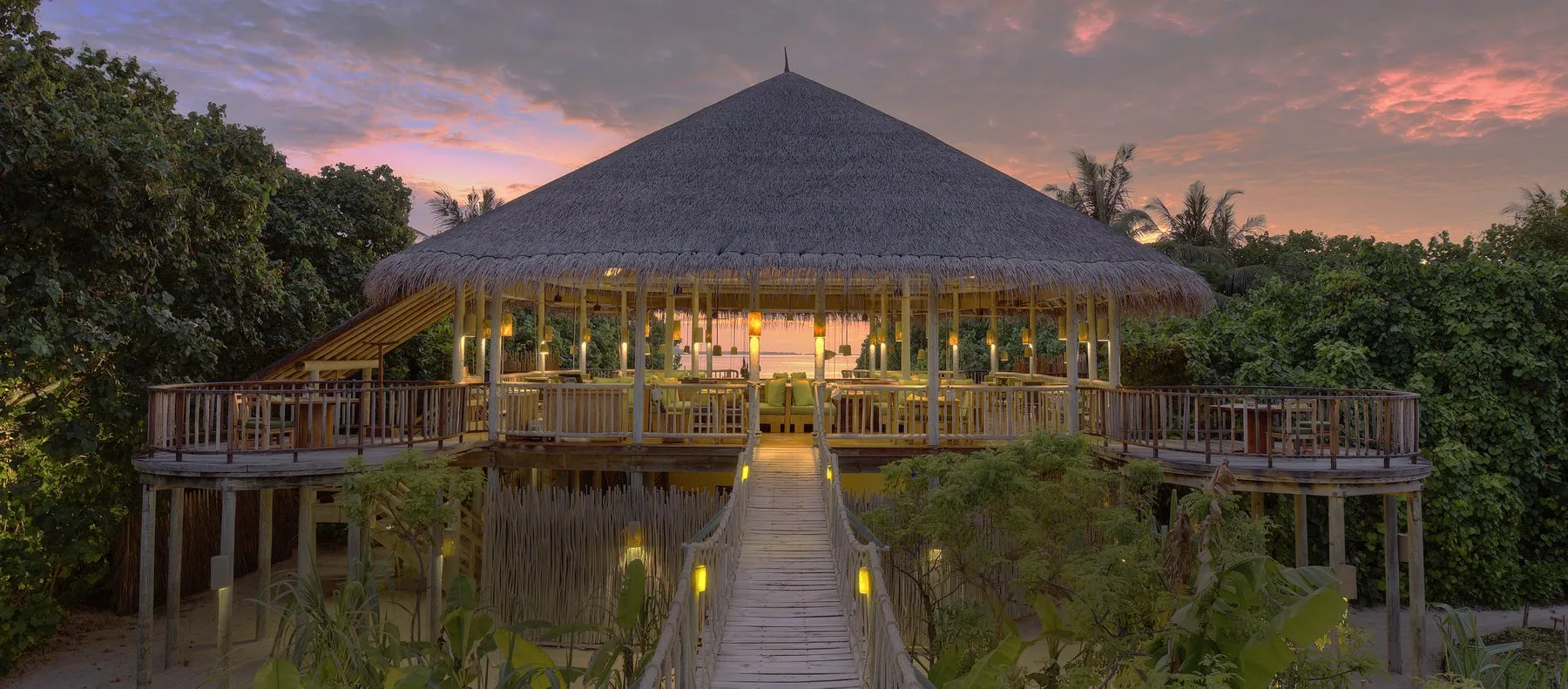
Dining at Six Senses Laamu is spread across the resort’s overwater facilities rather than concentrated in a single flagship room, with four distinct restaurants plus a signature bar. Leaf, the resort’s main restaurant, is set on a raised, tree-canopy platform overlooking the organic garden, a deliberately grounded counterpoint to the water-facing venues elsewhere on the property. Zen serves modern Japanese cuisine, including sushi and sashimi, from an intimate overwater setting capped at a small number of guests a night, making it one of the resort’s harder reservations to secure. Longitude, the international restaurant, occupies a two-storey, open-air overwater structure and functions as the resort’s broadest, most flexible dining room. Kaji offers a teppanyaki experience built around set four- or five-course menus featuring premium beef and seafood cooked tableside. Chill Bar, positioned over the water near the jetty’s restaurant cluster, serves the resort’s most relaxed food and drink menu alongside its bar programme.
Across the venues, the kitchens draw where possible on the resort’s own garden and on sustainably sourced seafood, in keeping with the property’s broader environmental positioning, though the exact scope of any specific in-house farm or garden-to-table claim should be confirmed directly with the resort at the time of booking, since sourcing programmes at remote island properties can shift with supply conditions.
Spa and Wellness
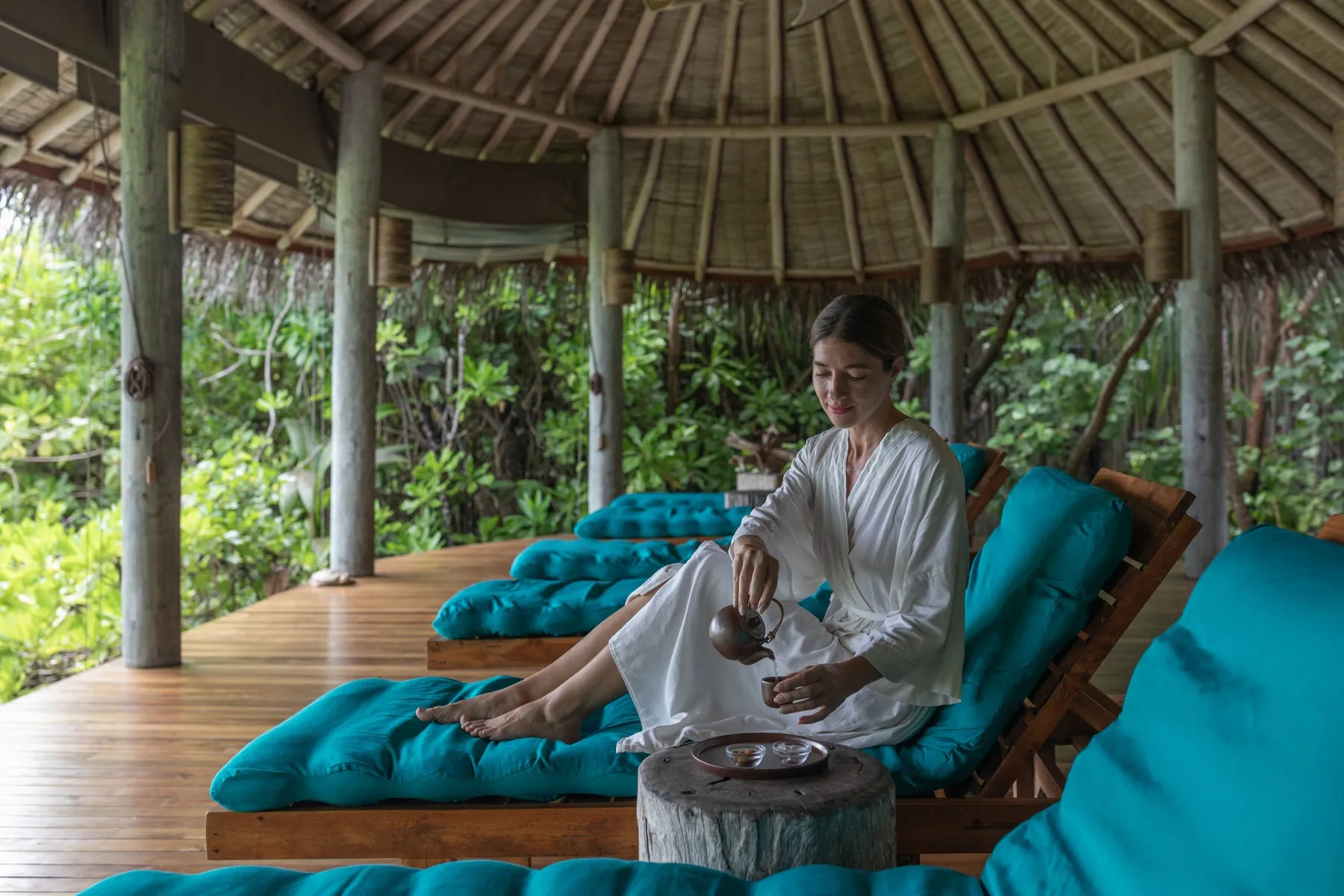
The Six Senses Spa at Laamu is built into the island’s natural vegetation rather than a single enclosed building, comprising four couple’s treatment pavilions or nests plus a dedicated Ayurvedic treatment pavilion, all set among trees away from the resort’s more trafficked overwater core. Treatments draw on natural, ethically produced products and a mix of locally inspired and Ayurvedic practices, supplemented by visiting practitioners offering more specialised modalities such as acupuncture, craniosacral therapy, reflexology and shiatsu.
Beyond treatments, the wellness offering extends into Six Senses’ broader biohacking and sleep-focused programming, using wearable tracking to inform personalised recommendations on movement, sleep and nutrition alongside more conventional spa bookings. A yoga pavilion with a panoramic lagoon view hosts daily classes, and a modern gym rounds out the fitness facilities. The overall approach favours a holistic, guest-directed model, structured retreat-style programming is available but not obligatory, over a purely menu-driven spa experience, consistent with Six Senses’ positioning across its portfolio.
Experiences
Two experiences set Six Senses Laamu apart from most of its Maldives peers, and both reward a longer stay rather than a quick overnight. The first is surf. The resort has partnered with Tropicsurf, a specialist surf-travel operator, since 2017, and the atoll surrounding the island holds six recognised breaks within about ten minutes by boat. Yin Yang, roughly five minutes offshore, is the best known: a fast, powerful right-hand reef break capable of serious barrels, generally rated for intermediate to advanced surfers. Closer to home, the house reef itself throws up quicker, more forgiving lefts, and a separate, gentler wave breaks close to the island beach, giving less experienced surfers and beginners a realistic entry point without a long boat ride. Guided surf excursions, coaching and equipment are organised through the resort’s surf programme, making this one of the more genuinely surf-oriented five-star properties in the Maldives rather than a beach resort that happens to sit near a wave.
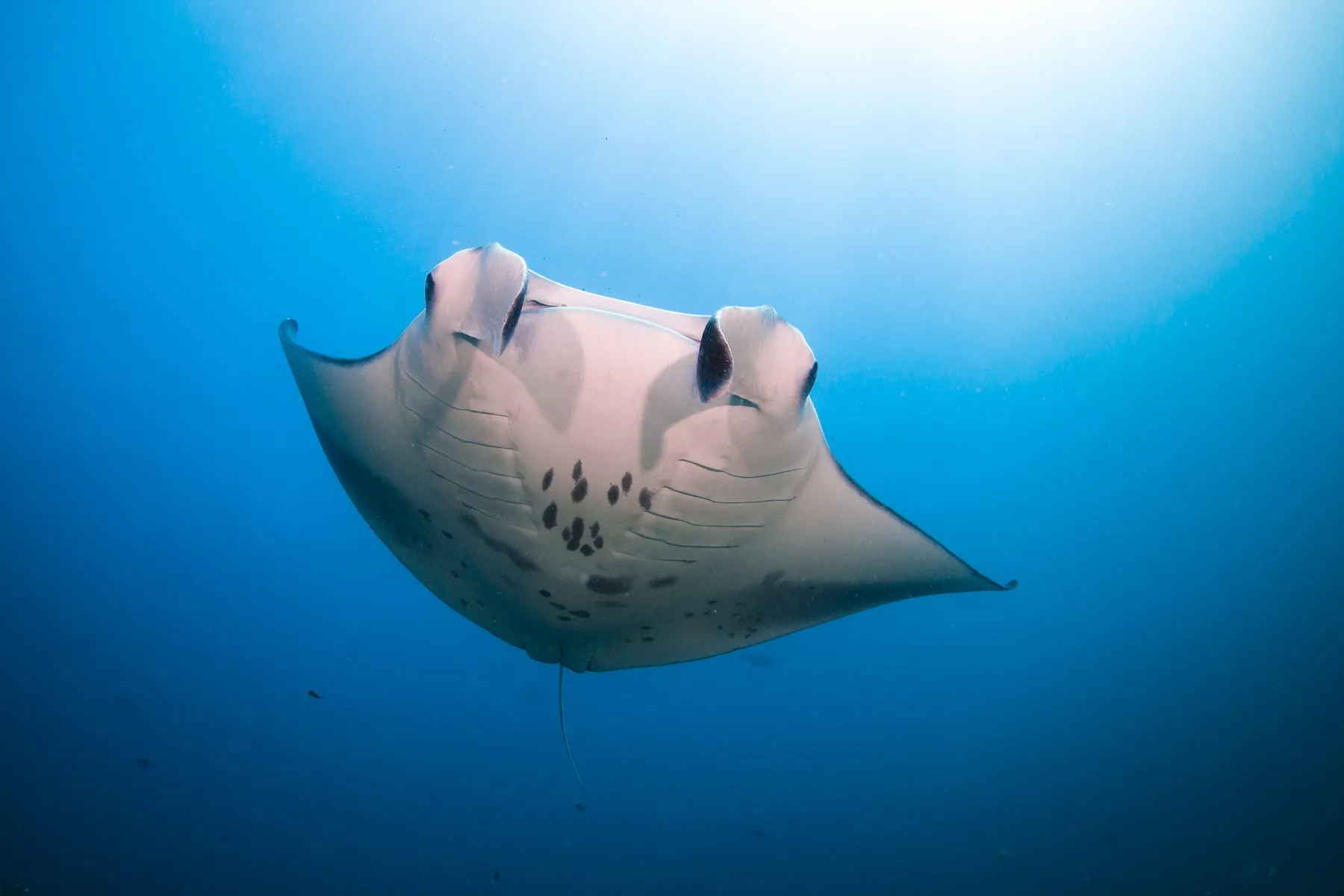
The second is the Maldives Underwater Initiative, the resort’s resident marine research programme, run in partnership with the Blue Marine Foundation, the Manta Trust and the Olive Ridley Project. A team of marine biologists based on the island conducts ongoing research across the atoll’s coral reefs, seagrass meadows and mangrove forests, tracking manta rays, turtles, sharks, dolphins, reef fish and coral health, work that feeds directly into local conservation management decisions rather than sitting purely in an academic silo. Guests access the programme through a complimentary daily guided house reef snorkel led by a resident biologist, a sunset dolphin cruise, and a Junior Marine Biology programme built for children between seven and twelve, which the resort has also adapted into a home-based format for guests wanting to continue the curriculum after departure. For anyone with a serious interest in marine science, meeting and learning from a working research team, rather than a generic dive-shop guide, is a genuinely distinguishing part of a stay here.
Beyond surf and marine research, the resort runs a conventional diving programme through its overwater dive centre, house reef access directly from several villa categories, and the wider suite of excursions typical of a remote Maldives property: sandbank picnics, sunset cruises and fishing trips arranged through the resort.
Who It Is For
Six Senses Laamu suits travellers for whom the ocean itself, not the villa or the spa menu, is the primary reason to visit. Surfers will find a genuine, well-organised programme rather than an incidental amenity, and divers and snorkellers with an interest in conservation will get more out of the resident marine biology team here than at almost any comparable Maldives resort. Couples seeking an overwater villa with real design ambition, and families with children old enough to engage with the Junior Marine Biology programme or a surf lesson, are also well served.
It suits less well travellers who want the shortest possible transfer from Male, or who are looking for the densest, most see-and-be-seen social scene the Maldives offers; Laamu’s whole appeal rests on distance and quiet, which means committing to a longer, more deliberate journey to get there. Guests who want their Maldives stay to be purely passive, a villa, a beach and minimal engagement with the water beyond it, may find the resort’s programming (surf, research, diving) more oriented toward active participation than a pure relaxation-only trip requires, though the option to simply stay on a villa deck remains available throughout.
Best Time to Visit
November through April covers the Maldives’ classic dry season: lower humidity, calmer seas and the most reliable weather window for diving, snorkelling and general beach time, and the period most Maldives-bound travellers default to. Laamu’s more southerly position means conditions can diverge somewhat from forecasts pitched at the Male-area atolls, so it is worth checking conditions specific to the southern atolls rather than assuming they track identically.
Surfers should weight the calendar differently. The most consistent swell at Yin Yang and the atoll’s other breaks arrives during the broader southwest monsoon window, roughly March through October, when Indian Ocean groundswell reaches the outer reef passes with more regularity. That period overlaps with the Maldives’ wetter, more humid season, so surf-focused travellers are trading some of the dry-season comfort for better waves, a trade worth making deliberately rather than by accident.
How to Get There
All routes to Six Senses Laamu begin at Velana International Airport near Male, and from there the resort offers two paths south. The primary option is the resort’s own branded seaplane service, a flight of roughly 65 to 70 minutes given Laamu Atoll’s distance from the capital, notably longer than the short seaplane hops typical of Male-atoll resorts. On a request basis, the resort also arranges a domestic flight to Kadhdhoo Airport, a journey of about 35 to 40 minutes, followed by a speedboat transfer of roughly 15 to 30 minutes to the island itself.
Either way, travellers should build the transfer into their overall trip planning as a meaningful leg in itself rather than an afterthought, both in time and in cost; onward connections, whether by seaplane or the domestic-flight-and-boat combination, are generally best coordinated directly with the resort or a specialist Maldives travel agent well ahead of arrival, since seaplane operations depend on daylight hours and can affect same-day connections for late international arrivals.
Nearby Experiences
Because Six Senses Laamu is the only resort on its atoll, “nearby” here means the surrounding reef and open water rather than other islands or resorts to visit. The atoll’s six surf breaks, Yin Yang chief among them, sit within ten minutes of the jetty by boat, and the house reef itself is close enough for direct access from several villa categories. Local Laamu Atoll communities and inhabited islands can typically be visited through resort-organised excursions for travellers interested in Maldivian island life beyond the resort boundary, though these should be arranged through the property given the atoll’s remoteness and limited independent transport infrastructure.
Divers based at the resort gain access to a genuinely under-visited stretch of reef by Maldives standards, precisely because Laamu Atoll’s single-resort status keeps dive and snorkel sites far less trafficked than the more heavily developed Male-area atolls, a point the resort’s own marine research team can speak to directly given their ongoing fieldwork across the same sites.
Things to Know Before Booking
The transfer is the single biggest planning variable at Six Senses Laamu, longer and, in the case of the seaplane, potentially more schedule-dependent than at most Maldives resorts, so international flight timing should be planned with the onward connection in mind rather than treated as an afterthought. Given the property’s genuine distance from Male, a shorter stay of two or three nights will feel dominated by transfer time relative to time on the ground; the resort and most specialist agents recommend a longer stay, in the range of five to seven nights, to make the journey worthwhile.
Surf conditions and marine research programming both vary seasonally, so travellers with a specific priority, chasing swell at Yin Yang, or timing a stay around particular research activity or seasonal wildlife such as manta aggregations, should confirm current conditions and programme availability directly with the resort ahead of booking rather than assuming year-round consistency. Standard check-in is 2:00 PM and check-out 12:00 PM, with late check-out available on request, subject to availability and typically an additional charge.
Sustainability
Six Senses Laamu’s sustainability profile rests most distinctively on the Maldives Underwater Initiative, a resident marine research programme run in partnership with three established conservation organisations: the Blue Marine Foundation, the Manta Trust and the Olive Ridley Project. Rather than functioning as a marketing add-on, MUI fields a team of marine biologists conducting ongoing research across three core habitats, coral reefs, seagrass meadows and mangrove forests, and across a defined set of vulnerable species, including manta rays, turtles, sharks, dolphins, reef fish, coral and barnacles. That research feeds into population monitoring intended to inform local conservation management decisions, structured around three stated pillars: research, education and community engagement.
The education pillar reaches guests directly through the complimentary daily house reef snorkel, led by a resident biologist, and the Junior Marine Biology programme for children aged seven to twelve, which the resort has also extended into a home-based format so families can continue the curriculum after their stay ends. The architecture and construction approach reinforces the same broader environmental commitment: the resort was built substantially from local and sustainable materials, a choice reported to have lengthened the original construction timeline given the logistical challenges of sourcing sustainably on a remote atoll. As with any resort-run sustainability programme, the detail of current initiatives, research output and community partnerships is best confirmed directly with the resort or through MUI’s own published research and education materials, since programmes and partnerships can evolve over time.
Practical Information
Rates at Six Senses Laamu sit within the upper tier of the Maldives market, with entry-level Lagoon Beach Villas with Pool commonly starting in the high hundreds of dollars per night in lower season and rising well beyond that for higher categories and peak dates; this guide prices the property from an indicative $950 per night as a general orientation rather than a live rate, and travellers should always confirm current pricing, meal plan inclusions and any minimum-stay requirements directly with the resort.
The gateway airport is Velana International Airport near Male, reached by the resort’s own seaplane in roughly 65 to 70 minutes, or by a domestic flight to Kadhdhoo Airport (about 35 to 40 minutes) plus a speedboat transfer (roughly 15 to 30 minutes) on request. Standard check-in is 2:00 PM and check-out 12:00 PM. November through April offers the calmest, driest conditions overall, while March through October brings the most consistent surf swell at the atoll’s breaks. A stay of five to seven nights is recommended given the length of the transfer, enough time to settle into the resort’s water-centred programming, from surf sessions to marine research activities, without the journey dominating a shorter trip.
Editorial Conclusion
Six Senses Laamu asks more of a traveller than most Maldives resorts, a longer transfer, a further-flung atoll, a programme built around active engagement with the water rather than passive villa time, and it rewards that commitment in kind. The resort’s combination of a genuine, research-grade marine biology programme and a serious, well-organised surf offering is not easily matched elsewhere in the archipelago, and the architecture’s long, stilted procession out over the lagoon gives both categories of villa a real sense of remove from the everyday. It is not the resort for a traveller who wants the shortest possible hop from Male or the most curated social scene; it is close to ideal for one who wants the Maldives at its most physically engaged, reef, swell and open water treated as the main event rather than the backdrop.
In pictures
On the map
Olhuveli, Maldives
Questions
Frequently asked
How do guests get to Six Senses Laamu, and how long does it take?
Most guests fly into Velana International Airport near Male and continue on Six Senses Laamu's own branded seaplane, a journey of roughly 65 to 70 minutes given the atoll's distance from the capital. On a request basis, the resort also arranges a shorter domestic flight to Kadhdhoo Airport (about 35 to 40 minutes) followed by a speedboat transfer of 15 to 30 minutes. Either way, this is one of the longer transfers among Maldives resorts, since Laamu Atoll sits well south of the more heavily developed Male atolls.
Is Six Senses Laamu a good choice for surfers?
Yes, more so than most Maldives resorts. Six senses Laamu has partnered with the surf outfitter Tropicsurf since 2017, and the atoll has six recognised breaks within about ten minutes by boat, including Yin Yang, a fast right-hand barrel rated for intermediate to advanced surfers roughly five minutes offshore. There is also a gentler wave close to the house reef for less experienced surfers. Conditions are most consistent during the southwest monsoon swell window, broadly March through October.
What is the Maldives Underwater Initiative (MUI)?
MUI is the resort's in-house marine research programme, run in partnership with the Blue Marine Foundation, the Manta Trust and the Olive Ridley Project. A team of resident marine biologists studies coral reefs, seagrass meadows and mangroves across Laamu Atoll, tracking species including manta rays, turtles, sharks and reef fish, and leads guest-facing activities such as a complimentary daily house reef snorkel and a Junior Marine Biology programme for children aged seven to twelve.
What are the villa categories, and which suits a first stay?
The resort's 97 villas fall broadly into beach villas (Lagoon Beach Villa with Pool and Ocean Beach Villa with Pool being the entry categories) and water villas built along a long overwater jetty (Lagoon Water Villa, Ocean Water Villa and the Sunset Laamu Water Villa at the jetty's far end). First-time guests weighing convenience against overwater atmosphere often choose a Lagoon Beach Villa for easy access to the main island facilities, or an Ocean Water Villa for a shorter walk to open water and the house reef.
When is the best time to visit?
November through April brings the Maldives' classic dry season, with calmer seas and lower humidity, and is the most reliable window for diving and general beach time. Surfers tend to target the southwest monsoon period, roughly March through October, when swell reaching the atoll's outer reef passes is most consistent. Laamu's southern position means weather can differ somewhat from the more commonly cited Male-area forecasts, so it is worth checking conditions for the atoll specifically.
Same destination
More hotel guides in Maldives
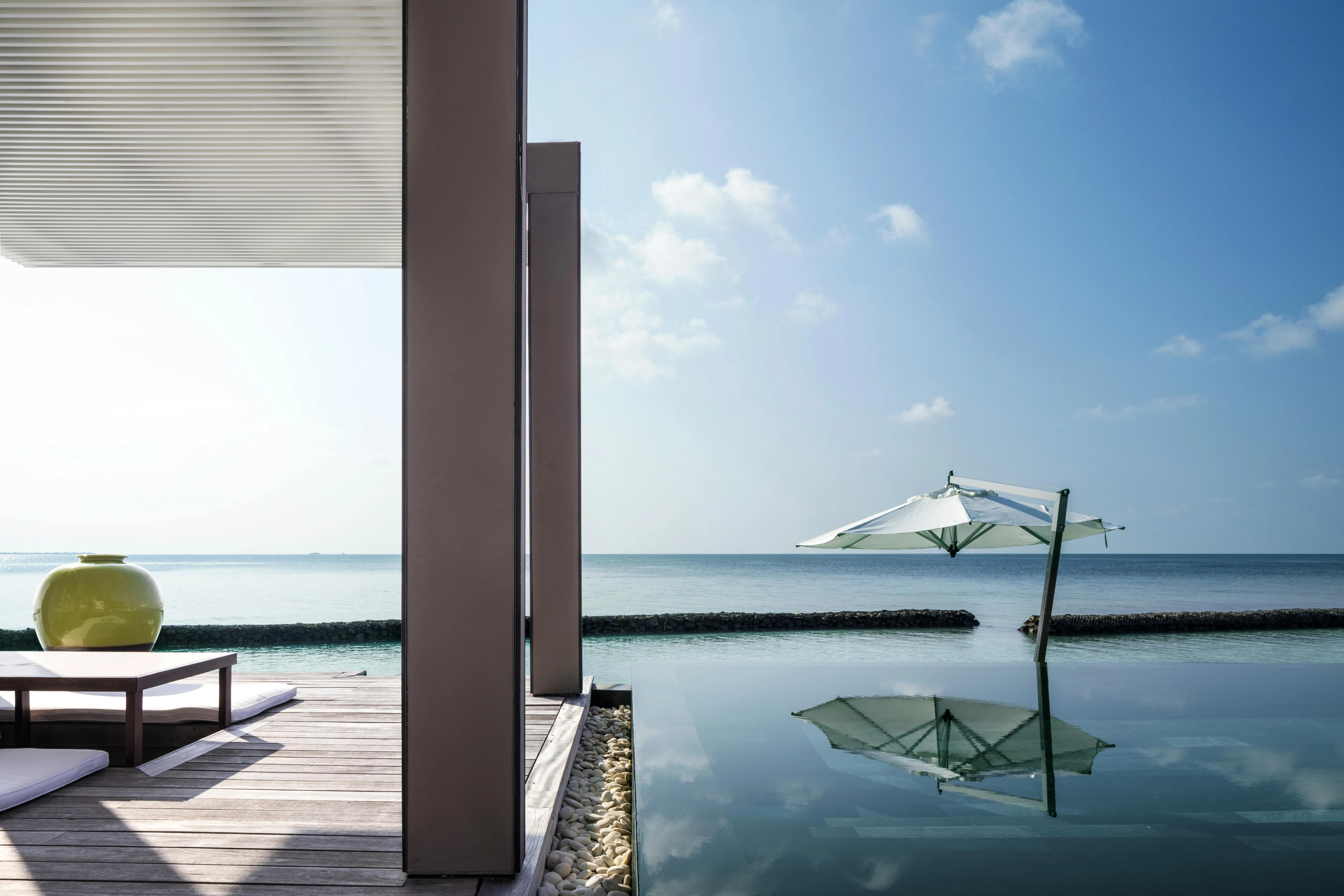
Randheli Island, Maldives
Cheval Blanc Randheli
Jean-Michel Gathy's private-island debut for LVMH's hotel house, forty minutes by seaplane into the Noonu Atoll.
From $2,200 per night
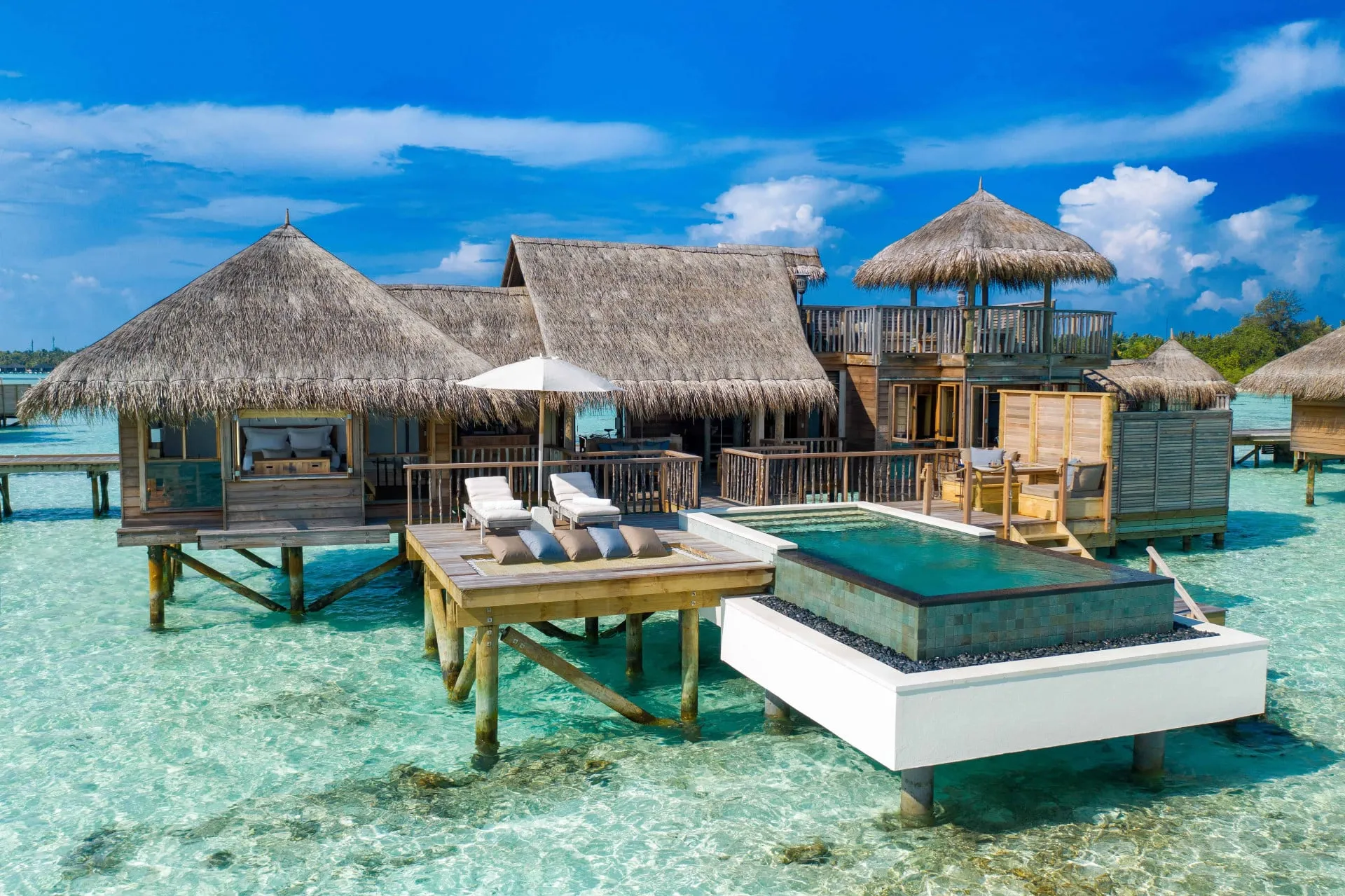
Lankanfushi Island, Maldives
Gili Lankanfushi
The Maldives resort that invented barefoot luxury and has spent two decades refusing to put its shoes back on.
From $1,550 per night
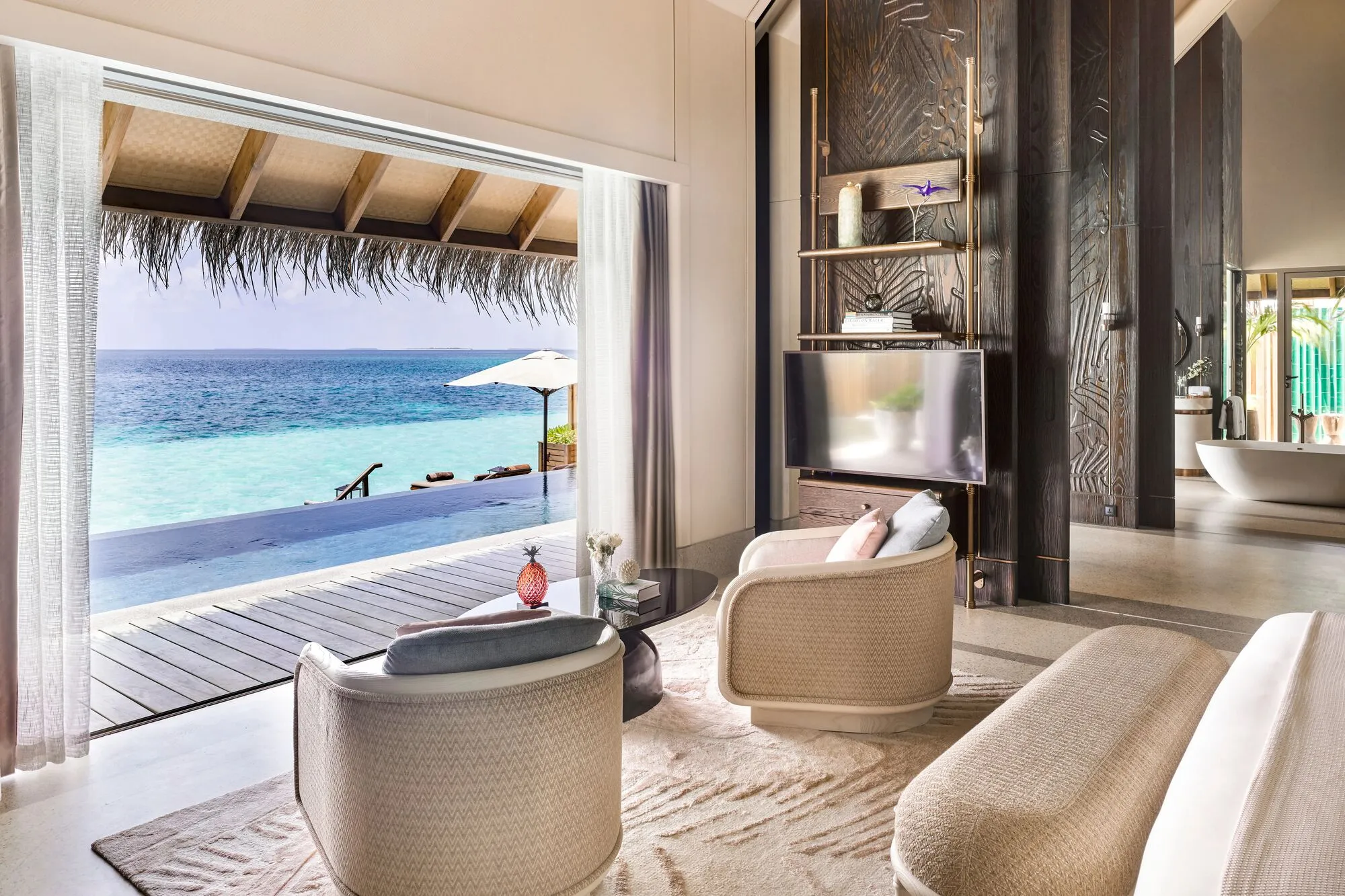
Muravandhoo Island, Maldives
JOALI Maldives
An art-immersive private island in Raa Atoll where more than forty commissioned installations sit alongside 73 villas and a working coral restoration reef.
From $1,600 per night