Kunfunadhoo Island, Maldives
Soneva Fushi
The resort that invented barefoot luxury in the Maldives, and has spent three decades refusing to modernise the idea away.
- Rates from
- From $1,750 per night
- Nearest airport
- Velana International Airport, Male
- Transfer
- 30-40 min by seaplane
- Best months
- November to April for the driest, calmest seas; May to November for the manta ray and whale shark season at nearby Hanifaru Bay
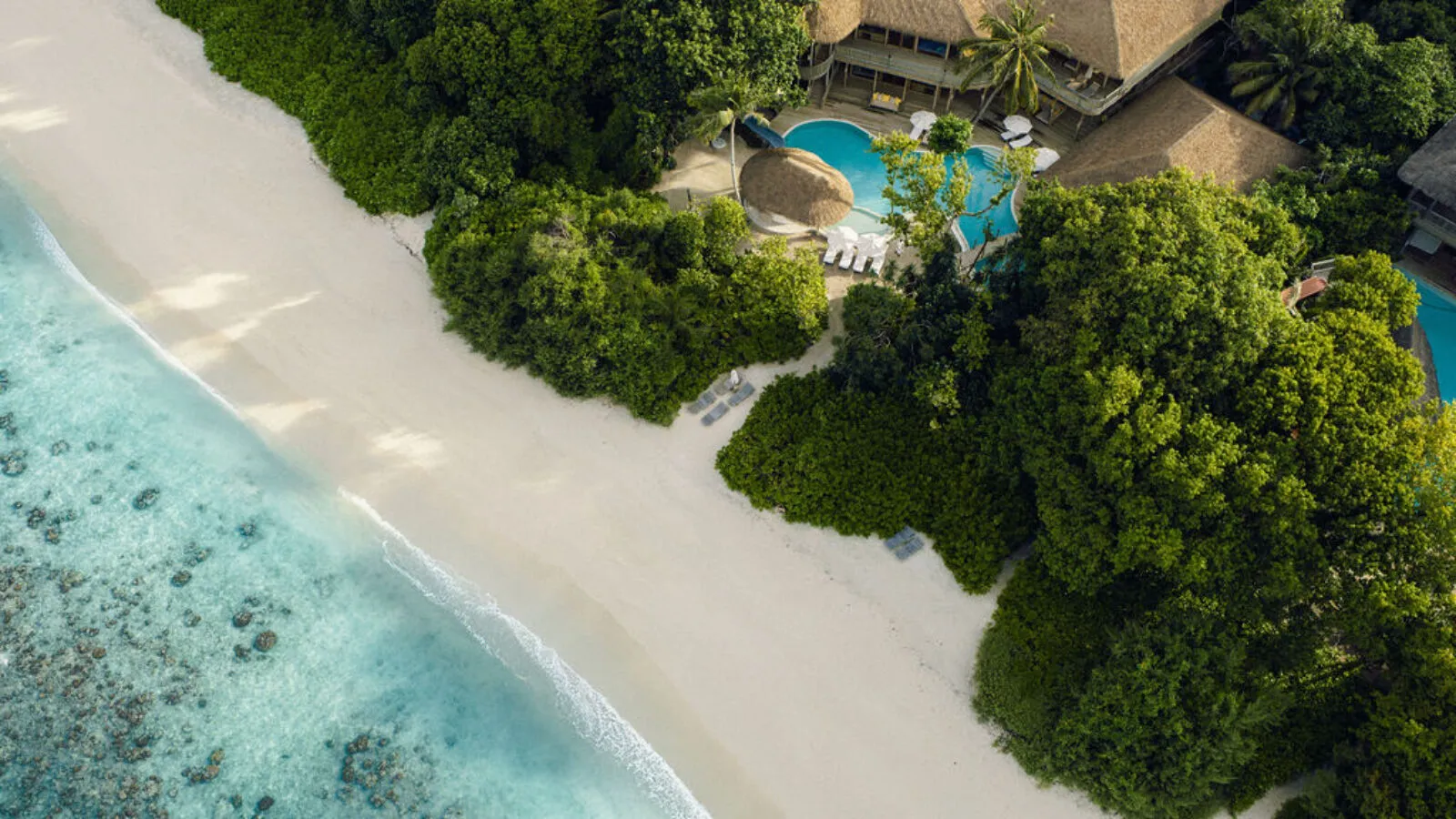
There is a particular quiet to Kunfunadhoo Island that has nothing to do with isolation and everything to do with restraint. No engines idle nearby, no golf carts hum along paved drives, no reception desk gleams under downlighting. Guests arrive by seaplane, step onto a jetty, and are asked, more or less immediately, to take off their shoes. What follows is not a performance of simplicity so much as an entire operating system built around it: thatched roofs instead of tile, sand paths instead of tarmac, jungle canopy instead of manicured lawn. Soneva Fushi has been doing this since 1995, and it is still, three decades on, the clearest expression of what it originally set out to prove: that the most expensive thing a resort can offer a guest is nothing much at all, arranged with total precision.
The resort occupies the whole of Kunfunadhoo, a jungle-thick island in Baa Atoll roughly 115 kilometres north of Male, and its founders, Sonu Shivdasani and Eva Malmstrom Shivdasani, built it as a direct reaction against the glass-and-marble resort template that dominated the era. Sonu, then an Oxford graduate with no hospitality background, and Eva, a Swedish former fashion model, leased the island in 1990 after a string of failed bids on other properties, and spent five years shaping what became known internally, and later publicly, as barefoot luxury. Soneva Fushi is generally credited as the first resort in the Maldives built around that Robinson Crusoe idea, and it opened with the country’s first wine cellar, a small detail that says a great deal about the founders’ instinct to pair rusticity with genuine indulgence rather than treat the two as opposites.
What makes the island worth a long, unhurried visit today is less any single amenity than the way the whole place holds together. The overwater restaurant sits a short walk from an observatory with a research-grade telescope. A recycling facility that turns kitchen scraps into fertiliser for the resort’s own gardens operates a few hundred metres from a villa with a private waterslide into the lagoon. None of it reads as contradiction, because the island was designed from the outset as a single, continuous idea rather than a checklist of five-star features bolted together. Guests who come expecting polish in the conventional sense sometimes take a day or two to recalibrate; guests who come for exactly what the brand promises tend to leave calling it their favourite resort in the region, and meaning it.
Baa Atoll itself adds weight to the setting. Declared a UNESCO Biosphere Reserve in 2011, it wraps Soneva Fushi in one of the richest stretches of reef in the Maldives and sits within reach of Hanifaru Bay, the marine protected area famous for its seasonal aggregations of manta rays and whale sharks. The resort’s founders did not simply find a beautiful, remote island; they found one inside a protected marine ecosystem, and built a business model that has spent thirty years trying to be worthy of that fact rather than merely adjacent to it.
Why It Stands Out
Soneva Fushi’s clearest distinction is chronological: it is not a resort borrowing the language of barefoot luxury from somewhere else, it is the property that coined the phrase and the “No News, No Shoes” ethos that came with it. Every subsequent Maldives resort built around rustic minimalism, thatched roofs and deliberately unhurried service is, whether it credits the fact or not, working in a lineage Soneva Fushi started. That originality still shows in details competitors have never quite matched: the resort’s own seaplane operation, an in-house observatory with a resident stargazing programme, and Eco Centro, a genuinely industrial-scale waste-processing facility rather than a token recycling bin by the kitchen door.
The second distinction is scale of ambition within apparent simplicity. Eleven distinct dining destinations, a fine-dining meal served midway along a jungle zipline, a chocolate room with all-day complimentary access, and a rotating programme of guest chefs sit inside a resort that still asks guests not to wear shoes to dinner. Few properties anywhere pull off that particular tension between five-star culinary ambition and deliberate informality as convincingly.
Architecture
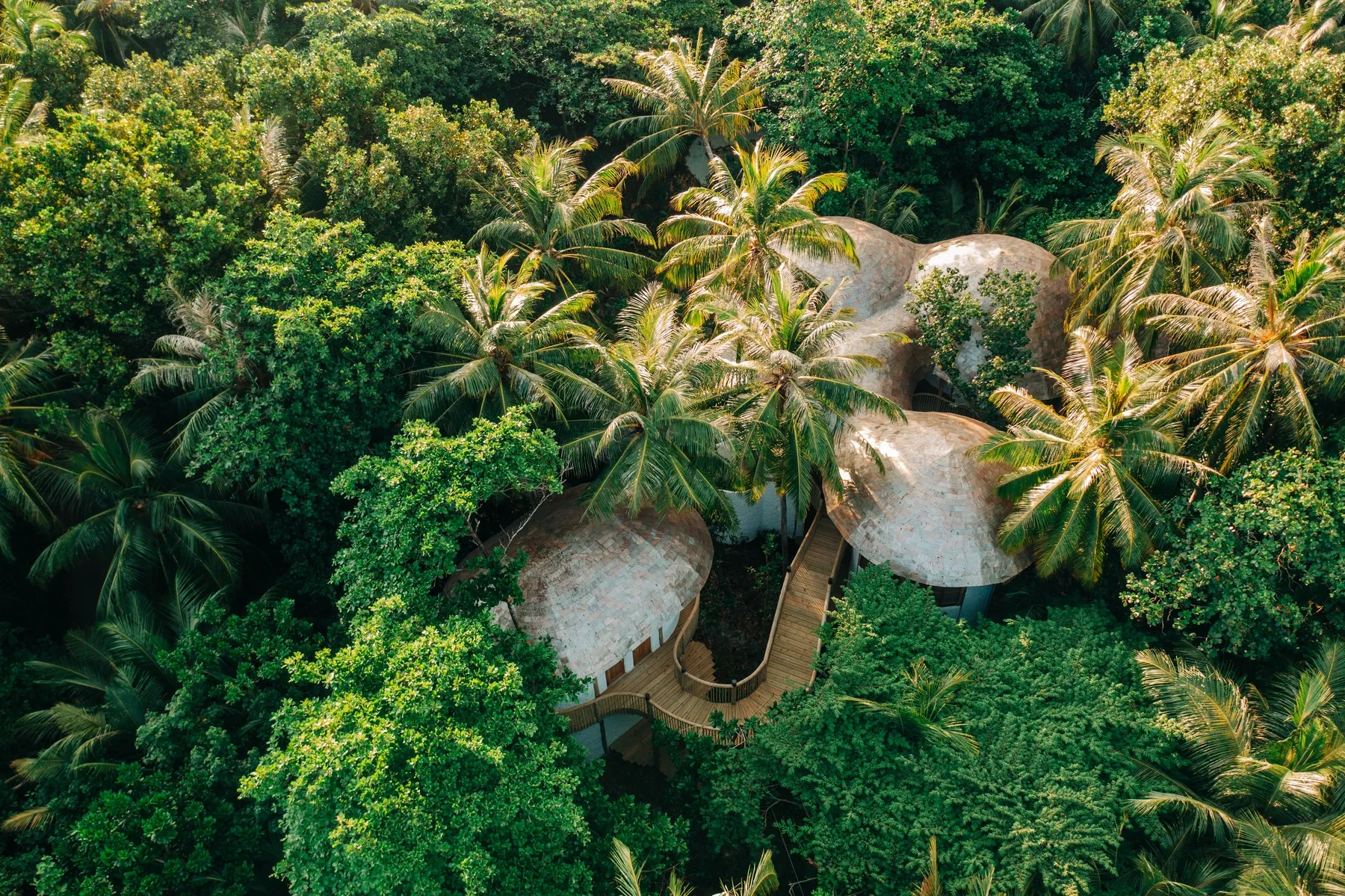
The architecture at Soneva Fushi is organised around a founding refusal: nothing should be built that could not, in principle, have been built by hand from what the island itself provides. Villas are constructed from sustainably sourced timber, local coconut-palm thatch and stone, with structures set back into the jungle canopy rather than positioned to dominate a cleared sea view. Roads do not exist in any conventional sense; guests move around the island on foot, by bicycle, or in electric buggies along sandy paths that wind between trees rather than cut straight lines through them. Public buildings, including the reception pavilion and the main restaurant structures, are open-sided and thatched, designed to let breeze and light move through rather than to seal guests inside climate-controlled boxes. The overwater dining structures, by contrast, extend the same material language out over the lagoon on stilts, their silhouettes low and irregular against the horizon rather than boxy or symmetrical.
Interior Design
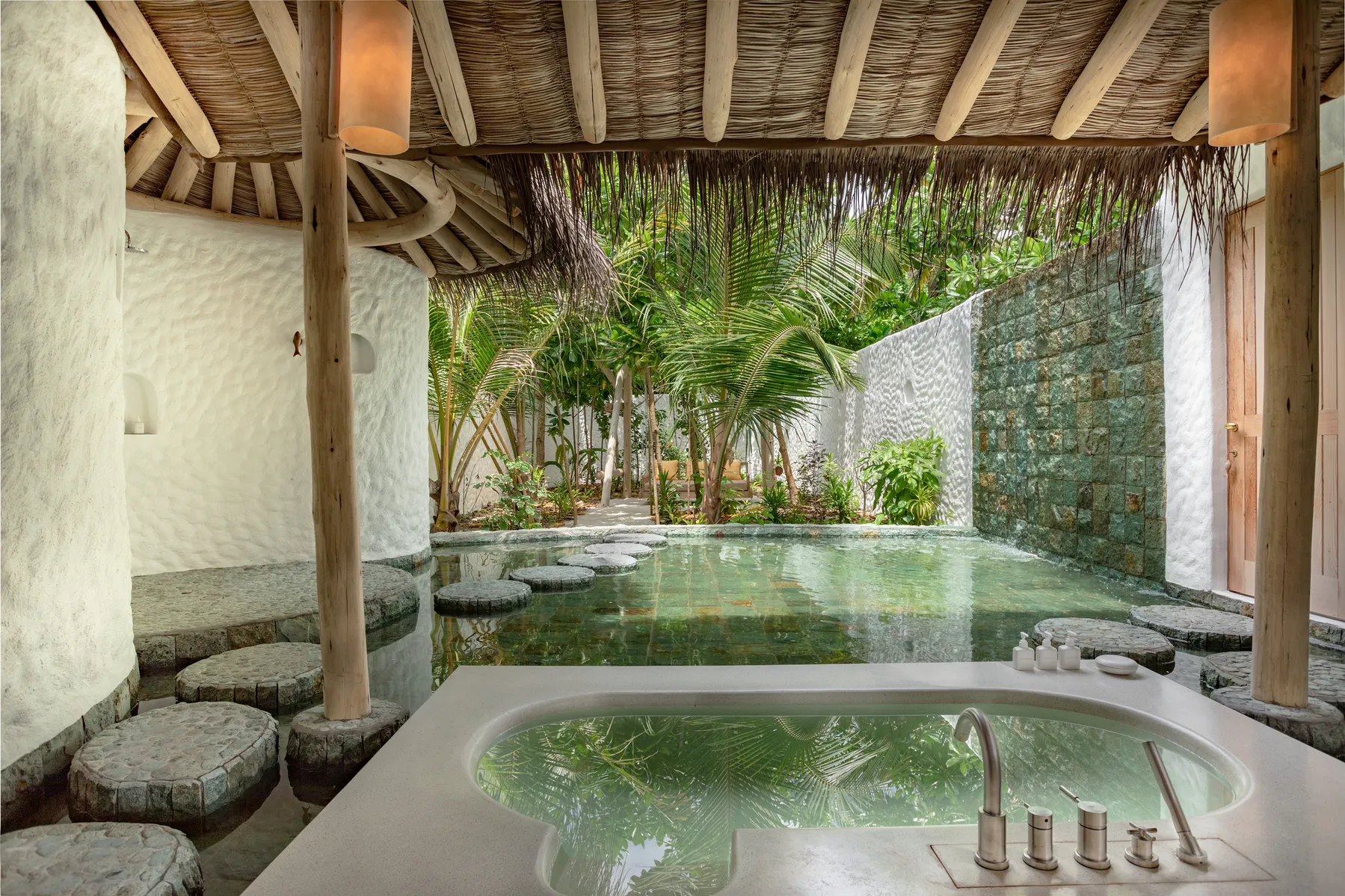
Inside the villas, the same restraint governs the palette: raw and oiled timber, woven palm and rattan detailing, stone bathroom floors, and soft, undyed textiles that read as deliberately unfinished rather than under-furnished. Air conditioning and modern plumbing are present but visually minimised, tucked behind timber screens or positioned so they do not interrupt the sightline from bed to jungle or bed to sea. Many villas include open-air bathrooms, a signature Soneva Fushi feature since its earliest years, along with day beds, hammocks and free-standing tubs positioned for a private view rather than a symmetrical one. The intent throughout is that nothing in the room should look imported from a hotel supply catalogue; furniture is generally sourced or made regionally, and the overall effect leans toward a well-appointed private house rather than a branded hotel interior.
Atmosphere
The prevailing mood on Kunfunadhoo is unhurried, and the resort works hard to keep it that way. There is no formal dress code beyond a request for shirts at dinner, and the barefoot policy extends even to some of the finer dining venues, which sets an immediate, informal tone that many first-time guests find disarming. Evenings tend to centre on food, stargazing or the resort’s beloved open-air Cinema Paradiso, a screen built directly into the beach where guests recline on loungers under the stars. Days are similarly unstructured by design: there is no daily activities board pushing guests toward a packed schedule, and the island rewards travellers willing to let a morning disappear into a hammock or a snorkel session rather than a resort itinerary. Families and honeymooners share the island comfortably, in part because its scale and jungle density naturally disperse guests rather than concentrating them around a single pool deck.
Rooms and Suites
Accommodation at Soneva Fushi runs to roughly fifty villas spread across several categories, all sharing the same thatched, jungle-set architectural language but differing sharply in scale and setting. Crusoe villas form the core of the collection, ranging from one-bedroom suites to larger multi-bedroom residences, most with private pools and direct beach access, and are named for the resort’s founding Robinson Crusoe concept. Sunset Retreats and the newer Sunset Reserve villas occupy the island’s western edge, positioned for evening light and generally counted among the largest and most private villas on the property. At the top of the range, the Water Reserve villas extend out over the lagoon on stilts, among the largest overwater villas of their kind in the Maldives, each with a private pool and a terrace slide that drops guests directly into the sea. Every villa comes with a personal Barefoot Guardian, a dedicated point of contact available around the clock for everything from dinner reservations to arranging an excursion, which functions as a private-house butler service rather than a shared concierge desk.
Dining
Few Maldives resorts match Soneva Fushi’s culinary range, and the resort counts eleven distinct dining destinations across the island, supplemented by a rotating calendar of visiting Michelin-starred guest chefs. Out of the Blue, a two-storey overwater structure housing five separate outlets, anchors the more formal end of the offering with Japanese, Thai, Chinese and Indonesian cooking. Fresh in the Garden serves organic, largely home-grown ingredients from a treetop dining room raised into the jungle canopy, while Shades of Green, set within the resort’s own organic gardens, runs a rotating plant-based bistro menu built around whatever the gardens are producing that week. So Fishy at Bar(a)bara takes a rustic, seaside-shack approach to sustainably caught seafood, and Mihiree Mithaa, whose name translates loosely from Dhivehi as “here it is,” runs as the resort’s principal buffet venue. By the Beach offers simpler, barefoot-in-the-sand dining under the stars.
The most talked-about experience remains Flying Sauces, billed as the world’s first fine-dining zipline restaurant: guests are served a sustainably sourced tasting menu at height, gliding between platforms suspended in the jungle canopy. Beyond the named venues, the resort offers an extensive in-villa dining menu covering everything from breakfast to late-night treats, private chef experiences such as Once Upon a Table and So Bespoke for custom-designed meals, and a complimentary chocolate room and ice cream room with all-day access, both firmly established as house signatures since the resort’s early years. Soneva Fushi also opened with the first wine cellar in the Maldives, and the cellar remains a point of pride for a resort otherwise defined by rusticity.
Spa and Wellness
Wellness at Soneva Fushi runs through the Six Senses Spa, reflecting the shared heritage between the Soneva and Six Senses brands, and combines signature Six Senses treatments with locally inspired therapies delivered in a mix of indoor and open-air treatment champas set among the trees. Facilities include a sauna, steam room, a dedicated yoga pavilion, a Watsu pool for water-based bodywork, a fitness centre and a spa gallery. Treatments range from simple coconut oil scrubs, drawing on ingredients grown on the island itself, to more elaborate offerings such as a gold-leaf facial. The spa’s emphasis throughout is on unhurried, single or couples’ treatment settings rather than a high-throughput wellness circuit, in keeping with the island’s broader pace.
Experiences
Soneva Fushi’s activity programme leans heavily on the reef, the jungle and the night sky rather than a conventional watersports rota, though diving, snorkelling and dolphin cruises are all readily available through the resort’s marine centre. The island’s observatory, built around a substantial research-grade telescope, runs regular evening sessions with a resident astronomer, and the resort states it was among the first in the world to offer 3D astronomy technology to guests, allowing a closer look at deep-sky objects beyond what a standard telescope view provides. Eco Centro, the island’s waste-processing and recycling facility, is open to guided guest tours and doubles as an informal education stop for families curious about how the resort actually runs. Makers’ Place, built in partnership with a British artist, turns recycled ocean plastic and aluminium into art and functional objects, and guests can watch or join workshops there. For children, The Den runs a full weekly programme, from cooking classes to guided marine-biologist-led snorkelling trips, entirely screen-free and included in the room rate. In the evenings, Cinema Paradiso, the resort’s open-air cinema built into the beach, remains one of the most photographed and best-loved fixtures on the island.
Who It Is For
Soneva Fushi suits travellers who want the idea of a private island taken seriously rather than merely marketed: guests happy to leave their shoes at the door, slow down for a week, and treat unstructured time as the point rather than a gap to be filled. It works particularly well for honeymooners drawn to genuine privacy and jungle seclusion over a polished infinity pool, and for multigenerational families thanks to the strength of The Den and the range of multi-bedroom villa configurations. It is also a natural fit for travellers with a real interest in sustainability, since the resort’s environmental programme is substantial enough to explore in its own right rather than serving as background branding. It is a less obvious match for guests who want ultra-modern minimalist design, a tightly scheduled activities programme, or a resort where every villa opens directly onto open ocean; Soneva Fushi’s jungle-first layout means some villas sit well back from the shoreline, a trade-off worth confirming at the time of booking.
Best Time to Visit
The Maldives’ dry season, running roughly November through April, brings the calmest seas, the most reliable sunshine and the best conditions for diving and reef visibility around Kunfunadhoo, making it the peak and most expensive booking window. The wetter southwest monsoon period from May through November brings shorter, more localised afternoon showers rather than sustained bad weather, and coincides with the season for manta ray and whale shark aggregations at nearby Hanifaru Bay, with sightings typically peaking around the full and new moons of June through August. Travellers prioritising marine life over guaranteed sunshine may find the shoulder months a genuinely worthwhile trade, particularly given the lower rates typically on offer outside the December to April peak.
How to Get There
All international arrivals connect through Velana International Airport near Male, from which Soneva Fushi is reached by seaplane, a flight of roughly 30 to 40 minutes over open water and scattered atolls. Guests can choose between Soneva’s own seaplane service and the Manta Air scheduled service, the latter occasionally routing via an intermediate stop before continuing to Kunfunadhoo. There is no speedboat or road option to the resort; the seaplane transfer is a fixed part of the journey and, weather permitting, one of the more scenic approaches to any resort in the Maldives, given the low-altitude views over the reef systems of Baa Atoll.
Nearby Experiences
Baa Atoll’s defining natural attraction sits within reach of the resort: Hanifaru Bay, a UNESCO-protected marine sanctuary and one of the largest known gathering points for reef manta rays anywhere in the world, along with seasonal whale shark sightings, both concentrated in the May to November window when monsoon currents concentrate plankton in the bay. Guided snorkelling and diving excursions to Hanifaru and the wider atoll’s reef systems can be arranged through the resort’s marine centre, subject to the strict visitor limits the protected status imposes. Beyond marine life, Baa Atoll’s scattering of small inhabited islands offers a quieter, more everyday counterpoint to resort life for guests curious about local Maldivian island culture, though most visits of this kind are arranged as a resort-organised excursion rather than independent travel.
Things to Know Before Booking
The seaplane transfer only operates during daylight hours, so flight timing on arrival and departure days should be built into any wider itinerary, particularly for guests connecting from long-haul flights into Male. Villa categories vary considerably in their distance from the beach given the jungle-first layout, so travellers who want guaranteed direct beach or overwater access should confirm the specific villa type rather than assuming all categories offer it. The barefoot ethos is a genuine house policy rather than a marketing flourish, and guests more comfortable with a conventional five-star dress code and pace may want to adjust expectations accordingly. Rates are quoted in US dollars and typically exclude the resort’s mandatory 2 percent environmental levy along with standard Maldivian service charge and taxes, all of which should be factored into any budget comparison against other resorts.
Sustainability
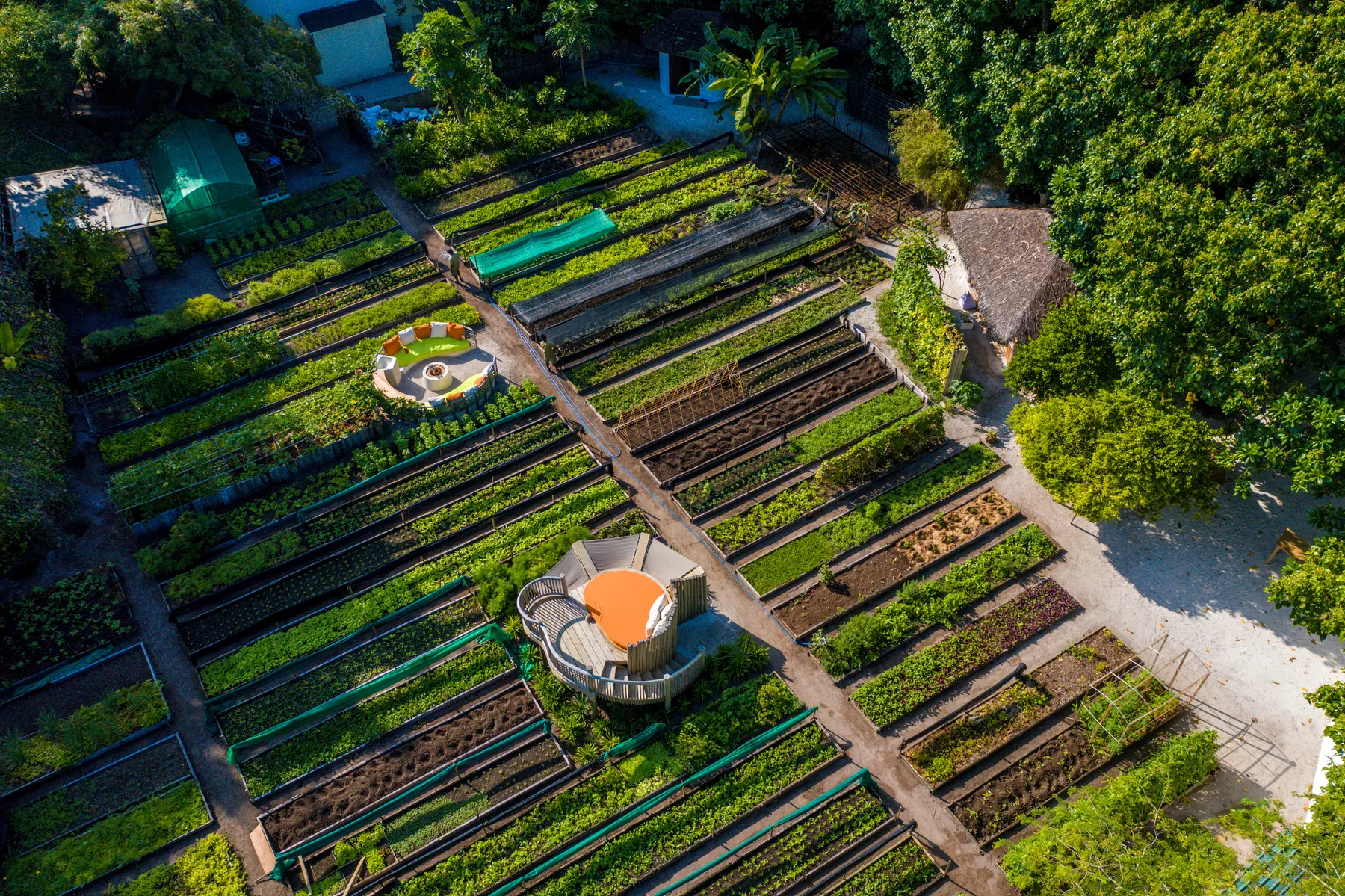
Sustainability is not an add-on at Soneva Fushi; it is close to the operating premise of the brand. The resort’s Eco Centro Waste to Wealth facility processes the great majority of the island’s waste, roughly 90 percent by the resort’s own account, converting it into compost, biochar, mulch and other soil-conditioning materials that feed back into the resort’s own organic gardens, closing much of the loop between kitchen and farm on-site. Alongside it, Makers’ Place, developed in partnership with a British artist, recycles waste plastic and aluminium collected from the resort and surrounding islands into art and everyday objects, run as a carbon-neutral workshop that guests can visit and, at times, work in alongside resident artists.
Soneva as a group has stated it has been carbon neutral across both direct and indirect emissions since 2012, a claim backed by a structural piece of its business model: a mandatory 2 percent environmental levy applied to room revenue since 2008, among the earliest such levies in the hospitality industry. Proceeds fund the non-profit Soneva Foundation, which has run large-scale carbon-offset projects including a clean cookstove distribution programme in Myanmar, a Gold Standard-certified initiative the resort states has mitigated several hundred thousand tonnes of CO2 while improving fuel efficiency and health outcomes for hundreds of thousands of people. The Environment Fund built from the levy has, by Soneva’s own figures, raised well over ten million US dollars over its lifetime and mitigated more carbon than the group’s own operational footprint.
Guests can see much of this in practice rather than take it entirely on faith: guided tours of Eco Centro, visits to the organic permaculture gardens irrigated with treated greywater, and conversations with resident sustainability staff are all built into the resort’s guest programme rather than kept behind the scenes. As with any resort-run sustainability initiative, the figures above reflect Soneva’s own published claims rather than independent third-party audit, and travellers with a close interest in the detail should ask on property for the most current numbers.
Practical Information
Soneva Fushi prices from roughly $1,750 per night for entry-level villa categories in low season, rising sharply for larger villas, peak-season dates and the resort’s largest Water Reserve and Sunset Reserve categories; this guide’s figure is an indicative starting point rather than a live rate, and travellers should confirm current pricing, meal-plan inclusions and the mandatory environmental levy directly with the resort or a trusted travel advisor. Check-in is from 2:00 PM and check-out by 12:00 PM, standard for the region, with early check-in or late check-out available on request depending on occupancy. A stay of five to seven nights suits the resort’s pace and the seaplane transfer’s cost in both time and money, though shorter stays are certainly possible for travellers combining Soneva Fushi with another Maldives property or a wider regional itinerary. The resort operates a full concierge and Barefoot Guardian service for arranging excursions, dining reservations and spa treatments, and given the island’s size and dispersed layout, most guests find it worth engaging that service early rather than trying to plan everything on arrival.
Editorial Conclusion
Soneva Fushi’s achievement is less any single villa or restaurant than its stubbornness: three decades after inventing barefoot luxury, it has neither abandoned the idea for something glossier nor let it calcify into cliche. The jungle is still allowed to crowd the paths, the shoes are still optional, and the sustainability programme has grown from a founding principle into genuine industrial infrastructure rather than a line in a brochure. For travellers drawn to the Maldives’ overwater-villa spectacle above all else, other resorts in the archipelago will deliver a more symmetrical view of the lagoon. For travellers who want to understand where the whole barefoot-luxury category came from, and to experience it delivered by the people who built it, Kunfunadhoo Island remains the place to go.
In pictures
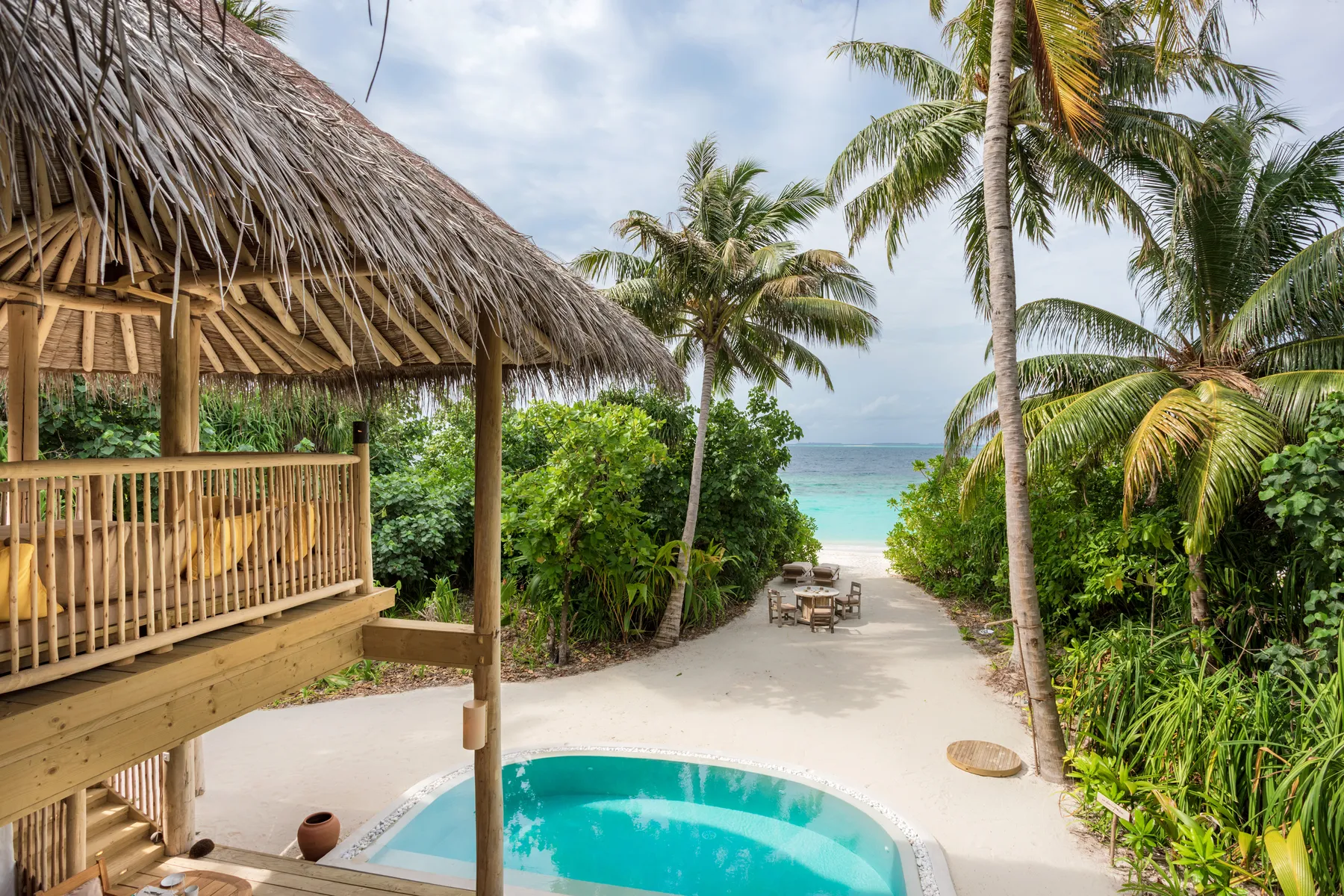
On the map
Kunfunadhoo Island, Maldives
Questions
Frequently asked
What does 'barefoot luxury' actually mean at Soneva Fushi?
It is both a philosophy and a literal house rule. Soneva popularised the 'No News, No Shoes' idea in the mid-1990s: guests are gently discouraged from wearing shoes anywhere on the island, villas and public areas are built without air conditioning ducts or hard edges intruding on the jungle, and the design language favours thatch, timber and stone over marble and glass. Wi-Fi and modern comforts are all present, but the aesthetic and pace are deliberately unpolished.
How do guests get from Male to Soneva Fushi?
All arrivals land at Velana International Airport near Male, then transfer to Kunfunadhoo Island by seaplane, a flight of roughly 30 to 40 minutes over the atolls. Guests can fly on Soneva's own seaplane service or on Manta Air, which occasionally makes an intermediate stop. There is no road transfer option; the island has no roads to speak of, only sandy paths and wooden walkways.
Is Soneva Fushi a good choice for families with children?
Yes, it is one of the more deliberately family-oriented resorts in the Maldives. The Den, a screen-free kids' club for ages four to twelve, runs a complimentary weekly programme of cooking classes, Lego rooms, a small cinema and guided excursions such as snorkelling with a marine biologist, all included in the room rate. Many villa categories also sleep three or more bedrooms for multigenerational groups.
What is the Eco Centro Waste to Wealth centre, and can guests visit it?
Eco Centro is Soneva Fushi's on-island recycling and composting facility, which the resort states processes around 90 percent of the property's waste into compost, biochar, mulch and other reusable materials rather than sending it off-island. Guests can join guided tours of the centre, which also houses Makers' Place, a workshop where waste plastic and aluminium are turned into art and practical objects.
What is the environmental levy added to the bill, and where does it go?
Soneva applies a 2 percent environmental levy on room revenue across its resorts, a policy it introduced in 2008. The proceeds fund the non-profit Soneva Foundation, which has run carbon-offset projects such as a large-scale clean cookstove programme in Myanmar, intended to mitigate more carbon than the Soneva properties themselves emit.
Same destination
More hotel guides in Maldives
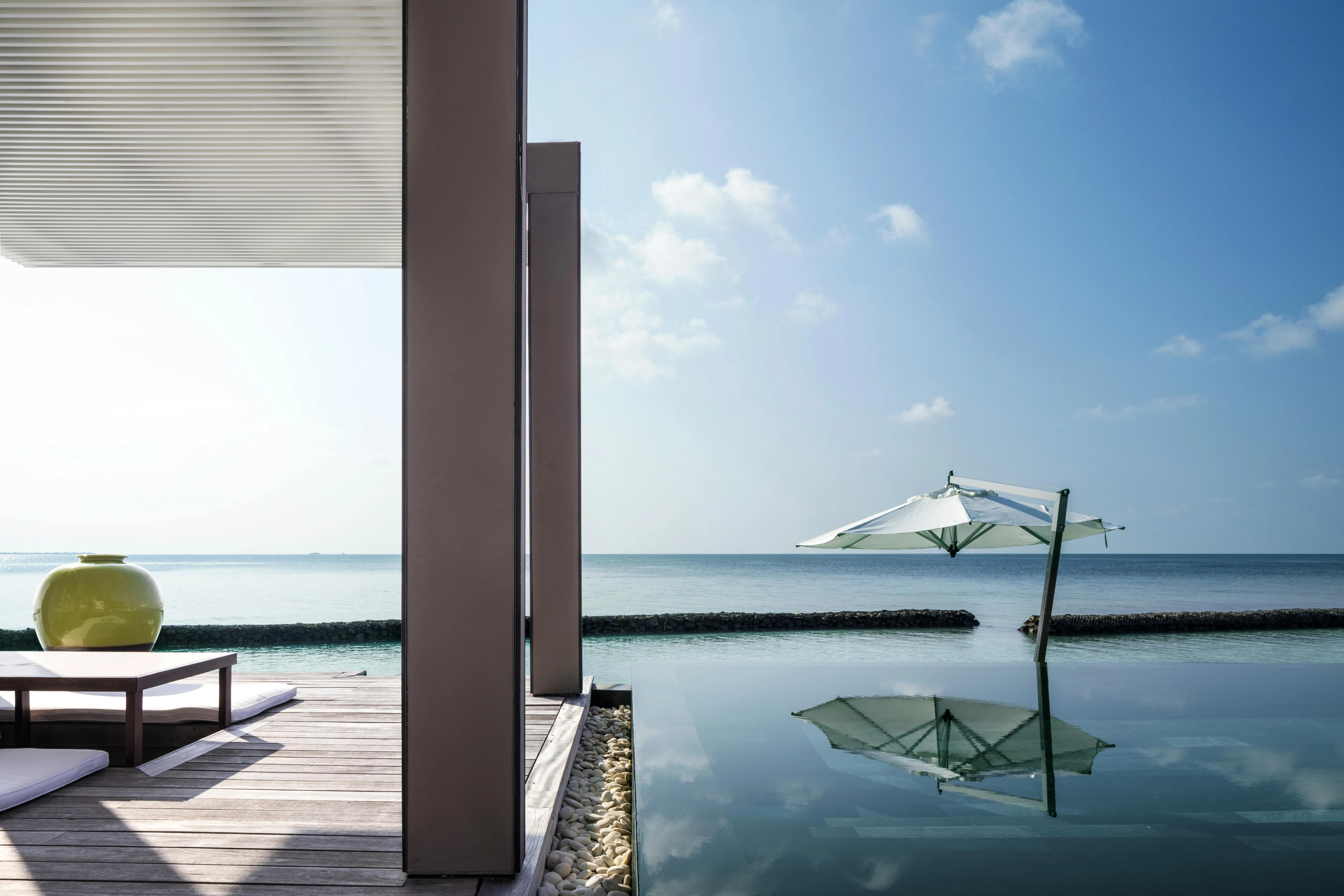
Randheli Island, Maldives
Cheval Blanc Randheli
Jean-Michel Gathy's private-island debut for LVMH's hotel house, forty minutes by seaplane into the Noonu Atoll.
From $2,200 per night
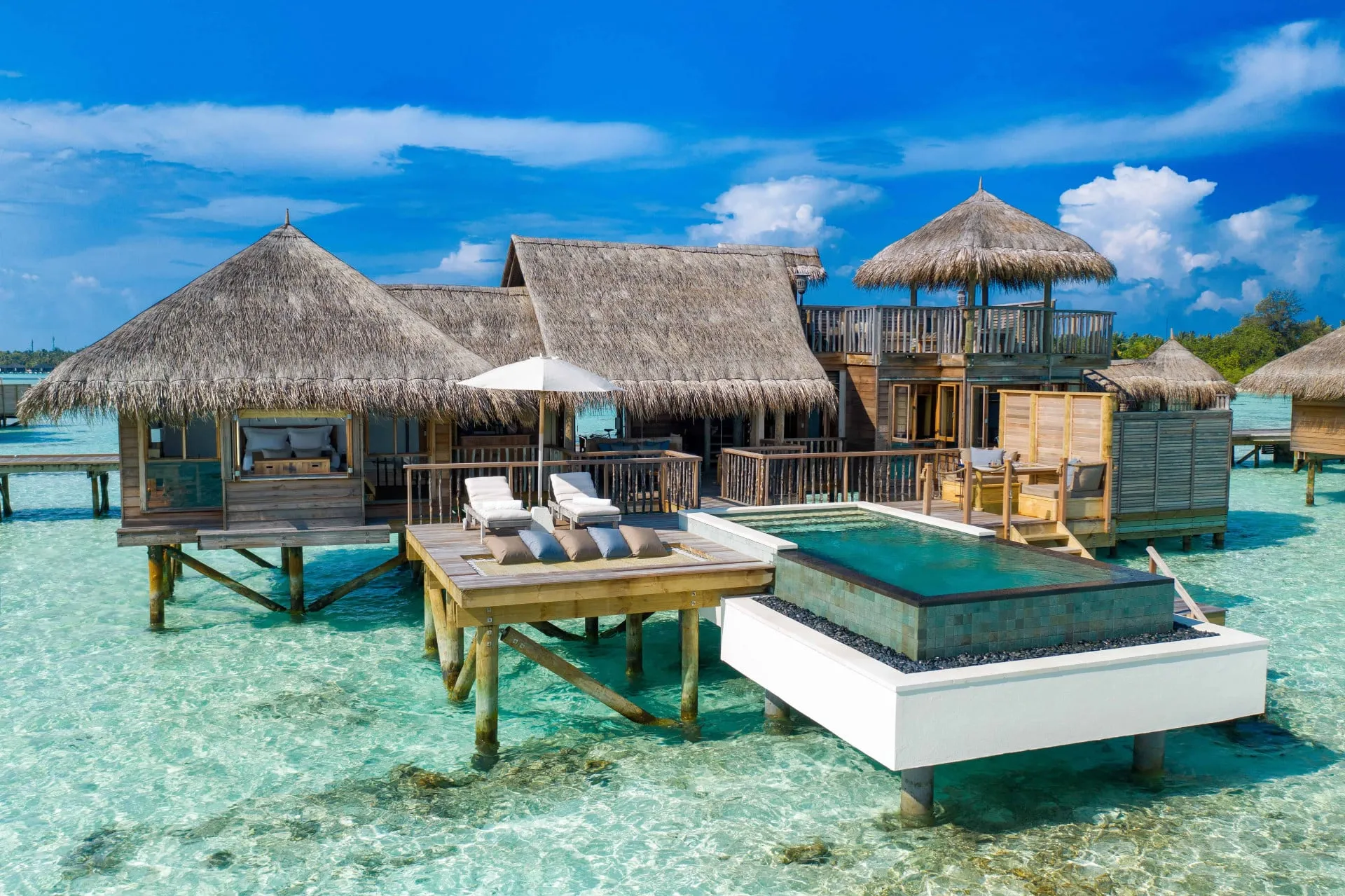
Lankanfushi Island, Maldives
Gili Lankanfushi
The Maldives resort that invented barefoot luxury and has spent two decades refusing to put its shoes back on.
From $1,550 per night
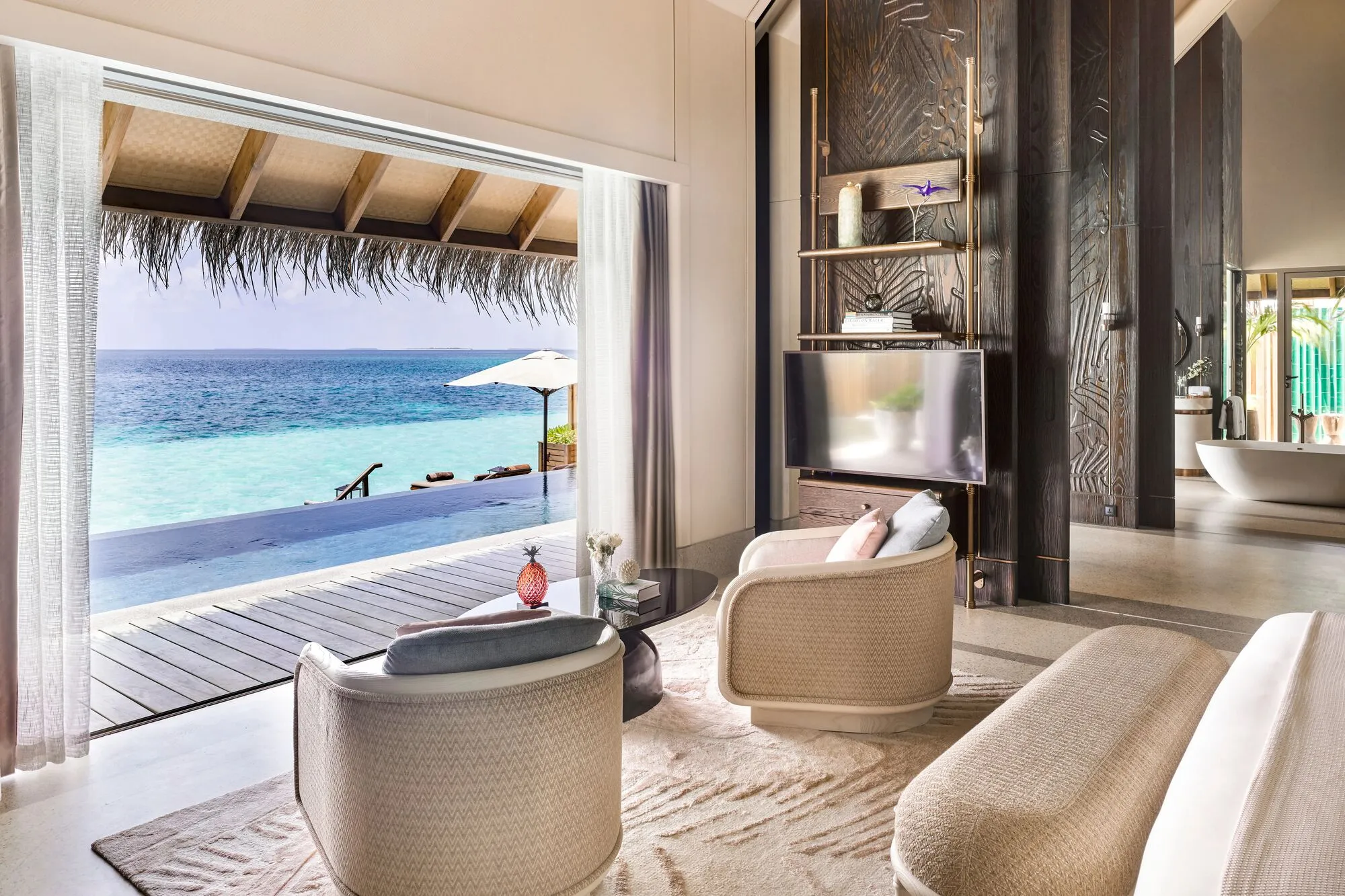
Muravandhoo Island, Maldives
JOALI Maldives
An art-immersive private island in Raa Atoll where more than forty commissioned installations sit alongside 73 villas and a working coral restoration reef.
From $1,600 per night