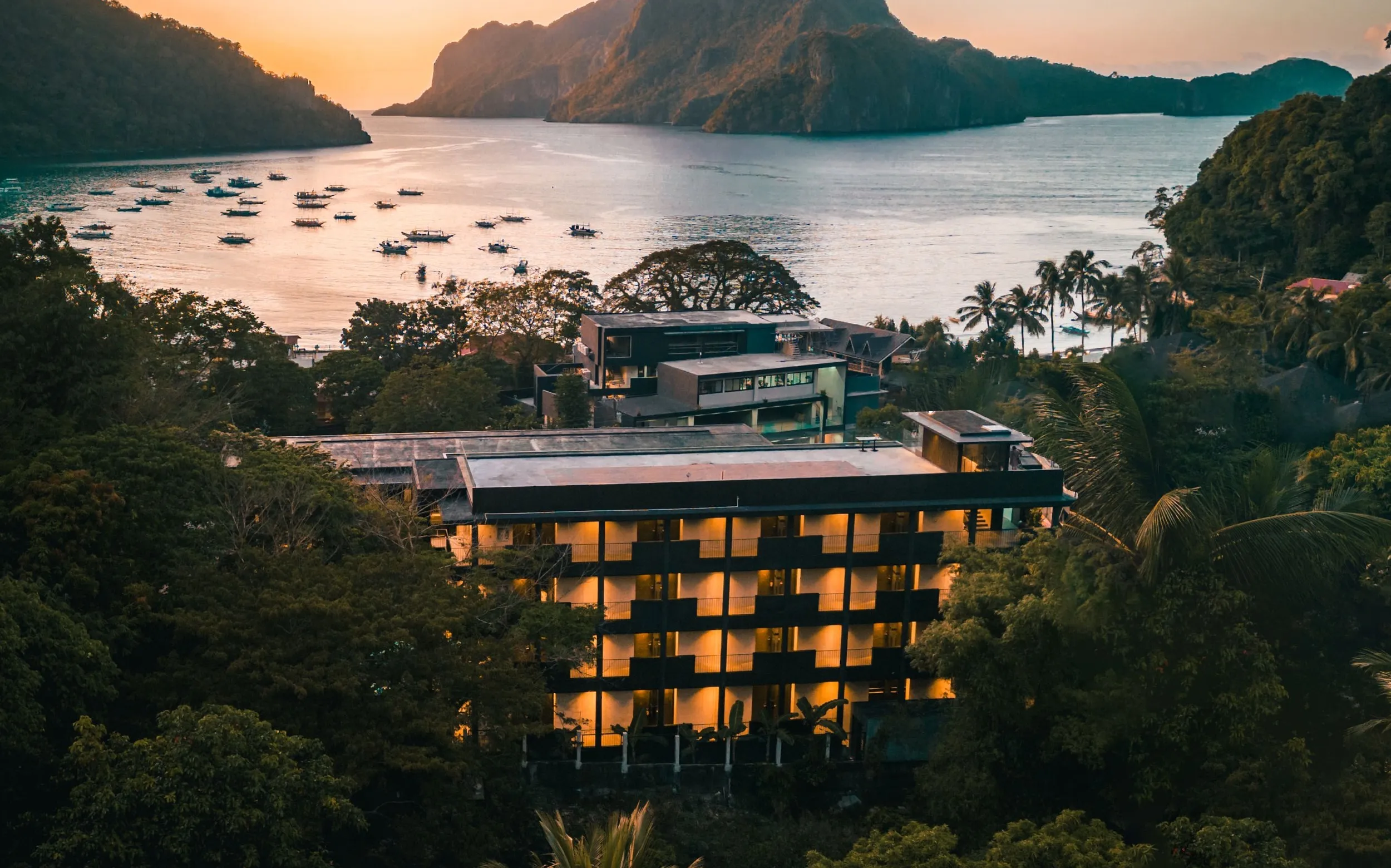
El Nido town, Philippines
The Funny Lion
A brutalist, bamboo-clad courtyard hotel in the middle of El Nido town, built for travellers who want the Bacuit archipelago without a private-island price tag.
- Rates from
- From $140 per night
- Nearest airport
- El Nido (Lio) Airport (ENI)
- Transfer
- 20-30min by road
- Best months
- December to May, Palawan's dry season with the calmest seas for island-hopping
There is no lagoon view from the rooms at The Funny Lion, no private beach, no seaplane transfer, and that absence is more or less the point. El Nido’s reputation was built on the private-island resorts scattered through the Bacuit archipelago’s limestone karst, places reached by boat or small plane and designed to keep a guest from ever needing to leave. The Funny Lion sits instead on Balinsasayaw Road, in the thick of El Nido town itself, a few minutes’ walk from the tricycle stand, the dive shops, and the bus terminal, and it has built its identity around that difference rather than apologising for it.
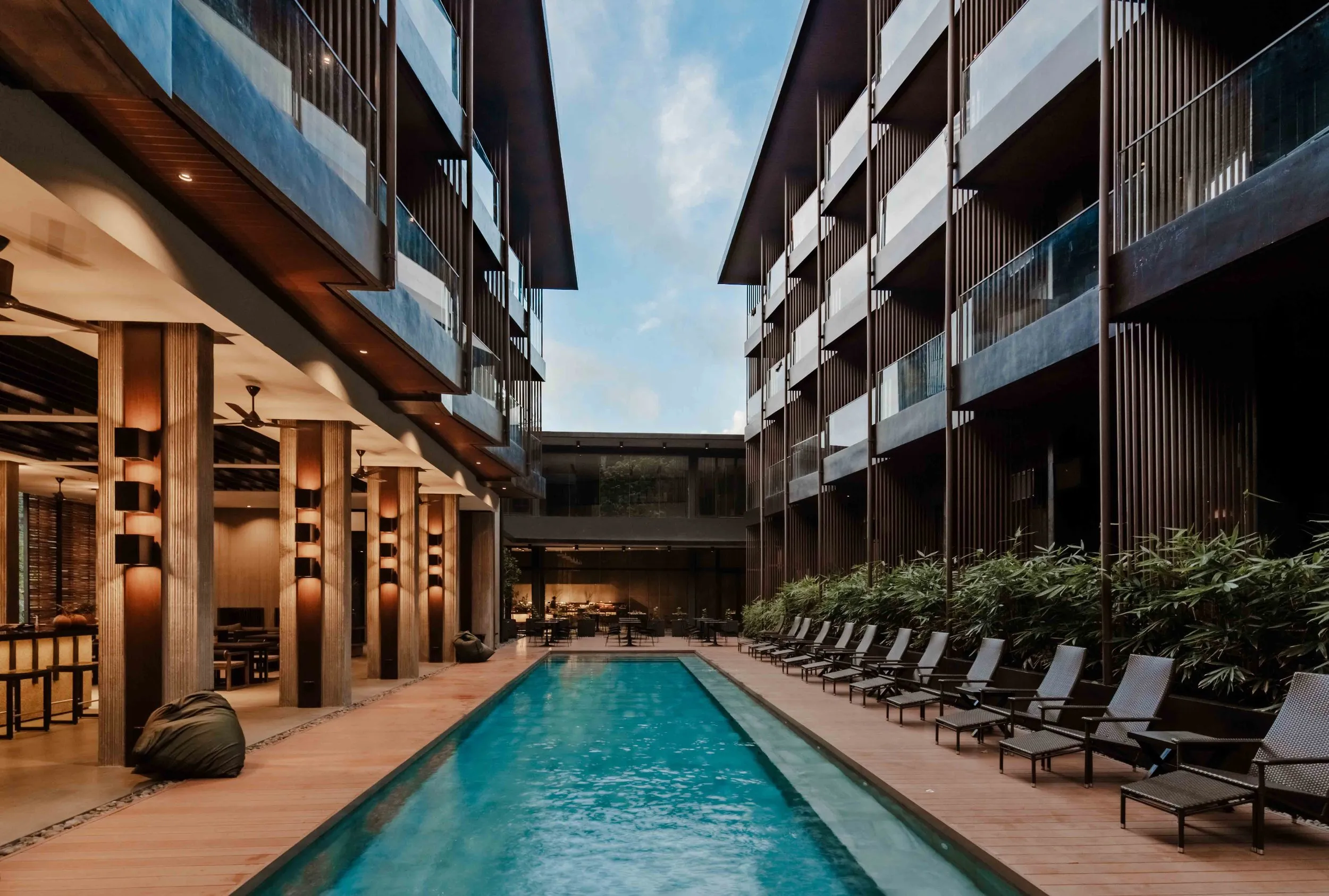
The hotel opened in December 2022 as the second property in a small Palawan-focused group founded by Nikki and Ria Hernandez-Cauton, who spent sixteen years building Amorita Resort on Bohol’s Panglao Island before turning to Palawan. Its fifty rooms are wrapped around a compact courtyard pool, and its most immediate impression, before any of El Nido’s water even comes into view, is architectural: rough concrete corridors, bamboo screening rippling across a restaurant facade, and a colour and material palette that reads more like a design object than a conventional beach hotel. It has since become one of the more talked-about boutique addresses in a town more commonly associated with the resorts just offshore, picking up a Michelin Guide recommendation and industry recognition for value and sustainability along the way.
It also arrives at a specific moment in El Nido’s own development, as the town itself, rather than only the karst islands beyond it, has matured into a legitimate base for a stay in its own right, with a denser spread of restaurants, dive operators and small hotels than the area had a decade ago. The Funny Lion is a product of that shift as much as a cause of it: a hotel built for guests who want El Nido’s water without giving up the choice and spontaneity that comes with staying somewhere they can walk out of.
Why It Stands Out
Most of what El Nido is known for happens on the water, and most of the area’s best-regarded hotels are built to be self-contained islands, complete with their own restaurants, spas and stretches of sand, reachable only by boat or plane. The Funny Lion inverts that model entirely: it is a town hotel, built to put guests inside El Nido’s actual community rather than at a remove from it, with the tour operators who run the Bacuit archipelago’s boat circuits a short walk from the front desk rather than a resort-arranged excursion away.
The second thing that sets it apart is a design language unusually confident for its price bracket. Interior designer Eric Paras, known in Manila for his A-11 furniture and design studio, paired earthy, safari-inflected tones with rough, deliberately unfinished concrete and extensive bamboo detailing, working alongside a brutalist architectural shell from Don Caparas and Studio Concilio. Boutique hotels at this rate point rarely commit this hard to a specific aesthetic; The Funny Lion’s rooms and public spaces read as considered rather than generic, without pushing into the kind of design-hotel pricing that would put it out of reach of the backpacker-to-midrange travellers El Nido has always attracted in volume.
Value is the third piece of the pitch, and it is a deliberate one. The group’s founders have described the brand as built for travellers who want four-star amenities, a pool, air conditioning, a proper restaurant, without the private-island price tag, and independent recognition for value (including a Condé Nast Johansens citation) suggests that positioning has landed as intended.
A fourth point worth naming is consistency of concept. Boutique hotels that lean on a strong design story often let it thin out somewhere between the lobby and the guest room, with photogenic public spaces giving way to a more generic room product. The Funny Lion’s material and colour language, concrete, bamboo, khaki and navy green, is carried through from the courtyard to the corridors to the rooms themselves, which keeps the property feeling like a single considered idea rather than a design statement bolted onto a standard hotel floor plan.
Architecture
The building’s architecture, credited to Don Caparas working with Studio Concilio, leans into raw, exposed concrete in a way that reads closer to brutalism than to the thatch-and-timber vernacular most visitors associate with Palawan hospitality. Corridors and stairwells are left largely unadorned, their rough-cast surfaces standing in deliberate contrast to the softer material choices used inside the rooms and restaurant. It is a look that trades tropical prettiness for texture, and it gives the hotel a distinct silhouette against the more conventional resort architecture found elsewhere in town and along the coast.
That concrete shell is broken up by lighter, more organic elements at key points, most visibly at Hunt, the all-day restaurant, where floor-to-ceiling bamboo panelling wraps the dining terrace. The panels do double duty: they shield diners from sun and rain while softening what would otherwise be a hard-edged facade, and they are the single most photographed architectural feature on the property. The layout itself is organised around a central courtyard and pool, a sensible response to a compact in-town plot that leaves little room for the sprawling, spread-out footprint a private-island resort can afford.
Working within a town-centre plot rather than an open island site also shaped the building’s massing. Rather than a low, horizontal spread of individual pavilions, the kind of layout the Bacuit archipelago’s private-island resorts typically favour, The Funny Lion stacks its rooms around the courtyard in a more compact, multi-storey arrangement, trading ground-level sprawl for a smaller footprint that still leaves room for a proper pool deck at the centre. It is an architectural response to real site constraints as much as an aesthetic choice, and it is part of what allows the hotel to sit inside El Nido’s walkable core rather than on its outskirts.
Interior Design
Interior design is where The Funny Lion makes its clearest case for attention, and it is the property’s defining trait. Eric Paras, the designer behind the scheme, has described the concept as a modern safari, a palette of khaki, green and brown drawn more from East African lodge design than from typical Southeast Asian beach-resort style, deliberately grounded in Palawan specifics through the use of bamboo and other locally sourced materials rather than left as an imported aesthetic.
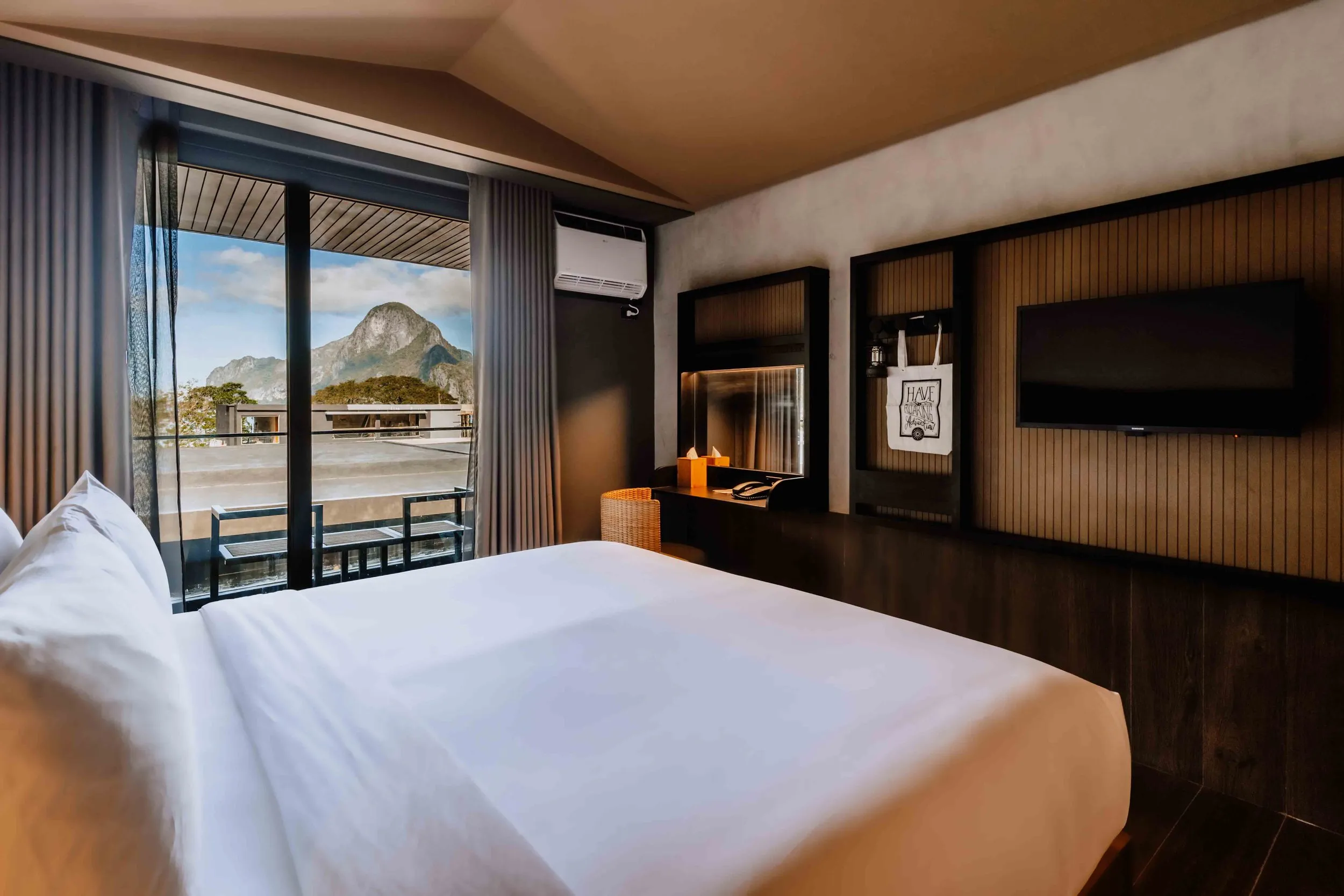
The fifty guest rooms, compact at roughly 27 square metres, carry that language through low, rustic-finished dining and side tables, navy green headboards, and rough concrete used as a structural and decorative material rather than something to be plastered over and hidden. Lighting is used deliberately to soften the concrete’s severity, with fixtures chosen to throw warm, low pools of light rather than the brighter, flatter illumination more common to resort interiors. The overall effect is intentionally unpolished: a homey, slightly worn-in mood that avoids the glossy, overly considered look of higher-end resort design without reading as unfinished.
Public spaces extend the same vocabulary at a larger scale. The bamboo panelling at Hunt restaurant is the most prominent example, but the same combination of concrete, timber and rattan recurs through the lobby and courtyard areas, giving the property a consistent visual identity from arrival through to the guest room rather than a lobby built for photographs and rooms built to a separate, more generic brief.
The safari framing is worth dwelling on, since it is an unusual reference point for a Palawan hotel to reach for. Rather than leaning on the rattan-and-thatch shorthand most Southeast Asian beach hotels use to signal tropical relaxation, Paras borrowed a palette and materiality more associated with East African lodges, khaki canvas tones, deep greens, sun-worn browns, and grafted it onto a Palawan material list of bamboo and local timber. The result avoids the two obvious failure modes of resort design at this price point: a generic international boutique look with no sense of place, and an overly literal, thatched-hut version of “tropical” that reads as costume rather than architecture.
Atmosphere
The Funny Lion’s atmosphere is shaped as much by its town location as by its design. Where a private-island resort in the Bacuit archipelago tends toward hush and isolation, this is a hotel with a pulse: the courtyard pool functions as a genuine social hub, guests come and go on their own schedules to join boat tours booked a few doors down, and the energy leans toward playful rather than hushed, a register the brand’s own name leans into.
That said, the compact courtyard layout and the concrete architecture give the property a contained, almost enclosed feel once inside, a deliberate buffer against the busier tricycle traffic and foot activity of El Nido’s main streets just outside. It reads less like a resort attempting total isolation and more like a well-designed urban retreat, a place to return to after a day on the water rather than a destination built to be never left.
Rooms and Suites
The hotel’s fifty rooms are compact by design, built to around 27 square metres each, air-conditioned, and finished with private bathrooms, balconies or terraces, a work desk, mini-bar and complimentary toiletries. Third-party booking platforms list categories running from an entry-level room up through King-bedded and higher-tier options, with balconies generally oriented toward the courtyard pool. Exact category names and configurations are worth confirming directly with the hotel or a booking platform at the time of reservation, since naming conventions vary between the property’s own site and third-party listings.
Across the board, the material and colour language established elsewhere in the hotel carries through: navy green headboards, rustic low tables, rough concrete surfaces softened by warm lighting and locally sourced bamboo and rattan detailing. Rooms are not built for extended in-room lounging in the manner of a resort suite; they are designed as a comfortable base for guests spending most of their daylight hours out on the water or exploring the town.
Balconies and terraces are a consistent feature across the room categories, most oriented toward the courtyard pool rather than an external street view, which helps rooms feel private despite the hotel’s in-town setting. Bathrooms follow the same restrained material palette as the rest of the property, finished with private fixtures rather than the open-air or garden-facing bathrooms more common at resort-scale properties, a sensible trade-off given the compact, multi-storey plan. A work desk in every room signals the hotel’s awareness that not every guest is purely on holiday, useful for the growing number of remote-working travellers who use El Nido as a base for a longer Palawan stay.
Dining
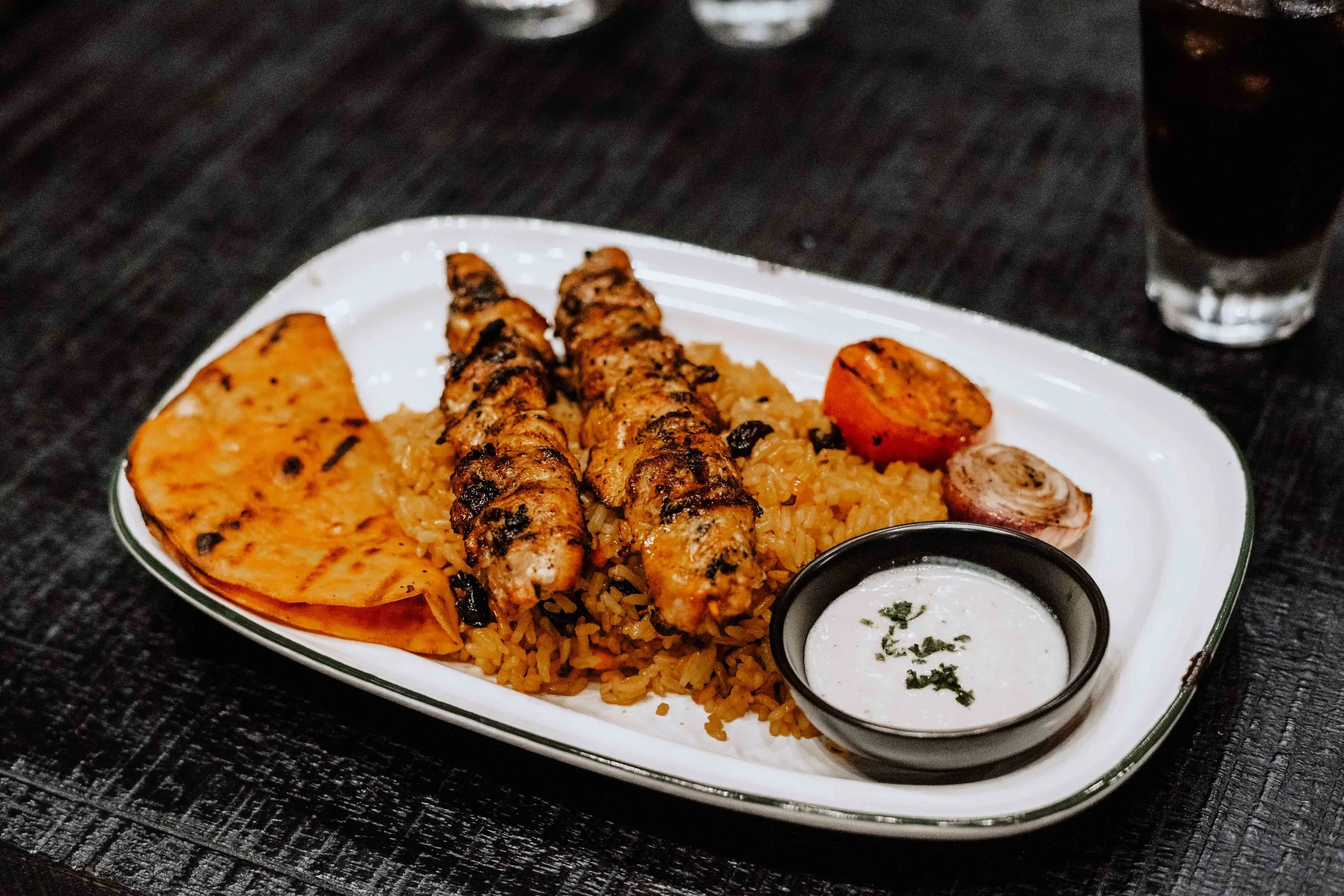
Hunt, the hotel’s all-day restaurant, is the centrepiece of its food and drink offering, an indoor-outdoor space with air-conditioned and poolside terrace seating wrapped in the property’s signature bamboo panelling. Its design takes visual cues from El Nido’s limestone cliffs, and its menu runs across Asian and Continental registers with an emphasis on fresh, locally sourced seafood: salads, pastas, paninis and seafood dishes pitched at approachable rather than fine-dining register. On Friday nights, the restaurant shifts format for a weekly fire grill buffet, a fixture of the hotel’s week that draws both guests and, at times, outside diners from around town.
Beyond Hunt, the hotel maintains a bar for guests looking for something less structured than a full meal, in keeping with the property’s general emphasis on easy, unpretentious dining over formality. Breakfast at Hunt is typically the meal most guests take on property, before heading out for a day of island-hopping, while lunch and dinner are as likely to be eaten out in town as at the hotel itself.
That flexibility is one of the more underrated advantages of staying at a town hotel rather than a resort in this particular destination. Given the restaurant’s location inside a town with its own dense concentration of independent cafes, bars and seafood restaurants, guests are not confined to the hotel’s own kitchen in the way they would be on a private island, where the resort’s own venues are, by necessity, the only option for every meal of a stay. A guest at The Funny Lion can treat Hunt as a reliable home base while still working through El Nido’s wider restaurant scene over a two or three-night stay.
Spa and Wellness
The Sea Tree Spa is the hotel’s dedicated wellness facility, offering treatments built around natural, local ingredients and traditional Filipino massage techniques. Menus typically include shorter and longer massage formats alongside other body treatments, positioned as a relaxed, accessible spa offering rather than an expansive destination-spa programme of the kind found at larger island resorts. A fitness centre rounds out the wellness facilities for guests wanting to keep up a routine between days on the water.
Experiences
The hotel’s location is itself the core of its experience offering. El Nido town is the launch point for the Bacuit archipelago’s well-known island-hopping circuits, commonly sold by local operators as Tours A through D, covering the area’s lagoons, limestone karst formations and snorkelling sites, and the walk from The Funny Lion’s front door to a tour operator’s booking desk is measured in minutes rather than requiring a resort-arranged boat transfer. The same proximity applies to the town’s dive shops, for guests looking to explore the area’s reefs and wrecks at depth rather than on the surface.
On-property, the group has built a handful of signature experiences into its Palawan portfolio, including access to a private beach and visits to a native stingless bee farm with honey tastings, activities positioned as a point of difference from a purely urban stay. El Nido Beach itself is a short walk from the hotel, offering a straightforward sand-and-sea option for guests not booked onto a boat tour that day.
The town setting also means access to services a private island simply cannot offer on its own grounds: independent dive shops with their own certification programmes and dive sites beyond a single resort’s house reef, currency exchange and pharmacies for practical needs, and a genuine choice of tour operators rather than a single resort-arranged itinerary at a fixed price. For travellers who prefer to compare a few island-hopping operators before booking, or who want to add a sunset paddleboard session or a kayak rental on a whim rather than through a resort activities desk, that flexibility is a meaningful part of what a stay in town buys over a stay offshore.
Who It Is For
The Funny Lion suits travellers who want El Nido’s water and karst scenery without committing to the isolation, logistics or cost of a private-island resort. Design-conscious couples and independent travellers are the most obvious fit, drawn by the interiors and the walkable town setting; first-time visitors to El Nido who want flexibility, the ability to shop around for different tour operators, restaurants and bars rather than being locked into a single resort’s programming, will also find the format suits them well.
It is a less natural fit for travellers whose primary goal is total seclusion or a private stretch of beach steps from their room; those guests are better served by one of the Bacuit archipelago’s private-island properties. Families travelling with young children may also want to weigh the hotel’s compact courtyard layout and in-town setting against the larger grounds and structured programming more typical of a resort.
Best Time to Visit
Palawan’s dry season, running roughly from December through May, is the most reliable window for calm seas and consistent conditions for island-hopping, and it is correspondingly the region’s busiest and most expensive period. The wet season, June through November, brings a higher chance of rain and rougher water, with the heaviest rainfall typically concentrated from July through October, though travellers with flexible plans can still find good weather windows and lower rates outside the peak months.
How to Get There
Most visitors fly into El Nido (Lio) Airport, a small domestic airport around 20 to 30 minutes from town by road depending on traffic and mode of transport; tricycles, vans and the hotel’s own paid shuttle all cover the route. An alternative approach is to fly into Puerto Princesa, Palawan’s main airport, and continue to El Nido by road, a journey of several hours, or by boat via other Palawan towns for travellers building a longer island-hopping itinerary. Once in El Nido town, The Funny Lion’s central location means no further transfer is needed to reach restaurants, tour operators or the town beach.
Nearby Experiences
Beyond the archipelago’s boat tours, El Nido town itself rewards a bit of unstructured time: independent restaurants and bars line the main strip, and the harbour area is worth a walk at sunset. Caalan Beach sits a short distance from the hotel as a quieter alternative to the more central El Nido Beach. Further afield, Nacpan and Calitang beaches, a roughly forty-minute drive north of town, offer a longer stretch of coastline and a slower pace than the more heavily trafficked town beach, while Taraw Cliff’s viewpoint hike, reached from a trailhead near the town centre, rewards an early start with a panorama over El Nido Bay and its karst islands.
For travellers extending their Palawan trip, both Coron, with its wreck diving and starker limestone landscape, and Puerto Princesa, home to the Underground River, are reachable by domestic flight or boat and are covered by the group’s two sister Funny Lion properties for those wanting to stay within the same brand.
Things to Know Before Booking
This is a town hotel, not a beachfront or overwater property; guests wanting a room that opens directly onto sand should look instead to one of the Bacuit archipelago’s private-island resorts. Room categories and exact rates vary by season and booking channel, and are worth confirming directly with the hotel or a trusted booking platform rather than assumed from third-party listings, which are not always consistent with one another. El Nido’s dry season (December to May) brings the best conditions for the archipelago’s boat tours but also the highest demand for rooms and tour slots, so advance booking is worth prioritising for stays in that window.
Sustainability
The Funny Lion has been recognised by Smart Travel Asia among its rankings for sustainable hotels in Asia, and the group has spoken publicly about sourcing practices that favour local suppliers, including coffee sourced from indigenous Tagbanwa farming communities in Palawan, and about prioritising local hiring across its properties. Beyond these documented points, a fully independent audit of the hotel’s environmental footprint, energy use or waste management is not publicly available, so this guide describes only what has been reported rather than extending it into a broader claim about the property’s overall environmental performance.
Practical Information
Rates at The Funny Lion El Nido start from around USD 140 per night, rising with room category and season, with the December-to-May dry season commanding the highest prices. Check-in is from 2:00pm and check-out by 12:00pm. The nearest airport is El Nido (Lio) Airport, roughly 20 to 30 minutes away by road, and most stays run two to three nights, enough time to settle into the design of the rooms, work through Hunt’s menu including a Friday fire grill buffet, and still leave a full day or two free for the Bacuit archipelago’s boat tours.
Editorial Conclusion
The Funny Lion makes a straightforward argument in a destination not known for straightforward hotels: that El Nido does not require a private island to be worth visiting well. By putting a confidently designed, brutalist-and-bamboo boutique hotel in the middle of town rather than on the water, the property gives guests direct access to the archipelago’s tour operators, dive shops and restaurants without the cost or logistical commitment of a resort transfer, and it backs that positioning with an interior design scheme, courtesy of Eric Paras, considered enough to stand on its own merits. It will not suit every kind of El Nido trip, particularly for travellers set on waking up beside the water itself, but for those happy to stay in town and venture out by day, it is a well-considered, design-forward alternative to the archipelago’s more familiar private-island script.
In pictures
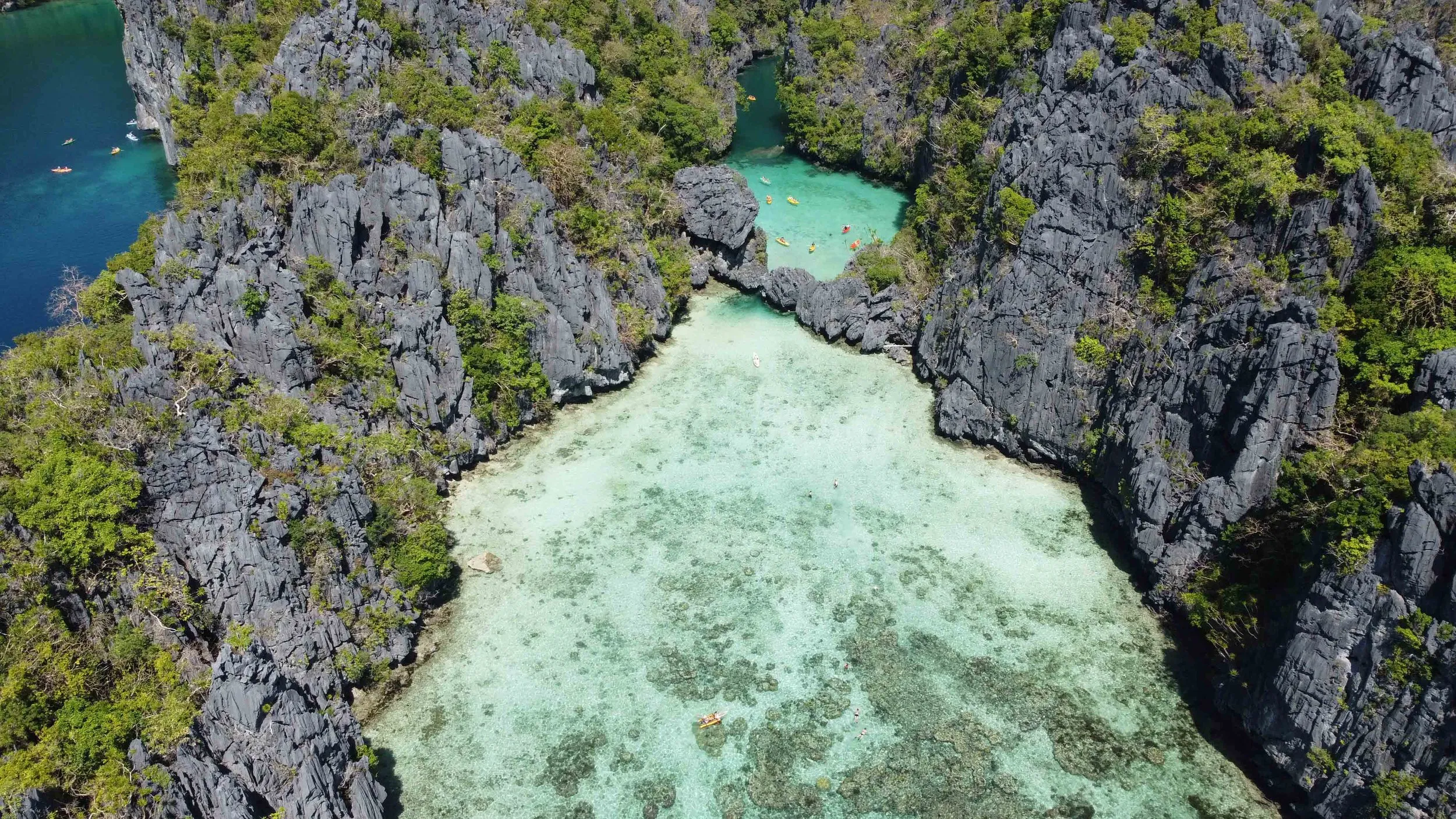
On the map
El Nido town, Philippines
Questions
Frequently asked
Where exactly is The Funny Lion located in El Nido?
The hotel sits on Balinsasayaw Road in the heart of El Nido town, on mainland Palawan, within walking distance of the town's restaurants, dive shops, boat tour operators, and the bus and ferry terminals. El Nido Beach is around a five-minute walk away. This is a town hotel, not a private-island resort like most other properties associated with the El Nido name.
How do guests get to The Funny Lion from the airport?
The nearest airport is El Nido (Lio) Airport, roughly 20 to 30 minutes away by road depending on traffic and transport type. The hotel offers a paid airport shuttle, and tricycles and vans are also available for the transfer into town.
Is The Funny Lion part of a larger hotel group?
Yes. It is one of three Palawan properties under The Funny Lion brand, founded by Nikki and Ria Hernandez-Cauton, who also developed Amorita Resort in Bohol. The group's first Funny Lion opened in Coron, followed by El Nido in December 2022 and Puerto Princesa in December 2023, each with its own architectural identity.
Does The Funny Lion arrange island-hopping tours?
The hotel does not operate its own boats, but its location in El Nido town puts it within walking distance of the tour operators and dive shops that run the area's standard island-hopping circuits (commonly sold as Tours A through D) through the Bacuit archipelago's lagoons and limestone islands. The concierge can help arrange bookings.
What is the design concept behind The Funny Lion El Nido?
The interiors, by designer Eric Paras, take what has been described as a modern safari approach: earthy khaki, green and brown tones, bamboo detailing, and rough concrete surfaces set against a brutalist architectural shell by Don Caparas and Studio Concilio. The result is a deliberately unpolished, playful aesthetic rather than a conventional tropical-resort look.
Same destination
More hotel guides in Philippines
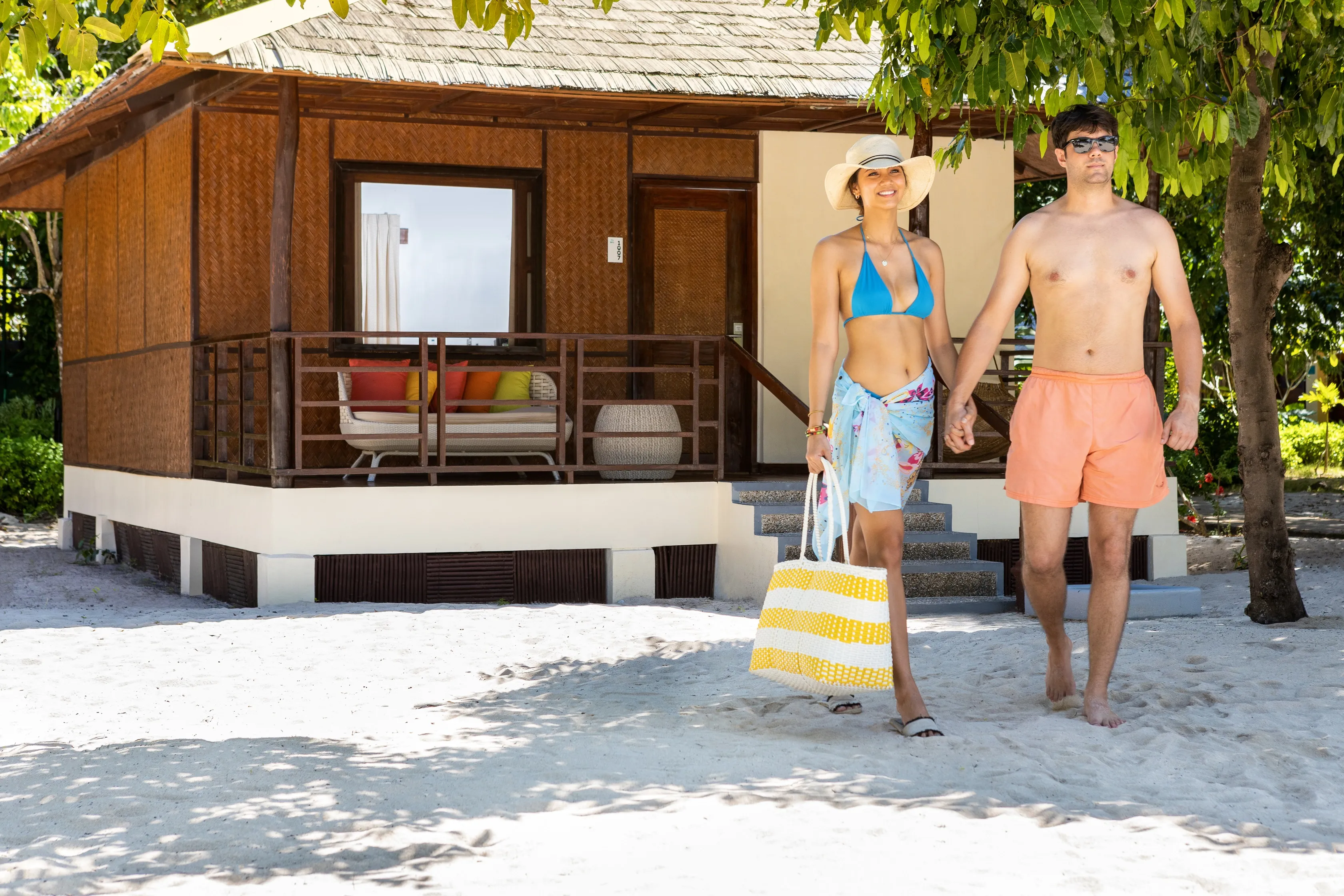
Dimakya Island, Busuanga, Coron, Philippines
Discovery Coron
A nineteen-hectare private island off northern Busuanga, diving Coron's Japanese wrecks by day and disconnecting from everything else after dark.
From $260 per night
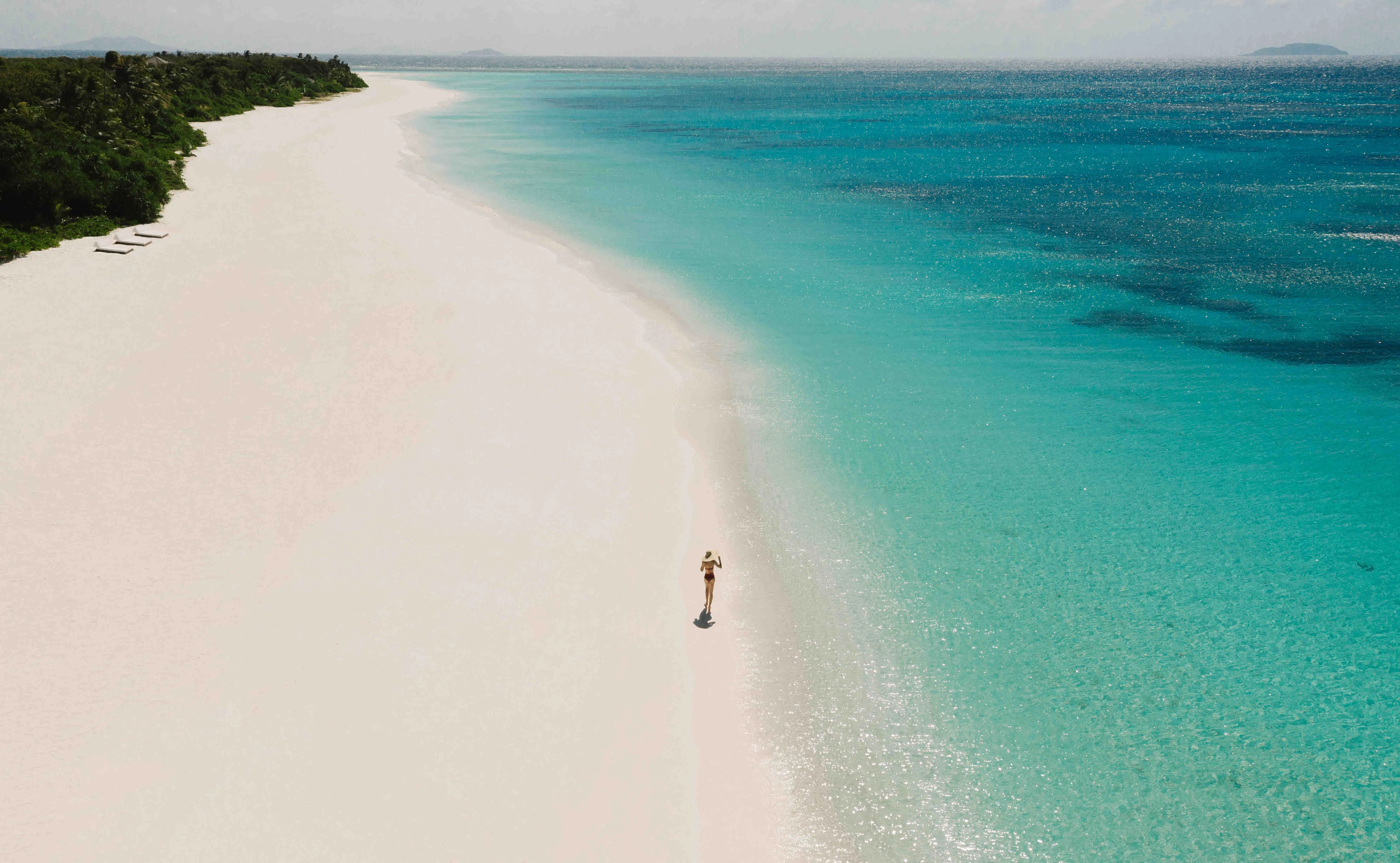
Pamalican Island, Cuyo Islands, Philippines
Amanpulo
A private island in the Cuyo archipelago, reachable only by Aman's own aircraft, built around bahay kubo-inspired casitas set beneath forty-year-old coconut palms.
From $1,900 per night
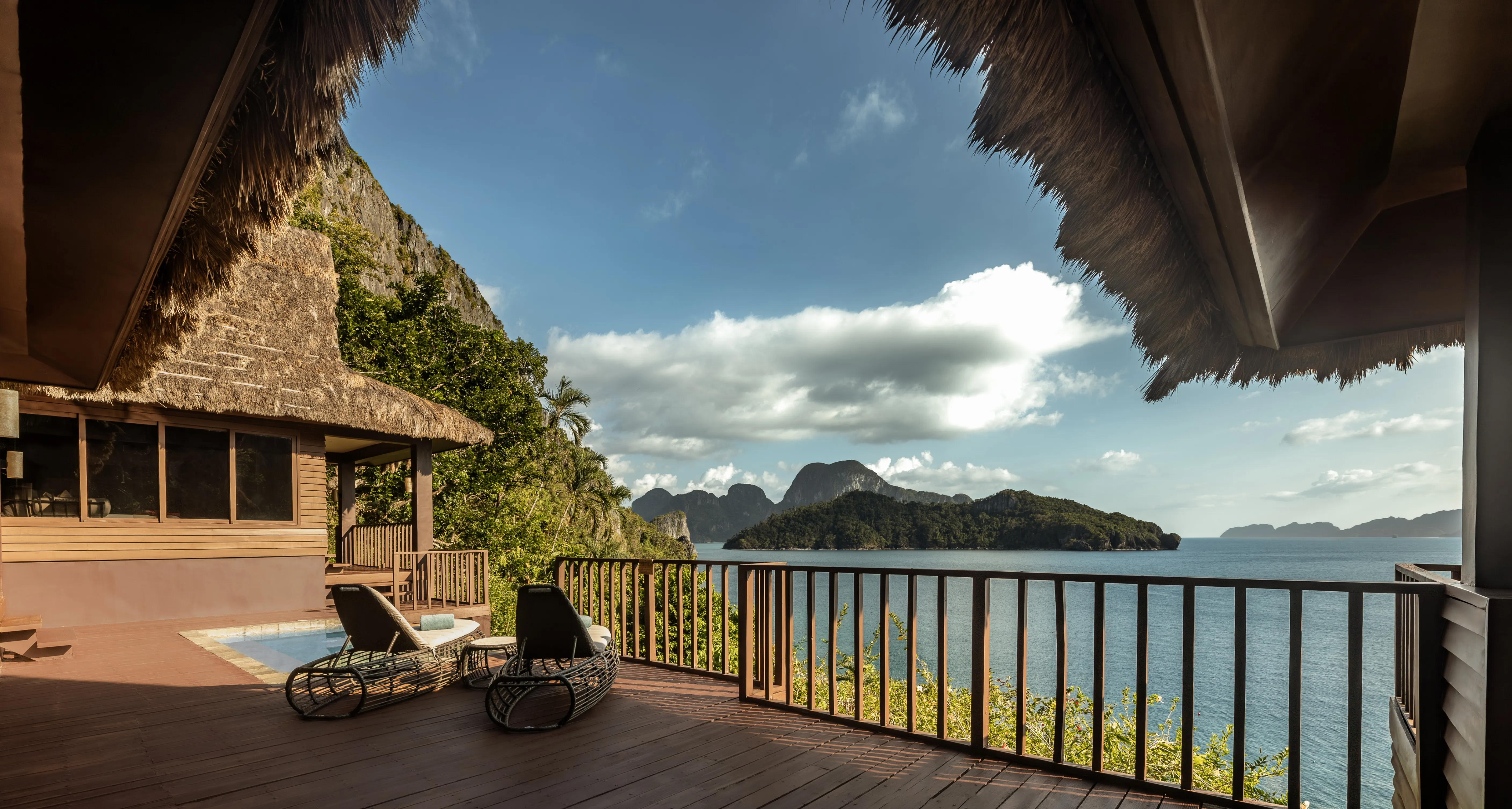
Cauayan Island, Bacuit Bay, El Nido, Philippines
Cauayan Island Resort
A privately owned island in Bacuit Bay, thirty stilt-raised villas set between limestone cliffs and open water, reachable only by boat.
From $500 per night